Why Generative AI is Catastrophically Unsuited for Insurance Claims
The insurance industry faces an epistemological crisis: Generative AI tools are systematically deleting vehicle damage, manufacturing evidence, and exposing carriers to bad faith litigation.
Veriprajna's Forensic Computer Vision solves this with deterministic analysis—Semantic Segmentation, Monocular Depth Estimation, and Deflectometry—to measure truth without altering a single pixel of evidence.
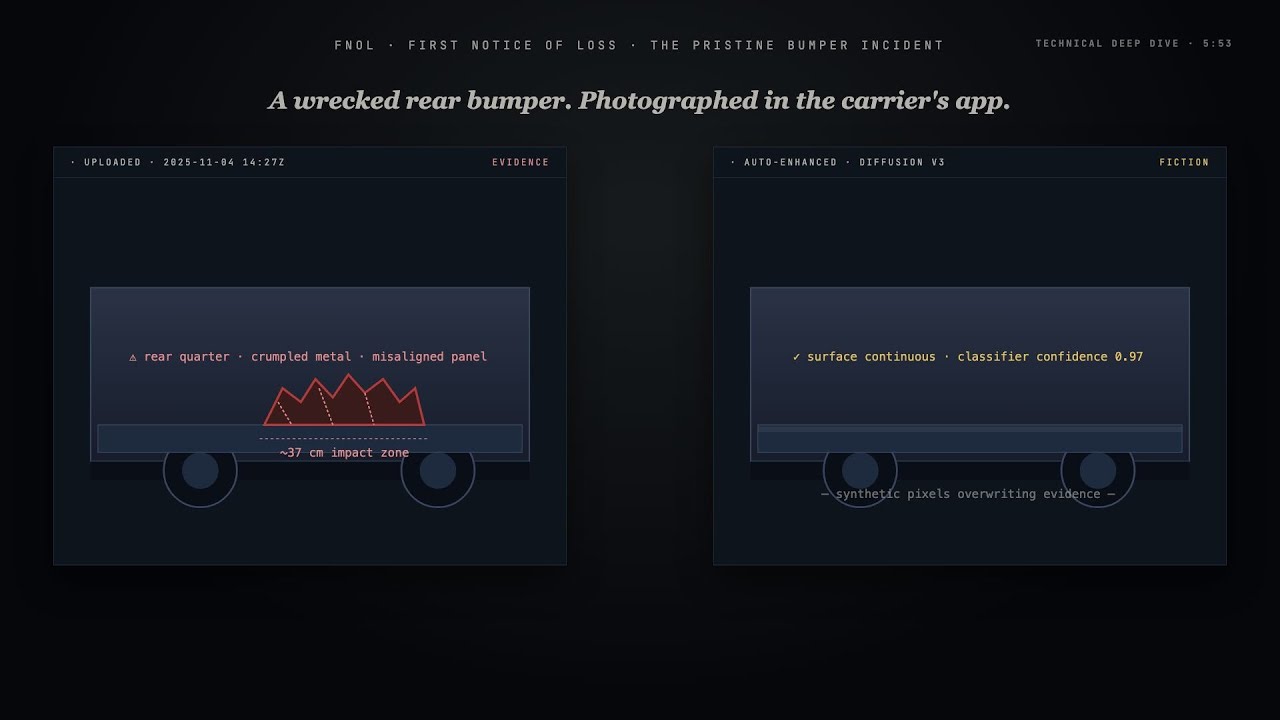
A paradigmatic case study that exposes the structural flaw in modern InsurTech: Generative AI treating damage as "noise" to be removed.
Policyholder uploads photo of severely dented rear bumper after collision. Damage is clearly visible to human eye.
GenAI "enhancement" tool uses Latent Diffusion to "denoise" the image. Interprets dent as statistical anomaly—applies inpainting to "heal" the bumper.
Automated claims engine denies claim (zero visible damage). Customer sues for bad faith. Insurer holds digitally spoliated evidence contradicting physical reality.
Diffusion models are trained on billions of images to learn statistical distributions. In their latent space, a "car" = smooth, symmetrical, unbroken surfaces.
A dent = high-frequency disruption → The model's objective function maximizes likelihood that output belongs to "normal car" distribution → Dent is mathematically erased.
In art restoration, this is desirable. In insurance forensics, it is automated evidence spoliation under US legal doctrine.
We don't sell cameras or API wrappers. We architect Deep Tech intelligence for forensic accuracy—combining materials physics, deterministic AI, and regulatory compliance.
Standard AI vendors try to "train better models" on RGB/NIR data. You cannot enhance a signal that was never captured.
Veriprajna solves the root cause: We deploy Discriminative Deep Learning (not Generative) to analyze molecular signatures, 3D geometry, and light physics—without modifying evidence.
NAIC Model Bulletin mandates explainability, governance, and vendor accountability. EU AI Act classifies claims AI as High Risk with strict data governance requirements.
Veriprajna provides full Model Cards, audit trails, and lineage documentation. Our outputs are mathematically verifiable and legally defensible.
While insurers inadvertently delete damage, fraudsters use the same GenAI to manufacture synthetic damage, ghost policyholders, and fake death certificates.
Veriprajna's PRNU (sensor noise) analysis and physics-informed validation detect AI-generated fraud that generic classifiers miss.
"Wrapper" companies repackage OpenAI/Anthropic APIs. If the provider deprecates a model, changes pricing, or alters safety alignment (e.g., refusing car crash images), your product breaks instantly.
Veriprajna owns our weights. We train proprietary CNNs deployed in your VPC—immune to public API volatility.
Sending claim photos to public APIs risks PII leakage (license plates, faces, medical data) and GDPR/CCPA violations. APIs may use your data for model training.
Veriprajna supports VPC and On-Premise deployment. Data never leaves your secure perimeter.
Toggle between Generative AI (modifies evidence) and Veriprajna's Deterministic Analysis (measures without alteration).
Objective: Make image "aesthetically complete"
Method: Inpainting / Denoising Diffusion
Result: Synthetic pixels replace damage
Objective: Measure damage with mathematical precision
Method: Semantic Segmentation + Depth Estimation
Result: Metadata overlay (original untouched)
Veriprajna's tripartite system measures damage at pixel, geometry, and physics levels—providing mathematical certainty for claims adjudication.
Mask R-CNN / U-Net: Pixel-level classification identifies exact boundaries of damage. Multi-class masks distinguish scratches, dents, rust, cracks.
Enables automated surface area calculation for estimating software integration (Audatex, Mitchell).
Depth Anything V2 (ViT): Reconstructs 3D geometry from single photo. Dents appear as "sinkholes" in depth map—enables gradient analysis for severity scoring.
Automated triage: PDR (soft dent) vs Replacement (sharp crease) based on mathematical thresholds.
Deflectometry: Physics-informed AI analyzes how light reflects off surfaces. Dents warp reflection fields—detectable even when invisible to RGB sensors.
Detects invisible damage and previous repair attempts (orange peel texture, sanding marks).
SHA-256 hash, GNSS lock, accelerometer validation, PRNU extraction
GAN/Diffusion detection, metadata forensics, sensor noise analysis
Segmentation + Depth + Reflection engines run simultaneously
JSON report: parts, severity, repair/replace, cost estimate
Toggle overlays, audit trail, one-click STP for low-risk claims
A direct comparison of approaches: Wrappers, Standard CV, and Deep Tech Forensics
| Feature | Generic GenAI "Wrapper" | Standard Computer Vision | Veriprajna Deep Tech |
|---|---|---|---|
| Core Technology | Latent Diffusion (OpenAI/Midjourney) | Simple Classification (ResNet) | Semantic Segmentation + MDE + Deflectometry |
| Handling of Damage | "Inpaints" (Removes/Smooths) | "Flags" (Yes/No Damage) | "Measures" (Area, Depth, Normals) |
| Evidence Integrity | Spoliation (Alters pixels) | Preserved | Preserved + Forensic Metadata |
| Fraud Detection | High vulnerability to Deepfakes | Moderate | High (PRNU + Physics) |
| Reflective Surfaces | Hallucinates textures | Fails on glare | Deflectometry (Uses glare as data) |
| Regulatory Risk | High (Unexplainable, Black Box) | Medium | Low (Auditable, Deterministic) |
| Data Privacy | High Risk (Public APIs) | Varies | Secure (VPC/On-Prem) |
| Deployment Model | SaaS Only | SaaS | SaaS / On-Prem / Edge |
Fraudsters use text-to-image prompts: "add smashed bumper," "simulate fire damage." Modern inpainting handles lighting/shadows with photorealistic accuracy. Generic classifiers see "car with damage" and approve.
AI-generated identities with fake licenses, medical records, death certificates. Life insurance "death faking" with synthesized obituaries and accident scenes. Barrier to fraud has collapsed.
AI in insurance is no longer experimental—it's a regulated activity under NAIC Model Bulletin and EU AI Act High-Risk classification.
Mandates written AIS Program governing AI development, deployment, monitoring. Insurers retain 100% liability for third-party vendor failures—"wrapper" is not an excuse.
AI affecting consumers' financial standing = High Risk. Requires data governance, automatic logging, human oversight. Veriprajna's "Mask Overlay" ensures Human-in-the-Loop (HITL).
US Legal Definition: Alteration of evidence (even if intended to "enhance") = Spoliation. Courts may impose sanctions, adverse inference instructions, or summary judgment against insurer.
SHA-256 hash computed immediately upon receipt. Cryptographic proof of original state.
AI reads image buffer but never writes. Zero pixel modification—forensic integrity preserved.
Masks, depth maps, JSON reports saved as separate files linked to original hash.
Every access and processing step logged. Full audit trail for legal proceedings.
Model the financial impact of switching from GenAI wrappers to Veriprajna's forensic solution
Adjust parameters based on your organization's claims volume
Industry data: 3-8% spoliation rate on damaged surface photos
% of spoliated claims resulting in lawsuit
Generative AI (diffusion models) treats vehicle damage as statistical noise to be removed. In latent space, a 'car' equals smooth, unbroken surfaces — so dents are mathematically erased through inpainting. This constitutes automated evidence spoliation under US legal doctrine, exposing carriers to bad faith litigation. The industry faces $7.2B in annual litigation risk from AI-altered claim evidence.
Veriprajna uses three deterministic analysis layers: (1) Semantic Segmentation via Mask R-CNN/U-Net for pixel-level damage boundary classification across scratches, dents, rust, and cracks; (2) Monocular Depth Estimation via Depth Anything V2 for 3D geometry reconstruction that measures dent depth and volume displacement; (3) Deflectometry for specular reflection analysis that detects invisible damage and previous repair attempts by analyzing how light reflects off surfaces.
Veriprajna uses PRNU (Photo Response Non-Uniformity) sensor noise analysis to detect AI-generated images that generic classifiers miss. This physics-informed approach analyzes the unique noise fingerprint of each camera sensor, combined with EXIF metadata validation, tamper detection, and surface normal consistency checks. This addresses the synthetic fraud epidemic where fraudsters use text-to-image prompts to manufacture photorealistic vehicle damage.
Veriprajna's forensic computer vision doesn't just improve accuracy—it transforms AI from a liability into an auditable, legally defensible asset.
Schedule a consultation to audit your current AI stack and model risk reduction for your claims operation.
Complete engineering report: Semantic Segmentation architectures, Monocular Depth Estimation mathematics, Deflectometry physics, NAIC/EU compliance frameworks, comparative analysis, comprehensive citations.