The Architecture of Understanding: Beyond Syntax in Enterprise Legacy Modernization
Executive Summary
The modernization of enterprise legacy systems—specifically the migration of mainframe architectures to cloud-native environments—has reached a critical inflection point in the mid-2020s. For decades, the financial and government sectors have operated under a paradoxical paradigm: the imperative to modernize is existential, yet the failure rate of such initiatives remains catastrophically high, hovering between 70% and 80%. 1 The recent advent of Large Language Models (LLMs) promised a revolution, offering the tantalizing possibility of automated code translation. However, early adoption cycles have revealed a critical, systemic deficiency in standard Generative AI approaches when applied to complex, monolithic repositories.
We are currently witnessing the emergence of a new category of engineering failure, typified by the apocryphal yet highly realistic scenario of a major bank attempting to rewrite thirty years of COBOL into Java using a commercial coding assistant. The AI, functioning as a sophisticated localized translator, converted the syntax perfectly. However, the resulting application crashed the database upon deployment. The failure was not one of syntax, but of context. The AI, constrained by the "Lost in the Middle" syndrome and a text-based understanding of software, missed a critical variable dependency defined thousands of lines prior to the execution block. 3
This whitepaper, presented by Veriprajna, argues that the prevailing "LLM Wrapper" approach—which treats code as a linear sequence of text tokens—is fundamentally unsuited for the non-linear complexity of enterprise modernization. Software is not text; it is a graph. It is a highly structured system of logical dependencies, data flows, and state changes that exists in a multi-dimensional topological space. 5
We posit that the only viable path forward is the adoption of Repository-Aware Knowledge Graphs . By shifting from stochastic text prediction to graph-based deterministic reasoning, we can map variable dependencies across millions of lines of code, resolving the "Lost in the Middle" phenomenon and transforming modernization from a risky gamble into a mathematically verifiable engineering process. 7 This document outlines the technical transition from surface-level syntax translation to deep, semantic structural transformation.
Chapter 1: The Silent Crisis of Legacy Infrastructure
1.1 The Modernization Paradox
In the current digital economy, the infrastructure of global commerce relies precariously on technology developed during the Cold War. It is a startling, often unacknowledged reality that, in 2025, a significant majority of the world's financial, healthcare, and government systems are powered by legacy codebases—monolithic applications written in languages like COBOL, PL/I, and RPG that have long since fallen out of the mainstream computer science curriculum. These systems are not merely "old"; they are the foundational bedrock of the global economy, yet they are eroding at an alarming rate.
The statistics paint a grim picture of this dependency. Approximately 70% of the software running Fortune 500 companies was developed over two decades ago. 9 In the banking sector, the situation is even more acute: 43% of banking systems are built on COBOL, and these systems process 95% of all ATM transactions. 1 We are effectively running the modern, instant-payment economy on a digital foundation that predates the internet.
The cost of maintaining this status quo is skyrocketing. Technical debt has accumulated to an estimated $1.52 trillion in the U.S. alone. 1 Organizations are trapped in a cycle of "keeping the lights on," with 80% of federal IT budgets dedicated to operations and maintenance, leaving a meager 20% for innovation. 9 This resource drain is compounded by a severe skills shortage; as the generation of developers who wrote these systems retires, the institutional knowledge required to maintain them disappears. 10
Table 1: The Economic Burden of Legacy Systems
| Metric | Statistic | Source |
|---|---|---|
| Technical Debt Cost (US) | $1.52 Trillion | 1 |
| Federal IT Maintenance Budget |
~80% of Total Spend | 9 |
| Banking Dependence | 95% of ATM Transactions on COBOL |
1 |
| Data Breach Probability | 3x Higher for Systems >10 Years Old |
11 |
|---|---|---|
| Developer Atrition | 58% Consider Quiting due to Legacy Stacks |
1 |
This data indicates a systemic vulnerability. The modernization imperative is not merely about cost reduction; it is about survival. Systems older than ten years are statistically three times more likely to experience a security breach compared to modern applications. 11 As regulatory requirements for data privacy and real-time reporting tighten (e.g., GDPR, DORA), the inability of legacy systems to adapt becomes a compliance risk of the highest order.
1.2 The Anatomy of the "Bank Failure"
To understand the necessity of a new approach, we must dissect the scenario that has become the "Patient Zero" of AI modernization failures. This case study, referenced by Veriprajna leadership, illustrates the specific mechanism by which standard AI fails in enterprise environments.
A major financial institution initiated a project to migrate a core transaction processing system from an IBM Mainframe (COBOL/DB2) to a cloud-native Java Microservices architecture. The bank utilized a popular AI coding assistant—essentially a wrapper around a foundation model—to translate the code.
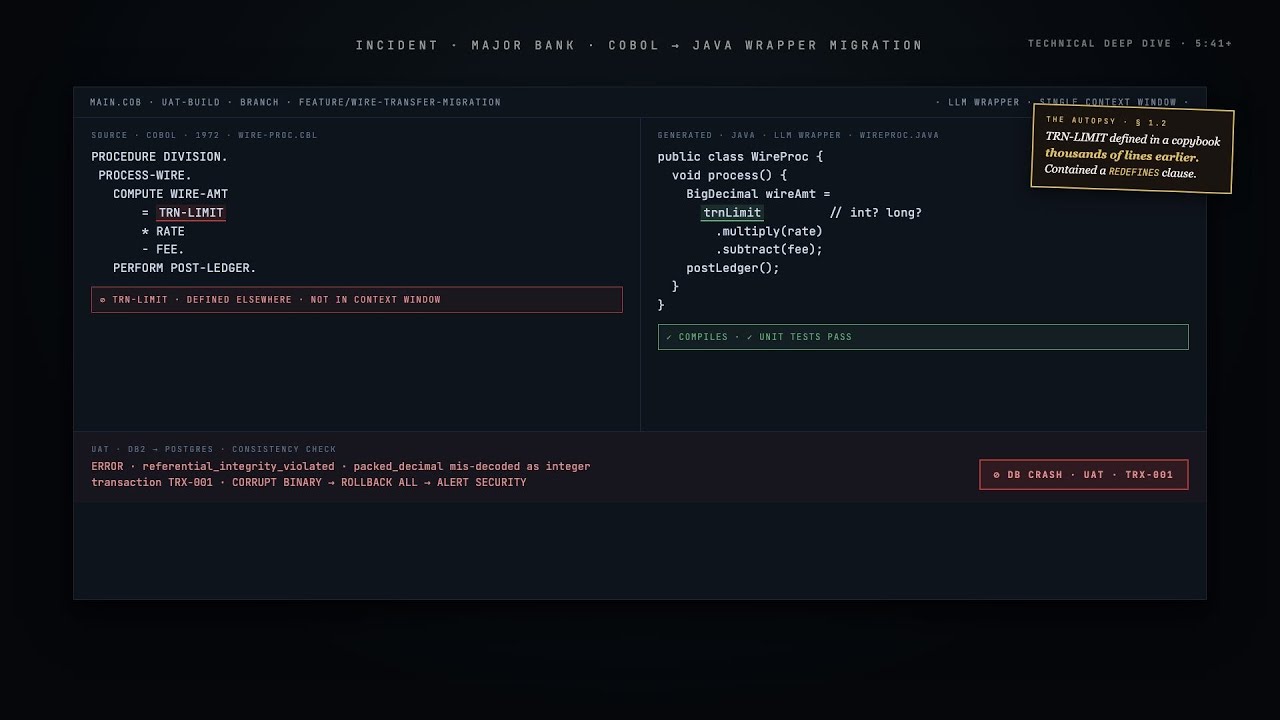
The AI ingested a COBOL program responsible for processing high-value wire transfers. The program contained a complex COMPUTE statement involving a variable we will call TRN-LIMIT. The AI translated the syntax perfectly. It converted the COMPUTE statement into a Java BigDecimal operation. The code compiled. The unit tests—generated by the same AI based on the local code block—passed.
However, upon deployment to the User Acceptance Testing (UAT) environment, the first transaction crashed the database consistency check.
The Autopsy: The variable TRN-LIMIT was not defined in the source file the AI translated. It was defined in a COPYBOOK (a shared header file) included thousands of lines earlier in the execution chain. More importantly, that COPYBOOK contained a REDEFINES clause—a COBOL construct that allows the same memory address to be interpreted as two different data types depending on a flag set in a completely different module. The AI, operating on a "chunk" of text, saw TRN-LIMIT as a simple numeric field. It did not see the REDEFINES clause because it was located in a different file that was not in the immediate context window. It "hallucinated" a standard definition for the variable. In the mainframe environment, the memory address held a packed decimal; in the Java environment, the AI treated it as a standard integer. The mismatch caused the Java application to write corrupted binary data into the database column, triggering a referential integrity failure. 4
The failure was not one of syntax; the Java code was syntactically perfect. The failure was one of contextual blindness . The AI missed a dependency that existed outside its "field of vision," leading to a catastrophic semantic divergence.
1.3 The "Lift and Shift" vs. Refactoring Dilemma
The industry's track record on modernization is abysmal, even before the introduction of Generative AI. Research indicates that between 70% and 80% of digital transformation and legacy modernization projects fail to meet their objectives. 2
Traditionally, organizations have faced a binary choice:
1. Rehost (Lift and Shift): Move the compiled application to an emulator in the cloud. This preserves the "spaghetti code" and the debt, merely changing the hosting bill. It fails to unlock the agility of the cloud. 14
2. Rewrite (Refactor): Manually rewrite the code in a modern language. This is astronomically expensive, slow, and risky due to the lack of documentation and the "Big Ball of Mud" architecture where business logic is inextricably tangled with data access. 10
Generative AI was supposed to offer a "Third Way"—automated refactoring. However, the "Bank Failure" proves that without a deeper understanding of software topology, AI merely accelerates the creation of flawed code.
Chapter 2: The Failure of Stochastic Translation
2.1 The "Wrapper" Economy and its Limits
Into this high-stakes environment entered the "LLM Wrapper." The immediate reaction from the software consultancy market to the release of GPT-4 was the proliferation of tools that act as thin software layers between a developer and a foundation model. 15 These tools promise to "chat with your code," allowing developers to paste in a COBOL paragraph and receive a Java method in return.
While these wrappers lower the barrier to entry for AI adoption, they are fundamentally flawed when applied to large-scale system re-engineering. Wrappers typically rely on Naïve RAG (Retrieval-Augmented Generation). In this process, the system takes a user query, searches a vector database for code snippets that are textually similar to the query, and feeds those snippets to the LLM as context. 17
The limitations of this approach in an enterprise context are severe:
1. Contextual Myopia: A wrapper sees code as text segments. It does not understand that a variable ACCOUNT-BALANCE modified in SECTION-A drives a decision logic in SECTION-Z five thousand lines away.
2. Syntactic Success, Semantic Failure: As noted, an LLM can produce Java code that compiles perfectly but fails to replicate the exact runtime behavior of the original COBOL because it missed a global state change. 4
Veriprajna distinguishes itself by rejecting the "Thin Wrapper" philosophy. We assert that deep AI solutions must understand the structure of the repository, not just the text of the file.
2.2 The "Lost in the Middle" Syndrome
To understand why standard AI fails at legacy modernization, we must understand the cognitive architecture of Large Language Models. These models are based on the Transformer architecture, which uses an "attention mechanism" to weigh the importance of different parts of the input text. 18
While modern LLMs boast massive context windows (up to 1 million tokens), their ability to effectively use that context is not uniform. Empirical research has demonstrated a phenomenon known as the "Lost in the Middle" effect . When presented with a long sequence of information, LLMs exhibit a U-shaped performance curve:
● Primacy Bias: They are highly accurate at recalling information at the beginning of the prompt.
● Recency Bias: They are highly accurate at recalling information at the end of the prompt.
● The Trough: Performance degrades significantly for information located in the middle. 3
In a modernization project, a single COBOL program might be thousands of lines long, and it might reference copybooks (dependencies) that are thousands of lines long themselves. If the definition of a critical variable—say, MAX-TRANSACTION-LIMIT—appears in the middle of this massive context, the AI is statistically likely to overlook it. 21
When the AI overlooks a variable definition, it does not stop. It "hallucinates." It assumes a default type or value for the variable based on probability, not fact. In a banking system, assuming a variable is an Integer when it is actually a Packed Decimal can lead to rounding errors that corrupt financial data. 22
Table 2: The Cognitive Limitations of Standard LLMs
| Phenomenon | Description | Impact on Modernization |
|---|---|---|
| Lost in the Middle | Degraded atention in the center of long prompts.3 |
Missed variable defnitions buried in large fles. |
| Hallucination | Fabrication of plausible but incorrect facts.22 |
Inventing dependencies or logic to fll gaps in context. |
| Primacy/Recency Bias | Focus on start/end of text.20 |
Ignoring core business logic located in the middle of a procedure. |
| Stochastic Generation | Probabilistic text prediction. |
Inconsistent code generation; rerunning the prompt yields diferent logic. |
2.3 The "Bag of Words" vs. The "Tree of Logic"
Standard LLMs and Vector RAG systems process code primarily as a sequence of tokens. They rely on semantic similarity—checking if words in the query match words in the document vector space. 17
However, code is not natural language. In natural language, "The cat sat on the mat" has a meaning largely independent of a sentence fifty pages prior. In software, x = y + 1 has zero meaning unless we know the definitions, types, and current states of x and y. These definitions might exist in a different file, a different module, or be inherited from a parent class. 5
When a "wrapper" AI retrieves context for a query like "Refactor the payment logic," it might fetch five chunks of code that contain the word "payment." It will likely miss the chunk named GlobalVarDef.cbl which defines the tax rate used by the payment logic, because that file never mentions the word "payment."
This disconnect represents the fundamental gap between textual retrieval and structural understanding . To bridge this gap, we must stop treating code as literature and start treating it as a graph. 23
Chapter 3: The Physics of Software –
Code as a Graph
3.1 Software as a Relational System
At Veriprajna, we recognize that a software repository is fundamentally a relational database of logic . Every entity within the codebase—variables, functions, classes, modules, database schemas—exists in a dense web of relationships.
● Containment: A file contains a class; a class contains a method; a method contains a variable declaration.
● Inheritance: Class B inherits properties and methods from Class A.
● Invocation: Method X calls Method Y.
● Data Flow: Variable Z is modified by Function Q and read by Function R.
These relationships constitute the "ground truth" of the application. They are not probabilistic; they are deterministic. If Method X calls Method Y, that is a hard fact, not a statistical likelihood. Standard LLMs operate in the probabilistic domain. To safely modernize legacy systems, we must anchor their probabilistic generation capabilities to the deterministic reality of the code structure. 7
3.2 The Abstract Syntax Tree (AST)
The foundational unit of this structural understanding is the Abstract Syntax Tree (AST) . The AST is a tree representation of the abstract syntactic structure of source code. Unlike a raw string of text, an AST captures the hierarchy and grammatical rules of the language. 24
For example, the COBOL statement: COMPUTE INTEREST = PRINCIPAL * RATE is not just five words. In an AST, it is an AssignmentNode with a Target (Interest) and an Expression. The Expression is a MultiplicationNode with a LeftOperand (Principal) and a RightOperand (Rate).26 By parsing legacy code into ASTs, we move beyond the ambiguities of text. We can programmatically identify every variable usage, every arithmetic operation, and every control flow branch. This allows us to perform "Round Trip" engineering—converting code to AST and back to code without data loss—ensuring that our structural analysis is accurate. 27
Unlike "Text Chunking" used in standard RAG—where a file is blindly cut into 500-token segments, often splitting a function in half—AST parsing respects the logical boundaries of the code. A function is treated as a discrete unit of logic, not a random span of text. 23
3.3 The Call Graph and Dependency Matrix
While the AST represents the structure of a single file, the Call Graph represents the nervous system of the entire application. It visualizes the flow of control, mapping which paragraphs or subroutines invoke others. 29
In legacy COBOL systems, call graphs are often obscured by dynamic calls or GOTO logic that creates "spaghetti code." A static text analysis cannot easily resolve where a GOTO LABEL_X lands if LABEL_X is defined dynamically or conditionally.
By constructing a rigorous Call Graph, Veriprajna identifies "Dead Code" (code that is never called) and "God Classes" (modules that are too heavily coupled). This analysis is critical for breaking down monoliths into microservices. If we do not know the complete call chain, we cannot safely extract a service; we risk leaving behind a "dangling reference" that will cause a runtime failure—the exact scenario that plagued the bank in our opening case study. 31
Table 3: Structural Analysis vs. Text Analysis
| Feature | Text Analysis (Standard AI) |
Structural Analysis (Veriprajna) |
|---|---|---|
| Unit of Analysis | Token / Word | Node (AST Element) |
| Context Boundary | Arbitrary Token Limit | Logical Scope (Function/Class) |
| Dependency Resolution | Keyword Matching | Graph Traversal |
| GOTO Handling | Treats as text string | Maps control fow edges |
| Accuracy | Probabilistic | Deterministic |
3.4 Dependency Injection and Inversion
Modern Java and Cloud-Native architectures rely heavily on Dependency Injection (DI) and Inversion of Control (IoC). Legacy COBOL, conversely, relies on hard-coded dependencies and global state. Moving from one to the other requires identifying every dependency in the graph and "inverting" it.
We must change the paradigm from "Module A hard-codes a connection to Database B" to "Module A accepts a Database Connection as a parameter." This architectural shift is impossible if the AI cannot see the dependency in the first place. The Knowledge Graph makes these dependencies explicit, allowing the AI to generate the necessary DI boilerplate automatically, ensuring the new system is modular and testable. 4
Chapter 4: The Veriprajna Semantic Forge
4.1 Architecture of the Repository-Aware Knowledge Graph
The solution to the "Lost in the Middle" syndrome and the fragility of text-based migration is the Repository-Aware Knowledge Graph . This is a unified graph database that combines the static structure of the code (ASTs, Call Graphs) with the semantic meaning of the business logic (Documentation, Comments, Variable Intent). 5
Veriprajna employs a proprietary pipeline, often referred to in advanced research as a "Semantic Forge," to build this intelligence. This is not a generic ETL process; it is a purpose-built engine for legacy modernization. 33
4.2 Phase 1: Intelligent Parsing with Tree-sitter
We utilize robust parsers, primarily Tree-sitter, to ingest the legacy codebase. This process supports over 13 languages, including COBOL, JCL, PL/I, and Java. The parser generates an AST for every file in the repository.
Crucially, we employ Semantic Chunking . Standard RAG pipelines use "naive splitting," cutting text every n tokens. This frequently severs a function signature from its body or a variable definition from its usage, destroying the context. Semantic Chunking uses the AST to identify logical boundaries. We chunk the code by SECTION, PARAGRAPH, or METHOD, ensuring that every node in our graph represents a complete, executable unit of logic. 23
4.3 Phase 2: Entity and Relationship Extraction
Once the ASTs are generated, the Semantic Forge extracts the entities and relationships to populate the graph database (e.g., Neo4j, Memgraph).
● Entities: Classes, Paragraphs, Variables, Database Tables, API Endpoints.
● Relationships:
○ CALLS: Connects a paragraph to the subroutine it invokes.
○ UPDATES_TABLE: Connects a logic block to the DB2 table it modifies.
○ IMPORTS_COPYBOOK: Connects a source file to its dependency.
○ DEFINES_VARIABLE: Connects a data division to the variables it creates.
This phase transforms the static text into a dynamic topology. We can now query the graph: "Show me every paragraph that updates the CUSTOMER-ID field." This query returns exact results instantly, a feat impossible with grep or vector search. 14
4.4 Phase 3: Entity Resolution and Merging
This is the critical differentiation point. A standard parser sees ACCT-NUM in File A and ACCT-NUM in File B as two different strings. Our system performs Symbol Resolution . It determines that both refer to the same entry in a shared Copybook. It merges these into a single Variable Node in the graph.
Furthermore, we perform Cross-Modal Merging . If the codebase contains a PDF requirement document that describes the "User API," and the code contains a class named UserAPI, the system calculates embeddings to recognize they are the same concept. It merges the documentation node with the code node. This links the intent (docs) with the implementation (code), providing the AI with the "Why" alongside the "How". 8
4.5 Phase 4: Transitive Closure Calculation
The "Bank Failure" was caused by a transitive dependency: A depends on B, B depends on C. The AI saw A but missed C.
The Veriprajna Knowledge Graph calculates Transitive Closure . When the system analyzes Module A, it does not stop at the direct neighbors. It traverses the graph deeply (A -> B -> C) to identify the "Root of Truth" for every variable. This ensures that when the AI generates code for Module A, it imports the correct definitions from Module C, even if Module C is in a different directory or repository. 8
Chapter 5: Graph Retrieval-Augmented Generation (GraphRAG)
5.1 The Limitations of Vector RAG
Vector Retrieval-Augmented Generation (RAG) is the industry standard for adding knowledge to LLMs. It converts text into vectors (numerical representations) and finds similar vectors. While excellent for querying unstructured text like FAQs, it is insufficient for code.
● Variable Renaming: If a developer renames Account to Acct, the semantic similarity drops, even if the logic is identical.
● Logic vs. Keywords: Searching for "Interest Calculation" might miss the actual math if the function is named FNC-001 and contains no comments.
● Fragmented Context: Vector RAG retrieves "chunks" based on cosine similarity. It might retrieve a unit test and a UI comment, but miss the core business logic because the variable names don't match the query words. 36
5.2 The GraphRAG Advantage
GraphRAG operates on the structure of the Knowledge Graph, not just the text similarity.
1. Anchor Identification: When a user asks "Refactor the Payment Logic," the system uses vector search to find the entry point (e.g., the ProcessPayment paragraph).
2. Graph Traversal (Expansion): Instead of stopping there, GraphRAG traverses the graph edges. It pulls in:
○ The CALLS edges to find subroutines.
○ The READS edges to find variable definitions.
○ The INCLUDES edges to find Copybooks.
3. Context Construction: These connected pieces—which may be textually dissimilar but are logically inseparable—are assembled into a coherent prompt.
This Relevance Expansion ensures that the LLM receives a self-contained, executable slice of logic. It understands not just the text of the calculation, but the machinery of it. 36
5.3 Multi-Hop Reasoning
Research shows that GraphRAG significantly outperforms Vector RAG in tasks requiring "multi-hop reasoning"—connecting facts that are separated by several steps. In software, almost every bug is a failure of multi-hop reasoning (e.g., A calls B, B changes X, C reads X. If A changes, does C break?).
GraphRAG allows the AI to answer complex impact analysis questions: "If I change the interest rate logic in Module A, which reporting screens in Module Z will be affected?" Vector RAG cannot answer this because Module A and Module Z share no text similarity; they are linked only by a chain of function calls. The Graph traverses this chain to provide a definitive answer. 38
Table 4: Vector RAG vs. GraphRAG
| Feature | Vector RAG | GraphRAG |
|---|---|---|
| Retrieval Key | Similarity (Cosine Distance) | Relationship (Graph Edge) |
| Context Quality | High Recall, Low Precision (Noise) |
High Precision, Connected Context |
| Multi-Hop Reasoning | Poor (Misses indirect links) | Excellent (Traverses chains) |
|---|---|---|
| Hallucination Risk | High (Guesses missing links) |
Low (Retrieved links are explicit) |
| Best Use Case | Unstructured Text (FAQs) | Structured Systems (Code, Biology) |
Chapter 6: Engineering the Migration – Technical Deep Dive
6.1 Solving the "Global Variable" Trap
One of the most dangerous aspects of COBOL is the use of global variables defined in the DATA DIVISION and modified by various PERFORM statements throughout the program. In Java, best practice dictates encapsulation; a method should not rely on hidden state.
The Solution: Veriprajna's agents perform Data Flow Analysis on the graph. We trace the lifecycle of every variable.
● If a paragraph CALC-TAX reads GROSS-INCOME, the graph identifies GROSS-INCOME as an Input Dependency .
● When generating the Java method calcTax(), the AI explicitly adds BigDecimal grossIncome to the method signature.
● It then updates the caller of the method to pass the correct value.
This automatic refactoring from "Implicit Global State" to "Explicit Parameter Passing" prevents the side-effect bugs that plagued the bank in our case study. 4
6.2 Deconstructing the GOTO Spaghetti
One of the fiercest obstacles in COBOL migration is the GOTO statement. GOTO allows program execution to jump anywhere, creating non-linear control flows that are anathema to modern structured programming. 40 Java has no GOTO statement.
Translating GOTO logic requires more than syntax translation; it requires Control Flow Flattening .
1. Graph Analysis: We map the GOTO destinations as edges in the Control Flow Graph (CFG).
2. Pattern Recognition: The graph identifies patterns.
○ A GOTO that jumps back to an earlier label is identified as a Loop .
○ A GOTO that skips a block is identified as a Conditional (if/else).
○ A GOTO to an exit paragraph is a Return .
3. Restructuring: The AI, guided by the graph, refactors these jumps into while loops, do-while loops, or break/continue statements in Java.
Without a graph to visualize the "loops" created by GOTO, a text-based LLM will often generate a recursive function call that leads to a StackOverflowError, or simply hallucinate a logic flow that doesn't exist. 4
6.3 Handling "Dead Code"
Legacy systems are full of code that is no longer used—old promotions, retired products, debug routines. Migrating this code is a waste of money and adds security surface area. Text-based AI migrates everything it is given; it cannot distinguish between active and dead code.
The Solution: The Call Graph identifies Unreachable Nodes—paragraphs or files that have no incoming edges (no callers). Veriprajna's system flags this "Dead Code" for deletion before the migration starts. This typically reduces the codebase size by 20-30%, resulting in significant cost savings and a cleaner final architecture.31
Chapter 7: The Agentic Future – Deep AI vs. Shallow Wrappers
7.1 Beyond the Chatbot: The Agentic Workflow
Veriprajna does not deploy "Chatbots." We deploy Autonomous AI Agents . An agent is a system capable of planning, executing, and correcting its actions based on feedback. 2
The Shallow Wrapper Workflow:
1. User: "Convert this code."
2. Wrapper: Sends text to GPT-4.
3. Output: Returns Java code.
4. Result: Code fails to compile or run. Developer manually debugs.
The Veriprajna Deep Agent Workflow:
1. Planning: The agent analyzes the AST of the target COBOL file. It identifies dependencies and queries the Knowledge Graph.
2. Retrieval: It fetches the GraphRAG context necessary for the migration.
3. Generation: It generates the Java code using a "Schematic-Constraint Decoder" that enforces Java syntax rules and type safety. 7
4. Verification (The Loop): The agent compiles the generated Java code in a sandbox.
5. Self-Correction: If the compiler throws an error (e.g., "Variable not found"), the agent reads the error, queries the graph for the missing dependency, and re-generates the code.
6. Validation: It runs unit tests (generated from the original COBOL traces) to ensure the output matches the input behavior.
This Compile-Fix Loop shifts the burden of validation from the human to the AI, dramatically reducing the cost of refactoring. 42
7.2 Human-in-the-Loop Supervision
While the agent is autonomous in execution, it is supervised in strategy. The Knowledge Graph provides Interpretability . Unlike a "Black Box" neural network, the graph allows developers to see exactly why the AI made a decision. "The AI imported com.bank.logic because it found a dependency on COPYBOOK-X."
This transparency is vital for regulated industries like banking, where every line of code must be auditable. We move from "Trust me, I'm AI" to "Here is the citation chain for this logic". 43
Chapter 8: Conclusion and Strategic Outlook
8.1 The ROI of Repository-Awareness
McKinsey data suggests that GenAI can reduce coding tasks by 50%, but only if deployed correctly. 14 The Return on Investment (ROI) for Veriprajna's graph-based approach is driven by the elimination of rework.
● Manual Migration: High cost, high risk, slow time-to-market.
● Wrapper AI: Medium cost (due to debugging "hallucinations"), high risk (hidden bugs), medium time-to-market.
● Repository-Graph AI: Low cost (automation), low risk (deterministic verification), fast time-to-market.
By eliminating the "Context Switching" overhead—where developers spend hours hunting for where a variable is defined—Veriprajna increases developer productivity by 2x to 3x compared to standard AI tools. 2
8.2 Future-Proofing via Continuous Modernization
Modernization is not a one-time event; it is a lifecycle. Once the codebase is converted to a Knowledge Graph, it remains a living asset. As the new Java code evolves, the graph is updated in real-time. This enables:
● Automated Documentation: The AI can generate up-to-date documentation for the new system by reading the graph. 44
● Architectural Drift Detection: The system can alert architects if new code violates modularity rules defined in the graph. 45
8.3 The Structural Shift
The lesson of the "Bank Failure" is clear: Code is not text. It is a complex, interconnected system of logic. Attempting to modernize it using tools that only understand text is akin to trying to navigate a city using a list of street names but no map. You will get "Lost in the Middle."
Veriprajna offers the map. By building Repository-Aware Knowledge Graphs, we provide the AI with the structural intelligence it needs to navigate the complexities of legacy systems. We map the dependencies, we untangle the knots, and we deliver modernization that works not just in syntax, but in reality.
We do not just write code; we engineer understanding. This is the difference between a chatbot and a solution provider. This is the future of enterprise modernization.
Veriprajna. Deep AI for Deep Solutions.
Works cited
2025 Legacy Code Stats: Costs, Risks & Modernization - Pragmatic Coders, accessed December 10, 2025, https://www.pragmaticcoders.com/resources/legacy-code-stats
Legacy App Modernization: AI Automation Slashes Costs & Time - SoftProdigy, accessed December 10, 2025, https://softprodigy.com/ai-driven-legacy-app-modernization/
Lost-in-the-Middle Effect | LLM Knowledge Base - Promptmetheus, accessed December 10, 2025, https://promptmetheus.com/resources/llm-knowledge-base/lost-in-the-middle-efectf
How We Use AI Agents for COBOL Migration and Mainframe Modernization | All things Azure - Microsoft Developer Blogs, accessed December 10, 2025, https://devblogs.microsoft.com/all-things-azure/how-we-use-ai-agents-for-cobol-migration-and-mainframe-modernization/
Bridging Code and Context: A Knowledge Graph-Based Repository-Level Code Generation, accessed December 10, 2025, https://quantiphi.com/blog/bridging-code-and-context-a-knowledge-graph-based-repository-level-code-generation/
Structural-Semantic Code Graph (SSCG) - Emergent Mind, accessed December 10, 2025, https://www.emergentmind.com/topics/structural-semantic-code-graph-sscg
SemanticForge: Repository-Level Code Generation through Semantic Knowledge Graphs and Constraint Satisfaction - ResearchGate, accessed December 10, 2025, https://www.researchgate.net/publication/397521461_SemanticForge_Repository-Level_Code_Generation_through_Semantic_Knowledge_Graphs_and_Constraint_Satisfaction
RANGER: Repository‑level Agent for Graph‑Enhanced Retrieval - arXiv, accessed December 10, 2025, https://arxiv.org/html/2509.25257v1
40 Legacy Software Migration Trends for Enterprises in 2025 | Adalo, accessed December 10, 2025, https://www.adalo.com/posts/cost-savings-from-replacing-legacy-tools-with-no-code-stats
The problems with migrating legacy code: Moving from COBOL to Java and how Metabob can help, accessed December 10, 2025, https://metabob.com/blog-articles/the-problems-with-migrating-legacy-code-moving-from-cobol-to-java-and-how-metabob-can-help.html
7 Signs Legacy System Modernisation Can't Wait Any Longer - Dreamix, accessed December 10, 2025, https://dreamix.eu/insights/when-to-invest-in-legacy-system-modernisation/
How to plan a seamless COBOL to Java migration in 8 weeks? - OptiSol Business Solutions, accessed December 10, 2025, https://www.optisolbusiness.com/insight/how-to-plan-a-seamless-cobol-to-java-migration-in-8-weeks
Application Modernization Statistics: Future-Proof Insights - eSparkBiz, accessed December 10, 2025, https://www.esparkinfo.com/blog/application-modernization-statistics
Modernizing legacy architectures using GenAI-powered Knowledge Graphs | by Sigmoid, accessed December 10, 2025, https://sigmoidanalytics.medium.com/modernizing-legacy-architectures-using-genai-powered-knowledge-graphs-73d96169f6d7
How GPT Wrappers Can Accelerate Your AI Product Development - Synergy Labs, accessed December 10, 2025, https://www.synergylabs.co/fr/blog/how-gpt-wrappers-can-accelerate-your-ai-product-development
The Ephemeral Scaffolding or Enduring Infrastructure? LLMs, Their Wrappers, and the Specter of a Dotcom Déjà Vu - Torome, accessed December 10, 2025, https://torome.co.uk/Template/PDO3/the-ephemeral-scafolding-or-enduring-inffrastructure-llms-their-wrappers-and-the-specter-of-a-dotcom-deja-vu
GraphRAG vs. Vector RAG: Side-by-side comparison guide - Meilisearch, accessed December 10, 2025, https://www.meilisearch.com/blog/graph-rag-vs-vector-rag
Lost in the Middle in LLMS. Why large language models ignore the… | by Cengizhan Bayram | Nov, 2025 | Medium, accessed December 10, 2025, https://medium.com/@cenghanbayram35/lost-in-the-middle-in-llms-86e461dc7212
A practical guide to the Claude code context window size - eesel AI, accessed December 10, 2025, https://www.eesel.ai/blog/claude-code-context-window-size
Lost in the Middle: How Language Models Use Long Contexts - MIT Press Direct, accessed December 10, 2025, https://direct.mit.edu/tacl/article/doi/10.1162/tacl_a_00638/119630/Lost-in-the-Middle-How-Language-Models-Use-Long
Why Language Models Are “Lost in the Middle” - Towards AI, accessed December 10, 2025, https://pub.towardsai.net/why-language-models-are-lost-in-the-middle-629b20d86152
LLM Hallucinations – Definition, Examples and Potential Remedies - Software Mind, accessed December 10, 2025, https://softwaremind.com/blog/llm-hallucinations-definition-examples-and-potential-remedies/
Repository GraphRAG MCP Server: A Deep Dive for AI Engineers, accessed December 10, 2025, https://skywork.ai/skypage/en/repository-graphrag-mcp-server-ai-engineers/1978326852212269056
AST-Based Source Code Migration Through Symbols Replacement, accessed December 10, 2025, https://www.computer.org/csdl/proceedings-article/csde/2022/10089298/1M7LebbRyEw
BMSD 2011, accessed December 10, 2025, https://is-bmsd.org/Documents/ProceedingsOfFirstBMSD.pdf
Abstract Syntax Tree Creation - Compiler Design - Meegle, accessed December 10, 2025, https://www.meegle.com/en_us/topics/compiler-design/abstract-syntax-tree-creation
AST (Abstract Syntax Tree) - by Dinis Cruz - Medium, accessed December 10, 2025, https://medium.com/@dinis.cruz/ast-abstract-syntax-tree-538aa146c53b
Daily Papers - Hugging Face, accessed December 10, 2025, https://huggingface.co/papers?q=outlier%20chunk%20handling
What is a Call Graph? And How to Generate them Automatically freeCodeCamp, accessed December 10, 2025, https://www.freecodecamp.org/news/how-to-automate-call-graph-creation/
Generation of Call Graph for Java Higher Order Functions - IEEE Xplore, accessed December 10, 2025, https://ieeexplore.ieee.org/document/9138056/
Enhancing Neural Code Representation with Additional Context - arXiv, accessed December 10, 2025, https://arxiv.org/html/2510.12082v1
Can We Translate Code Better with LLMs and Call Graph Analysis? - IJCAI, accessed December 10, 2025, https://www.ijcai.org/proceedings/2025/0848.pdf
Code Graph: From Visualization to Integration - FalkorDB, accessed December 10, 2025, https://www.falkordb.com/blog/code-graph/
Codebase to Knowledge Graph generator : r/LocalLLaMA - Reddit, accessed December 10, 2025, https://www.reddit.com/r/LocalLLaMA/comments/1mzvk44/codebase_to_knowledge_graph_generator/
SemanticForge: Repository-Level Code Generation through Semantic Knowledge Graphs and Constraint Satisfaction - arXiv, accessed December 10, 2025, https://arxiv.org/html/2511.07584
RAG vs GraphRAG: Shared Goal & Key Differences - Memgraph, accessed December 10, 2025, https://memgraph.com/blog/rag-vs-graphrag
Do You Really Need GraphRAG? A Practitioner's Guide Beyond the Hype, accessed December 10, 2025, https://towardsdatascience.com/do-you-really-need-graphrag-a-practitioners-guide-beyond-the-hype/
Navigating the Nuances of GraphRAG vs. RAG - foojay, accessed December 10, 2025, https://foojay.io/today/navigating-the-nuances-of-graphrag-vs-rag/
GraphRAG vs RAG: Which is Better? | by Mehul Gupta | Data Science in Your Pocket, accessed December 10, 2025, https://medium.com/data-science-in-your-pocket/graphrag-vs-rag-which-is-beter-81a27780c4ff
Why not GOTO Statement? [closed] - Stack Overflow, accessed December 10, 2025, https://stackoverflow.com/questions/19766205/why-not-goto-statement
Alternative to a goto statement in Java - Stack Overflow, accessed December 10, 2025, https://stackoverflow.com/questions/2430782/alternative-to-a-goto-statement-in-java
Legacy Code Modernization with Claude Code: Breaking Through Context Window Barriers, accessed December 10, 2025, https://www.tribe.ai/applied-ai/legacy-code-modernization-with-claude-code-breaking-through-context-window-barriers
Legacy IT Modernization with AI | MITRE, accessed December 10, 2025, https://www.mitre.org/news-insights/publication/legacy-it-modernization-ai
Documenting and Modernizing Legacy Codebases with C3 Generative AI, accessed December 10, 2025, https://c3.ai/blog/documenting-and-modernizing-legacy-codebases-with-c3-generative-ai/
The AI revolution in application modernization: from manual burden to strategic advantage, accessed December 10, 2025, https://vfunction.com/blog/ai-app-modernization-strategy/
Prefer a visual, interactive experience?
Explore the key findings, stats, and architecture of this paper in an interactive format with navigable sections and data visualizations.
Frequently Asked Questions
Why do AI coding assistants fail at enterprise legacy modernization?
AI coding assistants treat code as linear text and suffer from the Lost in the Middle syndrome — they accurately process the beginning and end of long contexts but miss critical variable definitions buried in the middle. In COBOL systems, a REDEFINES clause or COPYBOOK dependency thousands of lines away can completely change data interpretation, causing syntactically perfect but semantically broken translations.
What is a Repository-Aware Knowledge Graph for code modernization?
A Repository-Aware Knowledge Graph maps every entity in a codebase — variables, functions, classes, modules — as nodes in a graph, with edges representing containment, inheritance, invocation, and data flow relationships. Unlike text-based retrieval that searches for keyword similarity, the graph captures deterministic structural dependencies across millions of lines, ensuring no variable or state change is overlooked during migration.
How large is the enterprise legacy modernization challenge?
US technical debt alone stands at $1.52 trillion. Approximately 95% of ATM transactions still run on COBOL, 43% of banking systems are COBOL-based, and 80% of federal IT budgets go to maintenance rather than innovation. Legacy systems over ten years old are three times more likely to suffer security breaches, making modernization an existential imperative.
Also Published On
Build Your AI with Confidence.
Partner with a team that has deep experience in building the next generation of enterprise AI. Let us help you design, build, and deploy an AI strategy you can trust.
Veriprajna Deep Tech Consultancy specializes in building safety-critical AI systems for healthcare, finance, and regulatory domains. Our architectures are validated against established protocols with comprehensive compliance documentation.