Why 80% of COBOL-to-Java Migrations Fail—And How Knowledge Graphs Fix It
A major bank attempted to migrate 30 years of COBOL using a commercial AI coding assistant. The syntax conversion was perfect. The application crashed the database on deployment. The failure wasn't one of syntax—it was one of context.
Standard LLMs treat code as linear text, suffering from "Lost in the Middle" syndrome. Veriprajna's Repository-Aware Knowledge Graphs shift from stochastic text prediction to deterministic graph reasoning, achieving mathematically verifiable modernization.
Veriprajna partners with Fortune 500 enterprises, financial institutions, and government agencies to de-risk modernization through structural understanding—not statistical guessing.
Migrate mission-critical COBOL transaction systems to cloud-native Java microservices without operational risk. Our Knowledge Graph approach ensures zero data corruption and maintains regulatory compliance throughout the transition.
Break free from the maintenance trap where 80% of IT budgets service aging infrastructure. Transform PL/I and RPG systems into modern, maintainable architectures while preserving institutional logic.
Standard "LLM Wrappers" accelerate the creation of flawed code. Veriprajna's agentic workflow with compile-fix loops shifts validation burden from humans to AI, delivering production-ready code on first pass.
Patient Zero of AI modernization failures: Why syntax-perfect code crashes in production
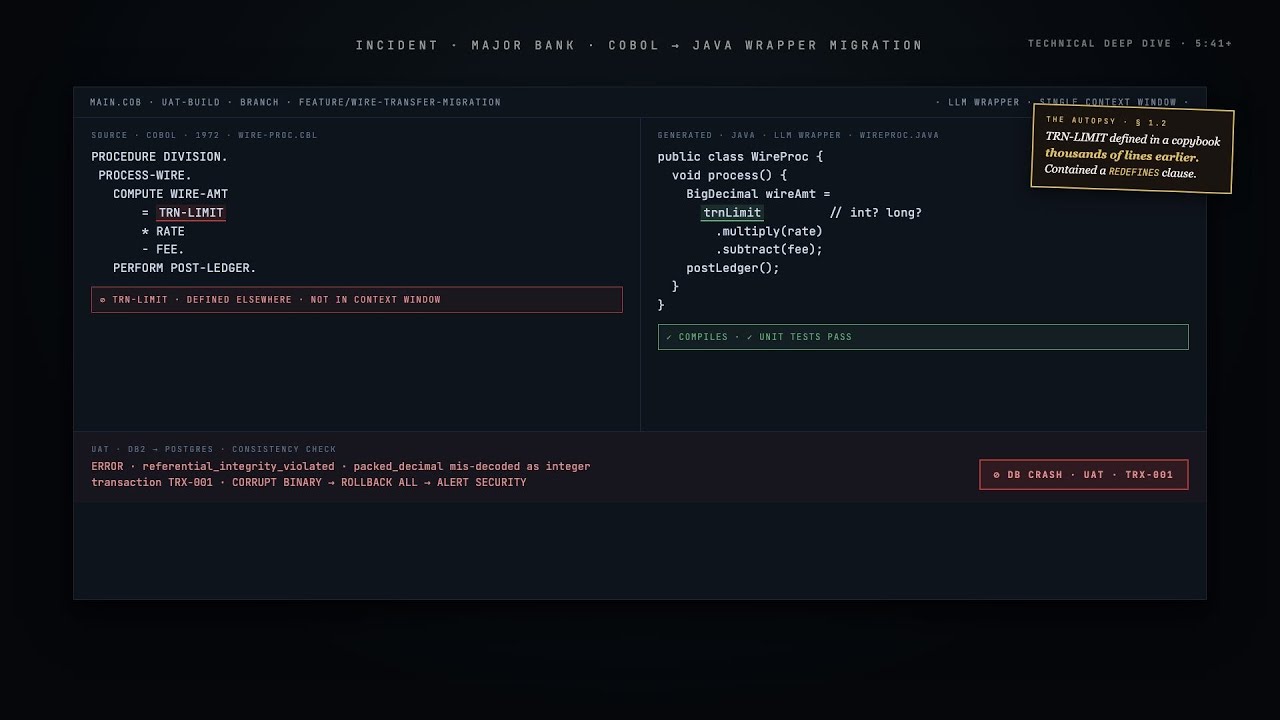
Challenge: A major financial institution needed to migrate a core wire transfer processing system from IBM Mainframe (COBOL/DB2) to cloud-native Java microservices.
Approach: They deployed a popular AI coding assistant—an LLM wrapper—to translate a COBOL program containing complex COMPUTE statements.
Initial Success: The AI translated syntax perfectly. The code compiled. Unit tests (generated by the same AI from local context) passed.
Production Failure: Upon deployment to UAT, the first transaction crashed the database consistency check.
Variable TRN-LIMIT as a simple numeric field in local context
TRN-LIMIT was defined in a COPYBOOK thousands of lines earlier with a REDEFINES clause
Mainframe: packed decimal. Java: standard integer. Mismatch corrupted binary data
Standard LLMs suffer from "Lost in the Middle" syndrome. When critical definitions appear in the middle of massive context windows, attention degrades significantly. The AI statistically overlooks mid-document information.
When the AI couldn't find TRN-LIMIT's definition, it didn't stop—it hallucinated a "plausible" type based on probability. In banking systems, assuming types leads to rounding errors and data corruption.
The Java code was syntactically perfect and compiled without errors. But it failed to replicate the exact runtime behavior of the original COBOL. This is the difference between translation and understanding.
Why context window size doesn't solve the problem: Understanding the cognitive architecture of LLMs
Large Language Models exhibit a well-documented attention pattern when processing long contexts:
A single COBOL program can be thousands of lines long. When critical variable definitions—like MAX-TRANSACTION-LIMIT—appear in the middle of this context, the AI is statistically likely to overlook it. The AI then hallucinates a default type, leading to catastrophic semantic divergence.
Empirical research showing degraded LLM performance for information in the middle of context windows
Modern LLMs boast context windows of 1 million+ tokens. However, the ability to effectively use that context is not uniform. A larger window doesn't eliminate the attention trough—it just makes it wider.
In enterprise COBOL systems with thousands of COPYBOOK dependencies, critical definitions can be scattered across multiple files totaling millions of lines. No amount of context window expansion can fix the fundamental issue: stochastic attention is not structural understanding.
Standard AI treats code as a "bag of words," searching for textual similarity. When Module A calls Module Z through a chain of intermediaries, text-based retrieval fails because the modules share no keywords.
Our Knowledge Graph represents code as a relational database of logic. Every variable, function, and dependency exists as a node with explicit edges. When analyzing Module A, we traverse the graph to discover:
Toggle the visualization to see how our system discovers hidden dependencies that text-based AI misses entirely.
Software is not text. It is a highly structured system of logical dependencies, data flows, and state changes that exists in a multi-dimensional topological space.
An AST captures the hierarchical grammatical structure of code. COMPUTE INTEREST = PRINCIPAL * RATE becomes a tree of AssignmentNode → MultiplicationNode → Operands.
Call Graphs visualize the nervous system of the application—which subroutines invoke others. Critical for breaking monoliths into microservices without dangling references.
The "Bank Failure" occurred due to A→B→C transitive dependency. Our graph calculates full closure, tracing dependency chains to the "Root of Truth" for every variable.
| Feature | Text Analysis (Standard AI) | Structural Analysis (Veriprajna) |
|---|---|---|
| Unit of Analysis | Token / Word | Node (AST Element) |
| Context Boundary | Arbitrary Token Limit | Logical Scope (Function/Class) |
| Dependency Resolution | Keyword Matching | Graph Traversal |
| GOTO Handling | Treats as Text String | Maps Control Flow Edges |
| Accuracy | Probabilistic | Deterministic |
A purpose-built pipeline for legacy modernization—combining static structure with semantic meaning
Tree-sitter parsers ingest COBOL, JCL, PL/I, Java (13+ languages). Semantic Chunking uses AST to identify logical boundaries—chunk by SECTION/PARAGRAPH, not arbitrary tokens.
Extract entities (Classes, Variables, DB Tables) and relationships (CALLS, UPDATES_TABLE, IMPORTS_COPYBOOK, DEFINES_VARIABLE) to populate Neo4j/Memgraph.
Symbol Resolution merges duplicate references. Cross-Modal Merging links documentation ("User API" PDF) with code (UserAPI class) via embeddings, connecting intent with implementation.
Calculate deep dependency chains (A→B→C). When analyzing Module A, traverse the graph to identify the Root of Truth for every variable, even if Module C is in a different repository.
Why semantic similarity fails for code, and how graph traversal solves multi-hop reasoning
If a developer renames Account to Acct, the semantic similarity drops, even if the logic is identical.
Searching for "Interest Calculation" might miss the actual math if the function is named FNC-001 with no comments.
Retrieves chunks based on cosine distance. Might retrieve a unit test and UI comment, but miss core business logic with different variable names.
Retrieval based on graph edges, not text similarity. Finds all CALLS, READS, INCLUDES relationships regardless of naming conventions.
Relevance Expansion traverses graph to pull subroutines, variable definitions, copybooks—logically inseparable pieces assembled into coherent prompts.
Can answer "If I change Module A, which reports in Module Z break?" by traversing A→B→...→Z even when modules share zero text similarity.
| Capability | Vector RAG | GraphRAG |
|---|---|---|
| Retrieval Key | Cosine Distance (Similarity) | Graph Edge (Relationship) |
| Context Quality | High Recall, Low Precision | High Precision, Connected |
| Multi-Hop Reasoning | Poor (Misses Indirect Links) | Excellent (Traverses Chains) |
| Hallucination Risk | High (Guesses Links) | Low (Explicit Links) |
| Best Use Case | Unstructured Text (FAQs) | Structured Systems (Code) |
Autonomous AI agents with compile-fix loops shift validation burden from humans to machines
Result: Human becomes the error-correction loop, spending hours fixing hallucinated dependencies.
Result: Production-ready code on first pass, dramatically reducing developer validation overhead.
While the agent is autonomous in execution, it is supervised in strategy. The Knowledge Graph provides Interpretability—developers can see exactly why the AI made a decision: "The AI imported com.bank.logic because it found a dependency on COPYBOOK-X at line 2,847."
Banking and government require auditable decisions. We move from "Trust me, I'm AI" to "Here is the citation chain for this logic."
Shifts validation burden from human to AI. Reduces post-generation debugging time by 70-80%, achieving 2-3x productivity gains.
Estimate the cost savings and productivity gains from graph-based modernization vs. manual or wrapper-based approaches
How Veriprajna solves the hardest problems in COBOL-to-Java migration
COBOL uses global variables in DATA DIVISION modified by various PERFORMs. Java best practice requires encapsulation—no hidden state.
Data Flow Analysis traces variable lifecycle. If CALC-TAX reads GROSS-INCOME, graph identifies it as Input Dependency and generates explicit parameter passing.
GOTO creates non-linear control flows. Java has no GOTO. Text-based AI generates recursive calls → StackOverflowError.
Control Flow Graph maps GOTO destinations. Pattern Recognition identifies:
Legacy systems contain 20-30% dead code (old promotions, debug routines). Text-based AI migrates everything—waste of money, increased security surface.
Call Graph identifies Unreachable Nodes—paragraphs with no incoming edges (no callers). Flag for deletion before migration starts.
AI coding assistants suffer from 'Lost in the Middle' syndrome — when critical definitions like COPYBOOK REDEFINES clauses appear thousands of lines from the code being translated, attention degrades and the AI statistically overlooks them. In one major bank case, the AI generated syntax-perfect Java that compiled and passed unit tests, but crashed the database on deployment because it hallucinated a variable type, creating a packed decimal vs standard integer mismatch.
Repository-aware knowledge graphs map every variable, COPYBOOK, data definition, and dependency as nodes and edges in a graph structure. Instead of processing code as linear text with attention degradation, the graph preserves all relationships regardless of distance in the source. This enables deterministic variable dependency resolution, impact analysis for change management, and automated dead code detection that typically reduces codebase by 20-30%.
The US has accumulated $1.52 trillion in technical debt from legacy banking and government systems. 95% of ATM transactions and 43% of banking systems still run on COBOL. The maintenance trap consumes 80% of IT budgets, while failed modernization projects (70-80% failure rate) waste billions more. Knowledge graph-based approaches achieve 2-3x developer productivity increases for successful migration.
Veriprajna's Repository-Aware Knowledge Graphs don't just improve migration success rates—they fundamentally change the physics of understanding.
Schedule a consultation to analyze your legacy codebase and model the ROI of graph-based modernization.
Complete technical report: AST parsing, GraphRAG architecture, agentic workflow design, comparative analysis vs. Vector RAG, enterprise case studies, comprehensive works cited.