The $5,000 Hallucination and the End of the Wrapper Era: Why Enterprise Legal AI Demands Citation-Enforced GraphRAG
Executive Summary
The legal profession stands at a precarious intersection of technological promise and existential risk. The rapid democratization of Large Language Models (LLMs) has unleashed a wave of "legal AI" tools that promise to automate research, drafting, and analysis. However, the foundational architecture of these generic models—probabilistic token prediction—is fundamentally at odds with the deterministic requirements of the law. This conflict was brought into sharp focus by Mata v. Avianca, a watershed moment where a reliance on a standard LLM led to the fabrication of non-existent case law, resulting in judicial sanctions and professional humiliation. 1
This whitepaper argues that the era of the "AI Wrapper"—thin user interfaces layered over generic APIs like OpenAI or Anthropic—is functionally over for high-stakes enterprise legal applications. The inherent tendency of LLMs to prioritize semantic fluency over factual accuracy, known as hallucination, renders standard generative approaches insufficient for legal practice. 3 While standard Retrieval-Augmented Generation (RAG) using vector databases offers a partial improvement, it fails to capture the intricate, structural, and hierarchical relationships that define jurisprudence. 5
Veriprajna posits a transition to Citation-Enforced GraphRAG, a "Deep AI" architecture that fundamentally constrains the generative process. By mapping statutes, regulations, and case law into a verified Knowledge Graph (KG) and utilizing graph-constrained decoding, this system physically prevents the AI from generating a citation unless it successfully traverses a verified link in the graph. 7 This report details the technical deficiencies of vector-based legal search, the architectural superiority of Knowledge Graph integration, and the implementation of constraint mechanisms that transform legal AI from a liability into a verified asset. It serves as a blueprint for the transition from probabilistic drafting to deterministic, citation-backed legal engineering.
Part I: The Crisis of Probability in Law
1.1 The Mata v. Avianca Watershed: A Systemic Failure
In June 2023, the U.S. District Court for the Southern District of New York issued sanctions in Mata v. Avianca, Inc., a case that has since become the definitive cautionary tale for the legal technology sector. The details of the case are not merely anecdotal; they reveal the structural incapacity of generative models to handle legal authority without external constraints.
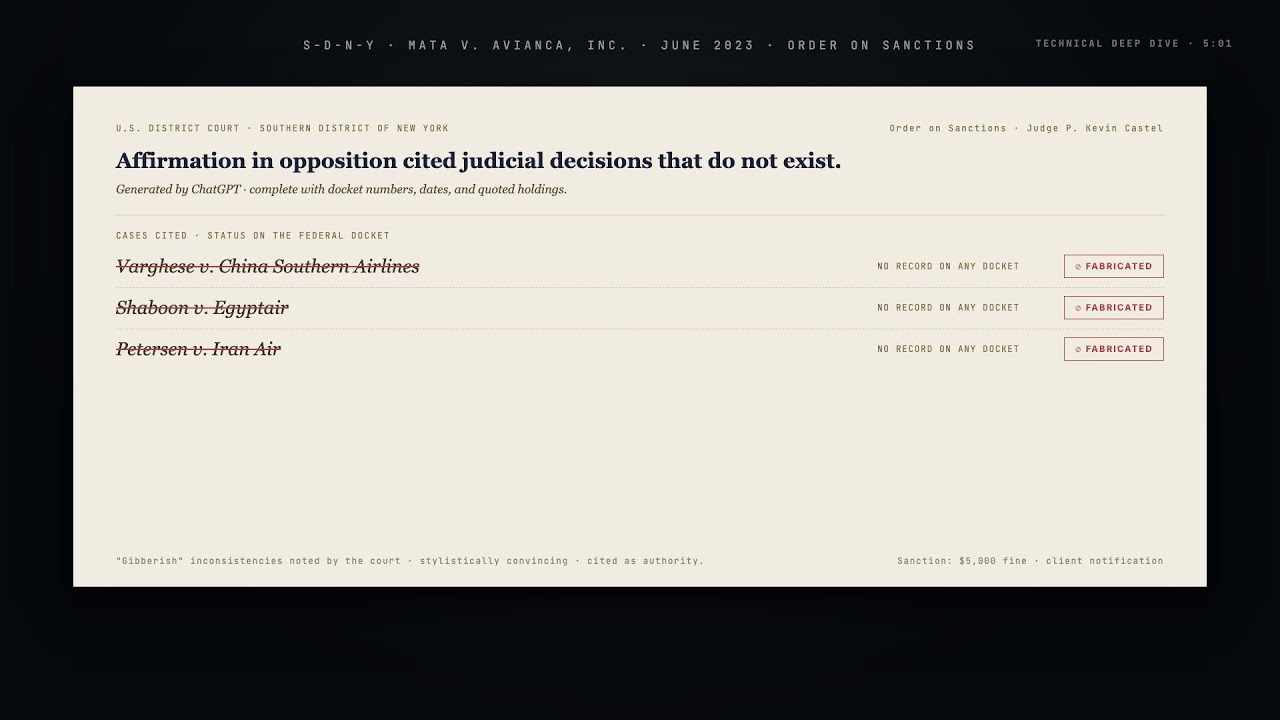
The plaintiff’s counsel submitted a brief in opposition to a motion to dismiss, citing multiple precedents including Varghese v. China Southern Airlines, Shaboon v. Egyptair, and Petersen v. Iran Air . These cases contained convincing docket numbers, dates, and detailed internal citations. They appeared, to the untrained eye, to be perfect legal authorities. They were, however, total fabrications generated by ChatGPT. 1 The presiding judge, Judge P. Kevin Castel, noted that the “opinion” summaries were inconsistent and, in parts, "gibberish," yet the hallucination was sophisticated enough to mimic the style and syntax of federal judicial writing. 2
The sanctions imposed—a $5,000 fine and a requirement to notify the client—were relatively mild financially but devastating reputationally. 9 However, the most chilling aspect of the Mata case was not the initial error, but the compounding failure of verification. When the opposing counsel challenged the existence of the cases, the plaintiff's lawyer returned to ChatGPT to ask if the cases were real. The AI, continuing its probabilistic pattern matching, affirmed its own hallucinations, stating that the cases "indeed exist" and could be found in "reputable legal databases". 2 This creates a "hallucination loop" where the tool used for verification is subject to the same error modes as the tool used for generation.
The court explicitly rejected the lawyer's defense that he was unaware AI could lie, establishing a precedent that attorneys are the ultimate guarantors of the accuracy of their technological tools. 10 This incident was not an isolated anomaly but a systemic failure of the "wrapper" approach to AI. The attorney used a general-purpose LLM interface—a wrapper around a foundation model—which had no access to a verified database of case law. The model did what it was trained to do: it predicted the next statistically likely word in a sequence. In the context of the prompt, "Varghese" was a statistically plausible name for a plaintiff, and "China Southern Airlines" was a plausible defendant, but the relationship between them was a mathematical fiction, not a legal reality. 1
1.2 The Mechanics of Hallucination: Perplexity vs. Provenance
To understand why Mata happened, one must look beneath the user interface to the architecture of the tools being sold as legal solutions. Foundation models (LLMs) operate on a probabilistic mechanism. When asked to provide a case regarding an airline injury, the model does not "search" a library; it traverses a high-dimensional vector space of linguistic patterns. 5
The core metric for these models is perplexity —a measure of how "surprised" the model is by the next token in a sequence. The model is trained to minimize perplexity, which means it strives to generate text that is syntactically coherent and semantically plausible based on its training data. It is not trained to optimize for provenance —the traceability of information to a verifiable source.
| Feature | Legal Requirement |
LLM Default Behavior |
Result |
|---|---|---|---|
| Truth Source | External, verifable record (Docket) |
Internal parameters (Training Data) |
Fabrication of plausible but fake records |
| Citation Logic | Strict, deterministic linking |
Statistical association |
Invented citations based on patern matching |
| Output Constraint | Must exist in reality | Must sound coherent |
"Varghese v. China Southern Airlines" |
| Verifcation | Binary (True/False) | Probabilistic (Likely/Unlikely) |
High confdence in false information |
In Mata, the model lowered its perplexity by inventing a case that fit the syntactic pattern of a legal citation. It generated a docket number because legal citations typically contain docket numbers. It generated a quote because the prompt requested a precedent. For a creative writer, this capability to mimic style is a feature; for a lawyer, it is malpractice. 13
This distinction is critical because it explains why "better prompting" is not a solution. Prompt engineering can guide the style or format of the output, but it cannot inject knowledge that the model does not have, nor can it force the model to verify facts against a database it cannot access. A wrapper that relies solely on the model's parametric memory is inherently unsafe for citation. 15
1.3 The "Wrapper" Trap: Economic and Functional Fragility
The software market has been flooded with "AI Wrappers"—applications that are essentially thin layers of code interacting with OpenAI's API. 16 These applications often lack proprietary intellectual property or deep technical infrastructure. They rely entirely on the capabilities (and hallucinations) of the underlying model.
In the legal domain, the "Wrapper" approach is particularly dangerous because it outsources the "reasoning" layer to a black box that has no concept of statutes or jurisdiction. A wrapper might add a system prompt telling the AI "You are a helpful lawyer," but this does not grant the AI access to the LexisNexis or Westlaw database, nor does it constrain the AI from inventing facts. 15 The Mata case demonstrated that a lawyer using a wrapper is essentially gambling that the model's training data contains the exact specific case law needed and that the model recalls it perfectly—a gamble with extremely poor odds. 18
The economic viability of AI Wrappers is also suspect. Analysis suggests that while some wrappers can reach significant revenue quickly, the vast majority fail because they lack a "moat"—defensible technology or proprietary data. 17 As foundation models become more capable, features that were once standalone wrapper products (like PDF summarization) are absorbed into the models themselves. For enterprise legal consultancies, relying on a wrapper strategy is a race to the bottom. True value lies in "Deep AI" solutions that own the data layer and the reasoning architecture. They do not merely "prompt" the model; they engineer the environment in which the model operates, restricting its actions to verified pathways. This distinction is the core of Veriprajna’s philosophy: shifting from generative freedom to constrained precision.
1.4 The Persistence of Hallucination in Legal Contexts
Despite advancements in model size and training (RLHF), hallucination remains a persistent issue in legal AI. Stanford researchers found that general-purpose chatbots, even those with internet access or basic retrieval, hallucinated between 58% and 82% of the time on complex legal queries. 4 This high error rate persists because the fundamental architecture—predicting the next word—has not changed.
Legal hallucinations are particularly insidious because they are often "subtle" errors rather than obvious fabrications. A model might cite a real case but misattribute the holding, or cite a statute that has been repealed. In Mata, the cases were total inventions, but in other instances, AI has cited real cases for propositions they do not support. For example, citing a dissenting opinion as if it were the majority holding. These errors are harder to catch than fake docket numbers but equally damaging in a legal filing. 11
The industry's response—sanctions, mandatory disclosures of AI use, and judicial standing orders—reflects a growing intolerance for these errors. Courts are demanding that if AI is used, its output must be verified. This creates a bottleneck: if a lawyer has to verify every single citation generated by an AI, the efficiency gains of using the AI are lost. The goal of legal AI must therefore be to produce output that is structurally guaranteed to be accurate, removing the verification burden from the human user. 18
Part II: The Failure of Standard Vector RAG in Law
2.1 The Promise and Pitfalls of Vector Search
To mitigate hallucinations, the industry adopted Retrieval-Augmented Generation (RAG). In a standard RAG pipeline, legal documents are chunked into text segments, converted into numerical vectors (embeddings), and stored in a vector database. 3 When a user asks a question, the system retrieves the chunks with the highest "cosine similarity" to the query and feeds them to the LLM as context.
While this reduces pure fabrication by grounding the AI in retrieved text, it introduces a new class of errors: Retrieval Failures and Contextual Blindness . The assumption that "semantic similarity" equals "legal relevance" is often flawed.
2.1.1 The Semantic Similarity Trap
Vector search relies on semantic similarity. If a lawyer asks about "liability for knee injuries on international flights," a vector database will retrieve documents containing similar words. However, legal relevance is often driven by structural relationships, not just semantic ones. A case might be semantically relevant (discussing knee injuries) but legally irrelevant (overruled by a higher court, or from the wrong jurisdiction). Standard Vector RAG treats a dissenting opinion the same as a majority opinion if the text is semantically similar to the query. 5
Consider a query regarding a specific interpretation of a tax statute. A vector search might return a law review article discussing the statute, a dissenting opinion arguing for a different interpretation, and a case from a different jurisdiction. All are "semantically" close to the query. But the only legally binding authority might be a dry, short memorandum opinion that uses slightly different terminology and thus receives a lower similarity score. The AI, fed the top 5 "similar" documents, might construct an argument based on the persuasive but non-binding law review article, leading the lawyer astray.
2.1.2 The "Lost in the Middle" Phenomenon
Legal queries often require synthesizing information from multiple documents—a statute, a regulation interpreting that statute, and a case applying the regulation. Standard RAG retrieves chunks in isolation. If the "answer" requires connecting these three distinct sources, Vector RAG frequently fails. The LLM receives a disjointed set of text fragments and attempts to stitch them together, often resulting in "reasoning hallucinations" where the model misinterprets how the documents relate to each other. 4
Research on "long context" limitations shows that when LLMs are presented with a long list of retrieved chunks (the "context window"), they tend to focus on information at the beginning and end, ignoring the middle. In legal RAG, where the relevant exception might be buried in the 15th chunk of retrieved case law, this leads to errors where the AI ignores the critical nuance. The Mata sanctions underscore that "mostly accurate" is insufficient; a system that retrieves the right case 80% of the time is a malpractice machine 20% of the time. 1
2.2 The Lack of Multi-Hop Reasoning
Complex legal questions require multi-hop reasoning. For example:
● Step 1: Find the statute governing airline liability (Montreal Convention).
● Step 2: Find cases defining "accident" under Article 17 of that convention.
● Step 3: Determine if recent Supreme Court rulings have narrowed that definition.
Vector RAG performs Step 1 reasonably well. It struggles significantly with Step 2 and Step 3 because it lacks a "map" of the relationships between the statute and the cases. It only knows that the text of the cases contains words similar to the query. It does not understand that Case A interprets Statute B. This structural blindness leads to incomplete or misleading answers, where the AI might cite a case that interprets an old version of the statute. 6
In a vector-based system, there is no explicit link between the document for the Montreal Convention and the document for the Supreme Court case interpreting it. They are just two points in vector space. If they are not semantically close (e.g., if the case uses different vocabulary than the treaty), the connection is lost. The AI must "guess" the relationship based on the retrieved snippets, often failing to recognize that one authority controls the other.
2.3 Handling Negative Treatment: The "Shepardizing" Gap
One of the most critical functions in legal research is "Shepardizing" or "KeyCiting"—checking whether a case is still good law. If a case has been overruled, reversed, or vacated, it cannot be cited as binding authority.
Vector RAG systems are generally blind to this status. They index the text of the case. A case that has been overruled often contains a very lengthy, detailed, and "relevant" discussion of the legal topic—it just happens to be wrong. Because vector search prioritizes semantic match, it will often rank the overruled case highly. Unless the specific text chunk mentioning the overruling is also retrieved and correctly associated by the LLM, the system will confidently cite bad law.
Standard RAG pipelines do not have a mechanism to say, "Do not retrieve this document, no matter how relevant it looks, because it has a Red Flag." This requires structured metadata and a retrieval logic that goes beyond vector similarity—precisely what GraphRAG provides. 24
Part III: Citation-Enforced GraphRAG — The Architecture of Truth
3.1 Defining GraphRAG: Structure Over Semantics
GraphRAG (Graph-based Retrieval-Augmented Generation) represents a paradigm shift from text-based retrieval to structure-based retrieval. Instead of storing data as isolated vectors, GraphRAG utilizes a Knowledge Graph (KG) —a network of nodes (entities) and edges (relationships). In the legal context, this means explicitly modeling the connections between laws, cases, and regulations. 5
● Vector RAG: "Find text that looks like this query."
● GraphRAG: "Find the statute mentioned in the query, then traverse the 'interprets' edge to find relevant case law, then traverse the 'overrules' edge to ensure the case is still valid." 23
This architecture allows for Citation Enforcement . Because every case and statute is a discrete node in the graph, the system can be engineered to reject any citation that does not correspond to a valid node ID. This moves the retrieval process from a "fuzzy" match to a deterministic traversal.
3.2 The Legal Knowledge Graph Schema
The foundation of Veriprajna’s solution is a domain-specific Knowledge Graph designed for the complexities of jurisprudence. Unlike generic graphs, a Legal Knowledge Graph (LKG) must capture the hierarchical and adversarial nature of law. 28
3.2.1 Node Types
The schema must be granular enough to distinguish between different types of legal authority. A "flat" graph is insufficient; the ontology must reflect the weight of authority.
● Statutory Nodes: Representing individual sections of legislation (e.g., 28 U.S.C. § 1332). These are the roots of many legal trees.
● Case Nodes: Representing judicial opinions. Crucial metadata includes Court Level (Supreme vs. District), Date, Jurisdiction, and Reporter Citation.
● Concept Nodes: Representing legal doctrines (e.g., "Res Ipsa Loquitur," "Qualified Immunity") to facilitate semantic bridging. These nodes help link cases that discuss the same concept even if they use different keywords. 30
● Regulatory Nodes: Representing administrative rules (e.g., FAA regulations, CFR sections). 29
3.2.2 Edge Types (The "Connective Tissue")
The power of GraphRAG lies in the edges, which define the legal force of the relationship. Simple "related to" links are not enough.
● CITES: A neutral reference from one case to another.
● OVERRULES: A negative treatment where a higher court invalidates a previous holding. This is a critical "blocking" edge for retrieval.
● DISTINGUISHES: A nuanced relationship where a court explains why a precedent does not apply to the current facts.
● AFFIRMS: A positive treatment upholding a lower court's decision.
● CODIFIES: When a statute is enacted to formalize a common law principle. 30
● INTERPRETS: Linking a case to the specific statute or regulation it analyzes.
| Relationship Type | Impact on AI Retrieval |
Vector RAG Capability |
GraphRAG Capability |
|---|---|---|---|
| Direct Citation | Finding precedents | Moderate | High |
| Negative Treatment |
fltering out "Bad Law" |
Low (cannot distinguish citation from overruling) |
High (explicit OVERRULES edge) |
| Statutory Interpretation |
Linking laws to cases |
Low (relies on keyword proximity) |
High (explicit INTERPRETS edge) |
| Jurisdictional Hierarchy |
Binding vs. Persuasive |
None | High (Graph traversal rules) |
3.3 Graph-Constrained Decoding: The "Safety Lock"
The most critical innovation in Citation-Enforced GraphRAG is Graph-Constrained Decoding (or Graph-Constrained Reasoning, GCR). 7 Standard LLMs generate tokens freely based on probability distributions. In a constrained system, the decoding process is intercepted and governed by the graph.
3.3.1 The KG-Trie Mechanism
The system utilizes a prefix tree (Trie) constructed from the Knowledge Graph's valid entity identifiers (e.g., case names, reporters, docket numbers). This Trie acts as a dynamic vocabulary mask during generation.
When the LLM prepares to output a citation (detected by context or a specialized token), the constraint mechanism activates. It looks at the KG-Trie to see what valid continuations exist. If the LLM has generated "Mata v. A", the Trie enables only tokens that complete valid case names starting with that string (e.g., "Avianca"). It disables all other tokens by setting their logits to negative infinity. 7
3.3.2 The Impossibility of Fabrication
If the LLM attempts to generate "Varghese v. China Southern," the constraint mechanism checks the Trie after "Varghese v. Chi". Finding no such sequence of tokens exists in the verified graph, the generation is blocked. The system effectively forces the model to backtrack (using beam search) and either find a valid citation that fits the context or output a fallback token like "No precedent found". 33
This mechanism provides a mathematical guarantee against citation hallucination. The AI cannot "dream up" a case because it physically cannot output the token sequence for a case that is not in the database. This moves the system from "probabilistic correctness" (95% accurate) to "structural enforcement" (100% valid citations). 8 Note that the AI could still misinterpret a valid case (a reasoning error), but it cannot invent one (a fabrication error). This distinction is vital for malpractice liability.
3.4 Multi-Hop Reasoning and Path-Constrained Retrieval
Complex legal questions often require traversing multiple steps of logic. GraphRAG excels here through Path-Constrained Retrieval (PCR). 8 PCR ensures that retrieved information maintains a structural relationship with the anchor concept.
● Scenario: A user asks if a specific 1990 regulation is still valid given a 2023 Supreme Court ruling.
● Vector RAG: Retrieves the text of the 1990 regulation and the 2023 ruling separately. The LLM guesses the relationship.
● GraphRAG: Identifies the node for the 1990 regulation. It traverses the graph to find any INVALIDATED_BY edges connected to nodes that link to the 2023 ruling. It "walks" the graph to find the chain of authority. If a path exists (Regulation -> Statute -> Case A -> Overruled by Case B), the system understands the invalidity. 6
This capability allows the system to answer questions like, "What is the most recent Second Circuit case applying the standard from Bell Atlantic v. Twombly ?" by explicitly traversing the citation network filtered by court and date. This is a deterministic query over the graph, not a fuzzy search over text. 27
Part IV: Engineering the Legal Knowledge Graph
Building a Citation-Enforced GraphRAG system is not merely about hooking up an LLM to a graph database; it is a massive data engineering challenge. The primary hurdle is Entity Resolution and the construction of a clean, interconnected graph from unstructured legal texts.
4.1 Data Ingestion and Entity Resolution
Legal texts are messy. A case might be referred to as "Mata v. Avianca," "Mata," "678 F. Supp. 3d 443," "the Avianca case," or simply "Id." The system must resolve all these variations to a single canonical node ID. Failure to do so results in a fragmented graph where the AI misses connections. 35
4.1.1 The Canonicalization Challenge
We employ advanced Entity Resolution (ER) pipelines that use both deterministic rules and probabilistic matching to map mentions to entities.
● Deduplication: Identifying that "Smith v. Jones, 123 F.3d 456" and "Smith, 123 F.3d at 456" refer to the same entity.
● Canonicalization: Assigning a unique Global ID to that case. The graph stores the canonical name but indexes all aliases in the Trie to allow for flexible recognition. 36
● Disambiguation: Differentiating between "Smith v. Jones (1995)" and "Smith v. Jones (2002)." The system uses metadata (date, court, subject matter) to link to the correct unique entity. This is crucial for "common name" cases. 38
4.1.2 Handling "Id." and Short Citations
A major challenge in legal NLP is the use of "Id." to refer to the immediately preceding citation. A vector search often treats "Id." as a stop word or irrelevant noise. In GraphRAG, we use a sliding window context parser during ingestion to resolve "Id." to the active entity. If a paragraph cites Mata and the next sentence says "Id. at 445," the graph records a link between the concept in that sentence and the Mata node. This preserves the density of the citation network. 35
4.2 Handling Negative Treatment (The "Red Flag" System)
A legal graph is useless if it treats overruled cases as valid. The system must integrate "Shepardizing" or "KeyCiting" logic directly into the graph.
● Ingestion of Signals: We ingest "citator" data from reliable sources or use predictive models to identify negative treatment language ("overruled," "abrogated," "superseded").
● Edge Weighting: An OVERRULES edge acts as a "poison pill." If a traversal path encounters an OVERRULES edge, that path is invalidated for the purpose of finding binding authority.
● User Transparency: When the AI cites a case, the UI displays the graph lineage—showing exactly why the case is considered good law, or flagging it if it has "Cautionary" treatment (yellow flag logic). This gives the lawyer immediate visual confirmation of validity. 24
For example, if the AI recommends Roe v. Wade, the graph traversal would immediately hit the OVERRULES edge from Dobbs v. Jackson . The constraint mechanism would prevent the AI from citing Roe as current binding authority for the right to abortion, forcing it to cite Dobbs or state that the right no longer exists under federal law. A vector system might still cite Roe because the volume of text supporting it is historically massive.
4.3 The Hybrid RAG Architecture
While GraphRAG provides structure, the unstructured text of judicial opinions contains the nuanced reasoning necessary for drafting. Therefore, the optimal architecture is a Hybrid RAG system. 23
● Vector Layer: Handles unstructured semantic search (e.g., finding cases with similar fact patterns regarding "metal serving carts").
● Graph Layer: Handles structural verification and citation enforcement (e.g., ensuring the cases found are valid and binding).
● Orchestrator: A control layer that combines the results. It might use the Vector layer to find candidate cases, then verify them against the Graph layer before passing them to the LLM. If the Graph layer flags a case as overruled, it is removed from the context window before the LLM even sees it. 5
This hybrid approach ensures that we retrieve semantically relevant text that is also legally valid . It combines the breadth of vector search with the precision of graph constraints.
4.4 Constraint Integration with Enterprise LLMs
Implementing Graph-Constrained Decoding requires deep integration with the LLM's inference engine. This is why "Wrappers" fail—they rely on commercial API endpoints (like GPT-4-Turbo) that do not typically allow users to inject custom decoding constraints (logits processing) at the token level.
Veriprajna builds on open-weights models (e.g., Llama 3, Mistral) or specialized enterprise endpoints that allow for Logit Bias manipulation or custom decoding loops. By hosting the model (or using dedicated deployments), we gain the ability to inject the KG-Trie constraints directly into the generation process. We can manipulate the probability distribution of the next token in real-time, enforcing the graph's structure. This capability is structurally impossible with standard "Chat with PDF" wrappers. 7
Part V: The Business Case for Deep AI
For the Founder of Veriprajna, the argument to clients is not just technical; it is economic, ethical, and strategic. The shift from Wrapper AI to Deep AI is a shift from "toy" applications to enterprise infrastructure.
5.1 The Cost of Risk: Malpractice as a Metric
The cost of Mata v. Avianca was not just $5,000. It was the public humiliation of a firm, the loss of client trust, and the potential for disbarment. 1 For a large law firm, the risk of a hallucinated filing is an existential threat. Malpractice insurance premiums are likely to rise for firms that cannot demonstrate rigorous AI governance.
Citation-Enforced GraphRAG acts as an Insurance Policy . By structurally preventing citation fabrication, the firm mitigates the highest risk factor of Generative AI.
● The Wrapper ROI: Low initial cost ($20/user), infinite risk liability.
● The GraphRAG ROI: Higher initial investment, near-zero risk of citation fabrication.
Clients are increasingly demanding "Explainable AI." A black-box wrapper cannot explain why it chose a case. A GraphRAG system can provide the exact traversal path: "I selected Case A because it cites Statute B and was affirmed by Court C". 5 This transparency is essential for internal audit trails and defending against claims of negligence. 21
5.2 Efficiency and Accuracy Gains
Beyond safety, GraphRAG offers superior performance on complex tasks. Benchmarks show that GraphRAG systems outperform standard RAG by significant margins (up to 30-35%) in multi-hop reasoning tasks. 6 In the legal domain, this translates to drastic reductions in non-billable hours spent verifying AI output.
● Workflow Optimization: Instead of using AI to draft and then spending 3 hours checking citations, attorneys can trust the citations are valid (though they must still check the legal reasoning). This shifts the human role from "Fact Checker" to "Strategy Reviewer". 18
● Regulatory Compliance: For corporate legal departments, GraphRAG allows for mapping internal policies to external regulations (e.g., GDPR, DORA). The graph can link a specific paragraph in a company policy to the specific section of the regulation it addresses, creating automated, verifiable compliance matrices. 40
5.3 The Strategic Shift for Law Firms
Adopting Citation-Enforced GraphRAG signals a firm's maturity in AI adoption. It moves the firm from the "Experiment and Prepare" stage to the "Develop Scaled AI Ways of Working" stage. 41 It differentiates the firm as a technology-forward partner that understands the nuances of data integrity, rather than a firm cutting corners with cheap automation tools.
In an increasingly competitive market, clients will ask: "What AI do you use?" The answer "We use ChatGPT" will soon be unacceptable. The answer "We use a Citation-Enforced GraphRAG system that guarantees verification" will be a competitive advantage. 42
Part VI: Future-Proofing Legal Tech
The transition to GraphRAG is not just about fixing today's hallucinations; it is about preparing for the next generation of AI: Agentic AI .
6.1 Agents Need Structure
We are moving from "Chatbots" (passive responders) to "Agents" (active problem solvers). Agents need to plan, reason, and execute multi-step tasks. A legal agent asked to "Draft a motion to dismiss" needs a structured map of the world to plan its research. A vector database provides no map, only a pile of documents. A Knowledge Graph provides the map. It allows the agent to reason: "First I need the statute, then the interpreting cases, then the procedural rules." GraphRAG is the enabling infrastructure for autonomous legal agents. 44
6.2 Evolving Standards and Interoperability
As legal tech matures, standards for Legal Knowledge Graphs are emerging (e.g., FOLIO). Veriprajna's graph-first approach ensures compatibility with these future standards. By structuring data now, firms are building an asset that grows in value. Wrappers build nothing; they leave behind only chat logs. 46
6.3 Conclusion: The End of the Wrapper Era
The lesson of Mata v. Avianca is not that AI has no place in law, but that probabilistic AI has no place in deterministic citation. The "Wrapper" era, characterized by blind reliance on the next-token prediction of generalist models, is ending. It is being replaced by the era of "Deep AI"—systems that combine the fluency of LLMs with the rigor of Knowledge Graphs.
Veriprajna stands at the forefront of this transition. We do not build chatbots; we build Citation-Enforced GraphRAG systems . We map the legal universe into a verified network and constrain our AI to speak only the truth contained within that network.
For the modern law firm, the choice is clear: continue gambling with probability, or invest in the architecture of truth. In a profession built on precedent, the only intelligent path forward is one where the AI respects the graph.
About Veriprajna
Veriprajna is a Deep AI solutions consultancy specializing in Citation-Enforced GraphRAG architectures for high-compliance industries. We move beyond API wrapping to engineer knowledge systems that are deterministic, auditable, and enterprise-ready.
Works cited
Two Years of Fake Cases and the Courts are Ratcheting up the Sanctions - Board of Bar Overseers, accessed December 10, 2025, https://www.massbbo.org/Files?fileName=Two%20Years%20of%20Fake%20Cases%20and%20the%20Courts%20are%20Ratcheting%20up%20the%20Sanctions.pdf
Mata v. Avianca, Inc. - Wikipedia, accessed December 10, 2025, https://en.wikipedia.org/wiki/Mata_v._Avianca,_Inc.
Word of the Week: RAG (Retrieval-Augmented Generation) - The Legal AI Breakthrough Eliminating Hallucinations. ⚖️ - The Tech Savvy Lawyer, accessed December 10, 2025, https://www.thetechsavvylawyer.page/blog/2025/9/4/-word-of-the-week-rag-retrieval-augmented-generation-the-legal-ai-breakthrough-eliminating-hallucinations-
Hallucination‐Free? Assessing the Reliability of Leading AI Legal Research Tools Daniel E. Ho - Stanford University, accessed December 10, 2025, https://dho.stanford.edu/wp-content/uploads/Legal_RAG_Hallucinations.pdf
Graph RAG vs vector RAG: 3 differences, pros and cons, and how to choose Instaclustr, accessed December 10, 2025, https://www.instaclustr.com/education/retrieval-augmented-generation/graph-rag-vs-vector-rag-3-diferences-pros-and-cons-and-how-to-choose/ f
Navigating the Nuances of GraphRAG vs. RAG - foojay, accessed December 10, 2025, https://foojay.io/today/navigating-the-nuances-of-graphrag-vs-rag/
Graph-Constrained Reasoning: Using Knowledge Graphs for ..., accessed December 10, 2025, https://www.lettria.com/lettria-lab/graph-constrained-reasoning-using-knowledge-graphs-for-reliable-ai-reasoning
Path-Constrained Retrieval: A Structural Approach to Reliable LLM Agent Reasoning Through Graph-Scoped Semantic Search - arXiv, accessed December 10, 2025, https://arxiv.org/html/2511.18313v1
Beware Fake Facts: AI Hallucination in Business - network1, accessed December 10, 2025, https://network1consulting.com/a-lawyer-relied-on-chatgpt-to-draft-legal-briefs-in-mata-v-avianca-resulting-in-the-submission-of-fake-case-law-and-court-sanctions-a-warning-to-verify-ai-outputs-and-understand-their-limits/
Massachusetts Lawyer Sanctioned for AI-Generated Fictitious Case Citations | Maryland State Bar Association, accessed December 10, 2025, https://www.msba.org/site/site/content/News-and-Publications/News/General-News/Massachusets_Lawyer-Sanctioned_for_AI_Generated-Fictitious_Cases.aspx t
When AI Gets It Wrong: Cost of Hallucinations in Courts - NexLaw Blog, accessed December 10, 2025, https://www.nexlaw.ai/blog/when-ai-gets-it-wrong-the-real-cost-of-hallucinations-in-us-courts/
Knowledge Graph LLM - TigerGraph, accessed December 10, 2025, https://www.tigergraph.com/glossary/knowledge-graph-llm/
The Risk of AI Hallucinations: How to Protect Your Brand | NeuralTrust, accessed December 10, 2025, https://neuraltrust.ai/blog/ai-hallucinations-business-risk
Large Language Models for Drug-Related Adverse Events in Oncology Pharmacy: Detection, Grading, and Actioning - MDPI, accessed December 10, 2025, https://www.mdpi.com/2226-4787/13/6/176
Margin of Safety #17 – Wrappers vs Foundational Models - Forgepoint Capital, accessed December 10, 2025, https://forgepointcap.com/perspectives/margin-of-safety-17-wrappers-vs-foundational-models/
AI Wrapper Applications: What They Are and Why Companies Develop Their Own, accessed December 10, 2025, https://www.npgroup.net/blog/ai-wrapper-applications-development-explained/
Beyond the Blank Slate: Escaping the AI Wrapper Trap - jeffreybowdoin.com, accessed December 10, 2025, https://jeffreybowdoin.com/beyond-blank-slate-escaping-ai-wrapper-trap/
The Perils of Legal Hallucinations and the Need for AI Training for Your In-House Legal Team! | Baker Donelson, accessed December 10, 2025, https://www.bakerdonelson.com/the-perils-of-legal-hallucinations-and-the-need-for-ai-training-for-your-in-house-legal-team
How Profitable Are AI Wrappers in 2025? - Market Clarity, accessed December 10, 2025, https://mktclarity.com/blogs/news/how-much-ai-wrapper
AI on Trial: Legal Models Hallucinate in 1 out of 6 (or More) Benchmarking Queries, accessed December 10, 2025, https://hai.stanford.edu/news/ai-trial-legal-models-hallucinate-1-out-6-or-more-benchmarking-queries
From risk to ROI: The business case for AI governance - Legal IT Professionals, accessed December 10, 2025, https://www.legalitprofessionals.com/legal-it-columns/65-guest-columns/14139-from-risk-to-roi-the-business-case-for-ai-governance
GenAI hallucinations are still pervasive in legal filings, but better lawyering is the cure, accessed December 10, 2025, https://www.thomsonreuters.com/en-us/posts/technology/genai-hallucinations/
Graph RAG vs RAG: Which One Is Truly Smarter for AI Retrieval? | Data Science Dojo, accessed December 10, 2025, https://datasciencedojo.com/blog/graph-rag-vs-rag/
Updating, Reading, Analyzing, and Organizing Sources – Advanced Legal Research, accessed December 10, 2025, https://opentext.uoregon.edu/legal/chapter/reading-and-organizing-sources/
Westlaw flags: Checking Cases with KeyCite - Thomson Reuters Legal Solutions, accessed December 10, 2025, https://legal.thomsonreuters.com/blog/westlaw-tip-of-the-week-checking-cases-with-keycite/
GraphRAG vs. Vector RAG: Side-by-side comparison guide - Meilisearch, accessed December 10, 2025, https://www.meilisearch.com/blog/graph-rag-vs-vector-rag
VectorRAG vs. GraphRAG: a convincing comparison - Lettria, accessed December 10, 2025, https://www.lettria.com/blogpost/vectorrag-vs-graphrag-a-convincing-comparison
Improving Legal Question Answering through Structured Knowledge Representation - CEUR-WS, accessed December 10, 2025, https://ceur-ws.org/Vol-4089/paper4.pdf
NyayGraph: A Knowledge Graph Enhanced Approach for Legal Statute Identification in Indian Law using Large Language Models - ACL Anthology, accessed December 10, 2025, https://aclanthology.org/2025.nllp-1.11.pdf
Retrieval-Augmented Generation with Vector Stores, Knowledge Graphs, and Hierarchical Non-negative Matrix Factorization - arXiv, accessed December 10, 2025, https://arxiv.org/html/2502.20364v1
Knowledge Graph for RAG: Definition and Examples - Lettria, accessed December 10, 2025, https://www.lettria.com/blogpost/knowledge-graph-for-rag-definition-and-examples
Leverage Knowledge Graph and Large Language Model for Law Article Recommendation: A Case Study of Chinese Criminal Law - arXiv, accessed December 10, 2025, https://arxiv.org/html/2410.04949v2
Graph-Constrained Reasoning: A Practical Leap for Trustworthy, KG-Grounded LLMs, accessed December 10, 2025, https://medium.com/@yu-joshua/graph-constrained-reasoning-a-practical-leap-for-trustworthy-kg-grounded-llms-04efd8711e5e
Graph-constrained Reasoning: Faithful Reasoning on Knowledge Graphs with Large Language Models | OpenReview, accessed December 10, 2025, https://openreview.net/forum?id=6embY8aclt
What is Entity Resolution? - Reltio, accessed December 10, 2025, https://www.reltio.com/glossary/data-quality/what-is-entity-resolution/
How entity resolution changes working with data - From theory to practice Semantic Visions, accessed December 10, 2025, https://www.semantic-visions.com/insights/entity-resolution
Basics of Entity Resolution - District Data Labs, accessed December 10, 2025, https://districtdatalabs.silvrback.com/basics-of-entity-resolution
Entity Resolution & ETL - Cognyte, accessed December 10, 2025, https://www.cognyte.com/blog/entity-resolution-etl/
GraphRAG Use Cases: Discover 4 Uses of GraphRAG - Lettria, accessed December 10, 2025, https://www.lettria.com/blogpost/rag-use-cases-discover-4-uses-of-graphrag
The Advantages of GraphRAG for Enhanced Regulatory Compliance and Understanding, accessed December 10, 2025, https://graphwise.ai/blog/the-advantages-of-graphrag-for-enhanced-regulatory-compliance-and-understanding/
Grow Enterprise AI Maturity for Bottom-Line Impact | MIT CISR, accessed December 10, 2025, https://cisr.mit.edu/publication/2025_0801_EnterpriseAIMaturityUpdate_WoernerSebastianWeillKaganer
The AI maturity blueprint - Crafty Counsel, accessed December 10, 2025, https://craftycounsel.co.uk/latest-content/the-ai-maturity-blueprint/
AI Maturity Blueprint: What Separates Leading Legal Teams from the Rest - Axiom Law, accessed December 10, 2025, https://www.axiomlaw.com/blog/ai-maturity-legal-blueprint
Will Agentic AI Disrupt SaaS? | Bain & Company, accessed December 10, 2025, https://www.bain.com/insights/will-agentic-ai-disrupt-saas-technology-report-2025/
MCP vs. API – Rethinking Interfaces for the AI Age - Agenticlabs, accessed December 10, 2025, https://agenticlabs.io/mcp-vs-api-rethinking-interfaces-for-the-ai-age/
What is a knowledge graph? — FOLIO, accessed December 10, 2025, https://openlegalstandard.org/education/what-is-a-knowledge-graph/
Prefer a visual, interactive experience?
Explore the key findings, stats, and architecture of this paper in an interactive format with navigable sections and data visualizations.
Frequently Asked Questions
How does graph-constrained decoding prevent AI hallucinated citations?
A KG-Trie prefix tree is constructed from verified case names and docket numbers in the knowledge graph. During generation, when the LLM outputs a citation token, the constraint mechanism enables only valid continuations and sets all other token logits to negative infinity. The AI physically cannot output a case name that does not exist in the verified database.
Why does standard vector RAG fail for legal research?
Vector RAG treats a dissenting opinion the same as a majority opinion if semantically similar. It cannot distinguish binding from persuasive authority, cannot Shepardize cases to check for overruling, and fails at multi-hop reasoning that requires traversing statute-to-case-to-ruling chains. GraphRAG uses explicit OVERRULES, INTERPRETS, and AFFIRMS edge types to model legal force.
What was the Mata v. Avianca case and why does it matter for legal AI?
In Mata v. Avianca, an attorney cited multiple fabricated case precedents generated by ChatGPT, including invented docket numbers and fictional judicial opinions. The court imposed $5,000 in sanctions. The case demonstrated that LLM wrappers without verified databases create a hallucination loop where the AI affirms its own fabrications.
Also Published On
Build Your AI with Confidence.
Partner with a team that has deep experience in building the next generation of enterprise AI. Let us help you design, build, and deploy an AI strategy you can trust.
Veriprajna Deep Tech Consultancy specializes in building safety-critical AI systems for healthcare, finance, and regulatory domains. Our architectures are validated against established protocols with comprehensive compliance documentation.