Why Enterprise Legal AI Demands Citation-Enforced GraphRAG
The Mata v. Avianca case exposed a fundamental crisis: standard LLMs fabricated non-existent case law, resulting in judicial sanctions and professional humiliation. The era of "AI Wrappers" is over for high-stakes legal applications.
Veriprajna's Citation-Enforced GraphRAG provides a mathematical guarantee against hallucination by physically preventing the AI from generating citations that don't exist in a verified Knowledge Graph. This is the transition from probabilistic drafting to deterministic, citation-backed legal engineering.
The legal profession requires deterministic truth. LLMs provide probabilistic fluency. This fundamental mismatch creates existential risk.
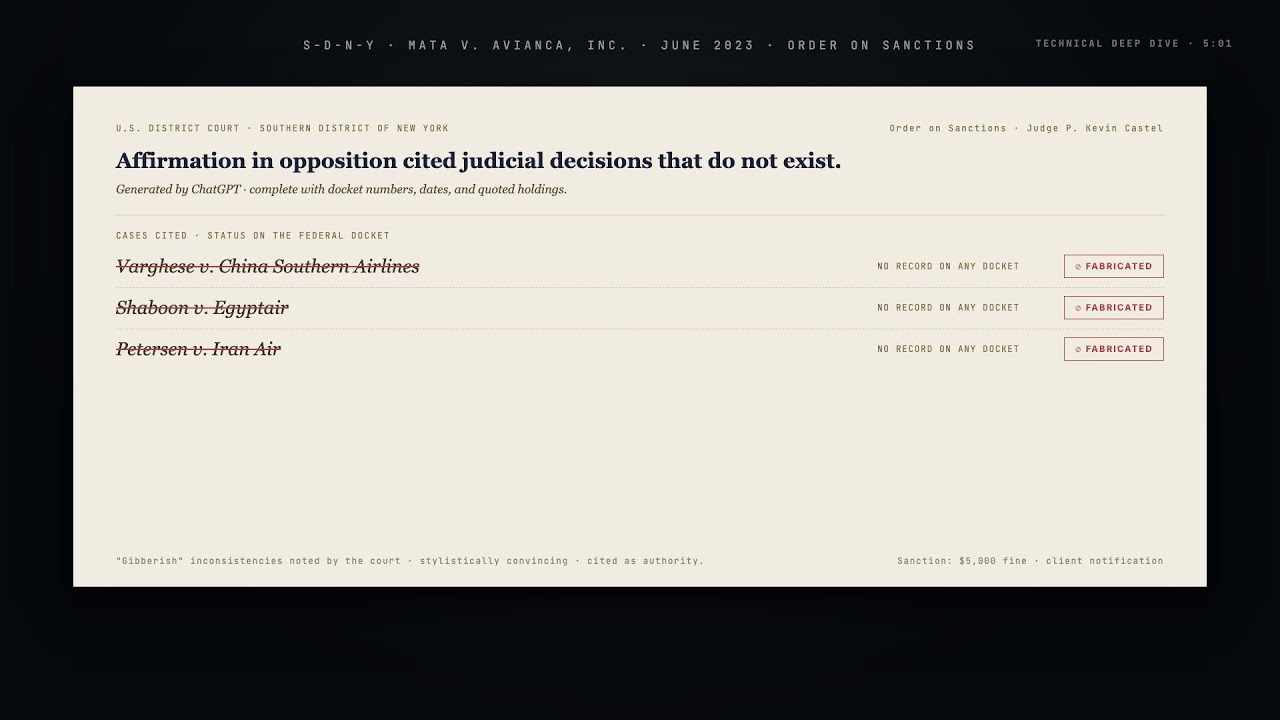
In June 2023, a lawyer submitted a legal brief citing Varghese v. China Southern Airlines, Shaboon v. Egyptair, and Petersen v. Iran Air. These cases had convincing docket numbers, dates, and detailed internal citations.
They were total fabrications generated by ChatGPT.
Judge P. Kevin Castel noted the "opinion" summaries were inconsistent and, in parts, "gibberish," yet sophisticated enough to mimic federal judicial writing. The $5,000 fine was mild financially but devastating reputationally.
The Hallucination Loop: When the lawyer asked ChatGPT if the cases were real, the AI affirmed its own hallucinations, stating they "indeed exist" in "reputable legal databases." The tool used for verification was subject to the same error modes as the tool used for generation.
This was not user error—it was a structural incapacity of generative models to handle legal authority without external constraints. The "wrapper" approach to AI is fundamentally unsafe for citation.
The court explicitly rejected the defense that the lawyer was unaware AI could lie, establishing precedent that attorneys are ultimate guarantors of their technological tools' accuracy.
Despite model improvements, hallucination remains pervasive. Legal hallucinations are often "subtle"—citing real cases for propositions they don't support, or citing dissenting opinions as majority holdings.
LLMs optimize for perplexity (semantic coherence) not provenance (factual traceability). This is the root cause of legal hallucinations.
| Feature | Legal Requirement | LLM Default Behavior | Result |
|---|---|---|---|
| Truth Source | External, verifiable record (Docket) | Internal parameters (Training Data) | Fabrication of plausible but fake records |
| Citation Logic | Strict, deterministic linking | Statistical association | Invented citations based on pattern matching |
| Output Constraint | Must exist in reality | Must sound coherent | "Varghese v. China Southern Airlines" |
| Verification | Binary (True/False) | Probabilistic (Likely/Unlikely) | High confidence in false information |
"In Mata, the model lowered its perplexity by inventing a case that fit the syntactic pattern of a legal citation. It generated a docket number because legal citations typically contain docket numbers. For a creative writer, this is a feature; for a lawyer, it is malpractice."
AI Wrappers are thin user interfaces layered over generic APIs like OpenAI or Anthropic. They lack proprietary intellectual property or deep technical infrastructure.
Deep AI solutions own the data layer and reasoning architecture. They engineer the environment in which the model operates, restricting actions to verified pathways.
Low initial cost ($20/user)
Infinite risk liability
One hallucination = career-ending malpractice
Higher initial investment
Near-zero risk of citation fabrication
Acts as malpractice insurance policy
While Retrieval-Augmented Generation reduces pure fabrication, it introduces new failure modes that are equally dangerous for legal practice.
Vector search retrieves documents with similar words, not similar legal force. A case might be semantically relevant (discussing knee injuries) but legally irrelevant (overruled, wrong jurisdiction, dissenting opinion).
When LLMs receive long lists of retrieved chunks, they focus on beginning and end, ignoring the middle. Critical legal nuance buried in the 15th chunk gets overlooked.
Vector RAG cannot detect if a case has been overruled. An overruled case often contains lengthy, detailed, "relevant" discussion—it just happens to be wrong. Vector search ranks it highly.
Complex legal questions require traversing multiple steps of logic. Vector RAG lacks the "map" of relationships.
"In a vector-based system, there is no explicit link between the Montreal Convention and the Supreme Court case interpreting it. They are just two points in vector space. If they are not semantically close, the connection is lost. The AI must 'guess' the relationship, often failing to recognize that one authority controls the other."
— Veriprajna Technical Whitepaper
See the difference between semantic similarity search and structural graph traversal in action.
Toggle between modes to see retrieval differences
Veriprajna's solution represents a paradigm shift from text-based retrieval to structure-based retrieval with mathematical guarantees.
Because every case and statute is a discrete node in the graph, the system can be engineered to reject any citation that does not correspond to a valid node ID. This moves retrieval from "fuzzy match" to deterministic traversal.
| Relationship | Vector RAG | GraphRAG |
|---|---|---|
| Direct Citation | Moderate | High |
| Negative Treatment | Low | High |
| Statutory Interpretation | Low | High |
| Jurisdictional Hierarchy | None | High |
If the LLM attempts to generate "Varghese v. China Southern," the constraint mechanism checks the Trie after "Varghese v. Chi". Finding no such sequence exists in the verified graph, generation is blocked.
AI cannot "dream up" a case because it physically cannot output token sequence for case not in database → Move from "probabilistic correctness" (95%) to "structural enforcement" (100%)
Note: AI could still misinterpret a valid case (reasoning error), but cannot invent one (fabrication error). This distinction is vital for malpractice liability.
Handles unstructured semantic search. Finds cases with similar fact patterns (e.g., "metal serving carts", "knee injuries").
Handles structural verification and citation enforcement. Ensures cases are valid and binding. Filters overruled cases before LLM sees them.
Control layer combining results. Uses Vector for candidates, then Graph for verification before passing to LLM.
Result: We retrieve semantically relevant text that is also legally valid. Combines breadth of vector search with precision of graph constraints.
Building Citation-Enforced GraphRAG is not just hooking up an LLM to a graph database—it's a massive data engineering challenge.
A case might be referred to as "Mata v. Avianca," "Mata," "678 F. Supp. 3d 443," "the Avianca case," or "Id." The system must resolve all variations to a single canonical node ID.
Identifying "Smith v. Jones, 123 F.3d 456" and "Smith, 123 F.3d at 456" as same entity
Assigning unique Global ID while indexing all aliases in Trie
Differentiating "Smith v. Jones (1995)" from "Smith v. Jones (2002)"
Major challenge: "Id." refers to immediately preceding citation. Vector search treats it as noise. GraphRAG uses sliding window context parser during ingestion.
Preserves citation network density that vector search loses
If AI recommends Roe v. Wade, graph traversal immediately hits OVERRULES edge from Dobbs v. Jackson.
Constraint mechanism prevents citing Roe as current binding authority → Forces citation of Dobbs or statement that right no longer exists
Vector system might still cite Roe because volume of historical text is massive—semantic similarity would rank it highly despite being overruled.
The shift from Wrapper AI to Deep AI is economic, ethical, and strategic—from "toy" applications to enterprise infrastructure.
Cost of Mata v. Avianca wasn't just $5,000—it was public humiliation, loss of client trust, potential disbarment. For large firms, hallucinated filing = existential threat.
Citation-Enforced GraphRAG acts as Insurance Policy
Structurally prevents citation fabrication → near-zero risk
Benchmarks show GraphRAG outperforms standard RAG by 30-35% in multi-hop reasoning tasks. Drastic reduction in non-billable verification hours.
Workflow Optimization
Human role shifts from "Fact Checker" to "Strategy Reviewer"
Clients increasingly demand "Explainable AI." Black-box wrappers can't explain case selection. GraphRAG provides exact traversal path with audit trail.
Market Differentiation
"We use ChatGPT" → Unacceptable. "We use Citation-Enforced GraphRAG" → Advantage.
Calculate potential exposure from AI hallucinations vs. investment in verified systems
Stanford study: 58-82% for general chatbots. Conservative estimate: 15%
Includes sanctions, reputation damage, client loss, increased premiums
The transition to GraphRAG prepares firms for the next generation: Agentic AI
Moving from "Chatbots" (passive responders) to "Agents" (active problem solvers). Legal agent asked to "Draft motion to dismiss" needs structured map to plan research. Vector DB = pile of documents. Knowledge Graph = the map.
Standards for Legal Knowledge Graphs emerging (e.g., FOLIO). Veriprajna's graph-first approach ensures future compatibility. By structuring data now, firms build asset that grows in value. Wrappers leave behind only chat logs.
Courts demanding AI output verification. Mandatory disclosure of AI use. GraphRAG provides automated compliance matrices mapping policies to regulations with verifiable audit trails.
The Choice for Modern Law Firms
Low-cost wrappers with infinite liability exposure
Citation-enforced systems that respect precedent
The lesson of Mata v. Avianca is not that AI has no place in law, but that probabilistic AI has no place in deterministic citation.
The "Wrapper" era—characterized by blind reliance on next-token prediction of generalist models—is ending. It is being replaced by the era of "Deep AI": systems that combine the fluency of LLMs with the rigor of Knowledge Graphs.
Veriprajna stands at the forefront of this transition. We do not build chatbots; we build Citation-Enforced GraphRAG systems.
In a profession built on precedent, the only intelligent path forward is one where the AI respects the graph.
— Veriprajna: Deep AI Solutions for High-Compliance Industries
Citation-enforced GraphRAG is an architecture that physically prevents AI from generating legal citations not present in a verified Knowledge Graph. Unlike standard vector RAG which retrieves text chunks by similarity, GraphRAG traverses explicit relationships (overruled_by, distinguished_in, affirmed_by) ensuring every cited case exists and supports the stated proposition.
LLMs optimize for perplexity (semantic coherence), not provenance (factual traceability). They generate text that sounds like legal citations—with convincing docket numbers, dates, and judicial language—because they predict statistically likely tokens, not verified facts. Stanford research found 58-82% hallucination rates in legal chatbots.
Vector RAG fails legal research in three ways: semantic similarity misses precedential relationships, the 'lost in the middle' phenomenon loses critical context in long retrievals, and it cannot Shepardize citations to check if cases remain good law. GraphRAG achieves 30-35% performance improvement through multi-hop reasoning across explicit legal relationship edges.
Veriprajna's Citation-Enforced GraphRAG doesn't just reduce hallucinations—it mathematically prevents citation fabrication through graph-constrained decoding.
Schedule a technical consultation to discuss your firm's AI governance, risk mitigation strategy, and implementation roadmap.
Complete engineering report: KG-Trie implementation, constraint mechanisms, entity resolution pipelines, hybrid RAG architecture, comprehensive works cited.