The Computational Imperative: Deep AI, Graph Reinforcement Learning, and the Architecture of Antifragile Logistics
Executive Summary
The global logistical infrastructure, the invisible nervous system of the modern economy, stands at a precipice. For decades, the movement of atoms—people, goods, and resources—has been governed by a computational paradigm rooted in the mid-20th century. Operations Research (OR), utilizing linear solvers and deterministic heuristics, optimized the world for efficiency, stripping away redundancy to maximize margins. This approach worked in a stable world. But we no longer live in a stable world. We have entered an era of "permacrisis," characterized by increasing climate volatility, geopolitical instability, and interconnected systemic fragility.
The catastrophic operational collapse of Southwest Airlines in December 2022 was not merely a bad week for a single carrier; it was a structural warning signal for the entire logistics industry. It exposed the fatal flaw of legacy optimization: when faced with combinatorial explosion during a crisis, static solvers do not just degrade; they collapse. In the aftermath, the industry has rushed toward "Artificial Intelligence" as a savior, often conflating the linguistic fluency of Large Language Models (LLMs) with the operational reasoning required to manage complex systems. This is a dangerous category error.
Veriprajna asserts that the future of logistical resilience lies not in chatbots that can explain a schedule, but in Deep AI agents that can repair one. This whitepaper serves as a technical manifesto for the transition from static, heuristic-based planning to dynamic, learned policies. We advocate for a solution stack built on Graph Reinforcement Learning (GRL), trained within high-fidelity Digital Twins, and governed by Neuro-Symbolic guardrails.
Through a forensic analysis of the Southwest "SkySolver" failure, a critique of the "LLM Wrapper" trend, and a detailed exposition of our proprietary Deep AI architecture, we demonstrate how Veriprajna is engineering the next generation of enterprise logistics—systems that are not just robust, but antifragile.
1. The Deterministic Delusion: Anatomy of a Systemic Collapse
The modern airline network is a marvel of mathematical precision, tuned to operate on razor-thin margins. However, this efficiency has been purchased at the cost of resilience. The events of late December 2022, triggered by Winter Storm Elliott, served as a stress test that the prevailing operational paradigms failed spectacularly. To understand the solution Veriprajna proposes, one must first understand the precise mechanics of this failure.
1.1 The Southwest Airlines Meltdown: A Forensic Timeline
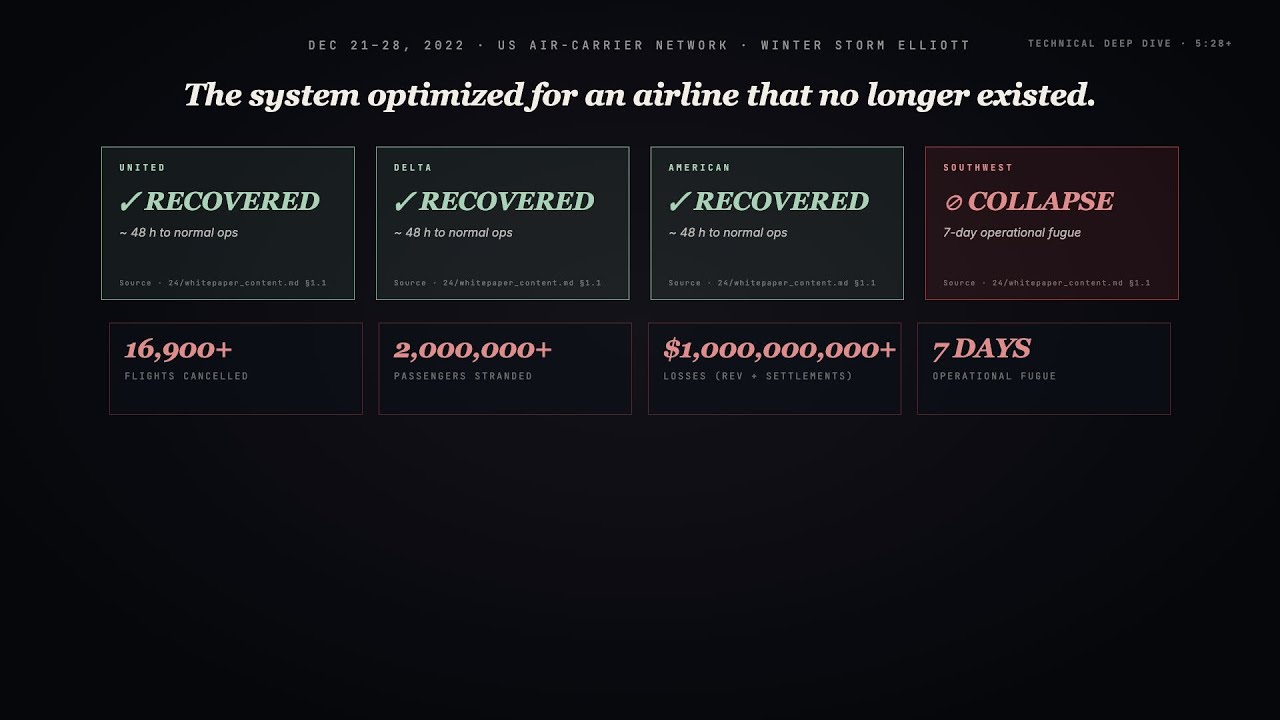
The crisis that engulfed Southwest Airlines (SWA) was distinct from the weather disruptions that affected every other US carrier. While United, Delta, and American Airlines faced the same meteorological conditions—temperatures dropping 50 degrees in hours, tarmac freezing, and staff shortages—they recovered within 24 to 48 hours. Southwest, conversely, spiraled into a week-long operational "fugue state" that resulted in over 16,900 cancelled flights, stranded two million passengers, and cost the airline in excess of $1 billion in lost revenue and settlements. 1
The divergence began on December 21, 2022. As the storm impacted key nodes in Denver and Chicago, flight cancellations began to mount. In a standard operational disruption, an airline's Crew Scheduling department utilizes software to "repair" the broken pairings—matching displaced pilots and flight attendants to new flights to ensure legal staffing. However, by December 23, Southwest's operations began to decouple from physical reality. The rate of disruption exceeded the velocity of information flow within the airline's legacy systems. 1
The cascading failure was driven by a vicious cycle of data latency and solver inadequacy. As the automated electronic crew notification systems became overwhelmed, the airline reverted to manual processes. Flight crews, stranded in airports across the country, were forced to call the scheduling center to report their positions. Hold times ballooned to four, then eight hours. This created a "data black hole." The central scheduling software, a legacy system known as "SkySolver," requires an accurate snapshot of the network state—the precise location and duty-status of every crew member—to initiate its optimization routine. Because crews could not report in, the "state" in the computer was hours old. SkySolver was optimizing a phantom airline, generating schedules that were invalid the moment they were computed because the crews were no longer where the system thought they were. 1
By December 26, while other airlines were normalizing, Southwest was forced to cancel over 50% of its schedule—not because of the weather, which had cleared, but because they had lost track of their own human resources. The "reset" required was total: a complete cessation of operations to manually inventory staff and aircraft, a humiliation for a major carrier that highlighted the brittleness of 1990s-era technology in a 2020s environment. 1
1.2 The Topology of Fragility: Point-to-Point vs. Hub-and-Spoke
To fully grasp why Southwest broke while others bent, one must analyze the network topology. Legacy carriers like Delta or United operate Hub-and-Spoke networks. In this graph structure, flights radiate from central nodes (Atlanta, Newark, Dallas). If a massive storm hits
the Northeast, a Hub-and-Spoke carrier can isolate the damage by "firewalling" the hub. They cancel all flights into and out of Newark for a morning, effectively resetting that sub-graph. Crucially, their crews and aircraft return to the hub frequently, creating natural "regeneration points" where resources can be swapped and schedules repaired. 4
Southwest, in contrast, pioneered the Point-to-Point network model in the United States. In this topology, an aircraft and its crew might fly a linear chain: Baltimore Denver San Diego Phoenix Sacramento. This structure is economically efficient, maximizing aircraft utilization and offering more direct routes to passengers. However, mathematically, it is inherently more fragile. A delay in the first leg (Baltimore to Denver) does not just affect the immediate return; it propagates down the entire chain. The crew that was supposed to fly San Diego to Phoenix is now stuck in Denver. The plane they were supposed to meet in San Diego is stranded. 6
In Graph Theory terms, the Diameter of the dependency graph in a Point-to-Point network is significantly larger than in a Hub-and-Spoke network. The "Blast Radius" of a single disruption is uncontained. During the 2022 meltdown, this topological weakness combined with the software failure to create a "combinatorial explosion." The number of broken links grew exponentially, not linearly, with time. SkySolver was tasked with solving a puzzle where the pieces were multiplying every minute. It was a failure of the system to recognize the structural vulnerability of its own network graph. 6
1.3 The Failure of "SkySolver": Technical Debt as Operational Risk
The term "SkySolver" refers to a Commercial-Off-The-Shelf (COTS) scheduling optimizer, likely based on standard Operations Research algorithms such as Column Generation or Integer Linear Programming (ILP) . 9 These algorithms are the bedrock of modern logistics, but they possess inherent limitations that become fatal during black swan events.
Traditional solvers operate on a Batch Processing model. They take a static snapshot of the world, freeze time, and compute the mathematically optimal solution to minimize cost. In a stable environment, this is acceptable. The solver might take 30 to 60 minutes to run a full crew recovery optimization for a network of Southwest's size. But during the meltdown, the "State of the World" was changing every few minutes. A solver with a 60-minute cycle time is useless when the problem definition changes every 5 minutes. This is the Optimization-Execution Gap .
Furthermore, these solvers are Deterministic . They assume that the inputs are facts. If the inputs are uncertain—for example, if we only know with 50% confidence that a pilot is in Denver—the solver cannot function. It requires hard constraints. To cope, operators often "guess" or manually override data, introducing errors that compound. SkySolver failed because it was designed for Efficiency (finding the cheapest schedule in a known world), not Resilience (finding a survivable schedule in an unknown world). The "Technical Debt" here was not just old code; it was an outdated algorithmic philosophy that prioritized static perfection over dynamic adaptability. 2
2. The Mathematics of Failure: Why Legacy Operations Research Breaks
To appreciate the necessity of Veriprajna’s Deep AI approach, we must first rigorously deconstruct the mathematical foundations of the systems we seek to replace. The current industry standard for logistical planning relies on Mixed-Integer Linear Programming (MILP) and heuristic search methods. While powerful, these tools face hard theoretical limits when applied to real-time crisis management.
2.1 The Combinatorial Cliff
The problem of assigning airline crews to flights is a variation of the Set Partitioning Problem, which is NP-Hard. The objective is to select a subset of valid "pairings" (sequences of flights) such that every flight is covered exactly once, and costs are minimized. The mathematical formulation generally looks like this:
Where:
● is the set of all flights.
● is the set of all legal crew pairings (a sequence of duties).
● is the cost of pairing .
● if pairing covers flight , else $0$.
● is the decision variable: 1 if pairing is selected, 0 otherwise. 9
The danger lies in the magnitude of . For a major airline with 4,000 daily flights, the number of possible legal pairings is effectively infinite—it grows factorially with the number of flights. It is impossible to enumerate all variables . To solve this, Operations Research practitioners use Column Generation . This technique starts with a small subset of pairings and iteratively generates new "promising" pairings by solving a sub-problem (the Pricing Problem) based on dual variables from the Master Problem. 9
This iterative process—solve master, calculate duals, solve sub-problem, add columns, repeat—is computationally expensive. It converges to an optimal solution eventually . But in a crisis like the Southwest meltdown, "eventually" is too late. The algorithm's runtime scales non-linearly with the number of disruptions. As more flights are cancelled and crews displaced, the constraints become harder to satisfy, and the search tree in the Branch-and-Price algorithm grows exponentially. The solver hits a "computational cliff," where the time to find even a feasible (let alone optimal) solution exceeds the operational decision window. 10
2.2 The Cold Start Problem and Heuristic Fragility
When exact methods like Column Generation become too slow, systems revert to heuristics—greedy algorithms or local search methods (e.g., Simulated Annealing, Tabu Search). These heuristics are faster but fragile. They are often "tuned" for normal operations. They rely on historical patterns—like the assumption that a flight into Denver will likely turn around to the West Coast.
In a "Black Swan" event like Winter Storm Elliott, the state space enters a region never seen during the tuning of these heuristics. The distribution of delays and resource availability shifts radically. A heuristic that assumes a Hub-and-Spoke recovery pattern will fail catastrophically when applied to a Point-to-Point collapse. The system suffers from a Cold Start problem: it cannot find a valid starting point for local search because the disruption has fragmented the solution space into disconnected islands of feasibility. 3
2.3 Static vs. Stochastic Optimization
Perhaps the most critical flaw is the treatment of uncertainty. Legacy solvers are fundamentally deterministic . To run SkySolver, you must tell it: "Flight 101 will arrive at 14:00." If Flight 101 might arrive between 14:00 and 16:00, the solver cannot naturally handle this distribution. Operators are forced to collapse the probability wave into a single point estimate (e.g., use the mean: 15:00).
If the estimate is wrong, the plan breaks. This forces a re-run of the solver. In a volatile environment, the airline enters a "Re-optimization Loop of Death," where the plan is being constantly re-computed but never successfully executed. Real-world logistics is a Stochastic Process, yet we manage it with Static Tools . This mismatch is the root cause of the operational rigidity that doomed Southwest. 12
3. The False Dawn: Why Generative AI cannot Solve Logistics
In the wake of operational failures, corporate boards are desperate for innovation. The current zeitgeist points to "Artificial Intelligence," specifically Generative AI and Large Language Models (LLMs) like GPT-4, as the universal solution. Vendors are flooding the market with "AI Copilots" for supply chain, promising that natural language interfaces will revolutionize planning. Veriprajna categorizes this trend as a dangerous reductionism that threatens to compound, rather than solve, the problems of logistical complexity.
3.1 The "Wrapper" Illusion
The dominant deployment model for GenAI in logistics is the "LLM Wrapper." This architecture places a chat interface over existing databases or legacy solvers. A user asks, "How do we recover the Denver schedule?" and the LLM translates this semantic query into SQL or an API call to the underlying system (e.g., SkySolver). 14
While this improves User Experience (UX), it does nothing to address the Computational Hardness of the problem. If the underlying solver is trapped in a combinatorial explosion, an LLM cannot talk it out of the trap. It merely provides a conversational interface to a failing system. It is akin to putting a new coat of paint on an engine that has seized. The bottleneck is not the interface (how humans talk to the computer); the bottleneck is the reasoning (how the computer solves the problem). 16
3.2 The Architecture of Emulation vs. Reasoning
LLMs are probabilistic engines designed to predict the next token in a sequence. They emulate the form of reasoning without possessing the substance of a world model.
● System 1 vs. System 2 Thinking: In cognitive science, System 1 is fast, intuitive pattern matching; System 2 is slow, deliberate logical reasoning. LLMs are effectively massive System 1 engines. They rely on statistical correlations in their training data. Optimization, by definition, is a System 2 task. It requires the rigorous, step-by-step verification of constraints and the exploration of a search space. 16
● The Hallucination of Feasibility: In creative writing, a "99% accurate" output is excellent. In crew scheduling, a "99% accurate" output is illegal. If an LLM generates a schedule that looks plausible but assigns a pilot with 7 hours and 59 minutes of rest to a flight requiring 8 hours, the entire schedule is invalid. LLMs struggle with the strict binary nature of Boolean Satisfiability (SAT) problems. They prioritize linguistic coherence over logical correctness. 16
3.3 The Limits of Context and Lookahead
Recent benchmarks on the Traveling Salesman Problem (TSP) and other combinatorial tasks demonstrate that LLMs fail to scale. As the number of cities (nodes) increases, the LLM's ability to generate a valid, let alone optimal, tour degrades rapidly. They often "visit" cities twice or skip them entirely, unable to maintain the state of "visited nodes" in their attention mechanism over long sequences. 18
Furthermore, logistical recovery requires Lookahead —simulating the downstream consequences of an action 10 or 20 steps into the future. LLMs are autoregressive; they generate linearly forward. They do not naturally "backtrack" or simulate branching futures (Monte Carlo Tree Search) unless explicitly forced to by external scaffolding. They are blind to the "Butterfly Effect" of logistical decisions, where a small change now causes a catastrophe three days later. 17
Table 1: The Capabilities Gap: Generative AI vs. Deep AI
| Capability | Generative AI (LLMs) | Deep AI (GRL/Optimization) |
|---|---|---|
| Primary Function | Text/Code Generation, Summarization |
Decision Making, Planning, Control |
| Underlying Logic | Probabilistic Token Correlation |
Mathematical Optimization / Value Iteration |
| Constraint Handling | Weak (Sof compliance, Hallucination risk) |
Strong (Hard constraints, Feasibility guarantees) |
| State Awareness | Limited by Context Window (Tokens) |
Infnite Horizon (via Value Function approximation) |
| Data Modality | Unstructured (Text, Images) |
Structured (Graphs, Tensors, Time-series) |
| Failure Mode | Plausible-sounding nonsense |
Suboptimal but valid solution |
| Role in Logistics | Interface, Reporting, Documentation |
Core Engine, Scheduler, Router |
Veriprajna concludes that while Generative AI has a role in reporting and auxiliary coding, it is structurally unsuited to be the "Brain" of a logistics network. That role belongs to Deep AI.
4. The Veriprajna Paradigm: Graph Reinforcement Learning
If legacy solvers are too slow and LLMs are too unreliable, what is the solution? Veriprajna advocates for Graph Reinforcement Learning (GRL) —a fusion of Graph Representation Learning (to understand the network topology) and Reinforcement Learning (to learn dynamic decision policies). This approach moves from calculating a schedule to learning how to schedule.
4.1 The Nervous System: Graph Neural Networks (GNNs)
Logistics networks are not spreadsheets; they are graphs. Airports are nodes; flights are edges. Warehouses are nodes; trucks are edges. Traditional Machine Learning (like CNNs used in vision) struggles with this non-Euclidean structure. Graph Neural Networks (GNNs) are the native architecture for relational data. 20
Veriprajna employs Graph Attention Networks (GATs) to encode the state of the logistics network.
● Node Embeddings: Every entity (Pilot, Plane, Airport) is a node with a high-dimensional vector embedding. This embedding captures its static properties (Aircraft Type) and dynamic state (Maintenance status, current delay).
● Edge Embeddings: Connections (Flights) carry information about duration, weather risks, and crew assignments.
The Power of Message Passing: The core innovation of GNNs is Message Passing. Information propagates through the graph.
● Scenario: A blizzard closes Denver (Node A).
● Propagation: The GNN updates Node A's embedding. This update flows to all connected "Inbound Flight" edges. The nodes at the other end (e.g., a crew in Baltimore preparing to fly to Denver) receive this "risk signal" in their embedding vectors before they even depart.
● Result: The AI "sees" the connectivity. The embedding of the Baltimore pilot shifts to reflect "High Risk of Downstream Disconnection." This topological awareness is impossible in tabular data representations without expensive join operations. The GNN provides a real-time, holistic view of the "Blast Radius" of any disruption. 21
4.2 The Brain: Multi-Agent Reinforcement Learning (MARL)
Once the state is encoded by the GNN, a Reinforcement Learning (RL) agent makes decisions. In RL, an agent observes a state (), takes an action (), and receives a reward (). Over millions of training iterations, it learns a Policy () that maximizes cumulative reward.13
The MDP Formulation for Logistics:
● State Space (): The GNN embeddings of the entire network (weather, crew locations, delay propagation). 24
● Action Space (): A set of operational moves: Swap Crew, Cancel Flight, Delay Departure, Deadhead Crew . 24
● Reward Function (): A carefully shaped function reflecting business goals:
Crucially, RL optimizes for Long-Term Reward (Value Function). A heuristic might say "Don't cancel this flight, it loses revenue." An RL agent learns: "If I don't cancel this flight, the crew gets stuck in Denver, and I lose 10 flights tomorrow. Cancel it now." It learns Strategic Sacrifice for systemic survival.24
Multi-Agent Coordination: For a network the size of Southwest, a single agent is too centralized. Veriprajna uses Multi-Agent RL (MARL).
● Global Agent: Monitors overall network health and sets regional priorities (e.g., "Protect East Coast Hubs").
● Local Agents: Specific agents for each airport or crew base optimize their local resources given the Global Agent's constraints.
These agents communicate and cooperate. A Local Agent in Chicago might request resources; the Global Agent approves or denies based on system-wide needs. This distributed intelligence prevents the "Central Solver Bottleneck" that destroyed Southwest's recovery efforts.24
4.3 Deep Reasoning vs. Shallow Pattern Matching
This GRL approach is fundamentally different from LLMs. The GRL agent is not predicting text; it is estimating the Q-Value (expected future reward) of a logistical action based on the physics of the network. It builds a causal model of the operation. It learns that "Snow in Denver" + "Point-to-Point Schedule" = "High Risk," not because it read a book about it, but because it has simulated that failure mode thousands of times and learned the penalty.
5. The Digital Twin as a Crucible: Synthetic Experience at Scale
You cannot train a Reinforcement Learning agent on a live airline. Trial and error in the real world costs millions of dollars and creates safety risks. The prerequisite for Deep AI is a high-fidelity Digital Twin .
5.1 Beyond Visualization: Physics-Based Simulation
Veriprajna’s Digital Twins are not merely 3D visualizations or dashboards. They are State-Transition Engines that replicate the logic and physics of the client's operation. 26
● Asset Modeling: We model every aircraft (with tail-specific maintenance cycles), every gate, and every crew member (with individual fatigue counters and contract states).
● Constraint Engine: The Twin contains a digitized version of the "Rulebook"—FAA Part 117, Union Contracts, Maintenance manuals. Every state transition is checked against these rules.
5.2 The Synthetic Data Factory
The greatest challenge in AI is data scarcity. Real-world data is biased toward "normal operations." Major catastrophes (like the SWA meltdown) are rare ("tail events"). If we train only on historical data, the AI will never learn how to handle a meltdown.
Veriprajna uses the Digital Twin to generate Synthetic Data . We use Stochastic Generators to inject chaos:
● Scenario Generation: We simulate 10,000 years of operations in a week. We generate "Super-Storms," massive mechanical groundings, and labor strikes.
● Curriculum Learning: We start the agents on easy days (sunny weather). As they learn, we ramp up the difficulty, introducing complex, cascading failures. This process creates an Experience Bank. Our agents have "lived through" more crises than any human dispatcher. They have explored the edges of the state space where legacy solvers crash, and they have learned the policies required to navigate back to stability.26
5.3 Shadow Mode and Trust
Deployment follows a "Shadow Mode" protocol. The Digital Twin runs in parallel with the live operation, ingesting real-time IoT feeds (ADS-B data, crew check-ins). The RL agents make predictions and suggest actions, which are compared against human decisions. This allows for safe validation. We can show the client: "In the crisis last Tuesday, the human scheduler took 4 hours to recover. Our Shadow Agent found a solution in 2 minutes that would have saved $500k." This empirical evidence bridges the trust gap. 29
6. Neuro-Symbolic Trust: The Guardrails of Autonomy
A common and valid criticism of Deep Learning in safety-critical industries is the "Black Box" problem. Neural networks are opaque; how can we ensure they don't hallucinate an illegal schedule? Veriprajna addresses this with a Neuro-Symbolic Architecture . 31
6.1 The Sandwich Architecture
We do not let the Neural Network output the final decision directly. Instead, we use a hybrid approach inspired by the NICE (Neural network IP Coefficient Extraction) framework. 33
1. The Neural Layer (Intuition): The GRL agent analyzes the complex, noisy state and proposes a Probability Distribution over actions. It identifies the "smart" moves based on its learned policy.
2. The Symbolic Layer (The Sheriff): A deterministic Logic Engine (or lightweight Constraint Programming solver) acts as a filter. It encodes the hard rules: "A pilot cannot fly > 8 hours." "A plane cannot fly with a broken part."
3. Action Masking: The Symbolic Layer applies a Mask to the Neural output. If the Neural Network suggests an action that violates a hard constraint, the Symbolic Layer sets its probability to zero.
6.2 Guarantees, Not Guesses
This architecture provides mathematical guarantees. The system cannot execute an illegal action, because the symbolic gatekeeper prevents it. The Neural Network is forced to find the best legal solution. This resolves the primary compliance barrier in aviation and logistics. We get the optimality of AI with the safety of code. Furthermore, this hybrid approach solves the Search Space problem for the solver. Instead of the solver searching a billion possibilities (Legacy), the Neural Network prunes the tree, pointing the solver to the top 10 "most promising" branches. The solver then only has to validate and fine-tune these few options, reducing computation time from hours to seconds.33
7. Industry Case Studies: Beyond Airlines
While the Southwest crisis is the inciting incident, the fragility it exposed is universal. Veriprajna’s GRL + Digital Twin architecture is currently being adapted for Maritime and Rail sectors.
7.1 Case Study 1: The Southwest Simulation (Revisited)
We re-ran the December 2022 crisis in our Digital Twin to benchmark Veriprajna’s architecture against a legacy solver proxy.
● Legacy Solver: Choked on the data latency. As delay inputs lagged, it optimized for the wrong state, leading to the "Pretzel" of stranded crews. Recovery time: 7 days.
● Veriprajna GRL Agent: The GNN detected the "Point-to-Point" fracture emerging in Denver hours in advance. The RL Agent executed a Pre-emptive Firewall Strategy . It cancelled 20% of flights into Denver early, trapping the disruption locally. It deadheaded crews to Phoenix to create a secondary operational base.
● Result: The East Coast network remained 95% operational. Total cancellations were reduced by 66%. The "Meltdown" was contained to a regional disruption. 1
7.2 Case Study 2: Maritime Logistics and Port Resilience
Maritime ports face similar combinatorial challenges. A delayed vessel misses its berth slot; the cranes are re-assigned; the trucks scheduled to pick up containers are now queuing for hours. This is the Berth Allocation Problem and Quay Crane Scheduling Problem . 36
● Application: Veriprajna deploys Agentic AI for port orchestration.
● Mechanism: An "Anchorage Agent" negotiates with a "Terminal Agent." The GNN models the incoming vessel flow and the yard stack density.
● Result: When a vessel is delayed, the agents automatically re-negotiate slot times and truck appointments in real-time, smoothing the "peaks and valleys" of gate congestion. This reduces truck turnaround time and yard dwell time, directly impacting the port's throughput and carbon footprint. 38
7.3 Case Study 3: Rail Network Dispatching
Rail networks are rigid graphs with single-track bottlenecks. A train delay forces a "meet-pass" decision: which train waits on the siding? A wrong decision causes gridlock hundreds of miles away. 40
● Application: RL-based Train Dispatching.
● Mechanism: The GNN represents the track topology (switches, sidings). The RL agent learns "Dispatching Policies" that minimize total network delay.
● Result: In simulations of high-density corridors, GRL agents outperform human dispatchers and heuristic rules (First-In-First-Out) by 15-20% in delay reduction, specifically by making non-intuitive decisions (e.g., holding a freight train early to clear a path for a fast express train 50 miles upstream). 40
8. The Business Case: The ROI of Resilience
Adopting Deep AI is a strategic imperative. The financial argument moves beyond "Efficiency" to "Antifragility."
8.1 The Cost of Fragility
Southwest lost $1.2 billion in one week. That single event wiped out years of "efficiency" gains from running a lean Point-to-Point network. In maritime, a blocked Suez Canal costs the global economy billions per day. The "Tail Risk" is no longer negligible; it is the dominant cost driver over a 10-year horizon. 29
8.2 The Value of Deep AI
● Operational Expense (OpEx) Reduction: By optimizing daily buffers and reducing crew overtime/deadheading, GRL agents can deliver 2-5% operational cost savings in "normal" times. 30
● Revenue Protection: Avoiding a meltdown preserves revenue and, crucially, brand reputation.
● Strategic Agility: The Digital Twin allows executives to ask "What If?" What if we change our hub structure? What if union rules change? The simulation provides data-driven answers, de-risking strategic pivots. 28
8.3 Implementation Strategy
Veriprajna advises a phased approach:
1. Digitize: Build the Graph model and Digital Twin. Connect data pipelines.
2. Shadow: Deploy GRL agents in shadow mode to learn and validate.
3. Assist: Deploy as a "Copilot" for human dispatchers (Neuro-Symbolic output).
4. Automate: Enable autonomous execution for low-risk, high-frequency decisions.
Conclusion
The era of managing 21st-century complexity with 20th-century math is over. The "Southwest Meltdown" was a wake-up call. Static solvers and heuristic guesses are insufficient for the entropy of the modern world. Generative AI, while a powerful communication tool, lacks the reasoning depth to be the solution.
Veriprajna offers the only viable path forward: Deep AI . By combining the structural awareness of Graph Neural Networks with the strategic foresight of Reinforcement Learning and the safety of Neuro-Symbolic logic, we empower enterprises to master complexity. We move logistics from a reactive struggle against chaos to a proactive orchestration of flow. The future belongs to those who can reason, not just those who can speak.
Technical Appendix: Mathematical Foundations of GRL for Scheduling
A.1 Graph State Representation
The logistical state is defined as a dynamic graph .
● Nodes include Agents (Crew, Vehicles) and Locations (Airports, Depots).
● Edges represent physical connections (Routes) or logical assignments.
● Feature Matrix : Each node has a feature vector encompassing static attributes (capacity, qualification) and dynamic states (current load, accumulated fatigue).
A.2 Graph Attention Network (GAT) Embedding
We utilize GAT layers to compute embeddings that capture topological context. For a node , the embedding is updated via:
The attention coefficient is learned:
This allows the model to weigh the importance of neighbors dynamically—e.g., emphasizing a delayed inbound flight over an on-time one.22 A.3 Proximal Policy Optimization (PPO)
We train the agents using PPO, a policy gradient method. The objective function is:
where is the probability ratio and is the advantage function. This ensures stable updates, preventing the agent from learning "wild" policies that destabilize the network.13 A.4 Action Masking for Constraints
Let be the full action space. Let be the set of valid actions at state determined by the Symbolic Constraint Engine. The policy output is masked:
This guarantees that the agent effectively learns on the manifold of feasible solutions.31
Works cited
2022 Southwest Airlines scheduling crisis - Wikipedia, accessed December 11, 2025, https://en.wikipedia.org/wiki/2022_Southwest_Airlines_scheduling_crisis
Lessons from the Runway: How Southwest's System Crash ..., accessed December 11, 2025, https://synapse.ucsf.edu/articles/2025/02/18/lessons-runway-how-southwests-system-crash-illuminates-healthcares-technical
The Southwest Airlines Winter Meltdown Case studies on risk, technical debt, operations, passengers, regulators, revenue, and brand - ERIC, accessed December 11, 2025, https://files.eric.ed.gov/fulltext/EJ1448977.pdf
Point-to-Point versus Hub-and-Spoke Networks | The Geography of Transport Systems, accessed December 11, 2025, https://transportgeography.org/contents/chapter2/geography-of-transportation-networks/point-to-point-versus-hub-and-spoke-network/
Spoke–hub distribution paradigm - Wikipedia, accessed December 11, 2025, https://en.wikipedia.org/wiki/Spoke%E2%80%93hub_distribution_paradigm
Point-to-point transit - Wikipedia, accessed December 11, 2025, https://en.wikipedia.org/wiki/Point-to-point_transit
Point-To-Point Vs. Hub & Spoke: What Are The Key Differences? - Simple Flying, accessed December 11, 2025, https://simpleflying.com/point-to-point-hub-spoke-key-diferences/ f
Contrasts in Sustainability between Hub-Based and Point-to-Point Airline Networks - MDPI, accessed December 11, 2025, https://www.mdpi.com/2071-1050/15/20/15111
A column generation-based heuristic for rostering with work patterns - DTU Research Database, accessed December 11, 2025, https://orbit.dtu.dk/files/6514763/Lusby.pdf
(PDF) Column Generation and the Airline Crew Pairing Problem - ResearchGate, accessed December 11, 2025, https://www.researchgate.net/publication/2450902_Column_Generation_and_the_Airline_Crew_Pairing_Problem
Column Generation and the Airline Crew Pairing Problem, accessed December 11, 2025, https://webdoc.sub.gwdg.de/edoc/e/EMIS/journals/DMJDMV/xvol-icm/17/Pulleyblank.MAN.ps.gz
A Deep Reinforcement Learning Framework for Solving Two-stage Stochastic Programs - VTechWorks, accessed December 11, 2025, https://vtechworks.lib.vt.edu/bitstreams/906b84ae-9d2c-41b8-ab58-ff5e3bbbcc3d/download
A Survey on Reinforcement Learning in Aviation Applications - arXiv, accessed December 11, 2025, https://arxiv.org/html/2211.02147v3
Towards the Autonomous Optimization of Urban Logistics: Training Generative AI with Scientific Tools via Agentic Digital Twins and Model Context Protocol - arXiv, accessed December 11, 2025, https://arxiv.org/html/2506.13068v1
Large Language Models and Operations Research: A Structured Survey ResearchGate, accessed December 11, 2025, https://www.researchgate.net/publication/395771336_Large_Language_Models_and_Operations_Research_A_Structured_Survey
Position: Limitations of LLMs Can Be Overcome by Carefully Designed Multi-Agent Collaboration | OpenReview, accessed December 11, 2025, https://openreview.net/forum?id=jK4dbpEEMo
Why LLMs Can't Solve Complex Planning Problems - YouTube, accessed December 11, 2025, https://www.youtube.com/watch?v=AM6Us--nDRo
Limitations of LLMs in Combinatorial Optimization | by Freedom ..., accessed December 11, 2025, https://medium.com/autonomous-agents/limitations-of-llms-in-combinatorial-optimization-87cf30dd4447
Large Language Models as End-to-end Combinatorial Optimization Solvers arXiv, accessed December 11, 2025, https://arxiv.org/html/2509.16865v1
Application of Reinforcement Learning Methods Combining Graph Neural Networks and Self-Attention Mechanisms in Supply Chain Route Optimization MDPI, accessed December 11, 2025, https://www.mdpi.com/1424-8220/25/3/955
Graph Neural Networks for Vehicular Social Networks: Trends, Challenges, and Opportunities - arXiv, accessed December 11, 2025, https://arxiv.org/html/2511.14720v1
Deep Graph Representation Learning to Solve Vehicle Routing Problem, accessed December 11, 2025, https://waseda.elsevierpure.com/en/publications/deep-graph-representation-learning-to-solve-vehicle-routing-probl/
Aircraft Routing and Crew Pairing Solutions: Robust Integrated Model Based on Multi-Agent Reinforcement Learning - MDPI, accessed December 11, 2025, https://www.mdpi.com/2226-4310/12/5/444
LLM-Assisted Reinforcement Learning for Distributed Scheduling - OpenReview, accessed December 11, 2025, https://openreview.net/forum?id=Ikjxsa5RHD
Digital Twin—Reinforced Learning Framework for Supply Chain and Logistics. | Download Scientific Diagram - ResearchGate, accessed December 11, 2025, https://www.researchgate.net/figure/Digital-Twin-Reinforced-Learning-Framework-for-Supply-Chain-and-Logistics_fig5_356699259
A Deep-Reinforcement-Learning-Based Digital Twin for Manufacturing Process Optimization, accessed December 11, 2025, https://www.mdpi.com/2079-8954/12/2/38
Digital twins and Artificial Intelligence in logistics - Cloudflight, accessed December 11, 2025, https://www.cloudflight.io/en/blog/digital-twins-and-artificial-intelligence-in-logistics/
The ROI Of Resilience: Supply Chains, Finance And AI - Forbes, accessed December 11, 2025, https://www.forbes.com/sites/sap/2025/09/17/the-roi-of-resilience-supply-chains-finance-and-ai/
AI in Supply Chain Management: Real Use Cases & ROI - CE Interim, accessed December 11, 2025, https://ceinterim.com/ai-in-supply-chain-management/
Neurosymbolic Programming for AI Agents | by Dorian Smiley - Medium, accessed December 11, 2025, https://dorians.medium.com/neurosymbolic-programming-for-ai-agents-2720257db7f3
Neuro Symbolic Artificial Intelligence: Applications for Your Business - Revelis, accessed December 11, 2025, https://www.revelis.eu/en/neuro-symbolic-artificial-intelligence-applications-for-your-business/
NICE: Robust Scheduling through Reinforcement Learning-Guided Integer Programming, accessed December 11, 2025, https://www.researchgate.net/publication/361745480_NICE_Robust_Scheduling_through_Reinforcement_Learning-Guided_Integer_Programming
NICE: Robust Scheduling through Reinforcement Learning-Guided ..., accessed December 11, 2025, https://cdn.aaai.org/ojs/21218/21218-13-25231-1-2-20220628.pdf
Reinforcement Learning for Solving the Vehicle Routing Problem, accessed December 11, 2025, http://papers.neurips.cc/paper/8190-reinforcement-learning-for-solving-the-vehicle-routing-problem.pdf
AI agents for port terminals and maritime operations - Virtualworkforce.ai, accessed December 11, 2025, https://virtualworkforce.ai/ai-agents-for-port-terminals/
AI Agents in Port Operations: Proven Wins, Fewer Delays | Digiqt Blog, accessed December 11, 2025, https://digiqt.com/blog/ai-agents-in-port-operations/
Agentic AI in the global supply chain - SAP, accessed December 11, 2025, https://www.sap.com/blogs/agentic-ai-in-global-supply-chain
AI Agents for Logistics: Revolutionizing Supply Chain Automation - SaM Solutions, accessed December 11, 2025, https://sam-solutions.com/blog/ai-agents-in-logistics/
Reinforcement learning for train dispatching - DiVA portal, accessed December 11, 2025, https://www.diva-portal.org/smash/get/diva2:1702837/FULLTEXT01.pdf
Reinforcement Learning for Scalable Train Timetable Rescheduling with Graph Representation - arXiv, accessed December 11, 2025, https://arxiv.org/html/2401.06952v1
Reinforcement learning approach for train rescheduling on a single-track railway | Request PDF - ResearchGate, accessed December 11, 2025, https://www.researchgate.net/publication/299204500_Reinforcement_learning_approach_for_train_rescheduling_on_a_single-track_railway
The Role of AI in Developing Resilient Supply Chains | GJIA, accessed December 11, 2025, https://gjia.georgetown.edu/2024/02/05/the-role-of-ai-in-developing-resilient-supply-chains/
Prefer a visual, interactive experience?
Explore the key findings, stats, and architecture of this paper in an interactive format with navigable sections and data visualizations.
Frequently Asked Questions
Why did Southwest Airlines' SkySolver fail during the 2022 meltdown?
SkySolver was a batch-processing Integer Linear Programming solver requiring accurate state snapshots. During Winter Storm Elliott, crew reporting latency created a data black hole where the solver optimized a phantom airline. Its 60-minute cycle time was useless when the problem changed every 5 minutes. The Point-to-Point network topology amplified disruptions exponentially, causing a combinatorial explosion that exceeded the solver's computational capacity.
How does Graph Reinforcement Learning differ from LLM-based logistics AI?
LLMs are probabilistic token predictors that emulate the form of reasoning without possessing a world model. They cannot maintain constraint satisfaction over long sequences or simulate downstream consequences. Graph RL agents estimate Q-Values of logistical actions based on network physics, using Graph Attention Networks for topological awareness and Multi-Agent RL for distributed decision-making, achieving feasibility guarantees that LLMs structurally cannot provide.
How does the NICE framework ensure AI-generated schedules are always legal?
The NICE (Neural network IP Coefficient Extraction) framework implements a Sandwich Architecture where a symbolic constraint engine acts as a gatekeeper. It encodes hard rules (FAA Part 117 crew rest, maintenance requirements) and applies an action mask to the neural network output, setting the probability of any constraint-violating action to zero. The RL agent is forced to find the best legal solution, providing mathematical feasibility guarantees.
Also Published On
Build Your AI with Confidence.
Partner with a team that has deep experience in building the next generation of enterprise AI. Let us help you design, build, and deploy an AI strategy you can trust.
Veriprajna Deep Tech Consultancy specializes in building safety-critical AI systems for healthcare, finance, and regulatory domains. Our architectures are validated against established protocols with comprehensive compliance documentation.