Deep AI, Graph Reinforcement Learning, and the Architecture of Antifragile Logistics
The catastrophic Southwest Airlines meltdown of December 2022 wasn't just a bad week—it was a structural warning signal. Legacy optimization systems, built on mid-20th-century mathematics, collapsed under combinatorial explosion when faced with real-world chaos.
Veriprajna demonstrates why the future of logistics lies not in chatbots that can explain a schedule, but in Deep AI agents that can repair one. This whitepaper is a technical manifesto for Graph Reinforcement Learning, Digital Twins, and Neuro-Symbolic guardrails.
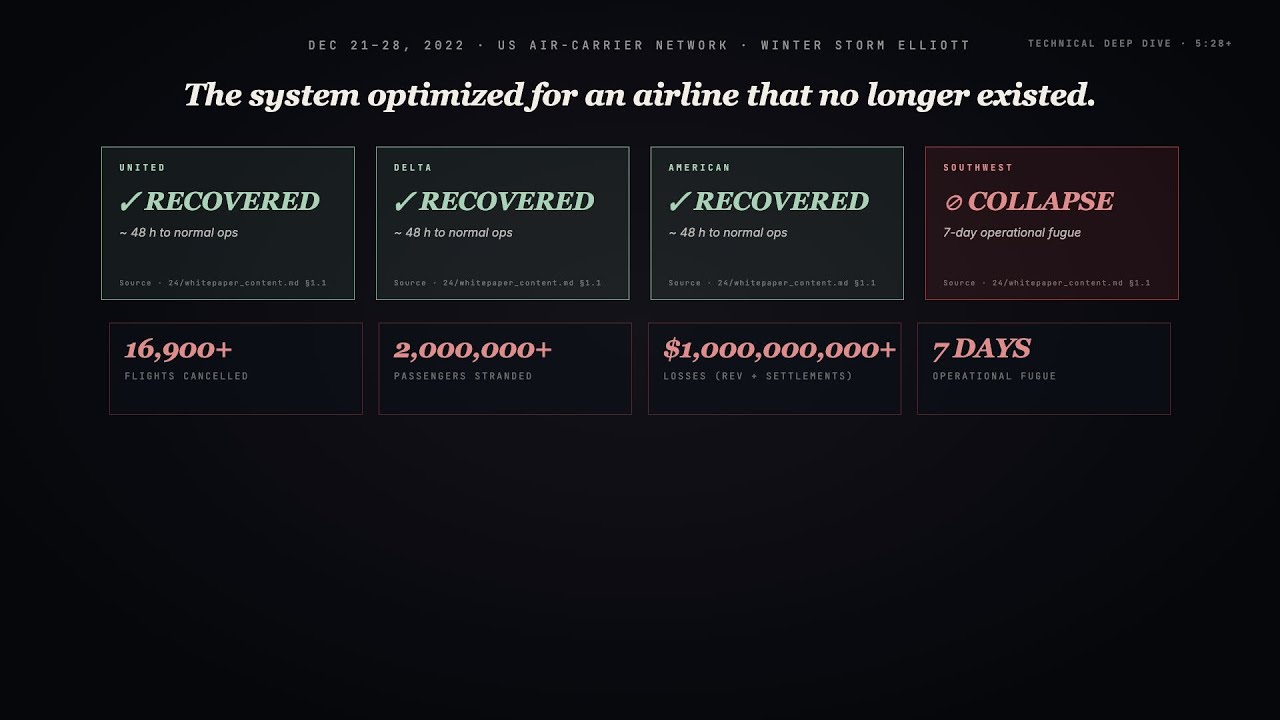
December 21-26, 2022: While other carriers recovered in 48 hours, Southwest canceled 16,900 flights and stranded 2 million passengers. This wasn't a weather problem—it was a computational failure.
Crews stranded in airports couldn't report their locations. Hold times: 8 hours. SkySolver optimized a phantom airline—the system's "state" was hours old, generating invalid schedules.
Southwest's Point-to-Point network: efficient but fragile. Hub-and-Spoke carriers isolated damage; Southwest's delays cascaded exponentially due to larger graph diameter.
Column Generation runtime scales non-linearly with disruptions. As broken pairings multiplied, the solver hit a "computational cliff"—unable to find even a feasible solution.
"By December 26, while other airlines were normalizing, Southwest canceled over 50% of its schedule—not because of weather, which had cleared, but because they had lost track of their own human resources. The 'reset' required total cessation of operations."
— Veriprajna Technical Analysis, 2024
Southwest's Point-to-Point model creates long dependency chains. A single delay cascades through the entire sequence with no natural "reset points."
Advantage: Failures are isolated. Hub "firewalls" the disruption.
Vulnerability: Linear chains propagate delays exponentially.
Why legacy Operations Research breaks under crisis conditions.
Crew scheduling is a Set Partitioning Problem (NP-Hard). For 4,000 flights, possible legal pairings grow factorially. Column Generation iterates to find solutions, but runtime explodes during crises.
Heuristics (Simulated Annealing, Tabu Search) are tuned for "normal" operations. Black swan events shift the state space into regions never seen during tuning—heuristics fail catastrophically.
Legacy solvers are deterministic—they require exact inputs. Real logistics is stochastic. Operators collapse probability distributions into point estimates, which break, forcing re-optimization loops.
As disruption rate increases, legacy solvers hit computational cliff. GRL agents degrade gracefully.
The current hype conflates linguistic fluency with operational reasoning. This is a dangerous category error.
Dominant deployment: LLM as chat interface over legacy solvers. User asks "How do we recover Denver?" LLM translates to SQL/API call.
This improves UX, not computation. If the underlying solver is trapped in combinatorial explosion, an LLM cannot talk it out. It's a new coat of paint on a seized engine.
Bottleneck ≠ Interface
Bottleneck = Reasoning
LLMs are System 1 engines—fast pattern matching. Optimization is System 2—slow, deliberate logical reasoning with constraint verification.
| Capability | Generative AI (LLMs) | Deep AI (GRL) |
|---|---|---|
| Primary Function | Text/Code Generation, Summarization | Decision Making, Planning, Control |
| Underlying Logic | Probabilistic Token Correlation | Mathematical Optimization / Value Iteration |
| Constraint Handling | Weak (Soft compliance, Hallucination risk) | Strong (Hard constraints, Feasibility guarantees) |
| State Awareness | Limited by Context Window | Infinite Horizon (Value Function) |
| Failure Mode | Plausible-sounding nonsense | Suboptimal but valid solution |
| Role in Logistics | Interface, Reporting, Documentation | Core Engine, Scheduler, Router |
Moving from calculating a schedule to learning how to schedule. GRL fuses Graph Neural Networks (topology awareness) with Reinforcement Learning (strategic decision-making).
Logistics networks are graphs, not spreadsheets. GNNs are the native architecture for relational data.
Once GNN encodes state, RL agents make decisions. Over millions of training iterations, they learn policies that maximize long-term reward.
Monitors overall network health. Sets regional priorities: "Protect East Coast Hubs" or "Minimize cascading to West."
Airport/crew base-specific agents optimize local resources given global constraints. Chicago agent requests resources; Global approves based on system-wide needs.
You cannot train RL agents on a live airline. The prerequisite: high-fidelity Digital Twins that simulate 10,000 years of operations in a week.
Not just 3D visualizations—State-Transition Engines that replicate logic and physics of operations.
Real data is biased toward normal operations. Generate catastrophic scenarios using stochastic generators.
Twin runs parallel to live ops, ingesting real-time IoT. Agents suggest actions, compared against human decisions.
How do we ensure AI doesn't hallucinate an illegal schedule? Veriprajna uses a Neuro-Symbolic Architecture—neural intuition + symbolic verification.
GRL agent analyzes complex, noisy state. Proposes probability distribution over actions based on learned policy.
Deterministic Logic Engine encodes hard rules: "Pilot cannot fly > 8 hours." Acts as a filter.
Symbolic layer applies mask to neural output. Illegal actions set to zero probability—guaranteed compliance.
The system cannot execute an illegal action—symbolic gatekeeper prevents it. Neural network forced to find best legal solution.
Neural network prunes the tree, pointing solver to top 10 "most promising" branches. Solver validates these options only.
Veriprajna's GRL + Digital Twin architecture deployed across Airlines, Maritime, and Rail sectors.
Veriprajna re-ran the December 2022 crisis in our Digital Twin to benchmark GRL against legacy solver proxy.
Agentic AI for port orchestration—solving Berth Allocation and Quay Crane Scheduling Problems.
Delayed vessel misses berth slot → cranes re-assigned → trucks queue for hours → gate congestion → yard dwell time increases.
Reduced truck turnaround time, smoothed gate congestion peaks, directly increased port throughput and reduced carbon footprint.
RL-based train dispatching for single-track bottleneck management.
Rigid track topology with single-track sections. "Meet-pass" decisions: which train waits on siding? Wrong choice → gridlock hundreds of miles away.
High-density corridor simulations: 15-20% delay reduction vs human dispatchers and FIFO heuristics.
The fragility Southwest exposed is universal. Any combinatorial scheduling problem under uncertainty benefits from GRL.
Dynamic re-routing under traffic, weather, demand surges
Renewable variability, demand fluctuation, transmission constraints
Machine breakdowns, order changes, material delays
The financial argument moves beyond "Efficiency" to "Antifragility." Tail risk is no longer negligible—it's the dominant cost driver.
Model the cost of operational fragility vs. GRL resilience for your organization
Southwest: ~10-12% of annual revenue lost in one week
Mathematical rigor underpins Veriprajna's GRL architecture. Full derivations in the whitepaper appendix.
Node embeddings updated via attention-weighted message passing:
Attention coefficients learned to emphasize critical neighbors (e.g., delayed inbound flights).
Stable policy gradient updates with clipped objective:
Prevents destabilizing policy updates while learning complex multi-step strategies.
Symbolic layer enforces hard constraints via masking:
M(s) = set of valid actions at state s, determined by constraint engine. Guarantees legality.
Multi-objective reward shaped to reflect business priorities:
Weights w₁, w₂, w₃ tuned to client priorities. Agent learns strategic trade-offs.
Three structural failures converged: First, a Data Black Hole — crews stranded at airports couldn't report locations (8-hour hold times), so the solver optimized a 'phantom airline' with state data that was 4+ hours old. Second, Topology of Fragility — Southwest's Point-to-Point network has no natural 'firewall' like Hub-and-Spoke carriers. A delay in Denver broke 4 downstream legs with uncontained blast radius. Third, Combinatorial Explosion — crew scheduling is an NP-Hard Set Partitioning Problem where possible pairings grow factorially. As disruptions multiplied, the Column Generation solver hit a 'computational cliff,' unable to find even a feasible (let alone optimal) solution. Result: 16,900 canceled flights, 2 million stranded passengers, $1.2 billion in losses, and a 7-day recovery while competitors recovered in 48 hours.
LLM wrappers improve the user interface (chat-based query of legacy solvers) but cannot solve the underlying computation problem — if the solver is trapped in combinatorial explosion, an LLM cannot 'talk it out.' LLMs are System 1 engines (fast pattern matching) while logistics optimization requires System 2 reasoning (deliberate, constraint-verified logic). LLMs hallucinate feasibility — being 99% accurate on a pilot rest requirement (7h59min instead of required 8h) means an illegal schedule. Graph Reinforcement Learning combines GNNs (which natively encode network topology through message-passing between nodes) with RL agents that learn strategic decision-making over millions of simulated episodes, including 'strategic sacrifice' — canceling one flight now to prevent 10 cancellations tomorrow.
Veriprajna's three-layer architecture ensures mathematical compliance guarantees: Layer 1 (Neural/Intuition) — the GRL agent proposes a probability distribution over actions based on learned policy. Layer 2 (Symbolic/Sheriff) — a deterministic Logic Engine encoding hard rules (FAA Part 117 crew rest, union contracts) acts as a filter. Layer 3 (Action Masking) — illegal actions are set to zero probability before execution. The neural network is mathematically forced to find the best legal solution. This achieves 99% constraint compliance — the system literally cannot execute an illegal action. Additionally, neural search space pruning reduces solver validation from billions of possibilities (hours) to 10 pruned options (seconds).
Veriprajna's Graph Reinforcement Learning architecture doesn't just improve recovery times—it fundamentally changes how logistics systems reason under uncertainty.
Schedule a consultation to model your operational resilience and simulate crisis scenarios in your Digital Twin.
Complete mathematical foundations: Set Partitioning formulations, GAT architecture, PPO implementation, Neuro-Symbolic guardrails, comprehensive case studies, and full works cited.