The End of the Edisonian Era: Deterministic Discovery in the Age of Closed-Loop AI
Executive Summary
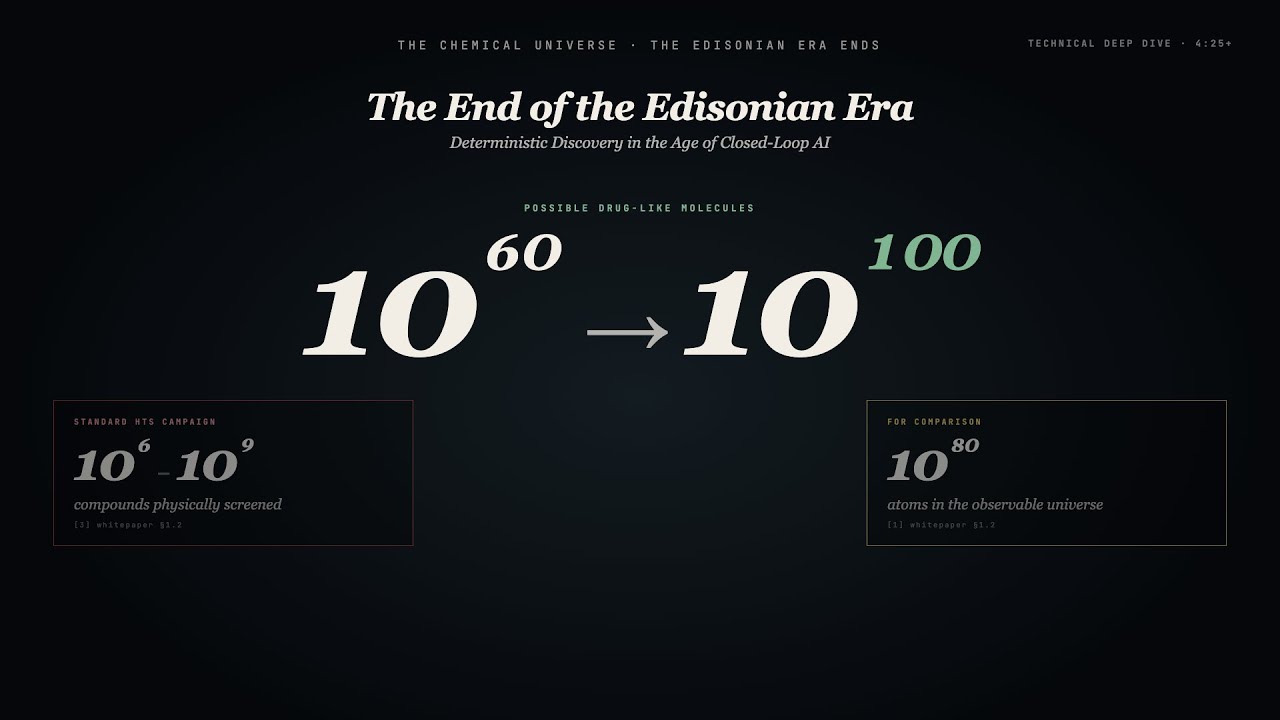
The history of materials science and pharmaceutical discovery has been defined by a single, persistent methodology: the Edisonian approach. Characterized by high-throughput trial and error, human intuition, and serendipity, this method has served humanity for over a century, delivering innovations from the lightbulb to the first generation of synthetic drugs. However, as the complexity of required materials increases and the "low-hanging fruit" of small molecules are harvested, the Edisonian method has hit a statistical and economic wall. The search space for drug-like molecules is estimated between $10^{60}$ and $10^{100}$ 1, a magnitude that renders physical screening physically impossible and economically ruinous. We are now witnessing the twilight of intuition-driven discovery and the dawn of Closed-Loop Autonomous Discovery, a methodology that integrates Active Learning, Physics-Informed Machine Learning (PIML), and robotic automation into a unified, deterministic engine.
Veriprajna stands at the forefront of this paradigm shift. We posit that the future of R&D lies not in simply pipetting faster, but in predicting smarter. By moving from open-loop intuition to closed-loop algorithmic selection, enterprises can navigate the chemical vastness with precision, transforming the "art" of discovery into a rigorous engineering discipline. This whitepaper outlines the architectural, mathematical, and economic imperatives for adopting Closed-Loop Discovery Labs. It dissects the limitations of traditional High-Throughput Screening (HTS), the mathematical superiority of Bayesian Optimization over random search, the critical yet undervalued role of "negative data," and the structural requirements for building self-driving laboratories. We challenge the prevailing reliance on "Generative AI wrappers" and advocate for deep, physics-compliant AI solutions that redefine the economics of innovation.
The message to the industry is clear: The "Edison Method" is obsolete. If you are testing new materials physically in a wet lab without simulating them first, you are lighting money on fire. Don't guess and check. Simulate and select.
1. The Statistical Impossibility of Edisonian Discovery
1.1 The Legacy of Trial and Error and Its Modern Limits
The methodology attributed to Thomas Edison—testing thousands of carbon filaments to find one that glows—was rooted in an era where theoretical understanding lagged significantly behind experimental capability. Edison himself, and his contemporaries like Nikola Tesla, recognized the gross inefficiency of this approach even in the 19th century. Tesla famously critiqued Edison's methodology, noting that a "little theory and calculation" could have saved 90% of the labor. 3 While Edison eventually adopted more structured approaches, his legacy in modern R&D persists as the "brute force" method: synthesizing and testing massive libraries of compounds in the hopes of finding a "hit."
In the 21st century, this approach is no longer viable. The inefficiency stems from the fundamental disconnection between theory and experiment, leading to a phenomenon known as "punctuated evolution". 4 In this model, long periods of incremental improvement are interrupted only by rare, serendipitous jumps discovered often by accident. In the field of energy materials, for instance, dubious ideas survive for years due to a lack of rigorous pre-validation, leading to wasted capital on materials that violate thermodynamic possibilities. 4 The "fail fast" mantra, while popular, is often applied too late in the process. In a traditional wet lab, failing is expensive. Reagents, synthesis time, and equipment usage burn capital.
The fundamental flaw of the Edisonian approach is its reliance on "screening" rather than "design." Screening assumes the answer lies within a pre-synthesized library. However, as we venture into complex biologics, multi-element alloys, and nanostructured interfaces, the probability of the optimal solution existing within a physically manageable library drops to near zero. The Edisonian method attempts to substitute labor for intelligence, a strategy that becomes exponentially less effective as the complexity of the problem space increases.
1.2 The Astronomical Magnitude of Chemical Space
To understand the futility of physical trial and error, one must grasp the sheer scale of the search problem. The concept of "chemical space" refers to the property space spanned by all possible molecules and chemical compounds adhering to a given set of construction principles and boundary conditions. 1 The number of pharmacologically active small molecules adhering to Lipinski's rules (molecular weight < 500, restricted atom types) is estimated at $10^{60}$. 1 When extending this to the broader organic chemistry space, including halogens, complex ring structures, and larger biologics, the number approaches $10^{100}$. 3
To put this in perspective, the number of atoms in the observable universe is roughly $10^{80}$. A standard High-Throughput Screening (HTS) campaign might test $10^{6}$ (one million) compounds. Even if a pharmaceutical giant screened a billion compounds ($10^9$), they would have explored $0.000000000000000000000000000000000000000000000000001%$ of the available space. The "small-molecule universe" is astronomical. When chemists search it using intuition or random screening, they are effectively lost. 2
The "Edison Method" in this context is akin to trying to map the Pacific Ocean by dipping a teaspoon into the water at random intervals. Without a map—a predictive model—the search is mathematically doomed to inefficiency. The vast majority of this space remains exploring "dark matter" in chemistry—compounds that are theoretically stable but have never been synthesized or tested. The only way to navigate this vastness is to move from physical exploration to computational exploration, where the cost of testing a hypothesis is measured in milliseconds of compute time rather than days of laboratory time.
1.3 The Economic Consequences of Intuition
The financial ramifications of this inefficiency are staggering. The cost of developing a new drug has risen to approximately $2.23 billion per asset as of 2024. 5 This figure includes the cost of the thousands of failures that precede a single success. The internal rate of return (IRR) for pharmaceutical R&D, while showing recent signs of recovery, hit a 12-year low of 1.2% in 2022 before rebounding to 5.9% in 2024, largely driven by outliers like GLP-1 agonists. 6 This decline in R&D productivity, often called "Eroom's Law" (Moore's Law spelled backwards), is a direct result of the increasing difficulty of targets and the exhaustion of easily discoverable molecules.
The industry faces a "patent cliff" and rising competition, necessitating a shift from serendipity to predictability. 7 High-throughput screening (HTS) was supposed to solve this by industrializing the trial-and-error process. However, HTS often yields high false-positive rates and identifies compounds with poor physicochemical properties (e.g., solubility, toxicity) because the screening is random rather than rational. 8 Furthermore, the capital expenditure required to maintain massive physical compound libraries and automated screening infrastructure is prohibitive for all but the largest organizations. 9
The economic reality is that physical experimentation is the most expensive phase of R&D. Testing materials that are thermodynamically unstable or synthesizing molecules that are toxic—when these properties could have been predicted—is "lighting money on fire". 11 To restore the economics of discovery, we must invert the funnel: perform massive, inexpensive in silico screening to identify the highest-probability candidates, and reserve the expensive wet lab for validation, not search.
1.4 The "Better Battery" Deception and Material Failures
The limitations of the Edisonian approach are particularly acute in materials science, where the "Better Battery" deception illustrates the pitfalls of intuition-led research. In the quest for higher energy density, researchers often pursue materials that theoretically offer high performance but practically violate thermodynamic stability or kinetic constraints. 4 Because these materials are tested physically without rigorous simulation, the "dead ends" are found only after significant investment.
Historical observations show that the development of battery materials proceeds by "punctuated evolution," where large jumps occur with the discovery of a new class of material (e.g., LiFePO4), followed by long periods of incremental optimization. 4 The Edisonian approach is reasonably effective at the optimization phase (incremental evolution) but statistically unlikely to find the next "big jump" (punctuated evolution) because the search space for new material classes is too vast for random sampling. Predictive AI, by contrast, can scan the entire known and hypothetical inorganic crystal structure database to identify thermodynamically stable candidates before a single gram is synthesized. 11
2. The Computational Imperative: Simulation Before Synthesis
2.1 Physics-Informed Machine Learning (PIML) vs. Black Box AI
To escape the Edisonian trap, R&D must move in silico. However, not all AI is created equal. The market is currently flooded with "black box" AI models that learn solely from data correlations. These models are insufficient for scientific discovery because experimental data in novel domains is often sparse, noisy, and expensive to acquire. Furthermore, standard machine learning models struggle to extrapolate—they perform well within the bounds of their training data but fail catastrophically when asked to predict properties of entirely new classes of materials.
The solution, and the core of Veriprajna's offering, is Physics-Informed Machine Learning (PIML). PIML integrates fundamental physical laws—conservation of mass, energy, thermodynamics, and quantum mechanics—directly into the neural network's architecture or loss functions. 13 Instead of asking the AI to learn physics from scratch using millions of data points (which don't exist for novel materials), we embed the partial differential equations (PDEs) governing the system into the model.
This approach offers three critical advantages:
1. Data Efficiency: PIML models require significantly less training data because the "rules of the game" (physics) are already known. For example, in material damage characterization, PIML frameworks achieved high predictive accuracy with reduced datasets by enforcing stress equilibrium and strain-displacement compatibility constraints. 14
2. Generalizability: Purely data-driven models fail when asked to predict outside their training distribution (extrapolation). PIML models, constrained by physical laws, extrapolate far better, ensuring that predictions remain physically plausible even in unexplored regions of chemical space. 15
3. Physical Consistency: Standard Generative AI can "hallucinate" molecules that violate valency rules or conservation of mass. PIML ensures that systems track every electron, preventing the spurious creation or deletion of matter during reaction prediction. For instance, the "FlowER" (Flow matching for Electron Redistribution) system explicitly tracks electron redistribution to ensure mass and charge conservation in chemical reaction predictions, a feat impossible for standard Large Language Models. 16
2.2 Transcending Density Functional Theory (DFT) with AI
Density Functional Theory (DFT) has been the workhorse of computational chemistry for decades, allowing for the calculation of electronic structures from first principles. However, DFT is computationally expensive and scales poorly with system size, typically to . A single high-fidelity DFT calculation for a complex molecule or crystal surface can take days on a high-performance computing cluster. 17 This computational cost limits DFT to validating a small number of candidates rather than scanning the entire search space.
The modern workflow utilizes AI to approximate DFT accuracy at a fraction of the cost. By training Graph Neural Networks (GNNs) on existing DFT data, we create "surrogate models" or Machine Learning Potentials (MLPs). 17 These models can predict potential energy surfaces and forces in milliseconds rather than hours, achieving speedups of $1000\times$ or more.
● Case in Point: The ANI-1x potential, developed using active learning, achieved DFT-level accuracy on molecular benchmarks while using only 10% of the data required by naive random sampling. 18
● Search Completeness: Combining DFT with ML allows for the calculation of "search completeness"—estimating what fraction of discoverable stable compounds have been found. This moves materials discovery from an open-ended hunt to a bounded optimization problem. 19 By using Bayesian statistical models to analyze the distribution of DFT energies, researchers can determine when a search of a specific chemical space has reached diminishing returns, optimizing the allocation of computational resources. 19
2.3 The Role of Graph Neural Networks (GNNs) vs. LLMs
There is a widespread misconception that Large Language Models (LLMs) like GPT-4, Claude, or Gemini are the universal solution for all AI problems, including science. While LLMs excel at processing text and can assist in literature review, protocol generation, or coding, they inherently struggle with the geometric and topological nature of molecules. 20 Molecules are not sentences; they are 3D graphs defined by nodes (atoms) and edges (bonds) with specific geometric constraints, chirality, and electronic properties that do not map linearly to text strings.
LLMs typically treat molecules as string representations (SMILES), which can lead to "hallucinations"—generating valid-looking strings that correspond to chemically impossible or unstable structures. 21
● GNN Superiority: Benchmarks show that GNNs, which explicitly model the graph structure of molecules and pass messages between neighboring atoms, consistently outperform LLMs in property prediction tasks involving geometric structure. 20 GNNs are "permutation invariant" (the order of atoms doesn't matter, unlike in a text string) and can directly incorporate 3D coordinates and bond angles.
● The Hybrid Approach: The ideal architecture, which Veriprajna advocates, is a hybrid one. LLMs act as the "reasoning agent" or "orchestrator," parsing scientific literature to extract synthesis recipes and designing high-level experimental protocols. Meanwhile, specialized GNNs and PIML models act as the "specialist engines," performing the rigorous property prediction, inverse design, and stability analysis. 24 This "Co-Pilot" model leverages the semantic reasoning of LLMs while relying on the geometric precision of GNNs for the heavy lifting of molecular design. 24
| Feature | Large Language Models (LLMs) |
Graph Neural Networks (GNNs) |
Physics-Informed ML (PIML) |
|---|---|---|---|
| Data Representation |
1D Text Strings (SMILES) |
3D Graphs (Nodes/Edges) |
Diferential Equations / Tensors |
| Primary Strength | Reasoning, Literature Synthesis, Coding |
Topological/Geome tric Property Prediction |
Physical Consistency, Extrapolation |
| Weakness | Hallucination, Lack of 3D Awareness |
Limited Semantic Understanding |
Complex Implementation, Solvers |
| Ideal Role | Orchestrator / Agent |
Property Predictor | Constraints / Simulation Engine |
3. The Architecture of Autonomy: Closed-Loop Discovery
3.1 The "Flywheel" of Active Learning
The transition from Edisonian to Computational is only the first step. The ultimate leap is the Closed-Loop Discovery Lab, often referred to as a Self-Driving Lab (SDL). In this paradigm, the AI is not just a passive analyst but an active experimenter. The system closes the loop between prediction and verification, creating a virtuous cycle of learning that accelerates exponentially.
The workflow operates as a continuous cycle, often described as Design-Make-Test-Analyze (DMTA) 12 :
1. Hypothesis Generation (Design): The AI model (the "Agent") predicts a candidate material with optimized properties using its current understanding of the search space. It does not just guess; it optimizes an acquisition function to select the experiment that yields the most value.
2. Automated Synthesis (Make): A robotic platform receives the design instructions. Liquid handlers, flow reactors, or 3D printers synthesize the material without human intervention.
3. Characterization (Test): Integrated sensors (spectroscopy, XRD, microscopy) measure the properties of the synthesized material.
4. Feedback (Analyze): The result is fed back into the AI model. Crucially, the model updates its internal beliefs (surrogate model) based on this new data point.
5. Iteration: The cycle repeats, with the AI selecting the next experiment.
This "flywheel" effect accelerates discovery by orders of magnitude. The A-Lab at Berkeley, for example, synthesized 41 novel inorganic materials in 17 days—a feat that would take human researchers months or years. 26 The AI agent autonomously corrected synthesis recipes based on intermediate results, demonstrating true adaptive behavior.
3.2 Active Learning: The Mathematical Engine
The brain of the closed-loop lab is Active Learning . Unlike traditional supervised learning, which requires a massive, static labeled dataset, active learning starts with small data and iteratively queries the "oracle" (the experiment) for the most valuable data points. 28 The core mechanism involves balancing Exploration (searching unknown regions of chemical space) and Exploitation (refining the area around a known hit). This is typically achieved through Bayesian Optimization.
3.2.1 Bayesian Optimization (BO) and Gaussian Processes
Bayesian Optimization is the standard mathematical framework for AL in chemistry. It uses a probabilistic model, typically a Gaussian Process (GP), to approximate the expensive "black box" function (the experiment). 30 The GP predicts two things for every point in the search space:
1. Mean (): The expected property value (e.g., yield, conductivity).
2. Variance (): The uncertainty of that prediction.
This uncertainty quantification is the superpower of BO. It allows the system to identify "dark" regions of the search space where the model knows nothing, and "bright" regions where it is confident of high performance.
3.2.2 Acquisition Functions: The Strategy of Search
The system uses an Acquisition Function to decide the next experiment based on the GP's predictions. The choice of function determines the strategy of the AI 30 :
● Upper Confidence Bound (UCB): This strategy is optimistic. It selects points that could be amazing (high uncertainty + high mean). It effectively says, "This area is uncertain, but the ceiling is high, so let's check it." The parameter tunes the balance between exploration and exploitation.
● Expected Improvement (EI): This calculates the probability that a new point will beat the current best known value, weighted by the magnitude of the improvement. It is a more conservative, exploitation-heavy strategy.
● Thompson Sampling: A probabilistic approach that samples a function from the posterior distribution and selects the maximum. It is particularly effective for handling complex, non-convex landscapes and batch experimentation because it naturally promotes diversity in the selected batch. 32
3.2.3 Multi-Fidelity and Cost-Informed Optimization
Real-world experiments vary in cost and fidelity. A computer simulation (DFT) is cheap but approximate; a wet-lab synthesis is expensive but accurate. Veriprajna advocates for Multi-Fidelity Bayesian Optimization (MF-BO) . 34
● MF-BO: This algorithm fuses data from low-fidelity sources (simulations) and high-fidelity sources (experiments). It learns the correlation between the two. If the simulation is highly correlated with reality in a certain region, the AI will rely on cheap simulations to explore that region, only triggering an expensive experiment when necessary. 34
● Cost-Informed BO (CIBO): This variant explicitly incorporates the monetary or temporal cost of an experiment into the acquisition function. If two experiments offer similar information gain, but one requires a $5,000 reagent and the other a $50 reagent, CIBO will select the cheaper path. Studies show CIBO can reduce optimization costs by up to 90% while achieving the same results. 36
3.3 The Value of Negative Data
In the Edisonian model, negative results (failed experiments) are often discarded or buried in lab notebooks. In the Active Learning model, negative data is gold.
● Decision Boundaries: To distinguish a "drug" from a "non-drug," the AI must know what a non-drug looks like. Negative data sharpens the decision boundary of the model. 29
● Reducing Hallucination: Including negative data in training sets helps ground generative models, preventing them from predicting reactions that are thermodynamically impossible. 38
● Mapping Dead Ends: By systematically exploring and recording failures, the AI maps the "dead ends" of chemistry. This topological knowledge of the failure landscape is permanent IP that prevents the organization from ever wasting resources on those paths again. 3
4. Middleware and Integration: The Digital Nervous System
4.1 Bridging the Gap: AI to Hardware
A major bottleneck in deploying autonomous labs is the fragmentation of laboratory hardware. Spectrometers, liquid handlers, and hotplates from different vendors speak different proprietary languages. To build a closed loop, we need a universal translation layer— Robotics Middleware . Without this, the AI is a brain in a jar, unable to control its hands.
4.2 The SiLA 2 Standard
The Standardization in Lab Automation (SiLA 2) has emerged as the critical enabler for modern autonomous labs. Unlike industrial standards like OPC UA, which are heavy, factory-centric, and complex to implement for scientific workflows, SiLA 2 is designed specifically for the life sciences and is based on modern web protocols. 40
● Microservice Architecture: SiLA 2 treats every instrument as a microservice. This allows the AI agent to send a high-level command (e.g., "Dispense 5ml") without needing to know the low-level serial port commands of the specific robot arm. 40
● Cloud Connectivity: It enables secure, server-initiated connections (HTTP/2, gRPC), allowing cloud-based AI brains (like Veriprajna's models) to control local lab hardware securely through firewalls. 41
● Interoperability: It allows for the integration of legacy devices with cutting-edge robotics. A 20-year-old HPLC can be wrapped in a SiLA 2 driver and become part of a cutting-edge autonomous loop. 42
Comparison: SiLA 2 vs. OPC UA
| Feature | SiLA 2 | OPC UA |
|---|---|---|
| Domain | Life Sciences / R&D | Industrial Automation / Manufacturing |
| Architecture | Microservices (gRPC/HTTP2) |
Client-Server (Binary/XML) |
| Complexity | Low (Feature Defnition | High (Complex Information |
| Col1 | Language) | Models) |
|---|---|---|
| Suitability for R&D | High (Flexible, Agile) | Low (Rigid, Setup Heavy) |
4.3 Digital Twins: Simulation Before Execution
Before a physical robot moves a muscle, the experiment should be simulated in a Digital Twin . A Digital Twin is a dynamic virtual replica of the physical lab, including the instruments, the environment, and the sample logistics. 43
● Simulation & Validation: The AI can run thousands of "virtual experiments" in the digital twin to validate the logic, timing, and collision paths of a protocol before executing it physically. This prevents costly crashes and lost samples. 44
● Anomaly Detection: By comparing real-time sensor data from the lab against the digital twin's predictions, the system can detect anomalies (e.g., a clogged pipette causing a pressure spike, or a drifting temperature sensor) before they ruin a batch. The twin acts as a "ground truth" for operational health. 44
● Capacity Planning: Digital twins allow lab managers to simulate staffing models and equipment utilization, identifying bottlenecks in the workflow (e.g., a centrifuge backlog) and optimizing the schedule for maximum throughput. 43
4.4 AI-Driven LIMS
The Laboratory Information Management System (LIMS) is the spine of the lab. Traditional LIMS are passive databases. The new generation is AI-Driven LIMS . 45
● Active Monitoring: Instead of just storing results, an AI-LIMS analyzes them in real-time. It can flag out-of-spec results immediately and trigger an automatic re-test or halt the workflow. 45
● Predictive Maintenance: By monitoring instrument usage patterns and performance data stored in the LIMS, the AI can predict when a device needs maintenance before it fails, reducing downtime. 46
5. Economic Impact: ROI of the Closed-Loop
5.1 CapEx vs. OpEx Optimization
The transition to AI-driven R&D fundamentally alters the cost structure of discovery.
● OpEx Reduction: Traditional HTS is OpEx-heavy (consumables, reagents, personnel time). Active learning reduces the number of physical experiments required to find a hit by orders of magnitude (often 10x to 100x reduction). For example, CIBO strategies can reduce reagent costs by 90%. 36
● CapEx Efficiency: While building a robotic lab requires upfront CapEx, the utilization rate of autonomous equipment is near 100% (running 24/7), compared to the 30-40% utilization typical of human-staffed labs. The return on assets (ROA) is therefore significantly higher.
5.2 Accelerating Time-to-Market
Speed is the primary currency in pharma and materials. The "patent life" of a drug is fixed; every day saved in R&D is an extra day of exclusivity in the market.
● Case Study (Exscientia): AI-designed small molecules entered Phase I trials in ~12 months, compared to the industry average of 4-5 years. 47
● Case Study (Insilico Medicine): An AI-discovered candidate for fibrosis went from target discovery to preclinical candidate in under 18 months for a fraction of the typical cost. 47
● Materials Science: The "A-Lab" demonstrated that autonomous systems can map phase diagrams and discover stable structures in days, a process that historically took decades. 26
5.3 The Cost of "Not" Simulating
The "Edison Method" incurs a hidden "opportunity cost." Every dollar spent testing a material that could have been ruled out by simulation is a dollar not spent on a viable candidate. With failure rates in pharma R&D hovering around 90%, the ability of AI to "fail fast" and "fail virtual" is the single largest lever for increasing ROI. 3 Predictive models like those developed at the Broad Institute for drug toxicity (DILI/DICT) allow researchers to filter out toxic compounds before synthesis, saving millions in downstream failure costs. 48
6. Case Studies and Real-World Validation
The shift to closed-loop discovery is not theoretical; it is already yielding results in the enterprise.
6.1 The A-Lab (Materials Science)
The "A-Lab" at Lawrence Berkeley National Laboratory is a premier example of a fully autonomous discovery engine.
● Throughput: It synthesized 41 novel inorganic compounds in 17 days.
● Autonomy: The system used active learning to correct its own synthesis recipes. When a reaction failed to produce the target phase, the AI analyzed the XRD pattern, adjusted the precursor ratios or heating profiles, and retried.
● Impact: This success rate (71%) for novel materials is vastly higher than human intuition-driven synthesis. 26
6.2 Pharmaceutical Leaders
● Merck: Is aggressively using AI and automation to prepare for the "patent cliff" of Keytruda, utilizing these technologies to densify their pipeline with high-quality candidates. 7
● Exscientia & Insilico: These "AI-first" biotech companies have validated the model that AI can deliver clinical candidates faster and cheaper than traditional big pharma methods. Their success has forced the entire industry to pivot. 47
7. Strategic Outlook: From Wrapper to Solution
7.1 Beyond the "Wrapper"
Many current AI offerings in the market are merely "wrappers" around public LLM APIs (OpenAI, Anthropic). These are useful for text generation but insufficient for deep science. They lack the domain specificity, the physical constraints, and the integration with hardware required for true R&D transformation. A wrapper cannot integrate with a SiLA 2 liquid handler; it cannot enforce conservation of mass in a chemical reaction; it cannot navigate a $10^{100}$ search space with Bayesian rigorousness.
Veriprajna positions itself as a Deep AI Solution Provider . This means:
● Custom Architectures: We build hybrid models combining GNNs for molecular geometry, PIML for physical consistency, and LLMs for reasoning.
● Data Sovereignty: We deploy private, fine-tuned models that ensure proprietary chemical data never leaves the client's secure environment.
● Full Stack Integration: We do not just provide code; we architect the entire loop, from the Bayesian optimization algorithms to the SiLA 2 drivers that control the pipettes.
7.2 The Future of Chemistry
The search space of $10^{100}$ is no longer an insurmountable abyss; it is a landscape to be navigated. The convergence of high-performance computing, generative AI, and robotic automation enables us to pipette our way to breakthroughs—but only after we have simulated the path.
The future belongs to those who stop guessing and start calculating. The Edisonian method was a necessity of the past. Closed-Loop Discovery is the imperative of the future.
Don't guess and check. Simulate and select.
Works cited
Chemical space - Wikipedia, accessed December 11, 2025, b https://en.wikipedia.org/wiki/Chemical_space
Scientists Map All Possible Drug-like Chemical Compounds - Duke Today, b accessed December 11, 2025, https://today.duke.edu/2013/04/smallmolecules
Edisonian approach - Wikipedia, accessed December 11, 2025, b https://en.wikipedia.org/wiki/Edisonian_approach
Addressing Edison's Concern, accessed December 11, 2025, b https://www.its.caltech.edu/~matsci/bt/EdisonText.html f
Measuring the return from pharmaceutical innovation 2024 | Deloitte US, b accessed December 11, 2025, https://www.deloite.com/us/en/Industries/life-sciences-health-care/articles/measturing-return-from-pharmaceutical-innovation.html
Pharma R&D Returns Grow Again, But Deloitte Warns Progress is 'Fragile' b BioSpace, accessed December 11, 2025, https://www.biospace.com/business/pharma-r-d-returns-grow-again-but-deloite-warns-progress-is-fragile
Top 10 pharma R&D budgets in 2024 - Fierce Biotech, accessed December 11, b 2025, https://www.fiercebiotech.com/special-reports/top-10-pharma-rd-budgets-2024
Virtual Screening and High-Throughput Screening in Drug Discovery b ResearchGate, accessed December 11, 2025, https://www.researchgate.net/publication/392708243_Virtual_Screening_and_High-Throughput_Screening_in_Drug_Discovery
High Throughput Screening Market Forecast, 2025-2032 - Coherent Market Insights, accessed December 11, 2025, https://www.coherentmarketinsights.com/industry-reports/high-throughput-screening-market
How do you choose between HTS, virtual screening and FBDD? - Domainex, accessed December 11, 2025, https://www.domainex.co.uk/news/how-do-you-choose-between-hts-virtual-screening-and-fbdd
How the Materials Project connects computational and experimental materials science, accessed December 11, 2025, https://it.lbl.gov/how-the-materials-project-connects-computational-and-experimental-materials-science/
The Bright Future of Materials Science with AI: Self-Driving Laboratories and Closed-Loop Discovery - ResearchGate, accessed December 11, 2025, https://www.researchgate.net/publication/397193999_The_Bright_Future_of_Materials_Science_with_AI_Self-Driving_Laboratories_and_Closed-Loop_Discovery
Physics-informed machine learning for combustion: A review - arXiv, accessed December 11, 2025, https://arxiv.org/html/2509.03347v1
Physics-Informed Machine Learning Models for the Characterization of Materials b with Damage, 18-R6214 | Southwest Research Institute, accessed December 11, 2025, https://www.swri.org/what-we-do/internal-research-development/2023/chemistry-materials/physics-informed-machine-learning-models-the-characterization-of-materials-damage-18-r6214
Physics-Constrained Machine Learning for Chemical Engineering - arXiv, accessed December 11, 2025, https://arxiv.org/html/2508.20649v1
A new generative AI approach to predicting chemical reactions | MIT News, accessed December 11, 2025, https://news.mit.edu/2025/generative-ai-approach-to-predicting-chemical-reactions-0903
Machine Learning Approaches for Accelerated Materials Discovery - AZoM, accessed December 11, 2025, https://www.azom.com/article.aspx?ArticleID=23290
Less is more: Sampling chemical space with active learning - AIP Publishing, accessed December 11, 2025, https://pubs.aip.org/aip/jcp/article/148/24/241733/963478/Less-is-more-Sampling-chemical-space-with-active
A Combined DFT/Machine Learning Framework for Materials Discovery: Application to Spinels and Assessment of Search Completeness and Efficiency | Theoretical and Computational Chemistry | ChemRxiv | Cambridge Open Engage, accessed December 11, 2025, https://chemrxiv.org/engage/chemrxiv/article-details/60c750b5469df44174f448e9
Benchmarking Large Language Models for Molecule Prediction Tasks | alphaXiv, accessed December 11, 2025, https://www.alphaxiv.org/overview/2403.05075
LLM Copilots for Bench Scientists: A Practical Guide | IntuitionLabs, accessed December 11, 2025, https://intuitionlabs.ai/articles/llm-copilots-bench-scientists
Evaluating the Performance and Robustness of LLMs in Materials Science Q&A and Property Predictions - arXiv, accessed December 11, 2025, https://arxiv.org/html/2409.14572v2
Graph Neural Networks in Modern AI-Aided Drug Discovery | Chemical Reviews, accessed December 11, 2025, https://pubs.acs.org/doi/10.1021/acs.chemrev.5c00461
Large Language Models Meet Graph Neural Networks: A Perspective of Graph Mining - MDPI, accessed December 11, 2025, https://www.mdpi.com/2227-7390/13/7/1147
Large Language Models vs Graph Neural Networks: It Depends - Symmetry Systems, accessed December 11, 2025, https://www.symmetry-systems.com/blog/large-language-models-vs-graph-neural-networks-it-depends/
Artificial intelligence-driven autonomous laboratory for accelerating chemical discovery, accessed December 11, 2025, https://www.oaepublish.com/articles/cs.2025.66
Autonomous Chemical Experiments: Challenges and Perspectives on Establishing a Self-Driving Lab - PMC - PubMed Central, accessed December 11, 2025, https://pmc.ncbi.nlm.nih.gov/articles/PMC9454899/
Active learning in robotics - Thomas A. Berrueta, accessed December 11, 2025, https://tberrueta.github.io/assets/pdfs/TaylorMechatronics2021.pdf
The Hidden Value of Failure: Why Negative Data is Critical for AI-Driven Drug Discovery, accessed December 11, 2025, https://www.digitalchemistry.ai/resources/white-papers/the-hidden-value-of-failure-why-negative-data-is-critical-for-ai-driven-drug-discovery/
Acquisition functions in Bayesian Optimization | Let's talk about science!, accessed December 11, 2025, https://ekamperi.github.io/machine%20learning/2021/06/11/acquisition-functions.html
Bayesian Optimization for Chemical Synthesis in the Era of Artificial Intelligence: Advances and Applications - MDPI, accessed December 11, 2025, https://www.mdpi.com/2227-9717/13/9/2687
what is Thompson sampling and upper Confidence bound | by Yashwanth Reddy - Medium, accessed December 11, 2025, https://medium.com/@reddyyashu20/what-is-thompson-sampling-and-upper-confidence-bound-d8088a703b02
Deconstructing the human algorithms for exploration - PMC - NIH, accessed December 11, 2025, https://pmc.ncbi.nlm.nih.gov/articles/PMC5801139/
Bayesian Optimization over Multiple Experimental Fidelities ..., accessed December 11, 2025, https://pubs.acs.org/doi/10.1021/acscentsci.4c01991
Multi-fidelity Sequential Learning for Accelerated Materials Discovery - ChemRxiv, accessed December 11, 2025, https://chemrxiv.org/engage/api-gateway/chemrxiv/assets/orp/resource/item/60c756c60f50dbb7f939813f/original/multi-fidelity-sequential-learning-for-accelerated-materials-discovery.pdf
Cost-Informed Bayesian Reaction Optimization - ChemRxiv, accessed December 11, 2025, https://chemrxiv.org/engage/api-gateway/chemrxiv/assets/orp/resource/item/66220e8a21291e5d1d27408d/original/cost-informed-bayesian-reaction-optimization.pdf
Cost-informed Bayesian reaction optimization - PMC - NIH, accessed December 11, 2025, https://pmc.ncbi.nlm.nih.gov/articles/PMC11465108/
accessed December 11, 2025, https://pmc.ncbi.nlm.nih.gov/articles/PMC12164950/#:~:text=Here%2C%20we%20demonstrate%20that%20information,limited%20volume%20of%20successful%20data.
Negative chemical data boosts language models in reaction outcome prediction PMC, accessed December 11, 2025, https://pmc.ncbi.nlm.nih.gov/articles/PMC12164950/
Standardization in Lab Automation - Wikipedia, accessed December 11, 2025, https://en.wikipedia.org/wiki/Standardization_in_Lab_Automation
SiLA Rapid Integration - Standards, accessed December 11, 2025, https://sila-standard.com/standards/
SiLA 2: The Next Generation Lab Automation Standard - ResearchGate, accessed December 11, 2025, https://www.researchgate.net/publication/360985834_SiLA_2_The_Next_Generation_Lab_Automation_Standard
Optimising digital twin laboratories with conversational AIs: enhancing immersive training and simulation through virtual reality - RSC Publishing, accessed December 11, 2025, https://pubs.rsc.org/en/content/articlehtml/2025/dd/d4dd00330f
Digital Twins in Pharmaceutical Quality Control | Lab Manager, accessed December 11, 2025, https://www.labmanager.com/digital-twins-in-pharmaceutical-quality-control-34142
AI-Powered LIMS Systems: Transforming Lab Accuracy & Automation | Medium, accessed December 11, 2025, https://medium.com/@healthray/ai-powered-lims-systems-transforming-lab-accuracy-automation-6e5aaf0748ba
AI-Driven Pharma LIMS Analytics Transform Lab Data Insights - LabLynx, accessed December 11, 2025, https://www.lablynx.com/resources/articles/ai-driven-pharma-lims-analytics/
Measuring AI ROI in Drug Discovery: Key Metrics & Outcomes | IntuitionLabs, accessed December 11, 2025, https://intuitionlabs.ai/articles/measuring-ai-roi-drug-discovery
De-risking drug discovery with predictive AI | Broad Institute, accessed December 11, 2025, https://www.broadinstitute.org/news/de-risking-drug-discovery-predictive-ai
Prefer a visual, interactive experience?
Explore the key findings, stats, and architecture of this paper in an interactive format with navigable sections and data visualizations.
Frequently Asked Questions
Why is high-throughput screening insufficient for modern drug discovery?
The search space for drug-like molecules spans 10^60 to 10^100 candidates. Even screening one billion compounds (10^9) covers less than 10^-51% of the space. With drug development costs reaching $2.23 billion per asset and R&D returns hitting a 12-year low of 1.2% in 2022, HTS is economically and statistically insufficient. Closed-loop AI with Bayesian optimization reduces required physical experiments by 10x-100x by computationally navigating the space before wet-lab validation.
How do Graph Neural Networks outperform LLMs for molecular design?
Molecules are 3D graphs with nodes (atoms) and edges (bonds) possessing specific geometric constraints and chirality. LLMs treat molecules as 1D SMILES strings, leading to hallucinated structures that violate valency or stability rules. GNNs model graph structure directly, are permutation invariant, and incorporate 3D coordinates and bond angles, consistently outperforming LLMs in property prediction benchmarks involving geometric structure.
What role does negative data play in AI-driven materials discovery?
In closed-loop discovery, failed experiments are critical IP. Negative data sharpens the decision boundaries of surrogate models, prevents generative models from hallucinating thermodynamically impossible reactions, and permanently maps dead-end regions of chemical space. This topological knowledge of the failure landscape ensures the organization never wastes resources repeating failed paths, a capability impossible in traditional Edisonian workflows.
Also Published On
Build Your AI with Confidence.
Partner with a team that has deep experience in building the next generation of enterprise AI. Let us help you design, build, and deploy an AI strategy you can trust.
Veriprajna Deep Tech Consultancy specializes in building safety-critical AI systems for healthcare, finance, and regulatory domains. Our architectures are validated against established protocols with comprehensive compliance documentation.