Deterministic Discovery in the Age of Closed-Loop AI
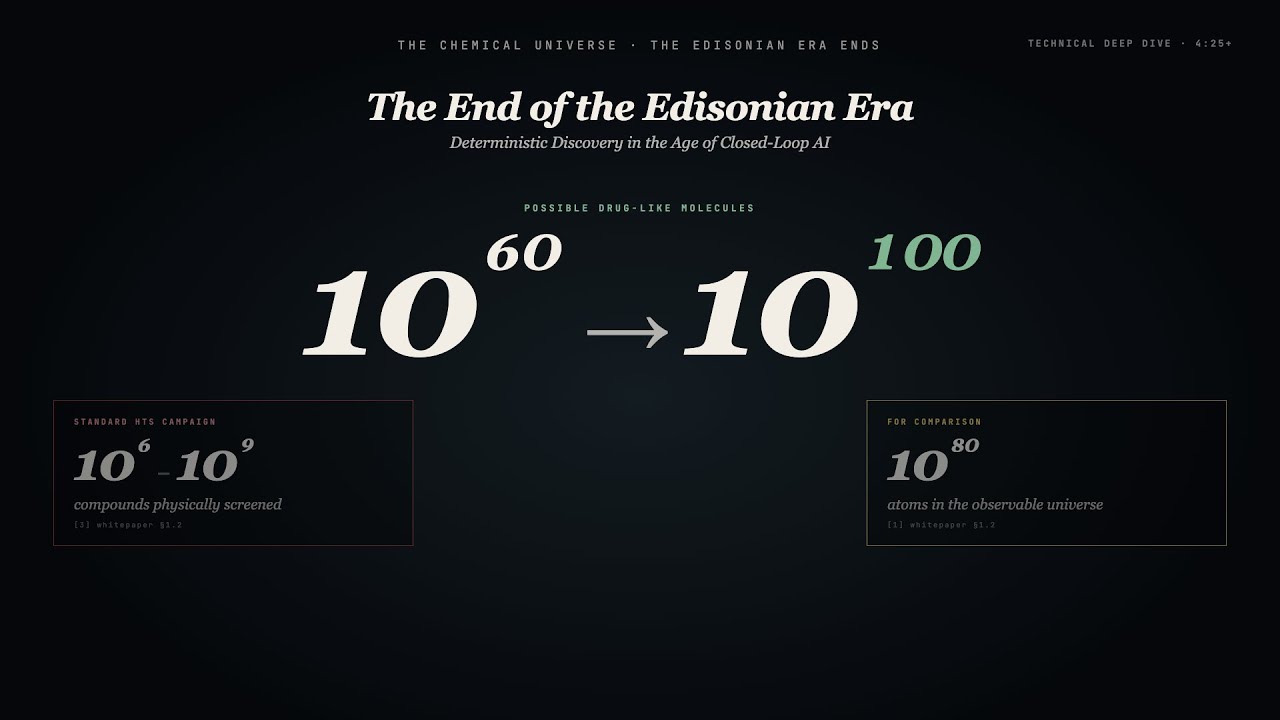
The history of materials science has been defined by trial and error. With chemical space spanning 1060 to 10100 molecules, physical screening is statistically impossible and economically ruinous.
Veriprajna architects Closed-Loop Autonomous Discovery—integrating Active Learning, Physics-Informed Machine Learning, and robotic automation into a unified, deterministic engine that transforms the "art" of discovery into rigorous engineering.
Veriprajna partners with pharmaceutical, materials science, and chemical enterprises to move from intuition-driven discovery to deterministic, simulation-first R&D.
Navigate the $1060 molecule search space with Bayesian Optimization. Achieve Phase I trials in ~12 months vs. industry average of 4-5 years. Filter toxic compounds before synthesis.
Deploy Self-Driving Labs that synthesize and characterize 24/7. Screen thermodynamic stability before wasting capital on unviable battery materials. Map phase diagrams in days, not decades.
Optimize reaction conditions with Cost-Informed Bayesian Optimization (90% reagent cost reduction). Integrate digital twins for zero-downtime protocol validation. Deploy AI-driven LIMS for predictive maintenance.
Thomas Edison tested thousands of carbon filaments through brute force. Tesla critiqued this, noting "a little theory and calculation" could save 90% of labor. Yet modern R&D still relies on this fundamentally inefficient methodology.
The number of drug-like molecules (Lipinski's rules) is estimated at 1060. Extending to broader organic chemistry yields 10100—more than atoms in the observable universe (1080).
"When chemists search chemical space using intuition or random screening, they are effectively lost." — Chemical Space Review
Drug development cost: $2.23B per asset. Pharma R&D IRR hit 12-year low of 1.2% in 2022, rebounding to only 5.9% in 2024. This is Eroom's Law—Moore's Law spelled backwards.
Testing materials that violate thermodynamics = lighting money on fire.
For comparison: Observable universe contains ~1080 atoms. Physical screening is mathematically doomed.
The only way to navigate 1060 molecules is to move in silico. However, not all AI is created equal. Black box models fail catastrophically outside training data.
Integrates fundamental laws—conservation of mass, energy, thermodynamics, quantum mechanics—directly into neural network architecture. Ensures predictions remain physically plausible.
Molecules are 3D graphs, not sentences. GNNs model atoms (nodes) and bonds (edges) with geometric constraints, chirality, and electronic properties. Superior to LLM SMILES representations.
Density Functional Theory scales O(N³-N⁴), taking days per calculation. Machine Learning Potentials (MLPs) achieve DFT-level accuracy at 1000× speed.
| Feature | Large Language Models (LLMs) | Graph Neural Networks (GNNs) | Physics-Informed ML (PIML) |
|---|---|---|---|
| Data Representation | 1D Text Strings (SMILES) | 3D Graphs (Nodes/Edges) | Differential Equations / Tensors |
| Primary Strength | Reasoning, Literature Synthesis | Topological/Geometric Property Prediction | Physical Consistency, Extrapolation |
| Weakness | Hallucination, Lack of 3D Awareness | Limited Semantic Understanding | Complex Implementation |
| Ideal Role | Orchestrator / Agent | Property Predictor | Constraints / Simulation Engine |
Veriprajna's Hybrid Architecture
We deploy hybrid systems: LLMs act as reasoning agents for protocol design and literature extraction. GNNs and PIML models perform rigorous property prediction, inverse design, and stability analysis. This "Co-Pilot" model leverages semantic reasoning while maintaining geometric precision.
The ultimate leap is the Self-Driving Lab (SDL). AI is not a passive analyst but an active experimenter, closing the loop between prediction and verification in a virtuous cycle.
AI predicts candidate using Bayesian Optimization—maximizes acquisition function
Robotic platform synthesizes material autonomously (liquid handlers, 3D printers)
Integrated sensors characterize properties (XRD, spectroscopy, microscopy)
Result fed back to AI—surrogate model updates beliefs, cycle repeats
This flywheel accelerates discovery by orders of magnitude
Unlike traditional supervised learning (requires massive static datasets), Active Learning starts with small data and iteratively queries the "oracle" (the experiment) for the most valuable points.
Uses a probabilistic model (Gaussian Process) to predict:
Try it: Adjust λ to see how acquisition strategy changes point selection
Real experiments vary in cost and fidelity. DFT is cheap but approximate; wet-lab is expensive but accurate.
To classify "drug" vs. "non-drug," the AI must know what failure looks like. Negative data is critical training signal.
Including negative data grounds generative models, preventing thermodynamically impossible reaction predictions.
Systematically recording failures creates permanent IP—preventing organization from wasting resources on known dead ends.
"In the Edisonian model, negative results are buried. In Active Learning, negative data is gold."
A major bottleneck in deploying autonomous labs is fragmented hardware. Spectrometers, liquid handlers, and robots speak different proprietary languages. We need a universal translation layer.
Standardization in Lab Automation (SiLA 2) is the critical enabler for modern autonomous labs. Unlike industrial OPC UA (factory-centric, complex), SiLA 2 is designed for life sciences with modern web protocols.
| Feature | SiLA 2 | OPC UA |
|---|---|---|
| Domain | Life Sciences / R&D | Manufacturing |
| Architecture | Microservices | Client-Server |
| Complexity | Low (Agile) | High (Setup Heavy) |
| R&D Suitability | High | Low (Rigid) |
A Digital Twin is a dynamic virtual replica of the physical lab—instruments, environment, sample logistics. Before a robot moves, the experiment runs virtually.
Traditional Laboratory Information Management Systems (LIMS) are passive databases. The new generation is AI-Driven LIMS—actively monitoring, analyzing, predicting.
The transition to AI-driven R&D fundamentally alters the cost structure of discovery, shifting from OpEx-heavy to CapEx-efficient with superior asset utilization.
Model your R&D economics transformation
Includes reagents, personnel time, equipment usage
Bayesian Optimization reduces required experiments by 10-100×
Speed is the primary currency in pharma and materials. The "patent life" of a drug is fixed—every day saved in R&D is an extra day of market exclusivity.
4× faster development = 4× more patent protection
While building robotic labs requires upfront investment, autonomous equipment runs 24/7 with near-100% utilization vs. 30-40% for human-staffed labs.
Return on Assets (ROA): Higher CapEx investment amortized over 3× more productive hours = superior ROI
The "Edison Method" incurs a hidden opportunity cost. Every dollar spent testing a material that could have been ruled out by simulation is a dollar not spent on a viable candidate.
With 90% failure rates in pharma R&D, the ability to "fail virtual" is the single largest ROI lever.
Result: Millions saved in downstream failure costs
The shift to closed-loop discovery is not theoretical—it is already yielding results in enterprise R&D.
Lawrence Berkeley National Laboratory
A premier example of fully autonomous discovery. The system synthesized 41 novel inorganic compounds in 17 days—a feat that would take human researchers months or years.
When a reaction failed to produce the target phase, the AI analyzed XRD patterns, adjusted precursor ratios or heating profiles, and autonomously retried. No human intervention.
The 71% success rate for novel materials vastly exceeds human intuition-driven synthesis.
AI-First Biotech Revolution
AI-designed small molecules entered Phase I trials in ~12 months, compared to industry average of 4-5 years. Validated that AI can deliver clinical candidates faster and cheaper than traditional big pharma.
4× Time ReductionAI-discovered candidate for fibrosis went from target discovery to preclinical candidate in under 18 months for a fraction of the typical cost.
Fraction of CostAggressively using AI and automation to prepare for the "patent cliff" of Keytruda, utilizing these technologies to densify pipeline with high-quality candidates.
Strategic PivotThese "AI-first" biotech companies forced the entire industry to pivot from serendipity to predictability.
Many current AI offerings are merely "wrappers" around public LLM APIs. These are useful for text generation but insufficient for deep science.
A wrapper around OpenAI or Anthropic APIs cannot:
We architect the entire closed-loop stack:
The search space of 10100 is no longer an insurmountable abyss; it is a landscape to be navigated.
High-Performance Computing
Generative AI
Robotic Automation
The convergence enables us to pipette our way to breakthroughs—but only after we have simulated the path.
The Edisonian method was a necessity of the past.
Closed-Loop Discovery is the imperative of the future.
Don't guess and check. Simulate and select.
Chemical space contains an estimated 10^60 drug-like molecules, vastly exceeding the observable universe's 10^80 atoms. Standard high-throughput screening campaigns test only 10^6 compounds, covering 0.0000000000000000000000000000000000000000000000000001% of the search space. Drug development costs have reached $2.23B per asset with R&D IRR at historic lows, demonstrating that brute-force discovery is both statistically impossible and economically ruinous.
Closed-loop AI uses Bayesian Optimization with Gaussian Processes to intelligently select the most informative experiments. Instead of screening millions of candidates, Active Learning reduces required experiments by 10-100x by balancing exploration of unknown regions with exploitation of promising areas. Multi-fidelity optimization further reduces costs by 90% by fusing cheap simulations with expensive wet-lab experiments.
Berkeley's A-Lab synthesized 41 novel inorganic compounds in 17 days with a 71% success rate, fully autonomously. Exscientia delivered AI-designed small molecules to Phase I clinical trials in approximately 12 months versus the industry average of 4-5 years. These results demonstrate that closed-loop autonomous discovery is no longer theoretical but delivering measurable enterprise ROI.
Veriprajna architects Closed-Loop Autonomous Discovery labs that navigate chemical space with deterministic precision.
Schedule a consultation to model ROI for your organization and design your transition from intuition to intelligence.
Complete analysis: Statistical impossibility of Edisonian methods, PIML architecture, Bayesian optimization mathematics, SiLA 2 integration, digital twins, AI-LIMS, comprehensive works cited.