The Death of the Feed: Pivoting Media from Content Publishing to Conversational Intelligence
Executive Summary
The digital media landscape is undergoing a tectonic shift more profound than the transition from print to digital. For two decades, the dominant business model of online journalism has been the "News Feed"—a linear aggregation of articles designed to capture attention and monetize it through advertising impressions. This model relied on a fragile symbiosis with search engines and social media platforms to drive referral traffic. Today, that pact is broken. The rise of Generative AI, "Zero-Click" search experiences, and changing user behaviors signal the end of the article as the primary atomic unit of information consumption.
Users no longer wish to wade through 800 words to extract a single fact. They demand synthesis, answers, and intelligence. They do not search keywords; they ask complex questions. The Search Generative Experience (SGE) and AI-native browsers have proven that the future of information retrieval is conversational, not navigational. Media companies that persist in "publishing"—selling static words—face an existential crisis of declining reach and eroding relevance. Those that pivot to "servicing"—selling answers and intelligence—will unlock unprecedented value from their most underutilized asset: their archives.
This whitepaper, prepared by Veriprajna, outlines the strategic imperative for this pivot. It argues that the future of the media business lies in transforming static content archives into dynamic, Conversational Retrieval-Augmented Generation (RAG) Engines. We detail the technical architecture required to achieve this, moving beyond basic Large Language Model (LLM) wrappers to sophisticated systems integrating GraphRAG, Temporal Reasoning, and Agentic Workflows. By vectorizing decades of archival history and structuring it into queryable knowledge graphs, media organizations can offer high-value intelligence products—transforming from content farms into "Intelligence-as-a-Service" providers. The directive is clear: Stop selling words. Start selling answers.
1. The Great Decoupling: The Structural Collapse of the Referral Economy
The digital publishing industry has spent the last twenty years optimizing for a metric that is rapidly becoming obsolete: the click. The entire infrastructure of modern media—from Content Management Systems (CMS) to programmatic advertising exchanges—was built on
the premise that users would search for information, click a link, and visit a publisher's domain. This "Referral Economy" incentivized scale, Search Engine Optimization (SEO), and volume. However, the data from 2024 and 2025 indicates that this era has concluded. We are witnessing "The Great Decoupling"—a divergence where search volume continues to rise, but the flow of traffic to publisher websites rapidly evaporates. 1 This is not merely a cyclical downturn but a structural obsolescence of the link-based economy.
1.1 The Traffic Crisis by the Numbers
The year 2025 has crystallized the existential threat facing the traditional news feed model. While daily Google searches have increased to between 9.1 and 13.6 billion, representing a significant jump from 8.5 billion in 2024, the proportion of those searches resulting in a click-through to a website has collapsed. 1 The search engine has transitioned from a signpost to a destination.
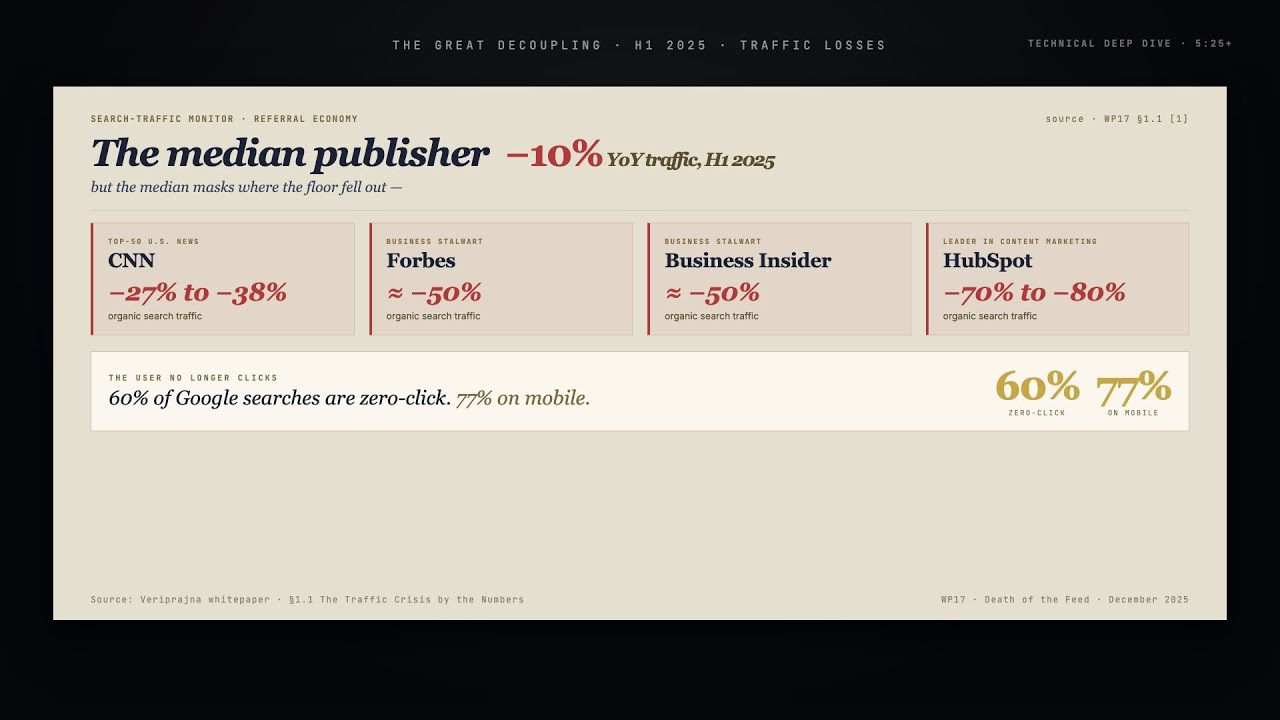
Data indicates that 60% of Google searches are now "zero-click," meaning the user's intent is satisfied entirely on the search results page, often by an AI-generated summary or a direct answer box. 1 This phenomenon is even more pronounced on mobile devices, where screen real estate is scarce and users prefer immediate answers; mobile zero-click rates have reached a staggering 77%. 1 The implication is clear: the search engine is no longer a referrer of traffic but a competitor for attention.
For publishers, the financial and operational impact has been catastrophic. In the first half of 2025 alone, the median publisher saw a 10% year-over-year traffic decline. 1 However, this median figure masks the devastation in the news sector. Analysis of the top 50 U.S. news websites reveals that 37 experienced traffic declines. Major brands like CNN have reported traffic declines between 27% and 38%, forcing a contraction in ad revenue. 1 Business stalwarts like Forbes and Business Insider have seen drops approaching 50%, while HubSpot—a leader in content marketing—experienced a plummet of 70-80% in organic traffic. 1
The correlation is direct and undeniable: the rise of AI Overviews (formerly SGE) in search results. These overviews now appear for nearly 13% of queries, particularly those that are informational in nature. 1 When an AI summary is present, the Click-Through Rate (CTR) to organic links plummets by approximately 47%. 1 Effectively, if an AI answers the question, the user has no incentive to scroll down to the "ten blue links."
1.2 The "Zero-Click" User Psychology
To understand why the feed is dying, one must understand the changing psychology of the user. The "Article" format is a relic of the print era, designed to aggregate multiple facts into a linear narrative because physical distribution was expensive and sporadic. In a newspaper, you printed an 800-word story because you couldn't print 800 individual answers.
In the digital age, this format imposes a high cognitive load. A user searching for specific information—"What is the mayor's stance on housing?"—does not want to read a 1,000-word feature piece on the history of city zoning. They want the specific extraction of the mayor's stance. The traditional model forces the user to perform the work of extraction: Search -> Click -> Scroll -> Scan -> Read -> Extract.
Generative AI has fundamentally altered this equation by functioning as an "Answer Engine." Platforms like ChatGPT, Perplexity, and Claude allow users to bypass the "search-click-read" loop entirely. Analysis of over 1 billion search sessions reveals that traffic to generative AI platforms is growing 165 times faster than traditional search. 2 Users are voting with their attention: 44% of AI-powered search users now cite it as their primary source of insight, surpassing traditional search engines. 3
This shift is particularly pronounced in complex, high-value queries. Users are increasingly inputting longer, more detailed prompts—searches with five or more words are growing 1.5 times faster than short keyword queries. 4 This indicates a desire for synthesis and nuance that a list of blue links cannot provide. The user is no longer satisfied with finding sources; they want the machine to read the sources for them.
1.3 The "Article" as a Barrier to Intelligence
The persistence of the article format in digital media is a case of skeuomorphism—designing digital tools to resemble their analog predecessors. While the article remains a valuable format for storytelling, opinion, and deep reporting, it is an inefficient container for data retrieval .
Consider a user attempting to understand the evolution of a geopolitical conflict or a corporate merger. In the current "Publishing" model, they must locate and read twenty separate articles spanning ten years, mentally stitching together a timeline of events. This places the entire cognitive load on the user. The publisher has the data—it exists in the archive—but it is locked inside unstructured text blobs (articles) that are disconnected from one another.
In the "Servicing" model, the user asks an AI agent to "Summarize the evolution of this conflict over the last decade, citing key turning points." The system performs the retrieval, synthesis, and timeline construction instantly. The value proposition shifts from the production of content to the extraction of intelligence from that content.
Publishers who continue to view their product solely as "articles" are manufacturing buggy whips in the age of the automobile. They are creating unstructured data blobs that are difficult for users to consume efficiently but are paradoxically easy for third-party AI models to scrape and monetize. To survive, media companies must reclaim the value of their data by building the retrieval mechanisms themselves.
1.4 The Opportunity: Deepening Engagement Over Scale
While traffic volume declines, a new opportunity emerges: engagement intensity. The "era of scale" is over. 5 The winners in the AI age will not be those who attract the most fleeting eyeballs, but those who provide the most indispensable answers. The decline in broad, shallow search traffic forces a pivot toward direct, deep relationships with high-value users. 5
By transforming archives into conversational engines, publishers can offer a service that third-party AI crawlers cannot replicate: authoritative, hallucination-free, deep-domain intelligence grounded in proprietary data. While a general-purpose LLM can give a generic answer about housing policy based on scraped data, a specialized "Veriprajna" engine built on a specific newspaper's 50-year archive can provide a hyper-local, citation-backed timeline of every vote, quote, and policy shift by specific city council members. This is the difference between "Content" and "Intelligence."
The "News Chat" is alive because it mirrors how humans naturally acquire knowledge: through dialogue, clarification, and synthesis, not through the passive consumption of static feeds. The "Feed" was a broadcast mechanism; the "Chat" is a consultation mechanism. This transition opens the door to higher-margin business models, moving from penny-per-click advertising to high-value subscription and licensing revenues.
2. From Publishing to Servicing: The "Intelligence-as-a-Service" Paradigm
The pivot from "Publishing" to "Servicing" requires a fundamental rethinking of the media business model. It moves the value capture point from the distribution of content to the querying of content. It is a transition from a volume-based business (more pages, more ads) to a utility-based business (better answers, higher retention).
2.1 The Concept of "Servicing" in Media
"Servicing" implies utility. It treats the media organization not as a broadcaster, but as a consultant or an analyst. In this model, the archive is not a "graveyard" of old stories—a cost center to be maintained—but a "knowledge base" of structured facts—a profit center to be mined. The product is no longer the story itself, but the capability to query that story in the context of thousands of others.
This shifts the revenue focus from advertising (monetizing attention) to subscriptions and licensing (monetizing utility). It aligns the publisher's incentives with the user's needs. In an ad model, the publisher essentially wants the user to stay on the page as long as possible (friction) or click through multiple pages (inefficiency). In a service model, the publisher wants to answer the user's question as quickly and accurately as possible (efficiency).
The "Service" model requires media companies to stop selling access to information and start selling the synthesis of information. It acknowledges that in a world of information abundance, the scarce resource is not the news itself, but the time required to understand it.
2.2 Case Study: The Financial Times and "Ask FT"
The Financial Times (FT) has pioneered this transition with "Ask FT," a generative AI feature available to its professional subscribers. Recognizing that their high-value audience—finance professionals, consultants, and policymakers—are time-poor and need actionable intelligence, the FT built a tool that allows them to "converse" with the archive. 6
Key Features of the "Ask FT" Implementation:
● Proprietary Grounding: Unlike open web AI tools (like ChatGPT or Perplexity) which draw from the entire internet, Ask FT answers are grounded solely in FT journalism. This provides a "walled garden" of trust. Users know the answer isn't a hallucination from a random blog; it is derived from vetted, editorial content. 7
● Citation and Provenance: The tool provides citations that link directly back to the source articles. This is crucial for professional workflows where verification is mandatory. It turns the AI from an oracle into a librarian, guiding the user to the primary source. 7
● Workflow Integration: The tool is designed for specific professional use cases: meeting preparation, rapid due diligence, and trend analysis. It integrates into the user's daily workflow, saving time rather than demanding it. 6
● Engagement Metrics: The FT has found that this service model drives retention. They track "Actual Core Readers" (ACR)—users who engage deeply with content. Ask FT has shown it can boost retention by making the archive accessible and useful, surfacing older evergreen content that would otherwise remain buried. 8
2.3 Case Study: BloombergGPT and Terminal Intelligence
Bloomberg represents the pinnacle of "Intelligence-as-a-Service." The Bloomberg Terminal has long been a query-based system, but the integration of Generative AI has supercharged its capabilities. Bloomberg developed BloombergGPT, a domain-specific LLM trained on a massive corpus of financial data, to allow users to interact with financial data using natural language. 9
Structural Retrieval vs. Text Retrieval: BloombergGPT moves beyond simple text retrieval to structural retrieval. It can translate natural language into Bloomberg Query Language (BQL), a complex proprietary code used to access data. A user can ask, "Show me a table of revenue growth for tech companies in Q3 2024," and the system generates the query, retrieves the structured data, and formats the answer.9
Furthermore, Bloomberg has introduced document search and analysis tools that synthesize earnings call transcripts and research reports. This allows analysts to "interrogate" documents—asking specific questions about a CEO's tone, a specific risk factor, or a competitive threat—rather than reading hundreds of pages linearly. 10 This effectively turns the "feed" of financial news into a dynamic, queryable database of market intelligence.
2.4 The Economic Model: B2B Intelligence APIs
The logical endpoint of this pivot is the creation of B2B Intelligence APIs. Instead of fighting for scraps of ad revenue, media companies can license their "Conversational Engines" to enterprise clients.
● Financial Institutions: Hedge funds and asset managers do not want to scrape news sites (which is often legally perilous and technically difficult). They want a clean, licensed API that delivers "sentiment analysis of Article X" or "timeline of CEO Y's statements."
● Corporate Intelligence: Companies want to monitor their brand reputation or track competitor activity through synthesized daily briefings. They want to ask, "What is the sentiment trend regarding our new product launch across all major news outlets?"
● Legal and Compliance: Law firms need precise, citation-backed histories of regulatory changes. A news archive RAG engine can provide a timeline of a specific law's evolution, citing every relevant article over a 20-year period.
We are seeing early signs of this with deals between publishers and AI companies (e.g., Axel Springer and OpenAI, FT and OpenAI). 11 However, simply licensing data for training is a low-margin, one-off game. The higher value lies in licensing the interface —the RAG engine itself—that provides continuous, up-to-date intelligence. This creates a recurring revenue stream that scales with the value the client derives from the data.
3. The Technical Architecture: Enterprise-Grade RAG
To deliver "Intelligence-as-a-Service," media companies must build systems far more sophisticated than the standard "chatbot" implementations seen in basic tutorials. A standard RAG pipeline—which typically involves chunking text, embedding it, and performing vector search—is insufficient for the complexity, temporality, and accuracy required in professional news analysis.
At Veriprajna, we advocate for and implement a multi-layered architecture that combines Vector Search, Knowledge Graphs, and Temporal Reasoning. This "Deep AI" approach ensures that the system doesn't just match keywords but understands the structure and timeline of the news.
3.1 Limitations of Naive RAG for News
"Naive RAG" or "Baseline RAG" involves splitting documents into small, fixed-size chunks (e.g., 500 words), embedding them into vectors, and retrieving the top-k matches based on semantic similarity. While useful for simple fact retrieval in static documentation, this approach fails catastrophically in news archives for several reasons:
| Limitation | Description | Impact on News Analysis |
|---|---|---|
| Loss of Global Context | Chunking breaks the narrative arc. A chunk discussing a "verdict" might be separated from the "crime" if they appear in diferent parts of a long article or across diferent articles. |
The AI cannot answer "What was the outcome of the trial?" if the trial spanned 5 years of articles. It retrieves fragments but fails to synthesize the full story.13 |
| Temporal Blindness | Vector similarity ignores time. An article from 2010 may be semantically identical to one from 2024 (e.g., "The housing market is crashing"). |
The AI confates old policy stances with current ones, generating factually accurate but chronologically wrong answers. It cannot distinguish_current_ truth from_historical_ truth.14 |
| Multi-Hop Reasoning Failure |
Naive RAG struggles to connect dots across disparate documents. (e.g., Article A links Person X to Company Y; Article B links Company Y to Scandal Z). |
The AI fails to answer "Is Person X connected to Scandal Z?" because no single chunk contains the direct link. It lacks the transitive reasoning capability.15 |
| Hallucination Risk | If the retrieval step misses the relevant context, the LLM atempts to "fll in the gaps" with training data hallucinations. |
The system invents quotes or events, destroying trust in a journalistic context. The "black box" nature of vector retrieval makes it hard to debug.16 |
3.2 GraphRAG: Connecting the Dots
To solve the "multi-hop" and "global context" problems, Veriprajna utilizes GraphRAG (Graph-based Retrieval Augmented Generation). Instead of treating the archive as a bag of isolated text chunks, we process it to extract a Knowledge Graph (KG) . 13
How It Works:
1. Entity & Relation Extraction: As documents are ingested, a specialized LLM processes the text to identify entities (People, Organizations, Locations, Events) and the relationships between them (e.g., "Elon Musk" -> acquired -> "Twitter"). 18
2. Graph Construction: These entities and relations are stored in a graph database (e.g., Neo4j). This creates a structured web of knowledge where every article is interconnected. We are not just indexing words; we are indexing the relationships between the concepts in the news. 19
3. Community Detection: Algorithms like Leiden are used to cluster closely related entities into "communities" (e.g., a "2024 Election" community or a "Tech Antitrust" community). This allows the system to understand the thematic structure of the news, not just individual facts. 18
4. Graph-Enhanced Retrieval: When a user asks a complex question, the system doesn't just look for keywords. It traverses the graph. It can find "Person X" and "Scandal Z" by hopping through the intermediate "Company Y" node, even if they never appear in the same article.
Impact: Benchmarks show that GraphRAG significantly outperforms baseline RAG on complex, reasoning-heavy queries. In multi-hop question answering tasks, GraphRAG has demonstrated improvements in comprehensiveness (72–83%) and diversity of insights compared to vector-only approaches. 13 It effectively "understands" the structure of the story, allowing for global summarization tasks like "What are the main themes in the last 5 years of coverage on Climate Change?"—a question baseline RAG fails to answer effectively.
3.3 Temporal RAG: The Fourth Dimension of News
News is inherently temporal. A fact is only a fact relative to a specific point in time. "The Prime Minister is Rishi Sunak" is true in 2023 but false in 2025. Standard embeddings struggle to capture this distinction. Veriprajna implements Temporal RAG to solve this. 14
Architecture for Temporal Reasoning:
1. Timestamp Metadata: Every chunk and graph edge is tagged with valid-time metadata (e.g., valid_start: 2020-01-01, valid_end: 2020-12-31) derived from the article publication date. 20
2. Time-Aware Graph Edges: Relationships in the Knowledge Graph are versioned. The edge CEO_of between "Steve Jobs" and "Apple" exists for specific time ranges, distinct from the edge between "Tim Cook" and "Apple". 21
3. Query Decomposition: When a user asks, "How has the mayor's stance changed since 2010?", the system decomposes this into temporal sub-queries: "Mayor stance 2010," "Mayor stance 2015," "Mayor stance 2020". 22
4. Chronological Synthesis: The generation layer is instructed to assemble retrieved facts into a coherent timeline, explicitly citing the date of each source. This turns the archive into a time machine, enabling users to replay the development of narratives. 23
This approach allows the system to answer "evolutionary" questions that define investigative journalism. It allows a user to ask, "Show me the timeline of the Mayor's voting record on housing," and receive a chronologically accurate response, rather than a jumbled bag of contradicting quotes from different years.
3.4 Agentic RAG: From Answers to Workflows
The final layer of sophistication is Agentic RAG . While standard RAG retrieves and answers, Agentic RAG plans and executes . 24 This moves the system from a chatbot to a research assistant.
In an agentic workflow, the LLM acts as a reasoning engine (a "brain") that has access to tools.
● The Planner: Breaks down a user request ("Write a due diligence report on Company X") into sub-tasks: "Find Company X financial history," "Find Company X legal disputes," "Find Company X executive leadership changes."
● The Researcher: Executes specific GraphRAG and Temporal RAG queries for different aspects. It knows where to look.
● The Critic: Reviews the retrieved information for gaps or contradictions. "Wait, the housing price data ends in 2023, I need to search for 2024 data." It self-corrects before generating the final answer. 24
● The Writer: Synthesizes the final report with citations, adhering to the requested format (e.g., a bulleted memo or a timeline).
This capability transforms the system from a "search bar" into a "virtual research assistant." It allows media companies to sell high-value outcomes (e.g., "generate a compliance report") rather than just access to raw text. 25 It also significantly reduces hallucinations by introducing a verification step (The Critic) into the loop. 16
4. The Implementation Roadmap: Transforming the Archive
For a media company with 50 years of PDF, HTML, and physical archives, the transformation into an Intelligence Engine is a significant engineering undertaking. The following roadmap outlines the "Veriprajna" methodology for executing this pivot.
Phase 1: Ingestion and Strategic Chunking
The quality of the output is determined by the quality of the input (Garbage In, Garbage Out). Simply dumping PDFs into a vector store is a recipe for failure.
● Cleaning and Denoising: Historical archives often contain "noise"—navigation menus, ads, "read more" links, and broken HTML. We use advanced parsing tools to extract only the core journalistic content. 26 For scanned PDFs, we employ OCR (Optical Character Recognition) optimized for newspaper layouts to distinguish between columns, headlines, and captions.
● Semantic Chunking: We avoid fixed-size chunking (e.g., "every 500 words"). Instead, we use semantic chunking that respects document structure—keeping headlines, subheads, and paragraphs together. This ensures that the vector representation of a chunk is semantically complete. 27
● Metadata Enrichment: This is critical. Every chunk must be enriched with metadata: Publication Date, Author, Section/Category, and Named Entities (detected via NLP). This metadata allows for pre-filtering (e.g., "Search only articles from 2020-2022 in the Business section"), which drastically improves retrieval accuracy. 28
Phase 2: Hybrid Indexing Strategy
We employ a "Hybrid Search" mechanism to ensure no relevant document is missed.
● Dense Retrieval (Vector Search): Captures semantic meaning (e.g., "housing crisis" matches "residential shortage"). We use high-dimensional embeddings optimized for retrieval quality. 27
● Sparse Retrieval (Keyword Search/BM25): Captures exact keyword matches (e.g., specific names, bill numbers, unique identifiers). This is essential for journalism, where specific entities (e.g., "Bill 402") matter more than semantic approximations.
● Reranking: A cross-encoder model reranks the results from both streams to select the most relevant chunks before sending them to the LLM. This step is computationally more expensive but essential for precision. 30
Phase 3: Constructing the Knowledge Graph
This is the differentiator. We process the high-value archive content to build the graph.
● Entity Extraction: We utilize LLMs to extract triples (Subject, Predicate, Object) from the text. 31
● Entity Resolution: We perform entity resolution to ensure "Mr. Musk," "Elon Musk," and "The Tesla CEO" are mapped to the same node in the graph. This is crucial for connecting stories over time.
● Graph Storage: The graph is stored in a graph database (e.g., Neo4j or Amazon Neptune) alongside the vector index. This enables the "multi-hop" reasoning described in Section 3. 32
Phase 4: The Interface – "News Chat" and Generative UI
The user interface must be designed for trust and utility. It cannot simply be a text box.
● Citation-First Design: Every claim in the AI response must have a clickable footnote leading to the source article. This "provenance" is the primary product feature. 33
● Generative UI: When temporal queries are asked, the system should render interactive visual timelines, not just text. 34 If a user asks for a comparison of stock prices or poll numbers, the system should generate a chart. The interface adapts to the type of answer required.
● Follow-Up Suggestions: The system should anticipate the next question based on the graph structure (e.g., "You asked about the Mayor; would you like to see his voting record on the Zoning Bill?").
5. Business Strategy: Monetization and Moats
The technology is the enabler; the business model is the driver. How do media companies monetize this new engine?
5.1 The "Intelligence Tier" Subscription
Publishers should introduce a new, super-premium subscription tier: The Intelligence Tier .
● Target Audience: Professionals, researchers, corporate clients, financial analysts.
● Value Proposition: Unlimited access to the Conversational Engine, Agentic workflows (e.g., "Draft a report"), and deep archive search.
● Pricing: High-margin B2B pricing (e.g., $1,000+/year/user), distinct from the standard $10/month "read the news" subscription. This aligns with the "high engagement, low volume" reality of the post-feed world. 35
5.2 API Licensing and "Data as a Product"
Instead of fighting AI crawlers, publishers should formalize the data exchange.
● Licensed RAG APIs: Sell API access to the clean, vectorized, graph-structured archive to third-party developers, financial terminals, and enterprise search platforms (like Glean or Microsoft Copilot). This allows the publisher's intelligence to live inside the client's workflow.
● Usage-Based Pricing: Charge per query or per token generated. This aligns revenue with the value derived by the customer. 36
● Attribution Contracts: Enforce strict attribution requirements in the API terms, ensuring that the publisher's brand remains visible even when the content is consumed via an agent.
5.3 Defensibility: The Proprietary Data Moat
In a world of commoditized LLMs (where anyone can use GPT-4), the model is not the moat. The data is the moat.
● Unique Archives: A 50-year archive of local news is a dataset that OpenAI cannot replicate without a license. It is a unique, non-fungible asset.
● Curated Knowledge Graphs: The structure derived from that archive (the graph of local power players, the timeline of events) is a proprietary intellectual property that becomes more valuable as it grows.
● Trust: In an era of AI hallucinations and deepfakes, the "Verified" brand of a legacy publisher is a premium asset. Users will pay a premium for answers they can trust.
6. Case Study: The "Mayor's Housing Stance" Query
To illustrate the power of this system, let us trace a specific query mentioned in the Veriprajna vision: "How has the mayor's stance on housing changed since 2010?"
In the Old "Feed" Model:
1. User searches site: "Mayor housing stance."
2. Returns 50 articles.
3. User opens article from 2010 ("Mayor opposes high-rise").
4. User opens article from 2015 ("Mayor softens stance").
5. User opens article from 2022 ("Mayor champions new zoning").
6. User mentally synthesizes this evolution. Time taken: 45 minutes.
In the Veriprajna "News Chat" Model:
1. Query Decomposition (Agentic): The Agent breaks the query into: "Get Mayor entity," "Filter for Housing topic," "Range 2010-Present."
2. Temporal Retrieval: The system retrieves chunks tagged with [Mayor] + [Housing] across the timeline.
3. Graph Traversal: The system checks the Knowledge Graph for the HAS_STANCE relationship between the Mayor node and the High-Rise Development node, noting changes in the edge attributes over time (e.g., Stance: Negative (2010), Stance: Neutral (2015), Stance: Positive (2022)).
4. Synthesis: The LLM generates a narrative: "In 2010, the Mayor ran on a preservationist platform, opposing high-rises [Citation 1]. By 2015, following the affordability crisis, he shifted to a neutral stance, allowing limited development [Citation 2]. In 2022, he fully pivoted, championing the 'Build Now' bill [Citation 3]."
5. Output: A timeline visualization is rendered alongside the text. Time taken: 10 seconds. This turns "Content" into "Intelligence." It provides the user with the answer they actually wanted, not just the raw materials to build it themselves.
7. Deep Dive: Key Technologies and Methodologies
7.1 Understanding RAG vs. GraphRAG vs. Temporal RAG
To fully appreciate the Veriprajna solution, one must understand the distinct tiers of Retrieval-Augmented Generation technology.
| Feature | Baseline RAG | GraphRAG | Temporal RAG |
|---|---|---|---|
| Core Mechanism | Vector Similarity Search (Embeddings) |
Knowledge Graph Traversal + Community Detection |
Time-Stamped Edges + Valid-Time Metadata |
| Best Use Case | Finding specifc documents matching keywords. |
Connecting disparate facts; Multi-hop reasoning; Thematic summaries. |
Analyzing trends over time; "Before/Afer" comparisons; Evolution of events. |
| Context Understanding |
Low: Treats chunks as isolated islands. |
High: Understands relationships between entities across documents. |
High: Understands the chronological sequence of events. |
| Hallucination Risk | Moderate: May confate unrelated facts if they are semantically similar. |
Low: Constrained by explicit graph connections. |
Low: Constrained by valid time windows. |
| Query Example | "Articles about housing policy." |
"How does the housing policy relate to the |
"How did the housing policy change afer the |
Table 1: Comparison of RAG Architectures 17
7.2 The "Hallucination" Problem and Solutions
Trust is the currency of journalism. Standard LLMs hallucinate—they invent facts. A media-grade RAG system must have a "Zero-Tolerance" policy for fabrication.
Veriprajna's Mitigation Strategies:
1. Strict Grounding: The system prompt is engineered to strictly forbid using outside knowledge. Instruction: "Answer solely using the provided context. If the answer is not in the context, state that you do not know." . 38
2. Citation Enforcing: The model is forced to generate citation tags (e.g., ``) for every claim. A post-processing step verifies that the cited document actually contains the claimed fact. If the citation is invalid, the claim is removed. 33
3. Self-Correction (The "Critic" Agent): A second, separate LLM call is made to review the generated answer against the source documents. It acts as a fact-checker, flagging any statement that isn't supported by the evidence before the user sees it. 24
7.3 ROI Analysis: The "Service" Model vs. The "Ad" Model
Let us compare the economics of the traditional model versus the proposed AI-driven service model.
| Metric | Traditional Ad Model | AI Service Model (Veriprajna) |
|---|---|---|
| Unit of Value | Page View (Impression) | Query / Answer (Intelligence) |
| Revenue Driver | Volume (Trafc Scale) | Utility (High-Value Outcomes) |
| User Relationship | Transactional / Anonymous | Subscription / Authenticated |
| Pricing Power | Low (Programmatic Ads are commodities) |
High (Specialized Intelligence is scarce) |
| Churn Risk | High (Users bounce to other free sites) |
Low (Integrated into user workfol w) |
|---|---|---|
| Data Usage | One-time consumption | Repeated querying / compounding value |
Table 2: Economic Model Comparison 1
8. Looking Ahead: The Future of News Consumption
The transition to "News Chat" is inevitable. The technology is maturing rapidly, and user habits are solidifying. We are moving toward a world of "Generative UI" where the interface itself adapts to the answer. If a user asks for a timeline, the system renders a timeline. If they ask for a comparison, it renders a table. If they ask for a briefing, it generates a PDF. The "website" dissolves into a fluid, adaptive canvas for intelligence.
Media companies that master the underlying data structures—the vectors, the graphs, the temporal logic—will be the architects of this future. They will not just survive the death of the news feed; they will define the birth of the news conversation.
Veriprajna is your partner in this transformation. We do not just wrap APIs; we rebuild the foundations of your knowledge infrastructure. Let us turn your archive into your greatest asset.
Stop selling words. Start selling answers.
Report produced by Veriprajna Research Division. Date: December 11, 2025.
Works cited
2025 Organic Traffic Crisis: Zero-Click & AI Impact Analysis Report - The Digital Bloom, accessed December 11, 2025, https://thedigitalbloom.com/learn/2025-organic-traffic-crisis-analysis-report/
The ChatGPT effect: In 3 years the AI chatbot has changed the way people look things up - The Akron Legal News, accessed December 11, 2025, https://www.akronlegalnews.com/editorial/37582
New front door to the internet: Winning in the age of AI search - McKinsey, accessed December 11, 2025, https://www.mckinsey.com/capabilities/growth-marketing-and-sales/our-insights/new-front-door-to-the-internet-winning-in-the-age-of-ai-search
How AI is changing search, and what it means for Google, ChatGPT and the open web, accessed December 11, 2025, https://www.cazenovecapital.com/en-gb/uk/charity/insights/how-ai-is-changing-search-and-what-it-means-for-google-chatgpt-and-the-open-web/
5 Factors for 2025 - Factor 4: Declines in Search and Social Referral Traffic OpenWeb, accessed December 11, 2025, https://www.openweb.com/blog/5-factors-for-2025-factor-4-declines-in-search-and-social-referral-traffic
Smarter tools. Sharper insights: New features from FT Professional, accessed December 11, 2025, https://professional.ft.com/en-gb/blog/smarter-tools-sharper-insights-whats-new-ft-professional/
Ask FT | Your direct route to insight - FT Professional - Financial Times, accessed December 11, 2025, https://professional.ft.com/ask-ft
From experiment to impact: What results can generative AI products deliver for publishers?, accessed December 11, 2025, https://www.fstrategies.com/en-gb/insights/from-experiment-to-impact-what-rtesults-can-generative-ai-products-deliver-for-publishers
BloombergGPT: Putting Finance to Work using Large Language Models - Packt, accessed December 11, 2025, https://www.packtpub.com/en-us/learning/how-to-tutorials/bloomberggpt-putting-finance-to-work-using-large-language-models
Bloomberg to launch new AI tool for terminal by the end of the year - IT Brew, accessed December 11, 2025, https://www.itbrew.com/stories/2025/11/19/bloomberg-new-ai-tool-for-terminal
The Financial Times today announced a strategic partnership and licensing agreement with OpenAI, a leader in artificial intelligence research and deployment, to enhance ChatGPT with attributed content, help improve its models' usefulness by incorporating FT journalism, and collaborate on developing new AI products and features for FT readers., accessed December 11, 2025, https://aboutus.ft.com/press_release/openai
OpenAI and Axel Springer Form Global Partnership to Bring News Content to ChatGPT, accessed December 11, 2025, https://www.maginative.com/article/openai-and-axel-springer-form-global-partnership-to-bring-news-content-to-chatgpt/
What is GraphRAG? - IBM, accessed December 11, 2025, https://www.ibm.com/think/topics/graphrag
Temporal RAG: Time-Aware Retrieval That Stays Fresh - イノベーションジャパン, accessed December 11, 2025, https://ij2015.com/temporal-rag-time-aware-retrieval-that-stays-fresh
Navigating the Nuances of GraphRAG vs. RAG - foojay, accessed December 11, 2025, https://foojay.io/today/navigating-the-nuances-of-graphrag-vs-rag/
GraphRAG: Leveraging Graph-Based Efficiency to Minimize Hallucinations in LLM-Driven RAG for Finance Data - ACL Anthology, accessed December 11, 2025, https://aclanthology.org/2025.genaik-1.6.pdf
Welcome - GraphRAG, accessed December 11, 2025, https://microsoft.github.io/graphrag/
GraphRAG Explained: Enhancing RAG with Knowledge Graphs | by Zilliz Medium, accessed December 11, 2025, https://medium.com/@zilliz_learn/graphrag-explained-enhancing-rag-with-knowledge-graphs-3312065f99e1
What Is GraphRAG? - Neo4j, accessed December 11, 2025, https://neo4j.com/blog/genai/what-is-graphrag/
Temporal Vector Stores - Indexing Scraped Data by Time and Context | ScrapingAnt, accessed December 11, 2025, https://scrapingant.com/blog/temporal-vector-stores-indexing-scraped-data-by-time-and
Graph RAG vs Temporal Graph RAG: How AI Understands Time - F22 Labs, accessed December 11, 2025, https://www.f22labs.com/blogs/graph-rag-vs-temporal-graph-rag-how-ai-understands-time/
VersionRAG: Version-Aware Retrieval-Augmented Generation for Evolving Documents, accessed December 11, 2025, https://arxiv.org/html/2510.08109v1
Documentation best practices for RAG applications - AWS Prescriptive Guidance, accessed December 11, 2025, https://docs.aws.amazon.com/prescriptive-guidance/latest/writing-best-practices-rag/best-practices.html
Beyond Vanilla RAG: The 7 Modern RAG Architectures Every AI Engineer Must Know, accessed December 11, 2025, https://medium.com/@phoenixarjun007/beyond-vanilla-rag-the-7-modern-rag-architectures-every-ai-engineer-must-know-af18679f5108
Agentic RAG turns AI into a smarter digital sleuth - IBM, accessed December 11, 2025, https://www.ibm.com/think/news/ai-detectives-agentic-rag
Retrieval-Augmented Generation for Web Archives: A Comparative Study of WARC-GPT and a Custom Pipeline - The Code4Lib Journal, accessed December 11, 2025, https://journal.code4lib.org/articles/18555
Mastering RAG: How To Architect An Enterprise RAG System - Galileo AI, accessed December 11, 2025, https://galileo.ai/blog/mastering-rag-how-to-architect-an-enterprise-rag-system
Metadata Filtering and Hybrid Search for Vector Databases - Dataquest, accessed December 11, 2025, https://www.dataquest.io/blog/metadata-filtering-and-hybrid-search-for-vector-databases/
Vector Search embeddings with metadata | Vertex AI - Google Cloud Documentation, accessed December 11, 2025, https://docs.cloud.google.com/vertex-ai/docs/vector-search/using-metadata
Advanced RAG Techniques for High-Performance LLM Applications - Graph Database & Analytics - Neo4j, accessed December 11, 2025, https://neo4j.com/blog/genai/advanced-rag-techniques/
GraphRAG: Practical Guide to Supercharge RAG with Knowledge Graphs LearnOpenCV, accessed December 11, 2025, https://learnopencv.com/graphrag-explained-knowledge-graphs-medical/
Retrieval Augmented Generation (RAG) in Azure AI Search - Microsoft Learn, accessed December 11, 2025, https://learn.microsoft.com/en-us/azure/search/retrieval-augmented-generation-overview
Citation-Aware RAG: How to add Fine Grained Citations in Retrieval and Response Synthesis | Tensorlake, accessed December 11, 2025, https://www.tensorlake.ai/blog/rag-citations
12 Best AI Timeline Generators for Projects in 2025 | ClickUp, accessed December 11, 2025, https://clickup.com/blog/ai-timeline-generators/
API pricing strategies for monetization: Everything you need to know, accessed December 11, 2025, https://www.digitalapi.ai/blogs/api-pricing-strategies-for-monetization-everything-you-need-to-know
What Is AI API Monetization? Challenges and Opportunities | Metronome blog, accessed December 11, 2025, https://metronome.com/blog/what-is-ai-api-monetization-challenges-opportunities
RAG Meets Temporal Graphs: Time-Sensitive Modeling and Retrieval for Evolving Knowledge - arXiv, accessed December 11, 2025, https://arxiv.org/html/2510.13590v1
What is RAG? - Retrieval-Augmented Generation AI Explained - AWS, accessed December 11, 2025, https://aws.amazon.com/what-is/retrieval-augmented-generation/
Pivot to value with AI for long-term growth, accessed December 11, 2025, https://www.brillio.com/insights/point-of-view/pivot-to-value-with-ai-for-long-term-growth/
Prefer a visual, interactive experience?
Explore the key findings, stats, and architecture of this paper in an interactive format with navigable sections and data visualizations.
Frequently Asked Questions
Why does naive RAG fail for news archive intelligence?
Naive RAG splits documents into fixed-size chunks that break narrative arcs, ignores temporal context so articles from 2010 are treated identically to 2024, and fails at multi-hop reasoning where connecting Person X to Scandal Z requires traversing intermediate entities across multiple articles. Vector similarity alone cannot distinguish binding precedent from historical context or current truth from outdated facts.
How does GraphRAG improve news archive comprehensiveness over baseline RAG?
GraphRAG extracts entities and relationships from documents into a knowledge graph, then uses Leiden community detection to cluster related entities into thematic communities. When a user asks a complex question, the system traverses the graph through intermediate nodes rather than relying on keyword matching. Benchmarks show GraphRAG achieves 72-83% improvement in comprehensiveness and diversity of insights compared to vector-only approaches on multi-hop reasoning tasks.
What is the Intelligence-as-a-Service model for media companies?
Instead of selling page views via advertising, media companies transform their archives into queryable intelligence engines and sell access through premium subscription tiers and licensed B2B APIs. The Financial Times pioneered this with Ask FT, offering professionals citation-backed archive conversations. Bloomberg extended it further with BloombergGPT translating natural language into proprietary query language for structural data retrieval.
Also Published On
Build Your AI with Confidence.
Partner with a team that has deep experience in building the next generation of enterprise AI. Let us help you design, build, and deploy an AI strategy you can trust.
Veriprajna Deep Tech Consultancy specializes in building safety-critical AI systems for healthcare, finance, and regulatory domains. Our architectures are validated against established protocols with comprehensive compliance documentation.