Pivoting Media from Content Publishing to Conversational Intelligence
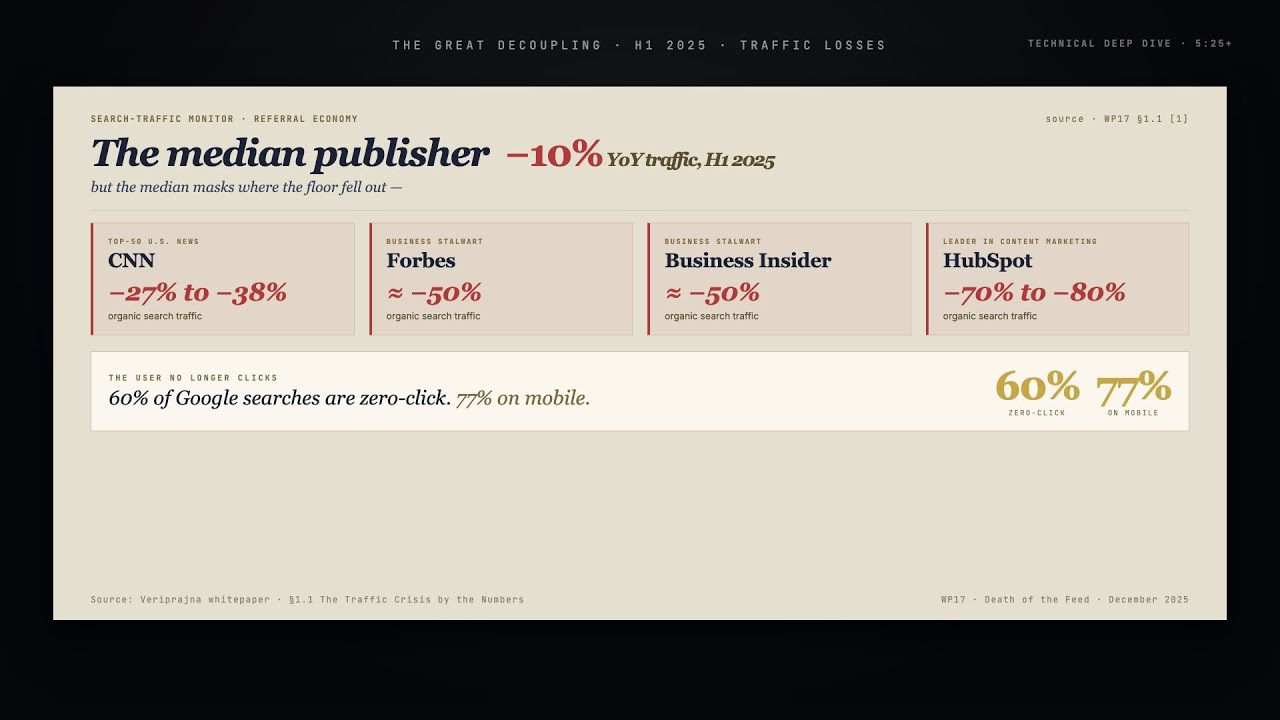
The news feed is dead. 60% of searches are now zero-click—users get their answers without ever visiting publisher websites. Traditional media companies optimized for 20 years to capture clicks are watching traffic evaporate while search volume soars.
This isn't a cyclical downturn—it's a structural obsolescence. The rise of Generative AI, Search Generative Experience (SGE), and conversational interfaces signals a fundamental shift: Users don't want articles. They want answers. Media companies that continue "publishing" face extinction. Those that pivot to "servicing"—selling intelligence, not words—will unlock unprecedented value from their most underutilized asset: their archives.
Search volume is rising, but the flow of traffic to publisher websites is evaporating. This is not a bug—it's the new reality.
In H1 2025, the median publisher saw 10% YoY traffic decline. But the devastation in news is worse: 37 of top 50 U.S. news sites experienced drops.
AI Overviews appear for 13% of queries. When present, CTR to organic links plummets 47%. The search engine has transitioned from signpost to destination.
Users no longer want to wade through 800 words to extract a single fact. They demand synthesis, answers, intelligence—not raw materials.
Data source: The Digital Bloom 2025 Analysis Report
The article format is a relic of the print era—designed to aggregate multiple facts into a linear narrative because physical distribution was expensive. In the digital age, this format imposes a high cognitive load.
A user trying to understand "How has the mayor's stance on housing changed since 2010?" must:
The user asks the same question. The AI system:
"Publishers who continue to view their product solely as 'articles' are manufacturing buggy whips in the age of the automobile. They are creating unstructured data blobs that are difficult for users to consume efficiently but are paradoxically easy for third-party AI models to scrape and monetize."
— Veriprajna Whitepaper, December 2025
The pivot from "Publishing" to "Servicing" moves the value capture point from the distribution of content to the querying of content. It's a transition from volume-based business to utility-based business.
In a world of information abundance, the scarce resource is not the news itself, but the time required to understand it. Shift from selling access to information → selling synthesis of information.
Transform your archive from a "graveyard" of old stories (cost center) into a "knowledge base" of structured facts (profit center). The product is the capability to query across thousands of articles.
The era of scale is over. Winners will be those who provide the most indispensable answers—not the most fleeting eyeballs. High-value users over high-volume users.
The FT built a conversational AI feature allowing professional subscribers to "converse" with their 50-year archive. Key features:
Bloomberg represents the pinnacle of Intelligence-as-a-Service. BloombergGPT allows users to interact with financial data using natural language.
A standard "chatbot" RAG implementation is insufficient. Professional news analysis requires GraphRAG, Temporal RAG, and Agentic workflows—not just keyword matching.
Vector similarity search. Basic keyword matching.
Knowledge graph traversal. Multi-hop reasoning.
Time-stamped edges. Chronological reasoning.
The final layer of sophistication: the LLM acts as a reasoning engine with access to tools. This transforms the system from a "search bar" into a "virtual research assistant."
Breaks "Write due diligence report" into sub-tasks
Executes GraphRAG + Temporal RAG queries
Reviews for gaps, self-corrects before final answer
Synthesizes final report with citations
Transforming a 50-year archive into an Intelligence Engine is a significant undertaking. Here's how we execute.
How do media companies capture value from conversational intelligence?
Super-premium tier for professionals, researchers, corporate clients.
License your RAG engine to enterprise clients.
Your defensibility in the age of commoditized LLMs.
| Metric | Traditional Ad Model | AI Service Model |
|---|---|---|
| Unit of Value | Page View (Impression) | Query / Answer (Intelligence) |
| Revenue Driver | Volume (Traffic Scale) | Utility (High-Value Outcomes) |
| User Relationship | Transactional / Anonymous | Subscription / Authenticated |
| Pricing Power | Low (Commoditized) | High (Specialized Intelligence) |
| Churn Risk | High (Bounce to free sites) | Low (Integrated into workflow) |
| Data Usage | One-time consumption | Repeated querying / Compounding value |
Compare how the same query is handled in traditional vs. conversational intelligence models.
Result: "In 2010, the Mayor ran on a preservationist platform, opposing high-rises [Citation 1]. By 2015, following the affordability crisis, he shifted to a neutral stance, allowing limited development [Citation 2]. In 2022, he fully pivoted, championing the 'Build Now' bill [Citation 3]."
Media companies must pivot from 'publishing' articles to 'servicing' intelligence. With 60% of Google searches now zero-click and AI Overviews reducing CTR by 47%, the article format is structurally obsolete. Companies like the Financial Times (Ask FT) and Bloomberg (BloombergGPT) demonstrate the path forward: transform archives into queryable knowledge bases using GraphRAG and Temporal RAG, then monetize through Intelligence-as-a-Service subscriptions and B2B intelligence APIs priced at $1,000+/year/user.
Naive RAG uses simple vector similarity search that breaks articles into fixed chunks, losing narrative context and temporal awareness. GraphRAG constructs a knowledge graph of entities and relationships (people, organizations, events) enabling multi-hop reasoning — connecting Person X to Scandal Z through intermediate Company Y. Research shows GraphRAG achieves 72-83% improvement in comprehensiveness over baseline RAG, while Temporal RAG adds time-stamped edges enabling chronological queries like tracking how a politician's stance evolved over a decade.
Three primary revenue streams emerge: (1) Intelligence Tier Subscriptions at $1,000+/year for professionals needing unlimited conversational queries and agentic workflows, (2) B2B Intelligence APIs licensing the RAG engine to hedge funds for sentiment analysis, corporate intelligence for competitor tracking, and legal teams for regulatory change histories, and (3) a Proprietary Data Moat where curated knowledge graphs become irreplaceable IP that OpenAI cannot replicate without licensing.
The news feed is dying. The news conversation is being born. Veriprajna helps media companies architect the intelligence infrastructure for this future.
We don't just wrap APIs—we rebuild the foundations of your knowledge infrastructure. Transform your archive into your greatest asset.
Complete technical report: GraphRAG architecture, Temporal RAG implementation, Agentic workflows, hallucination mitigation strategies, B2B monetization models, comprehensive works cited.