The Neuro-Symbolic Imperative: Architecting Deterministic Agents in a Probabilistic Era
Executive Abstract
The artificial intelligence landscape stands at a critical juncture, bifurcated by a fundamental misunderstanding of capability versus reliability. On one side lies the "Chatbot"—a probabilistic engine of linguistic synthesis, capable of mimicking human conversation with uncanny fluency. On the other lies the "Agent"—a deterministic executor of business logic, tasked with manipulating the physical and digital world through API integrations, financial transactions, and stateful workflows. The prevailing industry trend has been to conflate these two distinct entities, wrapping Large Language Models (LLMs) in thin orchestration layers and expecting them to perform as autonomous general-purpose reasoners. This approach, often termed "prompt chaining" or the "LLM Wrapper" model, has precipitated a crisis of reliability in enterprise deployment.
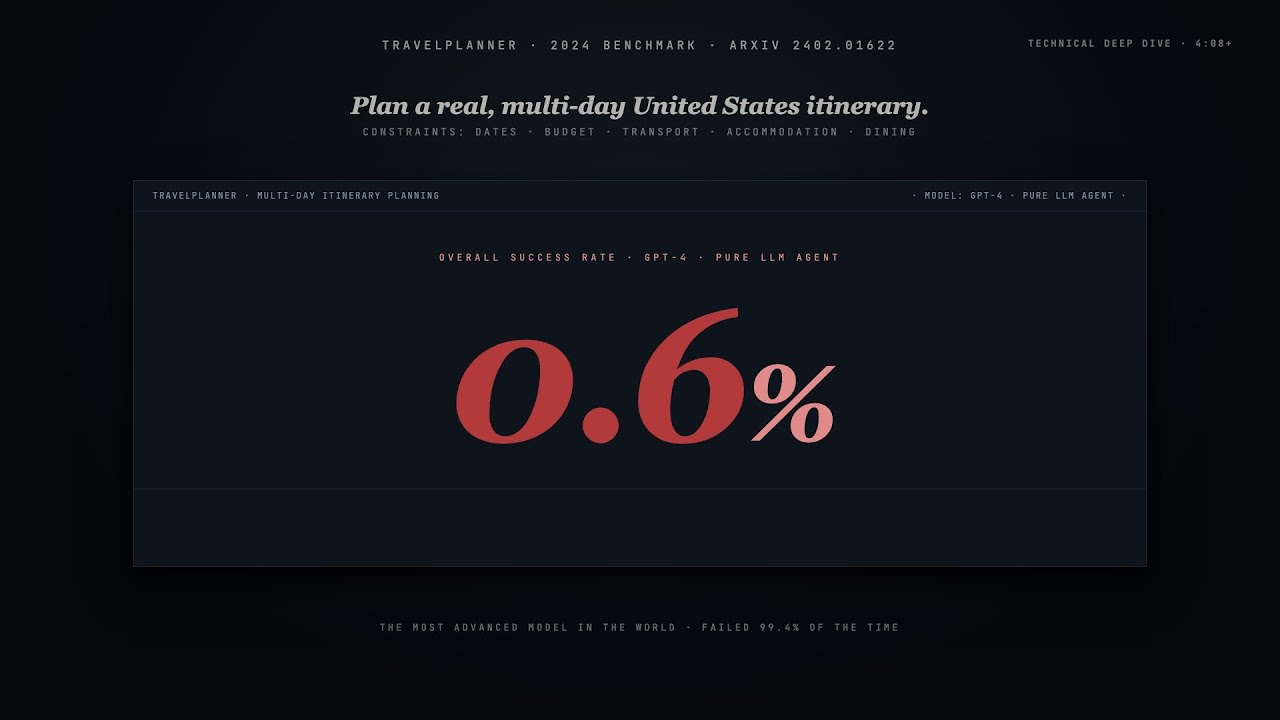
Veriprajna positions itself as the antidote to this architectural fragility. Through rigorous analysis of industry benchmarks—most notably the catastrophic 0.6% success rate of GPT-4 in the TravelPlanner evaluations—and deep engagement with complex legacy systems like Global Distribution Systems (GDS), we have codified a new methodology for enterprise AI: Neuro-Symbolic Orchestration . This whitepaper posits that the path to reliable Agentic AI does not lie in larger models or longer context windows, but in the decoupling of cognitive reasoning from control flow . By embedding probabilistic LLMs within rigid, hard-coded graphs using frameworks like LangGraph, organizations can achieve the best of both worlds: the flexibility of generative AI for data extraction and the ironclad reliability of Finite State Machines (FSMs) for process execution.
1. The Wrapper Delusion: Deconstructing the "Agentic" Hype Cycle
The rapid ascendancy of Generative AI, spearheaded by the transformer architecture, has democratized access to natural language understanding (NLU) capabilities that were previously the domain of specialized research labs. This democratization, however, spawned a premature confidence in the autonomy of these models. The industry witnessed an explosion of "Agent" frameworks—AutoGPT, BabyAGI, and naive implementations of ReAct (Reasoning + Acting)—which operated on a seductive but flawed premise: that an LLM, given a high-level goal and a suite of tools, could autonomously deduce the optimal sequence of actions to achieve any objective.
1.1 The Semantics of Failure
The core issue lies in the semantic gap between "plausibility" and "correctness." LLMs are probabilistic engines designed to predict the next token in a sequence based on statistical likelihood. 1 In creative writing or conversational tasks, this probabilistic nature is a feature, allowing for creativity and nuance. In enterprise workflows—such as supply chain logistics, financial auditing, or travel booking—this feature becomes a critical bug. When an LLM "hallucinates," it is essentially making a statistically probable but factually incorrect prediction. In a chat interface, this is a nuisance; in an API transaction chain, it is a system failure. 2
Veriprajna defines this phenomenon as the "Wrapper Delusion" : the belief that a stochastic model can be coerced into deterministic behavior solely through prompt engineering. Our research indicates that as the complexity of a task increases linearly, the probability of failure increases exponentially in pure LLM architectures. This is not merely a matter of "better prompting"; it is a fundamental mismatch between the architecture of the model (stateless, attention-based) and the requirements of the task (stateful, logic-based). 3
1.2 The Stochastic Trap of Sequential Chaining
The prevailing methodology for building agents—sequential tool chaining—relies on the LLM to act as the central orchestrator. In this model, the LLM receives an output from Tool A, decides which tool to call next (Tool B), formats the input for Tool B, and repeats the process until the task is done. This creates a "Chain of Probability."
If we assume an LLM acts correctly 90% of the time (a generous estimate for complex reasoning tasks), the mathematical reliability of a multi-step workflow degrades rapidly.
● 1 Step: 90% Success Probability
● 5 Steps: $0.90^5 \approx 59%$ Success Probability
● 10 Steps: $0.90^{10} \approx 34%$ Success Probability
In a flight booking workflow involving search, filtering, PNR creation, passenger detail entry, payment, and ticketing, the step count frequently exceeds ten operations. A 34% success rate is unacceptable for enterprise software, yet this is the theoretical ceiling for many pure LLM agents. 4 Real-world benchmarks paint an even grimmer picture, often showing success rates below 1% for complex planning tasks. 5
The industry is littered with "Proof of Concept" agents that work beautifully in a controlled demo environment but collapse under the variance of real-world data. These failures are rarely publicized, creating a "survivorship bias" in the public perception of AI capabilities. We see agents that get stuck in infinite loops, agents that confidently book the wrong dates, and agents that hallucinate successful transactions that never occurred. 2
1.3 Veriprajna’s Stance: Logic is Not a Language Task
Veriprajna asserts that Control Flow is not a Language Task. Deciding what to do next in a rigid business process should not be a matter of token prediction; it should be a matter of conditional logic. The decision to "ask for payment" should only occur if "flight is selected" AND "price is confirmed." This is a boolean condition, not a probabilistic suggestion. By offloading this logic to the LLM, developers are abdicating control of their application's state machine to a black box. 4
Our philosophy moves the "intelligence" from the orchestration layer to the leaf nodes. The LLM should be the worker —extracting data, summarizing text, formatting JSON—while the manager (the orchestration logic) should be hard-coded software. This distinction is the foundation of the Neuro-Symbolic approach, and it is the only path to 99.9% reliability in agentic systems. 8
2. The Empirical Reality: Analyzing the TravelPlanner Benchmark
To move beyond theoretical criticism, we must examine the empirical data. The travel domain serves as the perfect crucible for testing agentic capabilities because it sits at the intersection of "messy" human constraints (preferences, dates, budgets) and "rigid" system constraints (API schemas, flight availability, connection logic).
2.1 The TravelPlanner Benchmark Findings
The TravelPlanner benchmark, a rigorous evaluation framework designed to test Large Language Models on multi-day itinerary planning, provides the most damning evidence against pure LLM orchestration. The benchmark requires agents to plan travel within the United States, adhering to constraints regarding transportation, accommodation, dining, and budgeting. 10
| Metric | GPT-4 (Pure LLM) | Neuro-Symbolic Agent (Code-Driven) |
|---|---|---|
| Overall Success Rate | 0.6% | 97.0% |
| Hard Constraint Pass Rate |
~4.4% | ~99.0% |
| Delivery Rate | ~93% | 100% |
Data synthesized from. 5
The stark disparity between 0.6% and 97% cannot be overstated. It represents the difference between a random number generator and a functioning software product.
2.2 Autopsy of a Failure
Why does the most advanced model in the world fail 99.4% of the time? The failure is not linguistic; GPT-4 understands the request perfectly. The failure is cognitive endurance and state maintenance .
2.2.1 The Context Drift Phenomenon
As an agent iterates through the planning process—searching for flights, then hotels, then restaurants—the context window fills with intermediate data. This accumulation of tokens dilutes the model's attention mechanism. The model might successfully find a hotel within budget in Step 3, but by Step 10, when it is selecting a restaurant, it effectively "forgets" the remaining budget calculated in Step 4. This is known as Context Drift . The "Softmax" attention scores spread too thin over too many irrelevant tokens, causing the model to lose track of the hard constraints established at the start of the session. 2
2.2.2 The Hallucination Cascade
In a tool-chained architecture, the output of one step becomes the input of the next. If the agent makes a subtle error in Step 2—for example, misreading a flight arrival time as 2:00 PM instead of 2:00 AM—it propagates that error downstream. It might book a hotel check-in for the wrong day based on that hallucinated time. The GDS API does not know the agent's intent, only its input, so it processes the request. The agent, seeing a successful API response, reinforces its own error. This Hallucination Cascade creates a "successful" execution trace that results in a disastrous real-world outcome. 2
2.2.3 The "Reasoning-Action Mismatch"
Benchmarks reveal a frequent "Reasoning-Action Mismatch," where the model's internal monologue (Chain of Thought) correctly identifies a constraint, but the subsequent tool call violates it. The model might "think": I need to find a flight under $500, but then generate a tool call for a flight costing $600 because that flight appeared more prominently in the search results context. This disconnect highlights the fragility of using text generation as a proxy for logic execution. 13
2.3 The Neuro-Symbolic Correction
The system that achieved 97% success did not use a "better" LLM. It used a Neuro-Symbolic architecture. It utilized the LLM to parse the user's request into a structured query, but then handed that query to a Solver (a deterministic algorithm) to execute the search and optimization. The LLM was treated as a "Translator," not a "Planner." This architectural shift eliminates context drift because the solver maintains the state (budget, dates) in variables, not in tokens. 10
3. The Crucible of Complexity: Global Distribution Systems (GDS)
To understand why Veriprajna advocates for hard-coded graphs, one must appreciate the hostile environment of enterprise APIs. Flight booking is not a simple REST GET request; it is a complex interaction with Global Distribution Systems (GDS) like Sabre, Amadeus, and Travelport. These systems, designed in the mainframe era, are intolerant of ambiguity.
3.1 The GDS State Machine: A Legacy of Rigidity
A flight booking transaction is a Finite State Machine (FSM) . It requires a precise sequence of operations that cannot be reordered or skipped.
1. Session Initialization (Authentication): The process begins with authenticating against the GDS to obtain a session token. This token represents the "Workbench" or "State." It must be passed explicitly in every subsequent header. If an LLM "forgets" to include this token, or hallucinates a new one, the entire transaction context is lost.15
2. Air Shopping (Search & Offer Management): The Air_Sell or FlightOffersSearch command returns a list of "Offers." Crucially, an Offer is a transient object. The price and availability are dynamic. The GDS returns complex, nested JSON or XML structures containing Fare Basis Codes, Baggage Allowance Models, and Segment References.
○ The Failure Mode: LLMs struggle to ingest these massive payloads (often 50kb+) without truncating them. When they summarize the options for the user, they often strip out the critical offerId or segmentReference needed for the next step, rendering the selection unactionable. 17
3. The "Price" Transaction: Before booking, one must call a "Price" or "Confirm" endpoint. This locks the inventory. The inputs here must match the Search outputs bit-for-bit.
○ The Failure Mode: LLMs act as "lossy compressors." In transferring data from the Search output to the Price input, they frequently "autocorrect" or "normalize" data (e.g., changing a date format or correcting a perceived typo in a fare code), which breaks the cryptographic integrity required by the API. 19
4. PNR Creation (Passenger Name Record): Creating a PNR is a multi-step sub-routine. You must add:
○ Itinerary Segments.
○ Name Elements (strictly formatted: LAST/FIRST MR).
○ Contact Elements (AP - Address Phone).
○ Ticketing Time Limit (TKTL).
○ "Received From" Element (RF).
○ Commit Transaction (ET).
○ The Failure Mode: The order matters. You cannot commit (ET) before adding the
"Received From" (RF) field. An LLM, which has no inherent concept of temporal sequence other than what it learned from training data, frequently attempts to "save" the booking before all mandatory fields are populated, leading to cryptic error codes like ERR 1209 - SEQUENCE ERROR. 15
3.2 The Cryptic Feedback Loop
When a GDS returns an error, it is rarely descriptive. An error like UC (Unable to Confirm) or NO RECAP gives the LLM no semantic clue how to fix the problem.
● LLM Response: The model, trained to be helpful, often interprets the error as a "glitch" and simply retries the exact same request.
● Infinite Loops: This leads to the "Loop of Death," where the agent burns through tokens and API rate limits, repeatedly banging against a wall it cannot understand. 6
● Veriprajna Solution: A hard-coded ErrorHandler node in the graph maps specific error codes (e.g., UC) to specific recovery strategies (e.g., "Trigger Re-Shop Workflow"). The LLM is bypassed entirely during this recovery, preventing the loop. 22
4. The Neuro-Symbolic Renaissance: A Theoretical Framework
The solution to these failures is not "more AI," but "better Computer Science." Veriprajna advocates for the Neuro-Symbolic architecture, a paradigm that fuses the two great traditions of AI: Connectionism (Neural Networks) and Symbolism (Logic/Rules).
4.1 The Best of Both Worlds
● Neural Networks (The "System 1" Brain): Excellent at pattern recognition, fuzzy matching, and natural language understanding. They shine at perception : understanding what the user means when they say, "I want a flight that isn't too early."
● Symbolic AI (The "System 2" Brain): Excellent at rule execution, logic, arithmetic, and consistency. They shine at reasoning : ensuring that If A > B, then C .
In the Veriprajna architecture, we assign responsibilities according to these strengths:
● The LLM is the Interface Layer . It translates unstructured user intent into structured data (JSON).
● The Graph is the Execution Layer . It receives the structured data and executes the business logic using deterministic code. 8
4.2 From Pipelines to Graphs
Traditional software uses Pipelines (Linear execution). Agentic workflows require Cycles (Loops). An agent needs the ability to try a step, fail, analyze the error, and retry. This requirement necessitates a shift from Directed Acyclic Graphs (DAGs)—which move only forward—to Cyclic State Graphs.
● LangChain (in its basic form) popularized the DAG for LLM chains.
● LangGraph introduces the Cyclic Graph, enabling the creation of state machines where edges can loop back to previous nodes based on conditional logic. 24
4.3 The "Supervisor" Pattern
We implement a "Supervisor" architecture where a central, hard-coded state machine governs the lifecycle of the request. The LLM is demoted from "CEO" to "Task Worker."
● The Supervisor (Graph) decides: "We are in the Booking state. The next step is CollectPassengerInfo."
● The Worker (LLM) executes: "Extract the passenger name from this email text."
● The Supervisor (Graph) verifies: "Is the name valid? Yes. Transition state to Payment."
This inversion of control—where code calls the LLM, rather than the LLM writing the code—is the defining characteristic of robust agentic systems. 7
5. Architecting Determinism: The LangGraph Framework
LangGraph serves as the technological backbone of the Veriprajna methodology. It provides the primitives necessary to build stateful, multi-actor applications that are resilient to the stochastic nature of LLMs.
5.1 The Primitives of Control
LangGraph operates on three core concepts: State, Nodes, and Edges .
5.1.1 The Shared State Schema
Unlike standard chatbots that rely on a conversational history (a list of strings), LangGraph relies on a State Schema . This is a typed data structure (typically a Pydantic model or TypedDict) that acts as the "Memory" of the agent.
class FlightBookingState(TypedDict):
    # The conversational history for context
    messages: Annotated[list[AnyMessage], operator.add]

    # Structured variables extracted from the conversation
    origin: Optional[str]
    destination: Optional[str]
    travel_dates: Optional

    # The GDS Session Token (Crucial for transactional integrity)
    session_id: Optional[str]

    # The selected offer object (Raw JSON from API)
    selected_offer: Optional

    # Business logic flags
    is_price_locked: bool
    manager_approval_status: Enum("PENDING", "APPROVED", "REJECTED")
This schema is the "Source of Truth." It persists across the entire workflow. Even if the LLM hallucinates, it cannot overwrite the session_id unless specifically authorized by a node designed to update that field. 25
5.1.2 Nodes: Deterministic Units of Work
Each node in the graph is a Python function.
● Agent Nodes: Call an LLM to perform a specific cognitive task (e.g., "Extract Dates").
● Tool Nodes: Call an external API (e.g., "Amadeus Search").
● Logic Nodes: Execute pure Python code (e.g., "Validate Date Format").
By isolating the API calls into "Tool Nodes" that are executed by Python code (not LLM-generated code), we eliminate "Hallucination Injection." The API call is constructed using the validated variables from the State, ensuring the payload is syntactically perfect every time. 28
5.1.3 Conditional Edges: The Nervous System
The "intelligence" of the routing lives in the Conditional Edges . These are functions that inspect the State and determine the next node.
● Standard LLM Approach: The model outputs "Call Search Tool." (Probabilistic).
● LangGraph Approach: The Edge function reads if state.origin AND state.destination: return "Search_Node" else: return "Ask_User_Node". (Deterministic).
This ensures the agent cannot skip steps. It is physically impossible for the agent to attempt a booking before the selected_offer variable is populated in the State. 24
5.2 Persistence and Checkpointing
Enterprise workflows are long-running. A user might start a booking, get interrupted, and return hours later. LangGraph's Checkpointing feature saves the state to a database (e.g., Postgres, Redis) after every node transition.
● Session Resumption: When the user returns, the graph reloads the exact state from the database. It knows exactly where it left off (e.g., "Waiting for Payment"). It does not need to re-read the entire chat history and re-infer the context; the context is structured and saved. 27
● Time Travel Debugging: If an agent fails in production, developers can load the checkpoint just before the failure and replay the node execution to diagnose the issue. This observability is impossible with black-box LLM chains. 26
6. The Veriprajna Blueprint: A Case Study in Robust Flight Booking
To demonstrate the practical application of these principles, we present the Veriprajna Flight Agent Reference Architecture . This is not a theoretical model; it is a blueprint for a production-grade system capable of interacting with Sabre/Amadeus GDS.
6.1 Architecture Overview
The system is architected as a Hierarchical State Graph .
● The Master Graph: Handles high-level routing (Book Flight vs. Cancel Flight vs. FAQ).
● The Sub-Graph (Flight Booking): Handles the specific FSM of the booking process.
6.2 Detailed Node Walkthrough
Node 1: The "Collector" (Cognitive Layer)
● Function: This node uses an LLM to parse the user's natural language input.
● Goal: Populate the SearchCriteria in the State.
● Technique: We use Guided Generation (e.g., JSON Mode or Function Calling) to force the LLM to output a specific schema: {origin: str, dest: str, date: str}.
● Validation: A Python validator checks if the airport codes are valid (e.g., "LHR" is valid, "London" is ambiguous). If ambiguous, the graph loops back to a "Disambiguation" node, asking the user to clarify "Heathrow or Gatwick?". The LLM is not allowed to guess. 7
Node 2: The "Retriever" (Tool Layer)
● Function: Executes the GDS Search.
● Input: The validated SearchCriteria from the State.
● Action: Calls Amadeus.shopping.flight_offers_search.get().
● Logic:
○ If Response == 200: Save raw JSON to state.flight_cache. Transition to Summarizer.
○ If Response == Empty: Transition to BroadenSearch node (which suggests +/- 3 days).
○ If Response == Error: Transition to GDS_ErrorHandler.
● Key Insight: The LLM is completely bypassed here. The interaction with the API is pure code.
Node 3: The "Summarizer" (Cognitive Layer)
● Function: Converts the raw JSON into a user-friendly message.
● Input: The top 5 offers from state.flight_cache.
● Constraint: The LLM prompt is strictly instructed to only display data present in the JSON. It is forbidden from inventing perks or changing prices.
● Output: "I found 5 flights. The best option is United at $450..."
Node 4: The "Selector" (State Layer)
● Function: Captures the user's selection.
● Action: User says "Book the second one." The LLM resolves "second one" to the specific offer_id in the flight_cache.
● Update: state.selected_offer_id = "eJzTD9..." (The long GDS hash).
● Transition: Move to Pre_Booking_Validation.
Node 5: The "Gatekeeper" (Governance Layer)
● Function: Checks business rules before transaction.
● Logic:
○ Is the price within the corporate policy limit?
○ Is the flight on a blacklisted carrier?
● Conditional Edge:
○ If Violation: Route to ManagerApproval (HITL).
○ If Clean: Route to CreatePNR.
Node 6: The "Transactor" (Tool Layer)
● Function: Executes the PNR creation sequence.
● Sequence:
1. AddSegments(state.selected_offer_id)
2. AddPassenger(state.passenger_details)
3. PricePNR() -> CRITICAL CHECK: Compare returned price vs. cached price.
4. CommitPNR()
● Error Handling: If the GDS returns a "Price Change" warning (common in travel), the node halts and routes to a PriceChangeNotification node, asking the user to confirm the new price. It does not auto-book at the higher rate. 15
6.3 Table: Veriprajna Architecture vs. Standard Wrapper
| Feature | Standard LLM Wrapper | Veriprajna (Neuro-Symbolic Graph) |
|---|---|---|
| Control Flow | Probabilistic (LLM decides next step) |
Deterministic (Graph edges decide) |
| State Persistence | Implicit (Chat History) | Explicit (Database-backed Schema) |
| GDS Interaction | LLM generates JSON body (Prone to errors) |
Code generates JSON body (Type-safe) |
| Error Recovery | "I'm sorry, I failed." (Give up) |
"Error 8102 detected. Retrying with Format B." |
| Looping | Infnite Loop Risk (Token Drain) |
Controlled Loops with Max_Retries |
| Compliance | Opaque "Black Box" | Full Audit Trail of Logic Nodes |
7. The Human Element: Governance and HITL
In the enterprise, the goal of AI is not total autonomy; it is augmented productivity . There are moments where human judgment is legally or operationally required. Pure LLM chains struggle to pause and wait for humans; LangGraph makes this a native primitive.
7.1 The "Interrupt" Pattern
We utilize LangGraph's interrupt_before functionality to create "Airgaps" in the workflow.
● Scenario: A flight costs $2,000. Policy requires manager approval.
● Mechanism: The graph executes up to the Booking node. The Conditional Edge detects price > 1000. It triggers an Interrupt .
● State Freeze: The graph suspends execution. The State is persisted to the database. The memory is freed.
● Offline Action: The system sends an email to the Manager with a link.
● Resumption: The Manager clicks "Approve." The API sends a signal to the Graph
Supervisor. The Graph reloads the State, updates approval_status = APPROVED, and resumes the workflow at the Booking node. 29
7.2 The Audit Trail and Regulatory Compliance
The EU AI Act and emerging US regulations demand transparency for high-risk AI systems (which includes financial transactions like travel booking).
● The Wrapper Problem: An LLM trace is just a mess of tokens. It is hard to prove why the agent booked a specific flight.
● The Graph Solution: Veriprajna provides a Node Execution Log .
○ Log Entry: [2023-10-27 14:00:01] Node:Gatekeeper | Input: Price=1200 | Rule: Policy_Limit=1000 | Output: REJECT_NEED_APPROVAL
○ This log is readable by auditors. It proves that the system followed the governance policy deterministically. 34
8. The Economic Argument: Efficiency and Cost
Beyond reliability, there is a compelling economic argument for the Veriprajna approach. Pure LLM agents are computationally expensive.
8.1 The Cost of Hallucination Loops
When an LLM agent gets stuck in a loop—trying to fix a GDS error by hallucinating new parameters—it generates thousands of input/output tokens. A single "stuck" session can cost $5-$10 in API credits before timing out. By using hard-coded Error Handlers, Veriprajna prevents these loops. The error is caught by code (0 cost), analyzed, and fixed. The LLM is only called when absolutely necessary.2
8.2 Token Optimization
In a Neuro-Symbolic architecture, we do not need to feed the LLM the entire 50kb GDS response. The "Fetcher" node (Code) parses the JSON, extracts the 5 relevant fields, and passes only those to the "Summarizer" node (LLM). This reduces the context window usage by 90%, significantly lowering inference costs and latency. 36
9. Future Outlook: The Evolution of the Graph
The transition from Chatbots to Graphs is not a temporary trend; it is the maturation of the AI industry. As "Agentic" capabilities become standard, the differentiation will shift from "Who has the smartest model?" to "Who has the most robust graph?"
Veriprajna predicts the rise of Standardized Agent Protocols —libraries of pre-built, verified Sub-Graphs for common tasks (e.g., LangGraph.Hub.FlightBooking, LangGraph.Hub.SalesforceUpdate). Enterprises will compose applications by stitching together these verified graphs, using LLMs merely as the glue to smooth the natural language interface.
We are entering the era of Deterministic AI . The magic is not in the prompt; it is in the architecture.
Conclusion
The failure of Large Language Models to reliably conquer the "TravelPlanner" benchmark is not an indictment of AI; it is an indictment of the "Wrapper" methodology. By asking probabilistic models to perform deterministic orchestration, the industry has set them up to fail.
Veriprajna offers a proven path forward. By embracing Neuro-Symbolic Orchestration, we leverage the LLM for what it does best—understanding the nuance of human intent—while retaining the rigor of software engineering for what it does best: executing complex, stateful, compliant business processes.
For the modern enterprise, the choice is clear: You can build a Chatbot that talks about doing work, or you can architect an Agent that does the work. The difference is the Graph.
Works cited
LLM Recap: LLM Limitations and how to overcome them | by Chanon Krittapholchai | Medium, accessed December 11, 2025, https://medium.com/@chanon.krittapholchai/llm-recap-llm-limitations-and-how-to-overcome-them-cecdddf9af8d
Why Do Multi-Agent LLM Systems Fail? Insights for Owners | SEO Locale, accessed December 11, 2025, https://seolocale.com/why-do-multi-agent-llm-systems-fail-insights-for-owners/
What drives Multi-Agent LLM Systems Fail ? - Hugging Face, accessed December 11, 2025, https://huggingface.co/blog/Musamolla/multi-agent-llm-systems-failure
Evaluating LLMs on Sequential API Call Through Automated Test Generation arXiv, accessed December 11, 2025, https://arxiv.org/html/2507.09481v2
TravelPlanner: A Benchmark for Real-World Planning with Language Agents arXiv, accessed December 11, 2025, https://arxiv.org/html/2402.01622v4
Why do Multi-Agent LLM Systems Fail - Galileo AI, accessed December 11, 2025, https://galileo.ai/blog/multi-agent-llm-systems-fail
[D] A contract-driven agent runtime: separating workflows, state, and LLM contract generation : r/MachineLearning - Reddit, accessed December 11, 2025, https://www.reddit.com/r/MachineLearning/comments/1phl090/d_a_contractdriven_agent_runtime_separating/
How Neurosymbolic AI Brings Hybrid Intelligence to Enterprises - Orange Bridge Marketing, accessed December 11, 2025, https://orange-bridge.com/latest-ai-data-trends/neurosymbolic-ai-promises-to-bring-hybrid-intelligence-to-enterprises
Neurosymbolic Programming for AI Agents | by Dorian Smiley - Medium, accessed December 11, 2025, https://dorians.medium.com/neurosymbolic-programming-for-ai-agents-2720257db7f3
CHINATRAVEL: A REAL-WORLD BENCHMARK FOR LANGUAGE AGENTS IN CHINESE TRAVEL PLANNING - OpenReview, accessed December 11, 2025, https://openreview.net/pdf?id=9dfRC2dq0R
TravelPlanner Benchmark - Emergent Mind, accessed December 11, 2025, https://www.emergentmind.com/topics/travelplanner-benchmark
ChinaTravel: A Real-World Benchmark for Language Agents in Chinese Travel Planning, accessed December 11, 2025, https://arxiv.org/html/2412.13682v2
Why Do Multi-Agent LLM Systems Fail? - arXiv, accessed December 11, 2025, https://arxiv.org/pdf/2503.13657
Why Do Multi-Agent LLM Systems Fail? - OpenReview, accessed December 11, 2025, https://openreview.net/pdf?id=MqBzKkb8eK
Air Booking Guide - Support, accessed December 11, 2025, https://support.travelport.com/webhelp/JSONAPIs/Airv11/Content/Air11/Book/BookingGuide.htm
Sabre API Integration Guide for Travel Portals Flights Hotel - phptravels, accessed December 11, 2025, https://phptravels.com/blog/sabre-api-integration
Flight APIs Tutorial - Amadeus for Developers, accessed December 11, 2025, https://developers.amadeus.com/self-service/apis-docs/guides/developer-guides/resources/flights/
Sabre Air API Solutions | Flight Shopping & Pricing API - Traveltekpro, accessed December 11, 2025, https://traveltekpro.com/sabre-air-api-solutions-flight-shopping-pricing-api/
Toolchaining: The Problem No One is Talking About | Scale, accessed December 11, 2025, https://scale.com/blog/toolchaining-llm-plans
Sabre API Integration: Hands-On Experience with a Leading GDS - AltexSoft, accessed December 11, 2025, https://www.altexsoft.com/blog/sabre-api-integration/
How to Integrate a Flight Booking API: A Step-by-Step Guide - Traveltekpro, accessed December 11, 2025, https://traveltekpro.com/how-to-integrate-a-flight-booking-api-a-step-by-step-guide/
LangGraph State Machines: Managing Complex Agent Task Flows in Production, accessed December 11, 2025, https://dev.to/jamesli/langgraph-state-machines-managing-complex-agent-task-flows-in-production-36f4
Building Better Agentic Systems with Neuro-Symbolic AI | Cutter Consortium, accessed December 11, 2025, https://www.cuter.com/article/building-bett er-agentic-systems-neuro-symbolic-t ai
LangChain vs LangGraph: Explained - Peliqan, accessed December 11, 2025, https://peliqan.io/blog/langchain-vs-langgraph/
What is LangGraph and How It Is Useful In Building LLM-Based Applications? Ampcome, accessed December 11, 2025, https://www.ampcome.com/articles/what-is-langgraph-how-it-is-useful-in-building-llm-based-applications
LangChain Vs LangGraph: Best, Definitive 2025 Agents Guide, accessed December 11, 2025, https://binaryverseai.com/langchain-vs-langgraph-decision-guide-framework/
LangGraph State: The Engine Behind Smarter AI Workflows - CloudThat Resources, accessed December 11, 2025, https://www.cloudthat.com/resources/blog/langgraph-state-the-engine-behind-smarter-ai-workflows
AI Agent Workflows: A Complete Guide on Whether to Build With LangGraph or LangChain, accessed December 11, 2025, https://towardsdatascience.com/ai-agent-workflows-a-complete-guide-on-whether-to-build-with-langgraph-or-langchain-117025509fa0/
Why use LangGraph? : r/AI_Agents - Reddit, accessed December 11, 2025, https://www.reddit.com/r/AI_Agents/comments/1l4uq7v/why_use_langgraph/
LangChain vs. LangGraph: A Developer's Guide to Choosing Your AI Workflow, accessed December 11, 2025, https://duplocloud.com/blog/langchain-vs-langgraph/
What is LangGraph? - IBM, accessed December 11, 2025, https://www.ibm.com/think/topics/langgraph
Constraining LLM Outputs with Finite State Machines | by Chirag Bajaj | Medium, accessed December 11, 2025, https://medium.com/@chiragbajaj25/constraining-llm-outputs-with-finite-state-machines-79ca9e336b1f
Human in the Loop AI: Benefits, Use Cases, and Best Practices - WitnessAI, accessed December 11, 2025, https://witness.ai/blog/human-in-the-loop-ai/
What Is Human In The Loop (HITL)? - IBM, accessed December 11, 2025, https://www.ibm.com/think/topics/human-in-the-loop
The Human-AI Agents Partnership: In-, On-, or Out-of-the-Loop? - Lumenova AI, accessed December 11, 2025, https://www.lumenova.ai/blog/ai-agents-the-human-ai-partnership/
LLM Inference Optimization Techniques | Clarifai Guide, accessed December 11, 2025, https://www.clarifai.com/blog/llm-inference-optimization/
Effective context engineering for AI agents - Anthropic, accessed December 11, 2025, https://www.anthropic.com/engineering/efective-context-engineering-for-ai-agfents
Prefer a visual, interactive experience?
Explore the key findings, stats, and architecture of this paper in an interactive format with navigable sections and data visualizations.
Frequently Asked Questions
Why do pure LLM agents fail at complex multi-step enterprise tasks?
LLM agents degrade exponentially with task complexity. At 90% per-step accuracy, a 5-step workflow drops to 59% success, and 10 steps collapses to 34%. On the TravelPlanner benchmark, GPT-4 achieved only 0.6% overall success despite understanding requests perfectly — the failures stem from cognitive endurance, state maintenance, and context drift, not linguistic capability. Sequential tool chaining creates a 'Chain of Probability' where each decision point multiplies the failure risk, and models enter infinite retry loops when encountering cryptic system errors.
What is neuro-symbolic orchestration for enterprise AI agents?
Neuro-symbolic orchestration separates the LLM (System 1 neural perception) from the control flow (System 2 symbolic reasoning). The LLM serves as the interface layer — translating unstructured user intent into structured JSON. The graph serves as the execution layer — running deterministic business logic through hard-coded conditional edges, typed state management, and persistence checkpointing. This mirrors human cognition where rapid pattern matching is governed by deliberate logical reasoning, achieving 97% reliability versus 0.6% for pure LLM approaches.
How does LangGraph solve the infinite loop problem in AI agents?
LangGraph replaces probabilistic orchestration with deterministic cyclic state graphs. When a GDS system returns a cryptic error like ERR 1209 or UC, a hard-coded ErrorHandler node maps the specific error code to a recovery strategy — bypassing the LLM entirely during recovery to prevent the 'Loop of Death' where agents burn through tokens retrying identical failed requests. Persistence and checkpointing preserve transactional state across failures, and the Supervisor pattern ensures LLMs only act as workers within bounded tasks while coded managers control transitions.
Also Published On
Build Your AI with Confidence.
Partner with a team that has deep experience in building the next generation of enterprise AI. Let us help you design, build, and deploy an AI strategy you can trust.
Veriprajna Deep Tech Consultancy specializes in building safety-critical AI systems for healthcare, finance, and regulatory domains. Our architectures are validated against established protocols with comprehensive compliance documentation.