Architecting Deterministic Agents in a Probabilistic Era
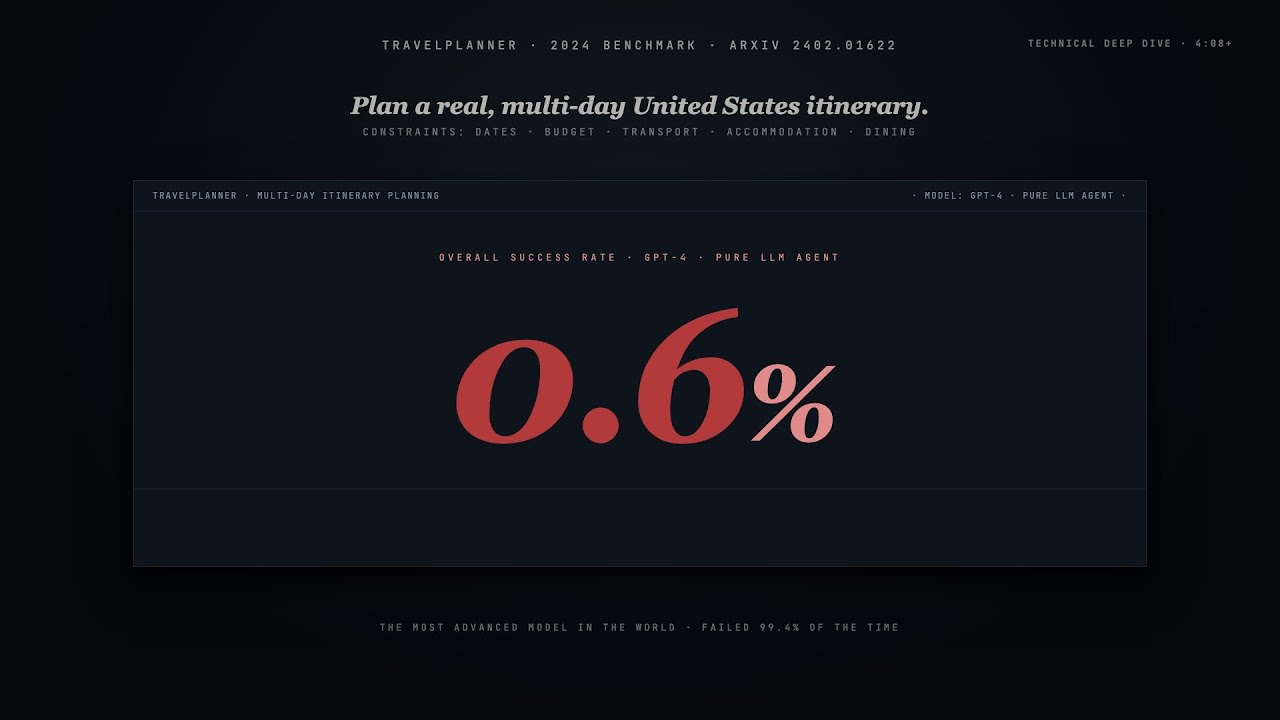
Pure LLM agents fail 99.4% of the time in complex enterprise workflows. The industry has conflated chatbots with agents, wrapping probabilistic models in thin orchestration layers and expecting them to perform as autonomous reasoners. This is the "Wrapper Delusion."
Veriprajna's Neuro-Symbolic Orchestration achieves 97% success rates by decoupling cognitive reasoning from control flow—embedding LLMs within rigid, hard-coded graphs using frameworks like LangGraph.
Veriprajna partners with enterprises deploying agentic AI for mission-critical workflows—travel booking, financial transactions, supply chain logistics, and legacy system integration.
Move from "Proof of Concept" to production. Our Neuro-Symbolic architecture eliminates the reliability gap, achieving 99.9% uptime for stateful workflows that pure LLM wrappers cannot deliver.
Stop fighting hallucination loops and context drift. LangGraph's state machines give you precise control over workflow execution while leveraging LLMs for natural language understanding.
Reduce LLM API costs by 90% through token optimization. Our architecture prevents expensive hallucination loops and passes only essential data to the LLM—not 50KB raw API responses.
The belief that a stochastic model can be coerced into deterministic behavior solely through prompt engineering.
LLMs predict the next token based on statistical likelihood. In creative writing, this is a feature. In API transaction chains, this is a system failure. "Plausibility" ≠ "Correctness."
If each step succeeds 90% of the time, a 10-step workflow has only 34% success rate. Flight booking involves 10+ operations—search, filter, price, PNR creation, payment, ticketing.
Control Flow is Not a Language Task. Deciding "what to do next" should be conditional logic, not token prediction. Move intelligence from orchestration to leaf nodes.
"As task complexity increases linearly, the probability of failure increases exponentially in pure LLM architectures. This is not a matter of 'better prompting'—it is a fundamental mismatch between the architecture of the model (stateless, attention-based) and the requirements of the task (stateful, logic-based)."
— Veriprajna Technical Whitepaper, 2025
Sequential tool chaining creates exponential failure risk. When an LLM orchestrates multi-step workflows, each decision compounds the error rate.
A flight booking workflow involves: Search → Filter → Offer Selection → Price Lock → PNR Creation → Passenger Details → Payment → Ticketing. That's 8+ sequential steps where a single error cascades downstream.
Adjust the sliders to see how per-step accuracy and workflow complexity impact overall success probability.
Typical LLM accuracy for complex reasoning tasks
Flight booking typically requires 10-15 steps
The travel domain sits at the intersection of "messy" human constraints and "rigid" system constraints—making it the perfect crucible for testing agentic capabilities.
| Metric | GPT-4 (Pure LLM) | Neuro-Symbolic Agent | Improvement |
|---|---|---|---|
| Overall Success Rate | 0.6% | 97.0% | 161× better |
| Hard Constraint Pass Rate | ~4.4% | ~99.0% | 22× better |
| Delivery Rate | ~93% | 100% | +7% |
| Common Sense Pass Rate | ~63% | ~100% | +37% |
As the agent iterates through planning steps, the context window fills with intermediate data, diluting attention. By Step 10, the model "forgets" the budget calculated in Step 4.
A subtle error in Step 2 (misreading arrival time as 2:00 PM instead of 2:00 AM) propagates downstream. The agent books a hotel for the wrong day, reinforcing its own error.
The model's Chain of Thought correctly identifies "find flight under $500," but the subsequent tool call books a $600 flight because it appeared prominently in search results.
Flight booking is not a simple REST GET request. It's a complex Finite State Machine (FSM) interaction with GDS systems like Sabre, Amadeus, and Travelport—designed in the mainframe era and intolerant of ambiguity.
Authenticate to obtain session token. Must be passed in every subsequent header. If LLM forgets or hallucinates, entire context is lost.
GDS returns 50KB+ nested JSON with transient "Offers." LLMs often strip out critical offerId needed for next step when summarizing.
Inputs must match Search outputs bit-for-bit. LLMs "autocorrect" date formats or fare codes, breaking cryptographic integrity.
Multi-step subroutine with strict ordering. Cannot commit (ET) before adding "Received From" (RF). LLMs violate sequence, get ERR 1209.
GDS errors are rarely descriptive. "UC" (Unable to Confirm) or "NO RECAP" gives the LLM no semantic clue. It retries the exact same request, burning tokens in infinite loops.
Hard-coded ErrorHandler node maps specific error codes to recovery strategies. "UC" triggers Re-Shop workflow. LLM bypassed entirely during recovery.
Fusing Connectionism (Neural Networks) and Symbolism (Logic/Rules). The LLM is the Interface Layer. The Graph is the Execution Layer.
Excellent at perception: pattern recognition, fuzzy matching, natural language understanding. Shines at understanding what the user means when they say "I want a flight that isn't too early."
Excellent at reasoning: rule execution, logic, arithmetic, consistency. Shines at ensuring that If A > B, then C. Guarantees constraint satisfaction.
Traditional software uses linear pipelines. Agentic workflows require cycles—the ability to try, fail, analyze, and retry.
Typed data structure (Pydantic/TypedDict) acts as "Memory." Persists across workflow. LLM cannot overwrite session_id unless explicitly authorized.
Deterministic units of work. Agent Nodes call LLMs. Tool Nodes call APIs. Logic Nodes execute Python. API calls constructed from validated State variables.
Routing intelligence lives here, not in LLM. Python function inspects State and returns next node name. Deterministic, not probabilistic.
Production-ready capabilities that pure LLM wrappers cannot deliver
Long-running workflows (user starts booking, gets interrupted, returns hours later). LangGraph saves state to database after every node transition.
Enterprise AI goal: augmented productivity, not total autonomy. Legal/operational moments require human judgment. LangGraph makes this a native primitive.
EU AI Act demands transparency for high-risk AI (financial transactions). Pure LLM traces are token messes. Veriprajna provides readable Node Execution Logs.
Pure LLM agents are computationally expensive. Hallucination loops generate thousands of tokens. Single stuck session can cost $5-$10 in API credits.
Production-grade system capable of interacting with Sabre/Amadeus GDS using hierarchical state graphs
Uses LLM to parse natural language input. Goal: Populate SearchCriteria in State. Uses Guided Generation (JSON Mode) to force specific schema output.
Executes GDS Search using validated SearchCriteria. Calls Amadeus API. LLM completely bypassed—interaction is pure code.
Converts raw JSON into user-friendly message. Prompt strictly instructs to only display data from JSON—forbidden from inventing perks or changing prices.
Checks business rules before transaction. Is price within corporate policy? Is carrier blacklisted?
Executes PNR creation sequence: AddSegments → AddPassenger → PricePNR (compare vs cached) → CommitPNR.
The system that achieved 97% success in TravelPlanner did not use a "better" LLM. It used a Neuro-Symbolic architecture.
The LLM was treated as a Translator, not a Planner. A deterministic Solver executed search and optimization, maintaining state in variables—not tokens.
Three compounding failure modes cause pure LLM agents to achieve only 0.6% success on the TravelPlanner benchmark. First, the Chain of Probability: if each step succeeds 90% of the time, a 10-step workflow has only 34% success rate (0.9 to the power of 10). Flight booking requires 10+ sequential operations. Second, Context Drift: as the context window fills with intermediate data, softmax attention spreads too thin, causing the agent to 'forget' constraints like budget limits set in earlier steps. Third, Hallucination Cascade: a subtle error in Step 2 (misreading 2:00 AM as 2:00 PM) propagates through all downstream steps, with the agent reinforcing its own errors. The fundamental issue is architectural: control flow (deciding what to do next) is a logic task, not a language task.
The key architectural inversion is treating the LLM as a Translator (perception), not a Planner (control). In Veriprajna's architecture: Control flow uses deterministic graph edges (Python conditional logic), not probabilistic token prediction. State persistence uses explicit typed database schemas (Pydantic/TypedDict), not implicit chat history. API interaction uses code-generated type-safe JSON, not LLM-generated payloads prone to format errors. Error recovery uses mapped deterministic strategies, not retry-and-hope loops. The LLM handles what it excels at — extracting structured data from natural language, resolving ambiguous references, and generating human-friendly summaries. The graph handles what requires determinism — budget validation, API sequencing, constraint checking. This eliminates context drift because constraints live in typed state variables, not attention windows.
LangGraph provides four critical enterprise capabilities. Persistence and Checkpointing: state saved to database after every node transition, enabling session resumption hours later and time-travel debugging where engineers can load any checkpoint and replay execution. Human-in-the-Loop (HITL): native interrupt patterns where the graph suspends at approval gates (e.g., flight costs exceed $1,000 policy limit), emails a manager, and resumes only after human approval. Audit Trail and Compliance: node execution logs show exactly why each decision was made, meeting EU AI Act transparency requirements for high-risk AI. Cost Optimization: hard-coded error handlers prevent hallucination loops (which cost $5-$10 per stuck session), and code-driven context compression reduces token usage by 90% — passing only 5 relevant fields to the LLM instead of 50KB raw GDS responses.
The difference is the Graph. Veriprajna's Neuro-Symbolic methodology doesn't just improve success rates—it fundamentally changes the architecture of autonomous systems.
Schedule a consultation to architect production-grade agentic AI for your enterprise workflows.
Complete engineering report: LangGraph architecture, State Schema design, TravelPlanner benchmark analysis, GDS integration patterns, HITL workflows, EU AI Act compliance, comprehensive works cited.