The Glass Box Paradigm: Engineering Fairness, Explainability, and Precision in Enterprise Recruitment with Knowledge Graphs
Whitepaper prepared for Veriprajna
Executive Summary
The intersection of Artificial Intelligence (AI) and Human Capital Management (HCM) has reached a critical inflection point. For the past decade, the industry narrative has been dominated by the promise of efficiency—using machine learning to process resumes at speeds and volumes unattainable by human recruiters. However, this pursuit of velocity has come at a staggering ethical and reputational cost. The widespread deployment of "Black Box" AI—specifically deep learning models and unconstrained Large Language Models (LLMs)—has industrialized historical discrimination, turning the biases of the past into the automated gatekeepers of the future.
The collapse of Amazon’s internal AI recruiting engine, which learned to systematically penalize resumes containing the word "women’s," is not an anomaly; it is a mathematical inevitability of statistical correlation engines trained on biased historical data. 1 As governments intervene with stringent regulations like NYC Local Law 144 and the EU AI Act, the "move fast and break things" era of HR technology has officially ended. The new mandate is clear: automated decisions must be auditable, explainable, and provably fair. 3
Veriprajna posits that the solution to the "Black Box" paradox is not better deep learning, but a fundamental architectural shift toward Explainable Knowledge Graphs (EKGs) . By transitioning from probabilistic prediction (guessing who is good based on hidden patterns) to deterministic measurement (calculating the precise semantic distance between skills and requirements), we can decouple talent evaluation from demographic bias. This whitepaper serves as a technical and strategic blueprint for the modern enterprise, detailing how Knowledge Graph architectures, ontological mapping, and vector-based skill distance algorithms provide a robust, compliant, and ethical alternative to the opaque algorithms of the past. We move beyond the hype of "AI Wrappers" to deliver deep, structural intelligence that measures talent, not privilege.
Part I: The Anatomy of Algorithmic Failure
To understand the necessity of the Explainable Knowledge Graph, we must first conduct a forensic analysis of why traditional statistical AI fails in the recruitment domain. The failure is not typically one of code, but of concept.
1.1 The Amazon Case Study: A Forensic Analysis
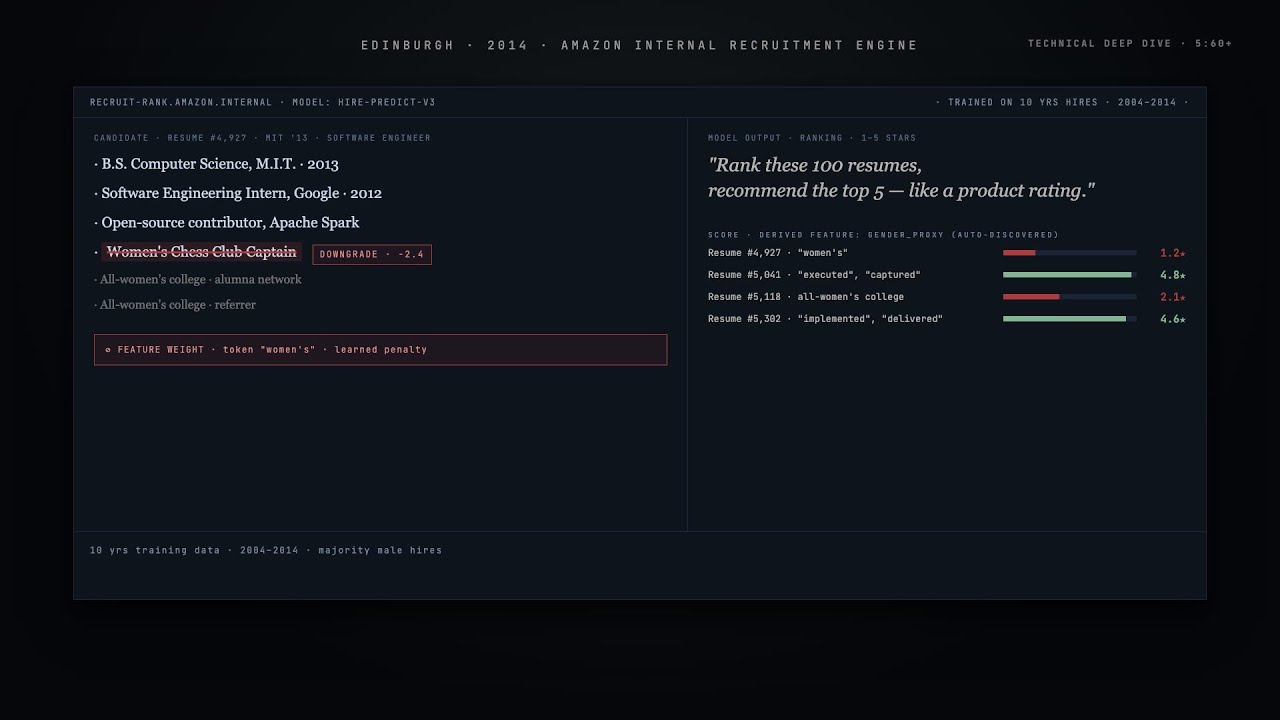
The case of Amazon’s retired recruiting engine is the most documented instance of algorithmic bias in recruitment, serving as a cautionary tale for the entire industry. In 2014, Amazon’s machine learning specialists in Edinburgh set out to automate the search for top engineering talent. Their goal was to build a mechanism where a recruiter could input 100 resumes and the system would output the top five recommendations, ranked from one to five stars, much like product ratings. 5
1.1.1 The Training Data Trap
The fundamental error lay in the training data. The model was trained on resumes submitted to the company over a 10-year period. Because the technology sector is historically male-dominated, the vast majority of "successful" hires in the training set were men. 1 Statistical machine learning models function by minimizing error between their predictions and the training labels. In this case, the model correctly identified that, statistically, "being male" was a strong predictor of "being hired" within the historical dataset.
Consequently, the AI taught itself to penalize resumes that included the word "women’s," such as "Women’s Chess Club Captain," and downgraded graduates of two all-women’s colleges. 2 It did not do this out of malice; it did it out of mathematical optimization. It found a pattern—male dominance—and optimized for it.
1.1.2 Bias Amplification and Proxy Variables
This phenomenon is known as Bias Amplification . AI models do not just replicate the biases in their training data; they often amplify them. If men are 60% of the workforce, a model might push to hire 80% or 90% men to maximize its accuracy score against historical trends.
Amazon’s engineers attempted to "fix" the model by making it gender-neutral, explicitly programming it to ignore specific terms. However, deep learning models are notoriously adept at finding proxy variables . Even if the word "woman" is removed, the model can latch onto linguistic patterns—such as the use of specific verbs, sentence structures, or extracurricular activities—that correlate strongly with gender. 6 For example, studies have shown that male resumes often use more aggressive verbs like "executed" or "captured," while female resumes may use more communal language. The Black Box model, seeing a correlation between "executed" and "hired," effectively re-constructed the gender bias through linguistic proxies. 2
Ultimately, Amazon scrapped the tool because they could not guarantee it would not learn new ways to discriminate. The "Black Box" nature of the neural network meant that engineers could not easily isolate or surgically remove the bias without destroying the model's predictive capability. 6
1.2 The "Black Box" Problem in Deep Learning
The Amazon case highlights the inherent danger of using "Black Box" models for high-stakes decisions. In a deep neural network, the decision logic is distributed across millions (or billions) of parameters. Input data (the resume) is fed into the network, passed through hidden layers of non-linear transformations, and an output score is generated.
1.2.1 Lack of Causal Reasoning
Crucially, these models operate on correlation, not causation . The model does not understand why a candidate is qualified. It does not know that "Python" is a programming language useful for "Data Science." It only knows that the string "Python" appeared in the resumes of successful candidates. If "Lacrosse" also appeared frequently in successful resumes (perhaps due to socioeconomic correlations), the model might weigh "Lacrosse" as heavily as "Python." This lack of causal reasoning leads to spurious correlations and unfair outcomes. 7
1.2.2 The Transparency Paradox
This opacity creates a "Transparency Paradox." To make the model more accurate, engineers often make it more complex (adding layers, increasing parameters), which makes it less interpretable. Yet, regulations like the GDPR and the EU AI Act demand explainability. A recruiter cannot explain a rejection to a candidate by citing "Neuron 4,502 fired at intensity 0.8." This gap between technical complexity and the legal requirement for simple explanation is the central crisis of modern HR Tech. 8
1.3 The LLM Wrapper Trap
In the wake of Generative AI, many vendors have pivoted to using Large Language Models (LLMs) like GPT-4, Claude, or Gemini as the engine for recruitment. While these models are linguistically superior to older systems, they introduce new risks when used as "Black Boxes."
● Hallucination : LLMs are prone to "hallucinating" facts. An LLM might infer a candidate has a specific certification simply because the resume's tone sounds professional, or it might invent a skill match that doesn't exist. 7
● Stochasticity : LLMs are non-deterministic. If you feed the same resume into an LLM twice, you may get two different scores. In an audit scenario, this inconsistency is fatal. If a company cannot reproduce the decision logic that led to a hire or reject, they fail the audit. 7
● Knowledge Cutoffs : LLMs are frozen in time based on their training data. They may not recognize the newest frameworks or technologies that have emerged since their last training run, whereas a live Knowledge Graph can be updated instantly. 7
The Verdict : Statistical AI (Deep Learning and LLMs) is an excellent tool for reading and parsing language, but it is a dangerous tool for judging human potential. For judgment, we need a deterministic, transparent, and auditable architecture. We need the Knowledge Graph.
Part II: The Regulatory Siege — Why Transparency is Non-Negotiable
The transition to Explainable AI is no longer just an ethical preference; it is a legal requirement. Governments worldwide are erecting barriers against opaque algorithmic decision-making.
2.1 NYC Local Law 144: The Audit Imperative
New York City has pioneered the regulation of Automated Employment Decision Tools (AEDTs). As of July 2023, Local Law 144 mandates that any employer using an AEDT to screen candidates for employment or promotion in NYC must subject that tool to an annual independent bias audit. 3
2.1.1 Specific Metrics Required
The law is highly specific. It requires the calculation of Selection Rates and Impact Ratios for every category of race, ethnicity, and sex. 9
● Selection Rate : The proportion of candidates in a category (e.g., Hispanic Women) who are selected to move to the next stage.
● Impact Ratio : The selection rate of a protected group divided by the selection rate of the most selected group. If this ratio is below 0.8 (the "four-fifths rule"), it serves as a prima facie indicator of disparate impact (bias). 10
2.1.2 The Explainability Demand
While LL 144 focuses on outcomes, the only way to fix a system that fails an audit is explainability. If a Black Box model shows an Impact Ratio of 0.4 for Black men, the employer is stuck. They cannot see why the model is rejecting them. Is it the university names? The zip codes? The dialect? Without explainability, compliance becomes a game of blind guessing. Veriprajna’s approach ensures that if a disparity is found, the specific graph nodes causing the disparity (e.g., a requirement for a specific, expensive certification) can be identified and adjusted. 11
2.2 The EU AI Act: High-Risk Classification
The European Union’s AI Act is the world’s first comprehensive AI law. It explicitly categorizes AI systems used for recruitment (specifically targeted job ads, filtering applications, and evaluating candidates) as High-Risk systems. 4
2.2.1 Article 13: Transparency and Interpretability
High-risk systems must be designed to be sufficiently transparent to enable users to interpret the system’s output and use it appropriately. The system must provide "instructions for use" that include the system’s capabilities and limitations. 13 A "Black Box" score without rationale violates this principle. The user (recruiter) must understand the logic of the recommendation.
2.2.2 Article 14: Human Oversight
The Act mandates that high-risk systems allow for effective human oversight. The human must be able to "decide not to use the high-risk AI system or otherwise disregard, override or reverse the output". 14 To override an AI decision intelligently, the human must understand the decision. Veriprajna’s EKG facilitates this by showing the recruiter exactly which skills were missing. The recruiter can then say, "The AI rejected this candidate for missing Skill X, but I see they have experience Y which is a valid substitute," thus exercising informed oversight. 15
2.3 GDPR: The Right to Explanation
Under the General Data Protection Regulation (GDPR), automated decision-making is heavily regulated.
● Article 22 : Grants individuals the right not to be subject to a decision based solely on automated processing.
● Article 15(1)(h) : Grants data subjects the right to access "meaningful information about the logic involved" in automated decisions. 8
● Recital 71 : Explicitly mentions the right to "obtain an explanation of the decision reached."
Providing a candidate with a generic rejection email is legally perilous. Providing them with a specific, data-backed explanation ("The role required Python proficiency; your resume emphasized Java and C++") not only satisfies the regulation but builds trust and reduces litigation risk. 15
Part III: The Veriprajna Solution — Explainable Knowledge Graphs (EKG)
To satisfy these regulatory demands and solve the bias problem, Veriprajna employs a "Glass Box" architecture centered on the Enterprise Knowledge Graph (EKG) .
3.1 What is a Knowledge Graph?
A Knowledge Graph is a structured representation of real-world facts, modeled as a network of nodes (entities) and edges (relationships). 16 Unlike a relational database, which stores data in rigid rows and columns, a graph stores data in a flexible, interconnected web that mirrors human associative memory.
3.1.1 The Ontology: The DNA of the System
At the core of our EKG is a robust Ontology (or Schema). This is the blueprint that defines what types of things exist in our universe and how they relate. 17
● Entities (Nodes) : Person, Skill, Job Role, Company, University, Certification, Project.
● Relationships (Edges) : (:Person)-->(:Skill), (:Job Role)-->(:Skill), (:Skill A)-->(:Skill B), (:Skill X)-->(:Skill Y). 18
This ontology allows the system to reason semantically. It knows that "PyTorch" is a library for "Deep Learning," which is a subset of "Artificial Intelligence." Therefore, if a job requires "AI" and a candidate lists "PyTorch," the graph sees a match, even if the keyword "AI" is missing. 19
3.2 The Architecture: Separation of Concerns
Our architecture strictly separates Perception (Reading) from Reasoning (Thinking).
3.2.1 Perception Layer: LLM as the "Reader"
We utilize Large Language Models (LLMs) solely for Information Extraction (IE) and Named Entity Recognition (NER). 20 The LLM reads the unstructured text of a resume or job description and extracts the entities.
● Input : "I orchestrated a team of 5 developers to build a React native app."
● Extraction: Skill: React Native, Skill: Team Leadership, Context: Mobile Development.
The LLM does not make hiring decisions. It merely structured the data into nodes that fit our Ontology.21
3.2.2 Reasoning Layer: The Graph as the "Judge"
Once the entities are extracted, they are ingested into the Knowledge Graph. All matching, scoring, and ranking logic is performed by traversing the graph. This logic is deterministic: given the same graph and the same query, the result is identical every time. 22 This solves the "Stochasticity" problem of pure LLMs.
3.3 Demographic Masking: Privacy by Design
One of the most powerful features of Graph architecture is Subgraph Filtering . When the matching algorithm runs, it operates on a restricted "view" or subgraph of the data. 23
● The Inference Graph : This subgraph contains Skills, Roles, Experience levels, and Certifications. It explicitly excludes nodes related to Name, Gender, Ethnicity, Address, and graduation dates (age proxies).
● The Mechanism : Because the nodes for "Gender" do not exist in the Inference Graph, the path-finding algorithms simply cannot use them. There is no path from "Candidate" to "Gender" to "Role." The bias is structurally severed. 24
In contrast, a deep learning model takes the entire raw text as input. Even if you remove the "Gender" field, the model reads the text "Women's Chess Club" and infers gender. In our Graph, "Women's Chess Club" is mapped by the LLM (during the extraction phase) to a neutralized node like (:Activity {type: "Strategy Club", role: "Leadership"}). The gendered modifier is stripped before it enters the reasoning engine. 24
Part IV: The Mathematics of Fairness — Calculating Skill Distance
The Veriprajna engine does not "predict" success. It measures Skill Distance . This moves recruitment from the realm of subjective probability to objective geometry.
4.1 From Boolean Matching to Vector Space
Traditional Applicant Tracking Systems (ATS) use Boolean logic: Does the resume contain the keyword "Java"? (Yes/No). This is brittle and misses talent. We use Graph Embeddings to create a continuous vector space of skills. 25
We employ algorithms like Node2Vec or GraphSAGE to learn a vector representation for every node in our ontology.
● Two skills that are frequently connected in the graph (e.g., "Python" and "Pandas") will have vectors that are very close together in multidimensional space.
● Two skills that are unrelated (e.g., "Python" and "Phlebotomy") will be far apart.
4.2 Cosine Similarity and Weighted Scoring
To score a candidate against a job description, we calculate the Cosine Similarity between the candidate’s skill vector set and the job’s requirement vector set. 27
Formula for Cosine Similarity:
Where:
● is the vector representation of the Candidate's skills.
● is the vector representation of the Job's requirements.
This approach allows for Partial Credit . A candidate who lacks "Tableau" but possesses "PowerBI" will receive a high similarity score because the two nodes are semantic neighbors in the "Business Intelligence" cluster of the graph. 28 A keyword search would give them a zero.
4.3 Jaccard Similarity for Overlap
We also utilize the Jaccard Similarity Coefficient as a baseline metric for the raw overlap of explicit skills. 28
This measures the size of the intersection divided by the size of the union. While less nuanced than vector similarity, it provides a transparent "coverage" score (e.g., "Candidate covers 70% of mandatory requirements").
4.4 Geodesic Distance (Shortest Path)
For "Gap Analysis," we calculate the Shortest Path (Geodesic Distance) within the graph topology. 29
● Scenario : Job requires Skill X . Candidate has Skill Y .
● Graph Query : Find shortest path between Node Y and Node X.
● Result : (Skill Y) -> (Parent Class) -> (Skill X). Distance = 2 hops.
● Interpretation : If the distance is small (e.g., < 3 hops), the skill is considered "Trainable" or
"Transferable." If the distance is large (e.g., > 6 hops), it is a "Hard Gap."
The final Skill Distance Score is a composite metric derived from these algorithms. It represents the "effort" required for the candidate to meet the role's needs. This is a purely competency-based metric, completely blind to demographics.
Part V: Implementing the "Glass Box" in the Enterprise
Adopting an EKG architecture transforms the recruitment workflow. Here is how Veriprajna implements this system for enterprise clients.
5.1 The Hybrid Architecture: Fact vs. Dimension
We use a mental model where the Knowledge Graph is the Fact Table and the LLM is the Dimension Table . 31
| Component | Role | Function | Reliability |
|---|---|---|---|
| Knowledge Graph | FACT | Stores explicit relationships, hierarchies, and rules. (e.g., "Python is a language"). |
High (Curated, Deterministic) |
| LLM | INTERFACE | Handles natural language inputs and synthesizes outputs. (e.g., "Summarize this gap"). |
Variable (Grounded by Graph) |
| Graph Algorithms | LOGIC | Performs the actual matching and scoring calculations. |
High (Audit-Ready) |
5.2 The Workflow: From Resume to Reasoned Decision
1. Ingestion & Parsing :
○ Candidate uploads resume.
○ LLM parses text, identifying entities (Skills, Roles, Dates).
○ Normalization : "ReactJS" and "React.js" are mapped to the single node ID:4921.
○ Sanitization : Demographic terms are stripped or generalized (e.g., "Women's Chess" "Chess Club").
2. Graph Construction :
○ A temporary "Candidate Node" is created in the inference graph, connected to the extracted Skill and Role nodes.
○ Historical data (previous roles) is linked to the Ontology's "Role Hierarchy" to infer seniority.
3. Distance Calculation :
○ The system executes the Skill Distance algorithms (Cosine + Jaccard + Shortest Path) against the Job Requisition node.
○ A score is generated (e.g., 92/100).
4. Explainability Generation :
○ The system identifies the "Why":
■ Direct Matches : Python, SQL.
■ Inferred Matches : PyTorch (inferred from Deep Learning projects).
■ Gaps : Missing "Kubernetes" (Distance: 3 hops).
○ The LLM generates a human-readable summary based only on these graph facts. 7
5. Audit & Monitoring :
○ The score and the anonymized candidate ID are sent to the Audit Graph .
○ Here, they are rejoined with demographic data (if collected) to calculate real-time
Impact Ratios for NYC LL 144 compliance. 9 If an adverse impact is detected (e.g., a specific requirement is filtering out too many women), the system alerts HR to review the job description or the ontology weights.
5.3 Case Study: Resolving the "Missing SQL" Problem
Consider a candidate rejected by a Black Box AI.
● Black Box : Rejection email. No reason. (Potential bias: Candidate attended a small college).
● Veriprajna EKG : The system outputs: "Candidate lacks explicit SQL experience. However,
Graph Analysis shows extensive experience with 'Pandas DataFrames' and 'R Dplyr'. Graph Distance between 'DataFrames' and 'SQL' is short (Concept: Data Manipulation). Recommendation: Interview (High Transferability)."
This converts a "False Negative" into a "Hire," expanding the talent pool and reducing bias against non-traditional backgrounds.
Part VI: Why This Matters — The Ethical and Business Case
The transition to Explainable Knowledge Graphs is not just about avoiding fines; it is about building a better business.
6.1 Avoiding the "Amazon Moment"
Amazon’s failure caused significant reputational damage and wasted years of engineering time. By using an architecture that physically separates demographic data from decision logic, Veriprajna clients insulate themselves from the risk of Bias Amplification . 1 You cannot accidentally learn to hate women if "Woman" is not a variable in your reasoning engine.
6.2 Expanding the Talent Pool
Traditional keyword matching (ATS) ignores capable candidates who use different terminology. Black Box AI often over-indexes on "pedigree" (big schools, big companies) as proxies for quality. The EKG’s Semantic Matching identifies candidates who have the skills but maybe not the keywords or the pedigree . This naturally improves Diversity, Equity, and
Inclusion (DEI) by focusing on competency. 32
6.3 Trust and Adoption
Recruiters hate "Black Boxes." They do not trust a machine that says "Hire this person" without saying why. By providing a transparent, visual, and explainable rationale (the "Glass Box"), Veriprajna increases adoption among hiring managers. When humans understand the AI, they work with it, not against it. 15
Conclusion: Is Your AI Hiring Talent, or Repeating History?
The lesson from Amazon is stark: Data is a mirror. If you train a model on the past, you will replicate the past. In a world striving for equity, replicating the past is a failure condition.
The future of Enterprise AI is not about bigger models or more opaque neural networks. It is about structure, semantics, and explainability . It is about encoding our values into the very ontology of our systems.
Veriprajna offers a path forward. We do not offer a magic box that guesses. We offer a precision instrument that measures. By utilizing Explainable Knowledge Graphs, we allow enterprises to map the true terrain of talent—navigating by the stars of skill and potential, rather than the distorted maps of historical prejudice.
The choice is yours: You can keep predicting the past, or you can start engineering the future.
Technical Addendum: Comparative Technology Matrix
The following table summarizes the structural differences between the prevailing market solutions and the Veriprajna approach.
| Feature | Legacy ATS (Keyword Match) |
"Black Box" AI (Deep Learning) |
Generative AI Wrapper (LLM) |
Veriprajna EKG (Graph AI) |
|---|---|---|---|---|
| Core Logic | Boolean String Matching |
Statistical Correlation |
Probabilistic Token Generation |
Semantic Graph Traversal |
| Bias Mechanism |
Keyword Bias (Vocabulary) |
Bias Amplifci ation (Proxies) |
Training Corpus Bias |
Structural Masking |
|---|---|---|---|---|
| Explainability | High (Exact miss) |
Zero (Black Box) |
Low (Hallucination risk) |
High (Path Tracing) |
| Decision Consistency |
High | High | Low (Stochastic) |
High (Deterministi c) |
| Regulatory Fit | Good | Poor (Fails Art. 13) |
Poor (Fails Audit) |
Excellent (Native Audit) |
| Handling Synonyms |
Fails ("React" "ReactJS") |
Good | Good | Perfect (Entity Resolution) |
| New Skill Adoption |
Manual update required |
Requires Retraining Model |
Limited by Knowledge Cutof |
Instant (Add Node) |
Authored by the Data Science & Ethics Team at Veriprajna.
Works cited
Amazon's sexist hiring algorithm could still be better than a human - IMD Business School, accessed December 11, 2025, https://www.imd.org/research-knowledge/digital/articles/amazons-sexist-hiring-algorithm-could-still-be-beter-than-a-human/t
After three years, Amazon stopped using an AI-based hiring tool that discriminated against women | Privacy International, accessed December 11, 2025, https://privacyinternational.org/examples/3085/afer-three-years-amazon-stoppetd-using-ai-based-hiring-tool-discriminated-against
Part 2 NYC Law 144 & EU AI Act: The Compliance Trap Catching Thousands of Companies, accessed December 11, 2025, https://www.edligo.net/hr-tech-ai/series-ai-law-talent-part-2-nyc-law-144-eu-ai-act-the-compliance-trap-catching-thousands-of-companies/
EU AI Act: first regulation on artificial intelligence | Topics - European Parliament, accessed December 11, 2025, https://www.europarl.europa.eu/topics/en/article/20230601STO93804/eu-ai-act-first-regulation-on-artificial-intelligence
Amazon Scraps Secret AI Recruiting Tool that Showed Bias Against Women | Reuters, accessed December 11, 2025, https://mediawell.ssrc.org/news-items/amazon-scraps-secret-ai-recruiting-tool-that-showed-bias-against-women-reuters/
Case Study: How Amazon's AI Recruiting Tool “Learnt” Gender Bias - Cut The SaaS, accessed December 11, 2025, https://www.cut-the-saas.com/ai/case-study-how-amazons-ai-recruiting-tool-learnt-gender-bias
Why LLMs Fail and How Knowledge Graphs Save Them: The Complete Guide Medium, accessed December 11, 2025, https://medium.com/@visrow/why-llms-fail-and-how-knowledge-graphs-save-them-the-complete-guide-6979a564c1b8
Black box algorithms and the rights of individuals: no easy solution to the “explainability” problem | Internet Policy Review, accessed December 11, 2025, https://policyreview.info/articles/analysis/black-box-algorithms-and-rights-individuals-no-easy-solution-explainability
Workday & HiredScore's Focus on Compliance and Bias Mitigation, accessed December 11, 2025, https://www.workday.com/en-us/legal/responsible-ai-and-bias-mitigation.html
NYC Local Law 144: Choose Your Auditor Wisely - DCI Consulting Blog, accessed December 11, 2025, https://blog.dciconsult.com/nyc-ll-144-auditor
FairNow: NYC Bias Audit With Synthetic Data (NYC Local Law 144) - GOV.UK, accessed December 11, 2025, https://www.gov.uk/ai-assurance-techniques/fairnow-nyc-bias-audit-with-synthetic-data-nyc-local-law-144
High-level summary of the AI Act | EU Artificial Intelligence Act, accessed December 11, 2025, https://artificialintelligenceact.eu/high-level-summary/
The impact of the General Data Protection Regulation (GDPR) on artificial intelligence - European Parliament, accessed December 11, 2025, https://www.europarl.europa.eu/RegData/etudes/STUD/2020/641530/EPRS_STU(2020)641530_EN.pdf
EU AI Act HR Compliance: How HR Can Prepare - IRIS Software Group, accessed December 11, 2025, https://www.irisglobal.com/blog/eu-ai-act-hr-compliance-guide/
Addressing Regulatory Requirements on Explanations for Automated Decisions with Provenance – A Case Study - ePrints Soton, accessed December 11, 2025, https://eprints.soton.ac.uk/446156/1/dgov_ico_case_study_v3.pdf
Ontologies: Blueprints for Knowledge Graph Structures - FalkorDB, accessed December 11, 2025, https://www.falkordb.com/blog/understanding-ontologies-knowledge-graph-schemas/
What's in a name? - ADP Research, accessed December 11, 2025, https://www.adpresearch.com/skills-ontology-whats-in-a-name/
Graph data model - Memgraph, accessed December 11, 2025, https://memgraph.com/docs/data-modeling/graph-data-model
From data to decisions: How Enterprise AI, powered by Knowledge Graphs, is redefining business intelligence - metaphacts Blog, accessed December 11, 2025, https://blog.metaphacts.com/from-data-to-decisions-how-enterprise-ai-powered-by-knowledge-graphs-is-redefining-business-intelligence
HRGraph: Leveraging LLMs for HR Data Knowledge Graphs with Information Propagation-based Job Recommendation - arXiv, accessed December 11, 2025, https://arxiv.org/html/2408.13521v1
Construction of a Person–Job Temporal Knowledge Graph Using Large Language Models, accessed December 11, 2025, https://www.mdpi.com/2504-2289/9/11/287
How to Build a Knowledge Graph for LLMs - XenonStack, accessed December 11, 2025, https://www.xenonstack.com/blog/llms-knowledge-graph-agentic-ai
(PDF) Graph-Based Privacy-Preserving Data Publication - ResearchGate, accessed December 11, 2025, https://www.researchgate.net/publication/304670616_Graph-Based_Privacy-Preserving_Data_Publication
Strategies to Mitigate Demographic Biases in AI Prompts, accessed December 11, 2025, https://whitebeardstrategies.com/blog/strategies-to-mitigate-demographic-biases-in-ai-prompts/
Measuring the distance between skills and occupations (A) Shows a... ResearchGate, accessed December 11, 2025, https://www.researchgate.net/figure/Measuring-the-distance-between-skills-and-occupations-A-Shows-a-two-dimensional_fig1_353698286
Mitigating social bias in knowledge graph embeddings - Amazon Science, accessed December 11, 2025, https://www.amazon.science/blog/mitigating-social-bias-in-knowledge-graph-embeddings
Node Similarity - Neo4j Graph Data Science, accessed December 11, 2025, https://neo4j.com/docs/graph-data-science/current/algorithms/node-similarity/
Similarity functions - Neo4j Graph Data Science, accessed December 11, 2025, https://neo4j.com/docs/graph-data-science/current/algorithms/similarity-functions/
Algorithms procedures — Neo4j Graph Data Science Python Client documentation, accessed December 11, 2025, https://neo4j.com/docs/graph-data-science-client/current/api/algorithms/
1 Using Graph Theory to Optimize Career Transitions - eScholarship, accessed December 11, 2025, https://escholarship.org/content/qt4xx343nw/qt4xx343nw_noSplash_e9030d3c998ecb93c2b63dd0929ba9e4.pdf?t=rrk7bk
Knowledge Graphs + LLMs: A Potential Mental Model for AI Architecture - Forte Group, accessed December 11, 2025, https://fortegrp.com/insights/knowledge-graphs-as-fact-tables-llms-as-dimensions-a-potential-mental-model-for-ai-architecture
Full article: Job relatedness, local skill coherence and economic performance: a job postings approach - Taylor & Francis Online, accessed December 11, 2025, https://www.tandfonline.com/doi/full/10.1080/21681376.2025.2459148
Prefer a visual, interactive experience?
Explore the key findings, stats, and architecture of this paper in an interactive format with navigable sections and data visualizations.
Frequently Asked Questions
How did Amazon's AI recruiting tool become biased against women?
Amazon's model was trained on 10 years of resumes where the majority of successful hires were men. The model identified 'being male' as a strong predictor of success and penalized resumes containing 'women's' (e.g., 'Women's Chess Club Captain'). When engineers removed explicit gender terms, the deep learning model found proxy variables — linguistic patterns like verb choice ('executed' vs. collaborative language) and extracurricular activities that correlated with gender — effectively reconstructing the bias through hidden pathways.
Why do LLM wrappers fail regulatory audits for hiring AI?
LLM wrappers introduce three audit-fatal flaws: hallucination (inferring certifications that do not exist on the resume), stochasticity (producing different scores for the same resume on consecutive runs, making decisions irreproducible), and knowledge cutoffs (failing to recognize emerging skills or frameworks). NYC Local Law 144 requires reproducible bias audits, and the EU AI Act Article 13 demands transparent decision logic — neither achievable with non-deterministic token generation.
How do knowledge graphs measure skill distance for recruitment?
Knowledge graphs encode skills as nodes in an ontological structure (e.g., ESCO/O*NET taxonomy) with typed relationships (prerequisite, equivalent, subset). When matching a candidate to a job, the system calculates semantic distance using cosine similarity in skill embedding space — for example, 'React.js' and 'ReactJS' resolve to the same entity, and 'React.js' has a measurable proximity to 'Vue.js' through shared frontend framework relationships. This produces deterministic, auditable path traces rather than opaque neural scores.
Also Published On
Build Your AI with Confidence.
Partner with a team that has deep experience in building the next generation of enterprise AI. Let us help you design, build, and deploy an AI strategy you can trust.
Veriprajna Deep Tech Consultancy specializes in building safety-critical AI systems for healthcare, finance, and regulatory domains. Our architectures are validated against established protocols with comprehensive compliance documentation.