Engineering Fairness, Explainability, and Precision in Enterprise Recruitment with Knowledge Graphs
The "move fast and break things" era of HR technology has ended. Amazon's failed AI recruiting tool that learned to discriminate against women wasn't an anomaly—it was a mathematical inevitability of statistical correlation engines trained on biased data.
Veriprajna's Explainable Knowledge Graph architecture doesn't predict success—it measures skill distance, decoupling talent evaluation from demographic bias while meeting NYC Local Law 144, EU AI Act, and GDPR compliance requirements.
Veriprajna partners with Fortune 500 enterprises, recruitment platforms, and HR technology providers to architect fair, transparent, and compliant talent evaluation systems.
Eliminate the "Amazon Moment." Our architecture physically separates demographic data from decision logic—you cannot accidentally learn bias if gender/race nodes don't exist in your reasoning engine.
EU AI Act classifies recruitment AI as "High-Risk." Our Glass Box meets Article 13 transparency and Article 14 human oversight requirements through deterministic graph traversal algorithms.
Stop rejecting qualified candidates because they used "Pandas DataFrames" instead of "SQL." Graph-based semantic matching reveals transferable skills that keyword ATS systems miss entirely.
To understand why Knowledge Graphs are necessary, we must first dissect why traditional statistical AI fails catastrophically in the recruitment domain.
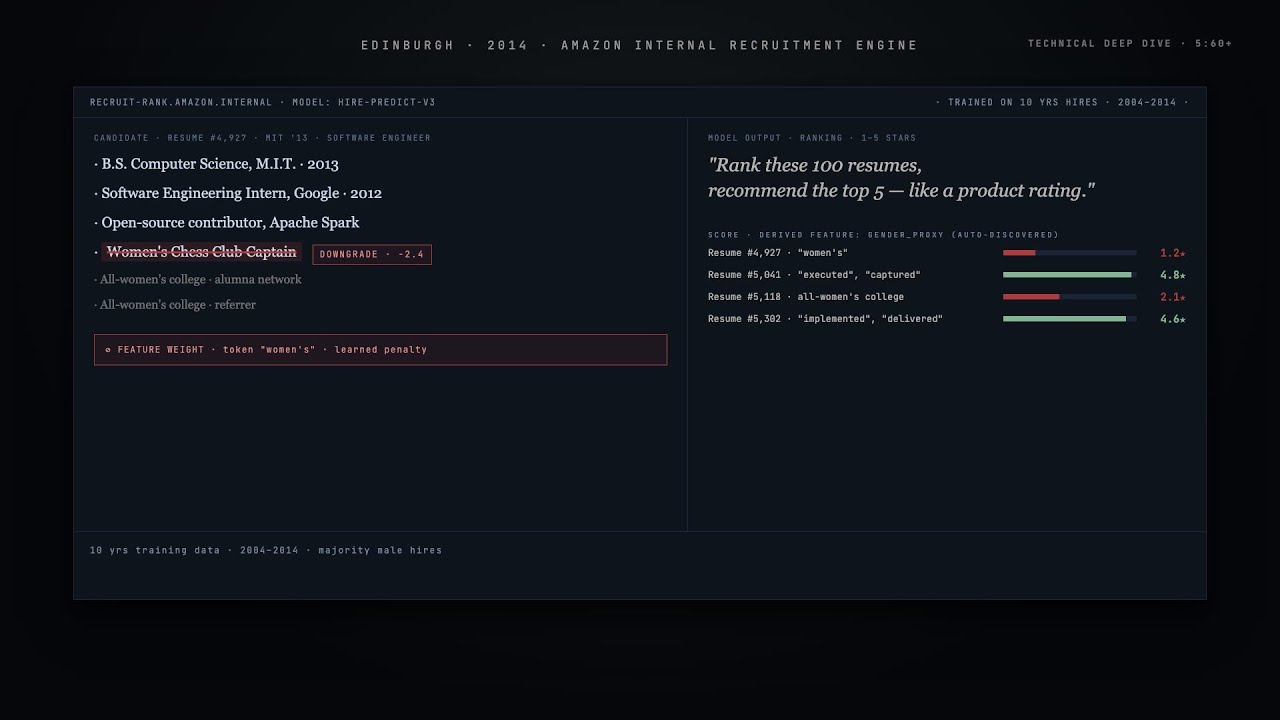
Amazon's 2014 Edinburgh team trained their model on 10 years of resumes. Because tech is male-dominated, the vast majority of "successful" hires were men.
AI doesn't just replicate bias—it amplifies it. If men are 60% of workforce, models often optimize toward 80-90% male hiring to maximize accuracy against historical trends.
The system systematically penalized resumes containing "women's" (e.g., "Women's Chess Club Captain") and downgraded graduates of all-women's colleges. Amazon scrapped the tool after 3 years because the Black Box nature meant they could not surgically remove bias without destroying predictive capability.
Deep learning operates on correlation, not causation. The model doesn't understand WHY "Python" matters for Data Science—it only knows the string "Python" appeared in successful resumes.
To increase accuracy, engineers add complexity (more layers, billions of parameters)—making models LESS interpretable. Yet regulations demand simple explanations.
Modern vendors use GPT/Claude as "Black Boxes." This introduces new failures: hallucination (inventing skills), stochasticity (different results for same resume), and knowledge cutoffs.
Traditional "Black Box" AI provides a score with zero explanation. Veriprajna's "Glass Box" Knowledge Graph shows exactly which skills matched, which are missing, and the semantic distance between them.
Recruiter has no insight. Candidate has no recourse. Auditor cannot verify fairness.
Recruiter understands decision. Candidate gets actionable feedback. Audit trail is complete.
Governments worldwide are erecting barriers against opaque algorithmic decision-making. Explainable AI is no longer optional—it's a legal requirement.
Effective July 2023, NYC mandates independent bias audits for Automated Employment Decision Tools (AEDTs).
World's first comprehensive AI law explicitly categorizes recruitment AI (job ads, filtering, evaluation) as High-Risk.
General Data Protection Regulation grants individuals explicit rights regarding automated decisions.
If a Black Box model shows an Impact Ratio of 0.4 for Black men, the employer is stuck. Without explainability, they cannot identify WHY the model rejects them—university names? zip codes? dialect?
Veriprajna's approach ensures that if disparity is found, the specific graph nodes causing it (e.g., expensive certification requirement filtering out lower-income candidates) can be identified and adjusted.
Our "Glass Box" architecture centers on the Enterprise Knowledge Graph (EKG)—a structured representation of skills, roles, and relationships that enables deterministic, auditable, and bias-free matching.
A Knowledge Graph is a structured representation of real-world facts, modeled as a network of nodes (entities) and edges (relationships). Unlike relational databases (rigid rows/columns), graphs store data in flexible, interconnected webs that mirror human associative memory.
The ontology (schema) defines what exists in our universe and how entities relate:
The system KNOWS relationships, not just keywords:
Try it: Click and drag nodes to explore how skills connect. Notice how "Pandas" and "SQL" are semantically close despite being different technologies—both are data manipulation tools.
We use Large Language Models solely for Information Extraction (IE) and Named Entity Recognition (NER). The LLM reads unstructured text and extracts entities—it does NOT make hiring decisions.
Once entities are extracted, they're ingested into the Knowledge Graph. All matching, scoring, and ranking is performed by deterministic graph traversal.
The most powerful feature of Graph architecture is Subgraph Filtering. The matching algorithm operates on a restricted "Inference Graph" that explicitly excludes demographic nodes.
Contains only:
Never visible to matching engine:
In our system, "Women's Chess Club" is mapped by the LLM during extraction phase to a neutralized node:
The gendered modifier is stripped before it enters the reasoning engine. Bias is structurally severed.
Veriprajna does not "predict" success. We measure Skill Distance—moving recruitment from subjective probability to objective geometry.
Traditional ATS uses Boolean logic: Does resume contain "Java"? (Yes/No). This is brittle and misses talent.
We use Graph Embeddings (Node2Vec, GraphSAGE) to create continuous vector space:
To score a candidate against a job, we calculate cosine similarity between vector sets:
See how semantic matching reveals hidden talent that keyword systems miss
Boolean keyword matching: Missing "SQL" ❌ | Missing "Tableau" ❌ → Auto-reject
Result: False negative. Qualified candidate filtered out due to terminology differences. This is how bias against non-traditional backgrounds occurs.
Provides transparent "coverage" score. Example: "Candidate covers 70% of mandatory requirements." Less nuanced than vector similarity but highly interpretable for audits.
Calculate shortest path within graph topology for missing skills:
Adopting an EKG architecture transforms recruitment workflow while integrating seamlessly with existing ATS platforms.
| Component | Role | Function | Reliability |
|---|---|---|---|
| Knowledge Graph | FACT | Stores explicit relationships, hierarchies, rules (e.g., "Python is a language") | High (Curated, Deterministic) |
| LLM | INTERFACE | Handles natural language inputs, synthesizes outputs (e.g., "Summarize gap") | Variable (Grounded by Graph) |
| Graph Algorithms | LOGIC | Performs actual matching/scoring calculations | High (Audit-Ready) |
No reason provided. Potential hidden bias: Candidate attended small college (socioeconomic proxy). No recourse for appeal.
Result: Converted False Negative into Hire. Expanded talent pool, reduced bias against non-traditional backgrounds.
The transition to Explainable Knowledge Graphs isn't just about avoiding fines—it's about building a better, more competitive business.
Amazon's failure caused significant reputational damage and wasted years of engineering time. By physically separating demographic data from decision logic, Veriprajna clients insulate themselves from Bias Amplification risk.
Traditional keyword matching (ATS) ignores capable candidates who use different terminology. Black Box AI often over-indexes on "pedigree" (big schools, big companies) as proxies for quality.
Recruiters hate "Black Boxes." They don't trust machines that say "Hire this person" without explaining why. By providing transparent, visual, explainable rationale, Veriprajna increases adoption among hiring managers.
| Feature | Legacy ATS (Keyword Match) |
"Black Box" AI (Deep Learning) |
Generative AI Wrapper (LLM) |
Veriprajna EKG (Graph AI) |
|---|---|---|---|---|
| Core Logic | Boolean String Matching | Statistical Correlation | Probabilistic Token Generation | Semantic Graph Traversal |
| Bias Mechanism | Keyword Bias (Vocabulary) | Bias Amplification (Proxies) | Training Corpus Bias | Structural Masking |
| Explainability | High (Exact miss) | Zero (Black Box) | Low (Hallucination risk) | High (Path Tracing) |
| Decision Consistency | High | High | Low (Stochastic) | High (Deterministic) |
| Regulatory Fit | Good | Poor (Fails Art. 13) | Poor (Fails Audit) | Excellent (Native Audit) |
| Handling Synonyms | Fails ("React" ≠ "ReactJS") | Good | Good | Perfect (Entity Resolution) |
| New Skill Adoption | Manual update required | Requires Retraining Model | Limited by Knowledge Cutoff | Instant (Add Node) |
The lesson from Amazon is stark: Data is a mirror. If you train a model on the past, you will replicate the past. In a world striving for equity, replicating the past is a failure condition.
The future of Enterprise AI is not about bigger models or more opaque neural networks. It is about structure, semantics, and explainability. It is about encoding our values into the very ontology of our systems.
Black Box models that guess based on hidden patterns, amplify historical bias, and provide zero explanation for life-changing decisions.
Glass Box Knowledge Graphs that measure skill distance with mathematical precision, structural bias masking, and complete audit trails.
Veriprajna offers a path forward.
We don't offer a magic box that guesses. We offer a precision instrument that measures. By utilizing Explainable Knowledge Graphs, we allow enterprises to map the true terrain of talent—navigating by the stars of skill and potential, rather than the distorted maps of historical prejudice.
Veriprajna's Knowledge Graph uses Subgraph Filtering to create a restricted 'Inference Graph' that explicitly excludes all demographic nodes — name, gender, address, graduation dates, and university affiliation. Because these nodes do not exist in the reasoning engine, graph path-finding algorithms physically cannot use them for scoring. This is fundamentally different from statistical approaches where removing a 'gender' field still allows the model to infer gender from proxies like 'Women's Chess Club.' In the Knowledge Graph, gendered modifiers are stripped during extraction and mapped to neutralized nodes before entering the reasoning layer.
Knowledge Graphs store skills as interconnected nodes with semantic relationships. When a job requires 'SQL' but a candidate has 'Pandas DataFrames,' the graph recognizes both as data manipulation tools with a semantic distance of only 0.15 — indicating high transferability. Similarly, 'PowerBI' and 'Tableau' are recognized as semantic neighbors in the 'Business Intelligence' cluster (distance: 0.09). Using cosine similarity on graph embeddings (Node2Vec, GraphSAGE), candidates receive partial credit for related skills. A traditional ATS would auto-reject these candidates for missing exact keyword matches, creating false negatives that disproportionately affect non-traditional backgrounds.
The EU AI Act classifies recruitment AI as 'High-Risk' requiring Article 13 transparency (interpretable outputs) and Article 14 human oversight (ability to override). Veriprajna's deterministic graph traversal produces identical scores for identical inputs, enabling full audit reproducibility. Every decision traces a visible path through graph nodes (Candidate → Skill → Job Requirement). For NYC LL 144, the system monitors real-time Impact Ratios (selection rates across demographic categories) against the Four-Fifths Rule threshold (0.8). If disparity is detected, the specific graph nodes causing it can be identified and adjusted — unlike black-box models where bias cannot be surgically removed without destroying predictive capability.
Veriprajna's Knowledge Graph architecture doesn't just check compliance boxes—it fundamentally solves the bias problem through structural design.
Schedule a technical consultation to explore how our EKG platform integrates with your existing ATS and HR systems.
Complete technical report: Graph ontology design, vector embedding mathematics, GDPR/EU AI Act compliance architecture, demographic masking algorithms, comprehensive works cited.