The Sentinel Grid: Navigating the 6.6 GW PJM Shortfall and the 230 GW ERCOT Interconnection Crisis Through Deep AI Engineering
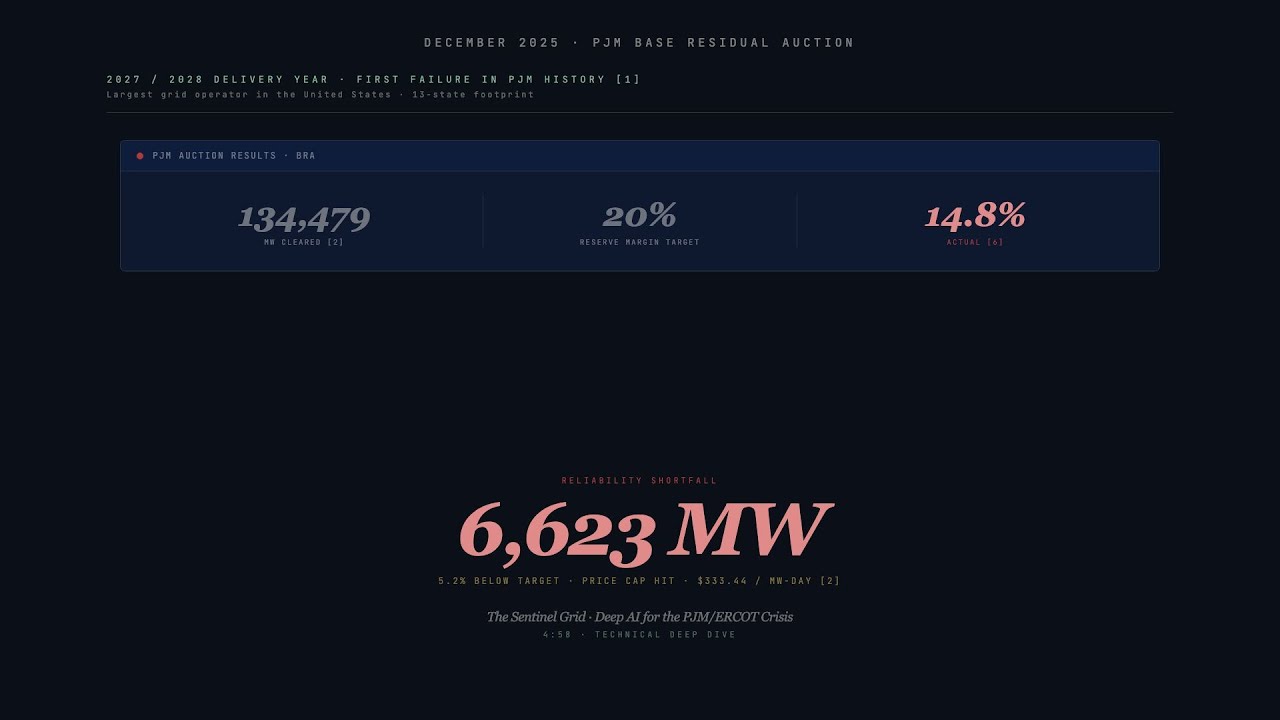
The North American electrical infrastructure has entered a period of structural instability characterized by a widening chasm between the retirement of legacy dispatchable generation and the explosive demand driven by artificial intelligence workloads. In December 2025, PJM Interconnection, the largest grid operator in the United States, announced a capacity auction shortfall of 6,623 MW for the 2027/2028 delivery year—the first such failure in the organization's history.1 Simultaneously, the Electric Reliability Council of Texas (ERCOT) faces a logistical and technical bottleneck, with a large-load interconnection queue swelling to 233 GW, even as new generation additions remain a full order of magnitude lower at approximately 23 GW.3 These twin crises signify the end of the era of "passive" grid management.
As an elite AI consultancy, Veriprajna recognizes that these challenges cannot be resolved through the deployment of generic large language model (LLM) wrappers or standard predictive analytics. The complexity of modern power systems, characterized by high-order uncertainty and non-linear dynamics, necessitates a "Deep AI" approach. This entails the integration of physics-informed neural networks (PINNs), topology-aware graph neural networks (GNNs), and agentic reinforcement learning (RL) frameworks. The following analysis dissects the specific mechanisms of the current grid failures and provides a comprehensive blueprint for the deployment of enterprise-grade AI solutions designed to restore system reliability and economic stability.
The PJM Capacity Inflection: Anatomy of a Systemic Deficit
The 2027/2028 Base Residual Auction (BRA) results for PJM Interconnection represent a watershed moment for energy markets. The procurement of 134,479 MW of generation resources fell 6,623 MW short of the 20% installed reserve margin target required to maintain the "one-event-in-ten-year" reliability standard.2 This shortfall has pushed the system's projected reserve margin down to 14.8%, signaling an elevated risk of load-shedding events beginning in June 2027.6
The economic signals within the auction were equally stark. Capacity prices hit the Federal Energy Regulatory Commission (FERC)-approved cap of $333.44/MW-day across the entire PJM footprint.2 While the price cap was implemented to shield ratepayers from extreme volatility, it effectively masked the true scarcity price that a free market would have dictated, potentially disincentivizing the very investment needed to close the gap.7
| PJM 2027/2028 BRA Key Metrics | Value / Detail |
|---|---|
| Cleared Capacity | 134,479 MW |
| Reliability Shortfall | 6,623 MW (5.2% below target) |
| Price Cap (UCAP) | $333.44 / MW-day |
| Total Regional Auction Cost | $16.4 Billion |
| Reserve Margin | 14.8% (Target: 20%) |
| Cleared New Generation | 774 MW (UCAP) |
The primary driver of this deficit is the "Thermal Retirement Cliff." Between 2011 and 2023, PJM saw the retirement of 54.2 GW of thermal capacity, with an additional 24 to 58 GW—representing up to 30% of installed capacity—at risk of retirement by 2030.1 These retirements are outpacing new entries, particularly because the "capacity value" of replacement resources is significantly lower. PJM's internal analysis reveals an intermittency gap: replacing 1 MW of retiring thermal generation requires approximately 5.2 MW of solar or 14 MW of onshore wind to maintain equivalent reliability.1 This disparity underscores the limitations of traditional capacity planning and the urgent need for deep AI models that can optimize the existing asset base.
The Shift in Effective Load Carrying Capability (ELCC)
A significant technical catalyst for the shortfall was the revision of Effective Load Carrying Capability (ELCC) ratings. ELCC is a statistical measure of how much a resource contributes to reliability during peak demand periods. In the 2027/2028 auction, PJM adjusted these ratings to reflect the diminishing marginal reliability value of intermittent resources as their penetration increases.7
While intermittent resources saw declines in accreditation, demand response (DR) saw a sharp rebound. The ELCC for DR increased from 69% in the 2026/2027 auction to 92% in the 2027/2028 auction.2 This increase was driven by a regulatory shift requiring DR to be available for all hours of the year and a change in the calculation of winter peak load to a coincident value.6 This shift highlights a critical opportunity for Veriprajna's deep AI solutions: the development of intelligent agents for demand-side flexibility that can guarantee 92% availability without disrupting industrial operations.
Data Centers: The Primary Demand Catalyst
While supply contracted, demand forecasts surged. PJM reported a 5,250 MW increase in its demand forecast, driven almost exclusively by the proliferation of data centers.5 In specific zones like Dominion (Virginia), AEP (Ohio/Indiana), and ComEd (Illinois), the 10-year average annual summer peak growth forecasts are significantly higher than the regional average, with PPL Electric reaching 6.4%.8 The concentration of this load in specific nodes creates localized "stress zones" where the risk of substation failure and transmission congestion is acute.
The ERCOT Queue Impasse: Scalability Limits and "Phantom" Loads
In the ERCOT region, the crisis is not yet one of cleared capacity, but of interconnection feasibility. By late 2025, ERCOT reported a large-load interconnection queue of 233 GW, a 269% increase from the end of 2024.9 To contextualize this, the entire ERCOT grid current peak demand is approximately 85 GW. The queue volume is nearly three times the total current peak load of the state.
The disconnect between requests and reality is profound. While 233 GW is seeking connection, ERCOT only synchronized 23 GW of new generation in 2025, mostly in the form of solar and battery storage.4 The remaining generation queue is dominated by solar (158 GW) and battery (175 GW), with natural gas accounting for a mere 47 GW.10 This creates a massive imbalance between requested load (predominantly 24/7 data center load) and the intermittent nature of the new generation queue.
| ERCOT Queue and Load Dynamics (Q4 2025) | Magnitude |
|---|---|
| Total Large Load Interconnection Requests | 233 GW |
| Data Center Share of Large Load Requests | 77% |
| Year-over-Year Queue Increase | 269% |
| 2025 Synchronized New Generation | 23 GW |
| Estimated Transmission Improvements | $14.089 Billion |
| Under Review |
The surge is partially composed of "phantom" loads—speculative requests from hyperscalers who submit multiple applications across various sites to hedge their bets on which utility will provide the fastest or cheapest connection.11 This practice clogs the study process, forcing engineers to perform complex reliability analyses on projects that may never reach financial close. ERCOT has recently contracted with McKinsey to overhaul this process, aiming to identify "credible" loads and streamline the queue by early 2026.12
Legislative and Regulatory Response: SB 6 and the Texas Energy Fund
Texas lawmakers have responded with Senate Bill 6 (SB 6), which mandates standardized interconnection rules and improves load forecasting.3 SB 6 also introduces mechanisms for large-load curtailment, requiring data centers with on-site backup generation to be callable during grid emergencies.13 Furthermore, the state established a $9 billion fund (Texas Energy Fund) to incentivize the construction of dispatchable gas plants. However, this initiative is already facing headwinds; approximately 35% of proposed gas projects have withdrawn, citing global turbine shortages and protracted permitting delays.11
The failure of traditional financial incentives to rapidly expand the gas fleet places an immense burden on the "Flexibility Imperative." The grid must become more intelligent because it cannot grow physically at the speed of the AI revolution.
The Deep AI Imperative: Transcending the LLM Wrapper Paradigm
In the face of these structural deficits, the energy sector has often turned to "AI" as a buzzword, usually resulting in superficial implementations such as chatbots for customer service or basic regression models for load forecasting. Veriprajna asserts that these solutions are insufficient for the current crisis. We distinguish between "Shallow AI" (general-purpose models) and "Deep AI" (models that respect the underlying physics and topology of the grid).
The grid is not a collection of independent data points; it is a synchronized, high-dimensional dynamical system governed by Kirchhoff's Laws and the swing equation. Any AI solution deployed to address a 6.6 GW shortfall must be "physics-aware."
Physics-Informed Neural Networks (PINNs) for Transient Stability
Traditional power system stability studies rely on solving systems of differential-algebraic equations (DAEs). For a grid as large as PJM, a single transient stability simulation can take hours. This prevents grid operators from performing "real-time" contingency analysis.
Veriprajna's core competency lies in the deployment of Physics-Informed Neural Networks (PINNs). Unlike standard neural networks that learn solely from data, PINNs embed the physical laws of the system directly into the loss function of the model. For a generator k, the neural network is trained to minimize the residual of the swing equation:
By utilizing automatic differentiation to compute the derivatives and , PINNs can determine system states up to 87 times faster than conventional numerical solvers.15 More importantly, PINNs can solve for the state at any specific time t without the need for sequential time-stepping (integration), allowing for near-instantaneous "look-ahead" capability during a potential blackout event.15
Topology-Aware Graph Neural Networks (GNNs)
The grid is inherently a graph, with substations as nodes and transmission lines as edges. Conventional machine learning models often treat grid data as a flat vector, losing the critical spatial context. Deep AI utilizes Graph Neural Networks (GNNs) to capture the spatio-temporal dependencies of the network.17
A GNN architecture like GraphSAGE or a Graph Attention Network (GAT) allows the model to "learn" the importance of different transmission corridors. In the event of a critical substation failure—such as the Baltimore event that risked a 1,200 MW load loss—a GNN can predict the propagation of the resulting voltage dip and frequency oscillation across the entire topology in milliseconds.17
The mathematical framework for a GAT node update is:
This mechanism ensures that the model focuses on the "critical neighbors" in the grid topology, providing far more accurate fault diagnosis and localization than traditional SCADA-based rule engines.18 For predictive maintenance, multilayer GNNs have demonstrated an F1 score of 0.8935 for identifying substations at risk of failure within 30 days, allowing for proactive intervention before a reliability event occurs.21
Architectural Deep Dive: Implementing the Sentient Grid
For an enterprise-grade AI consultancy, the value is not just in the algorithm, but in the end-to-end technical architecture that allows AI to interact with operational technology (OT) systems securely and reliably.
The Veriprajna "Deep Grid" Architecture
We propose a multi-layered architecture that bridges the gap between the physical assets and the decision-support layer.
- The Physical/IoT Layer: This layer includes the traditional SCADA inputs plus high-frequency data from LiDAR-based non-contact sensors and Dynamic Line Rating (DLR) devices. Sensors deployed by companies like LineVision now monitor over 275 km of lines for National Grid, providing real-time data on conductor sag and temperature.22
- The Data Orchestration Layer: This layer handles "AI-ready" data. Modern grid data is characterized by "high-order uncertainty" and sparse measurements.23 We utilize a data lake architecture (based on Spark/Hadoop) to perform automated anomaly detection, missing-value imputation, and plausibility checks before data reaches the models.25
- The Physics-AI Engine: This is the core of the Veriprajna solution. It runs parallel PINN and GNN models. The PINN provides fast-solver capabilities for transient stability, while the GNN provides topology-aware state estimation and fault prediction.
- The Agentic Control Layer: This layer utilizes Reinforcement Learning (RL) to make dispatch decisions. By formulating grid control as a Constrained Markov Decision Process (MDP), RL agents can learn optimal policies for load balancing that satisfy hard physical constraints (e.g., voltage limits).27
Dynamic Line Rating (DLR) and Computer Vision
One of the most immediate "Deep AI" solutions to the PJM/ERCOT capacity crisis is the optimization of existing transmission capacity through Dynamic Line Rating (DLR). Traditional Static Line Ratings (SLRs) are based on conservative "worst-case" assumptions (e.g., high temperature, no wind), which often leave 20-40% of a line's capacity unused.29
DLR utilizes real-time atmospheric data and IoT sensors to calculate the actual thermal capacity of the line. Veriprajna integrates computer vision and LiDAR data to monitor conductor behavior. In Indiana and Ohio, AES utilized these technologies to increase transfer capacity by 61% on 345 kV lines and 25% on 69 kV lines.30 The cost of this AI-driven upgrade was $0.39 million, compared to an estimated $1.63 million for traditional reconductoring.30
| DLR Implementation Impact | Static Baseline | DLR Optimized | % Improvement |
|---|---|---|---|
| Transfer Capacity (345 kV) | 1,000 MW (Est) | 1,610 MW | +61% |
| Transfer Capacity (69 kV) | 100 MW (Est) | 125 MW | +25% |
| Project Cost (AES Case) | $1.63M (Upgrade) | $0.39M (AI/IoT) | -76% (Cost Reduction) |
| Deployment Time | 2-3 Years | 3-6 Months | -80% (Time Reduction) |
For grid operators like PJM facing a 6.6 GW gap by 2027, the deployment of DLR across the 13-state footprint could "unleash huge amounts of electricity transmission capacity without building a single new line".31
The Economic Dimension: Assessing the Cost of Inaction
The failure to meet reliability standards carries a heavy economic toll. A new analysis by the NRDC found that data center growth in the PJM region could result in $163 billion in cumulative capacity costs from 2028 through 2033.32 In the ComEd territory of Northern Illinois alone, the impact is projected at $21.4 billion, translating to a $70-per-month increase for the average residential household.32
This price escalation is not just a function of demand, but of "market friction." When the PJM auction hits the price cap, it signals a failure of the current market structure to clear the required volume. For industrial consumers and tech hyperscalers, this represents a significant risk to the "Value of Lost Load" (VOLL).
The "Deep AI" Value Proposition for the C-Suite
For Veriprajna's clients, the value proposition of Deep AI is three-fold:
- Capital Efficiency: By using GNNs and PINNs to accurately identify stable operating limits, utilities can defer billions in transmission and generation investment. AI-driven grid modernization allows for the "orchestration" of existing assets rather than the "domination" of the landscape with new steel-in-the-ground infrastructure.33
- Interconnection Acceleration: AI-accelerated power grid models can reduce the time for interconnection studies from years to months. FERC Order 2023 mandates cluster studies, and Veriprajna's agentic AI tools can automate the screening of the 233 GW ERCOT queue, identifying projects that are "first-ready" based on physical feasibility and commercial readiness.34
- Risk Mitigation: In a world of extreme weather—such as the 2021 ERCOT winter storm or the PJM Baltimore substation failure—Deep AI provides the millisecond-level response capability required to prevent cascading blackouts.36
Interconnection 2.0: Automating the Queue with Agentic AI
The ERCOT 233 GW queue is currently a bottleneck of human engineering hours. FERC Order 2023 requires transmission providers to maintain publicly available "heatmaps" of transmission capacity to help developers find ideal points of interconnection.38 Veriprajna goes further, deploying agentic AI that acts as a "digital engineer."
These agents utilize Large Language Models (LLMs) not just to chat, but to perform complex reasoning over technical documentation and regulatory filings.34 When an interconnection request is submitted, our agents can:
- Automatically Screen for Compliance: Check against NERC and FERC standards (e.g., EOP-012-3 for cold weather readiness).37
- Perform Automated Load Clustering: Group projects into optimal clusters based on topological constraints rather than just arrival time.38
- Predict "Phantom" Load Probability: Use machine learning to assign a likelihood-of-completion score to projects in the queue, allowing planners to focus on credible demand.11
By implementing these automated screening tools, ERCOT can transition from a "first-come, first-served" model to a "first-ready, first-served" model, significantly reducing the $14 billion in estimated transmission improvements currently under review.10
Deep AI for Power Plant Retirement Forecasting
The 6.6 GW shortfall in PJM is fundamentally a problem of forecasting the "retirement cliff." Traditional models often fail to predict when a coal or gas plant will become uneconomic. Veriprajna utilizes Stacked LSTM (Long Short-Term Memory) and Gradient Boosting models to analyze plant-level CO2 emissions, fuel prices, and renewable penetration.25
Our models have achieved a Mean Absolute Percentage Error (MAPE) of 1.072% in predicting plant retirement ages.40 This allows grid operators to identify "hotspots" of potential early retirement and intervene with targeted capacity incentives or backstop procurement before the reliability gap opens. In the ERCOT region, where 35% of proposed gas projects have withdrawn, these predictive analytics are vital for identifying the next generation of "risk units".11
The Convergence of IT and OT: Security and Trust in AI
A critical barrier to the adoption of AI in the power sector is the perceived risk to critical infrastructure. Veriprajna addresses this through a "stability-aware" inference mechanism.20 We do not allow AI to operate as a "black box" in the control room.
Instead, we implement Explainable AI (XAI). When a GNN identifies a cascading failure risk, it generates a graph-based explanation highlighting the specific edges (lines) and nodes (substations) that are contributing to the risk.36 This allows human operators to verify the AI's reasoning before taking action. Furthermore, our architecture ensures that the digital environment is securely connected to the control layer (DCS platforms) without disturbing the proven safety-critical control structures.41
Strategic Roadmap: From Infrastructure to Intelligence
For utilities and large-load customers navigating the 2027 reliability crisis, Veriprajna recommends a three-phased roadmap:
Phase 1: Foundation and Visibility (0-12 Months)
- Data Readiness: Deploy AI-ready data lakes to aggregate SCADA, IoT, and weather data.25
- DLR Pilot: Implement Dynamic Line Rating on the top 5 most congested transmission corridors to unlock immediate capacity.22
- Queue Diagnostic: Use machine learning to screen the interconnection queue for phantom loads and "first-ready" projects.11
Phase 2: Integration and Acceleration (1-3 Years)
- PINN Deployment: Replace traditional numerical solvers with PINN-based transient stability tools for real-time contingency analysis.15
- Topological Intelligence: Integrate GNNs into state estimation and fault localization workflows.17
- Flexibility Orchestration: Deploy RL-based agents to manage co-located data center loads and demand response programs.28
Phase 3: The Sentient Grid (3-5 Years)
- Self-Healing Networks: Enable fully automated, AI-driven grid reconfiguration and restoration.33
- Autonomous Permitting: Transition to fully agentic workflows for Federal and state permitting compliance.34
- Market-AI Synergy: Use high-fidelity price forecasting to optimize dispatch and minimize the $163 billion risk in capacity costs.25
Conclusion: The Veriprajna Advantage
The PJM shortfall and the ERCOT queue crisis are symptoms of a technological lag. The electrical grid, the most complex machine ever built, is being pushed to its limits by the very technology it is struggling to power: AI.
Veriprajna positions itself at this intersection. We are not providing simple API wrappers; we are providing the deep mathematical and physical frameworks required to make the grid sentient. By integrating PINNs for stability, GNNs for topology, and RL for control, we enable our clients to transcend the limitations of their physical infrastructure. The 6,623 MW gap in PJM is not just a deficit; it is a mandate for a new kind of intelligence.
The future belongs to those who view the grid not as a collection of wires, but as a dynamic graph of intelligence. Veriprajna is the partner for that transition.
Works cited
- White House, Governors, and PJM Respond to Grid Capacity Shortfall - Jackson Walker, accessed February 9, 2026, https://www.jw.com/news/insights-grid-capacity-shortfall/
- PJM Auction Procures 134479 MW of Generation Resources, accessed February 9, 2026, https://insidelines.pjm.com/pjm-auction-procures-134479-mw-of-generation-resources/
- ERCOT's large load queue jumped almost 300% last year | Utility Dive, accessed February 9, 2026, https://www.utilitydive.com/news/ercots-large-load-queue-jumped-almost-300-last-year-official/808820/
- Item 16.2: System Planning and Weatherization Update - ERCOT.com, accessed February 9, 2026, https://www.ercot.com/files/docs/2025/12/02/16.2-System-Planning-and-Weatherization-Update_Revised.pdf
- PJM capacity prices hit record high as grid operator falls short of reliability target - Utility Dive, accessed February 9, 2026, https://www.utilitydive.com/news/pjm-interconnection-capacity-auction-data-center/808264/
- 20251217-pjm-auction-procures-134479-mw-of-generation-resources.pdf, accessed February 9, 2026, https://www.pjm.com/-/media/DotCom/about-pjm/newsroom/2025-releases/20251217-pjm-auction-procures-134479-mw-of-generation-resources.pdf
- PJM 2027/2028 Capacity Auction Results | Enel North America, accessed February 9, 2026, https://www.enelnorthamerica.com/insights/blogs/pjm-2027-2028-capacity-auction-results
- PJM trims near-term load forecast on stricter data center vetting, economic outlook, accessed February 9, 2026, https://www.utilitydive.com/news/pjm-interconnection-load-forecast-data-centers/809717/
- ERCOT Again Revising Large Load Interconnection Process - RTO Insider, accessed February 9, 2026, https://www.rtoinsider.com/122182-ercot-add-new-interconnection-rules-large-loads/
- ERCOT Monthly Operational Overview (October 2025), accessed February 9, 2026, https://www.ercot.com/files/docs/2025/11/17/ERCOT-Monthly-Operational-Overview-October-2025.pdf
- NEWS: ERCOT's large load queue has nearly quadrupled in a single year - Energy Central, accessed February 9, 2026, https://www.energycentral.com/energy-management/post/news-ercot-s-large-load-queue-has-nearly-quadrupled-in-a-single-year-xuBAQ6jDdRObFFt
- ERCOT Announces Strategic Organizational Changes to Support Grid Reliability, Rapid Demand Growth, and Innovation, accessed February 9, 2026, https://www.ercot.com/news/release/12122025-ercot-announces-strategic
- Assessment of Resource Adequacy Needs in ERCOT and Impact of Market Design Changes, accessed February 9, 2026, https://www.ercot.com/files/MarketNotice/2025/11/310252/Aurora%20Assessment%20of%20Resource%20Adequacy%20Needs%20in%20ERCOT%20Region%20and%20Impact%20of%20Market%20Design%20Changes%20%282025.11.10%29.pdf
- Large Loads: Interconnection,Tariff Designs and State Actions | The Brattle Group, accessed February 9, 2026, https://www.brattle.com/wp-content/uploads/2025/09/Large-Loads-Interconnection-Tariff-Designs-and-State-Actions.pdf
- Physics-Informed Neural Networks for Power Systems - arXiv, accessed February 9, 2026, https://arxiv.org/abs/1911.03737
- Physics-Informed Neural Networks for Power Systems - DTU Research Database, accessed February 9, 2026, https://orbit.dtu.dk/files/215621776/1911.03737_1_.pdf
- PowerGNN: A Topology-Aware Graph Neural Network for Electricity Grids - arXiv, accessed February 9, 2026, https://arxiv.org/html/2503.22721v1
- Uncertainty-Aware Multi-Branch Graph Attention Network for Transient Stability Assessment of Power Systems Under Disturbances - MDPI, accessed February 9, 2026, https://www.mdpi.com/2227-7390/13/22/3575
- 2025 in Review: Operations Improvements See PJM Through Record Peaks, Growing Demand, accessed February 9, 2026, https://insidelines.pjm.com/209696-2/
- Deep Reinforcement Learning for Intelligent Load Balancing in Smart Power Grids, accessed February 9, 2026, https://ieeexplore.ieee.org/document/11153398/
- Multilayer GNN for predictive maintenance and clustering in power grids - PMC, accessed February 9, 2026, https://pmc.ncbi.nlm.nih.gov/articles/PMC12519140/
- National Grid installs grid-enhancing technology allowing more renewable power to flow through existing transmission lines, accessed February 9, 2026, https://www.nationalgrid.com/media-centre/press-releases/national-grid-installs-grid-enhancing-technology
- Real-time power system dispatch scheme using grid expert strategy-based imitation learning - University of Strathclyde, accessed February 9, 2026, https://pureportal.strath.ac.uk/en/publications/real-time-power-system-dispatch-scheme-using-grid-expert-strategy/
- Physics-informed graphical neural network for power system state estimation, accessed February 9, 2026, https://www.researchgate.net/publication/378641259_Physics-informed_graphical_neural_network_for_power_system_state_estimation
- AI–Big Data Analytics Platform for Energy Forecasting in Modern Power Systems - MDPI, accessed February 9, 2026, https://www.mdpi.com/2504-2289/9/11/272
- Grid Resilience: Using AI-Driven Forecasting in Energy & Utilities Software Development, accessed February 9, 2026, https://6b.energy/insight/grid-resilience-using-ai-driven-forecasting-in-energy-utilities-software-development/
- RL2Grid: Benchmarking Reinforcement Learning in Power Grid Operations - arXiv, accessed February 9, 2026, https://arxiv.org/html/2503.23101v1
- Deep reinforcement learning for real-time energy dispatch in smart grids with high renewable penetration - ResearchGate, accessed February 9, 2026, https://www.researchgate.net/publication/400527431_Deep_reinforcement_learning_for_real_time_energy_dispatch_in_smart_grids_with_high_renewable_penetration
- Dynamic Line Rating - Department of Energy, accessed February 9, 2026, https://www.energy.gov/oe/articles/dynamic-line-rating-report-congress-june-2019
- Case Study Details - Future of Power Systems - Dynamic line capacity rating, accessed February 9, 2026, https://initiatives.weforum.org/future-power-system/innovation-playbook/dynamic-line-capacity-rating/aJYTG00000012UP4AY
- Energy and AI - Microsoft .NET, accessed February 9, 2026, https://iea.blob.core.windows.net/assets/b3a8b37f-32d1-4873-9eca-31cec5895264/EnergyandAI.pdf
- Data center distress: CUB, NRDC experts warn PJM states could get hit with forced blackouts, $163B in electricity capacity costs | Citizens Utility Board, accessed February 9, 2026, https://www.citizensutilityboard.org/blog/2025/10/23/data-center-concerns-cub-nrdc-experts-warn-pjm-states-could-get-hit-with-forced-blackouts-163b-in-additional-electricity-capacity-costs/
- The AI utility: A roadmap for transformation - Guidehouse, accessed February 9, 2026, https://guidehouse.com/insights/communities-energy-infrastructure/2025/ai-utility
- AI for Energy Opportunities for a Modern Grid and Clean Energy Economy, accessed February 9, 2026, https://www.energy.gov/sites/default/files/2024-04/AI%20EO%20Report%20Section%205.2g%28i%29_043024.pdf
- FERC Order 2023 Toolkit - Advanced Energy United, accessed February 9, 2026, https://advancedenergyunited.org/hubfs/2023%20Reports/FERC%20Order%202023%20Toolkit.pdf
- PowerGraph: A power grid benchmark dataset for graph neural networks - NIPS, accessed February 9, 2026, https://proceedings.neurips.cc/paper_files/paper/2024/file/c7caf017cbbca1f4b368ffdc7bb8f319-Paper-Datasets_and_Benchmarks_Track.pdf
- Rising Demand, Evolving Resources Continue to Challenge Winter Grid Reliability - NERC, accessed February 9, 2026, https://www.nerc.com/newsroom/2025-winter-reliability-assessment
- Explainer on the Interconnection Final Rule - Federal Energy Regulatory Commission, accessed February 9, 2026, https://www.ferc.gov/explainer-interconnection-final-rule
- ERCOT RPG 10/25: ERCOT Large load integration Planning Solution - Zero-Emission Grid, accessed February 9, 2026, https://www.zeroemissiongrid.com/insights-press-zeg-blog/ercot-large-load-integration/
- Forecasting coal power plant retirement ages and lock-in with random forest regression | Request PDF - ResearchGate, accessed February 9, 2026, https://www.researchgate.net/publication/371768240_Forecasting_coal_power_plant_retirement_ages_and_lock-in_with_random_forest_regression
- ABB launches Automation Extended program to modernize DCS without disrupting operations - Industrial Cyber, accessed February 9, 2026, https://industrialcyber.co/news/abb-launches-automation-extended-program-to-modernize-dcs-without-disrupting-operations/
- FERC Directs Nation's Largest Grid Operator to Create New Rules to Embrace Innovation and Protect Consumers, accessed February 9, 2026, https://www.ferc.gov/news-events/news/ferc-directs-nations-largest-grid-operator-create-new-rules-embrace-innovation-and
- Strategic Roadmap for Digital Transformation for Utilities - CelPlan, accessed February 9, 2026, https://celplan.com/wp-content/uploads/2025/06/Strategic-Roadmap-Utilities-Magazine-v2.pdf
- AI for the Grid: Opportunities, Risks, and Safeguards - CSIS, accessed February 9, 2026, https://www.csis.org/analysis/ai-grid-opportunities-risks-and-safeguards
Prefer a visual, interactive experience?
Explore the key findings, stats, and architecture of this paper in an interactive format with navigable sections and data visualizations.
Frequently Asked Questions
What caused PJM's historic 6,623 MW capacity shortfall and what are the consequences?
PJM's 2027/2028 Base Residual Auction procured 134,479 MW but fell 6,623 MW short of the 20% reserve margin target, dropping to 14.8%. The primary driver is the Thermal Retirement Cliff with 54.2 GW retired since 2011 and 24-58 GW more at risk by 2030. Capacity prices hit the FERC cap of $333.44/MW-day, and data center growth could drive $163 billion in cumulative capacity costs from 2028-2033. Replacing 1 MW of thermal generation requires approximately 5.2 MW of solar or 14 MW of wind to maintain equivalent reliability.
How do physics-informed neural networks improve grid stability analysis?
Physics-Informed Neural Networks (PINNs) embed physical laws like the swing equation directly into the model's loss function, enabling transient stability solutions up to 87 times faster than conventional numerical solvers. Unlike standard neural networks that learn solely from data, PINNs use automatic differentiation to compute system states at any time point without sequential time-stepping, providing near-instantaneous look-ahead capability during potential blackout events. This enables real-time contingency analysis for grids as large as PJM's 13-state footprint.
How can dynamic line rating and AI unlock additional grid capacity without new infrastructure?
Dynamic Line Rating uses real-time atmospheric data and IoT sensors to calculate actual thermal capacity, replacing conservative static ratings that leave 20-40% of capacity unused. In AES deployments across Indiana and Ohio, AI-driven DLR increased transfer capacity by 61% on 345 kV lines and 25% on 69 kV lines at a cost of just $0.39 million versus $1.63 million for traditional reconductoring, representing a 76% cost reduction and 80% faster deployment timeline of 3-6 months versus 2-3 years.
Also Published On
Build Your AI with Confidence.
Partner with a team that has deep experience in building the next generation of enterprise AI. Let us help you design, build, and deploy an AI strategy you can trust.
Veriprajna Deep Tech Consultancy specializes in building safety-critical AI systems for healthcare, finance, and regulatory domains. Our architectures are validated against established protocols with comprehensive compliance documentation.