Navigating the 6.6 GW PJM Shortfall and the 230 GW ERCOT Interconnection Crisis Through Deep AI Engineering
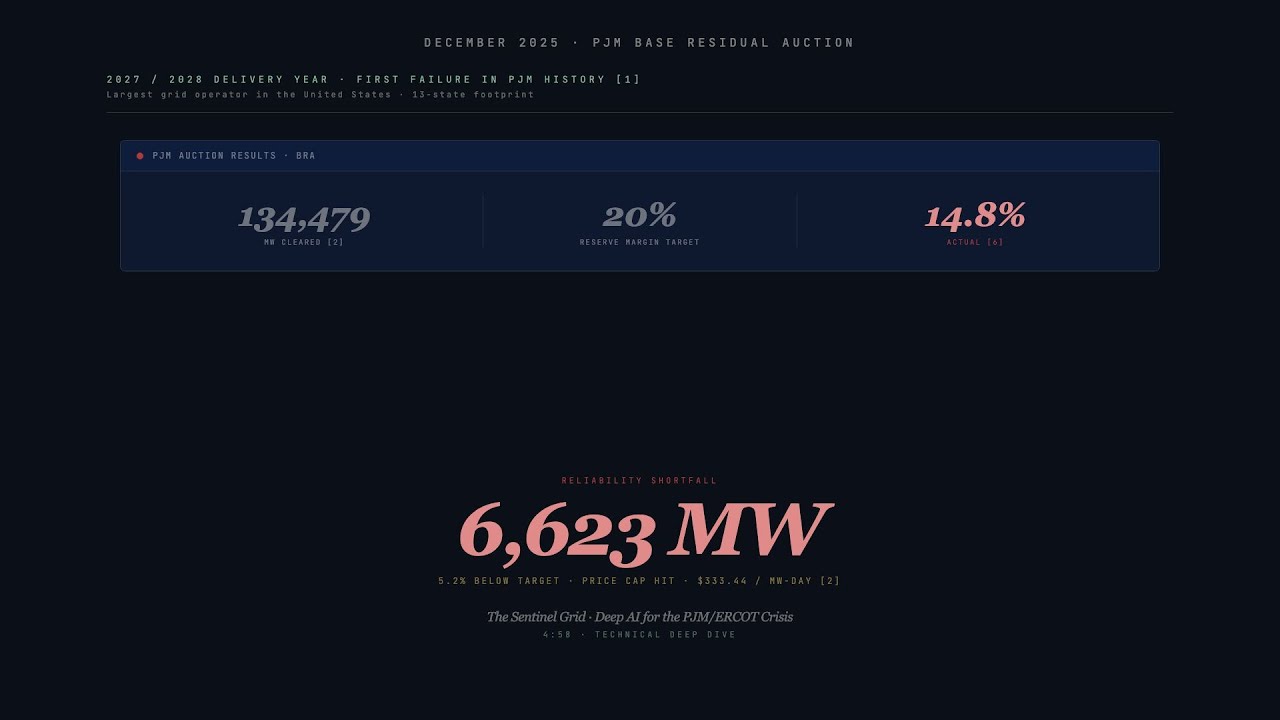
The North American electrical infrastructure has entered a period of structural instability. PJM Interconnection announced a capacity auction shortfall of 6,623 MW—the first such failure in its history. Simultaneously, ERCOT faces a large-load interconnection queue of 233 GW, while new generation additions remain at approximately 23 GW. These twin crises signify the end of passive grid management.
Veriprajna deploys Physics-Informed Neural Networks (PINNs), topology-aware Graph Neural Networks (GNNs), and agentic Reinforcement Learning (RL) frameworks—not generic LLM wrappers—to restore system reliability and economic stability.
Veriprajna partners with grid operators, utilities, and energy-intensive enterprises to bridge the gap between physical infrastructure limitations and AI-driven optimization.
Deploy real-time contingency analysis with PINN-based solvers that are 87x faster than conventional methods. Enable millisecond-level response during cascading failure events.
Unlock 20-40% additional transmission capacity without building new lines. Dynamic Line Rating with AI-driven atmospheric modeling delivers immediate relief to congested corridors.
Navigate the interconnection bottleneck with AI-accelerated feasibility studies. Reduce queue processing from years to months while ensuring grid stability compliance.
The 2027/2028 Base Residual Auction fell 6,623 MW short of reliability targets—pushing reserve margins to 14.8% against a required 20%.
Between 2011 and 2023, PJM retired 54.2 GW of thermal capacity. An additional 24-58 GW—up to 30% of installed capacity—faces retirement by 2030. Replacing 1 MW of thermal requires ~5.2 MW solar or ~14 MW wind.
ELCC for demand response surged from 69% to 92%—a critical opportunity for intelligent agents that guarantee high availability without disrupting industrial operations.
PJM reported a 5,250 MW demand forecast increase driven almost exclusively by data center proliferation. Zones like Dominion, AEP, and ComEd face localized stress with growth up to 6.4% annually.
"Capacity prices hit the FERC-approved cap of $333.44/MW-day across the entire PJM footprint—a price ceiling that masked the true scarcity value and may have disincentivized the very investment needed to close the gap."
— Source: PJM 2027/2028 BRA Results
The disconnect between requests and reality is profound. The queue volume is nearly three times the total current peak load of Texas.
The surge is partially composed of speculative requests from hyperscalers who submit multiple applications across sites to hedge their bets. This clogs the study process, forcing engineers to analyze projects that may never reach financial close.
Texas lawmakers introduced Senate Bill 6 mandating standardized interconnection rules, improved load forecasting, and large-load curtailment mechanisms. The state established a $9 billion Texas Energy Fund—but ~35% of proposed gas projects have already withdrawn.
Traditional grid management relies on static assumptions and reactive control. Substations operate as isolated units, transmission capacity goes unused, and failures cascade before operators can respond.
Physics-Informed Neural Networks model the swing equation in real-time. Graph Neural Networks map the grid topology. Reinforcement Learning agents optimize dispatch decisions—all in under 300ms.
Toggle the simulation to see how AI transforms grid operation from reactive to predictive.
Hardware captures grid state. Deep AI translates high-dimensional data into real-time control decisions at millisecond latency.
PINNs embed physical laws (swing equation) directly into the loss function. Computes system states 87x faster than conventional numerical solvers by using automatic differentiation—no sequential time-stepping required.
The grid is a graph—substations are nodes, lines are edges. GNNs like GraphSAGE and GAT learn the importance of different transmission corridors. Predicts cascade propagation in milliseconds with F1=0.89 for 30-day failure prediction.
Grid control formulated as a Constrained Markov Decision Process. RL agents learn optimal dispatch policies satisfying hard physical constraints (voltage limits, thermal limits) while maximizing reliability.
When a GNN identifies cascading failure risk, it generates graph-based explanations highlighting specific edges and nodes contributing to risk. Human operators verify AI reasoning before action—no black boxes in the control room.
A single PJM transient stability simulation can take hours with traditional DAE solvers. During a potential blackout event, operators need look-ahead capability in seconds, not hours.
SCADA inputs + LiDAR sensors + Dynamic Line Rating devices. Real-time conductor sag and temperature monitoring across 275+ km of transmission lines.
AI-ready data lake (Spark/Hadoop) with automated anomaly detection, missing-value imputation, and plausibility checks before model ingestion.
Parallel PINN + GNN models. PINNs for fast transient stability. GNNs for topology-aware state estimation and fault prediction.
Reinforcement Learning dispatch decisions. Constrained MDP formulation satisfying hard physical constraints. Self-healing network reconfiguration.
Dynamic Line Rating uses real-time atmospheric data to reveal the actual thermal capacity of existing lines—typically 20-40% above conservative static ratings.
Data center growth in PJM could result in $163 billion in cumulative capacity costs from 2028 through 2033. In ComEd territory alone, projected impact is $21.4 billion—translating to $70/month increase for average residential households.
Status quo approach:
Deep AI approach:
For utilities and large-load customers navigating the 2027 reliability crisis.
0-12 Months
1-3 Years
3-5 Years
PINNs embed physical laws (the swing equation) directly into the neural network loss function, using automatic differentiation to compute system states 87x faster than conventional numerical DAE solvers. Unlike sequential time-stepping methods that can take hours per transient stability simulation, PINNs can solve for any time t directly — enabling real-time 'what-if' contingency analysis during potential blackout events, with embedded Kirchhoff's Laws ensuring physical consistency.
The PJM 2027/2028 Base Residual Auction fell 6,623 MW short of reliability targets — the first such failure in PJM history — pushing reserve margins to 14.8% against a required 20%. Between 2011-2023, PJM retired 54.2 GW of thermal capacity, with an additional 24-58 GW at risk by 2030. Data center demand added 5,250 MW to forecasts. Capacity prices hit the FERC-approved cap of $333.44/MW-day, potentially resulting in $163 billion in cumulative costs from 2028-2033.
Dynamic Line Rating uses real-time atmospheric data (wind speed, ambient temperature, solar radiation) combined with AI-driven modeling to calculate the actual thermal capacity of existing transmission lines — which is typically 20-40% above conservative static ratings. DLR has demonstrated a 61% capacity increase on 345 kV lines with 76% cost reduction versus traditional reconductoring, deployable in 3-6 months versus 2-3 years for new line construction.
Veriprajna provides the deep mathematical and physical frameworks required to make the grid sentient. Let us show you how.
Complete engineering report: PINNs architecture, GNN specifications, RL framework, DLR implementation, regulatory alignment, economic modeling.