Moore’s Law is Dead. AI is the Defibrillator: The Strategic Imperative for Reinforcement Learning in Next-Generation Silicon Architectures
Executive Summary: The Silicon Precipice
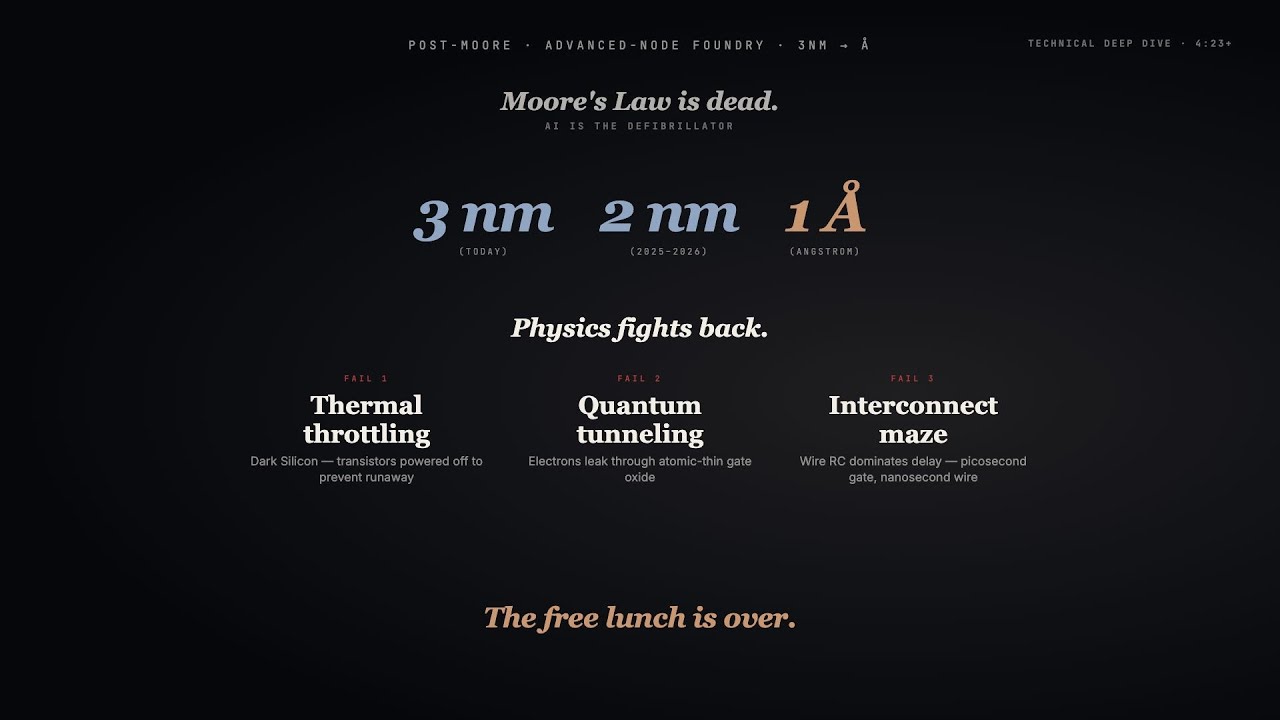
The global semiconductor industry stands at a precarious juncture, a point of inflection that historians of technology will likely demarcate as the end of the "classical scaling" era. For over five decades, the industry marched to the rhythmic metronome of Moore's Law, the empirical observation that transistor density would double approximately every two years, delivering a predictable dividend of performance and efficiency. This cadence underpinned the digital economy, enabling everything from the personal computer revolution to the rise of cloud computing and the ubiquity of smartphones. However, as fabrication processes push against the atomic boundaries of 3nm, 2nm, and impending Angstrom-scale nodes, the traditional engine of progress has seized. We have entered an era where physics fights back. The "free lunch" of automatic speedups derived from lithographic shrinking is over, replaced by a brutal landscape of thermal throttling, quantum tunneling, and interconnect bottlenecks that threaten to stall computational advancement. 1
The crisis we face is not merely one of manufacturing physics; it is a crisis of design complexity. The modern System-on-Chip (SoC) is arguably the most complex artifact ever constructed by humanity, containing billions of transistors organized into intricate hierarchies of logic, memory, and interconnects. The design space for placing these components—optimizing for power, performance, and area (PPA)—exceeds the number of atoms in the observable universe. For decades, human engineers, aided by heuristic-based Electronic Design Automation (EDA) tools, navigated this space through intuition and rules of thumb. Today, that approach has hit a hard cognitive ceiling. The problem of placing billions of components to minimize wire length and heat while satisfying thousands of hard constraints exceeds human cognitive load. Traditional tools, reliant on algorithms like Simulated Annealing developed in the 1980s, are trapping designs in local optima, unable to perceive the global architectural moves required to unlock the potential of extreme ultraviolet (EUV) lithography. 3
This whitepaper serves as the manifesto for Veriprajna, establishing the framework for a paradigm shift from human-centric heuristics to AI-native design. We posit that Artificial Intelligence—specifically Deep Reinforcement Learning (RL)—is the necessary defibrillator for Moore's Law. By reframing the physical design of chips not as a static optimization task but as a sequential game akin to Chess or Go, we unlock the ability to discover "alien" architectures: layouts that defy human symmetry and intuition but are verified by physics to run faster, cooler, and more efficiently. We analyze the pioneering work of Google’s AlphaChip and the industrial validation by giants like MediaTek and NVIDIA, demonstrating that RL agents are not experimental toys but the new engines of silicon dominance. 6 For the enterprise, the transition to Deep AI solutions is no longer an optional R&D experiment; it is the definitive strategy for survival in the post-Moore era.
1. The Death of Moore’s Law and the Cognitive Ceiling
1.1 The Collapse of Classical Scaling
To understand the necessity of AI in chip design, one must first appreciate the magnitude of the problem facing traditional scaling. Gordon Moore’s 1965 prediction was fundamentally an economic observation: as components got smaller, they became cheaper to produce in volume, driving a virtuous cycle of integration. For decades, this held true. Dennard Scaling accompanied Moore's Law, ensuring that as transistors shrank, their power density remained constant, allowing clock speeds to rise without melting the chip.
Dennard Scaling collapsed in the mid-2000s due to leakage currents and thermal limitations, forcing the industry into the multicore era. Now, Moore's Law itself is faltering. The cost per transistor at advanced nodes like 3nm is rising, not falling, due to the extreme complexity of multi-patterning and High-NA EUV lithography. Furthermore, the performance gains are diminishing. We have entered the era of "Dark Silicon," where thermal constraints dictate that a significant percentage of a chip’s transistors must remain powered off at any given time to prevent thermal runaway. The bottleneck has shifted from the transistor gate to the wire. In modern nanometer processes, the resistance and capacitance of the microscopic copper interconnects dominate signal delay and power consumption. A signal can traverse a logic gate in picoseconds but may take nanoseconds to travel across the die through the resistive wire maze. 1
This physical reality means that the geometric arrangement of blocks—floorplanning—is the single most critical determinant of a chip’s performance. A poor floorplan that elongates critical paths cannot be fixed by faster transistors. The "Manhattan" layouts favored by human engineers—neat, rectilinear rows and columns—are aesthetic artifacts of human organizational limitations, not physical optima. They are efficient for human comprehension but inefficient for electron flow. 3
1.2 The Cognitive Load and the Search Space Explosion
The complexity of modern logical synthesis and physical design is staggering. A high-end AI accelerator or server CPU may contain thousands of memory macros (SRAMs) and millions of standard logic cells. The permutation of possible placements is a number so large it renders brute-force search impossible.
Designers must simultaneously optimize for conflicting objectives:
1. Wire Length (HPWL): Minimizing the total length of interconnects to reduce latency and dynamic power.
2. Timing Closure: Ensuring that signals arrive at flip-flops within the precise clock cycle window, across billions of paths.
3. Congestion: Ensuring that there is enough physical space in the metal layers to route the wires without short circuits.
4. Thermal Density: Spreading out high-activity logic to prevent hotspots that degrade reliability or trigger throttling.
Human engineers manage this complexity through "Divide and Conquer." They break the chip into smaller, manageable blocks, optimize them individually, and then stitch them together. While practical, this approach sacrifices global optimality. An optimization in one block might create a congestion nightmare in a neighboring block, but the human designer cannot mentally simulate the ripple effects of a placement decision across the entire system. We have reached the limits of "wetware" optimization. 3
1.3 The Failure of Heuristics
Traditional EDA tools were designed to assist human engineers by automating the tedious aspects of this process. They rely on "heuristics"—rules of thumb derived from past experience. For example, "place connected blocks close together" is a heuristic. While generally sound, it fails to account for second-order effects like routing congestion or power grid voltage drop in a dense region.
Algorithms like Simulated Annealing (SA), the industry standard for floorplanning since the 1980s, attempt to find good layouts by randomly moving blocks and "cooling" the system to settle into a solution. However, SA has two fatal flaws in the modern context. First, it is memoryless . Every time an SA algorithm runs, it starts from a random seed. It learns nothing from the previous run, nor does it transfer knowledge from the design of a previous generation of chips. It burns varying amounts of compute to solve the same class of problems over and over again from scratch. Second, it is easily trapped in local minima . In the rugged, high-dimensional landscape of modern PPA (Power, Performance, Area) metrics, SA often settles for a "good enough" solution because it cannot "see" the global optimum hidden behind a ridge of high cost. 4
The result is that chip design remains a labor-intensive, iterative process. Teams of expert physical design engineers spend weeks or months manually tweaking floorplans, moving macros by hand to fix timing violations that the heuristic tools missed. This "human-in-the-loop" bottleneck is the primary driver of the exploding cost and time-to-market for advanced silicon. 12
2. The Paradigm Shift: Chip Design as a Game
2.1 From Heuristics to Learned Intuition
Veriprajna advocates for a fundamental shift in the philosophy of design automation: moving from heuristics (static rules) to learned intuition (dynamic policies). Just as a Grandmaster in Chess does not calculate every possible move but relies on a deep, pattern-matched intuition to identify the strongest lines of play, an AI agent can develop an "intuition" for silicon physics.
This paradigm shift is enabled by Deep Reinforcement Learning (RL) . In this framework, we treat chip floorplanning not as a math problem to be solved, but as a game to be played.
● The Board: The silicon die (canvas), discretized into a grid of placement sites.
● The Pieces: The netlist components—memory macros, logic clusters, and IP blocks.
● The Moves: Placing a component at a specific coordinate and orientation.
● The Score: A composite reward function derived from the physical qualities of the final layout (wire length, power, area, timing).
By playing this "game" millions of times on varied chips, the RL agent learns a generalized policy. It learns that placing memory controllers near the I/O interface reduces latency. It learns that arranging arithmetic units in a specific clustered pattern reduces congestion. Crucially, it learns these rules not because a human programmed them, but because it was rewarded for doing so. 3
2.2 The Markov Decision Process (MDP) for Silicon
Technically, we formulate the floorplanning problem as a Markov Decision Process (MDP).
1. State Space (): At step , the state includes the current partial layout (which blocks have been placed), a "mask" of available space on the canvas, and a feature-rich representation of the remaining unplaced blocks (the netlist graph). The state must capture the complex topology of the circuit—which blocks are connected to which, and how strongly. 12
2. Action Space (): The action is the decision of where to place the next macro. In the AlphaChip formulation, the canvas is discretized into a grid (e.g., $128 \times 128$), and the action is selecting a grid cell. This sequential decision-making process is distinct from analytical placers that try to solve for all positions simultaneously. The sequential nature allows the agent to adjust its strategy based on the emerging reality of the layout. 12
3. Transition Probability (): The environment is deterministic; placing a block in cell reliably occupies that space and updates the density map.
4. Reward Function (): This is the driver of behavior. Unlike board games with a sparse win/loss signal, chip design offers a dense, multi-objective reward. The reward is typically a negative weighted sum of costs, aiming for minimization: where HPWL is the Half-Perimeter Wire Length (a proxy for wire length). The agent seeks to maximize cumulative reward, which corresponds to minimizing PPA costs.12
2.3 The "Alien" Layout Phenomenon
One of the most compelling validations of this approach is the visual nature of the resulting designs. Human engineers, constrained by the need for cognitive manageability, favor logical grouping and symmetry. We place memory blocks in neat columns and logic in rectangular regions. We call this "Manhattan" layout because it resembles the city block structure.
RL agents, however, are unburdened by the human need for visual order. Their primary fidelity is to the physics of the cost function. As a result, AI-generated floorplans often look chaotic to the human eye. Macros are scattered in irregular clusters; logic clouds appear amorphous. These have been termed "Alien Layouts." Yet, when simulated, these alien configurations consistently outperform human designs. The "chaos" is actually a higher form of order—a hyper-optimization that minimizes the Euclidean distance of critical nets in a way that rigid human geometry cannot. The AI discovers that the shortest path for a signal is rarely a straight line along a cardinal axis, but often an intricate weave through the available space. This is the "defibrillator" effect: injecting non-intuitive, physics-optimal vitality into a stagnant design process. 6
3. The AlphaChip Revolution: A Technical Deep Dive
3.1 The Architecture of Discovery
Google’s AlphaChip (formerly revealed in a 2021 Nature paper) stands as the "Sputnik moment" for AI in EDA. It was the first rigorous demonstration that a deep reinforcement learning agent could outperform expert human teams on commercial-grade silicon. Understanding AlphaChip’s architecture is essential for grasping the potential of Veriprajna’s approach.
The core innovation of AlphaChip is the ability to perceive the chip netlist not as a list of text, but as a graph. Standard Convolutional Neural Networks (CNNs) excel at processing images (regular grids of pixels). However, a netlist is a hypergraph—an irregular web of logic gates connected by wires. Two gates might be adjacent in the netlist text but destined for opposite corners of the chip, or vice versa.
AlphaChip employs a novel Edge-Based Graph Neural Network (Edge-GNN) .
● Embeddings: The system creates a vector embedding for every node (macro/cluster) and every edge (wire) in the netlist.
● Message Passing: Through multiple layers of the GNN, information is propagated across the graph. A memory controller node "learns" that it is heavily connected to a specific arithmetic logic unit (ALU) node three hops away. The resulting embeddings capture the topological "centrality" and "gravity" of each component.
● Policy and Value Networks: These embeddings are fed into two neural networks. The Policy Network predicts the probability distribution of the best next move (where to place the current block). The Value Network estimates the likely final quality of the chip from the current partial state, guiding the search. 3
3.2 Pre-training and Transfer Learning
The "superpower" of AlphaChip, and the key differentiator from Simulated Annealing, is Transfer Learning . Google pre-trained the agent on a diverse dataset of chip blocks—memory controllers, TPU cores, PCIe interfaces, and open-source RISC-V designs (like Ariane). By practicing on these varied landscapes, the agent learned general principles of floorplanning. It learned, for instance, that placing routing-heavy blocks in the center of the die typically causes congestion.
When presented with a new, unseen TPU block, the agent did not start from zero (tabula rasa). It started with a pre-trained intuition. This allowed it to converge to a superhuman layout in a matter of hours, whereas human teams took weeks. As the agent designed more chips (TPU v5e, v5p, Trillium), it got smarter, creating a virtuous cycle of improvement that no heuristic tool can match. 6
3.3 The Metrics of Superiority
The impact of AlphaChip on Google’s TPU generations is quantifiable and profound.
● Speed: Design cycle compression from months to hours.
● Wire Length: Significant reduction in total wire length, directly correlating to reduced capacitance and power consumption.
● Area: Tighter packing of macros allowed for reduced die area or the inclusion of more logic in the same footprint.
● Timing: The RL agent optimized timing closure, reducing the number of "negative slack" paths that require manual fixing.
In the latest 6th generation Trillium TPUs, AlphaChip was used to design a larger proportion of the blocks, contributing to a 4.7x increase in peak compute performance and a 67% improvement in energy efficiency compared to the previous generation.6
4. Industrial Validation: The MediaTek Case Study
While Google’s success could be dismissed as the unique advantage of a hyperscaler with infinite compute, the adoption of this technology by MediaTek, a leading merchant fabless semiconductor company, proves its broad commercial viability. MediaTek utilized AlphaChip principles to optimize their flagship Dimensity SoCs, which power millions of Android smartphones globally.
4.1 Dimensity and the PPA Trifecta
MediaTek’s implementation of RL floorplanning targeted the holy trinity of mobile silicon: Power, Performance, and Area (PPA). In the fiercely competitive mobile market, a 5% battery life gain or a 2% die size reduction can determine market leadership.
Table 1: MediaTek Dimensity 9400/9500 Performance Gains (Attributed to Advanced Design & Process)
| Metric | Improvement vs. Previous Gen |
Strategic Implication |
|---|---|---|
| Single-Core Performance | +35% (Dimensity 9400) | Faster app launching and responsiveness. |
| Multi-Core Performance | +28% (Dimensity 9400) | Enhanced multitasking and background processing. |
| Power Efciency | +40% (Dimensity 9400) | Signifcantly longer batery life; critical for 5G/AI workloads. |
| GPU Efciency | +44% Power Savings | "Console-level" gaming on mobile without thermal throtling. |
| AI Processing (NPU) | 2x Compute / 33% Less Power |
Enables on-device Generative AI (LLMs, Stable Difusion). |
Data synthesized from MediaTek press releases and technical analyses. 18
While these gains are a composite of process node improvements (TSMC 3nm), architectural changes (All Big Core), and physical design, MediaTek executives explicitly credited the "smart EDA" and RL algorithms for enabling the floorplans that delivered these metrics. Specifically, the RL agent helped optimize the placement of the complex L3 cache and memory controller hierarchies, reducing wire length and latency which directly feeds into the power efficiency numbers. 6
4.2 Cross-Industry Ripple Effects
MediaTek's success has triggered a "FOMO" (Fear Of Missing Out) wave across the industry.
Competitors and partners alike are recognizing that RL-driven PPA optimization is a competitive necessity.
● Samsung Foundry has reported using similar AI-driven flows to reduce power by 8% on critical blocks and improve timing by over 50% in weeks rather than months. 22
● Academic Validation: Professors from Harvard, NYU, and Georgia Tech have cited the AlphaChip approach as a "cornerstone" of modern research, validating that this is a fundamental scientific advance, not just a product feature. 6
5. Beyond Floorplanning: Standard Cells and Routing
Veriprajna’s vision extends beyond the placement of large macro blocks. The RL revolution is fractal; it applies at the macro scale and the micro scale.
5.1 NVIDIA NVCell: The Micro-Optimization
While Google focused on the "macro" view, NVIDIA Research targeted the microscopic world of Standard Cell Layout . A standard cell (e.g., a NAND gate or a Flip-Flop) is the atomic unit of digital design. Optimizing the internal layout of these cells—arranging the transistors and internal wiring—is excruciatingly detailed work involving complex Design Rule Checks (DRC) at the 3nm/2nm level.
NVIDIA’s NVCell framework utilizes Reinforcement Learning to automate this process.
● The Approach: NVCell uses a combination of Simulated Annealing for initial placement and an RL agent for the detailed routing and DRC fixing. The RL agent learns to "clean up" the layout, moving wires and vias to satisfy manufacturing rules while minimizing area.
● The Results: NVCell generates layouts that are 92% smaller or equal in area to those hand-crafted by expert layout engineers. It also achieves this with zero human intervention.
● The Implication: By shrinking the standard cell library itself, every chip built using that library becomes smaller and more efficient. This is a multiplicative advantage. 7
5.2 The Routing Frontier
The next major hurdle is Routing —connecting the placed components with millions of wires across 10-15 layers of metal. This is a 3D maze solving problem of immense scale. Traditional routers (like A* search) route nets sequentially. They route Net A, then Net B. By the time they get to Net Z, the board is cluttered, leading to congestion and long detours.
RL agents are being developed to perform "congestion-aware" routing. By treating routing as a multi-agent pathfinding problem, the AI can anticipate congestion. An agent routing Net A might choose a slightly longer path intentionally to leave a critical channel open for Net B, which it knows (from the GNN embedding) is a timing-critical path. This "cooperative" foresight is impossible for sequential heuristics but natural for RL agents trained on global reward functions. 6
6. The Veriprajna Approach: Deep AI for the Enterprise
The examples of Google and NVIDIA represent the pinnacle of hyperscaler R&D. However, for the broader semiconductor market—automotive, IoT, industrial, and consumer electronics—adopting RL is not as simple as cloning a GitHub repository. There is a vast chasm between an open-source research paper and a production-grade tape-out flow. Veriprajna exists to bridge this gap.
6.1 The "Wrapper" vs. "Deep AI" Distinction
Many consultancies today offer "AI for EDA" which amounts to little more than LLM wrappers—chatbots that write Tcl scripts for legacy tools. While useful for productivity, this is not transformative. It does not change the physics of the chip.
Veriprajna provides Deep AI solutions . We do not just automate the interface of the tool; we replace the optimization engine inside the loop. Our agents interact directly with the netlist and the physics engine, making millions of placement decisions based on RL policies, not just scripting commands.
6.2 The Data Factory Challenge
The primary barrier to entry for RL is data. RL agents are data-hungry. Google had the luxury of a unified repository of every TPU ever designed. Most enterprises have "dirty" data—legacy designs scattered across servers, in different formats (LEF/DEF, GDSII), with inconsistent naming conventions. Veriprajna’s Solution: We build the EDA Data Lake. Our infrastructure ingests legacy design files, cleans and normalizes them, and converts them into "offline RL" training datasets. We turn your company’s history of tape-outs into a competitive asset, training a custom "Corporate Brain" that embodies the collective wisdom of your design teams over the last decade.6
6.3 The "Black Box" Trust Issue
A major cultural hurdle is the "Black Box" nature of Neural Networks. A veteran engineer looks at an "alien" RL layout and asks: "Why did it put the clock divider there? Is it a hallucination?" Veriprajna’s Solution: We implement Explainable AI (XAI) for EDA. Our dashboards don't just show the final result; they show the "Reward Trajectory." We visualize the agent’s decision-making process, highlighting sensitivity maps that show which constraints (congestion, timing, thermal) drove specific placement decisions. We prove that the "alien" placement is not random, but a calculated response to a congestion hotspot that the human engineer hadn't noticed. 27
6.4 Infrastructure and Cost
Training RL agents requires significant GPU compute. Critics point to the high computational cost of training as a drawback. However, this is a CAPEX vs. OPEX trade-off.
● Traditional: High OPEX in engineering salaries and months of delay (opportunity cost).
● RL-Driven: High initial Compute CAPEX (training), but near-zero marginal cost for inference (generating new designs) and massive reduction in time-to-market. Veriprajna optimizes this by using Transfer Learning. We pre-train our "Foundation Model" for chip design on public data (OpenROAD, RISC-V). Client engagements only require "fine-tuning" on their specific IP, reducing the compute cost by orders of magnitude compared to training from scratch.12
7. Comparative Landscape: Veriprajna vs. Commercial Tools
The EDA giants, Synopsys and Cadence, have also recognized the AI trend. It is important to position Veriprajna’s Deep AI approach against these incumbent solutions.
Table 2: Comparative Analysis of AI-EDA Solutions
| Feature | Synopsys DSO.ai | Cadence Cerebrus |
Veriprajna (Deep RL) |
|---|---|---|---|
| Core Technology | AI-driven Design Space Exploration (DSE). Tunes tool parameters. |
Reinforcement Learning for parameter tuning & fow optimization. |
Deep RL for direct Physical Design. Agents place macros/cells directly. |
| Optimization Level |
Meta-Optimizatio n: Runs the standard tool many times with diferent setings (knobs). |
Flow Optimization: Automates the RTL-to-GDS fow steps. |
Atomic Optimization: The agent_is_ the placer. It plays the game of placement. |
| "Alien" Capability | Low. Still relies on the underlying analytical placer engines. |
Medium. Can fnd non-intuitive fow setings, but layout is constrained by legacy engines. |
High. Generates fundamentally novel topologies ("Alien Layouts"). |
| Learning Scope | Project-specifc. | Reinforcement | Foundation |
| Col1 | Ofet n relearns for new designs. |
learning with some transfer capabilities. |
Model. Pre-trained on vast datasets; true transfer learning across architectures. |
|---|---|---|---|
| Transparency | Black Box product. | Proprietary ecosystem. |
Open/Customizabl e. Client owns the trained policy and weights. |
| Economic Model | Expensive licensing add-on. |
Expensive licensing add-on. |
Solution/Service. We build the capability within your org. |
Analysis based on industry literature and technical comparisons. 22
While DSO.ai and Cerebrus are excellent tools for optimizing the parameters of existing flows (e.g., finding the right synthesis effort levels), Veriprajna aims to replace the algorithms themselves with learned policies. We are not just tuning the engine; we are replacing the internal combustion engine with an electric motor.
8. Conclusion: The Strategic Roadmap for the Post-Moore Era
Moore’s Law is dead. The reliable heartbeat of physics-driven scaling has stopped. But the demand for compute—driven by the very AI revolution we are discussing—is accelerating exponentially. This divergence between supply (silicon scaling) and demand (AI compute) creates a crisis that only AI itself can solve.
Reinforcement Learning is the defibrillator. It restarts the heart of the industry by unlocking a new dimension of scaling: Complexity Scaling . If we cannot make the transistors much smaller, we must arrange them much smarter.
For the semiconductor enterprise, the path forward is clear but challenging. It requires a transformation of the engineering culture:
1. Embrace the Alien: Move past the bias for human-readable "Manhattan" layouts. Trust the physics-verified results of the agent.
2. Invest in Data Infrastructure: Your legacy designs are your most valuable IP. Clean them, store them, and use them to train your AI.
3. Shift from Headcount to Compute: The elite design team of the future is not 50 engineers doing manual layout, but 5 engineers guiding a fleet of RL agents running on a GPU cluster.
Veriprajna stands ready to be the partner in this transformation. We do not sell tools; we deliver the capability to design the impossible. We are building the future where chips design chips, creating a recursive loop of intelligence that will carry the industry far beyond the limitations of Moore’s Law.
The board is set. The pieces are moving. It is time to let the agent play the game.
Appendix: Technical Glossary
Edge-GNN (Graph Neural Network): A type of neural network that processes data structured as a graph (nodes and edges). "Edge-centric" means the network explicitly updates representations for the wires (edges) as well as the gates (nodes), crucial for understanding routing congestion.
HPWL (Half-Perimeter Wire Length): A standard heuristic for estimating the length of wire needed to connect a set of pins. It is calculated as half the perimeter of the bounding box that encloses all pins. Minimizing HPWL is the primary proxy for minimizing delay and power.
MDP (Markov Decision Process): A mathematical framework for modeling decision-making in situations where outcomes are partly random and partly under the control of a decision maker. It is the formal foundation of Reinforcement Learning.
PPO (Proximal Policy Optimization): A popular reinforcement learning algorithm that strikes a balance between ease of implementation, sample complexity, and ease of tuning. It is the algorithm used by OpenAI (for ChatGPT training) and Google (for AlphaChip).
Transfer Learning: A machine learning technique where a model developed for a task is reused as the starting point for a model on a second task. In EDA, this means using the "intuition" learned from designing a CPU to help design a GPU.
Works cited
AI Chips Are Scaling Faster Than Moore's Law Ever Predicted - VKTR.com, accessed December 11, 2025, https://www.vktr.com/ai-technology/the-end-of-moores-law-ai-chipmakers-say-its-already-happened/
AI's Computing Revolution Outpaces Moore's Law - Przemek Chojecki - Medium, b accessed December 11, 2025, https://pchojecki.medium.com/ai-moores-law-18391003432e
google-research/circuit_training - GitHub, accessed December 11, 2025, b https://github.com/google-research/circuit_training
Floorplanning, accessed December 11, 2025, b https://cc.ee.ntu.edu.tw/~ywchang/Courses/PD_Source/EDA_floorplanning.pdf
Simulated annealing algorithms: an overview - IEEE Circuits and Devices b Magazine, accessed December 11, 2025, http://arantxa.ii.uam.es/~die/[Lectura%20EDA]%20Annealing%20-%20Rutenbar.pdf
How AlphaChip transformed computer chip design - Google DeepMind, accessed December 11, 2025, https://deepmind.google/blog/how-alphachip-transformed-computer-chip-design/
Invited- NVCell: Standard Cell Layout in Advanced Technology Nodes with b Reinforcement Learning - IEEE Xplore, accessed December 11, 2025, https://ieeexplore.ieee.org/iel7/9585997/9586083/09586188.pdf
AI, native supercomputing and the revival of Moore's Law | APSIPA Transactions b on Signal and Information Processing - Cambridge University Press & Assessment, accessed December 11, 2025, https://www.cambridge.org/core/journals/apsipa-transactions-on-signal-and-information-processing/article/ai-native-supercomputing-and-the-revival-of-moores-law/3791FFFAC8FCA71718FA360D0C8FC0D8
AI Chips: What They Are and Why They Matter, accessed December 11, 2025, https://knowen-production.s3.amazonaws.com/uploads/attachment/file/5306/AI-Chips_E2_80_94What-They-Are-and-Why-They-Mater.pdft
AI Designed an Alien Chip That Works, But Experts Can't Explain Why - Futurism, accessed December 11, 2025, https://futurism.com/the-byte/ai-designed-chip
FLOORPLANNING CHALLENGES IN EARLY CHIP PLANNING, accessed December 11, 2025, https://ceca.pku.edu.cn/docs/20180608094752776081.pdf
How Google Improves Computing Chip Design with Reinforcement Learning | by Devansh, accessed December 11, 2025, https://machine-learning-made-simple.medium.com/how-google-improves-computing-chip-design-with-reinforcement-learning-d59fa5fb0f73
How Google's AlphaChip is Redefining Computer Chip Design - Unite.AI, accessed December 11, 2025, https://www.unite.ai/how-googles-alphachip-is-redefining-computer-chip-design/
State, Action and Reward Space – AI Robotics - Reinforcement Learning Path, b accessed December 11, 2025, https://www.reinforcementlearningpath.com/spaces/
Chip Placement With Deep Reinforcement Learning | PDF | Mathematical b Optimization - Scribd, accessed December 11, 2025, https://www.scribd.com/document/740911130/Chip-Placement-with-Deep-Reinforcement-Learning
arXiv:2411.10053v1 [cs.AI] 15 Nov 2024, accessed December 11, 2025, https://arxiv.org/pdf/2411.10053
Google Alphachip Redefines How Computer Chips Work - First Movers AI, accessed December 11, 2025, https://firstmovers.ai/googles-alphachip/
MediaTek Dimensity 9400 | Efficiency and AI Performance, accessed December 11, 2025, https://www.mediatek.com/press-room/mediateks-dimensity-9400-flagship-soc -ofers-extreme-performance-and-eff ficiency-for-the-latest-ai-experiences
MediaTek's Next Chip Will Boost Low-Power AI in Next Year's Top Android Phones - CNET, accessed December 11, 2025, https://www.cnet.com/tech/mobile/mediateks-next-chip-will-boost-low-power-ai-in-next-years-top-android-phones/
MediaTek Dimensity 9500 Unleashes Best-in-Class Performance, AI Experiences, and Power Efficiency for the Next Generation of Mobile Devices - PR Newswire, accessed December 11, 2025, https://www.prnewswire.com/news-releases/mediatek-dimensity-9500-unleashes-best-in-class-performance-ai-experiences-and-power-efficiency-for-the-next-generation-of-mobile-devices-302562586.html
MediaTek Announces Breakthrough in Artificial Intelligence and Chip Design, accessed December 11, 2025, https://www.mediatek.com/tek-talk-blogs/mediatek-announces-breakthrough-in-artificial-intelligence-and-chip-design
Cadence Extends Digital Design Leadership with ML-based Cerebrus - AI-Tech Park, accessed December 11, 2025, https://ai-techpark.com/cadence-extends-digital-design-leadership-with-ml-based-cerebrus/
NVCell: Generate Standard Cell Layout in Advanced Technology Nodes with Reinforcement Learning - Research at NVIDIA, accessed December 11, 2025, https://research.nvidia.com/publication/2020-12_nvcell-generate-standard-cell-layout-advanced-technology-nodes-reinforcement
NVCell: Standard Cell Layout in Advanced Technology Nodes with Reinforcement Learning, accessed December 11, 2025, https://research.nvidia.com/publication/2021-12_nvcell-standard-cell-layout-advanced-technology-nodes-reinforcement-learning
AI boost for standard cell layout at 3nm ... - eeNews Europe, accessed December 11, 2025, https://www.eenewseurope.com/en/ai-boost-for-standard-cell-layout-at-3nm/
The False Dawn: Reevaluating Google's Reinforcement Learning for Chip Macro Placement, accessed December 11, 2025, https://arxiv.org/html/2306.09633v10
The Five Biggest Challenges in Enterprise AI Adoption - Vantiq, accessed December 11, 2025, https://vantiq.com/blog/the-five-biggest-challenges-in-enterprise-ai-adoption/
The Limits Of AI's Role In EDA Tools - Semiconductor Engineering, accessed December 11, 2025, https://semiengineering.com/the-limits-of-ais-role-in-eda-tools/
AI in Test Engineering: Use Cases, Tools, and Real-World Impact - Tessolve, accessed December 11, 2025, https://www.tessolve.com/blogs/ai-in-test-engineering-use-cases-tools-and-real-world-impact/
Is Synopsys more user friendly to beginners compared to Cadence? : r/chipdesign - Reddit, accessed December 11, 2025, https://www.reddit.com/r/chipdesign/comments/1ica16y/is_synopsys_more_user_friendly_to_beginners/
EDA Deep Dive - Part 3: The AI Era - by Bharath Suresh - Chip Insights, accessed December 11, 2025, https://chipinsights.substack.com/p/eda-deep-dive-part-3-the-ai-era
DSO.ai: AI-Driven Design Applications - Synopsys, accessed December 11, 2025, https://www.synopsys.com/ai/ai-powered-eda/dso-ai.html
Cadence Cerebrus In SaaS And Imagination Technologies Case Study, accessed December 11, 2025, https://semiengineering.com/cadence-cerebrus-in-saas-and-imagination-technologies-case-study/
Prefer a visual, interactive experience?
Explore the key findings, stats, and architecture of this paper in an interactive format with navigable sections and data visualizations.
Frequently Asked Questions
How does Reinforcement Learning approach chip floorplanning?
RL treats chip floorplanning as a sequential game formulated as a Markov Decision Process. The silicon die is the board, netlist components are pieces, and placing a component at specific coordinates is a move. An Edge-based Graph Neural Network creates embeddings capturing the topological connectivity of the circuit, feeding Policy and Value Networks that predict optimal placement. The agent optimizes a composite reward of wire length, congestion, density, and timing.
What are alien layouts and why do they outperform human designs?
Alien layouts are AI-generated floorplans that appear chaotic to human engineers — macros scattered in irregular clusters rather than neat Manhattan rows. They outperform because human symmetry preferences are cognitive comfort artifacts, not physical optima. The RL agent's fidelity is to the physics cost function, discovering that minimum signal delay often requires intricate weaving through available space rather than rectilinear paths along cardinal axes.
How does AI-driven chip design differ from Synopsys DSO.ai and Cadence Cerebrus?
DSO.ai and Cerebrus perform meta-optimization — running existing EDA tools with different parameter settings to find better configurations. Veriprajna's approach replaces the placement engine itself with RL agents that directly decide macro coordinates. This 'atomic optimization' generates fundamentally novel topologies impossible within legacy tool constraints, while transfer learning across chip generations creates compounding design intelligence.
Also Published On
Build Your AI with Confidence.
Partner with a team that has deep experience in building the next generation of enterprise AI. Let us help you design, build, and deploy an AI strategy you can trust.
Veriprajna Deep Tech Consultancy specializes in building safety-critical AI systems for healthcare, finance, and regulatory domains. Our architectures are validated against established protocols with comprehensive compliance documentation.