The Strategic Imperative for Reinforcement Learning in Next-Generation Silicon Architectures
The semiconductor industry faces a crisis: transistor scaling has hit atomic boundaries at 3nm nodes, while design complexity has exploded beyond human cognitive limits. The traditional engine of progress has seized.
Veriprajna delivers the solution: Deep Reinforcement Learning agents that treat chip floorplanning as a game like Chess, discovering "alien" layouts that compress design cycles from months → hours while achieving superhuman PPA optimization.
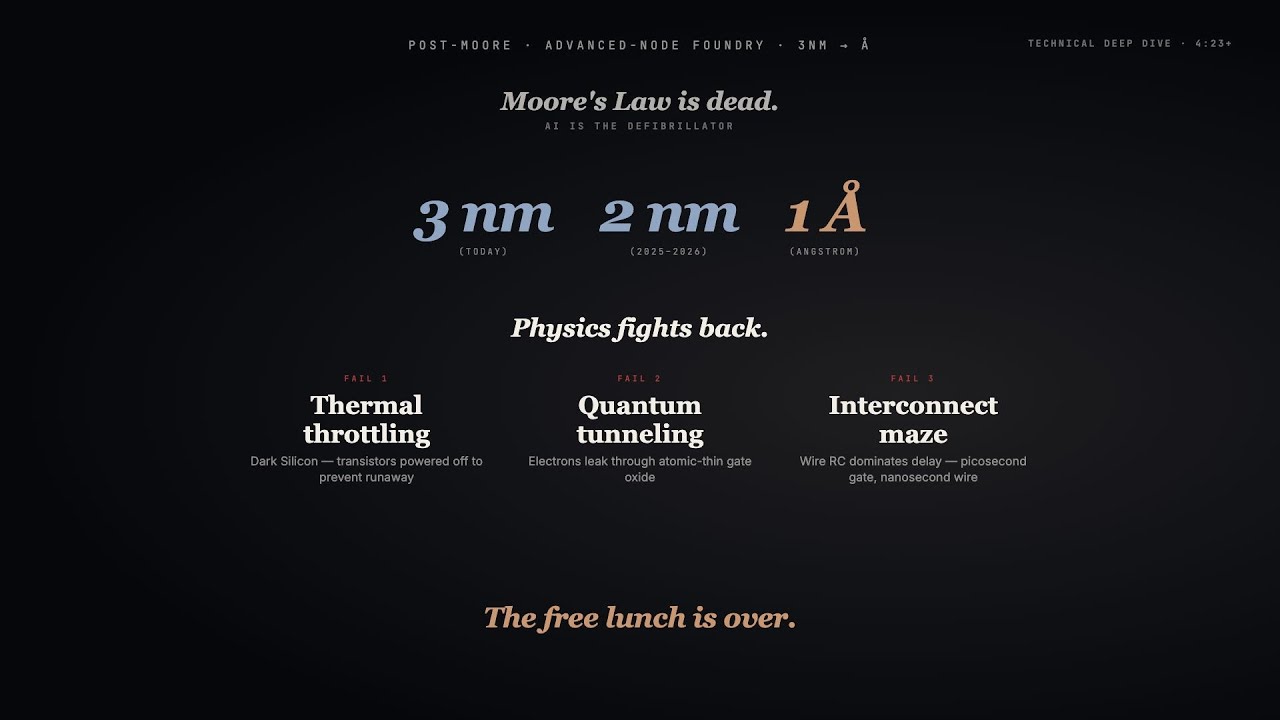
For 50 years, Moore's Law delivered a predictable dividend. That era is over. We've entered a regime where physics fights back.
Dennard Scaling collapsed in 2005. Moore's Law is faltering at 3nm/2nm nodes where cost-per-transistor is rising, not falling. Dark Silicon, quantum tunneling, and thermal throttling dominate.
Modern SoCs contain billions of transistors across thousands of macros. The permutations for optimal placement exceed the number of atoms in the observable universe. Human intuition cannot scale.
Traditional EDA tools rely on Simulated Annealing from the 1980s—memoryless algorithms that restart from zero each run, trapped in local minima. They cannot "see" the global optimum.
"The 'free lunch' of automatic speedups from lithographic shrinking is over. The bottleneck has shifted from the transistor gate to the wire. Geometric arrangement is now the single most critical determinant of chip performance—yet we still use rules of thumb from an era of micron-scale designs."
— Veriprajna Technical Whitepaper, 2024
Veriprajna reframes floorplanning from a static optimization problem to a sequential decision-making game—like Chess or Go—where RL agents learn superhuman strategies.
Like a Chess Grandmaster who doesn't calculate every move but relies on pattern-matched intuition, RL agents develop a "physics intuition" for silicon by playing millions of floorplanning games.
Floorplanning is formulated as a sequential MDP where each placement decision updates the state and influences future options—enabling dynamic adaptation impossible for analytical placers.
RL agents, unburdened by human aesthetic preferences, generate visually chaotic layouts that consistently outperform human "Manhattan" designs. The "chaos" is actually hyper-optimization—minimizing Euclidean distance of critical nets in ways rigid human geometry cannot.
Physics Over Aesthetics
Human designers favor neat rows and columns for cognitive manageability. AI discovers that the shortest signal path is rarely a straight cardinal line—it's an intricate weave through available space that satisfies Kirchhoff's laws at nanosecond precision.
Watch how an RL agent makes sequential placement decisions, adapting its strategy as the layout emerges—unlike analytical placers that solve all positions simultaneously and get trapped in local optima.
Agent learns to minimize wire length while balancing congestion, timing violations, and thermal density—a multi-objective optimization beyond human mental simulation.
Google's AlphaChip stands as the "Sputnik moment" for AI in EDA—the first rigorous demonstration that deep RL could outperform expert human teams on commercial-grade silicon.
Novel Graph Neural Network that processes chip netlist as a hypergraph—not text. Explicitly updates representations for both gates (nodes) AND wires (edges).
Dual-head architecture: Policy Network predicts best next move probability; Value Network estimates final chip quality from partial state.
Pre-trained on diverse chips (CPU, TPU, RISC-V). Learns general principles like "placing routing-heavy blocks centrally causes congestion." Starts smart, not random.
Proximal Policy Optimization—same algorithm behind ChatGPT RLHF. Balances exploration vs exploitation, preventing catastrophic policy collapse.
Unlike Simulated Annealing which resets to zero each run, AlphaChip gets progressively smarter with every chip it designs. Google trained it on TPU v3 blocks, then applied it to v4, v5e, v5p, and Trillium—each iteration improving the agent's generalized "chip design intuition."
RL chip design has moved from academic papers to production tape-outs powering millions of devices globally.
Flagship Mobile SoC for Android Devices
MediaTek utilized AlphaChip principles to optimize Dimensity 9400/9500 floorplans, specifically targeting the holy trinity of mobile silicon: Power, Performance, Area (PPA). Executives explicitly credited "smart EDA" for enabling layouts that delivered market-leading metrics.
Standard Cell Layout RL Framework
While Google tackled macro-level floorplanning, NVIDIA Research targeted the microscopic world of Standard Cells—optimizing the internal transistor/wire layout of atomic logic gates (NAND, Flip-Flops) at 3nm/2nm nodes.
NVCell combines Simulated Annealing for initial placement with an RL agent for detailed routing and Design Rule Check (DRC) fixing—learning to navigate complex manufacturing constraints at atomic scale.
By shrinking the standard cell library itself, every chip built using that library becomes smaller and more efficient. This is a multiplicative advantage across the entire EDA ecosystem.
Reported using AI-driven flows to reduce power by 8% on critical blocks and improve timing by 50% in weeks vs months.
Professors from Harvard, NYU, Georgia Tech cite AlphaChip as a "cornerstone" of modern research—fundamental scientific advance, not just product feature.
MediaTek's success triggered "Fear Of Missing Out" across semiconductor industry—RL-driven PPA now viewed as competitive necessity.
Google and NVIDIA represent hyperscaler R&D. Veriprajna bridges the chasm between research papers and production tape-out flows for automotive, IoT, industrial, and consumer semiconductor markets.
Many consultancies offer "AI for EDA" that amounts to chatbots writing Tcl scripts for legacy tools. This automates the interface, not the optimization engine.
Veriprajna's Differentiation
We replace the placer algorithm itself with RL policies. Our agents interact directly with the netlist and physics engine, making millions of placement decisions based on learned intuition—not scripted heuristics.
Primary barrier: RL agents are data-hungry. Most enterprises have "dirty" data—legacy designs scattered across servers in inconsistent formats (LEF/DEF, GDSII).
Veriprajna Infrastructure
We build your EDA Data Lake—ingesting legacy files, normalizing formats, converting to offline RL training datasets. Your decade of tape-outs becomes a competitive asset: a custom "Corporate Brain."
Cultural hurdle: "Black Box" neural networks. Veteran engineers ask: "Why did it put the clock divider there? Is it hallucinating?"
XAI Dashboards
We visualize the agent's Reward Trajectory and decision-making process. Sensitivity maps highlight which constraints (congestion, timing, thermal) drove specific placements—proving "alien" layouts are calculated physics responses, not chaos.
Critics cite high GPU compute cost for training. This is the wrong lens—it's a one-time investment vs. perpetual labor cost.
Veriprajna optimizes via Transfer Learning: Pre-train foundation model on OpenROAD/RISC-V. Client engagements only require fine-tuning—reducing compute by orders of magnitude.
Synopsys and Cadence have recognized the AI trend. Here's how Veriprajna's Deep RL approach differs from incumbent solutions.
| Feature | Synopsys DSO.ai | Cadence Cerebrus | Veriprajna (Deep RL) |
|---|---|---|---|
| Core Technology | AI-driven Design Space Exploration (DSE). Tunes tool parameters. | RL for parameter tuning & flow optimization. | Deep RL for direct Physical Design. Agents place macros/cells directly. |
| Optimization Level | Meta-Optimization: Runs standard tool many times with different settings (knobs). | Flow Optimization: Automates RTL-to-GDS flow steps. | Atomic Optimization: The agent IS the placer. Plays the game of placement. |
| "Alien" Capability | Low. Still relies on underlying analytical placer engines. | Medium. Can find non-intuitive flow settings, but layout constrained by legacy engines. | High. Generates fundamentally novel topologies ("Alien Layouts"). |
| Learning Scope | Project-specific. Often relearns for new designs. | RL with some transfer capabilities. | Foundation Model. Pre-trained on vast datasets; true transfer learning across architectures. |
| Transparency | Black Box product. | Proprietary ecosystem. | Open/Customizable. Client owns the trained policy and weights. |
| Economic Model | Expensive licensing add-on. | Expensive licensing add-on. | Solution/Service. We build the capability within your org. |
Strategic Positioning: While DSO.ai and Cerebrus excel at optimizing parameters of existing flows (finding right synthesis effort levels), Veriprajna aims to replace the algorithms themselves with learned policies. We're not tuning the internal combustion engine—we're replacing it with an electric motor.
Model the impact of RL-driven floorplanning on your chip design economics
Essential concepts for understanding RL in chip design
A neural network that processes data structured as a graph (nodes and edges). "Edge-centric" means explicitly updating representations for wires (edges) AND gates (nodes)—crucial for understanding routing congestion.
Standard heuristic for estimating wire length needed to connect pins. Calculated as half the perimeter of the bounding box enclosing all pins. Minimizing HPWL is the primary proxy for minimizing delay and power.
Mathematical framework for modeling decision-making where outcomes are partly random and partly controlled. Formal foundation of Reinforcement Learning. Defined by states, actions, rewards, and transition probabilities.
Popular RL algorithm balancing ease of implementation, sample complexity, and tuning. Used by OpenAI (ChatGPT training) and Google (AlphaChip). Prevents catastrophic policy collapse during training.
ML technique where a model trained for one task is reused as the starting point for a second task. In EDA: using "intuition" learned from designing a CPU to help design a GPU—starting smart, not random.
The holy trinity of chip design metrics. Power = energy consumption, Performance = clock speed/throughput, Area = die size. These are often conflicting objectives requiring multi-objective optimization.
Phenomenon where thermal constraints force a significant percentage of chip transistors to remain powered off at any given time to prevent thermal runaway—a consequence of Dennard Scaling collapse.
Traditional optimization algorithm (1980s) that randomly moves blocks and "cools" the system to settle into a solution. Fatal flaws: memoryless (no learning) and easily trapped in local minima.
Moore's Law is dead. The demand for compute—driven by AI itself—is accelerating exponentially. This divergence creates a crisis that only AI can solve.
Move past the bias for human-readable "Manhattan" layouts. Trust the physics-verified results of the agent. The shortest path for electrons is rarely the most aesthetically pleasing to humans.
Your legacy designs are your most valuable IP. Clean them, store them in a unified data lake, and use them to train your AI. Past tape-outs become the curriculum for your RL agent's PhD.
The elite design team of the future is not 50 engineers doing manual layout, but 5 engineers guiding a fleet of RL agents running on a GPU cluster. Trade OPEX for CAPEX.
Reinforcement Learning is the defibrillator. It restarts the heart of the industry by unlocking a new dimension of scaling: Complexity Scaling. If we cannot make the transistors much smaller, we must arrange them much smarter. The board is set. The pieces are moving. It is time to let the agent play the game.
Veriprajna stands ready to be your partner in this transformation. We don't sell tools; we deliver the capability to design the impossible.
Modern SoCs contain billions of transistors across thousands of macros, creating design space permutations exceeding 10^100, more than atoms in the observable universe. Traditional tools rely on Simulated Annealing algorithms from the 1980s that are memoryless, restarting from zero each run and getting trapped in local minima. Additionally, Dennard Scaling collapsed in 2005 and wire delay now exceeds gate delay, making geometric arrangement the single most critical determinant of chip performance, yet the tools were designed for an era of micron-scale designs.
RL agents formulate floorplanning as a Markov Decision Process where the silicon die is the board, IP blocks are the pieces, and placement coordinates are the moves. Using Edge-GNN to encode the chip netlist as a hypergraph and PPO for training, agents play millions of placement games, developing physics intuition for silicon. The resulting 'alien' layouts appear visually chaotic but actually minimize Euclidean distance of critical nets, achieving 10-15% better PPA metrics because electrons follow physics, not human aesthetic preferences for neat rows.
Google's AlphaChip designed blocks for TPU v5 and Trillium (v6), contributing to a 4.7x performance boost and 67% energy efficiency improvement. MediaTek used RL principles for Dimensity 9400/9500, achieving 35% single-core performance gains and 40% power efficiency improvements. NVIDIA's NVCell framework applied RL to standard cell layout at 3nm, with 92% of cells matching or beating hand-crafted area while requiring zero human intervention. Samsung Foundry reported 8% power reduction and 50% timing improvement on critical blocks.
Veriprajna's Deep RL solution doesn't just improve design cycles—it fundamentally changes the physics of silicon optimization.
Schedule a consultation to explore how RL-driven floorplanning can compress your time-to-market and unlock alien architectures verified by physics.
Complete engineering report: Edge-GNN architecture, MDP formulation, PPO training details, MediaTek/NVIDIA case studies, comparative EDA analysis, comprehensive references.