The Sovereignty of Software Integrity: Architecting Resilient Systems in the Era of Deep AI and Kernel-Level Complexity
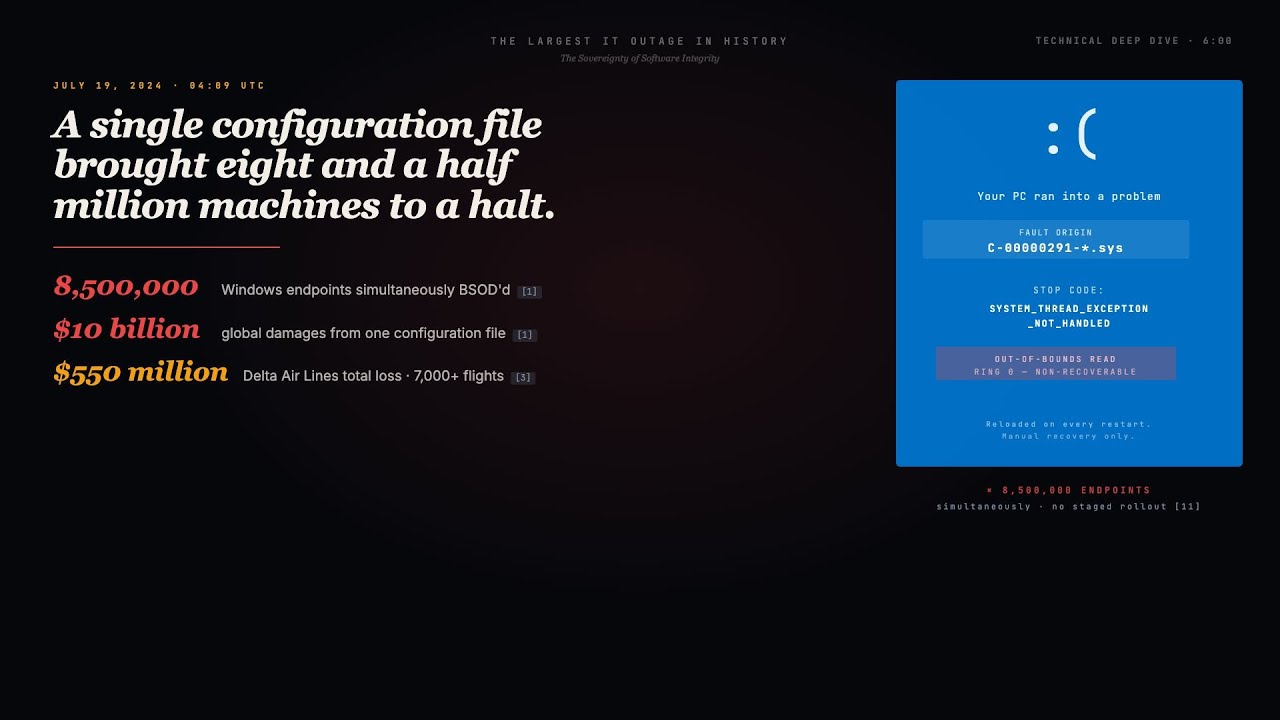
The events of July 19, 2024, represent more than a localized software failure; they signal a structural crisis in the global digital infrastructure. When approximately 8.5 million Windows systems simultaneously succumbed to a Blue Screen of Death (BSOD), the resulting $10 billion in global damages underscored the extreme fragility of a world built upon interconnected, high-privilege software updates.1 For enterprises, the incident served as a stark reminder that the current paradigm of "best-effort" security and probabilistic software delivery is no longer sufficient. The subsequent litigation, specifically the $550 million loss reported by Delta Air Lines and the resulting claims of gross negligence and computer trespass, has initiated a fundamental reassessment of the legal and technical responsibilities of software providers.2
In this context, the role of the AI consultancy must evolve. The market is saturated with "LLM wrappers"—thin application layers that rent intelligence from third-party providers to perform superficial tasks.4 However, the systemic challenges exposed by the CrowdStrike outage demand "Deep AI" solutions. These solutions integrate directly with system architecture, utilize formal verification to provide mathematical guarantees of correctness, and employ autonomous telemetry to predict and mitigate failures before they cascade.6 This whitepaper, presented by Veriprajna, analyzes the technical mechanics of the global outage, explores the shifting legal landscape of software liability, and defines the architectural requirements for a resilient, AI-native enterprise.
The Technical Anatomy of a Global Cascade: From Heuristics to Systemic Collapse
The technical failure that paralyzed 8.5 million endpoints was rooted in the "Rapid Response Content" mechanism of the CrowdStrike Falcon platform. This system is designed to provide high-velocity updates to security sensors without requiring a full update of the sensor’s executable code.8 While this architecture allows for rapid defense against zero-day threats, it creates a "Rapid Response Paradox": the speed of the update pipeline exceeds the capacity of traditional validation gates.
The Logic of the Failure: Channel File 291
The specific mechanism of the crash involved Channel File 291, a configuration file located in the C:\Windows\System32\drivers\CrowdStrike\ directory.9 Although these files carry a .sys extension, they do not contain executable code; instead, they are binary data structures containing "Template Instances".8 These instances configure a "Content Interpreter"—a specialized, kernel-mode engine designed to evaluate system activity against behavioral patterns.10
On July 19, 2024, two new Template Instances were deployed for inter-process communication (IPC) detection. These instances were designed to inspect a 21st input parameter, a field that had not been utilized by previous iterations of the IPC template.11 The failure was the result of a disparity between two critical components of the update pipeline: the Content Validator and the Content Interpreter.
| Pipeline Component | Location | Role | Behavior during Incident |
|---|---|---|---|
| Template Type Definition | Cloud | Defines the schema for a behavioral heuristic. | Updated to expect 21 input fields.11 |
| Content Validator | Cloud | Checks Template Instances for safety before deployment. | Validated the update based on the 21-field expectation.11 |
| Content Interpreter | Endpoint (Kernel) | Executes the heuristic on live system data. | Only supported 20 input fields due to a latent code issue.11 |
| Resulting Action | System | Execution of the heuristic. | Attempted to read 21st field, causing an out-of-bounds read and BSOD.11 |
The Content Validator approved the update because it was consistent with the new cloud-based definition of the template. However, the Content Interpreter—the actual code running in the Windows kernel (Ring 0)—remained limited to 20 fields.11 When the sensor attempted to access the 21st parameter, it performed an out-of-bounds memory read beyond the allocated input data array.11 In the high-privilege environment of the kernel, such a memory fault is non-recoverable, triggering an immediate system crash and an endless reboot cycle, as the faulty file was reloaded upon every restart.9
The "Dead Agent" and the Manual Recovery Crisis
The crisis was exacerbated by the "Dead Agent" race condition. Because the crash occurred so early in the boot sequence, the Falcon sensor's management agent—the component responsible for receiving cloud-based commands—never had the opportunity to initialize.12 This meant that the endpoints were "orphaned"; they could not receive a "rollback" command from CrowdStrike because the very software meant to process that command was the cause of the system's failure.12
This necessitated a manual recovery process of unprecedented scale. IT administrators were forced to boot individual machines into Safe Mode, navigate to the driver directory, and manually delete the faulty C-00000291-*.sys file.3 For large-scale enterprises like Delta Air Lines, which relied heavily on Windows-based applications for crew tracking and mission-critical systems, this required the manual intervention of approximately 40,000 servers and thousands of workstations.3
The Economic and Industrial Impact of Interdependency
The global damage resulting from the July 19 outage is estimated to exceed $10 billion, with U.S. Fortune 500 companies accounting for approximately $5.4 billion of that loss.1 These figures exclude the impact on Microsoft itself, reflecting the secondary costs of lost productivity, flight cancellations, and medical procedure delays.1
Sector-Specific Vulnerabilities
The aviation, healthcare, and financial sectors faced the most severe disruptions due to their reliance on real-time, high-availability IT systems. The outage revealed how a single configuration error can act as a systemic "multiplier," where the failure of a security tool leads to the collapse of the very business operations it was meant to protect.
| Sector | Nature of Impact | Key Statistics / Examples |
|---|---|---|
| Aviation | System-wide grounding; loss of crew-tracking capabilities. | Delta Air Lines cancelled 7,000+ flights; $550M total loss.3 |
| Healthcare | Cancellation of elective surgeries; loss of access to patient records. | Widespread disruptions to hospital operations and critical care.1 |
| Finance | Failure of payment gateways; interruption of cross-border settlements. | Disruption of global payment systems and ATM networks.1 |
| Corporate | Lost productivity; depletion of IT resources for manual recovery. | $5.4B loss for Fortune 500 companies (excluding Microsoft).1 |
For Delta Air Lines, the impact was particularly acute. While competitors like American Airlines and United Airlines recovered within 24 to 72 hours, Delta's disruption lasted over five days.3 This prolonged recovery was attributed to several factors, including a heavy reliance on Windows-based applications for the "crew-tracking" system, which, when combined with 40,000 crashed servers, created a data-integrity vacuum that prevented the airline from efficiently repositioning its staff.3
The Shifting Legal Landscape: From Product Failure to Gross Negligence
The aftermath of the outage has moved from the server room to the courtroom. The litigation between Delta Air Lines and CrowdStrike represents a landmark moment in the history of software liability. Historically, software vendors have been shielded by contractual terms that limit liability to the cost of the subscription.1 However, the July 19 incident has opened the door to tort-based claims of "gross negligence" and "computer trespass".2
The Delta v. CrowdStrike Ruling (May 2025)
In May 2025, Judge Kelly Lee Ellerbe of the Fulton County Superior Court issued a ruling that significantly altered the legal risk profile for security vendors. The court declined to dismiss several of Delta's most potent claims, effectively ruling that the standard "Economic Loss Rule" (which limits remedies to contract law) might not apply in cases where a "confidential relationship" or independent statutory duties are involved.2
The Gross Negligence Argument
Delta’s core allegation is that CrowdStrike acted with gross negligence by bypassing standard software development practices. The claim centers on the fact that CrowdStrike pushed the July 19 update to all 8.5 million systems simultaneously, without a staged rollout or "canary" deployment.2 The court noted that CrowdStrike’s own internal reports admitted that the "Content Validator" contained a logic error and that the "Content Interpreter" lacked a runtime bounds check—failures that Delta argues represent a conscious disregard for known risks.2
The Computer Trespass Claim
Perhaps most significant is the "computer trespass" claim. Delta argues that because it had opted out of automatic software updates in its settings, CrowdStrike’s act of "forcing" the update via the kernel-level channel file constituted an unauthorized access to Delta’s proprietary systems.2 The judge ruled that statutory duties regarding computer trespass are independent of the Subscription Services Agreement (SSA), allowing this claim to proceed despite the liability caps within the contract.2
| Legal Claim | Basis for Claim | Implications for the Industry |
|---|---|---|
| Gross Negligence | Choice of "speed over safety"; failure to test even on a single machine.2 | Sets a precedent for "standard of care" in automated updates. |
| Computer Trespass | Unauthorized access to the kernel by overriding customer preferences.2 | Challenges the "forced update" model used by modern SaaS/Cloud vendors. |
| Fraud by Omission | Hiding the lack of testing and staging protocols from customers.2 | Requires greater transparency in software supply chain security. |
| Breach of Contract | Failure to provide a "no backdoor" or secure update environment.2 | Tightens the interpretation of performance warranties. |
The Veriprajna Paradigm: Beyond the "Wrapper" to Deep AI Solutions
The CrowdStrike incident is a symptom of a broader problem: the "Abstraction Fallacy." As software systems grow more complex, developers rely on layers of abstraction that obscure the underlying risks. This is mirrored in the current AI market, where many consultants offer "LLM wrappers"—thin integrations with models like GPT-4 or Claude—to automate simple text-based tasks.16 While these wrappers provide immediate productivity gains, they lack the "Deep AI" architecture required to solve systemic problems like kernel-level stability or predictive telemetry.
Differentiating Deep AI from LLM Wrappers
A "Deep AI" solution provider, as envisioned by Veriprajna, does not merely "wrap" a third-party API. Instead, it utilizes specialized architectures—such as Large Concept Models (LCMs), Vision-Language Models (VLMs), and formally verified code generation—to integrate intelligence into the core logic of the enterprise.16
| Feature | LLM Wrapper (Surface AI) | Deep AI Solution (Veriprajna) |
|---|---|---|
| Core Architecture | Single third-party LLM (GPT-4, Gemini).4 | Hybrid/Modular: Transformers, CNNs, GNNs, and specialized SLMs.16 |
| Integration Level | UI/Workflow layer; external API calls.4 | System/Kernel level; integrated telemetry and logic.6 |
| Reliability Model | Probabilistic; "Best-effort" text generation.7 | Deterministic; Formally verified and mathematically proven.7 |
| Resilience | Dependent on model provider's uptime/pricing.4 | Sovereign AI; localized models with autonomous mitigation.5 |
| Primary Goal | Content generation and summarization.16 | Predictive reliability and structural integrity.6 |
The Imperative of AI Sovereignty
The "Deep Tech Crash" scenario—a potential collapse of business applications due to a failure in underlying AI infrastructure—is a significant risk for companies dependent on external wrappers.5 Veriprajna advocates for "Sovereign AI," where organizations deploy specialized models (Small Language Models or SLMs) on their own infrastructure.17 This approach ensures that the "North Star" of the business strategy—its digital integrity—is not compromised by the business models or technical failures of third-party providers.5
Formal Verification: The New Standard for High-Assurance Software
The logic error that caused the CrowdStrike outage would have been impossible to ignore under a regime of formal verification. Formal verification uses mathematical proofs to ensure that a piece of software (the implementation) always satisfies its intended behavior (the specification).7 While historically limited to "niche" research projects like the seL4 microkernel due to the immense human effort required, AI is now making formal verification mainstream.7
AI-Driven Proof Generation and the VeCoGen Framework
Recent research has introduced tools like VeCoGen, which combine Large Language Models with formal verification engines to automate the generation of verified C code.18 By using the ANSI/ISO C Specification Language (ACSL), these AI systems can iterate through candidate programs, submitting each to a "proof checker" that mathematically confirms its correctness.7
For security-critical components like the CrowdStrike Content Interpreter, this process offers a level of certainty that manual QA cannot match. As Martin Kleppmann (2025) predicts, we are entering an era where AI-generated code will be preferred over handcrafted code precisely because AI can generate the proof alongside the implementation.7 In this model, the "proof checker" acts as a verified gatekeeper, rejecting any hallucinated or erroneous code before it ever reaches the kernel.7
The Verification Gap: Logic Errors in Validators
The CrowdStrike RCA noted that the "Content Validator" failed because it "based its assessment on the expectation that the IPC Template Type would be provided with 21 inputs".11 This is a classic "semantic gap." The validator had a different "worldview" than the interpreter. Deep AI solutions address this by:
1. Extracting Semantic Properties: Using AI agents (like FaultLine) to trace data flows from source to sink and reason about requirements before a single line of code is deployed.23
2. Iterative Refinement: Subjecting initially secure code to multiple rounds of "adversarial" AI feedback to identify how vulnerabilities might evolve or amplify over time.24
3. Formal Specification Alignment: Ensuring that the cloud-based validator and the endpoint-based interpreter share a single, mathematically verified formal specification.7
Predictive Telemetry and Autonomous Resilience: The AITA Framework
A critical failure on July 19 was the "blindness" of the system. The update was pushed, and the systems crashed, with no automated mechanism to detect the "out-of-bounds read" and halt the rollout globally in the first seconds of the event. Veriprajna’s approach to "Deep AI" includes the implementation of AI-Driven Telemetry Analytics (AITA).6
Beyond Static Monitoring
Traditional monitoring systems rely on static thresholds—e.g., "Alert if CPU > 90%." These systems are reactive and prone to high false-positive rates.6 AITA frameworks use unsupervised machine learning (such as Isolation Forest, DBSCAN, and Autoencoders) to establish a "full-stack view" of normal hardware behavior.6
| Reliability Metric | Traditional Monitoring | AI-Driven (AITA) Framework |
|---|---|---|
| Mean Time to Detect (MTTD) | High (minutes to hours) | 35% Reduction (seconds).6 |
| False Positives | High (alert fatigue) | 40% Reduction.6 |
| Monitoring Overhead | 100% (Baseline) | 30% Reduction in resource cost.6 |
| Anomaly Accuracy | Rule-dependent | 97.5% Precision; 96.2% Recall.27 |
By analyzing low-level signals from hardware metrics, AITA can predict service degradation or system-level anomalies before they impact business operations.6 In the context of a kernel update, an AITA-enabled sensor would have detected the "latent out-of-bounds read" as a deviation from the established baseline during the very first millisecond of evaluation, triggering an immediate "local kill-switch" and preventing the system-wide BSoD cascade.6
The "Self-Healing" IT Operation
The ultimate goal of Deep AI in the enterprise is the transition from "Reactive" to "Self-Healing" operations.20 When an anomaly is detected, the AI-driven system can automatically:
● Isolate Affected Components: Restrict the faulty driver's access to the kernel or roll back to the last known-good configuration file automatically.20
● Adaptive Alerting: Adjust thresholds dynamically based on model confidence, minimizing "noise" for the IT staff.6
● Root Cause Analysis (RCA): Identify the causal relationship between the configuration change and the memory fault in real-time, providing the "Why" alongside the "What".20
Architecting the Future: Strategic Recommendations for the Enterprise
The CrowdStrike incident has made it clear that "business as usual" is a catastrophic risk. Enterprises must move toward an "AI-Native" architecture that prioritizes resilience, verification, and sovereignty over mere automation.19
1. Implement a "Ring 0" Safety Protocol
Organizations must demand that any software operating in the kernel (Ring 0) adheres to a strict safety protocol that mirrors the findings of the CrowdStrike RCA.11 This includes:
● Strict Schema Versioning: The binary must verify the config version matches its internal schema before parsing. No "blind trust" of input files.12
● Boot Loop Simulation: Updates must be deployed to a diverse set of virtualized hardware environments and forcibly rebooted five times. If the agent doesn't report "Healthy," the rollout is aborted.12
● Mandatory Staged Rollout: The "Progressive Exposure" model must be non-negotiable. Updates should move from internal "dogfooding" to early adopters and then through multiple customer waves, with defined "watch windows" between each.29
2. Transition from Wrappers to Deep AI Expertise
The "diamond-shaped" organizational structure is replacing the traditional pyramid.31 Enterprises no longer need a mass of junior "analysts" to manage LLM wrappers; they need tech experts and data scientists who can bridge the gap between high-level business strategy and low-level system reforms.31
| Organizational Model | Workforce Composition | Focus |
|---|---|---|
| Traditional Pyramid | Large pool of junior staff / generalist MBAs.31 | Repetitive tasks; manual monitoring. |
| AI-Native Diamond | Mid- to senior-level experts in AI and Engineering.31 | Decision-making; system-level reasoning. |
| The Role of Veriprajna | Vertical and Horizontal Integration.18 | Optimization across engineering disciplines. |
3. Adopt Agentic Governance and Guardrails
As "Agentic AI" usage rises, the complexity of governing autonomous systems becomes the primary barrier to production.19 Only 20% of companies currently have a mature model for the governance of autonomous AI agents.19 Veriprajna recommends:
● Embedded Governance: Treating governance not as an external "check" but as a core architectural capability.28
● Agentic SOC: Utilizing "Superagency"—the convergence of human and machine intelligence—to manage the speed of modern threats.32
● Real-Time Verifiers: Deploying "Assessors" and "Verifiers" alongside every AI-generated exploit or fix to ensure that the solution does not create a secondary failure.33
Synthesis: The Resilience Mandate
The largest IT outage in history was not an act of God; it was a predictable outcome of a software culture that prioritizes deployment velocity over structural integrity. The $10 billion cost of the CrowdStrike event is a "down payment" on a necessary global upgrade to our digital foundations.1
The move toward "Deep AI" represents a fundamental shift in the nature of software development. We are moving away from the era of "artisanal bugs" and probabilistic text-generation "wrappers" toward a future of mathematically verified, self-healing, and sovereign AI systems.5 Veriprajna positions itself at the forefront of this transition, providing the deep technical expertise required to ensure that the next generation of enterprise software is as resilient as it is innovative.
The legal precedents established by the Delta v. CrowdStrike litigation will soon force the entire industry to adopt these standards.2 The "Gross Negligence" of today will be the "Baseline Expectation" of tomorrow. For the modern enterprise, the choice is clear: either redesign for an AI-native, verified future, or remain vulnerable to the next global cascade.28 Digital sovereignty and software integrity are no longer optional "features"—they are the prerequisites for survival in the age of Deep AI.
Note: This report utilizes extensive technical and legal data points from official Root Cause Analysis (RCA) reports, judicial rulings from 2024-2025, and peer-reviewed research in AI-driven formal verification and telemetry..1
Works cited
Realigning Incentives to Build Better Software: A Holistic Approach to Vendor Accountability, accessed February 6, 2026, https://arxiv.org/html/2504.07766v2
Judge Lets Delta's Cyber Failure Suit vs ... - BankInfoSecurity, accessed February 6, 2026, https://www.bankinfosecurity.com/judge-lets-deltas-cyber-failure-suit-vs-crowdstrike-proceed-a-28443
2024 Delta Air Lines disruption - Wikipedia, accessed February 6, 2026, https://en.wikipedia.org/wiki/2024_Delta_Air_Lines_disruption
The AI Wrappers Debate: How to Value Them? | L40°, accessed February 6, 2026, https://www.l40.com/insights/how-to-value-ai-wrappers
Wrappers, deeptechs, and generative AI: a profitable but fragile house of cards, accessed February 6, 2026, https://www.duperrin.com/english/2025/05/20/wrappers-deeptechs-generative-ai/
(PDF) AI-Driven Telemetry Analytics for Predictive Reliability and Privacy in Enterprise-Scale Cloud Systems - ResearchGate, accessed February 6, 2026, https://www.researchgate.net/publication/397556116_AI-Driven_Telemetry_Analytics_for_Predictive_Reliability_and_Privacy_in_Enterprise-Scale_Cloud_Systems
Prediction: AI will make formal verification go mainstream — Martin ..., accessed February 6, 2026, https://martin.kleppmann.com/2025/12/08/ai-formal-verification.html
Falcon Content Update Preliminary Post Incident Report - CrowdStrike, accessed February 6, 2026, https://www.crowdstrike.com/en-us/blog/falcon-content-update-preliminary-post-incident-report/
CrowdStrike failure: What you need to know - CIO, accessed February 6, 2026, https://www.cio.com/article/3476789/crowdstrike-failure-what-you-need-to-know.html
Tech Analysis: Addressing Claims About Falcon Sensor Vulnerability | CrowdStrike, accessed February 6, 2026, https://www.crowdstrike.com/en-us/blog/tech-analysis-addressing-claims-about-falcon-sensor-vulnerability/
External Technical Root Cause Analysis — Channel ... - CrowdStrike, accessed February 6, 2026, https://www.crowdstrike.com/wp-content/uploads/2024/08/Channel-File-291-Incident-Root-Cause-Analysis-08.06.2024.pdf
Crowdstrike Case Study: Analyzing the "Channel File 291" crash which impacted (and why the Kernel trusted it) : r/sysadmin - Reddit, accessed February 6, 2026, https://www.reddit.com/r/sysadmin/comments/1qjo7nk/crowdstrike_case_study_analyzing_the_channel_file/
Delta hits CrowdStrike with lawsuit over system crash, accessed February 6, 2026, https://topclassactions.com/delta-airlines-class-action-lawsuit-and-settlement-news/delta-hits-crowdstrike-with-lawsuit-over-system-crash/
Delta's lawsuit against CrowdStrike given go-ahead - The Register, accessed February 6, 2026, https://www.theregister.com/2025/05/21/judge_allows_deltas_lawsuit_against/
5 Things To Watch In Delta's Lawsuit Against CrowdStrike - CRN, accessed February 6, 2026, https://www.crn.com/news/security/2025/5-things-to-watch-in-delta-s-lawsuit-against-crowdstrike
Generative AI vs LLM: What is Best For Your Business? - Signity Software Solutions, accessed February 6, 2026, https://www.signitysolutions.com/blog/generative-ai-vs-llm
LLMs vs Other AI Models: Choosing the Right AI Architecture for Your Business, accessed February 6, 2026, https://metadesignsolutions.com/llms-vs-other-ai-models-choosing-the-right-ai-architecture-for-your-business/
VeCoGen: Automating Generation of Formally Verified C Code With Large Language Models | Request PDF - ResearchGate, accessed February 6, 2026, https://www.researchgate.net/publication/392638303_VeCoGen_Automating_Generation_of_Formally_Verified_C_Code_With_Large_Language_Models
The State of AI in the Enterprise - 2026 AI report | Deloitte US, accessed February 6, 2026, https://www.deloitte.com/us/en/what-we-do/capabilities/applied-artificial-intelligence/content/state-of-ai-in-the-enterprise.html
The Impact of AI-Enhanced System Monitoring on Anomaly ..., accessed February 6, 2026, https://ijsret.com/wp-content/uploads/IJSRET_V4_issue4_316.pdf
How to Create an Effective AI Strategy | Deloitte US, accessed February 6, 2026, https://www.deloitte.com/us/en/what-we-do/capabilities/applied-artificial-intelligence/articles/effective-ai-strategy.html
VeCoGen: Automating Generation of Formally Verified C Code with ..., accessed February 6, 2026, https://2025.formalise.org/details/Formalise-2025-papers/11/VeCoGen-Automating-Generation-of-Formally-Verified-C-Code-with-Large-Language-Models
FaultLine: Automated Proof-of-Vulnerability Generation using LLM Agents - arXiv, accessed February 6, 2026, https://arxiv.org/html/2507.15241v1
Peer-reviewed and accepted in IEEE-ISTAS 2025 Security Degradation in Iterative AI Code Generation: A Systematic Analysis of the Paradox - arXiv, accessed February 6, 2026, https://arxiv.org/html/2506.11022v2
(PDF) AI-Driven Performance Monitoring and Anomaly Detection in DevOps - ResearchGate, accessed February 6, 2026, https://www.researchgate.net/publication/388792844_AI-Driven_Performance_Monitoring_and_Anomaly_Detection_in_DevOps
Detecting Anomalies in Systems for AI Using Hardware Telemetry - arXiv, accessed February 6, 2026, https://arxiv.org/html/2510.26008v2
AI-Driven Anomaly Detection for Securing IoT Devices in 5G-Enabled Smart Cities - MDPI, accessed February 6, 2026, https://www.mdpi.com/2079-9292/14/12/2492
Tech Trends 2026 | Deloitte Insights, accessed February 6, 2026, https://www.deloitte.com/us/en/insights/topics/technology-management/tech-trends.html
Architecture strategies for safe deployment practices - Microsoft Azure Well-Architected Framework, accessed February 6, 2026, https://learn.microsoft.com/en-us/azure/well-architected/operational-excellence/safe-deployments
10 Best Practices for Software Deployment in 2025, accessed February 6, 2026, https://goreplay.org/blog/best-practices-for-software-deployment-20250808133113/
How AI is Redefining Strategy Consulting: Insights from McKinsey, BCG, and Bain - Medium, accessed February 6, 2026, https://medium.com/@takafumi.endo/how-ai-is-redefining-strategy-consulting-insights-from-mckinsey-bcg-and-bain-69d6d82f1bab
AI in the workplace: A report for 2025 - McKinsey, accessed February 6, 2026, https://www.mckinsey.com/capabilities/tech-and-ai/our-insights/superagency-in-the-workplace-empowering-people-to-unlock-ais-full-potential-at-work
From CVE Entries to Verifiable Exploits: An Automated Multi-Agent Framework for Reproducing CVEs - arXiv, accessed February 6, 2026, https://arxiv.org/html/2509.01835v1
Combining Tests and Proofs for Better Software Verification - arXiv, accessed February 6, 2026, https://arxiv.org/html/2601.16239v1
Prefer a visual, interactive experience?
Explore the key findings, stats, and architecture of this paper in an interactive format with navigable sections and data visualizations.
Frequently Asked Questions
What caused the CrowdStrike outage that crashed 8.5 million Windows systems?
Channel File 291 deployed two new Template Instances expecting 21 input parameters, but the kernel-level Content Interpreter only supported 20 fields. The Content Validator approved the update because it matched the cloud-side definition, but the endpoint interpreter performed an out-of-bounds memory read when accessing the 21st parameter, triggering an unrecoverable BSOD and endless reboot cycle across 8.5 million systems.
How does formal verification prevent kernel-level software crashes?
Formal verification uses mathematical proofs to guarantee that software implementation always satisfies its specification. Tools like VeCoGen combine LLMs with formal verification engines to automatically generate verified C code using ANSI/ISO C Specification Language. A proof checker rejects any code with memory faults or logic errors before deployment, making the type of semantic gap that caused the CrowdStrike crash architecturally impossible.
What is AI-driven telemetry analytics and how does it enable self-healing systems?
AI-Driven Telemetry Analytics uses unsupervised machine learning including Isolation Forest and Autoencoders to establish behavioral baselines from hardware metrics. It achieves 97.5% anomaly detection precision, reduces mean time to detect by 35%, and cuts false positives by 40%. When anomalies are detected, the system autonomously isolates affected components and rolls back to known-good configurations.
Also Published On
Build Your AI with Confidence.
Partner with a team that has deep experience in building the next generation of enterprise AI. Let us help you design, build, and deploy an AI strategy you can trust.
Veriprajna Deep Tech Consultancy specializes in building safety-critical AI systems for healthcare, finance, and regulatory domains. Our architectures are validated against established protocols with comprehensive compliance documentation.