Architecting Resilient Systems in the Era of Deep AI and Kernel-Level Complexity
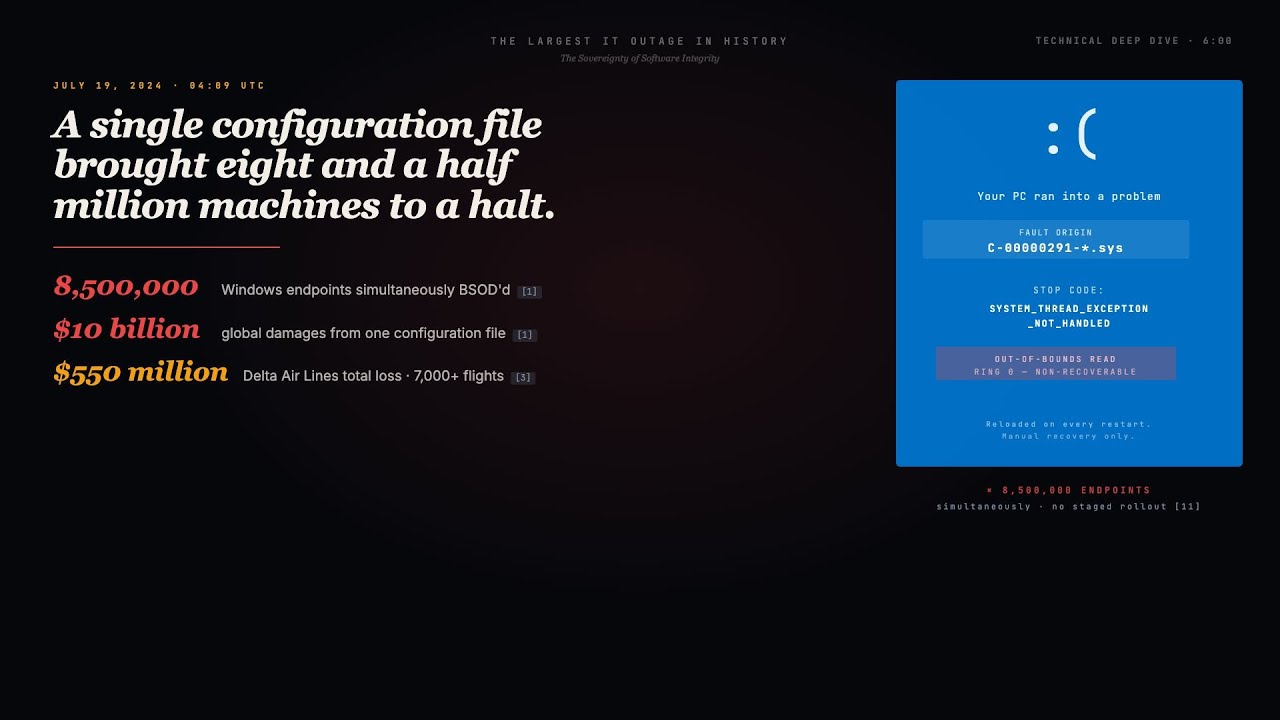
On July 19, 2024, a single configuration file crashed 8.5 million systems. The $10 billion aftermath exposed a structural crisis: the era of "best-effort" software delivery is over. This whitepaper analyzes the failure and defines the architectural requirements for an AI-native, resilient enterprise.
From a single heuristic update to 8.5 million blue screens: how the "Rapid Response Paradox" turned speed into systemic collapse.
Schema updated to expect 21 input fields for IPC detection.
Validated the update based on the 21-field expectation. Passed.
Only supported 20 fields. Attempted to read the 21st parameter.
Non-recoverable fault at Ring 0. Endless reboot cycle triggered.
The crash occurred so early in the boot sequence that the Falcon sensor's management agent never initialized. Endpoints were "orphaned"—they could not receive a rollback command because the very software meant to process that command was the cause of the failure.
IT administrators were forced to boot individual machines into Safe Mode, navigate to the driver directory, and manually delete the faulty file. For Delta Air Lines, this required manual intervention on approximately 40,000 servers and thousands of workstations.
A single configuration error acted as a systemic multiplier—the security tool's failure collapsed the very operations it was meant to protect.
Estimated economic damage by sector (US Fortune 500, excluding Microsoft)
System-wide grounding; loss of crew-tracking capabilities.
Cancellation of surgeries; loss of access to patient records.
Payment gateway failures; cross-border settlement interruptions.
Lost productivity; mass IT resource depletion for manual recovery.
While competitors recovered within 24-72 hours, Delta's heavy reliance on Windows-based crew-tracking systems combined with 40,000 crashed servers created a data-integrity vacuum. The airline couldn't efficiently reposition staff, turning a technical failure into an operational paralysis that cascaded for over five days.
The Delta v. CrowdStrike litigation represents a landmark moment in software liability law. The days of hiding behind contractual liability caps may be numbered.
The Fulton County Superior Court declined to dismiss Delta's most potent claims, ruling that the standard "Economic Loss Rule" might not apply when a "confidential relationship" or independent statutory duties are involved. This opens the door to tort-based claims that bypass contractual liability caps.
CrowdStrike pushed the July 19 update to all 8.5 million systems simultaneously, without staged rollout or canary deployment. Their own internal reports admitted the Content Validator contained a logic error and the Content Interpreter lacked a runtime bounds check.
Delta had opted out of automatic updates. CrowdStrike's act of "forcing" the update via the kernel-level channel file constituted unauthorized access to proprietary systems. The judge ruled statutory duties exist independently of the contract.
Hiding the lack of testing and staging protocols from customers. The absence of even a single-machine test before global deployment represents a conscious disregard for known risks.
Failure to provide a secure update environment as warranted. The performance guarantees in the Subscription Services Agreement were demonstrably violated.
"The 'Gross Negligence' of today will be the 'Baseline Expectation' of tomorrow. The legal precedents established by the Delta v. CrowdStrike litigation will soon force the entire industry to adopt these standards."
— Veriprajna Technical Whitepaper
The market is saturated with "LLM wrappers"—thin application layers that rent intelligence from third-party providers. The systemic challenges exposed by the CrowdStrike outage demand something fundamentally different.
Deploy specialized Small Language Models (SLMs) on your own infrastructure. Your digital integrity cannot depend on the business decisions of third-party providers.
Hybrid system design: Transformers, CNNs, GNNs, and specialized SLMs working in concert—not a monolithic dependency on a single model.
Intelligence integrated into core system logic—kernel telemetry, driver validation, and autonomous mitigation at the infrastructure layer.
The logic error that caused the outage would have been impossible to ignore under formal verification. AI is now making this once-niche technique mainstream.
Mathematical proofs that ensure software (the implementation) always satisfies its intended behavior (the specification). Not testing—proving. While historically limited to niche research like the seL4 microkernel, AI is now making it mainstream.
Tools like VeCoGen combine LLMs with formal verification engines to automate verified C code generation. The AI generates candidate programs; a proof checker mathematically confirms correctness. The "proof checker" rejects any hallucinated or erroneous code before it reaches the kernel.
We are entering an era where AI-generated code will be preferred over handcrafted code precisely because AI can generate the proof alongside the implementation.
The Content Validator had a different "worldview" than the Content Interpreter. This classic semantic gap—two components disagreeing on the schema they share—is precisely what formal verification prevents.
Semantic Property Extraction: AI agents trace data flows from source to sink, reasoning about requirements before a single line of code is deployed.
Iterative Adversarial Refinement: Secure code is subjected to multiple rounds of adversarial AI feedback to identify how vulnerabilities might evolve.
Formal Specification Alignment: Cloud validator and endpoint interpreter share a single, mathematically verified specification.
On July 19, the system was blind. No automated mechanism detected the out-of-bounds read and halted the rollout. AI-Driven Telemetry Analytics changes this equation fundamentally.
Seconds vs. minutes-to-hours with static thresholds
Eliminates alert fatigue for operations teams
Reduced resource consumption through intelligent sampling
96.2% recall using Isolation Forest, DBSCAN, and Autoencoders
An AITA-enabled sensor would have detected the out-of-bounds read as a deviation from baseline during the very first millisecond, triggering an immediate local kill-switch.
Restrict the faulty driver's kernel access or roll back to the last known-good configuration file automatically.
Dynamically adjust thresholds based on model confidence, minimizing noise for IT staff while surfacing genuine threats.
Identify the causal relationship between configuration change and memory fault in real-time: the "Why" alongside the "What."
"Business as usual" is a catastrophic risk. Three strategic pillars for enterprises that refuse to be the next headline.
Any software operating in the kernel must adhere to a strict safety protocol. No exceptions.
The "diamond-shaped" organization is replacing the traditional pyramid. Enterprises need experts who bridge strategy and systems.
Only 20% of companies have a mature governance model for autonomous AI agents. The complexity of governing agentic AI is the primary barrier to production.
The largest IT outage in history was not an act of God; it was a predictable outcome of a software culture that prioritizes deployment velocity over structural integrity. The $10 billion cost is a down payment on a necessary global upgrade to our digital foundations.
Digital sovereignty and software integrity are no longer optional features—they are prerequisites for survival in the age of Deep AI.
Evaluate how your organization would fare against a similar systemic failure. Adjust the parameters to model your exposure.
Delta: 120+ hrs • Competitors: 24-72 hrs
The move toward Deep AI represents a fundamental shift: from artisanal bugs and probabilistic wrappers to mathematically verified, self-healing, sovereign AI systems.
Veriprajna provides the deep technical expertise to ensure the next generation of enterprise software is as resilient as it is innovative.
Complete technical analysis: CrowdStrike RCA mechanics, Delta v. CrowdStrike legal analysis, formal verification frameworks, AITA telemetry architecture, and strategic enterprise recommendations.
A template type update configured the cloud Content Validator to expect 21 input fields for IPC detection. The validator passed the update. However, the kernel-level Content Interpreter only supported 20 fields. When it attempted to read the 21st parameter, an out-of-bounds memory read triggered a non-recoverable kernel panic at Ring 0. The crash occurred so early in boot that the management agent never initialized, creating orphaned endpoints unable to receive rollback commands.
Formal verification provides mathematical proofs that software always satisfies its intended behavior. AI-driven tools like VeCoGen combine LLMs with formal verification engines to automate verified code generation. The AI generates candidate programs while a proof checker mathematically confirms correctness, rejecting any hallucinated or erroneous code before it reaches the kernel. The CrowdStrike semantic gap between validator and interpreter would have been impossible to ignore under formal specification alignment.
AITA uses Isolation Forest, DBSCAN, and Autoencoders for anomaly detection achieving 97.5% precision and 96.2% recall. It reduces Mean Time to Detect by 35%, false positives by 40%, and monitoring overhead by 30%. An AITA-enabled sensor would detect an out-of-bounds read as a deviation from baseline during the very first millisecond, triggering automatic isolation, restricting the faulty driver's kernel access, and rolling back to the last known-good configuration without human intervention.