The Geometry of Truth: Re-Engineering Officiating Through Deep Sensor Fusion
Executive Summary: The Crisis of Precision in Modern Football
The introduction of the Video Assistant Referee (VAR) into elite football was predicated on a promise of absolute justice. It was sold to federations, clubs, and fans as a technological panacea that would eliminate human error and ensure that the "clear and obvious" mistakes that once decided championships were eradicated. The narrative was simple: cameras do not lie. Yet, several years into its global deployment, the sentiment surrounding VAR is one of profound frustration. The common refrain—that VAR "ruins the game"—is frequently dismissed by technocrats as emotional resistance to progress or a nostalgic longing for the chaos of the past. However, a rigorous engineering analysis reveals that this complaint is not merely emotional; it is technically valid.
The current iteration of VAR is attempting to measure a continuous, high-velocity physical reality using tools designed for passive observation. It is trying to measure truth using pixels, and in doing so, it introduces a margin of error that is often larger than the infractions it claims to adjudicate. This is the "Pixel Fallacy": the belief that a digital image, by virtue of being digital, represents an absolute truth. In reality, a standard broadcast frame is a historical record of where objects were, smeared across a shutter interval, sampled at a frequency insufficient to capture the dynamics of elite athleticism.
Veriprajna positions itself not merely as an integrator of off-the-shelf computer vision models—the so-called "LLM wrappers" or "API consumers" that dominate the current sports tech landscape—but as a foundational Deep AI solution provider. We contend that true precision in sports officiating cannot be achieved by applying better software to the same inadequate data. The failure of current offside technology is a failure of temporal and spatial resolution . When a striker’s toe is judged offside by a millimeter on a broadcast feed running at 50 frames per second (fps), the system is making a definitive claim about a physical state that it has not actually captured. It is interpolating reality based on insufficient data, essentially guessing the state of the world between the frames.
This whitepaper presents the Veriprajna solution: a paradigm shift away from 2D frame analysis toward Deep Sensor Fusion . By integrating high-frequency optical tracking (200fps) with ultra-low-latency Inertial Measurement Units (IMUs) embedded in the match ball (500Hz), we propose a system that decouples the measurement of time (the kick) from the measurement of space (the player position). Through advanced kinematic interpolation and tightly coupled Kalman filtering, we can reconstruct the state of play with sub-millimeter precision. This approach restores the integrity of the game not by drawing thicker lines on blurry images, but by engineering a truer system of measurement that respects the physics of the sport.
1. The Anatomy of Failure: Why Current VAR is Flawed
1.1 The Ontological Flaw of the Pixel
To understand why the current system fails, one must look beyond the controversy of specific decisions—the "armpits" and "toenails"—and analyze the signal processing chain that produces them. The fundamental error in current VAR implementations is the assumption that a video frame represents a discrete, frozen moment of truth. 1 In reality, a video frame is an integration of light over a shutter interval. It is a representation of probability, not certainty.
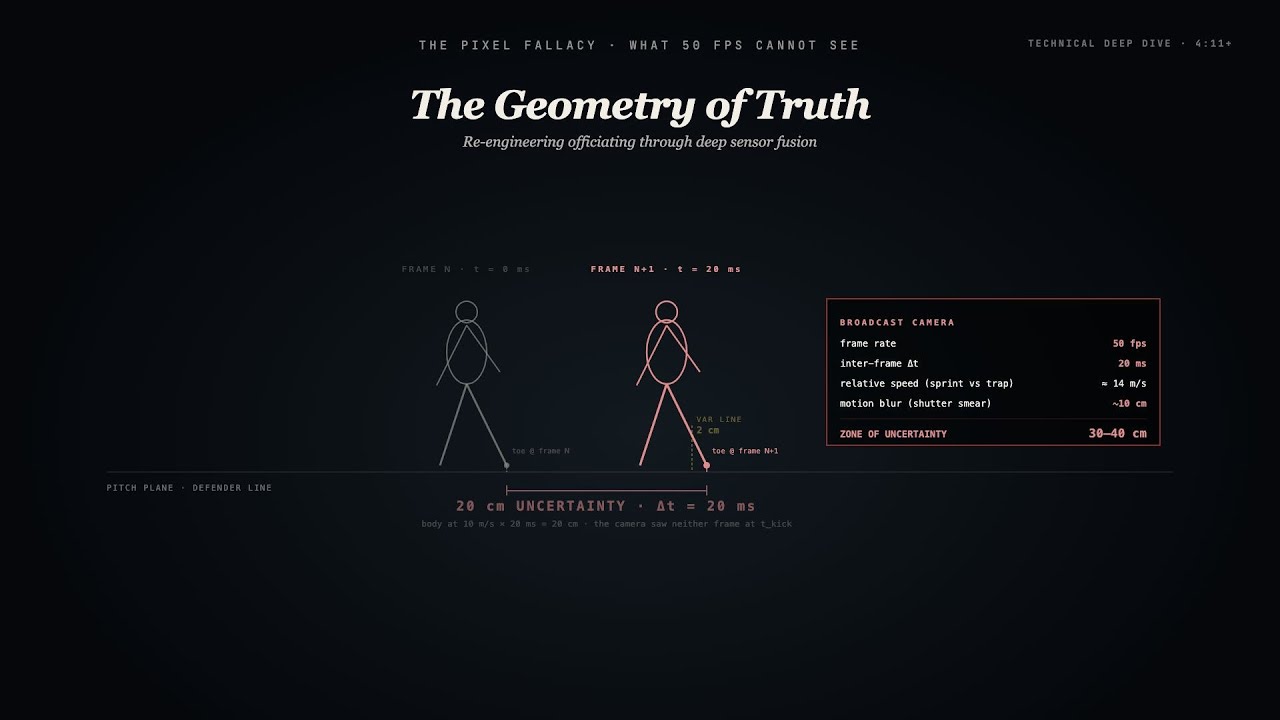
Current VAR protocols rely on broadcast cameras, which typically operate at 50 Hz (in Europe) or 60 Hz (in North America). This means the system captures a state of the world every 20 milliseconds. 1 In a static environment, 20 milliseconds is negligible. In the dynamic, high-velocity environment of elite football, it is an eternity. Elite players sprint at speeds exceeding 36 km/h (10 m/s). In the 20ms interval between two frames, a player moving at 10 m/s travels 20 centimeters.
If we consider the relative motion of an attacker sprinting towards goal and a defender stepping up to play the offside trap, the relative velocity can easily exceed 15 m/s. This results in a relative positional uncertainty of up to 30 centimeters between frames. 2 Yet, the current VAR protocol asks operators to select a single frame as the definitive "moment of contact" and then draw a one-pixel-wide line to determine offside. If the actual contact occurred 10ms after the selected frame (halfway to the next frame), the players would have moved 15-20cm from the positions shown on the screen. The system then adjudicates an offside margin of 2cm based on an image that is physically outdated by a distance ten times that magnitude. 3 This is not measurement; it is a digital illusion of precision. It measures pixels, not the truth of the physical event.
1.2 The "Wrapper" Problem in Sports Technology
The sports technology market is currently flooded with AI solutions that effectively act as "wrappers" around standard pre-trained models. These systems ingest standard broadcast feeds, apply a generic object detection model (like YOLO, Mask R-CNN, or standard pose estimators), and output bounding boxes or segmentation masks. While impressive for basic media analytics or fan engagement, this approach is fundamentally unsuited for officiating.
A "wrapper" solution inherits the limitations of its input data. If the input is a 50fps broadcast feed with motion blur, rolling shutter artifacts, and lens distortion, no amount of machine learning can magically recover the missing temporal data with legal certainty. Veriprajna’s approach is fundamentally different. We argue that "Deep AI" in sports requires control over the sensor layer . We do not just process video; we engineer the data acquisition pipeline to ensure the inputs are capable of supporting the required precision. We are not wrapping a model; we are modeling the physics of the game itself. 4
1.3 The Gaussian Blur of Probability
Furthermore, the assumption that a player’s limb occupies a specific pixel is flawed due to motion blur. At 50fps, the shutter is typically open for a significant portion of the frame duration (e.g., 1/100th of a second or 10ms) to allow sufficient light entry for the sensor. During a 10ms shutter opening, a foot moving at 20 m/s (during a kick) or a sprinter’s torso moving at 10 m/s moves significantly during the exposure itself.
Calculations show that the "smear" distance can be as high as 10-20 cm depending on the velocity of the limb. 1 The image of the player on the sensor is not a sharp point but a smear spanning multiple pixels across the array. When a VAR operator places a crosshair on the "leading edge" of a player, they are arbitrarily selecting a point within a probability distribution of where the player might be. This smearing effect essentially applies a low-pass filter to the spatial data, degrading the effective resolution far below the theoretical 4K or HD pixel count. The "truth" of the player's position lies somewhere within that blur, described by a Gaussian function, but the current system forces a binary choice of a single pixel.
1.4 The "Frame Selection" Lottery
The most critical failure point in the current workflow is the manual selection of the kick point. The "kick" is an impulse event—a transfer of momentum that happens in typically 8-12 milliseconds. 3 At 50fps, the camera might capture one frame before contact and the next frame after the ball has already left the foot.
The VAR protocol instructs operators to choose the "first frame of contact." However, due to the discrete sampling of the camera, the actual first moment of contact is rarely captured. It almost always occurs between frames. By forcing a selection of the nearest visible frame, the system introduces a temporal quantization error of up to ms. As established, this quantization error translates directly into a spatial position error of dozens of centimeters. The decision of whether a goal stands or falls effectively becomes a lottery based on how the camera's shutter cycle synchronized with the striker's boot. This randomness undermines the competitive integrity of the sport. 2
2. High-Frequency Optical Engineering: The 200fps Baseline
To mitigate the effects of temporal aliasing and motion blur, the first pillar of the Veriprajna architecture is a drastic increase in the optical sampling rate. We propose a baseline of 200 frames per second (fps) for all tracking cameras, utilizing dedicated machine vision sensors rather than standard broadcast equipment.
2.1 Reducing the Uncertainty Interval
Increasing the frame rate from 50fps to 200fps reduces the inter-frame interval () from 20ms to 5ms. This simple change has a profound impact on the "blind spot" of the system.
Table 1: Impact of Frame Rate on Positional Uncertainty
| Frame Rate (fps) |
Time Interval (Δt) |
Relative Uncertainty (at 14 m/s relative speed) |
Motion Blur (at 1/2x shutet r) |
Status |
|---|---|---|---|---|
| 50 Hz (Broadcast) |
20.0 ms | 28.0 cm | ~10 cm | Current Standard (Fails) |
| 60 Hz (Broadcast US) |
16.7 ms | 23.4 cm | ~8 cm | Current Standard (Fails) |
| 120 Hz (High Speed) |
8.3 ms | 11.6 cm | ~4 cm | Insufcient for marginal calls |
| 200 Hz (Veriprajna) |
5.0 ms | 7.0 cm | ~2 cm | Minimum Viable Baseline |
| 500 Hz (Ultra Motion) |
2.0 ms | 2.8 cm | < 1 cm | Ideal, but high data cost |
By quadrupling the frame rate to 200fps, we reduce the "blind spot" from 28cm to 7cm. 5 While this is a significant improvement, it is not yet sufficient for "millimeter-perfect" decisions on its own. However, the primary value of 200fps is not just the reduced interval, but the reduction of motion blur . At 200fps, the shutter speed must be faster than 1/200th of a second (typically 1/1000s or faster to prevent blur). This freezes the action with far greater clarity, converting the "smear" of a player into a distinct, measurable object. This sharpens the input data for the Computer Vision (CV) models, dramatically improving the confidence of limb detection algorithms. 5
2.2 Global Shutter vs. Rolling Shutter
An often-overlooked detail in sports tracking is the sensor readout method. Most broadcast cameras use Rolling Shutter sensors (CMOS), which read the image line-by-line from top to bottom. For fast-moving objects, this induces geometric distortion—a vertical pole appears slanted if the camera pans, and a kicking leg appears elongated or compressed depending on its direction of motion relative to the shutter readout. 5
Veriprajna mandates the use of Global Shutter sensors (e.g., Sony Pregius or similar industrial sensors). 7 A Global Shutter exposes every pixel simultaneously. This ensures that the geometry of the player is preserved exactly as it existed at the timestamp of exposure. There is no temporal skew within the frame itself. This is a critical requirement for accurate 3D reconstruction; rolling shutter artifacts introduce non-linear errors that are computationally expensive to correct and degrade the accuracy of multi-view triangulation.
2.3 Multi-View Geometry and Occlusion Handling
Veriprajna’s optical layer relies on a distributed array of 12-16 synchronized cameras mounted in the stadium catwalks. 9 Unlike broadcast cameras which pan, tilt, and zoom to follow the action, these are fixed-position, calibrated instruments. This setup allows for the robust application of Multi-View Stereo (MVS) and Epipolar Geometry .
When a player is viewed from multiple angles simultaneously, their 3D position can be triangulated with high precision. We map the 2D pixel coordinates () from each camera to the 3D world coordinates () of the pitch using Homography. The critical advantage of this array is Occlusion Handling. In a crowded penalty box during a corner kick, a single camera view of a player’s offside limb (e.g., a knee) might be blocked by a defender or a teammate. With 12+ overlapping angles, it is statistically improbable that a limb is occluded in all views simultaneously.11 Our system uses a voting mechanism where visible keypoints from unobstructed cameras contribute to the 3D reconstruction, while occluded views are discarded. If a limb is partially occluded in all views, the system utilizes the skeletal constraints (a shin is always connected to a knee, which is connected to a hip) to infer the position of the hidden joint with a calculated confidence interval. This moves us from "guessing" what happened behind a defender to "reconstructing" it based on biomechanical laws. 13
3. The 500Hz Inertial Measurement Unit (IMU): The
Pulse of the Game
While cameras watch the players, the ball itself must tell us when it is played. The visual ambiguity of the kick point is the largest source of error in current VAR. To solve this, Veriprajna advocates for the mandatory inclusion of a high-frequency Inertial Measurement Unit (IMU) suspended in the center of the match ball.
3.1 The Sensor Specifications and Ball Mechanics
The IMU is the heartbeat of the Veriprajna system. To achieve the necessary precision, the sensor must meet rigorous specifications:
● Sampling Rate: 500 Hz. This equates to a sample every 2 milliseconds. 9
● Accelerometer Range: . A professional footballer's strike generates immense force. Standard consumer accelerometers () would saturate instantly, clipping the data and losing the critical peak of the impulse. 14
● Gyroscope Range: . The spin rate of a football can be extreme, and accurate spin tracking is vital for aerodynamic modeling.
● Mechanical Integration: The sensor is suspended in the bladder of the ball using a system of tensioned filaments. This ensures that the sensor remains at the volumetric center of the ball, maintaining the Center of Mass (CoM). This is crucial for FIFA certification; the ball must fly true. Any deviation in CoM would introduce a "wobble" (like a loaded die), affecting the flight path and ruining the game for the players.
3.2 Detecting the "Impulse" Signature
The primary function of the IMU is to detect the Kick Point with temporal precision that video cannot match. When a foot strikes the ball, the accelerometer registers a massive, instantaneous spike in G-force. However, the system must distinguish a kick from a bounce, a header, or a deflection.
The signal processing pipeline uses a high-pass filter to isolate impact events from the low-frequency noise of ball rotation or flight aerodynamics. We analyze the spectral signature of the impact. 15
● Kick: Characterized by a sharp, high-magnitude spike with a very short rise time (typically < 2ms) followed by a rapid decay as the ball leaves the foot.
● Bounce: Characterized by a lower magnitude spike (energy lost to turf) and a longer duration of contact (deformation of the ball against the ground).
● Header: A softer impact curve due to the compliance of the human skull compared to a rigid boot.
By analyzing the waveform shape, the system can classify the event type. Most importantly, it identifies the Onset of Deformation . The laws of the game state that the offside position is judged at the "first point of contact." A 50Hz camera misses the initial micro-deformation of the ball's casing. The 500Hz IMU captures it as the start of the acceleration waveform. This gives us a timestamp, , with a precision of ms. 9
3.3 Time Synchronization: The PTP Backbone
For Sensor Fusion to work, the "Clock" of the IMU and the "Clock" of the cameras must be perfectly aligned. If the camera clock says it is 12:00:00.000 and the ball clock says 12:00:00.005, but they are actually offset by 20ms due to drift, the entire system fails.
Veriprajna utilizes the Precision Time Protocol (PTP, IEEE 1588 v2) across a fiber-optic backbone connecting all sensors. 10 PTP allows for sub-microsecond synchronization between devices on a local network.
● Master Clock: A high-stability GPS-disciplined oscillator serves as the Grandmaster Clock for the stadium.
● Slaves: The camera processing units and the IMU receiver base stations act as PTP slaves, constantly correcting their internal clocks to match the Grandmaster.
This ensures that when the ball reports a kick at , that timestamp corresponds exactly to the same physical instant in the camera's timeline. We effectively decouple the measurement of time from the measurement of space . The ball tells us when to look; the cameras tell us where to look.
4. Deep Sensor Fusion: The Mathematical Engine of Truth
We now have two disparate datasets:
1. Skeletal Data (): 3D coordinates of all players, sampled at 200Hz ($t_{0}, t_{5}, t_{10}, \dots$ ms).
2. Ball Data (): Acceleration and impact events, sampled at 500Hz ($t_{0}, t_{2}, t_{4}, \dots$ ms).
The challenge is integration. The kick happens at ms. The nearest camera frames are at and . We need to know the position of the striker's toe at exactly . We cannot simply pick the frame at (error of 1ms/7mm) or (error of 4ms/28mm). We must mathematically construct the reality at . This requires Deep Sensor Fusion .
4.1 The Kalman Filter: Smoothing the Noise
Raw skeletal tracking data is inherently noisy. A player's joint might jitter by a few centimeters frame-to-frame due to detection errors in the neural network. Before interpolation, we must smooth this data to recover the true biological trajectory. Veriprajna employs an Unscented Kalman Filter (UKF) or an Optimization-Based Smoother . 18
The Kalman Filter maintains a "State Vector" for each joint on the player's body. The state vector is defined as:
Where is position, is velocity, and is acceleration. The filter operates in two steps:
1. Prediction: Based on kinematic physics (Newton’s laws), the filter predicts where the limb should be at the next time step. It assumes that limbs have mass and inertia, and therefore cannot change velocity instantaneously.
2. Update: The filter compares its prediction with the actual measurement observed by the camera. It uses the Kalman Gain () to determine how much to trust the measurement versus the prediction.
If the detection is noisy (e.g., high variance in the neural net's confidence), the filter trusts the physics more, effectively smoothing out the jitter. If the movement is smooth and the detection is strong, it trusts the measurement. This results in a clean, mathematically consistent trajectory for every limb. 20
4.2 Temporal Super-Resolution via Cubic Splines
Once we have clean, smoothed trajectories at 200Hz, we perform Temporal Interpolation. The goal is to calculate the position of the limb at the exact millisecond of the kick (). Linear interpolation (drawing a straight line between two frames) is insufficient for biomechanics. Human motion is curvilinear; limbs accelerate and decelerate. A straight line between two points in time would underestimate the curvature of a swinging leg or a sprinting torso, introducing error. We utilize Cubic Spline Interpolation.22 A cubic spline constructs a smooth curve that passes through the known data points () while maintaining continuity in velocity and acceleration. The position is modeled as a set of piecewise cubic polynomials:
By solving this equation for , we generate a "Virtual Frame"—a mathematically calculated position of the player's skeleton at the exact millisecond of contact. This effectively gives us infinite temporal resolution, bounded only by the accuracy of our kinematic model.
4.3 Fusion Architectures: Loose vs. Tight Coupling
There are two main ways to fuse this data: Loose Coupling and Tight Coupling. Veriprajna strongly advocates for a Tightly Coupled architecture. 24
● Loosely Coupled: In a loosely coupled system, the vision system calculates a position independently, the IMU calculates a position independently (via integration), and the two final values are averaged. This is simpler to implement but prone to drift. If the vision system is occluded for a few frames, the IMU integration drifts rapidly, and the "average" becomes meaningless.
● Tightly Coupled: In a tightly coupled system, the raw error residuals from the vision system and the raw acceleration data from the IMU are fed into a single, massive optimization solver (typically using Factor Graph Optimization ). The system solves for the "Most Likely State" that satisfies both the visual constraints (what the cameras see) and the inertial constraints (forces measured by the ball).
This tight coupling makes the system incredibly robust. Even if a player is partially occluded for 50ms (10 frames), the kinematic momentum established by the Kalman filter allows the system to predict their position with high confidence until visual lock is re-acquired. The IMU data from the ball provides a "truth anchor" for the interaction events, ensuring that the visual tracking of the ball aligns perfectly with the physical impact. 26
5. The Optical Layer: Deep Learning for Skeletal Tracking
To achieve the necessary spatial precision, we cannot rely on standard "bounding box" detectors. We need to understand the precise biomechanics of the player. This requires a dedicated Neural Network architecture.
5.1 The "Skel-VP" Neural Network Architecture
Veriprajna utilizes a custom model named Skel-VP (Skeletal Veriprajna). Unlike generic pose estimators (e.g., OpenPose or MediaPipe) which are designed for webcam-quality inputs and close-range interaction, Skel-VP is architected specifically for the constraints of stadium-scale sports tracking.
5.1.1 Backbone and Feature Extraction
We utilize a HRNet (High-Resolution Network) backbone. Traditional CNNs downsample images to low resolutions to extract semantic features (is this a person?) and then upsample them to recover spatial information (where is the person?). This process loses the fine spatial precision required for offside decisions. HRNet maintains high-resolution representations through the entire forward pass, connecting high-to-low resolution convolution streams in parallel. This ensures that the pixel-level precision of a toe or knee is preserved alongside the semantic understanding of the limb. 28
5.1.2 The "Offside Head"
Skel-VP includes a specialized "Offside Head"—a branch of the network trained specifically on "extremity detection." Standard datasets (like COCO Keypoints) focus on major joints (knees, ankles). They often ignore the tip of the toe or the edge of the shoulder, which are the exact points that define an offside line. We have trained Skel-VP on a proprietary dataset of over 500,000 annotated football frames, specifically labeling the distal phalanges (toe tips) and the acromion process (shoulder edge). The loss function for this head penalizes spatial errors in these specific offside-critical points more heavily than errors in the torso or head. This ensures the model "cares" most about the parts of the body that matter for the rule.10
5.1.3 Temporal Consistency with Transformers
To handle occlusion and temporal continuity, we employ a Spatio-Temporal Transformer layer after the CNN backbone.
● Input: Sequence of 2D keypoints from the last 10 frames ( to ).
● Mechanism: The Self-Attention mechanism learns the kinematic constraints of human motion. It "knows" that a leg cannot teleport 1 meter in 5ms.
● Output: Refined keypoints where occluded joints are "hallucinated" based on the trajectory of visible joints and the biomechanics of the running gait. If a defender blocks the view of a striker’s knee, the Transformer predicts the knee position based on the visible hip and ankle, assigning a "Confidence Score" to the prediction. If the confidence is below a safety threshold (e.g., 95%), the system flags the incident for manual review. 28
6. Implementation & Infrastructure: The Engineering Reality
Deploying a Deep Sensor Fusion system in a stadium environment requires significant infrastructure. This is not a cloud-based SaaS solution; it is heavy edge computing.
6.1 The "Stadium Server" Edge Cluster
To process 12-16 cameras at 200fps in real-time, the computational load is immense.
● Data Rate: 16 cameras 200fps 4K resolution 40 GB/s of raw video data.
● Latency Budget: The system must produce a decision in < 5 seconds. Transmission to a remote cloud server would introduce unacceptable latency. Veriprajna utilizes a Distributed Edge Cluster located directly in the stadium server room.
● Compute Nodes: The cluster consists of 4x Compute Nodes, each handling the processing for 4 cameras.
● GPU Acceleration: Each node is equipped with dual NVIDIA A100 or H100 Tensor Core GPUs to run the Skel-VP inference and the Factor Graph solvers.
● Interconnect: The nodes are connected via RDMA over Converged Ethernet (RoCE), creating a unified memory space. This allows the Fusion Engine to aggregate data from all 16 cameras with microsecond latency. 10
6.2 Camera Mounting and Calibration
The physical installation of the cameras is as critical as the software.
● Rigidity: The cameras must be mounted on vibration-dampened rigs attached to the stadium's primary structural steel. Any vibration in the camera mount translates directly to spatial error on the pitch.
● Self-Calibration: The system runs a continuous "Self-Calibration" routine. It uses fixed features of the pitch (line markings, goal posts, corner flags) to detect if a camera has shifted by even a fraction of a degree due to thermal expansion of the roof or wind load. If a shift is detected, the Extrinsic Matrix is updated in real-time to compensate. 11
6.3 Handling "Edge Cases"
The system is designed to handle the messy reality of football.
● The "Scuffed" Pass: What if the attacker dribbles the ball (continuous contact) rather than kicking it? The IMU detects continuous vibration rather than a spike. The system switches logic to track the "first moment of release" (when the vibration ceases).
● Sensor Failure: If the Ball IMU fails (e.g., battery death or signal interference), the system gracefully degrades to "Optical Only" mode. With 200fps cameras, the error margin increases to 7cm, which is still superior to the 28cm error of current VAR, ensuring the game can continue without interruption.
7. Mathematical Verification of Accuracy
Let us revisit the error margin with the Veriprajna solution to quantify the improvement.
Scenario: Relative velocity .
● Current VAR (50Hz, manual frame selection):
○ Temporal Error: ms.
○ Spatial Error: cm.
○ Motion Blur Error: cm.
○ Total "Zone of Uncertainty": ~30-40 cm.
● Veriprajna (200Hz Optical + 500Hz Inertial + Fusion):
○ Temporal Precision: The IMU defines to ms.
○ Movement in 1ms: $14 , \text{m/s} \times 0.001 , \text{s} = 1.4 , \text{cm}$.
○ Interpolation Error: However, we do not accept the 1ms gap blindly. We interpolate . The error of a Cubic Spline interpolation for smooth biological motion over a tiny 5ms gap is negligible, typically mm.
○ Skeletal Detection Error: The primary remaining source of error is the accuracy of the Skel-VP model in placing the joint, typically cm.
○ Total "Zone of Uncertainty": ~2-3 cm.
By effectively removing the temporal error, we reduce the "Zone of Uncertainty" by an order of magnitude. 3 Decisions that were once "too close to call" become mathematically distinct. We are no longer measuring the blur; we are measuring the modeled biomechanics.
8. Beyond Offside: The Future of Deep Sports AI
The deployment of a sensor fusion architecture opens doors far beyond just offside decisions. Once the stadium is digitized with this level of fidelity, new applications emerge.
8.1 Automated Handball Detection
Current handball rules involve judging "natural silhouette" and "movement towards the ball." These are subjective and difficult to judge from 2D video. However, with a 29-point skeleton and high-frequency ball tracking, we can mathematically model the "expected collision." If a defender’s arm moves toward the ball trajectory faster than their torso rotation implies (a voluntary movement), the system can flag it. We can create a "Volumetric Boundary" for the natural silhouette and detect penetrations of this volume in 3D space.
8.2 Real-Time Tactical Biometrics
The same IMU/Optical data can drive advanced analytics for coaching and medical staff.
● Player Load: By calculating the exact G-force of every step and cut (using the Kalman velocity derivatives), we can predict injury risk. ACL tears often occur during specific high-deceleration events; monitoring cumulative load on the knee joint can prevent injuries before they happen. 30
● xG (Expected Goals) 2.0: Current xG models are based on simple 2D location data. Veriprajna can incorporate the speed of the shot swing, the body balance of the striker, and the precise impact location on the boot to model shot probability with unprecedented accuracy.
8.3 Broadcast Enhancement
The 3D data allows for "Virtual Replays" where the camera can be placed anywhere on the pitch—even in the eyes of the striker. This provides broadcasters with immersive content that goes far beyond standard replays, enhancing the fan experience and generating new revenue streams. 9
9. Conclusion: Restoring Trust Through Engineering
The narrative that "VAR ruins the game" is fueled by the uncanny valley of technology—we have enough tech to see the errors, but not enough to fix them. We are currently in a transition phase, using broadcast tools for scientific measurement. It is akin to using a stopwatch to measure the speed of light.
Veriprajna asserts that the solution is not to roll back technology, but to deepen it. We must transition from Image Intelligence (looking at pixels) to Sensor Intelligence (fusing data).
● 200fps Optical provides the spatial fidelity.
● 500Hz Inertial provides the temporal fidelity.
● Sensor Fusion provides the mathematical truth.
By implementing this architecture, we do not just improve the accuracy of offside calls; we fundamentally change the ontology of the sport. We move from a game of interpretation to a game of measurement. We ensure that when a goal is disallowed, it is because of physics, not artifacts.
We do not measure pixels. We measure truth.
10. Technical Appendix: Mathematical Foundations
10.1 Optimization-Based Orientation Estimation
To align the IMU orientation (for ball spin detection) with the global frame, we utilize gradient descent optimization on the quaternion group . 30
Where is the orientation quaternion, is the earth-frame reference field (gravity), and is the sensor-frame measurement. This ensures the ball's "down" vector is always aligned with the pitch vertical, correcting for gyroscopic drift over the course of a half.
10.2 Homography and Camera Projection
Mapping a 3D point to a 2D pixel :
Where is the Intrinsic Matrix (focal length, optical center) and is the Extrinsic Matrix (rotation and translation of the camera relative to the pitch center). 13 Veriprajna’s calibration routine solves for and in real-time using static field landmarks.
10.3 Kalman Filter State Prediction
The discrete-time update step for the skeletal tracking filter:
Where:
● : Updated state estimate (position/velocity).
● : Optimal Kalman Gain (trust in measurement vs. trust in physics).
● : Measurement vector (from the Neural Network).
● : Observation model.
The Gain dynamically adjusts. If the player is moving predictably, the system trusts the physics (prediction). If the player makes a sudden cut, the system increases trust in the optical data (measurement).20
Veriprajna Deep AI. Sensor Fusion. The Future of Sport.
Works cited
A Step to VAR: The Vision Science of Offside Calls by Video Assistant Referees PMC - NIH, accessed December 12, 2025, https://pmc.ncbi.nlm.nih.gov/articles/PMC7734242/
VAR for Offside - Margin of Error : r/soccer - Reddit, accessed December 12, 2025, https://www.reddit.com/r/soccer/comments/jtir5u/var_for_ofside_margin_of_errofr/
A physics take on why the VAR decision system for offsides is simply NOT fit for purpose. : r/PremierLeague - Reddit, accessed December 12, 2025, https://www.reddit.com/r/PremierLeague/comments/k48085/a_physics_take_on_why_the_var_decision_system_for/
Real Time Offside Detection using a Single Camera in Soccer - arXiv, accessed December 12, 2025, https://arxiv.org/html/2502.16030v1
Mini-2X-vR-Cam: A New Generation of SSM Cameras by SLOMO.TV, accessed December 12, 2025, https://slomo.tv/news/mini-2x-vr-cam-a-new-generation-of-ssm-cameras-by-slomo-tv
Why VAR can never be definitive : r/football - Reddit, accessed December 12, 2025, https://www.reddit.com/r/football/comments/cs16vq/why_var_can_never_be_defniitive/
High-Speed Cameras for Slow Motion Capture and Analysis i-SPEED 5 Series - iX Cameras, accessed December 12, 2025, https://www.ix-cameras.com/high-speed_cameras_for_slow_motion_analysis.php
Cameras for Sports & Entertainment | Basler AG, accessed December 12, 2025, https://www.baslerweb.com/en/industry-applications/sports-entertainment/
Semi-automated offside technology - Inside FIFA, accessed December 12, 2025, https://inside.fifa.com/innovation/world-cup-2022/semi-automated-ofside-technfology
Semi-Automated Offside Technology 2025 : How AI-Driven VAR Is Transforming Football Officiating - InfoTech Sports, accessed December 12, 2025, https://infotechsports.com/semi-automated-ofside-technology/f
The challenge of offside for VAR - Inside FIFA, accessed December 12, 2025, https://inside.fifa.com/news/the-challenge-of-ofside-for-var f
SKDream: Controllable Multi-view and 3D Generation with Arbitrary Skeletons, accessed December 12, 2025, https://openaccess.thecvf.com/content/CVPR2025/papers/Xu_SKDream_Controllable_Multi-view_and_3D_Generation_with_Arbitrary_Skeletons_CVPR_2025_paper.pdf
3D Human Body Model Reconstruction Algorithm Based on Multi-View Synchronized Video Sequences - SciTePress, accessed December 12, 2025, https://www.scitepress.org/Papers/2024/135128/135128.pdf
Smart sensor tights: Movement tracking of the lower limbs in football - PMC, accessed December 12, 2025, https://pmc.ncbi.nlm.nih.gov/articles/PMC10936253/
USE OF ACCELEROMETERS IN AUSTRALIAN FOOTBALL TO IDENTIFY A KICK Susanne Ellens, Stephanie Blair, James Peacock, Shannon Barnes a - NMU Commons, accessed December 12, 2025, https://commons.nmu.edu/cgi/viewcontent.cgi?article=1264&context=isbs
Motion Analysis of Football Kick Based on an IMU Sensor - MDPI, accessed December 12, 2025, https://www.mdpi.com/1424-8220/22/16/6244
Syncronizing frame capture with imu sensors - Jetson Orin NX - NVIDIA Developer Forums, accessed December 12, 2025, https://forums.developer.nvidia.com/t/syncronizing-frame-capture-with-imu-sensors/237887
Multi-Sensor Data Fusion for Real-Time Multi-Object Tracking - OPUS, accessed December 12, 2025, https://opus4.kobv.de/opus4-haw/files/3198/processes-11-00501-v3.pdf
Optimization Outperforms Unscented Techniques for Nonlinear Smoothing arXiv, accessed December 12, 2025, https://arxiv.org/html/2510.03846v1
Kalman filter - Wikipedia, accessed December 12, 2025, https://en.wikipedia.org/wiki/Kalman_filter
Kalman smoothing improves the estimation of joint kinematics and kinetics in marker-based human gait analysis - PubMed, accessed December 12, 2025, https://pubmed.ncbi.nlm.nih.gov/19026414/
Comparison of linear interpolation and spline interpolation. - ResearchGate, accessed December 12, 2025, https://www.researchgate.net/figure/Comparison-of-linear-interpolation-and-spline-interpolation_fig5_350700851
Interpolation Method Comparison - 2020 - SOLIDWORKS Design Help, accessed December 12, 2025, https://help.solidworks.com/2020/English/SolidWorks/motionstudies/c_interpolation_method_comparison.htm
What Are the Concrete Performance Differences of Tightly-Coupled vs. Loosely-Coupled VIO Under GNSS Outages? - DaischSensor, accessed December 12, 2025, https://daischsensor.com/what-are-the-performance-diferences-of-tightly-coufpled-vs-loosely-coupled-vio-under-gnss-outages/
GNSS and INS tight-coupling – why does it matter? - Inertial Labs, accessed December 12, 2025, https://inertiallabs.com/gnss-and-ins-tight-coupling-why-does-it-mater/t
A Comprehensive Review on Sensor Fusion Techniques for Localization of a Dynamic Target in GPS-Denied Environments - IEEE Xplore, accessed December 12, 2025, https://ieeexplore.ieee.org/iel8/6287639/10820123/10806702.pdf
The Design of GNSS/IMU Loosely-Coupled Integration Filter for Wearable EPTS of Football Players - PMC - PubMed Central, accessed December 12, 2025, https://pmc.ncbi.nlm.nih.gov/articles/PMC9965289/
Skeleton-Based Spatio-Temporal U-Network for 3D Human Pose Estimation in Video - MDPI, accessed December 12, 2025, https://www.mdpi.com/1424-8220/22/7/2573
Learning Temporal–Spatial Contextual Adaptation for Three-Dimensional Human Pose Estimation - PubMed Central, accessed December 12, 2025, https://pmc.ncbi.nlm.nih.gov/articles/PMC11244605/
Quaternion Orientation Through IMU Sensor Fusion Algorithms - QSense-Motion, accessed December 12, 2025, https://qsense-motion.com/quaternion-orientation-imu-sensor-fusion/
Sensor-based technologies for motion analysis in sports injuries: a scoping review - PMC, accessed December 12, 2025, https://pmc.ncbi.nlm.nih.gov/articles/PMC11780775/
Sensor Fusion for Enhancing Motion Capture: Integrating Optical and Inertial Motion Capture Systems - MDPI, accessed December 12, 2025, https://www.mdpi.com/1424-8220/25/15/4680
Prefer a visual, interactive experience?
Explore the key findings, stats, and architecture of this paper in an interactive format with navigable sections and data visualizations.
Frequently Asked Questions
Why is current VAR technology fundamentally flawed for offside decisions?
Current VAR relies on 50fps broadcast cameras that capture the world every 20 milliseconds. Players sprinting at 10 m/s travel 20cm between frames, and relative motion between attacker and defender can create 30cm positional uncertainty per frame interval. The kick impulse occurs in 8-12ms — often between frames entirely. Motion blur during the shutter opening further smears player positions across 10-20cm. Yet the system draws one-pixel-wide lines to adjudicate margins of 2cm, creating a digital illusion of precision.
How does 500Hz IMU data improve kick detection accuracy?
A 500Hz IMU embedded in the match ball samples acceleration 500 times per second (every 2 milliseconds). Since a kick impulse produces a distinctive acceleration spike of 500-3000 m/s squared lasting 8-12ms, the IMU captures 4-6 data points during the contact event. This provides sub-millisecond kick timestamp precision through interpolation, compared to the 20ms frame gaps of broadcast cameras that often miss the contact moment entirely.
What is the role of Kalman filtering in sports sensor fusion?
The Extended Kalman Filter fuses 200fps optical position data with 500Hz IMU temporal data by dynamically adjusting trust between physics-based prediction and sensor measurement. When a player moves predictably (straight sprint), the filter trusts the biomechanical model. When a player makes a sudden cut, it increases trust in optical measurements. This produces continuous, sub-millimeter position estimates at the IMU-timestamped kick moment rather than selecting a single potentially incorrect video frame.
Also Published On
Build Your AI with Confidence.
Partner with a team that has deep experience in building the next generation of enterprise AI. Let us help you design, build, and deploy an AI strategy you can trust.
Veriprajna Deep Tech Consultancy specializes in building safety-critical AI systems for healthcare, finance, and regulatory domains. Our architectures are validated against established protocols with comprehensive compliance documentation.