Re-Engineering Football Officiating Through Deep Sensor Fusion
Current VAR systems make definitive offside calls with a 28-40cm margin of error—larger than the infractions they claim to judge. This isn't a software problem. It's a fundamental physics failure called the "Pixel Fallacy."
Veriprajna engineered a paradigm shift: 200fps optical tracking + 500Hz ball IMU + Deep Sensor Fusion = 2-3cm precision. We don't measure pixels. We measure truth.
Veriprajna partners with football federations, elite leagues, and stadium operators to replace the "uncanny valley" of current VAR with scientifically defensible precision.
Restore competitive integrity. Current VAR's 28cm uncertainty makes marginal calls a "frame selection lottery." Our system reduces error by 10x, ensuring goals stand or fall on physics—not artifacts.
Retrofit existing infrastructure. Our 12-16 camera array mounts to catwalks with vibration-dampened rigs. Edge cluster processes 40GB/s on-site—no cloud latency. Graceful degradation if IMU fails.
Beyond officiating: 3D skeletal data enables virtual replays from any angle, xG 2.0 models incorporating biomechanics, and injury risk prediction via cumulative joint load analysis.
"VAR ruins the game" isn't emotional resistance—it's a technically valid complaint. The system attempts to measure continuous, high-velocity reality using tools designed for passive observation.
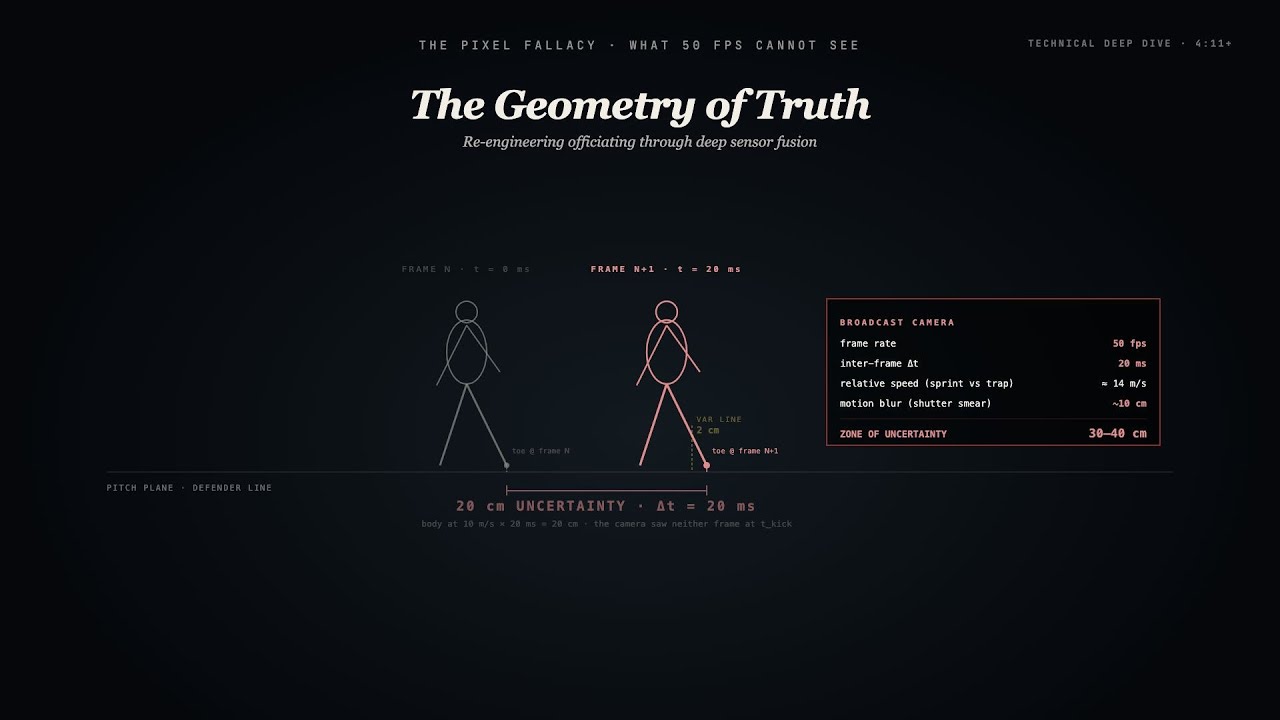
A video frame is NOT a frozen moment—it's an integration of light over a shutter interval. At 50fps, the camera captures a state every 20ms. A player sprinting at 10 m/s travels 20cm between frames.
Motion blur at 10ms shutter speed smears a kicking foot across 10-20cm. The "leading edge" VAR operators click is an arbitrary point within a probability distribution—not a physical truth.
A kick lasts 8-12ms. At 50fps, the "first contact" almost never aligns with a frame. Operators guess ±10ms, translating to 14-20cm spatial error. Decisions become random based on shutter sync.
"When a striker's toe is judged offside by a millimeter on a broadcast feed running at 50fps, the system is making a definitive claim about a physical state it has not actually captured. It is interpolating reality based on insufficient data—essentially guessing the state of the world between frames."
— The Geometry of Truth: Re-Engineering Officiating, Veriprajna 2024
Adjust the frame rate to see how temporal sampling affects positional uncertainty. At 50fps (current VAR), players move 28cm between frames. At 200fps (Veriprajna), the gap shrinks to 7cm.
Higher frame rates reduce the "blind spot" between observations. But even 200fps leaves a 5ms gap. That's why we fuse with 500Hz IMU data—decoupling time measurement (ball) from space measurement (cameras).
We don't apply AI to inadequate data. We engineer the sensor layer to capture the physics of the game, then fuse it mathematically.
12-16 fixed, calibrated cameras with Global Shutter sensors (Sony Pregius). Simultaneous pixel exposure eliminates rolling shutter distortion. 1/1000s shutter freezes action.
±200g accelerometer + ±4000°/s gyroscope suspended in ball center. Detects kick "onset of deformation" to ±1ms precision. High-pass filter classifies kick vs bounce vs header.
HRNet backbone preserves spatial precision. "Offside Head" trained on 500K frames labels toe tips/shoulder edges. Spatio-Temporal Transformer handles occlusion via biomechanical constraints.
Unscented Kalman Filter + Cubic Spline interpolation reconstructs "Virtual Frame" at exact kick timestamp. Factor Graph Optimization solves for Most Likely State satisfying all sensor constraints.
Most sports AI vendors ingest standard broadcast feeds (50fps, rolling shutter, motion blur) and apply object detection. No ML can recover temporal data that was never captured. This is LLM wrapper thinking.
Veriprajna is physics-first: If the sensor doesn't capture the reality, the AI has nothing to work with. We engineer measurement systems, not post-processing bandaids.
Rigorous error analysis quantifies the improvement. We reduce the "Zone of Uncertainty" from 30-40cm to 2-3cm.
Decisions on 2cm margins with 30cm error bars are statistically meaningless.
Decisions are now mathematically distinct. Calls "too close to judge" become measurably clear.
| Frame Rate | Time Interval (Δt) | Uncertainty @14m/s | Motion Blur | Status |
|---|---|---|---|---|
| 50 Hz | 20.0 ms | 28.0 cm | ~10 cm | Current VAR (Fails) |
| 120 Hz | 8.3 ms | 11.6 cm | ~4 cm | Insufficient |
| 200 Hz | 5.0 ms | 7.0 cm | ~2 cm | Veriprajna Baseline |
| 500 Hz IMU | 2.0 ms | 2.8 cm | <1 cm | Ball Kick Detection |
Adjust player velocities and camera specs to see the uncertainty zone
Elite sprint: ~10 m/s (36 km/h)
Offside trap: stepping up while attacker runs forward
Once the stadium is digitized with sub-centimeter 3D skeletal tracking and ball physics, transformative applications emerge.
Model "natural silhouette" as a 3D volumetric boundary. Detect arm movement toward ball trajectory faster than torso rotation implies—flagging voluntary vs involuntary contact mathematically.
Calculate exact G-forces on every step/cut via Kalman velocity derivatives. ACL tears correlate with high-deceleration events. Monitor cumulative joint load to prevent injuries before they happen.
Current xG uses 2D shot location. Veriprajna incorporates striker body balance, shot swing velocity, boot impact zone—modeling probability with unprecedented accuracy.
3D reconstruction enables "free viewpoint" replays—place the camera anywhere on the pitch, even in the striker's eyes. Next-generation fan engagement.
Deploying Deep Sensor Fusion requires significant infrastructure. This is heavy edge computing, not cloud SaaS.
On-site processing eliminates cloud round-trip latency. Unified memory space via RDMA enables microsecond data aggregation.
Cameras detect thermal drift/vibration and update extrinsic matrices automatically. Rigid mounting to structural steel critical.
For sensor fusion to work, the camera clock and ball clock must align to sub-microsecond precision. A 20ms drift would destroy the entire system.
We don't sell cameras. We architect intelligence systems for competitive integrity—combining physics, deep learning, and industrial engineering.
Other vendors try to "train better models" on 50fps broadcast feeds. You cannot enhance a signal that was never captured. Veriprajna solves the root cause: we change the sensor hardware to measure physics, not guess from pixels.
Our multi-view geometry handles crowded penalty box occlusion. With 12+ angles, it's statistically improbable a limb is blocked in all views. Transformer models hallucinate occluded joints via biomechanical constraints—with confidence scores.
Generic pose estimators (OpenPose, MediaPipe) ignore toe tips and shoulder edges—the exact points that define offside. Our Skel-VP "Offside Head" was trained on 500,000 annotated football frames specifically labeling distal phalanges.
Federation decisions affect millions in revenue, player careers, championship outcomes. Veriprajna provides mathematical confidence intervals for every call. If confidence < 95%, the system flags for manual review—no false precision.
Current VAR uses 50fps broadcast cameras with 20ms frame intervals. A player sprinting at 10 m/s travels 20cm between frames, and with attacker-defender relative motion of 14 m/s, the positional uncertainty reaches 28cm. Additionally, a kick lasts only 8-12ms but the 20ms frame interval means the exact moment of contact almost never aligns with a captured frame. Motion blur at 10ms shutter speed smears a kicking foot across 10-20cm. The operator selecting a frame is effectively participating in a lottery, not making a scientific measurement.
Veriprajna decouples time measurement from space measurement. A 500Hz ball IMU (accelerometer and gyroscope) detects kick onset to plus or minus 1ms precision via deformation signatures. Twelve to sixteen 200fps global-shutter cameras simultaneously capture player positions with 5ms temporal resolution. An Unscented Kalman Filter and cubic spline interpolation reconstruct a 'Virtual Frame' at the exact kick timestamp, while Factor Graph Optimization solves for the most likely state satisfying all sensor constraints. At 1ms precision, a player moving at 14 m/s covers only 1.4cm, and Skel-VP joint detection adds plus or minus 2cm, yielding 2-3cm total uncertainty.
The 3D skeletal tracking infrastructure enables automated handball detection using volumetric natural-silhouette modeling to mathematically determine voluntary versus involuntary arm movement. Injury risk prediction calculates exact G-forces on every step via Kalman velocity derivatives, monitoring cumulative joint load to prevent ACL tears. xG 2.0 models incorporate striker body balance, shot swing velocity, and boot impact zone for unprecedented accuracy. Broadcast applications include free-viewpoint replays from any angle, including the striker's perspective, using full 3D scene reconstruction.
The current VAR "uncanny valley" exists because we have enough technology to see errors, but not enough to fix them. It's using a stopwatch to measure the speed of light.
Veriprajna's Deep Sensor Fusion changes the ontology of officiating. We move from a game of interpretation to a game of measurement.
Complete engineering report: Kalman filtering mathematics, Skel-VP architecture, cubic spline interpolation, Factor Graph Optimization, PTP synchronization, edge computing infrastructure, comprehensive works cited.