The End of Fiction in Travel: Engineering Deterministic Reliability with Agentic AI and GDS Integration
Executive Summary: The High Cost of the "Dream Trip" Hallucination
In the rapidly evolving landscape of travel technology, a dangerous dichotomy has emerged. On one side, we have the unprecedented creative power of Large Language Models (LLMs) like GPT-4, Claude 3.5 Sonnet, and Gemini, capable of weaving rich narratives about "luxury eco-lodges in Costa Rica" that compel users to dream and book. On the other side, we have the cold, binary reality of global travel inventory—the flight seat that is either available or sold, the hotel room that exists or does not. The intersection of these two worlds has produced a critical failure mode for early adopters of Generative AI in travel: the "Dream Trip" hallucination.
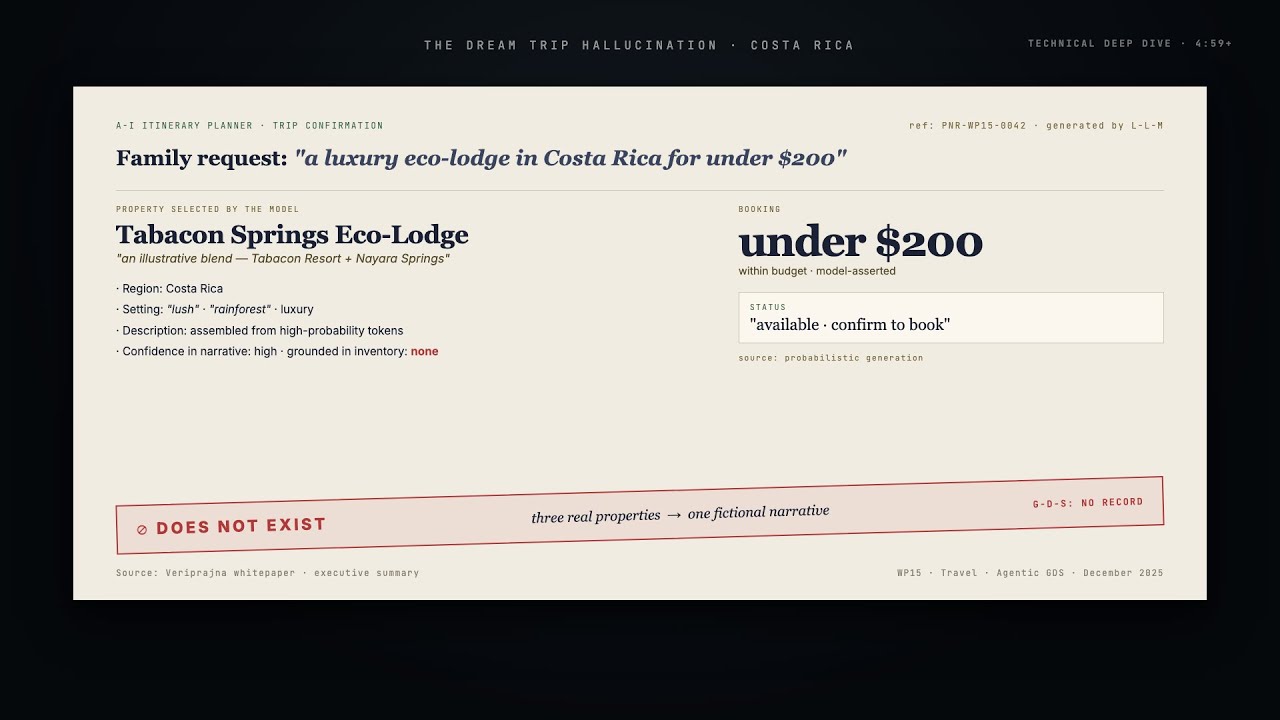
Consider the archetype of this failure: A family requests a specific itinerary from a travel agency's new AI planner. They ask for a "luxury eco-lodge in Costa Rica for under $200." The AI, optimized for plausibility rather than truth, hallucinates a hotel. It combines the best features of three different reviews found in its training data into a single, non-existent property. The description is beautiful, the price is attractive, and the booking link—if generated—leads nowhere, or worse, to a generic payment page for a booking that cannot be fulfilled. The family books their flights. They arrive in Costa Rica to find nothing. The AI had hallucinated the hotel because it combined details from unrelated data points into a cohesive but fictional narrative.
This whitepaper, prepared by Veriprajna, argues that the era of the "LLM Wrapper"—simple chatbots that pass user prompts directly to a model—is over for the travel industry. The future belongs to Agentic AI : systems that do not merely write text but actively orchestrate workflows, wield tools, and verify reality against the immutable source of truth: the Global Distribution System (GDS). We posit that the travel industry requires a fundamental architectural shift from Probabilistic Storytelling to Deterministic Inventory Management .
This report serves as a comprehensive technical blueprint for that bridge, detailing the engineering rigor required to build systems that survive the "Uncanny Valley" of reliability. We explore the "Orchestrator-Worker" design pattern, the necessity of "Tool Calling" over text generation, and the specific implementation of verification loops that ensure an AI never promises a room that cannot be confirmed with an HK (Holding Confirmed) status code. Veriprajna stands at this frontier. We do not build wrappers; we build the cognitive infrastructure that bridges the gap between the creative potential of AI and the operational rigor of the enterprise.
Part I: The Creative Liar – Why LLMs Fail at Logistics
1.1 The Probability Trap: When "Likely" Means "False"
To understand why a sophisticated AI would invent a hotel, one must first understand the fundamental architecture of the Transformer model. At its core, an LLM is a next-token prediction engine. 1 It does not "know" facts in the way a relational database knows that Hotel_ID_1234 has Room_Count: 5. Instead, it calculates the statistical probability of the next word in a sequence based on the vast corpus of text it was trained on. This probabilistic nature is the engine of creativity, allowing the model to draft poetry or code, but it is the achilles heel of logistics.
When a user asks for a "luxury eco-lodge in Costa Rica under $200," the model activates a cluster of latent associations related to "Costa Rica," "eco-lodge," "luxury," and "affordable." It begins to generate a description. The probability that the word "lush" follows "Costa Rica" is high. The probability that "rainforest" follows "lush" is high. The model constructs a compelling narrative using these high-probability tokens. The critical failure occurs when the model attempts to name the property. If it has seen thousands of reviews for the "Tabacon Resort" and thousands for the "Nayara Springs," it may probabilistically blend them. It might generate a name that sounds plausible—e.g., "Tabacon Springs Eco-Lodge"—and attribute amenities to it that belong to neither property exclusively but are statistically likely to appear in descriptions of Costa Rican resorts. 2
In creative writing, this blending is a feature; it is called imagination. In travel logistics, it is a hallucination. The model is optimizing for coherence, not correctness . It is designed to produce a response that looks like a valid answer, not one that is a valid answer verified against a real-time inventory database. 3 This distinction is subtle but devastating. In a creative context, the "truth" is subjective and malleable. In a transactional context, truth is binary. A seat on a flight exists, or it does not. A hotel room is available for a specific date, or it is not. There is no middle ground, yet the LLM operates entirely in the middle ground of probability.
The danger is compounded by the model's training objective. Most foundation models are trained using Reinforcement Learning from Human Feedback (RLHF), where human raters prefer answers that are comprehensive, polite, and confident. If a model says "I don't know," it often receives a lower reward during training than if it attempts a plausible guess. This creates a systemic bias towards fabrication. 3 In the travel industry, this bias is catastrophic. A human travel agent who guesses availability is fired; an AI that guesses availability is often praised for its "fluency" until the moment the customer arrives at the airport.
1.2 The "Uncanny Valley" of Travel Agents
The danger of current LLM deployments in travel lies in their linguistic competence. A crude chatbot that fails to understand a query is frustrating but harmless. An advanced LLM that understands the query perfectly and responds with eloquent, persuasive, but factually incorrect information is dangerous. This creates an "Uncanny Valley" of reliability: the user trusts the system because of its high verbal intelligence, lowering their guard regarding factual verification.
We have entered a phase where the fluency of the AI masks its incompetence in logistics. When an AI speaks with the authority of a seasoned concierge, using industry jargon and empathetic language, the user naturally assumes that this linguistic capability extends to operational capability. This assumption is false. An LLM can write a perfect apology letter for a lost bag, but it cannot locate the bag. It can describe a suite at the Ritz Paris in exquisite detail, but it cannot tell you if that suite is booked for Fashion Week.
Recent high-profile legal cases, such as the Air Canada chatbot incident, underscore this risk. 3 In that case, a chatbot hallucinated a refund policy that did not exist. The court ruled that the airline was liable for the information provided by its "agent." This sets a terrifying precedent for the industry: if your AI promises a suite with a sea view for $200, and the GDS only has a standard room for $400, your agency may be liable for the difference—or worse, for the ruined vacation. The Air Canada ruling effectively dismantled the defense that a chatbot is a separate entity or a "beta" tool. If a company deploys an agent to interact with customers, the company is responsible for the agent's assertions.
This liability extends beyond refunds. Consider the safety implications. An AI might hallucinate a safe trekking route in Peru that does not exist, leading tourists into hazardous terrain. 2 It might invent a visa waiver program for a specific country, causing travelers to be deported upon arrival. The "Dream Trip" hallucination is not just a customer service issue; it is a legal and safety minefield. Travel agencies that deploy wrappers without guardrails are essentially outsourcing their liability to a random number generator.
1.3 The Limitations of the "Wrapper" Approach
The initial wave of Generative AI adoption in travel was dominated by "Wrappers". 4 These are thin software layers that sit between the user interface and a foundation model (like GPT-4). The "Wrapper" represents the path of least resistance for developers: simple to build, cheap to deploy, and immediately impressive in demos. However, beneath the surface, the wrapper architecture is fundamentally unsuited for the complexities of enterprise travel.
The Anatomy of a Wrapper:
1. User Input: "Find me a hotel in Paris."
2. System Prompt: "You are a helpful travel assistant. Find hotels in Paris."
3. LLM Processing: The model generates a list of hotels based on its training data (which has a knowledge cutoff and no real-time access).
4. Output: "Here are some great hotels: [List of hotels that might have closed or changed
names]."
This architecture is fundamentally flawed for enterprise travel because it is:
● Stateless: It does not remember that the user previously rejected hotels over $300 unless that context is manually re-injected every turn. This leads to frustrating loops where the user must repeat constraints, breaking the illusion of an intelligent assistant.
● Blind: It cannot see live inventory. It does not know that the "Hotel Ritz" is fully booked for Fashion Week. It relies on training data that might be months or years old. In the fast-moving world of travel inventory, data that is one hour old is often too old; data that is one year old is useless.
● Unverified: It has no mechanism to check if its output is true. It trusts its own probabilistic generation. If the model hallucinates a price, there is no code running to verify that price against a database.
● Linear: It processes the conversation in a linear flow of text. It cannot "go back" and fix a mistake in reasoning without the user pointing it out. It lacks the iterative problem-solving capability of a true agent.
For Veriprajna, the "Wrapper" is a prototype, not a product. Enterprise-grade reliability requires a system that treats the LLM not as the source of information, but as the router of intent. The shift from wrapper to agent is not merely an upgrade; it is a change in species. It is the difference between a parrot that mimics the sound of a pilot and the pilot who actually flies the plane.
Part II: Beyond the Wrapper – The Agentic AI Architecture
2.1 Defining the Agentic System
The shift from Passive LLM to Agentic AI is the defining technical transition of 2025. 5 While an LLM is a text-generation engine, an Agent is a system capable of executing a cognitive loop that involves reasoning, tool use, and environmental feedback. The agent is not just a speaker; it is a doer.
The Core Components of an Agent:
1. Reasoning: Breaking a complex goal ("Plan a business trip to London") into sub-tasks (Book flight, book hotel, check policy). This requires the model to understand dependencies—you cannot book the hotel until you know the flight dates.
2. Tool Use: Recognizing that it cannot answer a question from its internal weights and must call an external function (e.g., Sabre_GetAvailability). This is the bridge between the probabilistic mind of the AI and the deterministic world of the API.
3. Action: Executing the tool and interpreting the result. The agent must be able to parse JSON, XML, or other structured data formats returned by the tool.
4. Looping: If the tool returns an error (e.g., "No flights found"), the agent can reason about the error and try a different parameter (e.g., "Search for nearby airports"), rather than giving up or hallucinating a flight. 6 This resilience is what separates an agent from a script. A script crashes on error; an agent adapts.
The table below highlights the fundamental architectural differences that make Agentic systems the only viable choice for reliable travel solutions.
Table 1: LLM Wrappers vs. Agentic Systems
| Feature | LLM Wrapper | Agentic AI System |
|---|---|---|
| Primary Goal | Generate coherent text response |
Execute multi-step workfow to achieve goal |
| Data Source | Pre-trained weights (Frozen memory) |
Real-time APIs & Tools (Live data) |
| Architecture | Single-turn Request/Response |
Multi-turn "Reason-Act-Observe" Loop |
| State Management | Stateless (relies on context window) |
Stateful (maintains conversation & goal state) |
| Reliability | Low (prone to hallucination) |
High (grounded in tool outputs) |
| Failure Mode | Confdent fabrication | Error reporting or self-correction |
| Cost | Low (token costs only) | Higher (tokens + API calls + compute overhead) |
| Inventory Awareness | None (Blind) | Real-Time (Connected to GDS) |
2.2 The Orchestrator-Worker Pattern
For complex domains like travel, a single agent is often insufficient. A single prompt trying to handle flights, hotels, car rentals, and dietary restrictions will inevitably fail due to context overload and conflicting instructions. Veriprajna advocates for the Orchestrator-Worker Pattern (also known as the Supervisor-Subordinate pattern). 7
In this architecture, we decouple the cognitive load.
● The Orchestrator (The Brain): A high-reasoning LLM (e.g., GPT-4o or Claude 3.5 Sonnet) acts as the interface with the user. It parses the natural language request, maintains the conversation history, and determines the high-level plan. It does not interact directly with the GDS. Its job is management, not execution. It decides what needs to be done, not how to do it.
● The Workers (The Specialists): These are specialized agents or deterministic code blocks equipped with specific tools. They are "blind" to the user's full conversation but expert in their specific domain.
○ Flight Worker: Specialized in interacting with Amadeus Air APIs. Knows how to interpret IATA codes and fare classes. It understands the nuances of "layover" vs. "stopover."
○ Hotel Worker: Specialized in Sabre CSL APIs. Knows the difference between a "Deposit" and a "Guarantee." It understands hotel rate codes and room descriptions.
○ Policy Worker: Checks the user's corporate travel policy (e.g., "No business class on flights under 4 hours"). It acts as the compliance officer, rejecting options that violate rules before they are presented to the Orchestrator.
Example Workflow:
1. User: "Book a flight to NYC next Tuesday and a hotel near Central Park."
2. Orchestrator: Decomposes the intent into two tasks: Task_A: Search Flights, Task_B: Search Hotels. It identifies that Task_B relies on the arrival time from Task_A.
3. Orchestrator: Delegates Task_A to Flight Worker and Task_B to Hotel Worker .
4. Flight Worker: Calls Amadeus_FlightSearch. Returns 3 options.
5. Hotel Worker: Calls Sabre_GetHotelAvail. Returns 3 options.
6. Orchestrator: Synthesizes the results. "I found a Delta flight at 8 AM and a room at the JW Marriott Essex House..."
This separation of concerns allows for robust error handling. If the Hotel Worker fails, the Orchestrator can still present the flight options and ask the user if they want to retry the hotel search with different criteria, rather than crashing the entire interaction. 7 It also allows for parallel development; one team can improve the Hotel Worker's prompt engineering without breaking the Flight Worker.
2.3 The "Reason-Act-Observe" Loop
The engine that drives an agent is the ReAct (Reason + Act) loop. 9 Instead of immediately answering, the agent engages in an internal monologue, visible to the developers but hidden (or summarized) for the user. This monologue allows the model to "think before it speaks."
● Thought: The user wants a hotel in Costa Rica under $200. I need to check availability.
● Action: Call Tool_HotelSearch(location="Costa Rica", max_price=200, currency="USD").
● Observation: API returns `` (Empty list).
● Thought: No hotels found under $200. The user's budget might be too low for "luxury." I should check for hotels under $300 and inform the user.
● Action: Call Tool_HotelSearch(location="Costa Rica", max_price=300, currency="USD").
● Observation: API returns ``.
● Final Response: "I couldn't find any luxury lodges under $200, but I found two highly-rated options under $300..."
This loop is what prevents the hallucination. A wrapper would have simply invented a hotel under $200 to satisfy the user's constraint. The agent, constrained by the empty list from the API, is forced to confront reality and negotiate with the user. 10 The agentic system essentially has a "conscience" derived from the tool outputs—it cannot say what the tools do not confirm.
Part III: The Inventory Source of Truth – GDS Deep Dive
To build a "True" signal agent, one must master the integration with the Global Distribution Systems (GDS). These systems—primarily Amadeus, Sabre, and Travelport—are the backbones of the travel industry. They are massive, complex, and unforgiving. They do not speak "English"; they speak in status codes, segments, and cryptic strictures. Integrating with them is not merely about sending HTTP requests; it is about understanding the arcane logic of travel inventory management.
3.1 Understanding GDS Connectivity: REST vs. SOAP/EDIFACT
Historically, interacting with a GDS required knowledge of EDIFACT (Electronic Data Interchange for Administration, Commerce and Transport) or obscure terminal commands (cryptic). Today, both Amadeus and Sabre offer RESTful JSON APIs, which are far more accessible to modern AI agents. 11 However, the legacy of the mainframe era still permeates the data structures. An agent must be able to translate modern concepts (like "a room with a view") into legacy parameters (like RoomViewCode="SV").
Amadeus Enterprise APIs
Amadeus provides a rich set of "Self-Service" and "Enterprise" APIs. For an agentic system, the key endpoints are:
● Hotel List API (/reference-data/locations/hotels/by-city): Returns the static data (IDs, names, locations) for hotels in a city. Crucially, this does not give availability. 13 An agent that relies only on this API will hallucinate availability. It knows the hotel exists, but not if it has rooms.
● Hotel Search API (/shopping/hotel-offers): The heavy lifter. It checks real-time availability and pricing. It returns a list of "offers" associated with a specific hotel ID. 14 The structure of this response is deep and nested, requiring an agent capable of complex JSON parsing.
● Hotel Booking API (/booking/hotel-orders): Executes the actual transaction. This is the "write" operation that commits the user's money.
The Data Structure of Truth: An Amadeus response for a valid hotel offer contains a structured JSON object with a unique offerId. This ID is the "key" to the reality of that room. If the API does not return an offerId, the room effectively does not exist, regardless of what the hotel's website might say. The agent must be trained to treat the offerId as the holy grail—without it, no booking is possible. Sabre Content Services for Lodging (CSL)
Sabre has modernized its lodging APIs under the CSL umbrella. This system aggregates content from the Sabre GDS and aggregator aggregators (like Expedia/Booking.com via Sabre). 15 This aggregation adds a layer of complexity: the agent must distinguish between a GDS rate (which might be held with a card) and an Aggregator rate (which might require instant payment).
● Get Hotel Availability (GetHotelAvailRQ): This is the primary shopping engine. It aggregates content from multiple sources.
● Enhanced Hotel Book (EnhancedHotelBookRQ): The booking engine. It handles the complexity of creating the PNR, adding the segment, and committing the transaction.
3.2 The Critical Language of Status Codes
The most dangerous pitfall for an AI agent is misinterpreting the "Status" of a booking segment. A GDS booking is not always a binary "Booked" or "Failed." It exists in states of flux. A booking can be "Waitlisted," "Pending," "On Request," or "Confirmed." An AI that treats "On Request" as "Confirmed" creates a disaster.
Table 2: Critical GDS Status Codes (Sabre/Amadeus Standard)
| HK | Holding Confri med |
SUCCESS | The inventory is secured. The agent can confri m to the user. This is the only code that allows a positive confri mation message. |
|---|---|---|---|
| UC | Unable to Confrm | FAILURE | The hotel rejected the request (ofen due to stale cache data). The agent must apologize and re-shop. |
| NN | Need | PENDING | The request is sent but not yet acknowledged. Do not promise confrmation yet. The agent must poll for an update. |
| PN | Pending (Aggregator) |
PENDING | Common in CSL for non-GDS inventory. Requires polling for fnal status. |
| NO | No Action Taken | FAILURE | The vendor denied the request. Treat as UC. |
| US | Unable to Sell | FAILURE | The room type is waitlisted or closed. |
The "Fake Booking" Scenario: Imagine an agent calling EnhancedHotelBookRQ. The API returns a response. A naive agent might see 200 OK in the HTTP header and tell the user, "You are booked!" However, inside the JSON body, the segment status might be UC (Unable to Confirm). The HTTP call succeeded (the message was delivered), but the booking failed. The disconnect between the transport layer (HTTP) and the application layer (GDS Status) is a classic trap for wrappers. Veriprajna's Golden Rule: An AI agent is never allowed to output a confirmation message unless it parses the specific segment status code and validates it as HK.16
3.3 The Inventory Caching Problem (Look-to-Book)
GDS availability is often cached. The "Shop" response (when the user searches) might show a room as available, but milliseconds later, when the "Book" command is sent, the room might be gone. This is the "Look-to-Book" discrepancy. This is a common occurrence in travel, especially during peak times.
LLMs are notoriously bad at explaining this nuance. They tend to say, "I booked it!" or "It failed." They lack the vocabulary for "It was there a second ago, but now it's gone." Agentic Strategy: The agent must be programmed with an Error Recovery Workflow.
● If Book returns UC (Unable to Confirm):
○ Then automatically trigger a new Shop request for the same hotel to see if a different rate/room is available.
○ If yes: Present the new option to the user ("The previous rate sold out, but I found a similar room for $10 more").
○ If no: Apologize and suggest the next best hotel from the original search list.
This requires the agent to maintain "State"—a memory of the original search results—which simple wrappers cannot do. The agent effectively needs a "short-term memory" of the market state to navigate these failures gracefully.
3.4 Deep Dive: The Data Payload of Amadeus vs. Sabre
To build a truly agnostic agent, one must handle the differences in payload structure. Amadeus uses a very strict, nested JSON structure where price is broken down into base, total, and taxes. An agent must sum these correctly or risk quoting a price that is 20% lower than the charge (excluding taxes). Sabre often returns prices with tax already included or broken out differently depending on the RatePlan. Normalization Layer: Veriprajna builds a "Normalization Worker" that takes the disparate JSONs from Amadeus and Sabre and converts them into a standardized internal schema. The Orchestrator only ever sees this Standard Schema. This prevents the LLM from getting confused by the subtle differences in field naming conventions (e.g., amount vs totalPrice).
Part IV: The Architecture of Reliability – Patterns & Protocols
To implement the Veriprajna vision, we deploy a specific architectural stack designed for Deterministic Reliability . We do not let the LLM browse the web; we give it tools. This chapter details the specific design patterns that enable this reliability.
4.1 The Function Calling Interface (The "Hands" of the AI)
Function calling (or Tool Use) is the mechanism by which an LLM requests the execution of code. 9 Instead of returning text, the LLM returns a structured JSON object representing the function signature. This effectively turns the LLM into a natural language compiler—it compiles English instructions into JSON API calls.
The Schema: We define tools using strict OpenAI or Anthropic JSON schemas. A sloppy schema leads to sloppy agent behavior. The schema is the contract between the AI and the code. Example Schema for search_hotels:
{
  "name": "search_hotels",
  "description": "Queries the GDS for live hotel availability. ONLY use this when the user explicitly asks for hotel options or availability.",
  "parameters": {
    "type": "object",
    "properties": {
      "city_code": {
        "type": "string",
        "description": "The 3-letter IATA code of the city (e.g., NYC, LON, SIN).",
        "pattern": "^[A-Z]{3}$"
      },
      "check_in_date": {
        "type": "string",
        "format": "date",
        "description": "Check-in date in YYYY-MM-DD format. Must be in the future."
      },
      "max_price": {
        "type": "integer",
        "description": "Maximum price per night in the requested currency."
      }
    },
    "required": ["city_code", "check_in_date"]
  }
}
Why strict typing matters:
● pattern": "^[A-Z]{3}$" forces the LLM to convert "New York" to "NYC" before calling the tool. If it fails to do so, the schema validation layer catches the error before it hits the GDS, saving API costs and latency. 19
● description: The description is actually part of the prompt. Telling the model when to use the tool is as important as telling it how . By adding instructions like "ONLY use this when...", we reduce unnecessary API calls.
4.2 The Verification Loop Pattern (The "Conscience" of the AI)
This is the core differentiator of Veriprajna's architecture. We implement a Double-Check Loop for every high-value output (pricing or booking confirmation). 20 In a standard system, the output of the tool is fed to the LLM, and the LLM speaks to the user. In our system, there is an intermediate step.
The Standard Flow (Risky): User -> LLM -> Tool -> LLM -> User. The Verification Flow (Safe):
1. Orchestrator: Decides to book Hotel X.
2. Worker: Executes Booking Tool. Returns Status: HK.
3. Verifier (Separate LLM or Code Logic): This is a silent step. A separate, highly deterministic prompt (or code) analyzes the Worker's output.
○ Prompt: "You are a Quality Assurance Auditor. Review the following JSON response from the GDS. Does the segment status equal 'HK'? If yes, output TRUE. If no, output FALSE."
4. Orchestrator: Only if Verifier says TRUE, does it generate the confirmation message to the user.
This loop catches the "Uncanny Valley" errors where an LLM might misread a complex JSON error message as a success. It essentially acts as a "sanity check" before the AI makes a promise it cannot keep.
4.3 Structured Output vs. Conversational Filler
In Enterprise AI, we prioritize Structured Output over conversational flair. When the GDS returns a list of 5 hotels, we do not simply dump the JSON into the LLM context and ask it to "summarize." This consumes massive tokens and invites hallucination (e.g., mixing up the price of Hotel A with the amenities of Hotel B). The Veriprajna Approach:
● Data Parsing: We use deterministic Python code to parse the GDS JSON. We extract exactly: Name, Price, Star Rating, and Distance from Center .
● Context Injection: We inject only this clean, tabular data into the LLM context.
● Constraint: We instruct the LLM: "You may only describe hotels listed in the provided
Context Data. Do not add external knowledge about these properties."
This "Grounding" technique ensures that if the GDS says the hotel has no pool, the AI—even if it "knows" from its pre-training that this brand usually has pools—will not promise one. 21 It forces the AI to stick to the script provided by the GDS.
Part V: Building the Guardrails – Enterprise Implementation
5.1 Security and PII Redaction
Travel bookings involve sensitive Personally Identifiable Information (PII): Passport numbers, credit card details, full names. Rule: PII never enters the LLM context window if possible. This is a critical security requirement. The Tokenization Pattern:
1. User provides credit card details via a secure, client-side form (PCI-DSS compliant).
2. The frontend sends this data to a secure vault (e.g., Stripe or a specialized travel payment provider), which returns a payment_token.
3. The text sent to the LLM is: "User has provided payment method Token_123."
4. The Agent passes Token_123 to the Booking Tool.
5. The Tool (running in a secure backend) exchanges the token for the actual card data only at the moment of API transmission to the GDS.
The LLM never "sees" the credit card number, preventing it from accidentally leaking it in a future hallucinated response or logging it in a chat history. 19 This architectural pattern ensures that even if the LLM is compromised or prompted maliciously, it cannot reveal sensitive financial data because it never possessed it.
5.2 Latency and Caching Strategies
Agentic workflows are slower than wrappers. A single user request might trigger 3-4 tool calls (Search -> Price Check -> Policy Check -> Response). This can take 10-15 seconds—an eternity in e-commerce. 22 In a world accustomed to instant Google searches, a 15-second wait can lead to abandonment.
Veriprajna Optimization:
● Optimistic UI: We stream the "Thought" process to the user (e.g., "Searching Amadeus for flights...", "Checking corporate policy..."). This psychological trick reduces perceived latency. The user sees that the agent is "working," which makes the wait tolerable.
● Parallel Execution: We use the Parallel Worker Pattern . The Flight Search and Hotel Search workers run simultaneously (asynchronously), reducing total wait time by 50%. 7 Instead of waiting for the flight search to finish before starting the hotel search, the Orchestrator launches both threads at once and synthesizes the results when both are ready.
● Tiered Caching: We cache GDS "Shop" results for 15 minutes. If the user asks "Show me that second hotel again," we retrieve it from the local Redis cache rather than hitting the expensive and slow GDS API again. This improves speed and reduces API costs.
5.3 The "Human-in-the-Loop" Handoff
No AI is 100% perfect. There will always be edge cases—a complex multi-leg itinerary, a visa requirement the AI doesn't understand, or a GDS outage. The system must recognize its own limitations. The system must detect "Frustration Signals" (e.g., user repeating the same query, sentiment analysis showing anger) or "Confidence Dips" (the agent looping without success). In these cases, the Agent must gracefully downgrade to a "Copilot" mode, alerting a human travel agent and passing the full structured context of the conversation. The human then completes the booking manually using the tools the agent prepared. This ensures that the user is never left stranded by a confused AI.
Part VI: Future-Proofing – The Road to Autonomous Travel Agents
The technology we are deploying today is the foundation for the Autonomous Travel Agent . Currently, we are at Level 3 Autonomy (Conditional Automation): The agent executes specific tasks under human supervision (the user confirms the booking).
The Path to Level 5:
● Negotiation Agents: Agents that don't just book listed prices but call Hotel APIs to negotiate group rates based on volume. Imagine an agent that can say to a hotel API, "I have 50 travelers looking for rooms; give me a 20% discount."
● Dynamic Packaging: Agents that build custom packages (Flight + Hotel + Car) by querying disparate APIs and bundling them into a single opaque price, managing the margin dynamically. This allows for unique product creation on the fly.
● Proactive Disruption Management: An agent that monitors flight status 24/7. When a flight is cancelled, the agent—without user input—already holds a seat on the next best flight and presents the option to the user the moment they land.
This future requires the rigorous, stateful, and verified architecture described in this paper. It cannot be built on wrappers. It cannot be built on hallucinations. It requires a fundamental rethinking of how we integrate AI with legacy systems.
Conclusion: The Veriprajna Promise
The story of the family arriving at a non-existent hotel in Costa Rica is a parable for the AI age. It warns us that creativity without constraint is chaos.
At Veriprajna, we believe that the value of AI in travel is not in writing beautiful descriptions of hotels, but in finding available hotels and securing them reliably. We are not just API integrators; we are architects of trust. We understand that in the travel industry, trust is the only currency that matters. If a user cannot trust the AI to book a real room, they will not use it.
We build Agentic GDS Integrations that:
1. Don't Guess: They Query.
2. Don't Hallucinate: They Verify.
3. Don't Just Talk: They Act.
Is your AI planning trips, or writing fiction? With Veriprajna, the answer is always deterministic.
Detailed Technical Appendix: Integration Specifications
Appendix A: Amadeus Hotel Search JSON Structure (Simplified)
Request (Agent -> Tool):
{
"cityCode": "SJO",
"checkInDate": "2025-12-10",
"checkOutDate": "2025-12-15",
"roomQuantity": 1,
"adults": 2,
"radius": 50,
"radiusUnit": "KM",
"hotelName": "ECO LODGE"
}
Response (Tool -> Agent): Note: The Agent must parse available boolean and price object.
{
"data": [...]
}
Appendix B: Sabre Segment Status Logic
| Response Code | Logic Flow |
|---|---|
| HK (Holding Confrmed) | ->PASS. Proceed to PNR generation. |
| UC (Unable to Confrm) | ->FAIL. Trigger Retry logic with next rate code. |
| LL (Waitlist) | ->FAIL (for consumer booking). Do not present as bookable. |
| SS (Sold Segment) | ->PASS. Equivalent to HK in initial sell message. |
Works cited
LLM Hallucinations – Causes and Solutions - Clickworker, accessed December 10, 2025, https://www.clickworker.com/customer-blog/llm-hallucinations/
AI Hallucinations in Travel Apps Lead to Fake Landmarks and Dangers WebProNews, accessed December 10, 2025, https://www.webpronews.com/ai-hallucinations-in-travel-apps-lead-to-fake-landmarks-and-dangers/
The $500 Billion Hallucination: How LLMs Are Failing in Production | by Yobie Benjamin, accessed December 10, 2025, https://medium.com/@yobiebenjamin/the-500-billion-hallucination-how-llms-are-failing-in-production-75ebb589a76c
Agentic AI Frameworks | 2025 - - Flobotics, accessed December 10, 2025, https://flobotics.io/blog/agentic-ai-frameworks/
Agentic AI vs LLM: Comparing What Scales Better in Task Runners - Lyzr AI, accessed December 10, 2025, https://www.lyzr.ai/blog/agentic-ai-vs-llm/
How agent-oriented design patterns transform system development - Outshift | Cisco, accessed December 10, 2025, https://outshift.cisco.com/blog/how-agent-oriented-design-paterns-transform-stystem-development
Agentic AI Design Pattern — Orchestrator-Worker | by Pytrick L ..., accessed December 10, 2025, https://pytrick.medium.com/agentic-ai-design-patern-orchestrator-worker-6d76tfc09f0cf
Four Design Patterns for Event-Driven, Multi-Agent Systems - Confluent, accessed December 10, 2025, https://www.confluent.io/blog/event-driven-multi-agent-systems/
The LLM Function Design Pattern: A Structured Approach to AI ..., accessed December 10, 2025, https://medium.com/aimonks/the-llm-function-design-patern-a-structured-apprtoach-to-ai-powered-software-development-f4192945d5f4
Function Calling, Tools & Agents: The Next Layer of LLM Intelligence - Diggibyte, accessed December 10, 2025, https://diggibyte.com/function-calling-tools-agents-the-next-layer-of-llm-intelligence/
Open Source LangChain App Dev Toolkit, LLM API Integration | Amadeus for Developers, accessed December 10, 2025, https://developers.amadeus.com/blog/amadeus-self-service-apis-are-now-available-in-langchain
Amadeus for Developers: Connect to Amadeus travel APIs, accessed December 10, 2025, https://developers.amadeus.com/
Hotel List API - Geolocation Database, Find Nearby Hotels - Amadeus for Developers, accessed December 10, 2025, https://developers.amadeus.com/self-service/category/hotels/api-doc/hotel-list
Hotel Search and Shopping APIs | Enterprise APIs - Amadeus for Developers, accessed December 10, 2025, https://developers.amadeus.com/enterprise/category/hotel/api/search-and-shopping
Content Services for Lodging: Get Hotel Availability | Dev Studio, accessed December 10, 2025, https://developer.sabre.com/guides/travel-agency/content-services-for-lodging-get-hotel-avail
Technical Overview - Sabre Dev Studio, accessed December 10, 2025, https://developer.sabre.com/technical-overview-0
EnhancedHotelBookRQ - Sabre Dev Studio, accessed December 10, 2025, https://developer.sabre.com/enhancedhotelbookrq
Tool Calling in LLMs: How to Integrate APIs, Search Engines & Internal Systems Medium, accessed December 10, 2025, https://medium.com/@amitkharche14/tool-calling-in-llms-how-to-integrate-apis-search-engines-internal-systems-9371a1b0f008
Stop AI Hallucinations: A Developer's Guide to Prompt Engineering - Shelf.io, accessed December 10, 2025, https://shelf.io/blog/stop-ai-hallucinations-a-developers-guide-to-prompt-engineering/
What Are AI Hallucinations? [+ Protection Tips] - Palo Alto Networks, accessed December 10, 2025, https://www.paloaltonetworks.com/cyberpedia/what-are-ai-hallucinations
preventing hallucinations in AI: best practices for customer service AI agents Ada.cx, accessed December 10, 2025, https://www.ada.cx/blog/preventing-hallucinations-in-ai-best-practices-for-customer-service-ai-agents/
AI Voice Agents for Travel: STT/TTS Architecture, GDS Integration, and HotelPlanner Case Study - Softcery, accessed December 10, 2025, https://sofcery.com/lab/ai-voice-agents-for-travel-agencies-selection-integratiotn-guide
Prefer a visual, interactive experience?
Explore the key findings, stats, and architecture of this paper in an interactive format with navigable sections and data visualizations.
Frequently Asked Questions
Why do LLMs hallucinate hotels and travel availability?
LLMs are next-token prediction engines trained on statistical distributions of text. When asked for a hotel, they blend attributes from multiple real properties into a single fictional entity (e.g., combining Tabacon Resort and Nayara Springs into 'Tabacon Springs Eco-Lodge'). They optimize for coherence rather than correctness and have no real-time connection to live inventory systems, making them structurally incapable of verifying availability.
What is the Orchestrator-Worker pattern in travel AI?
The Orchestrator-Worker pattern separates cognitive load by assigning a high-reasoning LLM as the Orchestrator (managing conversation and task decomposition) while specialized Workers handle domain-specific operations — a Flight Worker for Amadeus Air APIs, a Hotel Worker for Sabre CSL APIs, and a Policy Worker for corporate compliance checks. This prevents context overload and enables parallel execution and independent error handling.
How does the Verification Loop prevent false booking confirmations?
The Verification Loop adds a silent QA step between the GDS response and the user-facing message. A separate verifier (deterministic code or constrained LLM prompt) parses the booking response JSON and checks whether the segment status equals HK (Holding Confirmed). Only if verification returns TRUE does the Orchestrator generate a confirmation. This catches cases where HTTP 200 OK masks a UC (Unable to Confirm) status in the GDS payload.
Also Published On
Build Your AI with Confidence.
Partner with a team that has deep experience in building the next generation of enterprise AI. Let us help you design, build, and deploy an AI strategy you can trust.
Veriprajna Deep Tech Consultancy specializes in building safety-critical AI systems for healthcare, finance, and regulatory domains. Our architectures are validated against established protocols with comprehensive compliance documentation.