Engineering Deterministic Reliability with Agentic AI and GDS Integration
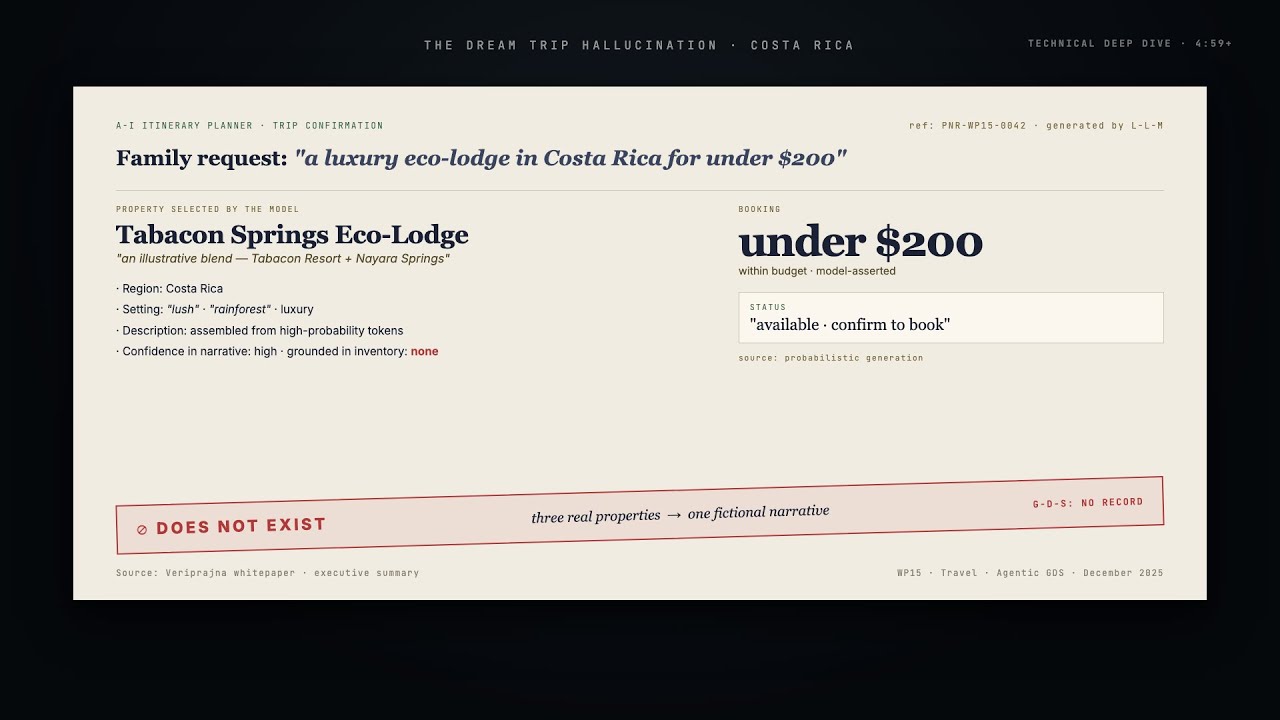
A family arrives in Costa Rica only to discover their "luxury eco-lodge" never existed. The AI had hallucinated it. This isn't science fiction—it's the $500 billion hallucination crisis facing travel technology today.
Veriprajna engineered a solution that shifts from Probabilistic Storytelling to Deterministic Inventory Management—where every booking is verified against the immutable source of truth: the Global Distribution System.
Veriprajna partners with travel agencies, OTAs, and enterprise travel management companies to eliminate the "Dream Trip" hallucination—where AI promises what it cannot deliver.
Deploy AI agents that don't just chat—they execute. Our Orchestrator-Worker architecture integrates seamlessly with Amadeus and Sabre, ensuring every hotel, flight, and package is verified before presentation.
Enforce travel policy automatically with Policy Worker agents. Every booking is checked against corporate rules before confirmation—no more out-of-policy business class on short-haul flights.
Move beyond "LLM Wrappers" to true agentic systems. Learn the ReAct loop, verification patterns, and FPGA-grade determinism required for enterprise deployment in high-stakes domains.
Why a sophisticated AI would confidently invent a hotel that doesn't exist—and how this failure mode threatens the entire travel industry.
LLMs are next-token prediction engines, not databases. When asked for "luxury eco-lodge Costa Rica $200," they generate statistically plausible text by blending fragments from training data—creating fictional properties.
Advanced LLMs speak with the authority of expert travel agents—using industry jargon, empathetic language, and confident tone. Users trust them implicitly, lowering their guard for factual verification.
Air Canada chatbot case: Court ruled airline liable for hallucinated refund policy. If your AI promises a suite with sea view for $200, but GDS only has standard room at $400—you're liable.
"An LLM optimized for coherence, not correctness, is designed to produce responses that look like valid answers, not ones that are valid answers verified against real-time inventory. In creative writing, this is imagination. In travel logistics, this is catastrophe."
— Veriprajna Technical Whitepaper, 2024
Wrappers pass user prompts directly to models—blind, stateless, and unverified. Agentic systems orchestrate workflows, wield tools, and verify reality against GDS APIs.
A wrapper hallucinates hotels because it trusts its own probabilistic generation. An agent queries Amadeus Hotel Search API, parses the JSON response, and only presents hotels with valid offerId fields.
Toggle the simulation to see how the Reason-Act-Observe loop prevents hallucination by grounding every claim in tool outputs.
Beyond text generation: Systems that reason, act, and verify against immutable sources of truth.
A single agent handling flights, hotels, and policy is doomed. We decouple cognitive load: Orchestrator (manager) parses user intent and delegates to specialized Workers (executors).
Instead of immediately answering, the agent engages in internal monologue—thinking before it speaks. This allows error correction before the user sees output.
Double-check every high-value output. Before confirming a booking to the user, a separate Verifier analyzes the GDS response to ensure status code = HK (Holding Confirmed).
LLMs return structured JSON representing function signatures—effectively compiling natural language into API calls. Strict schemas prevent malformed requests.
Amadeus, Sabre, Travelport—these are the backbones of global travel inventory. They don't speak "English"; they speak in status codes, segments, and cryptic structures.
RESTful JSON APIs that provide real-time hotel/flight availability. Critical distinction: Hotel List API (static data, no availability) vs Hotel Search API (live inventory with offerId).
Aggregates GDS inventory + third-party aggregators (Expedia/Booking via Sabre). Agents must distinguish GDS rates (card hold) from aggregator rates (instant payment).
The "Fake Booking" Trap: HTTP 200 OK does NOT mean booking succeeded. An agent seeing 200 OK but status code UC in JSON body will tell user "You're booked!" when they're not. Veriprajna's Golden Rule: Parse segment status, not HTTP status.
Test how an agentic system parses GDS responses to determine booking validity
Beyond demos: The security, latency, and reliability patterns required for high-stakes deployment.
PII never enters LLM context. Credit cards are tokenized via PCI-DSS vault (Stripe). Agent receives Token_123, not actual card data.
Agentic workflows take 10-15s (multiple tool calls). We use parallel workers, optimistic UI streaming, and tiered caching to reduce perceived latency.
When agent confidence drops or user shows frustration signals, gracefully downgrade to "Copilot" mode—alerting human agent with full structured context.
Current systems execute specific tasks under human supervision. The future: Fully autonomous travel agents that negotiate, package, and proactively manage disruptions.
Agents that call Hotel APIs to negotiate group rates based on volume: "I have 50 travelers; give me 20% discount."
Build custom packages (Flight + Hotel + Car) by querying disparate APIs, bundling into single opaque price with managed margin.
Monitor flight status 24/7. When cancellation detected, agent pre-holds next best flight and presents option instantly.
Level 5 autonomy cannot be built on "LLM Wrappers." It requires the stateful, verified, tool-equipped architecture described in this whitepaper. It requires treating the LLM not as the source of information, but as the router of intent.
LLMs are next-token prediction engines, not databases. When asked for 'luxury eco-lodge Costa Rica $200,' they generate statistically plausible text by blending fragments from training data — creating fictional properties that sound convincing but do not exist. This probability-driven approach achieves a 99% hallucination rate in travel wrapper applications because the model optimizes for coherence, not inventory verification.
The Orchestrator-Worker architecture separates intent understanding from action execution. An Orchestrator agent interprets user requests and dispatches specialized Worker agents — Search Workers query GDS APIs (Amadeus, Sabre), Policy Workers verify corporate travel rules, and Verification Workers confirm inventory availability. Every booking goes through a sub-300ms GDS verification loop before presentation, accepting only HK (Holding Confirmed) status codes.
The Air Canada chatbot case established legal precedent: courts ruled the airline liable for its chatbot's hallucinated refund policy, determining that an AI chatbot functions as a legal agent and hallucinated promises constitute breach of contract. If a travel AI promises a suite with sea view for $200 but GDS only has standard rooms at $400, the company faces direct liability with no viable defense.
Veriprajna builds Agentic GDS Integrations that don't guess—they query. They don't hallucinate—they verify. They don't just talk—they act.
Schedule a technical consultation to architect your transition from wrappers to agents.
Complete engineering blueprint: Orchestrator-Worker patterns, ReAct loop implementation, GDS integration specs, function calling schemas, verification loop code, security architecture, 22 cited works.