The Millisecond Imperative: Architectural Determinism in High-Velocity Material Recovery
Executive Summary
The global materials recovery industry stands at a critical inflection point, driven by the convergence of tightening purity standards, labor shortages, and the escalating complexity of post-consumer waste streams. While Artificial Intelligence (AI) has been correctly identified as the mechanism to transcend the limitations of heuristic optical sorting, the prevailing implementation strategy—reliant on cloud-centric architectures and general-purpose computing—is fundamentally flawed. This whitepaper, prepared by Veriprajna, rigorously demonstrates that the non-deterministic latency inherent in cloud-based AI is physically incompatible with the kinematics of high-speed sorting conveyance.
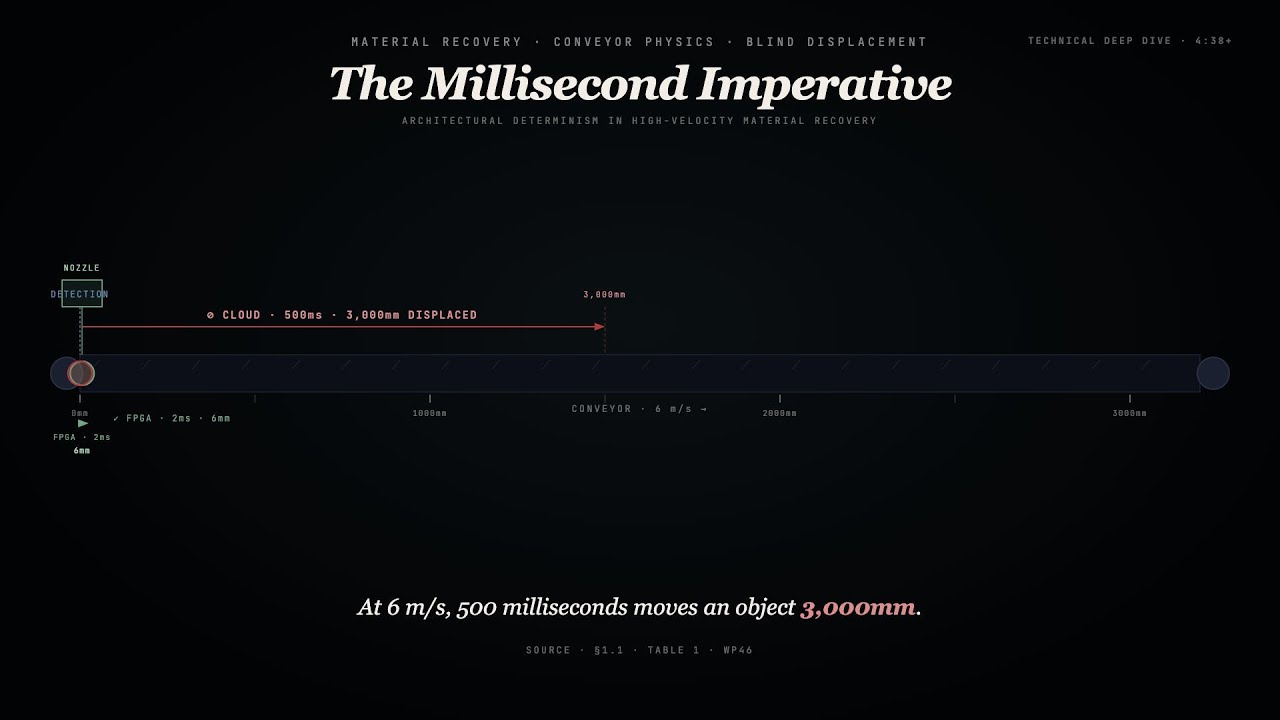
Our analysis reveals that the standard 500-millisecond round-trip latency of cloud inference creates a "blind displacement" of 1.5 to 3.0 meters on conveyor belts operating at industrial speeds of 3 to 6 meters per second. 1 This spatial uncertainty necessitates reduced throughput, excessive safety buffering, and compromised ejection purity, effectively negating the economic benefits of AI deployment.
Veriprajna advocates for a paradigm shift toward Quantized Edge Models deployed on Field-Programmable Gate Arrays (FPGAs) . By leveraging streaming dataflow architectures and reduced-precision arithmetic (INT8/INT4), FPGA-based solutions achieve deterministic latencies under 2 milliseconds. 3 This architectural approach eliminates the Von Neumann bottleneck, neutralizes network jitter, and restores the sub-millimeter synchronization required for precise pneumatic ejection.
This document serves as a technical manifesto for the recycling industry, positioning Veriprajna not as a mere integrator of commodity Large Language Model (LLM) APIs, but as a Deep AI architect capable of bridging the gap between high-level machine learning abstractions and the unforgiving physics of the factory floor.
1. The Physics of Throughput: Velocity, Displacement, and the Decision Window
To understand the architectural failure of cloud AI in recycling, one must first quantify the kinematic environment of a modern Material Recovery Facility (MRF). The efficacy of an automated sorting system is not governed by the sophistication of the neural network in the abstract, but by a strict, inviolable relationship between the velocity of the material stream, the spatial resolution of the ejection mechanism, and the total system latency.
1.1 The Kinematics of Conveyor-Based Sorting
The fundamental metric of MRF profitability is throughput—measured in tons per hour (TPH). To maximize TPH, facility operators drive conveyor belts at the highest velocities physically possible without compromising material stability. Modern high-speed sorting systems, such as the TOMRA AUTOSORT™ SPEEDAIR and Machinex MACH Hyspec®, operate at conveyor velocities () ranging from 2.5 m/s to 6 m/s. 1
At these velocities, the position of a target object—whether a PET bottle, a crushed aluminum can, or a fragment of fiber—is highly transient. The displacement of an object () over a given time interval () is described by the linear equation:
While this equation appears trivial, its implications for system design are profound when includes the non-deterministic latency of a remote server. In a sorting context, precision is paramount. The ejection mechanism typically consists of a manifold of high-speed pneumatic valves mounted at the discharge end of the belt. These valves, often spaced at a pitch of 12.5mm to 31mm, must fire a precise blast of compressed air to divert the target object from its ballistic trajectory. 6
To successfully eject a target without disturbing neighboring "good" material (collateral damage) or missing the target entirely (yield loss), the temporal error in the firing signal must correspond to a spatial error smaller than the object's radius or the nozzle pitch.
Table 1: Object Displacement at Industrial Belt Speeds
| Latency Source |
Duration (t) | Displacement at 3 m/s (vbelt) |
Displacement at 6 m/s (vbelt) |
Implications for Sorting |
|---|---|---|---|---|
| FPGA Edge AI | 2 ms | 6 mm | 12 mm | Precision Ejection Possible |
| Local GPU (Unoptimized) |
50 ms | 150 mm | 300 mm | Requires Tracking/Comp ensation |
| 5G Edge Cloud | 20-50 ms | 60 mm - 150 mm |
120 mm - 300 mm |
Marginal / High Jitet r Risk |
|---|---|---|---|---|
| Cloud AI (Standard) |
500 ms | 1500 mm (1.5 m) |
3000 mm (3.0 m) |
Catastrophic Failure |
As illustrated in Table 1, a 500ms delay—typical for a round-trip request to a cloud API including ingest, transmission, queuing, inference, and return—results in an object moving 1.5 meters at standard sorting speeds. 8 Even at a moderate speed of 3 m/s, the object has vacated the detection zone and potentially the ejection zone before the inference result is returned. This latency creates a "blind window" where the system effectively loses track of the object's state.
1.2 The "Latency Tax" on Facility Footprint and CapEx
Proponents of cloud-based solutions frequently argue that latency can be mitigated by placing sensors further upstream, effectively "looking ahead." While theoretically possible, this imposes a severe "Latency Tax" on the facility design that manifests in increased Capital Expenditure (CapEx) and operational complexity.
1. Physical Footprint Expansion: To accommodate a 1.5-meter processing lag, the conveyor system must be extended significantly. In brownfield installations where space is at a premium, extending a sorting line by several meters to accommodate a slow AI system is often structurally impossible. It requires re-engineering the entire plant layout, moving gantries, and altering feed angles.
2. The Tracking Uncertainty Principle: The longer an object remains on the belt between detection and ejection, the greater the probability of positional drift. Conveyor belts are not precision instruments; they vibrate, oscillate, and wear unevenly. 10
○ Vibration-Induced Drift: Industrial belts experience high-frequency vibrations from motors and rollers. Over a 1.5-meter travel distance, a lightweight plastic object can migrate laterally by several centimeters due to these vibrations.
○ Aerodynamic Lift: At speeds of 4-6 m/s, air resistance becomes a significant force. Lightweight films and paper behave like airfoils, fluttering and lifting off the belt surface—a phenomenon known as the "flying carpet" effect. 2
○ Collision and Settling: Waste streams are heterogeneous. A heavy glass bottle might roll and collide with a plastic tray, altering the trajectory of both.
Linear tracking algorithms can compensate for constant belt velocity, but they cannot predict non-linear stochastic movements caused by aerodynamics and collisions. The error accumulates over time. A 500ms delay introduces a probabilistic spatial error envelope that often exceeds the width of the ejection nozzles, rendering precise sorting impossible.
3. Throughput Capping: Faced with the inability to track objects over long distances, cloud-reliant operators are often forced to reduce belt speeds. Slowing a line from 4 m/s to 1 m/s reduces the facility's processing capacity by 75%. In an industry operating on thin margins per ton, this throughput reduction destroys the unit economics of the facility.
1.3 The Synchronization Challenge of Pneumatic Actuation
The ejection window for a pneumatic valve is measured in milliseconds. High-performance solenoid valves, such as those manufactured for optical sorters by specialist providers, have response times (opening times) of 2ms to 10ms. 6 The valve must open exactly when the center of mass of the target object aligns with the air jet to impart the maximum momentum transfer.
If the AI system cannot guarantee deterministic latency—meaning the processing time is fixed and predictable—the system controller cannot accurately calculate the firing time. This brings us to the most insidious enemy of real-time control: Jitter. A variable latency (e.g., 500ms ± 50ms) creates a firing uncertainty window of 100ms. At 3 m/s, 100ms represents 300mm of travel. The system would need to fire a burst of air 30cm long to ensure it hits the object, consuming vast amounts of compressed air and ejecting everything in that 30cm zone, effectively ruining purity.
2. The Cloud Bottleneck: Jitter, Non-Determinism, and the Fallacy of Connectivity
While bandwidth limitations and average latency are often cited as the primary drawbacks of cloud computing in industrial automation, network jitter is the true disqualifier for high-speed sorting applications. The architecture of the cloud is optimized for throughput and scalability, not for the microsecond-level determinism required to synchronize a vision system with a pneumatic actuator.
2.1 Anatomy of Cloud Latency in Industrial Loops
The "500ms" figure cited in the critique is a realistic aggregate of several latency sources in a standard Industrial IoT (IIoT) stack. To understand why this cannot be easily optimized away, we must dissect the lifecycle of a single inference request:
1. Ingest & Encode (20-50ms): The camera captures a high-resolution frame (e.g., 5MP). To transmit this over a standard internet connection, it must be encoded (e.g., H.264 or JPEG). This compression step consumes compute cycles and adds latency at the source.
2. Transmission (50-200ms): Data packets travel via the local LAN to the gateway, through the ISP infrastructure, across the public internet backbone, to the cloud provider's ingress point. Uplink bandwidth is often a bottleneck, especially for facilities streaming multi-spectral data from dozens of cameras. 15
3. Queuing & Ingress (10-50ms): Upon reaching the data center, the request passes through load balancers, API gateways, and message queues (e.g., Kafka or RabbitMQ) before reaching an available inference worker.
4. Inference (50-200ms): The model runs on a data center GPU (e.g., NVIDIA A100). While the GPU itself is fast, cloud inference services often use batching —grouping multiple requests together to maximize GPU utilization. 17 A request might wait 10-50ms just to be included in the next batch.
5. Return Path (50-100ms): The ejection command (a simple JSON or binary packet) must travel back to the facility through the same unpredictable network path.
2.2 The Scourge of Network Jitter
Jitter is the variation in packet delay over time. In a shared network environment like the public internet, routing paths change dynamically, router buffers fill up, and packets are dropped and retransmitted.
● Scenario: A sorting machine relies on a cloud signal to fire a valve at precisely $T_0 + 500ms$.
● Reality: Due to a momentary congestion spike at an ISP peering point, the packet arrives at .
● Result: The object, moving at 4 m/s, has traveled an additional 80mm ($0.02s \times 4000mm/s$). The air blast misses the center of mass, hitting the tail of the object or missing it entirely.
In high-speed sorting, Tail Latency (the 99th or 99.9th percentile latency) matters more than average latency. 19 If 1% of packets are delayed by 50ms, then 1% of the sorted material is missed. In a facility processing 50 tons per hour, a 1% purity drop represents 500kg of contaminants per hour, enough to downgrade a bale from "Grade A" to "Grade B" or trigger rejection by a buyer. 21
2.3 The Von Neumann Bottleneck at Scale
Beyond the network, cloud architectures suffer from the Von Neumann bottleneck inherent in general-purpose computing architectures (CPUs and GPUs). In these systems, data must be continually moved between memory (DRAM) and the processing unit over a bus.
For the high-resolution hyperspectral or RGB imaging used in sorting, the data volume is massive. Streaming raw video feeds saturates memory bandwidth. Furthermore, the sequential nature of instruction execution on CPUs and the kernel launch overhead on GPUs introduce varying processing delays. 23
● Kernel Launch Overhead: On a GPU, the CPU must prepare and launch each compute kernel (function). This overhead can be 5-10 microseconds per kernel. For a complex neural network with hundreds of layers, this overhead accumulates, adding to the non-determinism. 18
● OS Jitter: The operating system (Linux/Windows) managing the GPU is a time-sharing system. It interrupts the AI inference to handle network packets, log files, or background updates. These "OS noises" create unpredictable latency spikes. 25
2.4 The Fragility of Connectivity
Industrial facilities are notoriously hostile environments for connectivity. They are often essentially Faraday cages filled with electromagnetic interference from heavy motors and variable frequency drives (VFDs). Remote facility locations may rely on unstable cellular or satellite backhaul.
A cloud-dependent sorting line introduces a Single Point of Failure : the internet connection. If the connection drops, or if latency spikes due to a localized network storm, the sorting line must stop or revert to a "safety mode" that bypasses the AI, resulting in zero sorting. This violates the core tenet of industrial reliability: autonomy . A sorting machine must operate deterministically regardless of external network conditions. 27
3. The FPGA Paradigm: Dataflow Architectures and Deterministic Latency
To achieve the sub-millisecond precision required for 3-6 m/s sorting, Veriprajna advocates for the use of Field-Programmable Gate Arrays (FPGAs). FPGAs differ fundamentally from CPUs and GPUs; they are not instruction processors executing software, but reconfigurable hardware circuits . This distinction unlocks the capabilities required for "Deep AI" in industrial settings.
3.1 Dataflow vs. Control Flow: The Architectural Divide
To appreciate the speed of FPGAs, one must contrast their execution model with that of processors.
Control Flow (CPU/GPU): CPUs and GPUs operate on a temporal logic. They fetch an instruction, decode it, fetch data, execute the instruction, and store the result. This cycle is repeated billions of times. The performance is limited by the clock frequency and the efficiency of the instruction pipeline. Crucially, the hardware is fixed; the software must adapt to the hardware's rigid structure.29 Dataflow (FPGA): FPGAs operate on a spatial logic. The algorithm is physically mapped onto the chip's fabric using Lookup Tables (LUTs), Flip-Flops (FFs), and Digital Signal Processing (DSP) slices. Data flows through a pipeline of dedicated hardware blocks like water through a pipe.
● No Instruction Fetch: There is no "program counter" and no instruction fetching. The "program" is the circuit wiring itself.
● Deep Pipelining: Operations are deeply pipelined. As soon as the first pixel of an image enters the pipeline, processing begins. The system does not wait for a full frame to be buffered before starting analysis. 31
● Massive Parallelism: FPGAs support MISD (Multiple Instruction, Single Data) and task-level parallelism. The pre-processing logic, the neural network layers, and the valve control logic all run simultaneously on different parts of the chip without competing for CPU cycles. 33
3.2 Streaming Vision: Processing at the Speed of Light
The 2ms latency claim is achievable because FPGAs can process vision data in a streaming fashion.
● Standard Vision (GPU): A camera captures a frame Frame is buffered in memory CPU reads frame CPU copies frame to GPU memory GPU processes frame. The latency is dominated by the buffering of the full frame (e.g., 16ms at 60fps) plus the memory copy times.
● Streaming Vision (FPGA): The camera interface (e.g., MIPI CSI-2, Camera Link) is connected directly to the FPGA logic. As pixels arrive from the sensor, they are immediately fed into the processing pipeline. Line buffering (storing only a few rows of pixels) replaces frame buffering.
○ Result: The inference result for the object at the top of the image can be ready before the camera has even finished transmitting the bottom of the image. 35 This reduces the latency contribution of image acquisition from "Frame Time" to "Line Time," a reduction of orders of magnitude.
3.3 The Jitter-Free Guarantee
Because the FPGA logic is clocked hardware, the execution time is deterministic . If a neural network inference takes 1,450 clock cycles, it will always take 1,450 clock cycles, regardless of network traffic or background tasks.
This determinism allows the sorting controller to calculate the exact position of the object at the moment of ejection with sub-millimeter precision.
● Synchronization: The FPGA can read the conveyor belt's rotary encoder directly. By coupling the inference result with the precise encoder count at the moment of capture, the system can track the object's travel distance in real-time hardware logic, firing the valve at the exact encoder tick required. 37
3.4 FPGA vs. GPU: A Quantitative Comparison
Table 2: Architectural Comparison for Industrial AI
| Feature | GPU (Edge) | FPGA (Veriprajna) | Impact on Sorting |
|---|---|---|---|
| Execution Model | Control Flow (Instruction based) |
Datafow (Circuit based) |
FPGAs eliminate instruction overhead. |
| Latency | 15ms - 50ms (Variable) |
< 2ms (Deterministic) |
FPGA allows higher belt speeds. |
| Jiter | High (OS/Driver dependent) |
Near Zero (< 1 clock cycle) |
FPGA ensures precise ejection timing. |
| Batching | Required for efciency |
Batch Size = 1 (Streaming) |
FPGA enables item-by-item processing. |
| Memory Access | External DRAM (High Latency) |
On-Chip BRAM/URAM (Low Latency) |
FPGA removes memory botlenecks. |
| Power Efciency | Low (Wats/Op) | High (Ops/Wat) | FPGA reduces thermal management needs. |
As shown in Table 2, while GPUs excel at throughput-oriented tasks (like training), FPGAs are architecturally superior for latency-critical inference where batching is not an option. 29
4. Quantization: The Key to Edge Intelligence
A historical critique of FPGAs has been their limited on-chip memory compared to the gigabytes of VRAM available on GPUs. However, for inference tasks, full 32-bit precision is unnecessary. Veriprajna leverages Quantization to deploy massive Deep Neural Networks (DNNs) on FPGAs with negligible accuracy loss.
4.1 From FP32 to INT8 and INT4
Traditional deep learning models are trained using FP32 (32-bit floating point) numbers to ensure numerical stability during gradient descent. However, once trained, the model's weights and activations can be compressed.
● INT8 Quantization: Converting model parameters to 8-bit integers reduces the memory footprint by 4x (32 bits 8 bits). FPGAs are exceptionally efficient at integer arithmetic. A single DSP slice on a modern Xilinx UltraScale+ FPGA can perform two INT8 multiply-accumulate (MAC) operations in a single clock cycle, effectively doubling the compute density compared to floating-point operations. 40
● INT4 and Mixed Precision: Veriprajna pushes the envelope further with INT4 (4-bit integer) quantization. Research and internal benchmarks indicate that INT4 quantization can achieve up to a 77% performance boost over INT8 on compatible hardware. 40
○ Memory Impact: Reducing weights to 4 bits reduces memory bandwidth requirements by 8x . This allows even large models (e.g., ResNet-50 variants) to fit entirely within the FPGA's internal Block RAM (BRAM) or UltraRAM (URAM).
○ Throughput Impact: With weights stored on-chip, the FPGA can feed the compute engines at terabytes per second, eliminating the external DDR4 memory bottleneck that plagues GPU inference. 36
4.2 Accuracy Retention via Quantization-Aware Training (QAT)
The concern that lower precision leads to "dumber" AI is mitigated by Quantization-Aware Training (QAT) . Unlike Post-Training Quantization (PTQ), which truncates weights after training, QAT simulates the effects of quantization during the training process. The neural network "learns" to be robust to the noise introduced by lower precision.
In the context of waste sorting, the visual features required to distinguish a milk jug (HDPE) from a soda bottle (PET) are macroscopic: shape, opacity, and label texture. These features are highly resilient to quantization. Studies have shown that INT8 models maintain 99%+ of the accuracy of their FP32 counterparts for object detection tasks like YOLO, which is the industry standard for identifying recyclables. 44
4.3 Custom Quantized Architectures
Veriprajna does not merely quantize off-the-shelf models; we design custom architectures optimized for FPGA deployment. By utilizing frameworks like FINN (developed by Xilinx Research) and hls4ml (High-Level Synthesis for Machine Learning), we map specific layers of the neural network to specific resources on the FPGA. 47
● Layer-Specific Precision: We can use INT4 for weight-heavy convolutional layers while retaining INT8 or even higher precision for sensitive activation layers, optimizing the trade-off between size and accuracy at a granular level.
● Unrolling and Folding: We adjust the "folding factors" (parallelism) of each layer to match the throughput of the sensor, ensuring the pipeline never stalls and never overflows. 49
5. The "Zero-OS" Advantage: Bare Metal Performance
To fully exploit the deterministic speed of FPGAs, Veriprajna advocates for Bare Metal implementation, eschewing general-purpose operating systems like Linux or Windows for the critical control loop.
5.1 The Invisible Cost of Linux
Even "Real-Time" Linux (PREEMPT_RT) is fundamentally a time-sharing operating system. The kernel scheduler divides CPU time between the AI inference process, the network driver, the file system journal, the SSH daemon, and potentially hundreds of other background processes.
● Context Switching: Every time the CPU switches tasks, it must save the state of the current process and load the next. This consumes microseconds and flushes processor caches, degrading performance.
● Interrupt Latency: When a camera captures an image, it triggers an interrupt. The Linux kernel must pause what it is doing, handle the interrupt, and wake up the user-space driver. This introduces latency that varies depending on what the kernel was doing at that moment (e.g., handling a complex memory page fault). 25
5.2 Bare Metal Determinism on Heterogeneous SoCs
Veriprajna's architecture utilizes Heterogeneous SoCs (System on Chip), such as the AMD Xilinx Zynq UltraScale+ or Intel Agilex. These devices contain both FPGA fabric (Programmable Logic) and hard ARM processor cores on a single silicon die.
We implement a Asymmetric Multi-Processing (AMP) architecture:
1. The FPGA Fabric (PL): Handles the vision pipeline, neural network inference, and valve control signals. This is pure hardware logic. It has zero jitter .
2. The Real-Time Processing Unit (RPU): (e.g., ARM Cortex-R5) runs bare-metal C++ code or a lightweight RTOS (FreeRTOS) to manage configuration, state machines, and safety interlocks. This core has strictly bounded interrupt latency.
3. The Application Processing Unit (APU): (e.g., ARM Cortex-A53) runs Linux. This partition handles non-critical tasks: logging data to the cloud, serving the web-based User Interface (UI), and managing remote updates.
Crucially, the "Thinking" (FPGA) and "Acting" (RPU) paths are completely isolated from the "Reporting" (APU/Linux) path. Even if the Linux system crashes or freezes, the FPGA continues to sort material at full speed. 51 This architecture provides the best of both worlds: the modern connectivity of Linux and the bulletproof reliability of a microcontroller.
6. Economic Modeling: The ROI of Millisecond Latency
The shift from Cloud to Edge FPGA is not merely a technical upgrade; it is a financial imperative for MRF operators. The "Millisecond Imperative" translates directly to the bottom line.
6.1 Throughput and Revenue Multiplication
Consider a typical MRF processing a PET plastic stream.
● Cloud/Legacy Limit: Belt speed is capped at 2 m/s to accommodate latency and tracking errors. Throughput is limited to 5 TPH per meter of belt width.
● FPGA Edge Speed: With 2ms latency, the belt speed can be increased to 6 m/s (using stabilization technologies like SpeedAir). Throughput increases to 15 TPH per meter. 2
This 300% increase in processing capacity is achieved without expanding the facility footprint. For a facility operating 2 shifts (16 hours), this additional 10 TPH translates to 160 extra tons processed daily. With recycled PET (rPET) prices fluctuating between $400 and $800 per ton, the revenue implications are massive—potentially generating millions in additional annual revenue from the same physical plant.
6.2 Purity and Yield: The Value of Precision
Reduced latency means reduced spatial error, which directly impacts the two key metrics of sorting:
● Purity (Quality): Precise ejection prevents contaminants (e.g., PVC, aluminum, or paper) from being accidentally ejected into the PET stream. Higher purity bales command premium market pricing and prevent penalties from buyers.
● Yield (Recovery): Precise ejection ensures that the air blast hits the target center-mass. This reduces the number of "missed" targets (false negatives) that end up in the residue stream and are sent to landfill. Increasing recovery rates by even 1-2% significantly reduces the volume of lost revenue and lowers landfill tipping fees, which are rising globally. 53
6.3 Operational Expenditure (OpEx) Reduction
● Eliminating Cloud Costs: Streaming high-definition video to the cloud incurs massive bandwidth costs and API usage fees (charged per inference or per hour). For a 24/7 facility with dozens of optical sorters, these recurring costs can amount to hundreds of thousands of dollars annually. Edge FPGA solutions operate with zero cloud egress costs. 15
● Energy Efficiency: FPGAs are inherently more energy-efficient than GPUs. A quantized FPGA implementation processing a video stream might consume 10-20 Watts . A comparable industrial GPU setup could consume 100-200 Watts to achieve similar (though higher latency) performance. In regions with high industrial electricity rates, this 10x efficiency advantage significantly reduces the facility's carbon footprint and utility bill. 29
7. Veriprajna: Deep AI Solutions, Not Wrappers
The current AI landscape is flooded with consultancies that are effectively web development shops wrapping OpenAI or Anthropic APIs. These firms operate at the Application Layer (Layer 7), disconnected from the physical reality of industrial operations.
Veriprajna operates at the Physical Layer (Layer 1) and Data Link Layer (Layer 2) . We are a Deep Tech solution provider.
7.1 Hardware-Software Co-Design
We do not simply train a model and hand it over. We design the entire inference pipeline. We select the FPGA silicon, write the Verilog/VHDL or HLS code, design the custom quantization schemes, and integrate the sensor drivers. This holistic Hardware-Software Co-Design ensures that the software algorithms are perfectly matched to the hardware acceleration logic, maximizing performance per watt and per dollar. 56
7.2 Custom IP Generation
Veriprajna develops proprietary Intellectual Property (IP) cores specifically for high-speed sorting applications.
● VP-SortNet: A specialized, quantized neural network architecture optimized for identifying deformed, dirty, and crushed recyclables on high-speed belts. It is robust to the "real-world" noise of an MRF.
● VP-Sync: A bare-metal synchronization engine that locks vision inference to encoder pulses, ensuring sub-millimeter ejection accuracy regardless of belt speed fluctuations.
7.3 The Deep Tech Differentiator
In an era where "AI" is becoming commoditized, speed and physicality remain the moats. Any developer can call an API to identify a bottle in a static JPEG. Few can identify and eject that bottle moving at 6 meters per second, amidst a chaotic stream of trash, with 99% purity, 24 hours a day.
That is the domain of Veriprajna.
8. Conclusion
The critique of cloud-based AI in recycling is not a matter of preference; it is grounded in the immutable laws of physics. A 500ms latency is a non-starter for a process occurring at 3 to 6 meters per second. The "latency tax" imposed by cloud architectures stifles throughput, inflates CapEx, and degrades purity.
The future of the Circular Economy depends on increasing the efficiency and throughput of material recovery. This requires intelligence that is fast, deterministic, and located at the very edge of the network.
Quantized Edge Models on FPGAs represent the convergence of advanced machine learning and high-performance hardware engineering. They deliver the speed of light where it matters most: the moment of separation. By embracing Dataflow architectures, Bare Metal performance, and Quantization, the industry can unlock the next generation of intelligent, high-velocity infrastructure.
Veriprajna stands ready to guide the industry through this transition, providing the Deep AI expertise necessary to build systems that think as fast as they move.
References & Data Sources
● Belt Speeds & Throughput: 1
● Cloud Latency, Jitter & Network Overhead: 8
● FPGA Architecture (Dataflow/Streaming): 23
● FPGA Latency & Performance: 3
● Quantization (INT8/INT4/QAT): 40
● Bare Metal/OS Overhead & SoCs: 25
● Sorting Technology (Optical/Pneumatic/Valves): 6
● Cloud vs. Edge vs. GPU Comparisons: 15
● Frameworks (hls4ml, FINN): 47
Works cited
A Guide To Belt Material Selection For Recycling Applications - Con Belt, accessed December 12, 2025, https://www.conbelt.com/industry-news-blog/a-guide-to-belt-material-selection-for-recycling-applications/
AUTOSORT™ SPEEDAIR: High-Speed Sorting for Plastic Films - TOMRA, accessed December 12, 2025, https://www.tomra.com/waste-metal-recycling/products/machines/autosort-speedair
Real-time cell sorting with scalable in situ FPGA-accelerated deep learning, accessed December 12, 2025, https://pubs.rsc.org/en/content/articlehtml/2025/dd/d5dd00345h
Low latency optical-based mode tracking with machine learning deployed on FPGAs on a tokamak - ResearchGate, accessed December 12, 2025, https://www.researchgate.net/publication/382112556_Low_latency_optical-based_mode_tracking_with_machine_learning_deployed_on_FPGAs_on_a_tokamak
MACH Hyspec® - Optical Sorter - Machinex, accessed December 12, 2025, https://www.machinexrecycling.com/sorting/equipment/mach-hyspec-optical-sorter/
AVJ Series High Frequency Solenoid Valve, 2/2 Way, 5ms 100Hz - VPC Pneumatic, accessed December 12, 2025, https://www.vpc-pneumatic.com/avj-series-high-frequency-solenoid-valve-2-2-way.html
Understanding how AI can help the sortation process - Resource Recycling, accessed December 12, 2025, https://resource-recycling.com/resource-recycling-magazine/2024/02/19/understanding-how-ai-can-help-the-sortation-process/
Reducing Latency: Edge AI vs. Cloud Processing in Manufacturing - VarTech Systems, accessed December 12, 2025, https://www.vartechsystems.com/articles/reducing-latency-edge-ai-vs-cloud-processing-manufacturing
How do edge AI models compare to cloud-based AI models in terms of speed? Milvus, accessed December 12, 2025, https://milvus.io/ai-quick-reference/how-do-edge-ai-models-compare-to-cloudbased-ai-models-in-terms-of-speed
Tech Papers: Conveyor Belt Tracking: Best Practices & Methodology, accessed December 12, 2025, https://www.automate.org/robotics/tech-papers/conveyor-belt-tracking-best-practices-and-methodology
Machine Learning For Conveyor Belt Monitoring - Businessware Technologies, accessed December 12, 2025, https://www.businesswaretech.com/blog/machine-learning-for-conveyor-belt-monitoring
Integrated Optical Sorting Unit Opti-Sort - Bollegraaf, accessed December 12, 2025, https://www.bollegraaf.com/technologies/opti-sort/
How to Choose the Best Color Sorter Ejector Board: A Complete Buying Guide SmartBuy, accessed December 12, 2025, https://smartbuy.alibaba.com/buyingguides/color-sorter-ejector-board
How Is Pneumatic Solenoid Valve Response Time Measured? A Complete Guide, accessed December 12, 2025, https://rodlesspneumatic.com/blog/how-is-pneumatic-solenoid-valve-response-time-measured-a-complete-guide/
Edge AI Cameras vs Cloud: Balancing Latency, Cost & Reach - Medium, accessed December 12, 2025, https://medium.com/@API4AI/edge-ai-cameras-vs-cloud-balancing-latency-cost-reach-7e660131977f
Network Latency: Understanding Its Impact on Industrial ..., accessed December 12, 2025, https://www.omnitron-systems.com/blog/understanding-network-latency-and-its-impact-on-industrial-applications
Low-latency Mini-batch GNN Inference on CPU-FPGA Heterogeneous Platform, accessed December 12, 2025, https://ieeexplore.ieee.org/document/10106326/
Low-Latency GPU Packet Processing - eunomia-bpf, accessed December 12, 2025, https://eunomia.dev/others/cuda-tutorial/13-low-latency-gpu-packet-processing/
What is jitter on a speed test and how do you fix it? - Zoom, accessed December 12, 2025, https://www.zoom.com/en/blog/what-is-jiter/t
What Is Network Jitter and How It Affects Your Connection: Causes, Tests and Solutions, accessed December 12, 2025, https://pandorafms.com/blog/network-jiter-it/ t
Sort Purity - Flow Core – Syracuse University, accessed December 12, 2025, https://flowcore.syr.edu/help/sort-purity-2/
The Difference Between Purity, Single Cell, And Recovery Cell Sorting Techniques, accessed December 12, 2025, https://expertcytometry.com/diference-between-purity-single-recovery-cell-sorfting-techniques/
How the von Neumann bottleneck is impeding AI computing - IBM Research, accessed December 12, 2025, https://research.ibm.com/blog/why-von-neumann-architecture-is-impeding-the-power-of-ai-computing
CUDA Graphs vs Kernel Fusion — are we solving the same problem twice? Reddit, accessed December 12, 2025, https://www.reddit.com/r/CUDA/comments/1o2fl3g/cuda_graphs_vs_kernel_fusion_are_we_solving_the/
OS-Level Challenges in LLM Inference and Optimizations - eunomia-bpf, accessed December 12, 2025, https://eunomia.dev/blog/2025/02/18/os-level-challenges-in-llm-inference-and-optimizations/
Linux Hard-Real Time : r/embedded - Reddit, accessed December 12, 2025, https://www.reddit.com/r/embedded/comments/1kibqhb/linux_hardreal_time/
Edge vs Cloud in 2025: Why AI Needs Compute Closer to the Source - TECHi, accessed December 12, 2025, https://www.techi.com/edge-vs-cloud-in-2025-ai-compute-shift/
Edge vs Cloud AI: Key Differences, Benefits & Hybrid Future - Clarifai, accessed December 12, 2025, https://www.clarifai.com/blog/edge-vs-cloud-ai
Beyond the GPU: The Strategic Role of FPGAs in the Next Wave of AI - arXiv, accessed December 12, 2025, https://arxiv.org/html/2511.11614v1
FPGA VS GPU - Haltian, accessed December 12, 2025, https://haltian.com/resources/fpga-vs-gpu/
SMOF: Streaming Modern CNNs on FPGAs with Smart Off-Chip Eviction - arXiv, accessed December 12, 2025, https://arxiv.org/html/2403.18921v1
H2PIPE: High Throughput CNN Inference on FPGAs with High-Bandwidth Memory - arXiv, accessed December 12, 2025, https://arxiv.org/html/2408.09209v1
FPGAs vs GPUs for Best AI-Based Application - Logic Fruit Technologies, accessed December 12, 2025, https://www.logic-fruit.com/blog/fpga/fpgas-vs-gpus/
Real-Time Graph-based Point Cloud Networks on FPGAs via Stall-Free Deep Pipelining, accessed December 12, 2025, https://arxiv.org/html/2507.05099v1
Comparison of FPGA and GPU implementations of real-time stereo vision SciSpace, accessed December 12, 2025, https://scispace.com/pdf/comparison-of-fpga-and-gpu-implementations-of-real-time-2ur310ohq3.pdf
StreamTensor: Make Tensors Stream in Dataflow Accelerators for LLMs - Hanchen Ye, accessed December 12, 2025, https://hanchenye.com/assets/pdfs/MICRO25_StreamTensor.pdf
FPGAs for Smart Robotics - Microchip Technology, accessed December 12, 2025, https://www.microchip.com/en-us/solutions/industrial/fpga/smart-robotics
Design and Error Analysis of Material Sorting System Based on Machine Vision Web of Proceedings - Francis Academic Press, accessed December 12, 2025, https://webofproceedings.org/proceedings_series/ESR/ISRME%202019/ISRME19103.pdf
FPGA or GPU? Analyzing comparative research for application-specific guidance - arXiv, accessed December 12, 2025, https://arxiv.org/html/2511.06565v1
Convolutional Neural Network with INT4 Optimization on Xilinx Devices, accessed December 12, 2025, https://docs.amd.com/api/khub/documents/SDFn1nGbW4R1ag1QuXRHRg/content
What Is int8 Quantization and Why Is It Popular for Deep Neural Networks? MathWorks, accessed December 12, 2025, https://www.mathworks.com/company/technical-articles/what-is-int8-quantization-and-why-is-it-popular-for-deep-neural-networks.html
Optimizing Large Language Models through Quantization: A Comparative Analysis of PTQ and QAT Techniques - arXiv, accessed December 12, 2025, https://arxiv.org/html/2411.06084v1
[2011.07317] Memory-Efficient Dataflow Inference for Deep CNNs on FPGA arXiv, accessed December 12, 2025, https://arxiv.org/abs/2011.07317
lidar-ptq: post-training quantization for point cloud 3d object detection - arXiv, accessed December 12, 2025, https://arxiv.org/pdf/2401.15865
INT8 vs. FP32: Optimizing AI object recognition in video streams - DDT, accessed December 12, 2025, https://deepdyntech.com/int8-vs-fp32-optimizing-ai-object-recognition-in-video-streams/
Improving INT8 Accuracy Using Quantization Aware Training and the NVIDIA TAO Toolkit, accessed December 12, 2025, https://developer.nvidia.com/blog/improving-int8-accuracy-using-quantization-aware-training-and-tao-toolkit/
Gradient-based Automatic Mixed Precision Quantization for Neural Networks On-Chip, accessed December 12, 2025, https://arxiv.org/html/2405.00645v2
Binary Neural Networks in FPGAs: Architectures, Tool Flows and Hardware Comparisons, accessed December 12, 2025, https://pmc.ncbi.nlm.nih.gov/articles/PMC10675041/
Concepts — hls4ml 0.8.1 documentation, accessed December 12, 2025, https://fastmachinelearning.org/hls4ml/concepts.html
FPGA-QNN: Quantized Neural Network Hardware Acceleration on FPGAs - MDPI, accessed December 12, 2025, https://www.mdpi.com/2076-3417/15/2/688
Why FPGAs Play a Critical Role in Robotics? - Vemeko FPGA, accessed December 12, 2025, https://www.vemeko.com/blog/67194.html
Bare-Metal, RTOS, or Linux? Optimize Real-Time Performance with Altera SoCs, accessed December 12, 2025, https://people.ece.cornell.edu/land/courses/ece5760/DE1_SOC/wp-01245-optimize-real-time-performance-with-altera-socs.pdf
Optical Sorting Equipment - TOMRA Auto sort Recycling Equipment - NIR Technology, accessed December 12, 2025, https://vdrs.com/tomra-optical-sorting/
Analysis of Uncertainty in Conveyor Belt Condition Assessment Using Time-Based Indicators - MDPI, accessed December 12, 2025, https://www.mdpi.com/2076-3417/15/14/7939
Edge AI vs Cloud AI: A Comparative Study of Performance Latency and Scalability - ijrmeet, accessed December 12, 2025, https://ijrmeet.org/wp-content/uploads/2025/03/in_ijrmeet_Mar_2025_RG_24010_04_Edge-AI-vs-Cloud-AI-A-Comparative-Study-of-Performance-Latency-and-Scalability.pdf
The Energy-Efficient Hierarchical Neural Network with Fast FPGA-Based Incremental Learning This material is based upon work supported by the National Science Foundation under Grant No. 2234227. - arXiv, accessed December 12, 2025, https://arxiv.org/html/2509.15097v1
Model-Architecture Co-Design for High Performance Temporal GNN Inference on FPGA, accessed December 12, 2025, https://ieeexplore.ieee.org/document/9820671/
How to Choose the Right Conveyor Belt Speed?, accessed December 12, 2025, https://www.sungda.com/index.php/how-to-choose-the-right-conveyor-belt-speed/
Conveyor Belt Speed and Pulley Diameter | bulk-online, accessed December 12, 2025, https://www.bulk-online.com/en/forum/trough-belt-conveying/conveyor-belt-speed-and-pulley-diameter
Relationship Between Belt Speed, lump Size, and Belt Width - SKE Industries, accessed December 12, 2025, https://www.skecon.com/knowledge/relationship-between-belt-speed-lump-size-and-belt-width.html
Recycling Equipment | Machinex, accessed December 12, 2025, https://www.machinexrecycling.com/wp-content/uploads/2025/02/BrochureEquipementEN_web-3.pdf
Mechanical Separators - Machinex, accessed December 12, 2025, https://www.machinexrecycling.com/sorting/equipment/screening-separators/
What You Need to Know About Jitter in Industrial Automation - DO Supply, accessed December 12, 2025, https://www.dosupply.com/tech/2023/01/09/what-you-need-to-know-about-jitetr-in-industrial-automation/
Generating Systolic Array Accelerators With Reusable Blocks, accessed December 12, 2025, https://ceca.pku.edu.cn/docs/20200915170624995514.pdf
FPGA Implementation of Cycle-Reduced Diagonal Data Flow Systolic Array for Edge Device AI - IEEE Xplore, accessed December 12, 2025, https://ieeexplore.ieee.org/iel7/10395912/10395932/10396567.pdf
Low latency optical-based mode tracking with machine learning deployed on FPGAs on a tokamak - arXiv, accessed December 12, 2025, https://arxiv.org/html/2312.00128v3
Bridging the Gap Between AI Quantization and Edge Deployment: INT4 and INT8 on the Edge - OpenReview, accessed December 12, 2025, https://openreview.net/pdf?id=legjTSXjbD
Quantization Deep Dive: From FP32 to INT4 - The Complete Guide - Abhik Sarkar, accessed December 12, 2025, https://www.abhik.xyz/articles/quantization-deep-dive
Bare-Metal RISC-V + NVDLA SoC for Efficient Deep Learning Inference - arXiv, accessed December 12, 2025, https://arxiv.org/html/2508.16095v2
Embedded Linux vs bare metal: Which is better? - Liquid Web, accessed December 12, 2025, https://www.liquidweb.com/blog/bare-metal-linux/
How to Take Your Optical Sorter to Peak Performance - Van Dyk Recycling Solutions, accessed December 12, 2025, https://vdrs.com/expert-tips/how-to-take-your-optical-sorter-to-peak-performance/
Prefer a visual, interactive experience?
Explore the key findings, stats, and architecture of this paper in an interactive format with navigable sections and data visualizations.
Frequently Asked Questions
Why does cloud AI fail for high-speed recycling conveyor sorting?
Cloud AI introduces 500ms round-trip latency through image upload, network routing, inference queuing, and result return. On sorting conveyors running at 3-6 m/s, this creates 1.5-3.0 meters of blind displacement — objects travel far past the pneumatic ejection zone before the classification result arrives. Pneumatic valve nozzles are spaced at 12.5-31mm pitch, requiring sub-centimeter temporal accuracy that is physically impossible with cloud architectures. Network jitter adds further non-deterministic variance, and the 'flying carpet' effect causes lightweight materials to drift unpredictably over these distances.
How do FPGAs achieve deterministic sub-2ms sorting inference?
FPGAs use dataflow architecture where the neural network is compiled directly into hardware circuits, eliminating the instruction fetch-decode-execute overhead of CPUs and GPUs. Streaming vision processes pixels as they arrive from the camera sensor via line buffering rather than frame buffering — inference on the top of the image begins before the camera finishes transmitting the bottom. Execution is clocked hardware: if inference takes 1,450 clock cycles, it always takes exactly 1,450 cycles regardless of network traffic or background tasks, enabling sub-millimeter ejection precision coupled to rotary encoder counts.
What is the economic impact of millisecond latency in material recovery?
Cloud-dependent MRFs are forced to reduce belt speeds from 4 m/s to 1 m/s to compensate for latency, cutting facility throughput by 75% and destroying unit economics. FPGA edge AI restores full belt speed operation, multiplying throughput and revenue per hour. Sub-2ms deterministic latency also enables higher sorting purity by eliminating collateral ejection of adjacent 'good' material, increasing the value per ton of recovered commodities and reducing contamination penalties from downstream buyers.
Also Published On
Build Your AI with Confidence.
Partner with a team that has deep experience in building the next generation of enterprise AI. Let us help you design, build, and deploy an AI strategy you can trust.
Veriprajna Deep Tech Consultancy specializes in building safety-critical AI systems for healthcare, finance, and regulatory domains. Our architectures are validated against established protocols with comprehensive compliance documentation.