Why Cloud-Based AI Fails at High-Speed Recycling
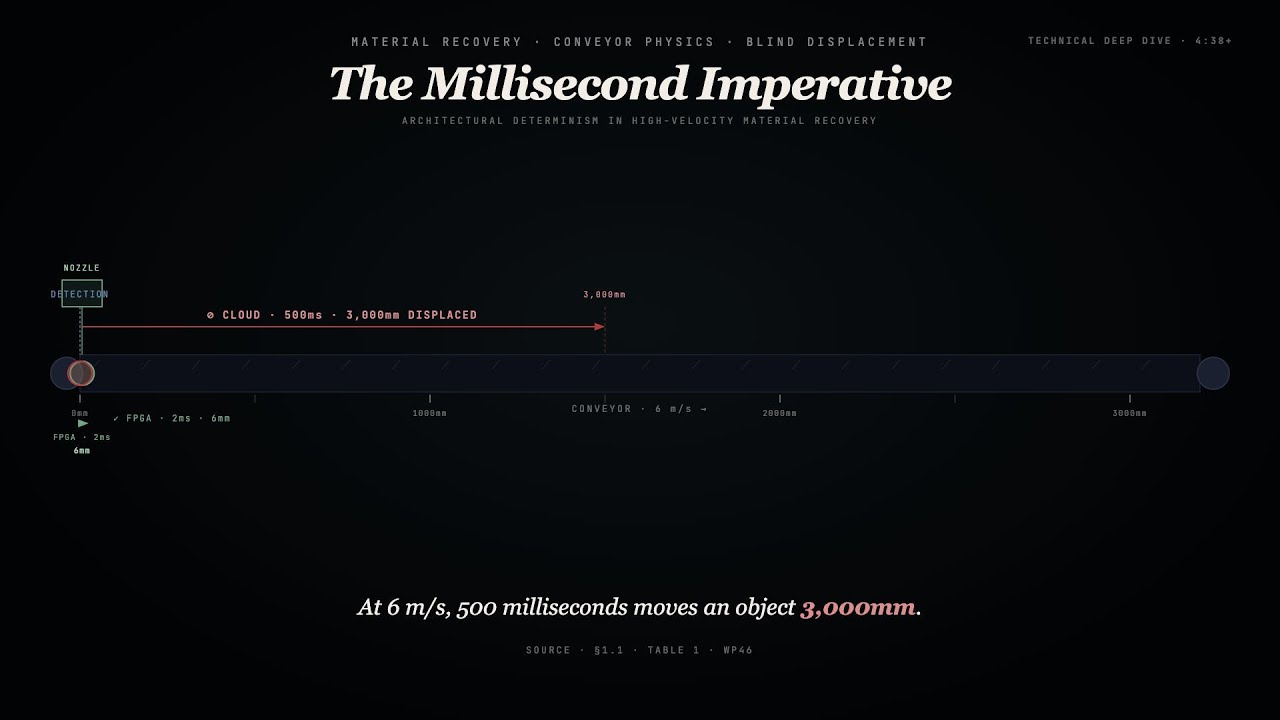
At conveyor speeds of 3-6 m/s, a 500ms cloud latency creates a 1.5 to 3.0 meter blind displacement—physically impossible to compensate for. This isn't a software optimization problem. It's a fundamental failure of physics.
Veriprajna engineers Quantized Edge Models on FPGAs achieving <2ms deterministic latency, enabling 300% throughput gains and restoring sub-millimeter ejection precision for industrial material recovery facilities.
Automated sorting efficacy is governed by an inviolable relationship between velocity, spatial resolution, and system latency.
500ms round-trip includes: image encode (20-50ms), transmission (50-200ms), queuing (10-50ms), GPU inference (50-200ms), return path (50-100ms). Non-deterministic jitter makes precise synchronization impossible.
Compensating for cloud lag requires extending conveyors by 1.5-3 meters, introducing tracking uncertainty from vibrations, aerodynamic lift, and collisions. Linear tracking cannot predict stochastic drift.
Dataflow architecture with streaming vision: inference begins as first pixel arrives. Deterministic hardware clocking eliminates jitter. Direct encoder synchronization enables sub-millimeter precision.
| Latency Source | Duration | Displacement @ 3m/s | Displacement @ 6m/s | Sorting Viability |
|---|---|---|---|---|
| FPGA Edge AI | 2 ms | 6 mm | 12 mm | ✓ Precision Ejection Possible |
| Local GPU (Unoptimized) | 50 ms | 150 mm | 300 mm | Requires Tracking/Compensation |
| 5G Edge Cloud | 20-50 ms | 60-150 mm | 120-300 mm | Marginal / High Jitter Risk |
| Cloud AI (Standard) | 500 ms | 1500 mm (1.5m) | 3000 mm (3.0m) | ✗ Catastrophic Failure |
Adjust belt speed and system latency to see how cloud AI creates an unbridgeable "blind window" where objects move beyond the detection zone before inference completes.
The red zone represents the "blind displacement" where the system has lost positional certainty.
FPGAs are not faster processors. They are reconfigurable hardware circuits that eliminate the Von Neumann bottleneck entirely.
Temporal Logic: Sequential fetch-decode-execute cycle. Hardware is fixed; software must adapt to rigid structure.
Spatial Logic: Algorithm is physically mapped onto silicon fabric. Data streams through dedicated hardware pipeline.
| Feature | GPU (Edge) | FPGA (Veriprajna) | Impact on Sorting |
|---|---|---|---|
| Execution Model | Control Flow (Instruction based) |
Dataflow (Circuit based) |
FPGAs eliminate instruction overhead |
| Latency | 15-50ms (Variable) |
<2ms (Deterministic) |
FPGA allows higher belt speeds |
| Jitter | High (OS/Driver dependent) |
Near Zero (<1 clock cycle) |
FPGA ensures precise ejection timing |
| Batching | Required (For efficiency) |
Batch Size = 1 (Streaming) |
FPGA enables item-by-item processing |
| Memory Access | External DRAM (High Latency) |
On-Chip BRAM/URAM (Low Latency) |
FPGA removes memory bottlenecks |
| Power Efficiency | Low (Watts/Op) |
High (Ops/Watt) |
FPGA reduces thermal management needs |
Deploying ResNet-50 scale models on FPGAs requires INT8/INT4 quantization with Quantization-Aware Training—achieving 99%+ accuracy retention while reducing memory by 8x.
32-bit floating point → 8-bit integers = 4x memory reduction. Single DSP slice performs two INT8 MAC operations per clock, doubling compute density.
4-bit integers for weight-heavy convolutional layers = 8x memory reduction. Entire model fits in on-chip BRAM/URAM, eliminating external DDR4 bottleneck.
Unlike post-training quantization (PTQ), QAT simulates quantization during training, allowing the network to learn robustness to reduced precision noise.
For waste sorting tasks (HDPE vs PET classification), macroscopic features (shape, opacity, texture) are highly resilient to quantization. INT8 models maintain 99%+ accuracy.
Even "Real-Time Linux" (PREEMPT_RT) introduces context switching, interrupt latency, and OS jitter. Veriprajna's architecture isolates critical inference from the operating system entirely.
Pure hardware logic. Handles vision pipeline, neural network inference, and valve control signals.
ARM Cortex-R5 runs bare-metal C++ or FreeRTOS. Manages configuration, state machines, safety interlocks.
ARM Cortex-A53 runs Linux. Handles non-critical tasks: logging, web UI, remote updates, cloud telemetry.
Critical Architectural Principle
The "Thinking" (FPGA) and "Acting" (RPU) paths are completely isolated from the "Reporting" (APU/Linux) path. Even if Linux crashes, the FPGA continues sorting at full speed.
The shift from Cloud to Edge FPGA is not merely a technical upgrade—it's a financial imperative. The "Millisecond Imperative" translates directly to the bottom line.
Model the economic impact of FPGA edge deployment for your facility
Scenario: Cloud AI limits belt speed to 2 m/s (5 TPH/meter). FPGA enables 6 m/s (15 TPH/meter) = 300% increase without expanding footprint.
Streaming HD video to cloud incurs massive bandwidth costs + API fees (per inference/hour). For 24/7 facility with dozens of sorters: $100K-$500K annually.
Quantized FPGA: 10-20W per video stream. Industrial GPU setup: 100-200W for similar (but higher latency) performance.
Reduced latency = reduced spatial error. Precise ejection prevents contaminants, increases recovery rates by 1-2%. Reduces landfill tipping fees.
The AI landscape is flooded with consultancies wrapping OpenAI or Anthropic APIs. They operate at the Application Layer (Layer 7), disconnected from physical reality.
Veriprajna operates at the Physical Layer (Layer 1) and Data Link Layer (Layer 2).
We don't just train models and hand them over. We design the entire inference pipeline: select FPGA silicon, write Verilog/VHDL/HLS, design quantization schemes, integrate sensor drivers.
Veriprajna develops proprietary Intellectual Property (IP) cores specifically for high-speed sorting applications.
In an era where "AI" is commoditized, speed and physicality remain the moats.
"Any developer can call an API to identify a bottle in a JPEG. Few can identify and eject that bottle moving at 6 meters per second, amidst chaotic trash, with 99% purity, 24 hours a day."
— Veriprajna Technical Whitepaper
Camera generates 3D data structure—every pixel contains spectral bands for chemical analysis.
PCA reduces dimensionality (99% variance). Separates base polymer from contamination.
INT8/INT4 convolutional network learns material signatures. 98%+ accuracy despite contamination.
Deterministic latency triggers pneumatic ejection at exact millisecond. Hardware synchronization.
At conveyor speeds of 3-6 m/s, cloud AI's 500ms round-trip latency creates a 1.5-3.0 meter blind displacement zone. Objects move beyond the ejection zone before inference completes, making precise sorting physically impossible regardless of model accuracy.
FPGAs use dataflow architecture where the neural network is physically mapped onto silicon fabric as a streaming hardware pipeline. Unlike GPUs that execute sequential fetch-decode-execute cycles, FPGAs process data as it arrives with zero instruction overhead, on-chip BRAM memory access in a single clock cycle, and hardware-clocked deterministic timing with near-zero jitter.
FPGA edge AI enables a 300% throughput increase, moving from 2 m/s cloud-limited belt speed to 6 m/s industrial speed. This translates to 15 TPH per meter of belt width versus 5 TPH cloud-limited, while consuming only 10-20W per video stream compared to 100-200W for GPU setups.
Veriprajna's FPGA edge solutions don't just improve latency—they fundamentally change the architecture to match the immutable laws of physics.
Schedule a technical consultation to discuss deterministic edge deployment for your industrial application.
Complete engineering specifications: FPGA architecture, quantization mathematics, dataflow design, bare-metal implementation, comparative benchmarks, extensive citations.