Navigating Liability and Technical Rigor in the Era of Deep AI Recruitment
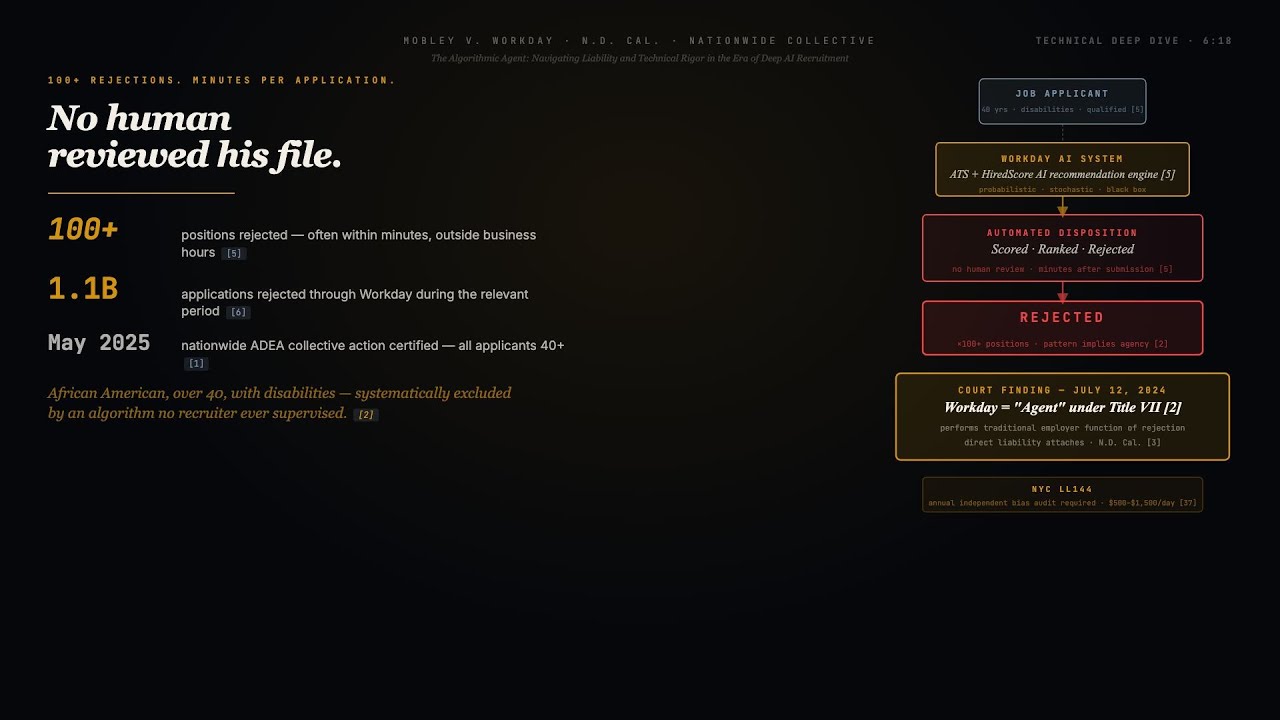
The certification of a nationwide collective action in Mobley v. Workday signals the end of the "black box" era. AI vendors now face direct liability as agents under federal anti-discrimination law.
Veriprajna's Neuro-Symbolic architecture replaces the probabilistic guesswork of LLM wrappers with deterministic verification, auditable logic, and constitutional guardrails built for the highest-stakes domain in enterprise AI.
The delegation of hiring functions to an automated system does not terminate the chain of liability—it extends it. Enterprises must transition from stochastic text generation to auditable, deterministic AI.
AI vendors performing screening, scoring, or rejection are now "agents" under Title VII, ADA, and ADEA. Your software contracts may not shield you from collective action.
If your AI recruitment tool cannot explain why a candidate was rejected, your company carries 100% of the legal and reputational risk.
LLM wrappers are structurally insufficient for regulated hiring. Probabilistic models hallucinate logic, lose context, and face inevitable moat absorption.
Mobley v. Workday, Inc. has fundamentally redefined the relationship between software providers, employers, and job applicants.
Judge Rita Lin of the Northern District of California denied Workday's motion to dismiss, ruling that AI vendors performing traditional employer functions—screening, scoring, rejecting candidates—qualify as agents under federal anti-discrimination statutes.
Workday argued it was merely a software vendor. The court drew a sharp distinction between passive tools and active algorithmic agents that exercise delegated decision authority.
"Because Workday's tools perform the traditional employer function of rejecting candidates or recommending those who should advance, Workday acts as an agent of its employer-customers."
— N.D. California, July 12, 2024
Disparate impact focuses on facially neutral policies that produce statistically significant negative outcomes for protected classes. The EEOC's Four-Fifths Rule is the primary benchmark.
If the selection rate for a protected group is less than 80% of the rate for the group with the highest selection rate, the procedure is regarded as having adverse impact. Employers are responsible even if the tool was designed by a third party.
Key Implication: Failure to adopt a "less discriminatory alternative" during model development leads to direct liability for both the employer and the agent vendor. Ignorance is not a defense.
Adjust values to see real-time Four-Fifths Rule analysis
An AI system may never use "age" as a parameter. But it learns to infer it with high accuracy through secondary data points embedded in every resume.
Legacy email providers like @aol.com or @hotmail.com correlate strongly with older demographic cohorts.
"15+ years experience" acts as a direct temporal anchor, strongly predicting age range above 40.
References to deprecated systems (Lotus Notes, COBOL, Visual Basic 6) encode generational technology experience.
Institutions that have been renamed, or graduation dates (even if later suppressed), reveal temporal markers.
Titles like "Junior Programmer" dated to the early 1990s signal career age with high precision.
When ML is trained on a company's "high performers" from a predominantly younger demographic, the algorithm treats these proxies as success indicators.
The system replicates and amplifies historical homogeneity—a self-reinforcing cycle of algorithmic exclusion.
The market is saturated with thin UI layers atop foundational models. Veriprajna rejects this approach as structurally flawed for regulated hiring due to the intrinsic nature of stochastic models.
Standard transformers exhibit high accuracy at the beginning and end of context windows but suffer a significant "attention trough" in the middle. In a 10-page resume, critical certifications located mid-document are statistically more likely to be overlooked.
When an LLM cannot find a specific qualification, it generates a "plausible" assumption based on surrounding text. This leads to inconsistent scoring across candidates—one may be credited with skills they don't have while another is penalized for omissions that don't exist.
As foundation model providers release more capable base models, they integrate the features wrappers rely on—resume parsing, sentiment analysis—as native capabilities. A company that merely wraps an API is training away its own competitive edge.
Lower values indicate lower risk. Veriprajna's architecture minimizes exposure across all dimensions.
We replace the "vibes" of generative text with the "physics" of deterministic verification. The LLM is not the decision-maker—it is the translator.
A specialized LLM identifies entities and intents within resumes and transcripts. "Candidate has 5 years of Python experience."
Intents are mapped to a structured Knowledge Graph defining relationships between skills, roles, and corporate standards.
A symbolic logic engine executes business rules against extracted data. The LLM cannot hallucinate policy—it is constrained by code.
Every recommendation generates a clear logic trail: which rule was triggered, by which data point, in which file.
Run before the prompt reaches core logic. Check for jailbreaks, PII exposure, and off-topic intents.
Manage conversation flow, enforcing the "happy path" and preventing drift into discriminatory or chaotic outputs.
Final defense: scan output for hallucinations, toxicity, or guideline violations before any data reaches a recruiter or candidate.
Compliance requires more than a checkbox audit. Veriprajna integrates bias-resilient pipelines into the model's core training and inference phases.
During training, a Predictor model maximizes accuracy while an Adversary model attempts to predict the protected variable (race, age) from the predictor's output. The predictor is penalized if the adversary succeeds, forcing the system to remove discriminatory patterns from its decision logic.
To ensure clients can defend their decisions in court, Veriprajna implements post-hoc explanation techniques that make every decision transparent and auditable.
Uses cooperative game theory to assign a contribution value to each feature.
Perturbs individual data points to create a local, interpretable model of the decision boundary.
Generates "What-If" scenarios to determine minimal changes required for a different outcome.
The Workday litigation proved that "ignorance is not a defense" in the algorithmic era. Organizations must implement a structured risk management model specifically tailored for AI.
Day-to-day management of AI risk through rigorous data selection and "blind hiring" techniques.
Policies, oversight, and approval gates for high-risk AI applications like hiring.
Independent verification by a third party not involved in development or use of the AEDT.
Typical enterprise exposure across key compliance dimensions. Veriprajna's architecture addresses all six pillars.
Enterprises are demanding to own their models and run them within their own infrastructure rather than relying on public API wrappers.
Proprietary hiring data must not train third-party base models. Enterprises need guarantees that candidate information remains within their virtual private clouds.
Models must be stable and auditable—not drifting or changing unpredictably due to external API updates. Version control and determinism are non-negotiable.
General-purpose LLMs lack the domain-specific Knowledge Graphs required for accurate technical and professional assessments. Sovereign models encode institutional knowledge.
"Veriprajna does not offer pass-through APIs. We offer Cognitive Architecture that encodes institutional knowledge, workflows, and deterministic logic into a system that uses AI as a powerful interface—not a fallible oracle."
— Veriprajna Technical Architecture
The certification of the Workday collective action is a definitive wake-up call. Hiring is no longer an administrative function—it is a high-risk technical domain.
Identify every algorithmic tool currently used to score, rank, or screen candidates. Determine if these tools "substantially assist" or "replace" human judgment—this is the threshold for agency liability.
Bring together HR, Legal, IT, and Security to define ownership and decision rights across the entire AI lifecycle—from vendor selection to model retirement.
If your AI vendor cannot explain why a candidate was rejected, or if they disclaim all liability for algorithmic bias, your company is carrying 100% of the risk.
Adopt architectures that separate linguistic processing from logical decision-making. Build systems that learn like neural networks but reason like logicians.
In July 2024, Judge Rita Lin of the Northern District of California ruled that AI vendors performing traditional employer functions — screening, scoring, and rejecting candidates — qualify as agents under federal anti-discrimination statutes including Title VII, ADA, and ADEA. The court drew a sharp distinction between passive software tools and active algorithmic agents that exercise delegated decision authority. In May 2025, a nationwide collective was certified for all applicants aged 40+ denied recommendations since September 2020, later expanded to include HiredScore AI. This means AI vendors can no longer disclaim liability through software contracts, and employers carry 100% of risk if their vendor cannot explain rejections.
AI hiring systems learn to infer protected characteristics with high accuracy through secondary data points embedded in resumes without ever using 'age' as a direct parameter. Email domain bias correlates @aol.com or @hotmail.com with older demographics. Experience thresholds like '15+ years' act as temporal anchors predicting age above 40. Legacy technology references (COBOL, Lotus Notes, Visual Basic 6) encode generational technology experience. Education context including renamed institutions or graduation dates reveal temporal markers. When ML is trained on a company's 'high performers' from a predominantly younger demographic, these proxies become self-reinforcing success indicators that amplify historical homogeneity.
Veriprajna replaces probabilistic guesswork with deterministic verification through a four-stage cognitive architecture: (1) Intent Extraction where a specialized LLM identifies entities and intents within resumes, (2) Ontological Grounding where intents are mapped to a structured Knowledge Graph defining relationships between skills, roles, and standards, (3) Rule Execution where a symbolic logic engine executes business rules against extracted data — the LLM cannot hallucinate policy because it is constrained by code, and (4) Auditable Logic Path where every recommendation generates a court-ready trail showing which rule was triggered by which data point. This is wrapped in three-layer constitutional guardrails: input rails for adversarial prompt detection and PII scrubbing, dialog rails for flow state enforcement, and output rails for hallucination detection and policy compliance verification.
The opportunity of AI in recruitment is real—widening talent pools and freeing recruiters for relationship building. But the cost of unverified automation is too high.
By embracing Deep AI and the physics of verification, your enterprise can harness AI while maintaining the highest standards of fairness, transparency, and legal compliance.
Complete analysis: Legal precedents, algorithmic exclusion mechanics, neuro-symbolic architecture, bias mitigation pipelines, XAI techniques, and enterprise risk management frameworks.