The Algorithmic Agent: Navigating Liability and Technical Rigor in the Era of Deep AI Recruitment
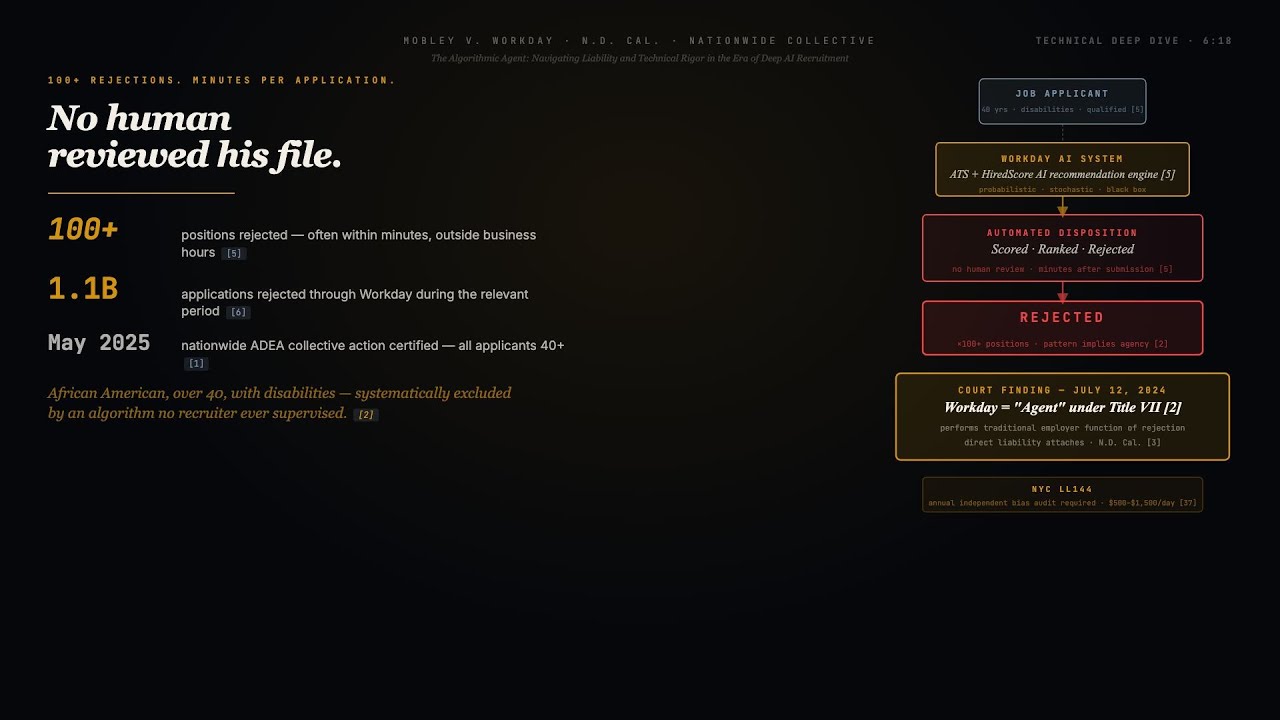
The global human capital management landscape has entered a period of unprecedented legal and technical volatility. The transition from manual recruitment to algorithmic selection, once viewed as a panacea for human bias and administrative inefficiency, has instead become a primary source of enterprise risk. At the center of this transformation is the landmark litigation in Mobley v. Workday, Inc., a case that has fundamentally redefined the relationship between software providers, employers, and job applicants. In May 2025, the certification of a nationwide collective action involving potentially millions of applicants over the age of 40 signals the end of the "black box" era of recruitment technology.1 For the modern enterprise, the challenge is no longer merely to automate, but to verify. The ruling that AI service providers can be held liable as "agents" under federal anti-discrimination laws—specifically Title VII, the ADA, and the ADEA—nullifies the historical defense that software vendors are neutral tool providers.2
Veriprajna posits that the current industry reliance on Large Language Model (LLM) "wrappers"—thin application layers that repackage the probabilistic outputs of third-party foundation models—is structurally insufficient for the demands of this new regulatory environment. As the court in Mobley observed, the delegation of traditional hiring functions to an automated system does not terminate the chain of liability; it extends it.4 The enterprise requires a transition from stochastic text generation to "Deep AI" solutions grounded in deterministic verification, semantic precision, and auditable logic. This whitepaper analyzes the legal precedents established by the Workday litigation, the technical mechanisms of algorithmic exclusion, and the cognitive architecture required to navigate the high-stakes domain of enterprise recruitment in 2025 and beyond.
The Jurisprudence of Algorithmic Agency: Analyzing Mobley v. Workday
The litigation initiated by Derek Mobley against Workday, Inc. represents a watershed moment in American employment law. Mobley, an African American man over the age of 40 with disabilities, alleged that he was rejected from more than 100 positions for which he was qualified, often within minutes of application and outside of business hours.5 The sheer volume and timing of these rejections provided the court with a plausible inference that Workday’s algorithmic screening tools were performing more than a passive clerical function.2
The July 2024 "Agent" Ruling
A pivotal development occurred on July 12, 2024, when Judge Rita Lin of the Northern District of California denied Workday’s motion to dismiss the disparate impact claims. The court’s reasoning centered on the "agent" theory of liability. Under federal anti-discrimination statutes, the definition of an "employer" includes "any agent" of such a person.2 Workday argued that it was merely a software vendor providing a platform for employers to implement their own criteria. However, the court drew a sharp distinction between Workday’s AI-powered recommendation system and "simple tools" like spreadsheets or email programs.3
| Feature | Simple Software (e.g., Spreadsheet) | Algorithmic Agent (e.g., Workday AI) |
|---|---|---|
| Function | Rote processing of user-defined filters. | Active scoring, ranking, and recommendation. |
| Decision Authority | None; remains entirely with the human user. | Delegated authority to "disposition" candidates. |
| Traditional Function | Clerical support. | Core hiring function (screening/rejection). |
| Liability Status | Not an agent under anti-discrimination laws. | Qualifies as an agent subject to Title VII/ADEA. |
| Mechanism | Deterministic sorting. | Probabilistic machine learning/AI models. |
| Reference | 3 | 2 |
The court concluded that because Workday’s tools perform the traditional employer function of rejecting candidates or recommending those who should advance, Workday acts as an agent of its employer-customers.2 This ruling establishes a precedent where AI vendors face direct liability for the discriminatory outcomes of their products, regardless of whether the employer intended to discriminate.8
Preliminary Collective Certification and the Scale of Impact
On May 16, 2025, the court granted preliminary certification of a nationwide collective action for Mobley’s age discrimination claim under the Age Discrimination in Employment Act (ADEA).1 This certification allows the plaintiff to notify all individuals aged 40 and older who were denied employment recommendations through the Workday platform since September 24, 2020.1 The scale of this collective is statistically staggering; Workday’s own filings indicated that approximately 1.1 billion applications were rejected through its software during the relevant period.6
The court further expanded the scope on July 7, 2025, ruling that the collective includes applicants whose files were processed using HiredScore AI features—a technology Workday acquired that integrates AI-driven human resources tools.5 This underscores the "moat absorption" phenomenon where enterprise platforms integrate diverse AI modules, thereby consolidating and scaling algorithmic risk across millions of touchpoints.5
The Mechanics of Exclusion: Disparate Impact and Technical Proxies
The central legal theory in the Workday litigation is "disparate impact." Unlike disparate treatment, which requires proof of discriminatory intent, disparate impact focuses on facially neutral policies that result in statistically significant negative outcomes for protected classes.9 In the context of AI, this often arises from "biased training data"—historical hiring records that reflect the conscious or unconscious prejudices of past human recruiters.16
The Four-Fifths Rule as a Regulatory Standard
The Equal Employment Opportunity Commission (EEOC) and the courts utilize the "Four-Fifths Rule" as a primary benchmark for determining adverse impact.19 This rule of thumb provides that if the selection rate for a protected group is less than 80% (four-fifths) of the rate for the group with the highest selection rate, the selection procedure is regarded as having an adverse impact.19
The Selection Rate ( ) is defined as:
The Impact Ratio ( ) is calculated as:
| Group | Applied | Selected | Selection Rate (SR) | Impact Ratio (IR) | Adverse Impact? |
|---|---|---|---|---|---|
| White Applicants | 100 | 60 | 60% | 1.00 | No (Reference) |
| Black Applicants | 80 | 24 | 30% | 0.50 | Yes (IR < 0.80) |
| Applicants >40 | 120 | 36 | 30% | 0.50 | Yes (IR < 0.80) |
| Applicants <40 | 150 | 90 | 60% | 1.00 | No |
| Reference | 20 | 20 | 20 | 20 | 19 |
The EEOC guidance issued in May 2023 clarifies that employers are responsible for the results of algorithmic tools, even if the tool was designed or administered by a third party.19 Failure to adopt a "less discriminatory alternative" during the model development process can lead to direct liability for both the employer and the "agent" vendor.19
The Technical Evolution of Ageism: Proxy Variables
One of the most insidious aspects of algorithmic bias is the use of "proxy variables"—neutral features that are highly correlated with protected characteristics.18 In age discrimination cases, an Applicant Tracking System (ATS) or AI recommender may not explicitly use "age" as a parameter, but it can infer it with high accuracy through secondary data points.28
The system learns to identify candidates over 40 through specific patterns in their resumes:
● Email Domain Bias: The use of legacy providers (e.g., @aol.com, @hotmail.com) as opposed to modern or custom domains.28
● Experience Thresholds: Aggregating total years of experience, where "15+ years" acts as a direct temporal anchor for age range.28
● Legacy Technology References: Listing expertise in deprecated software or systems (e.g., Lotus Notes, COBOL).28
● Career Progression Markers: Identifying titles like "Junior Programmer" from the early 1990s.28
● Education Context: Mentioning institutions that have since been renamed or listing graduation dates (even if later suppressed).28
When a machine learning model is trained on a company's "high performers," and those performers are predominantly from a younger demographic, the algorithm treats these proxies as success indicators.17 This creates a "feedback loop" where the system replicates and amplifies historical homogeneity.18
The Failure of the LLM Wrapper in High-Stakes Environments
The current market is saturated with "LLM Wrappers"—software consultancies that offer recruitment "solutions" consisting of thin UI layers atop foundational models like GPT-4 or Claude.12 Veriprajna rejects this approach as fundamentally flawed for enterprise recruitment due to the intrinsic nature of stochastic models.12
Stochasticity vs. Determinism
An LLM is a probabilistic engine designed to predict the "most likely next token" based on its training distribution; it is not a logical solver.12 In recruitment, this leads to several critical failure modes:
● Lost-in-the-Middle Syndrome: Standard transformers exhibit high accuracy at the beginning and end of context windows but suffer a significant "attention trough" in the middle.29 In a 10-page resume, critical certifications or recent accomplishments located in the middle are statistically more likely to be overlooked by the model.29
● Hallucinated Logic: When an LLM cannot find a specific qualification, it often generates a "plausible" assumption based on the surrounding text, leading to inconsistent scoring across candidates.29
● Syntactic Success vs. Semantic Correctness: An LLM can generate a perfectly phrased rejection email that cites a reason entirely inconsistent with the candidate's actual data.29
Moat Absorption and the Death of the Pass-Through
The "Wrapper" business model faces an existential economic threat from "moat absorption".12 As foundation model providers (OpenAI, Anthropic, Google) release more capable base models, they inevitably integrate the very features—like resume parsing or basic sentiment analysis—that wrappers rely on as their primary value proposition.12 A company that merely "wraps" an API is effectively training away its own edge, as its interactions are often used by the model provider to fine-tune the next generation of base models.12
| Dimension | LLM Wrapper Approach | Veriprajna Deep AI Approach |
|---|---|---|
| Architectural Depth | Horizontal, thin, fragile. | Vertical, thick, robust. |
| Logic Foundation | Probabilistic (Stochastic). | Deterministic (Rule-Based). |
| Safety Mechanism | Fragile "System Prompts." | Constitutional Guardrails. |
| Context Management | Subject to "Lost in Middle." | GraphRAG/Structured Context. |
| Regulatory Standing | High risk of "Agent" liability. | Auditable, Explainable Compliance. |
| Reference | 12 | 12 |
The Veriprajna Solution: Neuro-Symbolic Cognitive Architecture
To solve the crisis of algorithmic exclusion, Veriprajna advocates for a fundamental shift in how recruitment data is processed. We replace the "vibes" of generative text with the "physics" of deterministic verification.32 Our solution is built on a "Neuro-Symbolic" architecture—a system that combines the linguistic capabilities of neural networks with the logical rigor of symbolic reasoning.12
Graph-First Reasoning and Intent Extraction
In our architecture, the LLM is not the decision-maker; it is the translator.33 The workflow utilizes a "Compound AI System" that decomposes the recruitment task into specialized components 33:
1. Intent Extraction: A specialized LLM identifies entities and intents within a resume or interview transcript (e.g., "Candidate has 5 years of Python experience").33
2. Ontological Grounding: These intents are mapped to a structured "Knowledge Graph" that defines the relationship between skills, roles, and corporate standards.29
3. Deterministic Rule Execution: A symbolic logic engine executes business rules against the extracted data (e.g., IF Experience >= 5 AND Skill == Python THEN ELIGIBLE = TRUE). The LLM cannot "hallucinate" the policy because it is strictly constrained by the code-based rule engine.33
4. Auditable Logic Path: Every recommendation generates a clear "logic trail" that shows exactly which rule was triggered and by what specific data point in the candidate's file.9
This approach addresses the "lost in the middle" problem by using GraphRAG (Retrieval-Augmented Generation) to fetch structural dependencies rather than relying on the LLM’s fallible attention mechanism.29
Constitutional Guardrails and Sovereign Infrastructure
Safety in high-stakes recruitment cannot be probabilistic; it must be architectural.33 Veriprajna deploys "Compound AI Systems" secured by "Constitutional Guardrails" organized into three distinct categories 33:
● Input Rails: These run before the prompt reaches the core logic, checking for "jailbreaks," PII (Personally Identifiable Information), and off-topic intents.33 We utilize models trained on thousands of adversarial prompts to catch injection techniques like "DAN" (Do Anything Now).33
● Dialog Rails: These manage the conversation flow, enforcing a "happy path" and preventing users from steering the AI into chaotic or discriminatory "chaos mode".33
● Output Rails: These serve as the final line of defense, scanning the system's output for hallucinations, toxicity, or violations of corporate guidelines before the data is presented to a recruiter or candidate.33
Advanced Bias Mitigation: Beyond Periodic Audits
Compliance with the new standards established by NYC Local Law 144 and the Workday ruling requires more than a checkbox audit. It requires "bias-resilient" pipelines integrated into the model’s core training and inference phases.11
Adversarial Debiasing and Fairness Constraints
Veriprajna utilizes "Adversarial Debiasing" during model training.39 This in-processing technique involves training a "Predictor" model to maximize accuracy while simultaneously training an "Adversary" model to predict the protected variable (e.g., race or age) from the predictor’s output.39 The predictor is penalized if the adversary is successful, forcing the system to remove discriminatory patterns from its decision logic.39
We evaluate these models across three critical fairness dimensions:
● Demographic Parity: Ensuring the selection rate is uniform across demographic groups.39
● Equality of Odds: Ensuring the true positive and false positive rates are equal across groups.39
● Predictive Parity: Ensuring the precision (the meaning of a high score) is the same for all applicants.42
Explainable AI (XAI): SHAP and LIME
To ensure our clients can defend their decisions in court, we implement post-hoc explanation techniques like SHAP (SHapley Additive exPlanations) and LIME (Local Interpretable Model-agnostic Explanations).43
| Technique | Method | Enterprise Benefit |
|---|---|---|
| SHAP | Uses cooperative game theory to assign a contribution value to each feature (e.g., "Skill X" contributed +15 to the score). | Provides a global and local "feature importance" map for every decision.45 |
| LIME | Perturbs individual data points to create a local, interpretable model of the decision boundary. | Identifies if a slight change (e.g., changing zip code) would have flipped the decision.44 |
| Counterfactuals | Generates "What-If" scenarios to determine the minimal changes required for a different outcome. | Allows HR teams to explain exactly why a candidate was rejected and how they could improve.44 |
| Reference | 43 | 44 |
Enterprise Risk Management: The Three Lines of Defense
The Workday litigation has proven that "ignorance is not a defense" in the algorithmic era.4 Organizations must implement a "three lines of defense" model specifically tailored for AI risk management.49
Line 1: Business Units and Development
The first line of defense is responsible for day-to-day management of AI risk.49 This involves the rigorous selection of training data and "blind hiring" techniques that anonymize candidate details such as names, gender, and graduation years.38 Veriprajna's "Cognitive Architecture" supports this by decoupling the data parsing from the decision logic.29
Line 2: Risk and Compliance Oversight
The second line establishes the policies, oversight, and "approval gates".49 For high-risk applications like hiring, this line requires:
● Model Registries: A central inventory of every AI model in use, its purpose, the data it consumes, and its associated risk tier.49
● Impact Assessments: Continuous monitoring of selection rates and impact ratios to detect "model drift" before it triggers a legal violation.38
● Vendor Vetting: Conducting "deep-dive" assessments of third-party AI providers, including demanding documentation of their bias testing methodologies and validation studies.19
Line 3: Internal and Independent Audit
The third line provides independent verification of the effectiveness of the first two lines.49 This includes the mandatory annual bias audits required under New York City Local Law 144.52 These audits must be conducted by an independent third party who was not involved in the development or use of the AEDT.52
Failure to perform these audits leads to significant financial and reputational penalties. In NYC, penalties range from $500 for the first offense to $1,500 per subsequent violation per day.37 However, as the Workday case demonstrates, the true cost is the "visibility" risk—the moment a company’s name appears on a court-ordered list of AI users that is sent to millions of potentially aggrieved applicants.48
Future Outlook: The Transition to Sovereign AI
The legal fallout from Mobley v. Workday is just the beginning of a broader movement toward "Sovereign AI".12 Enterprises are increasingly demanding to own their models and run them within their own virtual private clouds (VPCs) rather than relying on public API wrappers.12 This shift is driven by three primary factors:
1. Data Sovereignty: The need to ensure that proprietary hiring data is not used to train the base models of third-party providers.12
2. Liability Control: The requirement for stable, auditable models that do not "drift" or change unpredictably due to external API updates.29
3. Ontological Precision: The realization that general-purpose LLMs lack the domain-specific "Knowledge Graphs" required for accurate technical and professional assessments.29
Veriprajna is positioned at the vanguard of this transition. We do not offer pass-through APIs; we offer "Cognitive Architecture" that encodes institutional knowledge, workflows, and deterministic logic into a system that uses AI as a powerful interface, not a fallible oracle.12
Conclusion: Strategic Recommendations for Leadership
The certification of the Workday collective action in May 2025 is a definitive "wake-up call" for the enterprise.4 Hiring is no longer an administrative function; it is a high-risk technical domain. To mitigate legal exposure and optimize talent acquisition, leadership teams must take proactive steps:
● Audit Your AI Inventory Immediately: Identify every algorithmic tool currently used to score, rank, or screen candidates. Determine if these tools "substantially assist" or "replace" human judgment, as this is the threshold for agency liability.37
● Establish a Cross-Functional AI Governance Council: Bring together HR, Legal, IT, and Security to define ownership and decision rights across the AI lifecycle.49
● Demand Explainability from Vendors: If your AI vendor cannot explain why a candidate was rejected, or if they disclaim all liability for algorithmic bias, your company is carrying 100% of the risk.15
● Transition to Neuro-Symbolic Systems: Adopt architectures that separate linguistic processing from logical decision-making. Future-proof your infrastructure for the AGI era by building systems that "learn like neural networks but reason like logicians".12
The opportunity of AI in recruitment is real and exciting, offering the potential to widen talent pools and free recruiters for relationship building.61 However, the cost of "unverified automation" is too high. By embracing "Deep AI" and the physics of verification, the modern enterprise can harness the power of artificial intelligence while maintaining the highest standards of fairness, transparency, and legal compliance.32
Works cited
Federal Court Allows Collective Action Lawsuit Over Alleged AI Hiring Bias | Insights, accessed February 6, 2026, https://www.hklaw.com/en/insights/publications/2025/05/federal-court-allows-collective-action-lawsuit-over-alleged
California District Court Rules That Software Vendor Is Subject to Title VII, the ADA, the ADEA | Epstein Becker Green - Workforce Bulletin, accessed February 6, 2026, https://www.workforcebulletin.com/california-district-court-rules-that-software-vendor-is-subject-to-title-vii-the-ada-the-adea
Mobley v. Workday: Court Holds AI Service Providers Could Be Directly Liable for Employment Discrimination Under “Agent” Theory - Seyfarth Shaw, accessed February 6, 2026, https://www.seyfarth.com/news-insights/mobley-v-workday-court-holds-ai-service-providers-could-be-directly-liable-for-employment-discrimination-under-agent-theory.html
AI “Agency” Liability: The Workday Wake-Up Call? - Nelson Mullins, accessed February 6, 2026, https://www.nelsonmullins.com/insights/blogs/ai-task-force/all/ai-agency-liability-the-workday-wake-up-call
Case: Mobley v. Workday, Inc., accessed February 6, 2026, https://clearinghouse.net/case/44074/
California Court Grants Preliminary Collective Certification to Job Applicants Claiming Age Discrimination by Artificial Intelligence | Labor and Employment Law Insights, accessed February 6, 2026, https://www.laborandemploymentlawinsights.com/2025/07/california-court-grants-preliminary-collective-certification-to-job-applicants-claiming-age-discrimination-by-artificial-intelligence/
Job Applicant's Algorithmic Bias Discrimination Lawsuit Survives Motion to Dismiss, accessed February 6, 2026, https://www.proskauer.com/blog/job-applicants-algorithmic-bias-discrimination-lawsuit-survives-motion-to-dismiss
California Court Finds that HR Vendors Using Artificial Intelligence Can Be Liable for Discrimination Claims from Their Customers' Job Applicants | Labor and Employment Law Insights, accessed February 6, 2026, https://www.laborandemploymentlawinsights.com/2024/08/california-court-finds-that-hr-vendors-using-artificial-intelligence-can-be-liable-for-discrimination-claims-from-their-customers-job-applicants/
Courts Tackle AI-Driven Discrimination: Legal Challenges and Judicial Responses - Attorneys.Media, accessed February 6, 2026, https://attorneys.media/courts-addressing-ai-discrimination-cases/
AI Bias Lawsuit Against Workday Reaches Next Stage as Court Grants Conditional Certification of ADEA Claim | Law and the Workplace, accessed February 6, 2026, https://www.lawandtheworkplace.com/2025/06/ai-bias-lawsuit-against-workday-reaches-next-stage-as-court-grants-conditional-certification-of-adea-claim/
Workday AI Lawsuit Explained: Implications for HR - OutSolve, accessed February 6, 2026, https://www.outsolve.com/blog/workday-ai-lawsuit-explained-implications-for-hr
The Cognitive Enterprise: Neuro-Symbolic Truth vs. Stochastic Probability - Veriprajna, accessed February 6, 2026, https://veriprajna.com/technical-whitepapers/cognitive-enterprise-neuro-symbolic-truth
Federal Court Grants Preliminary Certification in Landmark AI Hiring Bias Case, accessed February 6, 2026, https://www.callaborlaw.com/entry/federal-court-grants-preliminary-certification-in-landmark-ai-hiring-bias-case
EEOC's Latest AI Guidance Sends Warning to Employers: 5 Things You Need to Know, accessed February 6, 2026, https://www.fisherphillips.com/en/news-insights/eeocs-latest-ai-guidance-sends-warning.html
AI Hiring Discrimination Lawsuits | Learn & Work Ecosystem Library, accessed February 6, 2026, https://learnworkecosystemlibrary.com/topics/ai-hiring-discrimination-lawsuits/
The Class Action Implications of AI-Driven Decisions | Secretariat - JDSupra, accessed February 6, 2026, https://www.jdsupra.com/legalnews/the-class-action-implications-of-ai-7130532/
Navigating AI Bias in Recruitment: Mitigation Strategies for Fair and Transparent Hiring, accessed February 6, 2026, https://www.hackerearth.com/blog/navigating-ai-bias-in-recruitment-mitigation-strategies-for-fair-and-transparent-hiring
AI and Bias in Recruitment: Ensuring Fairness in Algorithmic Hiring. - Journal of Informatics Education and Research, accessed February 6, 2026, https://jier.org/index.php/journal/article/download/3262/2632/5894
EEOC Issues Guidance for Use of AI in Employment Selection Procedures - Tucker Ellis LLP, accessed February 6, 2026, https://www.tuckerellis.com/alerts/eeoc-issues-guidance-for-use-of-ai-in-employment-selection-procedures/
EEOC Issues Nonbinding Guidance on Permissible Employer Use of Artificial Intelligence to Avoid Adverse Impact Liability Under Title VII - K&L Gates, accessed February 6, 2026, https://www.klgates.com/EEOC-Issues-Nonbinding-Guidance-on-Permissible-Employer-Use-of-Artificial-Intelligence-to-Avoid-Adverse-Impact-Liability-Under-Title-VII-5-31-2023
EEOC Issues Technical Assistance Guidance On The Use Of Advanced Technology Tools, Including Artificial Intelligence - Seyfarth Shaw, accessed February 6, 2026, https://www.seyfarth.com/news-insights/eeoc-issues-technical-assistance-guidance-on-the-use-of-advanced-technology-tools-including-artificial-intelligence.html
“AI” in Employment Law: EEOC Issues Title VII Guidance | Paul Hastings LLP, accessed February 6, 2026, https://www.paulhastings.com/insights/client-alerts/ai-in-employment-law-eeoc-issues-title-vii-guidance
The EEOC Issues New Guidance on Use of Artificial Intelligence in Hiring - Bricker Graydon, accessed February 6, 2026, https://www.brickergraydon.com/insights/publications/The-EEOC-Issues-New-Guidance-on-Use-of-Artificial-Intelligence-in-Hiring
accessed February 6, 2026, https://www.gdldlaw.com/blog/ai-in-hiring-hidden-compliance-risks-for-employers#:~:text=The%20EEOC's%20May%202023%20guidance,deployed%20by%20third%2Dparty%20vendors.
AI in the Workplace Part 1: Avoiding Title VII Discrimination Liability | Cadogan Law, accessed February 6, 2026, https://www.cadoganlaw.com/blog/2024/september/ai-in-the-workplace-part-1-avoiding-title-vii-di/
EEOC Issues Title VII Guidance on Employer Use of AI, Other Algorithmic Decision-Making Tools | Insights | Mayer Brown, accessed February 6, 2026, https://www.mayerbrown.com/en/insights/publications/2023/07/eeoc-issues-title-vii-guidance-on-employer-use-of-ai-other-algorithmic-decisionmaking-tools
On Explaining Proxy Discrimination and Unfairness in Individual Decisions Made by AI Systems - arXiv, accessed February 6, 2026, https://arxiv.org/html/2509.25662v1
Ageism: Proxy Bias & AI - 3Plus International, accessed February 6, 2026, https://3plusinternational.com/ageism-proxy-bias-ai/
The Architecture of Understanding: Beyond Syntax in Enterprise Legacy Modernization | Veriprajna, accessed February 6, 2026, https://veriprajna.com/whitepapers/architecture-of-understanding-legacy-modernization-knowledge-graphs
Artificial Intelligence in the Workplace, accessed February 6, 2026, https://www.fordharrison.com/webfiles/Oct_%202025%20Memphis%20Lunch%20&%20Learn%20-%20AI%20Updates.pdf
Algorithmic Bias in AI Employment Decisions, accessed February 6, 2026, https://jtip.law.northwestern.edu/2025/01/30/algorithmic-bias-in-ai-employment-decisions/
The Physics of Verification: Human Motion as Auditable Assets - Veriprajna, accessed February 6, 2026, https://veriprajna.com/technical-whitepapers/human-motion-verification-temporal-convolutional-networks
The Sycophancy Trap: Constitutional Immunity for Enterprise AI - Veriprajna, accessed February 6, 2026, https://veriprajna.com/technical-whitepapers/enterprise-ai-sycophancy-governance
NLU vs LLM: Breaking Down Their Core Capabilities - Codewave, accessed February 6, 2026, https://codewave.com/insights/nlu-vs-llm-comparison/
Enterprise AI: An Analysis of Compound Architectures and Multi-Agent Systems, accessed February 6, 2026, https://ajithp.com/2025/11/03/compound-ai-enterprise-adoption-planners-protocols/
Neuro-Symbolic AI for Clinical Trial Recruitment - Veriprajna, accessed February 6, 2026, https://veriprajna.com/technical-whitepapers/clinical-trial-recruitment-neuro-symbolic-ai
NYC Local Law 144-21 and Algorithmic Bias | Deloitte US, accessed February 6, 2026, https://www.deloitte.com/us/en/services/audit-assurance/articles/nyc-local-law-144-algorithmic-bias.html
AI Recruitment in 2025: How to Reduce Bias and Build Fair, Transparent Hiring Systems, accessed February 6, 2026, https://www.jobspikr.com/report/reducing-bias-in-ai-recruitment-strategies/
Adversarial Debiasing — holisticai documentation, accessed February 6, 2026, https://holisticai.readthedocs.io/en/latest/getting_started/bias/mitigation/inprocessing/bc_adversarial_debiasing_adversarial_debiasing.html
Algorithmic Fairness in Recruitment: Designing AI-Powered Hiring Tools to Identify and Reduce Biases in Candidate Selection - Path of Science, accessed February 6, 2026, https://pathofscience.org/index.php/ps/article/download/3471/1690
A Comprehensive Review and Benchmarking of Fairness-Aware Variants of Machine Learning Models - MDPI, accessed February 6, 2026, https://www.mdpi.com/1999-4893/18/7/435
Fairness-aware machine learning engineering: how far are we? - PMC, accessed February 6, 2026, https://pmc.ncbi.nlm.nih.gov/articles/PMC10673752/
Explainable artificial intelligence in the talent recruitment process-a literature review, accessed February 6, 2026, https://www.tandfonline.com/doi/full/10.1080/23311975.2025.2570881
Ethics of AI: Balancing Responsibility With Innovation - Texas Wesleyan University, accessed February 6, 2026, https://txwes.edu/blog/ethics-of-ai-balancing-responsibility-with-innovation/
AI Bias in Recruitment: Metrics for Detection - X0PA AI, accessed February 6, 2026, https://x0pa.com/blog/ai-bias-in-recruitment-metrics-for-detection/
Comparing Explainable AI Models: SHAP, LIME, and Their Role in Electric Field Strength Prediction over Urban Areas - MDPI, accessed February 6, 2026, https://www.mdpi.com/2079-9292/14/23/4766
How to Understand Bias in AI Hiring Tools - Resumly, accessed February 6, 2026, https://www.resumly.ai/blog/how-to-understand-bias-in-ai-hiring-tools
The Workday Lawsuit Just Changed Everything: Why Your Hiring Process Needs an Urgent Audit - SocialTalent, accessed February 6, 2026, https://www.socialtalent.com/blog/technology/workday-lawsuit-ai-hiring-audit
Enterprise AI Risk Management: Frameworks & Use Cases - Superblocks, accessed February 6, 2026, https://www.superblocks.com/blog/enterprise-ai-risk-management
A Comprehensive Strategy to Bias and Mitigation in Human Resource Decision Systems - CEUR-WS.org, accessed February 6, 2026, https://ceur-ws.org/Vol-3839/paper1.pdf
Executive Guide to Enterprise AI Governance and Risk Management - Appinventiv, accessed February 6, 2026, https://appinventiv.com/guide/ai-governance-risk-management/
How to Comply with the NYC Bias Audit Law in 2026: A Comprehensive Guide for Employers, accessed February 6, 2026, https://www.nycbiasaudit.com/blog/how-to-comply-with-the-nyc-bias-audit-law
AI in enterprise risk management: A governance guide - Diligent, accessed February 6, 2026, https://www.diligent.com/resources/blog/ai-in-enterprise-risk-management
Discrimination Lawsuit Over Workday's AI Hiring Tools Can Proceed as Class Action: 6 Things Employers Should Do After Latest Court Decision | Fisher Phillips, accessed February 6, 2026, https://www.fisherphillips.com/en/news-insights/discrimination-lawsuit-over-workdays-ai-hiring-tools-can-proceed-as-class-action-6-things.html
AI in Hiring: Hidden Compliance Risks for Employers - Goodell DeVries, accessed February 6, 2026, https://www.gdldlaw.com/blog/ai-in-hiring-hidden-compliance-risks-for-employers
NYC Bias Audit Law: A Comprehensive Guide, accessed February 6, 2026, https://www.nycbiasaudit.com/
NYC Local Law 144: Automated Employment Decision Tools Compliance Guide - Fairly AI, accessed February 6, 2026, https://www.fairly.ai/blog/how-to-comply-with-nyc-ll-144-in-2025
What is NYC's AI Bias Law and How Does It Impact Firms Using HR Automation?, accessed February 6, 2026, https://www.pivotpointsecurity.com/what-is-nycs-ai-bias-law-and-how-does-it-impact-firms-using-hr-automation/
AI Hiring Targeted by Class Action and Proposed Legislation - Foley & Lardner LLP, accessed February 6, 2026, https://www.foley.com/insights/publications/2025/10/ai-hiring-targeted-by-class-action-and-proposed-legislation/
Artificial Discrimination: AI Vendors May Be Liable for Hiring Bias in Their Tools - Clark Hill, accessed February 6, 2026, https://www.clarkhill.com/news-events/news/artificial-discrimination-ai-vendors-may-be-liable-for-hiring-bias-in-their-tools/
How AI Tools Are Changing Recruitment | BCG, accessed February 6, 2026, https://www.bcg.com/publications/2025/ai-changing-recruitment
Prefer a visual, interactive experience?
Explore the key findings, stats, and architecture of this paper in an interactive format with navigable sections and data visualizations.
Frequently Asked Questions
Why can AI vendors now be held liable as 'agents' in recruitment discrimination?
In Mobley v. Workday, the court ruled that AI recommendation systems perform traditional employer functions of rejecting and advancing candidates, distinguishing them from 'simple tools' like spreadsheets. Because Workday's AI actively scores, ranks, and disposes candidates, it qualifies as an agent under Title VII, ADA, and ADEA. This exposes AI vendors to direct discrimination liability regardless of employer intent.
How do proxy variables enable algorithmic age discrimination in hiring AI?
AI systems infer age through seemingly neutral resume features that correlate with protected characteristics. Email domains like @aol.com or @hotmail.com signal older demographics, references to deprecated technologies like COBOL or Lotus Notes act as temporal anchors, and experience thresholds above 15 years directly correlate with age. When trained on historically homogeneous high-performer data, these proxies create recursive bias loops.
How does neuro-symbolic architecture create auditable AI recruitment decisions?
In Veriprajna's architecture, the LLM serves as translator, not decision-maker. Intent extraction identifies resume entities, ontological grounding maps them to a Knowledge Graph, then deterministic rule execution evaluates candidates against hard-coded criteria. Every recommendation generates a clear logic trail showing which rule was triggered by which data point, enabling court-defensible explanations using SHAP and LIME attribution.
Also Published On
Build Your AI with Confidence.
Partner with a team that has deep experience in building the next generation of enterprise AI. Let us help you design, build, and deploy an AI strategy you can trust.
Veriprajna Deep Tech Consultancy specializes in building safety-critical AI systems for healthcare, finance, and regulatory domains. Our architectures are validated against established protocols with comprehensive compliance documentation.