Engineering Regulatory Truth in the Age of Algorithmic Accountability
The December 2025 audit by the New York State Comptroller exposed a 1,600% discrepancy between reported and actual AI compliance violations. Approximately 95% of employers are operating in regulatory delinquency. The Wrapper Economy is over.
This whitepaper details why probabilistic AI wrappers are a liability under emerging law, and architects the path toward Deep AI—systems built on determinism, auditability, and sovereign control.
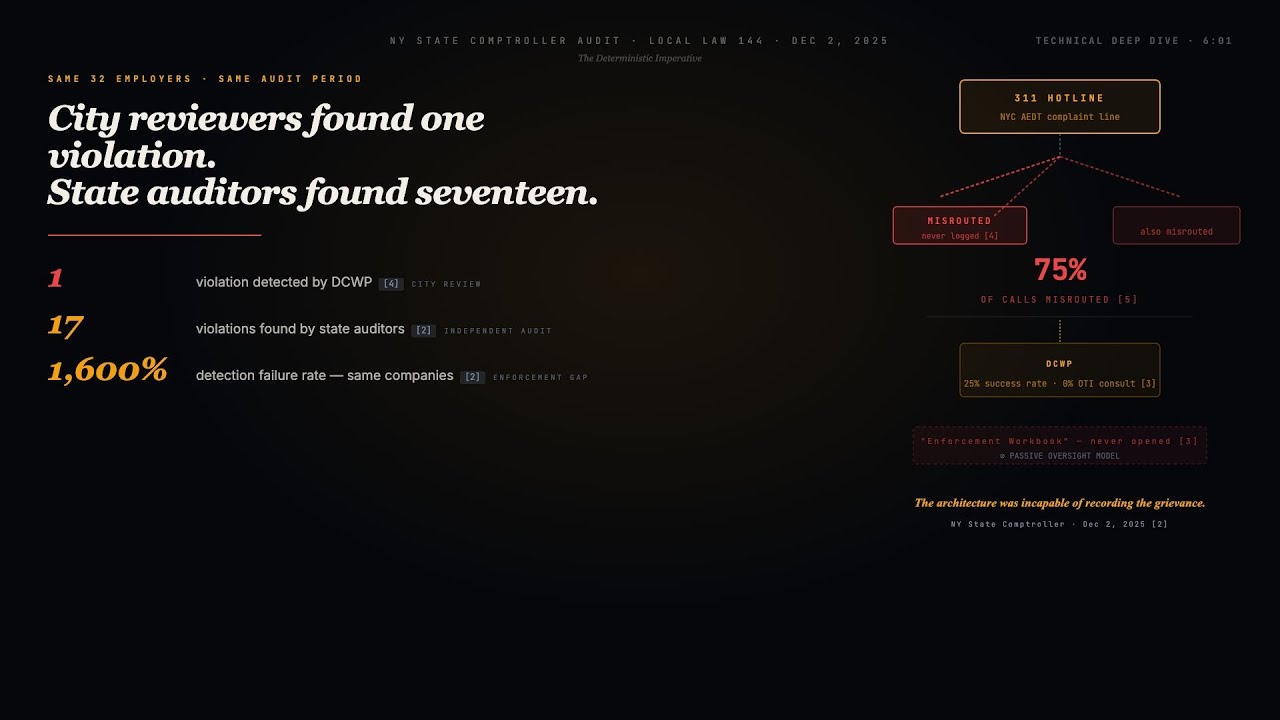
The December 2025 audit by the New York State Comptroller served as a definitive autopsy of "first-generation" AI regulation—and exposed a system that was architecturally incapable of enforcement.
The city's passive reviews identified 1 violation. State auditors using rigorous technical frameworks found 17 violations in the same dataset.
75% of test calls about AEDT issues were improperly routed and never reached the DCWP. The system was architecturally incapable of recording grievances.
DCWP officials admitted they lacked expertise to evaluate AEDT use and never consulted the NYC Office of Technology and Innovation when making determinations.
The Comptroller's recommendation—now adopted by DCWP—mandates proactive, research-driven enforcement. Regulators will no longer wait for complaints.
"This technical void allowed companies to use narrow interpretations of the law to avoid compliance—arguing their tools did not 'substantially assist' decision-making. The audit effectively closes this loophole."
— Veriprajna Analysis, 2026
A landmark study of 391 employers subject to NYC's jurisdiction reveals a marketplace paralyzed by the structural flaws of probabilistic AI.
Of 391 employers, only 18 published required bias audits and merely 13 posted transparency notices. This isn't negligence—it's an emergent behavior driven by the structural flaws of probabilistic AI.
Legal counsel advises that non-compliance is less risky than providing statistical evidence of bias that current probabilistic wrappers inevitably generate.
Impact Ratio < 0.80 (4/5ths rule) = "Smoking Gun" for plaintiffs
Because the law allows employers to self-determine if their tool "substantially assists" a decision, many have opted for "Null Compliance"—using a tool while claiming it falls outside the legal definition.
A wrapper treats every interaction as a sequence of tokens. While effective for marketing copy, it is fundamentally unsuited for the deterministic requirements of emerging law.
Standard AI wrappers operate on "semantic plausibility"—they generate what sounds correct. Deep AI operates on "forensic reality"—it outputs what is verifiably correct.
If an LLM is asked to evaluate a resume while "ignoring gender," it still discriminates based on latent correlations—college names, sports, phrasing styles—statistically linked to gender in training data.
Research shows LLMs exhibit "Exotic Bias"—favoring frequently mentioned but contextually inappropriate outcomes simply because they appear more often in training data.
Toggle the comparison to see the architectural difference between a Black Box wrapper and a Glass Box Deep AI system.
By mid-2026, the regulatory landscape shifts from a localized NYC issue to a global compliance challenge. These laws are not just overlapping—they are technically divergent.
A bias audit satisfying NYC's race/gender intersectional analysis may fail Colorado's "reasonable care" standard if it ignores age and disability. Data masking for Illinois' zip code ban may violate the EU AI Act's data "representativeness" requirements. No single probabilistic wrapper can reconcile these conflicts.
To survive this regulatory environment, the enterprise must transition from "Generative AI" (which guesses) to "Discriminative and Deterministic AI" (which measures).
Systems that decouple the "Voice" (neural pattern recognition) from the "Brain" (deterministic symbolic solvers). The neural layer identifies skills; the symbolic layer enforces hard-coded business rules and proxy prohibitions.
Deploying private enterprise LLMs on the client's own infrastructure. The "Bring Your Own Cloud" model ensures claim data, employee records, and proprietary logic never leave the secure perimeter.
While wrappers treat everything as text, many enterprise decisions are grounded in the physical world. For insurance, manufacturing, or healthcare, AI must understand physics, not just grammar.
If a regulator asks why a decision was made, the answer cannot be "because the model said so." Graph-based verification traces every decision to specific nodes in a Knowledge Graph.
Property Graph Indexing enables multi-hop queries with 100% accuracy, distinguishing directionality that vector similarity searches confuse.
Estimate your organization's risk profile based on AI usage, jurisdictional exposure, and current compliance posture.
Resume screeners, chatbots, assessment tools, scheduling, etc.
The December 2025 audit is not a sign that AI regulation has failed—it is a sign that it is becoming more sophisticated. Four stages of "Deep AI Transformation."
Maintain a comprehensive inventory classifying every tool by risk level, use case, and jurisdictional requirement. Align with NIST AI RMF or EU AI Act risk categories.
Bias mitigation cannot be an afterthought. Implement data balancing, adversarial hardening with GANs, and in-processing constraints via "Symbolic Residual" loss functions.
Deep AI operates in a loop: Plan (analyze AST/knowledge graph), Generate (constraint-decoded output), Verify (sandbox testing), Self-Correct (until physics residual = zero).
Move high-stakes AI off public APIs. Enable real-time fairness metric tracking that alerts the CRO the moment a model drifts toward a discriminatory threshold.
The "Enforcement Gap" identified in December 2025 is a clarifying moment. It proves that the Wrapper approach—based on probabilistic next-token prediction and passive compliance—is a liability, not an asset.
The fact that only 5% of employers currently meet their audit obligations is not a failure of law—it is a failure of architecture.
As we enter 2026, competitive advantage goes to those who treat AI as an engineering discipline, not a linguistic trick. Deep AI—built on neuro-symbolic logic, sovereign infrastructure, and physics-informed models—is the only way to meet the conflicting requirements of NYC, Colorado, Illinois, and the EU.
The December 2025 audit found a 1,600% discrepancy between reported and actual AI compliance violations. The city's passive reviews identified 1 violation while state auditors found 17 in the same 32-employer dataset. 75% of 311 hotline calls about AEDT issues were misrouted and never reached DCWP. Officials admitted they lacked technical expertise to evaluate AI tools. Of 391 employers studied, only 18 published required bias audits and merely 13 posted transparency notices, leaving approximately 95% in regulatory delinquency.
Wrappers operate on semantic plausibility, generating what sounds correct rather than what is verifiably correct. When asked to evaluate a resume while ignoring gender, LLMs still discriminate via latent correlations like college names and phrasing styles. They exhibit Exotic Bias favoring frequently mentioned but inappropriate outcomes. A bias audit satisfying NYC's intersectional analysis may fail Colorado's reasonable care standard if it ignores age. Data masking for Illinois' zip code ban may violate the EU AI Act's representativeness requirements. No single probabilistic wrapper can reconcile these conflicts.
Pillar 1: Neuro-Symbolic Cognitive Architectures that decouple the neural Voice from the symbolic Brain, with System 1 intuitive pattern matching and System 2 rigorous logical reasoning. Pillar 2: Sovereign Infrastructure deploying private SLMs on client infrastructure so PII never leaves the secure perimeter. Pillar 3: Physics-Informed Neural Networks grounding decisions in physical reality, not just text patterns. Pillar 4: Graph-Based Traceability using property graph indexing for 100% accurate multi-hop queries, tracing every decision to specific knowledge graph nodes.
Veriprajna provides the "Truth" (Veri) and "Wisdom" (Prajna) required for high-stakes enterprise AI.
For industries where a hallucination means a catastrophe—banking, healthcare, legal, defense—the path forward is clear.
Full technical analysis: Regulatory audit findings, wrapper architecture failures, neuro-symbolic design, sovereign deployment specifications, multi-jurisdictional compliance frameworks.