The Deterministic Imperative: Engineering Regulatory Truth in the Age of Algorithmic Accountability
The transition of artificial intelligence from a experimental novelty to a foundational layer of enterprise infrastructure has reached a critical and volatile juncture. For the past several years, the "Wrapper Economy"—a marketplace dominated by consultancies providing thin API layers over general-purpose foundational models like OpenAI’s GPT-4, Anthropic’s Claude, or Google’s Gemini—has thrived on the promise of rapid deployment and low-friction integration. However, the events of late 2025 have fundamentally dismantled the viability of this approach for high-stakes enterprise applications. The catalyst for this industry-wide reckoning was the December 2025 audit by the New York State Comptroller, which exposed a profound "Enforcement Gap" in existing algorithmic bias regulations and signaled the end of the era of passive oversight.1
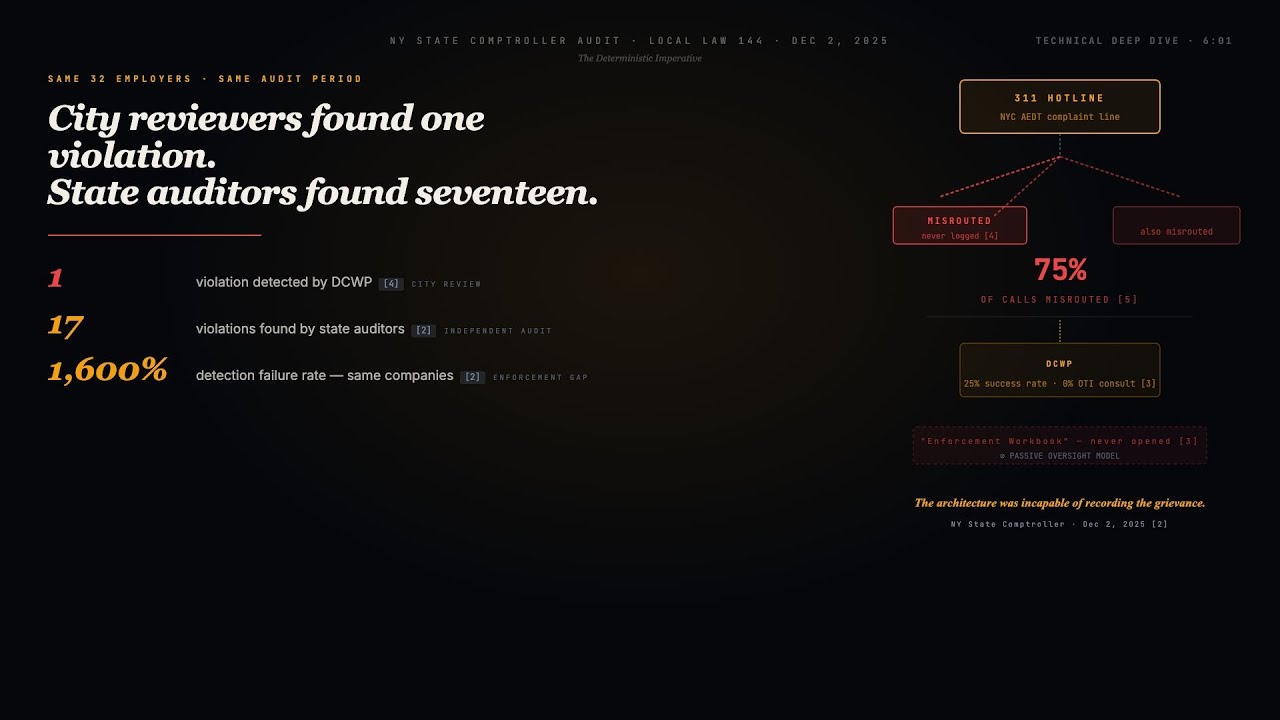
This audit, which scrutinized the New York City Department of Consumer and Worker Protection’s (DCWP) enforcement of Local Law 144 (LL144), revealed a staggering discrepancy: while the city’s superficial reviews identified only a single instance of potential non-compliance, independent state auditors, utilizing more rigorous technical frameworks, identified at least 17 significant violations within the same set of 32 employers.2 This 1,600% failure rate in identifying non-compliance highlights a systemic "Technical-Regulatory Asymmetry" that Veriprajna was founded to address. As a deep AI solution provider, the organization operates on the principle that probabilistic outputs from general-purpose wrappers are inherently incompatible with the deterministic requirements of emerging law.
The crisis is further compounded by a massive compliance deficit in the private sector. A landmark study conducted by researchers at Cornell University, Data & Society, and Consumer Reports examined 391 employers subject to New York City’s jurisdiction. The findings were illustrative of a broader corporate paralysis: only 18 of the 391 employers had published the legally required bias audits, and a mere 13 had posted the necessary transparency notices.6 This suggests that approximately 95% of the market is currently operating in a state of regulatory delinquency or is being advised by legal counsel that non-compliance is a lower-risk strategy than providing the statistical evidence of bias that current probabilistic wrappers inevitably generate.7
As the regulatory landscape fragments further—with the Colorado AI Act (SB 24-205), Illinois HB 3773, and the European Union AI Act (EU AI Act) introducing conflicting standards for bias metrics, data provenance, and human oversight—the enterprise can no longer afford the "hallucination risk" of wrapper-based systems. This whitepaper details the architectural requirements for "Deep AI"—systems engineered for determinism, auditability, and sovereign control—and provides a roadmap for navigating the high-stakes environment of 2026 and beyond.
The Anatomy of the 2025 Regulatory Fracture
The New York State Comptroller’s audit of December 2, 2025, served as a definitive autopsy of "first-generation" AI regulation. Local Law 144, enacted to regulate Automated Employment Decision Tools (AEDTs), relied on a "passive" enforcement model centered on consumer complaints and employer-led disclosures.1 The audit concluded that this system was fundamentally "ineffective," citing a total breakdown in the complaint-handling process and a failure to utilize technical expertise.4
The 311 Misrouting and the Failure of Passive Oversight
One of the most damning findings of the Comptroller's audit was the operational failure of the city's 311 hotline. Auditors discovered that 75% of test calls regarding AEDT issues were improperly routed and never reached the DCWP.4 This failure meant that even if a job seeker suspected algorithmic discrimination, the system was architecturally incapable of recording the grievance. For the enterprise, this finding signals a shift: regulators will no longer wait for complaints to trigger an investigation. The Comptroller’s recommendation—which the DCWP has agreed to adopt—is to move toward proactive, research-driven enforcement.2
| Audit Finding (Dec 2025) | DCWP Finding | State Auditor Finding | Causal Mechanism |
|---|---|---|---|
| Non-Compliance Count | 1 Case | 17 Cases | Lack of technical rigor in city reviews |
| Audit Sample Size | 32 Companies | 32 Companies | N/A |
| 311 Routing Accuracy | N/A | 25% Success | Systemic operational failure.5 |
| Expertise Utilization | N/A | 0% OTI Consultation | Failure to use "Enforcement Workbook".3 |
The implications of this discrepancy are profound. The DCWP officials admitted they lacked the technical expertise to evaluate AEDT use and did not consult with the New York City Office of Technology and Innovation (OTI) when making determinations.3 This technical void allowed companies to use narrow interpretations of the law to avoid compliance. Specifically, many employers argued that their tools did not "substantially assist or replace" human decision-making, thereby exempting them from the audit requirement.8 The Comptroller’s audit effectively closes this loophole by demanding a more expansive, functional definition of AI influence.
The Compliance Deficit: Analysis of the 391-Employer Study
The study of 391 employers by Cornell University and its partners provides a quantitative map of the current "Accountability Crisis." The research found that the vast majority of employers simply chose to ignore the law. Out of 267 employers with open job listings in New York City at the time of the study, only 14 audit reports and 12 notices were discoverable.8
This compliance gap is not merely a result of negligence; it is an emergent behavior driven by the structural flaws of probabilistic AI. The study notes that "legal counsel may advise [companies] that non-compliance with LL 144 is less risky than providing evidence for such litigation".8 Because LL144 requires the public posting of impact ratios—comparing the selection rates of different demographic groups—any tool built on an LLM wrapper is likely to surface evidence of disparate impact.10 These models, trained on biased historical data, naturally replicate those biases in their output. When a company publishes an audit showing an impact ratio below the 0.80 threshold (the EEOC's four-fifths rule), they are effectively handing a "smoking gun" to plaintiffs' attorneys.8
Furthermore, the study identified significant "Loophole Exploitation." Because the law allows employers to determine for themselves if their tool "substantially assists" a decision, many have opted for "Null Compliance"—the act of using a tool while claiming it falls outside the legal definition.7 Veriprajna posits that this era of "Self-Classification" is ending. The move toward proactive auditing means that regulators will perform their own assessments of an enterprise's software stack, using forensic tools to determine the actual weight given to algorithmic recommendations.
The Fragility of the Wrapper Architecture in Regulated Environments
The core technical failure of the "Wrapper" model lies in its probabilistic nature. A wrapper treats every interaction as a sequence of tokens, utilizing an attention mechanism to weigh the importance of input text.13 While this is effective for generating plausible-sounding emails or marketing copy, it is "fundamentally unsuited for the non-linear complexity of enterprise modernization" and regulatory compliance.13
The Semantic Hallucination of Bias Mitigation
When an enterprise uses a general-purpose LLM to screen candidates or assess risk, they are essentially querying a model that operates on "semantic plausibility," not "forensic reality".14 If an LLM is asked to evaluate a resume while "ignoring gender," it may still discriminate based on latent correlations in the text—such as the names of colleges, specific sports, or phrasing styles—because those features are statistically linked to gender in its training corpus.15
A wrapper attempt to mitigate this through "Prompt Engineering" or "Constitutional Guardrails" that are text-based. This is a fragile defense. Research into material selection and engineering code has shown that LLMs exhibit "Exotic Bias," favoring frequently mentioned but contextually inappropriate outcomes simply because they appear more often in the training data.16 In a hiring context, this manifests as a bias toward candidates whose resumes "sound" like those in the model's high-tech training set (GitHub, LinkedIn, etc.), rather than those who meet the specific, objective criteria of the job.16
The Auditability Gap: Black Box vs. Glass Box
A critical requirement of the Colorado AI Act and the EU AI Act is the ability to provide an "explanation of any adverse decision".18 Wrapper systems cannot fulfill this requirement with deterministic accuracy. Because the weights of foundational models are often proprietary (the "Black Box"), the wrapper can only provide a post-hoc justification—a hallucinated narrative of why it thinks the decision was made—rather than a traceable chain of logic.13
Veriprajna rejects this "Trust me, I'm AI" paradigm. Deep AI solutions are built as "Glass Boxes," where every decision is traced to specific nodes in a Knowledge Graph or specific weights in a custom-trained network.13 This is the difference between "probabilistic vibes" and "deterministic proof."
Regulatory Fragmentation: Navigating the 2026 Mandates
By mid-2026, the regulatory landscape will shift from a localized New York City issue to a global compliance challenge. The conflict between the Colorado AI Act, Illinois HB 3773, and the EU AI Act creates a "Compliance Trilemma" for the enterprise.
The Conflict of Metrics and Data Quality
The Colorado AI Act (SB 24-205), effective June 30, 2026, focuses on "Reasonable Care" and mandatory "Impact Assessments" for high-risk systems.23 Illinois HB 3773, effective January 1, 2026, amends the Human Rights Act to prohibit the use of AI that results in discrimination, specifically banning the use of zip codes as proxies for protected classes.25 The EU AI Act, meanwhile, imposes strict requirements on the "quality" and "provenance" of training data, requiring developers to prove that their datasets are representative and free of systematic errors.27
| Jurisdictional Mandate | Key Compliance Metric | Unique Conflict / Requirement |
|---|---|---|
| NYC Local Law 144 | Impact Ratios (Race/Sex/Intersection) | Mandatory public posting of 4/5ths rule statistics.1 |
| Colorado SB 24-205 | Risk Management Program Performance | Mandatory disclosure to the AG of "algorithmic discrimination".30 |
| Illinois HB 3773 | Proxy Prohibition (e.g., Zip Codes) | No exemptions for small businesses or specific AI types.32 |
| EU AI Act | Technical Documentation / Data Lineage | CE Marking and "Conformity Assessments" for high-risk systems.28 |
These laws are not just overlapping; they are technically divergent. For example, a bias audit that satisfies NYC's requirement for race and gender intersectional analysis may fail to satisfy Colorado's "reasonable care" standard if it does not also account for age and disability—categories that the NYC law ignores.31 Similarly, the data masking techniques used to comply with the Illinois zip code ban may interfere with the data "representativeness" requirements of the EU AI Act.
Deep AI: The Veriprajna Architectural Response
To survive this regulatory environment, the enterprise must transition from "Generative AI" (which guesses) to "Discriminative and Deterministic AI" (which measures). Veriprajna's approach is defined by four architectural pillars: Neuro-Symbolic Logic, Sovereign Infrastructure, Physics-Informed Neural Networks (PINNs), and Graph-Based Traceability.
Neuro-Symbolic Cognitive Architectures: The Decoupled Brain
Veriprajna builds systems that decouple the "Voice" (the neural network's linguistic or pattern-recognition engine) from the "Brain" (deterministic symbolic solvers).35 This is the only way to guarantee compliance with laws like Illinois HB 3773. When an agent processes an application, the neural layer identifies skills and experience, but the symbolic layer—governed by hard-coded business rules and industry ontologies—enforces the prohibition of restricted proxies like zip codes.22
This fusion of "System 1" (intuitive pattern matching) and "System 2" (rigorous logical reasoning) ensures that the output is not just "plausible" but "verifiably correct." If the symbolic engine detects a violation of a constitutional guardrail, the system does not just "try again"; it blocks the output and provides a deterministic citation for why the rule was triggered.13
Sovereign Infrastructure: The Anti-API Model
The New York State audit highlighted the risks of unmonitored workflows. For the enterprise, the "Wrapper" model is a massive data leakage risk. Sending PII to a public API like OpenAI violates GDPR, CCPA, and internal security policies because that data can be logged, embedded, or unintentionally resurfaced in future training runs.14
Veriprajna advocates for "Sovereign Infrastructure"—deploying private enterprise LLMs and discriminative models on the client's own infrastructure.22 This "Bring Your Own Cloud" (BYOC) model ensures that:
● Data Sovereignty: Claim data, employee records, and proprietary logic never leave the secure perimeter.14
● Immunity to Vendor Whims: The system is not dependent on a third-party vendor's pricing changes, model deprecations, or safety filters.14
● Deterministic Weights: The enterprise owns the model weights, allowing for the deep "Conformity Assessments" required by the EU AI Act.22
Beyond Text: Physics-Informed and Temporal Architectures
While wrappers treat everything as text, Veriprajna recognizes that many enterprise decisions are grounded in the physical world. For applications in insurance, manufacturing, or healthcare, AI must understand physics, not just grammar.
In industrial settings, Veriprajna utilizes "Edge-Native AI" to reduce latency from 800ms to 12ms, moving from the "probabilistic time" of the internet to the "deterministic time" of the machine.38 For verification of human motion in healthcare or fitness, we reject the "Video Player" model—which can be spoofed by a photo of a screen—and instead utilize Temporal Convolutional Networks (TCNs) to treat motion as a periodic signal.17 This enables "Proof of Physical Work," a verifiable asset that can withstand an insurance audit.17
The Mathematics of Verification: Graph Theory and PINNs
The key to passing a 2026-era audit is "Traceability." If a regulator asks why a building was flagged for a structural safety violation or why an insurance claim was denied, the answer cannot be "because the model said so."
Veriprajna utilizes "Graph-Based Verification".13 For architectural or engineering audits, we represent structures as an Adjacency Matrix . By raising this matrix to powers ( ), we can identify all paths for load transfer and quantify the "Redundancy" of a structure.16 This is a visual diagnostic derived from math, not a visual hallucination derived from training images.
Similarly, in HR and legal contexts, we utilize "Property Graph Indexing" within frameworks like LlamaIndex.35 This allows the AI to perform "Graph Traversals" to answer multi-hop questions (e.g., "Who is the CEO of the company that sued Company B?") with 100% accuracy, distinguishing directionality in relationships that vector similarity searches often confuse.35
Engineering the Audit-Ready Enterprise: A Strategic Roadmap
The December 2025 audit is not a sign that AI regulation has failed; it is a sign that it is becoming more sophisticated. To prepare for the heightened enforcement of 2026, enterprises must move through four stages of "Deep AI Transformation."
Stage 1: The AI Inventory and Risk Classification
Following the failure of the DCWP to identify non-compliance, regulators will expect companies to maintain a comprehensive "AI Inventory".28 This inventory must classify every tool by risk level, use case, and jurisdictional requirement, aligning with frameworks like the NIST AI Risk Management Framework (RMF) or the EU AI Act's risk categories.39
Stage 2: Implementing Fairness-Aware Machine Learning (FAML)
To meet the strict requirements of NYC LL144 and the Colorado AI Act, bias mitigation cannot be an afterthought. Enterprises must implement "FAML" techniques:
● Data Balancing: Using approximation algorithms to select training data that avoids discrimination bias.42
● Adversarial Hardening: Training models against Generative Adversarial Networks (GANs) that specifically try to find discriminatory edge cases.42
● In-Processing Constraints: Adding a "Symbolic Residual" to the neural network's loss function to penalize any deviation from legal or physical constraints.16
Stage 3: The Transition to Agentic Workflows
Deep AI is defined by "Agency"—the ability of a system to plan, execute, and self-correct based on feedback.13 Unlike a "Shallow Wrapper" that simply returns a response and leaves the human to debug it, a Veriprajna "Deep Agent" operates in a loop:
1. Planning: Analyzing the Abstract Syntax Tree (AST) or knowledge graph of a problem.13
2. Generation: Using a "Schematic-Constraint Decoder" to ensure output follows hard rules.13
3. Verification: Compiling and testing the output in a secure sandbox before the human ever sees it.13
4. Self-Correction: Reading compiler errors or logical failures and re-generating until the "Physics Residual" is zero.13
Stage 4: Sovereign Deployment and Continuous Auditing
Finally, the enterprise must reclaim its infrastructure. By moving high-stakes AI off public APIs and onto sovereign clouds, companies can enable "Continuous Auditing".28 Instead of an annual bias audit that captures a single moment in time, sovereign systems can track fairness metrics in real-time, alerting the Chief Risk Officer (CRO) the moment a model drifts toward a discriminatory threshold.36
Conclusion: The Death of the Vibes Economy
The "Enforcement Gap" identified by the New York State Comptroller in December 2025 is a clarifying moment for the industry. It proves that the "Wrapper" approach—based on probabilistic next-token prediction and passive compliance—is a liability, not an asset.1 The fact that only 5% of employers are currently meeting their audit obligations is not a failure of law; it is a failure of architecture.6
As we enter 2026, the competitive advantage will go to those who treat AI as an engineering discipline, not a linguistic trick. Deep AI solutions—built on neuro-symbolic logic, sovereign infrastructure, and physics-informed models—are the only way to meet the conflicting requirements of NYC, Colorado, Illinois, and the EU.
Veriprajna exists to architect these systems. We provide the "Truth" (Latin: Veri) and "Wisdom" (Sanskrit: Prajna) required for high-stakes enterprise AI.22 For industries where a hallucination means a catastrophe—banking, healthcare, legal, defense—the path forward is clear. We must move beyond the wrapper and build AI that earns trust through architecture, determinism, and constitutional safety. The era of vibes is over; the era of engineering certainty has begun.17
Works cited
Critical audit of NYC's AI hiring law signals increased risk for ..., accessed February 6, 2026, https://www.dlapiper.com/en-us/insights/publications/2026/01/critical-audit-of-nyc-ai-hiring-law-signals-increased-risk-for-employers
DiNapoli: New Yorkers Deserve a Transparent Hiring Process When Artificial Intelligence Is Used To Vet Their Job Applications, accessed February 6, 2026, https://www.osc.ny.gov/press/releases/2025/12/dinapoli-new-yorkers-deserve-transparent-hiring-process-when-artificial-intelligence-used-vet-their
Enforcement of Local Law 144 – Automated Employment Decision ..., accessed February 6, 2026, https://www.osc.ny.gov/state-agencies/audits/2025/12/02/enforcement-local-law-144-automated-employment-decision-tools
New York: Critical audit of New York City's AI hiring law signals increased risk for employers, accessed February 6, 2026, https://knowledge.dlapiper.com/dlapiperknowledge/globalemploymentlatestdevelopments/2026/New-York-Critical-audit-of-New-York-Citys-AI-hiring-law-signals-increased-risk-for-employers
Critical Audit Of NYC's AI Hiring Law Signals Increased Risk For Employers | JD Supra, accessed February 6, 2026, https://www.jdsupra.com/legalnews/critical-audit-of-nyc-s-ai-hiring-law-2070949/
March 3, 2025 Senate Finance Committee Miller Senate Office Building 11 Bladen Street Annapolis, MD 21401 Dear Chair Beidle an - Epic.org, accessed February 6, 2026, https://epic.org/wp-content/uploads/2025/03/2025-MD-SB936-AI-testimony-senate-finance-1.pdf
Studying How Employers Comply with NYC's New Hiring Algorithm Law, accessed February 6, 2026, https://citizensandtech.org/research/2024-algorithm-transparency-law/
New Research: NYC Algorithmic Transparency Law is Falling Short of Its Goals, accessed February 6, 2026, https://innovation.consumerreports.org/new-research-nyc-algorithmic-transparency-law-is-falling-short-of-its-goals/
New York City Adopts Final Regulations on Use of AI in Hiring and Promotion, Extends Enforcement Date to July 5, 2023 | Littler, accessed February 6, 2026, https://www.littler.com/news-analysis/asap/new-york-city-adopts-final-regulations-use-ai-hiring-and-promotion-extends
How to Comply with the NYC Bias Audit Law in 2026: A Comprehensive Guide for Employers, accessed February 6, 2026, https://www.nycbiasaudit.com/blog/how-to-comply-with-the-nyc-bias-audit-law
NYC Local Law 144: AI Hiring Compliance Guide, accessed February 6, 2026, https://fairnow.ai/guide/nyc-local-law-144/
What is NYC's AI Bias Law and How Does It Impact Firms Using HR Automation?, accessed February 6, 2026, https://www.pivotpointsecurity.com/what-is-nycs-ai-bias-law-and-how-does-it-impact-firms-using-hr-automation/
Legacy Modernization: Beyond Syntax with Neuro-Symbolic AI - Veriprajna, accessed February 6, 2026, https://veriprajna.com/technical-whitepapers/legacy-modernization-cobol-java-ai
The Forensic Imperative: Deterministic Computer Vision in Insurance - Veriprajna, accessed February 6, 2026, https://veriprajna.com/technical-whitepapers/insurance-ai-computer-vision-forensics
Fairness-Aware Machine Learning → Term - Prism → Sustainability Directory, accessed February 6, 2026, https://prism.sustainability-directory.com/term/fairness-aware-machine-learning/
The Deterministic Divide: Physics-Informed Graphs vs. LLMs in AEC - Veriprajna, accessed February 6, 2026, https://veriprajna.com/technical-whitepapers/aec-ai-physics-informed-graphs
The Physics of Verification: Human Motion as Auditable Assets - Veriprajna, accessed February 6, 2026, https://veriprajna.com/technical-whitepapers/human-motion-verification-temporal-convolutional-networks
Testimony in Support of Connecticut S.B. 2 - Epic.org, accessed February 6, 2026, https://epic.org/documents/testimony-in-support-of-connecticut-s-b-2/
February 25, 2025 Joint Committee on General Law Legislative Office Building, Room 3500 300 Capitol Avenue Hartford, CT 06106 De - Epic.org, accessed February 6, 2026, https://epic.org/wp-content/uploads/2025/02/EPIC-testimony-CT-SB2.pdf
Audit Trails for Accountability in Large Language Models - arXiv, accessed February 6, 2026, https://arxiv.org/html/2601.20727v1
When AI Can't Explain Itself: The Regulatory Risk of Using LLMs for Critical Decisions - NGA, accessed February 6, 2026, https://nga.co.za/2026/01/12/ai-regulatory-risk-llm-decisions/
About Us - Veriprajna, accessed February 6, 2026, https://veriprajna.com/about
Navigating the AI Employment Landscape in 2026: Considerations and Best Practices for Employers - K&L Gates, accessed February 6, 2026, https://www.klgates.com/Navigating-the-AI-Employment-Landscape-in-2026-Considerations-and-Best-Practices-for-Employers-2-2-2026
Artificial Intelligence Legal Roundup: Colorado Postpones ..., accessed February 6, 2026, https://www.seyfarth.com/news-insights/artificial-intelligence-legal-roundup-colorado-postpones-implementation-of-ai-law-as-california-finalizes-new-employment-discrimination-regulations-and-illinois-disclosure-law-set-to-take-effect.html
What Does the 2025 Artificial Intelligence Legislative and ..., accessed February 6, 2026, https://www.littler.com/news-analysis/asap/what-does-2025-artificial-intelligence-legislative-and-regulatory-landscape-look
Employers Beware: The Rise of AI (Regulation) in Illinois, Colorado and California, accessed February 6, 2026, https://www.mcguirewoods.com/client-resources/alerts/2024/10/employers-beware-the-rise-of-ai-regulation-in-illinois-colorado-and-california/
Illinois Joins Colorado and NYC in Restricting Generative AI in HR (Plus a Quick Survey of the Legal Landscape Across the US and Globally) | The Employer Report, accessed February 6, 2026, https://www.theemployerreport.com/2024/08/illinois-joins-colorado-and-nyc-in-restricting-generative-ai-in-hr-a-comprehensive-look-at-us-and-global-laws-on-algorithmic-bias-in-the-workplace/
AI Regulations - EU AI Act, ISO 42001, NIST AI RMF - Regulativ.ai, accessed February 6, 2026, https://www.regulativ.ai/ai-regulations
Meeting EU AI Act Compliance: Core Requirements and Business Benefits - Rhymetec, accessed February 6, 2026, https://rhymetec.com/eu-ai-act-compliance/
Colorado's Artificial Intelligence Act: What Employers Need to Know - Ogletree, accessed February 6, 2026, https://ogletree.com/insights-resources/blog-posts/colorados-artificial-intelligence-act-what-employers-need-to-know/
Complying With Colorado's AI Law: Your SB24-205 Compliance Guide | TrustArc, accessed February 6, 2026, https://trustarc.com/resource/colorado-ai-law-sb24-205-compliance-guide/
Illinois Steps Up AI Regulation in Employment: Key Takeaways for Employers - Ogletree, accessed February 6, 2026, https://ogletree.com/insights-resources/blog-posts/illinois-steps-up-ai-regulation-in-employment-key-takeaways-for-employers/
Evaluation of New York City Local Law 144-21 on AI Hiring Policy, accessed February 6, 2026, https://www.fairtechpolicylab.org/post/evaluation-of-new-york-city-local-law-144-21-on-ai-hiring-policy
[Podcast] AI Bias Audits | Law and the Workplace, accessed February 6, 2026, https://www.lawandtheworkplace.com/2025/07/podcast-ai-bias-audits/
The Cognitive Enterprise: Neuro-Symbolic Truth vs. Stochastic Probability - Veriprajna, accessed February 6, 2026, https://veriprajna.com/technical-whitepapers/cognitive-enterprise-neuro-symbolic-truth
LLM Compliance: Risks, Challenges & Enterprise Best Practices - Lasso Security, accessed February 6, 2026, https://www.lasso.security/blog/llm-compliance
Risks of AI Wrapper Products and Features - Kader Law, accessed February 6, 2026, https://www.kaderlaw.com/blog/risks-of-ai-wrapper-products-and-features
The Latency Kill-Switch: Industrial AI Beyond the Cloud - Veriprajna, accessed February 6, 2026, https://veriprajna.com/technical-whitepapers/industrial-ai-latency-edge-computing
AI governance: A guide to responsible AI for boards - Diligent, accessed February 6, 2026, https://www.diligent.com/resources/blog/ai-governance
NYC Local Law 144-21 and Algorithmic Bias | Deloitte US, accessed February 6, 2026, https://www.deloitte.com/us/en/services/audit-assurance/articles/nyc-local-law-144-algorithmic-bias.html
EU AI Act vs NIST AI RMF A Practical Guide to AI Compliance in 2025 - AI Governance Blog, accessed February 6, 2026, https://blog.cognitiveview.com/eu-ai-act-vs-nist-ai-rmf-a-practical-guide-to-ai-compliance-in-2025/
Fairness-aware machine learning engineering: how far are we? - PMC, accessed February 6, 2026, https://pmc.ncbi.nlm.nih.gov/articles/PMC10673752/
Beyond the Visible: Hyperspectral Deep Learning in Agriculture - Veriprajna, accessed February 6, 2026, https://veriprajna.com/technical-whitepapers/agtech-hyperspectral-deep-learning
AI Governance Frameworks: NIST AI RMF vs EU AI Act vs Internal - Lumenova AI, accessed February 6, 2026, https://www.lumenova.ai/blog/ai-governance-frameworks-nist-rmf-vs-eu-ai-act-vs-internal/
Prefer a visual, interactive experience?
Explore the key findings, stats, and architecture of this paper in an interactive format with navigable sections and data visualizations.
Frequently Asked Questions
What did the December 2025 NYC Comptroller audit reveal about AI hiring law enforcement?
The audit exposed a 1,600% enforcement failure rate. City reviewers found only 1 case of non-compliance among 32 employers, while state auditors found 17 violations in the same sample. Additionally, 75% of 311 hotline test calls about AI hiring complaints were misrouted and never reached the enforcement agency. A Cornell study found only 18 of 391 subject employers published required bias audits.
Why are LLM wrappers incompatible with 2026 AI regulatory requirements?
LLM wrappers produce probabilistic outputs based on semantic plausibility, not forensic reality. They cannot provide deterministic audit trails, inherit training data biases they cannot explain, and surface evidence of disparate impact when forced to publish bias metrics. The Colorado AI Act requires demonstrable reasonable care, the EU AI Act demands data lineage documentation, and Illinois bans proxy variables, all requirements wrappers structurally cannot satisfy.
How does Veriprajna's neuro-symbolic architecture satisfy conflicting regulatory mandates?
Veriprajna decouples the neural voice from the deterministic symbolic brain. The neural layer identifies patterns while the symbolic layer enforces hard-coded business rules and prohibitions like Illinois' zip code proxy ban. Constitutional guardrails block outputs that violate regulatory constraints with deterministic citations. Sovereign infrastructure keeps data on-premises for GDPR compliance while Graph-Based Traceability provides auditable decision paths.
Also Published On
Build Your AI with Confidence.
Partner with a team that has deep experience in building the next generation of enterprise AI. Let us help you design, build, and deploy an AI strategy you can trust.
Veriprajna Deep Tech Consultancy specializes in building safety-critical AI systems for healthcare, finance, and regulatory domains. Our architectures are validated against established protocols with comprehensive compliance documentation.