AlgoTier · Algorithmic trading controls
Why two trading orders need approval and two stay allowed.
A synthetic market shock changes the response from slowing every order to holding only the affected instruments for review. We follow the signals, the rules and the four orders that explain that change.
Explore the screenshot walkthrough ↓Full walkthrough · 8 min 19 sec · Recorded from the actual demo
12 observations
A fixed synthetic market-shock replay
06:10 to 06:30 ET in the scenario
4 sample orders
TECHX, EMFX, UTIL and GOLD
Simulated dispositions, with no exchange execution
1 decision to reconstruct
Scope, signals, policy and audit evidence
The worked example is the 06:18 GATE
All market values, times and orders below belong to the synthetic scenario. The screenshots show the same application used in the video.
The review problem
A control label leaves the affected orders unexplained.
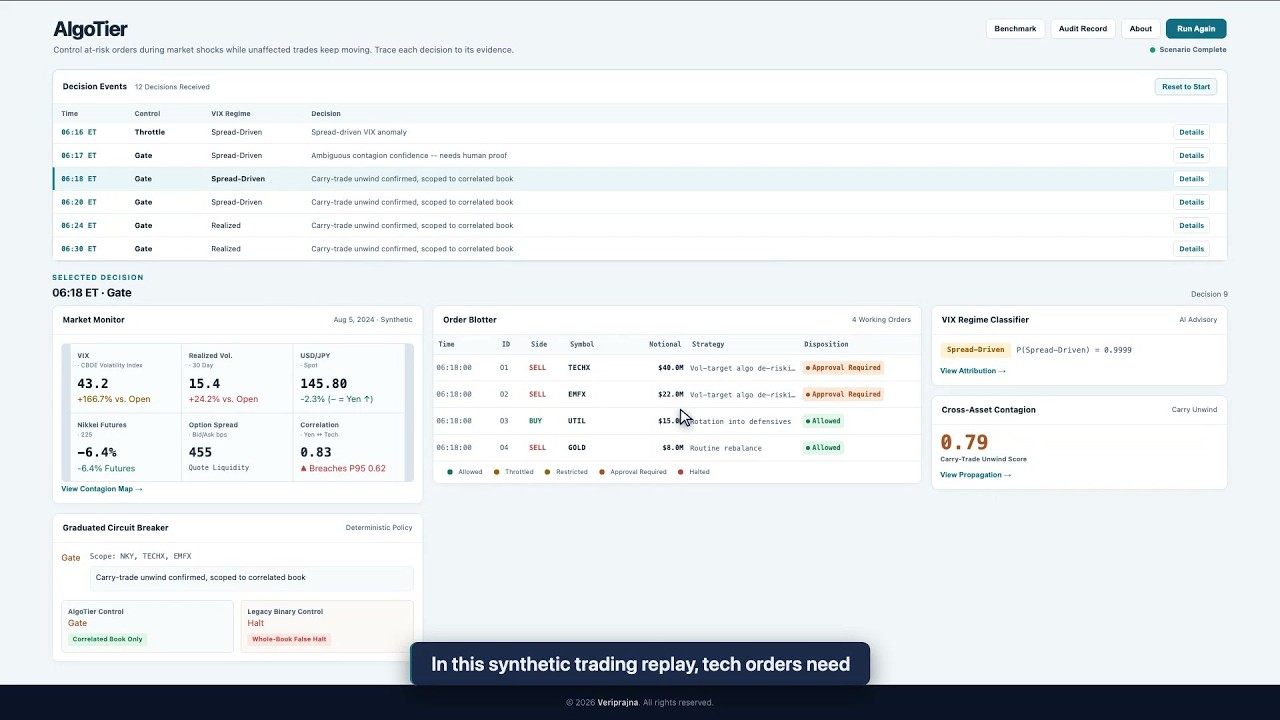
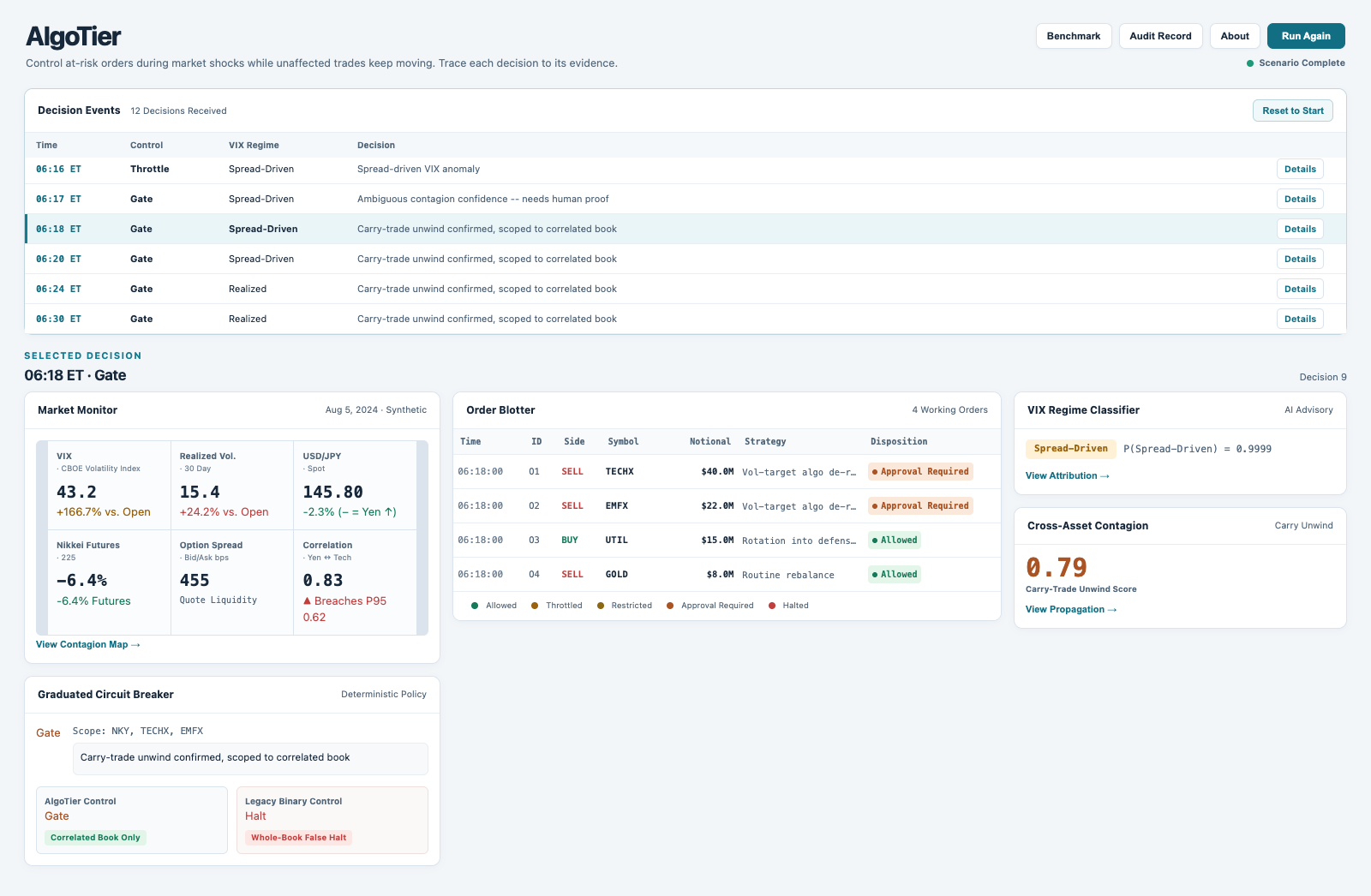
At 06:18, the Order Blotter shows orange Approval Required badges for TECHX and EMFX, and green Allowed badges for UTIL and GOLD. To explain that split, a reviewer needs the selected market observation, the instruments inside the control scope, and the rule that chose the response.
AlgoTier brings those items into one workspace. The event list selects the moment being reviewed; the panels below change to that decision. The screenshot shows the completed replay with 06:18 selected.
In the recording, the presenter selects an observation and opens its Details dialog. Pause and resume controls allow time to inspect each decision.
Read VIX, realized volatility, currency and equity changes, option spreads and correlation for that observation.
The Order Blotter shows each simulated disposition. The recorded detail view adds the order’s amount, strategy and control rationale.
Inspect the advisory scores beside the final control tier and instrument scope.
Follow the scenario
From normal order flow to a scoped approval gate
The replay starts with all four orders allowed. It then demonstrates two different responses: a book-wide throttle when the VIX signal is uncertain or spread-driven, followed by an approval requirement on the correlated scope as the carry signal develops.
| Observation | What changes | Recorded response |
|---|---|---|
| 06:10 to 06:12 | Baseline observations; carry score 0 | NONE. All four orders allowed. |
| 06:13 | VIX classification is INDETERMINATE | R5 selects THROTTLE across the book. |
| 06:14 to 06:16 | The classifier changes to SPREAD-DRIVEN | R1 continues THROTTLE at a simulated 25% order rate. |
| 06:17 | Carry score 0.542 enters the ambiguous band | R3 selects GATE on NKY, TECHX and EMFX. |
| 06:18 | Carry score 0.7913 exceeds the 0.60 confirmed threshold | R2 confirms the condition. The gate keeps the same scope. |
| 06:20 to 06:30 | Carry remains confirmed; realized volatility rises later | GATE remains the final response. At 06:24, it outranks the RESTRICT candidate. |
The first response handles uncertainty.
At 06:13, VIX is 22.0 and realized volatility is 13.1. The classifier returns INDETERMINATE. Rule R5 throttles all four orders and flags the decision for review. The scope includes UTIL and GOLD at this point too.
At 06:14, VIX reaches 45.4 while realized volatility is 13.9 and the option spread is 520 basis points. The label becomes SPREAD-DRIVEN. Rule R1 retains THROTTLE; the demo’s simplified VIX-only comparator shows HALT.
Watch the first throttle · 01:36 ↗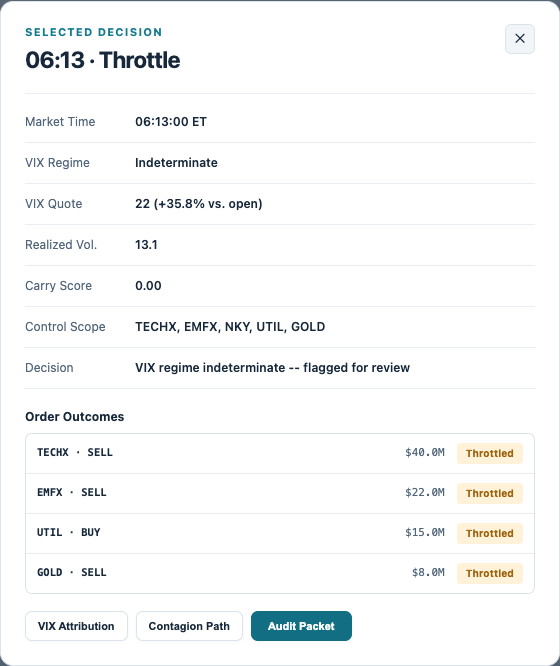
Inspect the change in control
The gate starts before the carry signal is confirmed.
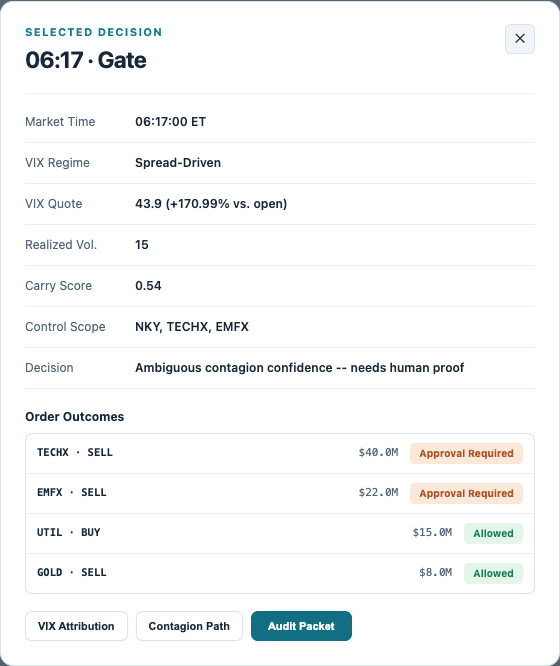
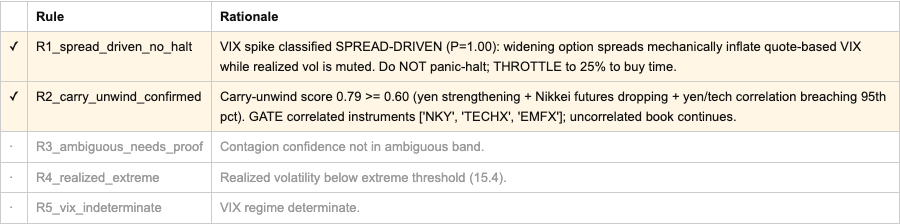
At 06:17, the carry score is 0.542, within the policy’s ambiguous band of 0.30 to below 0.60. Rule R3 already requires review on NKY, TECHX and EMFX. The dialog rounds the score to 0.54 and states “Ambiguous contagion confidence”.
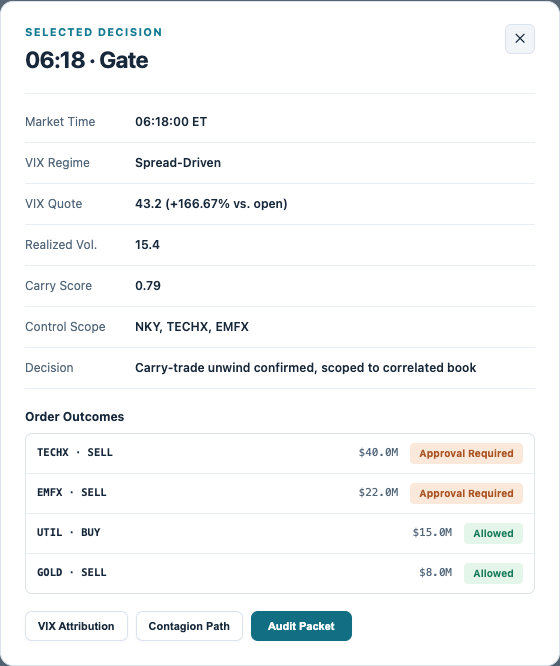
At 06:18, the score rises to 0.7913, displayed as 0.79. Rule R2 now confirms the carry condition. The important continuity is visible in the screenshots: the scope and the four order outcomes stay the same. Stronger evidence changes the recorded rationale, while the review requirement is already active.
Trace the evidence
Two advisory calculations answer different questions.
What drives the VIX classification?
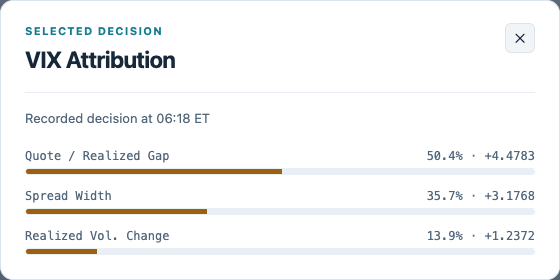
The VIX Regime Classifier uses three inputs: the divergence between quote and realized-volatility changes, option-spread width, and realized-volatility change. At 06:18 its SPREAD-DRIVEN score is 0.9999.
Opening View Attribution shows how the model forms that score. The quote/realized gap contributes 50.4% of the absolute feature contribution, spread width 35.7%, and realized-volatility change 13.9%. The signed values beside the bars are additive log-odds contributions.
Those percentages explain this synthetic classifier’s calculation. They do not measure the causes of an actual market move.
Which instruments enter the gate?
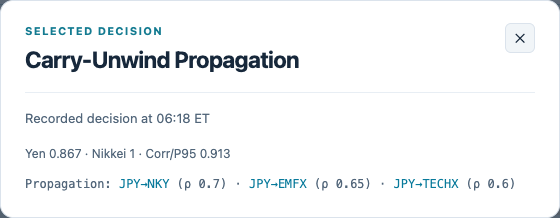
The carry calculation combines yen strengthening, a Nikkei decline and yen/tech correlation. At 06:18, the scenario has a USD/JPY change of −2.30%, a Nikkei change of −6.40%, and correlation of 0.83 against a synthetic reference of 0.62. The propagation view shows normalized factors of approximately 0.867, 1 and 0.913. Multiplying the underlying factors produces the carry score of 0.7913, displayed as 0.79. The JPY links show the configured propagation paths.
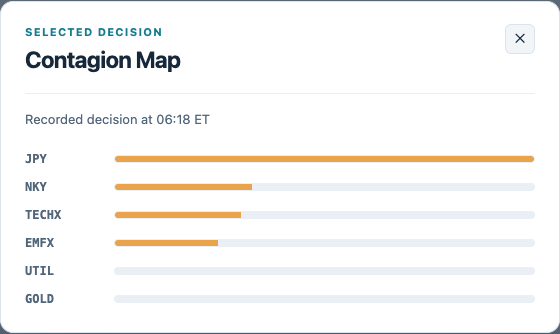
The graph calculation then assigns instrument stress. NKY is 0.3979, TECHX 0.3645 and EMFX 0.2990. All exceed the 0.25 scope cutoff. UTIL and GOLD have zero stress and remain outside the gate. JPY and SP500 are excluded from the instrument scope.
The graph uses fixed synthetic edges and two diffusion steps. Its edge weights, reference level and stress cutoff are demonstration assumptions that a production review would need to examine.
Read the consequence
The four orders make the scope visible.
The selected GATE records an approval requirement for orders inside its scope. Orders outside that scope remain allowed. There is no NKY sample order, which is why a scope containing three instruments produces two held orders in this four-order example.
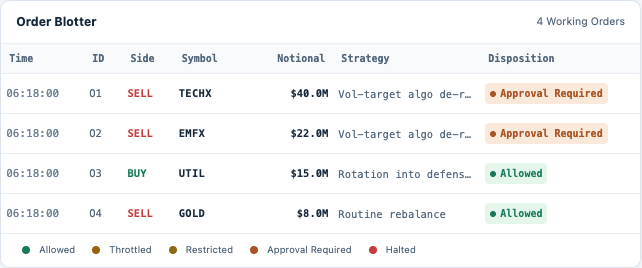
| Order | Strategy | Disposition and reason |
|---|---|---|
| SELL TECHX · $40M | Vol-target algo de-risking tech | Approval Required. TECHX is inside the gate. |
| SELL EMFX · $22M | Vol-target algo de-risking EM | Approval Required. EMFX is inside the gate. |
| BUY UTIL · $15M | Rotation into defensives | Allowed. UTIL is outside the gate. |
| SELL GOLD · $8M | Routine rebalance | Allowed. GOLD is outside the gate. |
Open an order to inspect its rationale.
Selecting TECHX opens the order’s timestamp, amount, strategy, disposition and control reason. This joins the order-level result to the selected decision, without asking the reviewer to infer the rule from a badge color.
Approval Required is a recorded requirement. The demo has no authenticated approver, approve/reject action or exchange connection. It demonstrates what the control would require from a separate approval workflow.
Watch individual order inspection · 04:23 ↗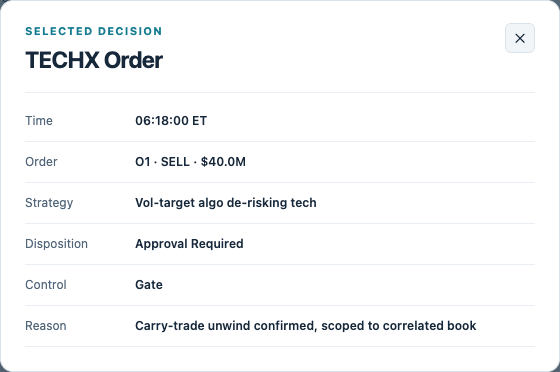
Reconstruct and check the decision
The audit packet preserves the evaluated rules.
From the selected decision, Audit Packet opens the recorded inputs, advisory outputs, scope and rule evaluations. At 06:18, R1 proposes THROTTLE because the VIX label is SPREAD-DRIVEN. R2 proposes GATE because the carry score exceeds 0.60. The policy’s severity ordering selects GATE. The other three rules remain visible with their reasons for not firing.
Review the record, then export its data.
The Audit Record dialog verifies the local hash chain and opens the selected decision for review. Export Packet (JSON) downloads that selected entry, including the simulated order dispositions. The printable HTML packet provides a complementary view of the decision and rule evaluation.
Each entry links its payload to the previous hash. It also records engine and scorer versions and a hash of selected configuration constants. The unmodified chain verifies across all 12 observations.
Watch the decision packet · 05:11 ↗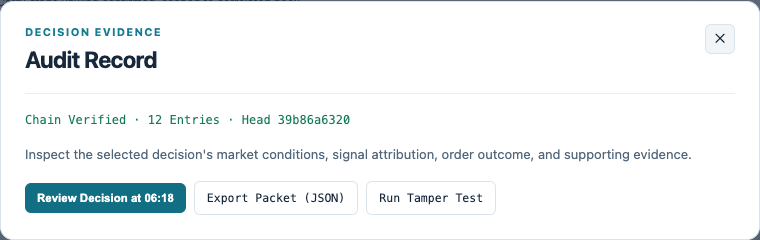
Change one stored value and locate the mismatch.
The built-in Run Tamper Test changes sequence 8’s stored tier from GATE to HALT while leaving its hash unchanged. Verification reports “Chain Broken at Seq 8: entry_hash mismatch (payload altered)”. Reset restores the original replay.
This is a bounded integrity demonstration. The log is in-memory and resettable, with no digital signature or independent anchor. It detects this payload edit; it does not establish protection against rewriting every record and hash.
Watch the tamper test · 06:38 ↗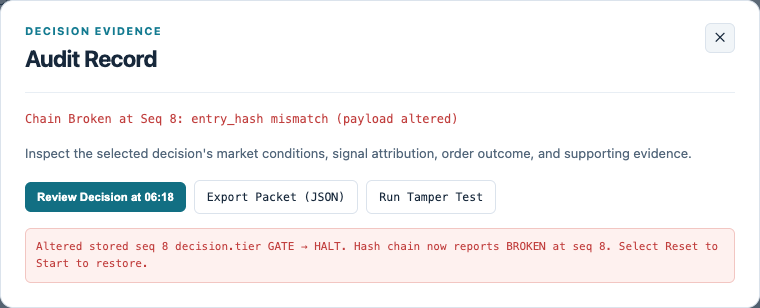
Interpret the comparison
What this demonstration establishes
The adjacent Legacy Binary Control is a defined comparison rule: it displays HALT whenever VIX has risen at least 100% against the first observation. At 06:14, AlgoTier displays THROTTLE; at 06:18, it displays a scoped GATE. This comparison illustrates the consequences of those specific rules.
| Shown in this demo | Work required for deployment |
|---|---|
| One fixed synthetic replay and four simulated orders | Live feeds, OMS/broker/exchange integration and operational validation |
| Recorded scope, rule outcomes and approval requirements | Authenticated approval workflow, permissions and execution controls |
| Inspectable synthetic classifier and graph calculations | Independent validation against representative market conditions |
| Local hash-chain verification and a controlled tamper test | Durable retention, independent integrity anchoring and access controls |
| Illustrative regulatory-reference mapping | Legal validation of applicability, obligations and supporting evidence |
The separate Scenario Benchmark uses fixed financial assumptions for a synthetic book. Its dollar figures are arithmetic comparisons, not measured trading returns, a market backtest or customer savings. The page’s worked proof is the reconstructable control decision and its order outcomes.
The replay produces NONE, THROTTLE and GATE as final tiers. RESTRICT is a later candidate that GATE outranks; HALT appears in the simplified comparator and the tamper exercise. A real approval or trade is never executed by this build.
Questions about the build
Review questions, answered directly
Does the model decide which trades to block?
Advisory calculations produce the VIX label, carry score and instrument stress. Deterministic rules select the control tier and scope, then assign simulated order dispositions. At 06:18, R2 proposes GATE because the carry score exceeds 0.60.
Why can utilities and gold stay allowed during the gate?
At the selected 06:18 observation, UTIL and GOLD have zero graph stress and remain outside the NKY, TECHX and EMFX scope. Their sample orders are therefore allowed. Earlier book-wide THROTTLE decisions also throttle UTIL and GOLD.
Does an uncertain signal mean orders keep going?
An INDETERMINATE VIX label triggers THROTTLE at 06:13. An ambiguous carry score of 0.542 triggers a scoped GATE at 06:17. The rules explicitly define a response to each kind of uncertainty.
Can someone approve a held order in the demo?
The demo records Approval Required but provides no authenticated approver or approve/reject action. Order execution and a staffed approval workflow are separate integration work.
What can a reviewer take away from the audit screen?
The selected entry can be exported as JSON, including its market state, advisory calculations, rule evaluations and simulated order dispositions. A printable HTML packet provides a complementary review view. The log is local and in-memory, so durable evidence retention is separate work.
Does this prove regulatory compliance or financial savings?
The regulatory-reference mapping is illustrative and requires legal validation. The separate Scenario Benchmark uses fixed assumptions for a synthetic book. Neither the mapping nor those dollar outputs establish compliance certification, realized savings or trading performance.
Technical Research
Explore related research for broader context on this demonstration.
- The Deterministic Alternative: Neuro-Symbolic Deep AI for Market Resilience (interactive whitepaper)
- The Deterministic Alternative: Navigating Market Volatility Through Neuro-Symbolic Deep AI (technical whitepaper)
Full solution
Explore the Algorithmic Trading Compliance AI solution →Bring a difficult control decision to the review
We welcome a discussion with trading compliance, market-risk and engineering teams.
Use the synthetic example to identify the evidence, scope and approval context your reviewers need to reconstruct a decision.
Review the control boundary
- ✓ Instrument scope and order outcomes
- ✓ Ambiguous signal handling
- ✓ Rule priority and thresholds
- ✓ Human-review requirements
Examine the evidence design
- ✓ Market inputs and advisory outputs
- ✓ Recorded rule evaluations
- ✓ Record integrity and retention needs
- ✓ Legal validation of reference mapping