Custom AI systems that detect fake reviews, synthetic content, and coordinated fraud across every platform where your brand appears. Built for the FTC's new enforcement reality.
$53,088
FTC penalty per fake review violation
FTC, January 2025 (inflation-adjusted)
275M+
Fake reviews blocked by Amazon alone in 2024
Amazon Brand Protection Report, 2024
~30%
Of all online reviews estimated to be fake
ReviewDriver / World Economic Forum, 2025
The tools that worked in 2023 are failing against 2026-era fraud.
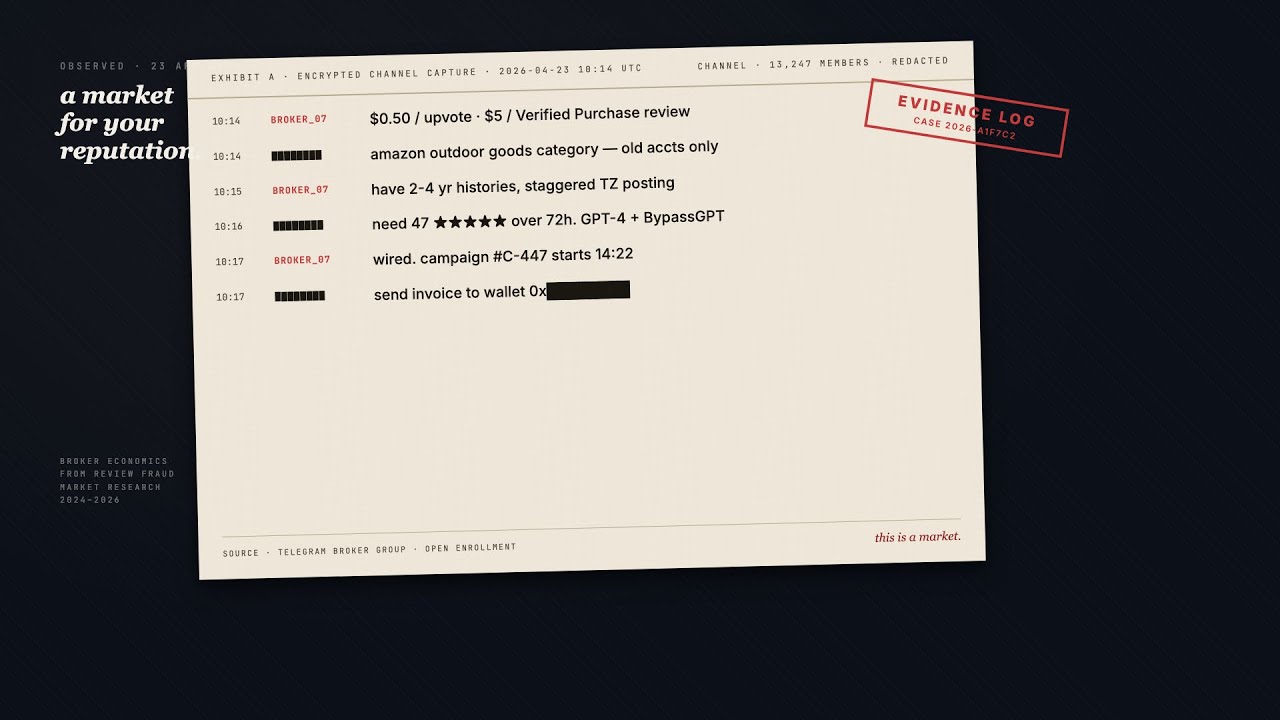
Here is what a fake review attack looks like today. A competitor hires a broker through a Telegram group with 13,000+ members. For $0.50 per upvote and $5 per "Verified Purchase" review, the broker deploys a network of compromised Amazon accounts, each with 2-4 years of purchase history and realistic activity patterns. Over 72 hours, 47 five-star reviews appear on a competing product. The text was written by GPT-4, then run through BypassGPT to defeat perplexity-based detection. Each review references a specific product feature scraped from the Q&A section. The accounts have staggered posting times across three time zones.
Your existing tools see 47 reviews that look individually legitimate. They pass Bazaarvoice's content filters. They pass GPTZero. The accounts are old enough to avoid "new account" flags. Your brand protection team does not notice until your product's conversion rate drops 18% over the following month, and by then the damage to your average rating is baked in.
This is not hypothetical. Amazon filed its first joint lawsuit with the BBB against review broker ReviewServiceUSA.com in July 2024. Trustpilot removed 4.5 million fake reviews in 2024, a 53% increase in automated removals over 2023. Tripadvisor intercepted 2.7 million fraudulent submissions, including AI-generated property photos creating "ghost hotels" that travelers booked and arrived at to find empty lots.
And the safety net is shrinking. Fakespot, the most widely used independent review verification tool, shut down permanently in July 2025 after Mozilla could not find a sustainable business model. Nine years of consumer trust and detection infrastructure, gone.
The Consumer Reviews and Testimonials Rule (effective October 2024) does not just ban fake reviews. It creates a "should have known" liability standard. If fake reviews exist on your listings and you lack reasonable detection and response processes, the absence of a detection system is itself the violation.
The FTC sent warning letters to 10 companies in December 2025, its first enforcement action under the rule. The UK Competition and Markets Authority launched 5 investigations in March 2026 under the new DMCCA, with penalties up to 10% of global turnover. The EU AI Act's Article 50, requiring machine-readable disclosure of AI-generated content, takes effect in August 2026.
A coordinated campaign of 100 fake reviews at $53,088 per violation represents $5.3 million in potential FTC fines. Regulatory enforcement is no longer theoretical.
A reference for evaluating your options. Honest about limitations, including ours.
| Approach | What It Does | What It Doesn't Do | Honest Gap |
|---|---|---|---|
| Platform-Native Tools (Amazon, Google, Yelp, Tripadvisor, Trustpilot) |
Massive scale detection. Amazon processes 275M+ reviews/year with ML, LLMs, and graph neural networks. Trustpilot auto-removes 90% of detected fakes. | Protect the platform, not your brand. Each platform operates independently. No cross-platform visibility. Won't share their detection data or signals with you. | Despite $500M/year spend and 8,000 employees, Amazon still has a 49% consumer distrust rate. Platforms are fighting their war, not yours. |
| Review Management Platforms (Bazaarvoice, PowerReviews, Yotpo) |
Syndication networks (Bazaarvoice: 2.3B sessions/month), fraud detection at ingestion, trust marks. Bazaarvoice runs 1,000+ fraud detection rules. | Only protect reviews within their own network. Cannot monitor reviews on Amazon, Google, or Yelp. A fake review on Amazon about your product is invisible to Bazaarvoice. | Syndication creates a secondary problem: a fake review that passes ingestion can propagate across 50+ retailer sites within 48 hours. |
| AI Text Detectors (Originality.ai, GPTZero, Copyleaks, Pangram Labs) |
Text-level AI detection. Originality.ai is best-in-class against humanizer tools. Copyleaks covers 30+ languages. | Text-only signal. Cannot detect coordinated campaigns using real human writers (Turker farms). No behavioral, temporal, or network analysis. No FTC compliance reporting. | A single-signal detector is inherently limited. Even the best text classifier fails when the text is genuinely human-written but the review is still fraudulent (paid, incentivized, or posted by a non-customer). |
| Review Audit Services (The Transparency Company, ReviewMeta) |
Transparency Co. runs daily audits with automated dispute filing. ReviewMeta analyzes Amazon review patterns. | Focused on specific platforms. ReviewMeta is Amazon-only. Limited AI-generated content detection. No custom detection models trained on your product category. | Audit services identify known fraud patterns. They struggle with novel attack vectors and custom broker tactics that adapt to their detection methods. |
| Big 4 / Large SIs (Deloitte, Accenture, KPMG) |
Brand risk advisory, compliance frameworks, enterprise-scale program design. | They advise on policy, not build detection systems. Engagements start at $300K+ and run 6-12 months before any technology is deployed. In 2024, Deloitte Australia submitted an AI-drafted report with fabricated citations to a government client. | The irony: some Big 4 firms are themselves struggling with AI content quality. Their value is compliance framework design, not detection engineering. You'll still need someone to build the system. |
| Internal Team (Build in-house) |
Full control over detection logic, direct integration with internal systems, institutional knowledge of your products and categories. | Requires NLP/ML, graph analytics, and forensics expertise. Amazon needs $500M/year and 8,000 people for their detection. Your team will build a fraction of that capability. | Realistic path for companies with existing ML teams. But the detection arms race moves fast. Internal teams face a continuous investment requirement as humanizer tools and broker tactics evolve monthly. |
| Doing Nothing | Zero cost. Zero effort. | Everything. No detection, no compliance documentation, no defense against competitor attacks, no FTC audit trail. | $53,088 per violation (FTC). 10% of global turnover (CMA). Up to 25% revenue loss from fake negatives. The "should have known" standard means no detection = no defense. |
Each capability addresses a specific gap that off-the-shelf tools leave open.
Unified ingestion pipeline across Amazon (SP-API), Google (Business Profile API), Yelp (Fusion API), Trustpilot (Business Unit API), Tripadvisor (Content API), and Bazaarvoice syndication networks. Each platform connector handles authentication, rate limiting, and field normalization into a common review schema.
The value is correlation. A burst of positive reviews on Amazon paired with negative reviews on Google for the same brand, posted within the same 48-hour window, is invisible when platforms are monitored in isolation. The unified pipeline surfaces cross-platform temporal patterns that no single-platform tool can detect.
We layer stylometric fingerprinting (emotiveness ratio, syntactic standardization, redundancy markers) with behavioral analysis (account age vs. first review timing, posting velocity, device clustering, session patterns). The ensemble design means a humanizer tool that defeats the text classifier still leaves behavioral signals intact.
We reach for stylometric analysis over simple perplexity scoring because the perplexity arms race is effectively lost. Bazaarvoice found in March 2026 that 23% of review writers now use AI at least sometimes. The question is no longer "was this written by AI?" but "is this review authentic?" Those are different questions requiring different detection architectures.
Automated audit trail generation: what detection was in place, what reviews were flagged, what confidence scores were assigned, what action was taken, when. Every decision is timestamped and exportable for regulatory inquiry.
The "should have known" standard means your defense is your process documentation. We build dashboards that produce this documentation as a byproduct of normal detection operations, covering Section 465.2 (fake reviews), Section 465.4 (insider reviews), and Section 465.7 (review suppression). The compliance layer also maps to CMA DMCCA requirements and EU AI Act Article 50 disclosure obligations.
When a brand suspects a coordinated attack, we build investigation tooling. Graph analysis maps reviewer-product-device relationships using publicly available signals: posting timestamps, reviewer profiles, product overlap patterns, and linguistic fingerprints. Temporal burst detection identifies review velocity anomalies that correlate with broker campaign timing.
For competitive intelligence, the system also monitors your competitors' review patterns. A sudden spike in their positive reviews, combined with negative reviews appearing on your listings, suggests a coordinated campaign. Having this evidence documented is critical for both FTC dispute filing and platform appeal processes.
For hospitality and marketplace listings, we build image forensic pipelines layering Error Level Analysis (ELA), Noise Pattern Analysis (NPA), and geometric verification. ELA maps compression inconsistencies that reveal synthetic composites. NPA isolates sensor noise patterns. Diffusion model outputs lack the stochastic noise signature of physical camera sensors. Geometric checks catch vanishing point failures and shadow inconsistencies common in AI-generated room interiors.
Where available, we verify C2PA Content Credentials for provenance metadata. Samsung's Galaxy S25 now ships with native C2PA camera signing, and LinkedIn, TikTok, and Cloudflare preserve credentials in transit. But the critical gap remains: most e-commerce and booking platforms strip metadata during image processing. Forensic analysis at the pixel level is the reliable fallback.
A $200M outdoor goods brand discovers a burst of 47 five-star reviews on their Amazon listing over 72 hours. Here is what the detection pipeline does.
The cross-platform pipeline detects a review velocity anomaly. This product category averages 2-3 reviews per day. 47 in 72 hours is a 6.7x deviation. The system flags the burst and begins enriching each review with behavioral metadata: account age, purchase history depth, review count across categories, posting time distribution, and linguistic fingerprint.
The stylometric ensemble analyzes each review for emotiveness ratio (adjective+adverb density relative to noun+verb), syntactic standardization (sentence length variance, grammatical error distribution), burstiness (entropy of sentence structure), and redundancy markers (repeated product name or feature mentions). 31 of 47 reviews show abnormally low burstiness scores despite surface-level vocabulary variation, consistent with AI text that was run through a humanizer tool. The humanizer adjusted word choice but could not inject the structural unpredictability of genuine human writing.
Behavioral analysis reveals that 22 of the 47 reviewing accounts share a pattern: accounts created 2-4 years ago with sporadic purchase activity, but their first review for this product category. 14 accounts posted reviews for the same three unrelated products in the previous 30 days, a product-overlap pattern consistent with a broker warming up accounts before a paid campaign. Device session analysis shows 8 accounts sharing browser fingerprint characteristics consistent with a single device farm.
The system checks whether correlated activity is happening on other platforms. It finds 12 new negative reviews on the brand's Google Business listing and 8 on Yelp, posted within the same 72-hour window. The negative reviews show similar stylometric signatures to the positive reviews on the competitor's Amazon listing. This cross-platform temporal correlation is the strongest signal: it indicates a single campaign targeting both the competitor boost and the brand attack simultaneously.
The system generates an evidence package: confidence scores for each flagged review, the specific signals that triggered each flag, temporal visualizations of the campaign, and cross-platform correlation data. This package serves three purposes: (1) platform dispute filings to Amazon, Google, and Yelp with evidence meeting their takedown thresholds, (2) FTC compliance documentation proving detection and response, and (3) a forensic record for potential legal action against the broker network. Your team reviews the package and initiates disputes within 24 hours of detection.
Three phases. Honest timelines. No multi-year advisory engagements before technology exists.
You provide: Platform credentials, historical review exports, records of past disputes or fraud incidents
Timeline depends on: Number of platforms (each adds 2-3 weeks), review volume (infrastructure sizing), integration complexity with your existing stack
Typical cadence: For a mid-market brand with 10K-50K reviews/month across 3-5 platforms, monthly review with your trust & safety team
Total timeline for Phase 1 + Phase 2: 8-13 weeks from kickoff to production monitoring for a mid-market brand on 3-5 platforms. This is not a 12-month advisory engagement. We build working systems, not PowerPoint decks.
Evaluate your current review fraud exposure and detection maturity. Takes 2 minutes. Results are actionable regardless of whether you work with us.
Standard AI detectors like GPTZero and ZeroGPT rely primarily on perplexity and burstiness scores to distinguish human from machine text. Humanizer tools (BypassGPT, Undetectable.ai, StealthWriter, and roughly 30 others on the market) specifically target these metrics by inserting comma variations, conversational filler, and vocabulary substitutions. In testing, basic perplexity-based detectors miss 40-60% of humanized AI text.
We build detection that does not depend on any single signal. The ensemble layers stylometric fingerprinting (emotiveness ratio, syntactic standardization patterns, redundancy markers) with behavioral signals that humanizer tools cannot touch: reviewer account age relative to first review, posting velocity across products, device and session clustering, cross-platform identity correlation.
A humanizer tool can rewrite text to fool a perplexity classifier. It cannot fabricate a 3-year Amazon purchase history, generate consistent browsing sessions, or create real device fingerprints. The behavioral layer is where coordinated campaigns break down, because the economics of fraud require reusing accounts, devices, and network infrastructure across campaigns.
The FTC's Consumer Reviews and Testimonials Rule (effective October 2024) creates several distinct obligations. First, it prohibits knowingly using AI-generated reviews or reviews from people without firsthand product experience (Section 465.2). Second, it bans review suppression through legal threats or selective filtering of negative reviews (Section 465.7). Third, it requires disclosure of material connections including employee reviews, incentivized reviews, and insider endorsements (Section 465.4).
The penalty is $53,088 per violation as of January 2025, and each fake review can constitute a separate violation. The critical legal exposure is the "should have known" standard. The FTC does not need to prove you deliberately posted fake reviews. If fake reviews exist on your listings and you lacked reasonable detection and response processes, that itself creates liability.
In December 2025, the FTC sent warning letters to 10 companies in its first enforcement action under the rule. In the UK, the CMA launched 5 investigations in March 2026 with penalties up to 10% of global turnover under the DMCCA. Compliance means: having detection technology in place, documenting what was flagged and how you responded, maintaining audit trails of your review authentication processes, and training staff on the rules. We build the infrastructure that produces this documentation automatically.
Yes. Cross-platform monitoring is the core design principle. Each platform has different data access constraints. Amazon Seller Central provides review data through SP-API with rate limits and restricted fields. Google Business Profile exposes reviews through the Business Profile API. Yelp's Fusion API provides public review data with daily limits. Trustpilot offers a Business Unit API for claimed profiles. Tripadvisor's Content API covers location reviews.
We build platform-specific connectors that handle each API's authentication, rate limiting, pagination, and field mapping, then normalize everything into a unified review schema. The value of cross-platform monitoring goes beyond convenience. A coordinated campaign often hits multiple platforms simultaneously. A burst of positive reviews on Amazon paired with negative reviews on Google for a competitor is invisible if you monitor each platform in isolation. The unified pipeline detects cross-platform temporal correlation, shared linguistic patterns across platforms (same broker network using similar templates), and reviewer identity signals that span platforms.
For platforms where API access is limited, we build structured scraping pipelines with appropriate caching and compliance guardrails. Typical integration takes 2-3 weeks per platform depending on API maturity and your existing data infrastructure.
AI-generated listing images have become a serious problem, particularly in hospitality. Tripadvisor removed 2.7 million fake reviews in 2024, with a meaningful portion supported by AI-generated property photos creating entirely fabricated listings.
The detection pipeline layers multiple forensic techniques. Error Level Analysis (ELA) re-compresses images at a known quality level and maps pixel-level compression inconsistencies. Authentic photos show uniform error levels. AI-generated images and composites show irregular compression artifacts where synthetic elements meet real backgrounds. Noise Pattern Analysis (NPA) isolates high-frequency sensor noise. Every real camera produces characteristic stochastic noise from its sensor. Diffusion model outputs (Midjourney, DALL-E, Stable Diffusion) lack this noise pattern entirely, or exhibit mathematically regular noise that does not match any physical sensor.
Geometric verification checks vanishing point consistency, shadow direction coherence, and reflection accuracy. AI-generated room interiors frequently fail these tests because diffusion models do not enforce geometric constraints. Where available, we check C2PA Content Credentials for provenance metadata, though this is limited by platform image processing that strips metadata during upload. For hospitality specifically, we also cross-reference listing photos against reverse image search databases, check for temporal inconsistencies (listing claims to be newly renovated but building permits show no recent work), and flag statistical anomalies in listing completeness relative to the claimed property tier.
Platform-native detection protects the platform, not your brand. Amazon blocks 275 million fake reviews annually and employs 8,000 people on the problem with a budget exceeding $500 million per year. Despite this, 49% of U.S. consumers in 2024 reported seeing what they believe were fake reviews on Amazon. Trustpilot removes 4.5 million fakes annually, yet volume grows faster than detection capacity. The platforms are fighting their own war. Your brand is collateral.
The concrete business case breaks down into three categories. Regulatory exposure: the FTC penalty of $53,088 per violation means a coordinated campaign of 100 fake reviews on your listings represents $5.3 million in potential fines. The UK CMA can fine up to 10% of global turnover. Revenue impact: a single fraudulent star rating manipulation can shift demand by 38%. Fake negative reviews from competitors can cut revenue by up to 25%. A drop from 4 stars to 3 stars correlates with a 70% decrease in consumer trust.
Brand equity: fake reviews cost U.S. businesses $152 billion annually in reputational damage and lost sales (World Economic Forum). And the gap is widening. Fakespot, the most widely used consumer-facing detection tool, shut down in July 2025 after Mozilla could not sustain the business. There is now less independent verification in the market, not more. The question is not whether review fraud will affect your brand. It is whether you will detect it before your customers do, and before the FTC does.
A typical engagement runs in three phases. Phase 1, Review Ecosystem Audit (2-3 weeks): we map every platform where your brand has review presence, assess current detection capabilities, identify exposure to the FTC rule and other applicable regulations, and quantify your review fraud surface. You provide platform access credentials, historical review data exports where available, and any records of past fraud incidents or disputes.
Phase 2, Detection Pipeline Build (6-10 weeks): we build the cross-platform ingestion connectors, deploy the multi-signal detection ensemble, and integrate with your existing moderation or brand management tools. The timeline depends on the number of platforms (each adds 2-3 weeks for connector development), your review volume (which determines infrastructure sizing), and integration complexity with your existing stack. Most e-commerce brands run Bazaarvoice, PowerReviews, or Yotpo for review management, and we build detection to plug into those workflows rather than replace them.
Phase 3, Monitoring and Response (ongoing): the system runs continuously, flagging suspicious reviews with confidence scores and evidence packages. Your team reviews flagged items through a dashboard that also generates FTC compliance documentation automatically. We tune detection models monthly based on new fraud patterns and humanizer tool evolution. For a mid-market brand monitoring 3-5 platforms with moderate review volume (10,000-50,000 reviews per month), Phase 1 and Phase 2 combined typically run 8-13 weeks from kickoff to production monitoring.
False positives are the highest-stakes failure mode in review fraud detection. Flagging a genuine customer review as fake damages the customer relationship, suppresses authentic social proof, and creates legal risk (the FTC rule also prohibits review suppression under Section 465.7).
We address this through tiered confidence scoring rather than binary classification. Every flagged review gets a confidence score from 0 to 100 based on the weighted signals from all detection layers. Low-confidence flags (below 60) are surfaced for human review with the specific signals that triggered the flag. High-confidence flags (above 85) can be auto-actioned based on your risk tolerance. The middle band requires human judgment, and the system provides the evidence to make that judgment quickly.
The multi-signal approach inherently reduces false positives compared to single-signal detectors. A review might score high on stylometric indicators (unusually uniform sentence structure) but low on behavioral indicators (the account has 4 years of verified purchases and consistent activity). The ensemble weighs these appropriately. We also build feedback loops: when your team overrides a flag (marking a flagged review as legitimate), that decision trains the model. Over 4-6 weeks of operation, the system calibrates to your specific reviewer population and product categories. Consumer electronics reviews have different linguistic norms than hotel reviews, and the model needs to learn those differences from your data. Target operating range: less than 2% false positive rate at production, measured weekly and reported in your compliance dashboard.
The technical depth behind this solution page, available as an interactive whitepaper.
Technical architecture for multi-layered synthetic content detection: stylometric fingerprinting, behavioral graph topology, multi-modal image forensics, and FTC regulatory compliance frameworks.
The FTC's first enforcement letters went out in December 2025. The "should have known" clock is running.
Whether you need an initial exposure audit or a full cross-platform detection system, we start with your specific review ecosystem and regulatory obligations.