Procurement AI Governance
Every major procurement platform now ships AI-powered supplier scoring. None of them publish fairness metrics. For federal contractors with FAR Part 19 obligations and enterprises navigating contradictory regulations, that gap is a compliance liability measured in contract losses and audit findings.
Veriprajna builds vendor-agnostic fairness auditing for procurement AI. We connect to SAP Ariba, Coupa, GEP, or Ivalua, test supplier scoring for disparate impact, and produce the mathematical proof that your AI treats every supplier category equitably.
49% Piloting, 4% Deployed
Procurement AI stuck in pilot purgatory
ProcureAbility 2026 CPO Report
0 of 4 Major Platforms
Publish supplier scoring fairness metrics
Veriprajna vendor analysis, March 2026
89% Need Upskilling
But only 6% have started AI training
BCG, 2026
The bias in procurement AI is not a bug in the model. It is a structural consequence of training on historical spend data. Here is exactly how it works.
Consider a sourcing event for industrial fasteners. Your S2P platform's AI scores five suppliers on delivery performance, quality metrics, financial stability, and price competitiveness. Supplier A (large incumbent, 12-year contract history, 4,200 transactions) scores 92. Supplier B (certified MBE, 3-year history, 180 transactions) scores 71.
On the surface, Supplier A wins on merit. But decompose the scoring factors. Delivery performance accounts for 25% of the score. The AI calculates it using on-time delivery rate weighted by transaction count. Supplier A's 97.2% rate across 4,200 transactions generates a confidence-weighted delivery score of 24.1 out of 25. Supplier B's 98.1% rate across 180 transactions generates a confidence-weighted score of 16.8 out of 25. Supplier B has a better delivery rate, but the confidence weighting penalizes them for having fewer data points.
The same pattern repeats across quality metrics (where audit frequency correlates with contract volume) and financial stability (where revenue size acts as a proxy for risk tolerance). By the time price competitiveness is evaluated, the gap is already insurmountable.
This is not the algorithm being malicious. It is the algorithm equating "more historical data" with "more reliable," which structurally disadvantages any supplier who has not already been given the chance to accumulate that data. The exclusion is self-reinforcing: suppliers who are scored lower receive fewer contracts, which means fewer transactions, which means lower confidence scores next cycle.
The EEOC's four-fifths rule (29 CFR 1607.4) states that any group's selection rate must be at least 80% of the highest-selected group's rate. Originally designed for employment, the same statistical test applies to supplier selection.
If your AI advances 60% of non-diverse suppliers past the scoring threshold, it must advance at least 48% of MBE/WBE-certified suppliers. If the MBE selection rate is 22% (common in volume-weighted scoring), the disparity ratio is 0.37, well below the 0.80 threshold. That is prima facie evidence of adverse impact.
SAP, Coupa, GEP, and Ivalua build general-purpose supplier scoring. Their AI is optimized for cost reduction and risk mitigation across their entire customer base. Adding fairness constraints specific to your subcontracting goals, your supplier categories, and your regulatory jurisdiction would mean maintaining a different model configuration per customer.
That is not how platform economics work. The platform gives you speed. The fairness layer is yours to build.
Pull this table up the next time leadership asks "doesn't our platform already handle this?" The answer is nuanced, and the fairness column is where the gap lives.
| Platform / Provider | AI Capabilities (2026) | Supplier Diversity Support | Fairness Auditing | Gaps |
|---|---|---|---|---|
| SAP Ariba + Joule | Joule Bid Analysis Agent, AI supplier response summaries, next-gen cloud-native S2P on BTP (Feb 2026) | Supplier Risk module tracks certifications; no diversity-specific scoring adjustment | None published | No disparate impact testing. Supplier Risk AI uses network-effect scoring that advantages high-volume suppliers. |
| Coupa | Navi Supplier Discovery Agent, 100+ AI tools, $15B customer savings Q3 FY26, agentic S2P | Acknowledges bias mitigation in blog posts; no published methodology | None published | Community Intelligence scores advantage suppliers with more network transactions. Bias mitigation is a talking point, not a feature. |
| GEP SMART | Agentic AI across full S2P, AI spend classification, predictive analytics, conversational voice agents | Supplier evaluation automation; no diversity-specific safeguards documented | None published | No public information on fairness testing for any AI-driven scoring or recommendation. |
| Ivalua | 30+ AI Agents, IVA virtual assistant, ML-powered spend classification, unified data model | Strong data unification; no diversity-specific AI safeguards | None published | Single data model is an advantage for fairness analysis, but Ivalua doesn't offer it natively. |
| Supplier.io / Tealbook / Fairmarkit | Diverse supplier discovery (20M+ / 5M+ databases), AI-powered RFP matching, certification verification | Core focus: finding and verifying diverse suppliers | Discovery only | Help you find diverse suppliers but don't audit whether your scoring algorithm gives them a fair chance once found. |
| Big 4 / Large SIs | AI governance frameworks, responsible AI advisory, implementation services for S2P platforms | Supplier diversity consulting practices (all Big 4 have one) | Framework-level | Sell governance slide decks and policy documents. Don't connect to your platform and run statistical tests on actual scoring outputs. Engagements start at $300K+ and produce recommendations, not running code. |
| IBM / Google Fairness Tools | AI Fairness 360 (IBM), What-If Tool (Google), open-source fairness metrics | General-purpose bias detection; not procurement-specific | Generic toolkits | Powerful statistical libraries but require significant customization for procurement use cases. No FAR Part 19 mapping, no S2P platform integration, no regulatory documentation pipeline. |
Each engagement is custom. These are the capabilities we reach for most often, shaped by what procurement officers actually need when they realize their AI has a fairness blind spot.
We connect to your S2P platform's API or data exports, pull supplier scoring decisions across sourcing categories, and run four-fifths rule analysis against every protected supplier category: MBE, WBE, SDVOSB, HUBZone, 8(a), small disadvantaged, and firm size tier.
Where disparate impact is detected, we apply causal decomposition using Structural Causal Models. This separates legitimate scoring signals (delivery performance, quality audits, financial stability) from proxy variables that correlate with incumbency or firm size. The output ranks every scoring factor by its contribution to disparate impact.
The audit report is designed to survive an OFCCP scheduling letter. It maps findings to NIST AI RMF functions (GOVERN, MAP, MEASURE, MANAGE) and includes remediation recommendations ranked by impact and implementation effort.
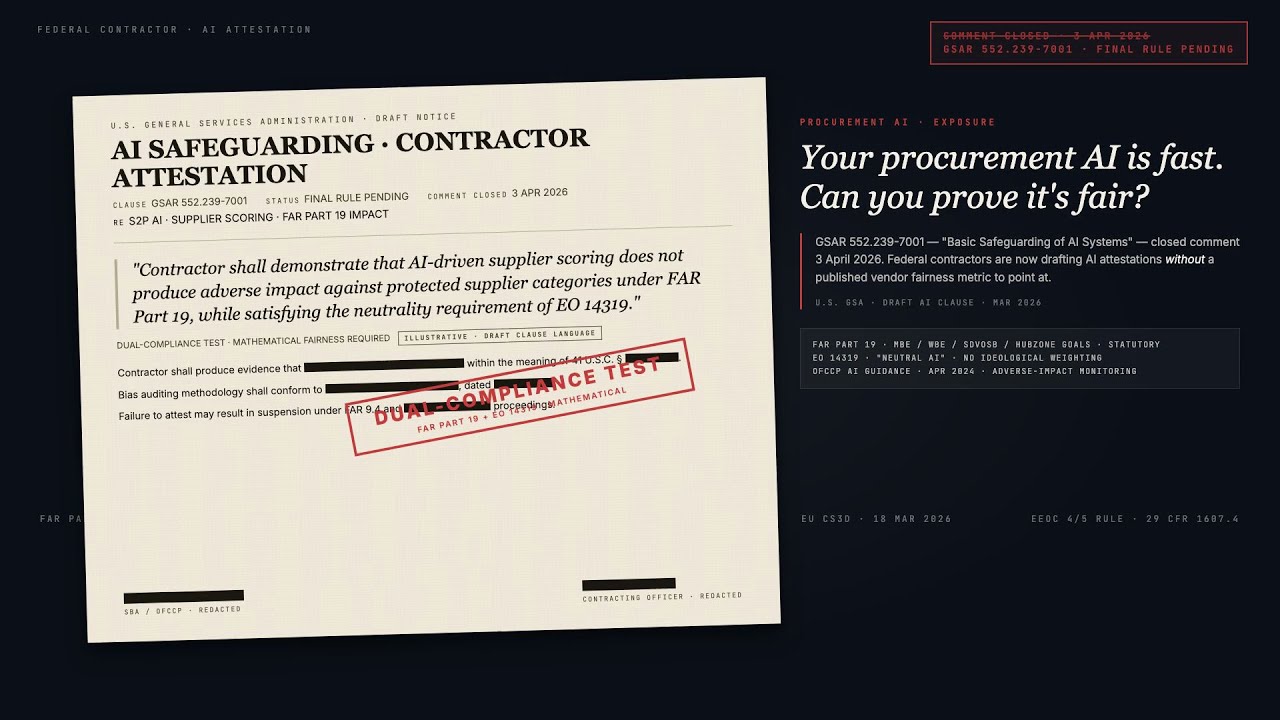
Federal contractors face a contradictory mandate: FAR Part 19 requires subcontracting goals for small and diverse businesses. EO 14319 prohibits AI with "ideological biases." GSA's draft GSAR 552.239-7001 adds new AI disclosure requirements. Internationally, CS3D creates supply chain due diligence obligations that extend to AI-driven procurement decisions.
We build the documentation pipeline that proves mathematical neutrality. Every scoring decision maps to objective performance metrics. No ideological weighting. No subjective diversity adjustments. The fairness attestation demonstrates two things simultaneously: the AI is provably neutral (EO 14319) and its outputs do not create adverse impact against protected supplier categories (FAR Part 19).
For CS3D-exposed organizations, we add human rights and environmental risk dimensions to the fairness framework, mapping your scoring factors against the directive's due diligence categories.
For each supplier recommendation your platform generates, we produce a human-readable decision trace. Which factors drove the score? Where did confidence weighting penalize low-transaction suppliers? Which variables acted as proxies for firm size rather than actual performance?
The explainability layer runs as a post-processing step on your platform's scoring output. It does not modify the scores. It annotates them. Procurement officers see the original recommendation alongside a decomposition that makes the scoring logic transparent.
This is what lets a category manager look at a supplier shortlist and say "I understand why Supplier B scored lower, and I can see the volume penalty is 14 points of the 21-point gap" instead of accepting or overriding a black-box number.
2026 is the year procurement AI shifts from analytical (recommends, human decides) to agentic (decides and acts). SAP's Joule Bid Analysis Agent and Coupa's Navi are already generating supplier shortlists autonomously. When no human reviews the output before execution, fairness guardrails cannot be afterthoughts.
We build middleware that intercepts agentic procurement decisions before execution. For each supplier shortlist, award recommendation, or negotiation parameter the agent generates, a rapid fairness check (sub-200ms latency) validates against your diversity thresholds. If the output would push any protected category below the four-fifths threshold for that sourcing category, the middleware routes to human review or triggers regeneration with adjusted constraints.
The constraint is mathematical, enforced at the output layer. It cannot be overridden by prompt drift, model updates, or creative phrasing. Every decision, every fairness check, and every override is logged for the compliance trail that autonomous procurement otherwise lacks.
Bookmark this section. The regulatory signals on procurement AI fairness are contradictory, fast-moving, and carry real penalties. Here is what applies to you right now and what is coming.
| Regulation / Order | Status | What It Requires | Procurement AI Impact |
|---|---|---|---|
| FAR Part 19 | Active, recently overhauled | Specific percentage goals for small business, veteran-owned, SDVOSB, HUBZone, small disadvantaged, and women-owned subcontractors | AI scoring that systematically disadvantages these categories creates compliance risk. No AI-specific provisions yet, but subcontracting goals are statutory. |
| EO 14319 ("Preventing Woke AI") | Active (July 2025) | Prohibits federal procurement of AI incorporating "ideological biases or social agendas" including DEI | Creates tension with diversity objectives. Resolution: prove mathematical neutrality (no ideological weighting) while showing no adverse impact. |
| GSA GSAR 552.239-7001 (Draft) | Comment period ends April 3, 2026 | AI disclosure requirements, use-rights for government, safeguarding provisions for AI systems in federal contracts | New documentation burden. AI systems used in procurement will need to disclose capabilities and comply with use-rights terms. Could exclude smaller vendors from competing. |
| OFCCP AI Guidance | Active but agency future uncertain | Federal contractors must monitor AI for adverse impact on protected groups; scheduling letters now request AI usage information | Even if OFCCP is defunded, the underlying legal obligation (EO 11246, Section 503, VEVRAA) remains. Smart contractors build the audit capability now. |
| EU CS3D (Omnibus Revisions) | Effective March 2026; application July 2029 | Risk-based human rights and environmental due diligence across global supply chains for companies with 5,000+ employees, EUR 1.5B+ turnover | Procurement AI that excludes suppliers from developing regions or ignores labor/environmental risk creates CS3D liability. Applies regardless of where AI runs. |
| NIST AI RMF 1.0 + RMF PAIS | Voluntary framework | GOVERN, MAP, MEASURE, MANAGE functions for AI risk. RMF PAIS specifically covers procurement of AI systems. | Increasingly referenced in federal procurement requirements. Mapping your fairness audit to NIST functions creates a defensible compliance position. |
| State/Local Diversity Mandates | Varies by jurisdiction | Many states mandate diversity scoring weight in evaluations. Illinois allocates up to 20% of technical evaluation points. | If your AI scoring doesn't account for these mandated weights, you risk non-compliance at the state/local level even while meeting federal requirements. |
The regulatory environment is not just complex; it is internally contradictory. You must meet diversity subcontracting goals (FAR Part 19) while avoiding anything that looks like ideological bias (EO 14319). The only path through this is provable mathematical fairness: statistical tests that show your AI is neutral AND equitable. Not a policy statement. Not a governance framework. Running code that produces audit-ready evidence on demand.
Every engagement follows this structure. Timelines are realistic, not aspirational. The phases below are for a single-platform fairness audit; multi-platform or agentic guardrail engagements add scope.
Connect to your S2P platform via API or data export. Pull three core datasets: supplier pool (who was considered), scoring output (what the AI assigned), and award decisions (who won). Map supplier attributes to protected categories tracked by your compliance team.
Caveat: Data extraction timelines depend on your platform's API maturity. SAP Ariba's Operational Reporting API and Coupa's REST API are well-documented. GEP and Ivalua may require custom export configuration. If your data lives across multiple systems (common in enterprises using Ariba for indirect and a different platform for direct), add 1-2 weeks.
Run four-fifths rule analysis across every protected supplier category for each sourcing category. Where disparate impact is detected, apply Structural Causal Models to isolate proxy variables from legitimate performance signals. Rank scoring factors by their contribution to adverse impact.
Caveat: Causal decomposition requires sufficient historical data. If you have fewer than 200 sourcing events in a category, the statistical power for causal inference is limited. We will flag categories where sample size constrains the analysis and recommend data accumulation periods.
Produce the audit report with findings mapped to NIST AI RMF functions. Each finding includes the statistical evidence, the contributing scoring factors, and remediation recommendations ranked by impact (how much the disparity would decrease) and implementation effort (what changes in your platform configuration or scoring model).
Caveat: Remediation options range from platform configuration changes (adjusting confidence weighting parameters) to model retraining with debiased features. The simplest fixes take days. Model retraining requires your platform vendor's involvement and typically takes 4-8 weeks beyond the audit engagement.
Present findings to procurement leadership, legal, and compliance. Produce the fairness attestation document that serves dual purpose: EO 14319 compliance (proving neutrality) and FAR Part 19 compliance (demonstrating no adverse impact). For CS3D-exposed organizations, include the supply chain due diligence mapping.
What comes next: Most organizations move to continuous monitoring ($8K-$15K/month) to maintain the compliance position and catch scoring drift as platform vendors update their models. This is especially critical for agentic procurement systems where autonomous decisions happen at volume.
Answer eight questions about your current procurement AI setup. The assessment scores your readiness across four dimensions and provides specific next steps you can act on regardless of whether you engage Veriprajna.
We work at the output layer, not the model layer. The audit connects to your S2P platform's API or data export (SAP Ariba, Coupa, GEP, Ivalua all expose supplier scoring data through standard integrations) and pulls three datasets: the pool of suppliers considered for each sourcing event, the scores assigned by the AI, and the final award decisions.
From there we run four-fifths rule analysis across every protected category your compliance team tracks: firm size tier, MBE/WBE/SDVOSB certification, HUBZone status, geographic region, and years in business. The analysis flags any category where the selection rate falls below 80% of the highest-selected group.
For flagged categories, we apply causal decomposition to separate legitimate performance signals (on-time delivery rate, quality scores, financial stability) from proxy variables that correlate with firm size or incumbency. This tells you whether the disparity is driven by genuine performance differences or by historical volume acting as a stand-in for reliability. The output is an audit-ready report with specific scoring factors ranked by their contribution to disparate impact, not a generic "bias risk score."
This is the regulatory tension every federal contractor is navigating right now, and the answer is mathematical neutrality. FAR Part 19 requires specific subcontracting percentage goals for small business, veteran-owned, service-disabled veteran-owned, HUBZone, small disadvantaged, and women-owned businesses. These are statutory requirements that EO 14319 does not override.
What EO 14319 prohibits is AI that incorporates "ideological biases or social agendas." The compliance path is proving your AI is neutral, not that it ignores diversity. We build documentation pipelines that map every scoring decision to objective performance metrics, demonstrate that no ideological weighting exists in the model, and simultaneously show that the AI's outputs do not create adverse impact against the supplier categories protected under FAR Part 19.
The key artifact is a fairness attestation that passes both tests: the AI is provably neutral (EO 14319 compliant) and its outputs do not systematically disadvantage protected supplier categories (FAR Part 19 compliant). This is a mathematical proof, not a policy statement.
A baseline fairness audit for a single S2P platform typically runs 4-6 weeks and costs $45K-$75K depending on the number of sourcing categories and the complexity of your supplier scoring model. The timeline breaks down as follows: week 1-2 is data extraction and integration (connecting to your platform's API, pulling historical scoring data, mapping supplier attributes to protected categories); week 2-3 is the statistical analysis (four-fifths rule testing, causal decomposition, proxy variable identification); week 4-5 is report generation and remediation recommendations; week 6 is stakeholder presentation and compliance documentation.
For organizations running multiple platforms (common in large enterprises that use Ariba for indirect and Coupa for direct spend), add 2-3 weeks per additional platform. The ongoing monitoring engagement, where we run continuous fairness checks on live scoring decisions rather than a point-in-time snapshot, runs $8K-$15K per month depending on transaction volume.
Most federal contractors start with the baseline audit to establish a compliance position, then move to continuous monitoring ahead of OFCCP scheduling letters or contract renewals.
Yes, and this is where the urgency is highest. Analytical AI recommends; a human decides. Agentic AI decides and acts. When SAP's Joule Bid Analysis Agent or Coupa's Navi autonomously generates supplier shortlists and triggers RFP distribution, there is no human checkpoint where someone might notice the shortlist skews toward incumbents.
We build fairness guardrails that operate in real-time within the agentic workflow. The architecture is a middleware layer that intercepts the agent's output before it reaches the execution step. For each supplier shortlist, award recommendation, or negotiation parameter the agent generates, the middleware runs a rapid fairness check (sub-200ms latency, designed not to bottleneck the workflow). If the output would push any protected category below the four-fifths threshold for that sourcing category, the middleware flags it and either routes to human review or triggers the agent to regenerate with adjusted constraints.
The constraint is mathematical, not a prompt instruction the agent can drift from. We also build audit logging that captures every agent decision, every fairness check result, and every override, creating the compliance trail that autonomous systems otherwise lack.
CS3D's omnibus revisions took effect March 18, 2026, with application starting July 2029 for companies with 5,000+ employees and EUR 1.5B+ net worldwide turnover. The directive requires risk-based human rights and environmental due diligence across your entire supply chain. If your procurement AI systematically excludes suppliers from developing regions, favors suppliers with poor labor practices because they offer lower prices, or fails to flag environmental risk in sourcing decisions, that creates CS3D liability.
The practical impact on procurement AI is threefold. First, your supplier scoring model needs to incorporate human rights and environmental risk signals, not just cost and delivery performance. Second, you need to demonstrate that the AI's recommendations don't perpetuate supply chain harms even indirectly. Third, you need documentation showing your due diligence process, including how AI-driven decisions were reviewed for adverse impacts.
We help by adding CS3D risk dimensions to the fairness audit framework, mapping your procurement AI's scoring factors against CS3D's human rights and environmental categories, and producing the due diligence documentation the directive requires. For U.S. companies selling into the EU, this applies regardless of where your procurement AI runs.
The core dataset is three tables: the supplier pool (who was considered), the scoring output (what scores the AI assigned and which factors drove them), and the award decisions (who won). We also need your supplier attribute data: firm size tier, diversity certifications (MBE, WBE, SDVOSB, HUBZone, 8(a)), geographic region, and years in business. Most S2P platforms export this through standard reporting or API endpoints. SAP Ariba exposes it through the Operational Reporting API, Coupa through its REST API, GEP through SMART Analytics exports, and Ivalua through its standard data extract.
We do not need access to your platform's AI model internals, proprietary algorithms, or source code. We do not need PII for individual procurement officers or contract signatories.
For data security, we operate under a standard consulting NDA with data handling terms. The analysis runs in an isolated environment. We can work within your infrastructure if your security posture requires it, running the audit tools on your servers rather than transferring data to ours. For federal contractors with FedRAMP requirements, we deploy within your authorized boundary.
The research underpinning this solution page, covering procurement bias mechanisms, neuro-symbolic debiasing architectures, and the case for deterministic AI in enterprise procurement.
The Deterministic Imperative: Architecting Deep AI for the Post-Wrapper EnterpriseProcurement bias analysis, causal AI for supplier fairness, knowledge graph verification, and the architectural shift from probabilistic scoring to deterministic, auditable procurement intelligence.
A single adverse finding on a federal contract can trigger suspension, debarment proceedings, and loss of future bidding eligibility.
A baseline fairness audit takes 4-6 weeks and gives you the mathematical proof that your procurement AI treats every supplier category equitably. That proof is cheaper than the remediation required after an audit finding.