AI Sales Intelligence
AI outbound tools send more emails. They also hallucinate prospect details, trigger spam filters, and create legal exposure. Signal-personalized outreach converts 5x better than generic blasts, but only when every claim is verified against source data.
Whether you are evaluating AI SDR tools for the first time, recovering from a failed deployment, or scaling a pilot that is not converting, the core problem is the same: volume without verification destroys more pipeline than it creates.
50-70%
Enterprise AI SDR annual churn
UserGems, 2026
2.6x
Revenue gap: human vs AI-booked meetings
AI SDR Industry Report, 2026
15% vs 25%
AI vs human meeting-to-qualified-opp rate
Nuacom SDR Comparison, 2026
The failure pattern is consistent across vendors. The first 30 days look great. By day 90, the damage is visible.
Single-pass LLM systems hallucinate 12-18% of prospect-specific claims. At 1,000 emails per day, that is 120-180 factually wrong messages landing in executive inboxes. Each one tags your brand as a company that did not bother to check.
The failure mode is specific: an AI email confidently references a "recent expansion into APAC" pulled from a 2019 article, or claims the prospect uses Salesforce when their job posting explicitly mentions HubSpot. The grammar is perfect, which makes the inaccuracy more jarring.
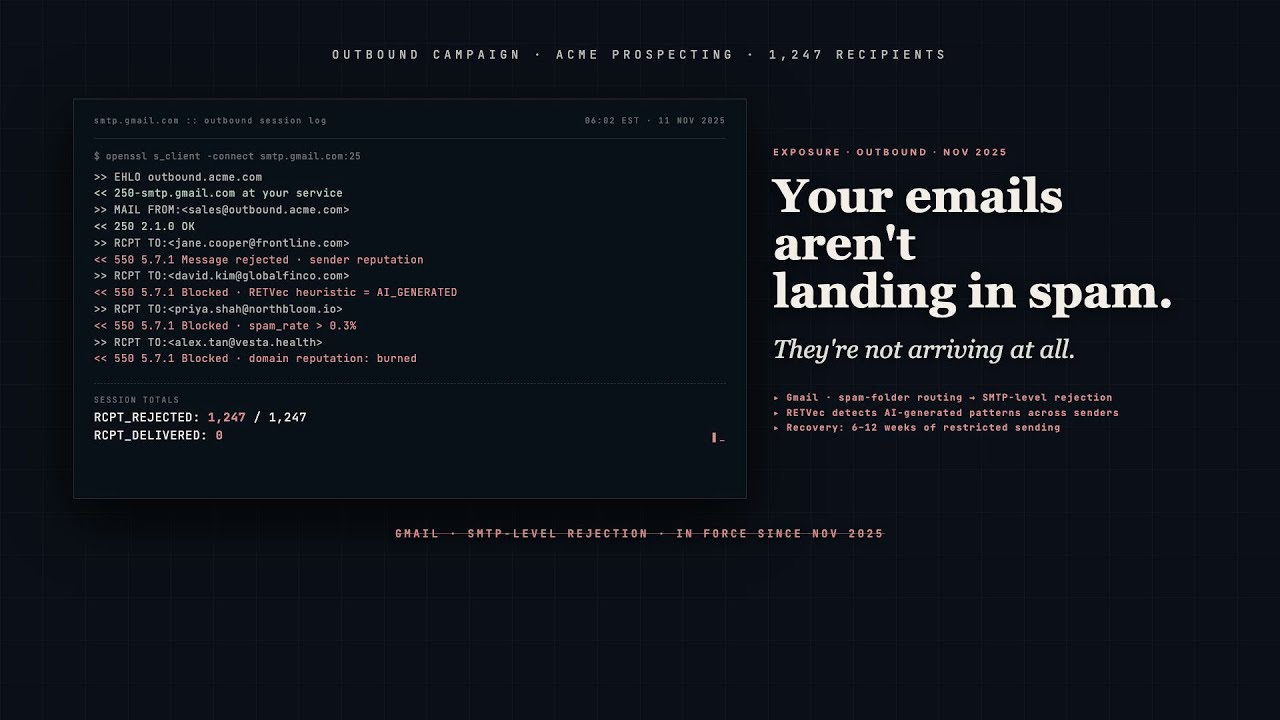
Gmail shifted from routing non-compliant emails to spam to rejecting them at the SMTP level in November 2025. Your emails no longer land in spam. They never arrive at all.
Google's RETVec system detects AI-generated text patterns across thousands of emails, even when individual word choices differ. Spam rate above 0.3% triggers domain reputation damage. Recovery takes 6-12 weeks of restricted sending, during which your legitimate transactional emails (invoices, password resets, deal confirmations) from the same domain also get throttled.
Under the doctrine of apparent authority, an AI agent acting on your company's behalf can bind you to commitments. An AI SDR that promises "guaranteed 100% uptime" or "full refund" may create enforceable obligations.
In regulated industries (FINRA, HIPAA), an AI that hallucinates a compliance certification ("We are FedRAMP authorized") triggers federal investigation risk. GDPR enforcement in 2026 requires explicit documented consent for cold outreach in the EU, and only 7% of enterprises have agentic-specific governance policies in place (Deloitte, 2026).
In March 2025, TechCrunch revealed that 11x.ai, backed by $74M from a16z and Benchmark at a $350M valuation, had been claiming customers it did not have. ZoomInfo's logo appeared on 11x's website despite conducting only a one-month trial where the product "performed significantly worse" than human SDRs. Former employees reported 70-80% customer churn in initial cohorts, with the product hallucinating and failing to load for some customers. The company's collapse illustrates the end state of the "volume over verification" approach: even $74M in funding cannot paper over a product that sends wrong information at scale.
A reference for evaluating your options. Save this table for your next vendor evaluation or budget review.
| Approach | What It Does | Cost Range | Strengths | Gaps |
|---|---|---|---|---|
| Autobound | Signal-based personalization from 400+ buying signals, including SEC filing analysis | $15-35K/yr | Deep signal library, 10-K processing within 24-48hrs of EDGAR publication | No claim verification against sources. Public company focus (~4,500 tickers). Personalization is not the same as verification. |
| Coldreach | Deep prospect research across 97M+ accounts, AI-generated outreach | $9-18K/yr | Broad account coverage, 3.8% average reply rate (claims) | Research depth without fact-checking layer. No governance or audit trail for enterprise compliance needs. |
| Clay | Data orchestration with 75+ enrichment sources, custom research workflows | $2-6K/yr | Flexible workflow builder ("Claygent"), best enrichment coverage | An enrichment tool, not a sending system. Requires significant configuration. No built-in verification or compliance layer. |
| Salesforce Einstein SDR | Native CRM AI for lead scoring, automated SDR tasks, 24/7 prospect engagement | $500-650/user/mo | Zero integration friction for Salesforce shops, uses existing CRM data | Locked to Salesforce ecosystem. Generic personalization. High per-user cost at scale. No external research capability. |
| Big 4 / Large SIs | Strategy consulting + platform implementation for "AI-powered sales transformation" | $500K-$3M+ | Brand credibility, large teams, established methodologies | They implement platforms, not build custom verification infrastructure. Engagements run 6-18 months. Their AI expertise is Salesforce/Microsoft configuration, not multi-agent pipeline engineering. |
| Internal Build | Hire ML engineers, build from scratch using LangChain/LangGraph | $300-600K/yr (2-3 FTEs) | Full control, no vendor dependencies | Recruiting ML engineers takes 3-6 months. Institutional knowledge risk. Most internal teams default to RAG without verification layers because the agentic architecture is harder to build. |
| Veriprajna (Custom Build) | Custom multi-agent verified outreach pipelines with governance, built on your stack | $80-150K build + support | Verification built into the architecture. Private company coverage. Governance and audit trails. CRM-native. | Higher upfront cost than SaaS. 10-14 week build timeline. Requires clean CRM data as starting point (we audit this in week 1). |
Pricing based on publicly available data as of Q1 2026. Enterprise pricing varies by contract terms and volume.
Five capabilities, each designed to solve a specific failure mode in AI-powered outbound. These are not product features. They are custom systems built to your data, your CRM, and your compliance requirements.
Three-agent architecture: a Researcher that extracts facts from structured sources, a Writer constrained to only use verified data, and a Fact-Checker that compares every claim against source documents before anything reaches a prospect.
We reach for LangGraph over CrewAI because enterprise sales needs deterministic state machines with explicit edges and conditions, not probabilistic agent delegation. The state machine enforces the rule: no email advances unless the fact-checker returns a compliance score above 0.95. Three failures routes to human review, never to degraded auto-send.
Before writing a single outbound email, we build the sending infrastructure: dedicated outreach subdomains isolated from your corporate domain, SPF/DKIM/DMARC alignment, automated warm-up sequences ramping from 5 to 30 emails/day over 30 days, and real-time reputation monitoring against Spamhaus and Google Postmaster Tools.
The architecture includes engagement-based throttling: if reply rates drop below a configurable threshold on any domain, sending pauses automatically. This prevents the silent domain burn that hits most AI outbound programs at the 60-90 day mark.
SEC filings cover 4,500 public companies. Your total addressable market is larger. We build custom research pipelines that pull from job postings (LinkedIn, Indeed, Greenhouse), review platforms (G2, Capterra), patent filings (USPTO API), and news with entity-level filtering.
Each source gets its own extraction logic and confidence scoring. A Greenhouse feed showing "Senior Salesforce Administrator" is high-confidence evidence of Salesforce usage. A press release mentioning "digital transformation" is low-confidence and gets flagged rather than cited. The output is a prospect intelligence card with sourced claims and confidence levels, not a bag of keywords.
An audit trail for every AI-generated claim: which source backed it, what the fact-checker scored, whether a human approved it, and when it was sent. This is the infrastructure that 93% of enterprises deploying agentic systems do not have (Deloitte, 2026).
The governance layer includes risk-calibrated review protocols: auto-send for lower-risk segments (mid-level contacts, standard industries), mandatory human approval for high-value targets (C-suite, regulated industries, deal sizes above your configurable threshold), and GDPR consent tracking with CAN-SPAM opt-out enforcement built into the pipeline.
Custom connectors built against the APIs your team already uses. For Salesforce: REST and Bulk APIs within the 100,000 daily call limit on Enterprise Edition, prospect intelligence synced as custom objects linked to Lead and Contact records. For HubSpot: CRM API v3 with entity resolution handling the deduplication problem that breaks at scale. For Outreach and Salesloft: approved emails pushed directly into sequences.
The AI layer sits alongside your stack, not on top of it. Your existing reporting, territory rules, and routing logic all work unchanged. The human review dashboard runs standalone or embeds as an iframe in Salesforce Lightning.
A step-by-step walkthrough of what happens between "new lead enters CRM" and "email lands in inbox." This is the process that separates verified outreach from the single-pass approach used by most AI SDR tools.
A new lead enters Salesforce (or HubSpot, or your CRM of choice). The pipeline reads the lead record and any enrichment data already in the CRM. It checks the lead against your "Do Not Contact" and opt-out lists before proceeding.
The Researcher queries structured data sources based on the prospect's company: SEC EDGAR for public companies (10-K Item 1A risk factors, Item 7 MD&A), LinkedIn API for employee signals, job board feeds for tech stack evidence, news APIs with entity-level filtering. Each retrieved fact is stored as a JSON object with source URL, retrieval timestamp, and confidence score. The output is a "Fact Sheet," not a paragraph of prose.
The Writer receives only the Fact Sheet. It is constrained: "Use ONLY the provided data points. Do not add any external facts." It synthesizes the verified facts into a compelling email aligned with your brand voice guidelines and the prospect's seniority level. The output is a draft with inline citations linking each claim back to the Fact Sheet.
The adversarial layer. The Fact-Checker compares every claim in the draft against the Fact Sheet. "Does the claim 'you grew revenue by 20%' appear in the source data? If not, flag as hallucination." It also checks tone compliance and brand safety guidelines. The output is a pass/fail status with a compliance score. In LangGraph, the conditional edge is explicit: score above 0.95 routes to the next step. Below 0.95 routes back to the Writer with specific correction notes. Three failures routes to human review.
The governance layer determines routing. High-value prospects (C-suite, regulated industries, large deal sizes) always go through human approval in the Centaur Dashboard: draft on the left, cited facts on the right, approve/edit/reject in one click. Lower-risk segments can auto-send after passing the Fact-Checker. Every human edit feeds back into the Writer agent's learning loop via RLHF.
The approved email pushes to your outreach tool (Outreach, Salesloft, Apollo) via API, scheduled according to the engagement-based throttling rules. The complete audit trail (source data, fact sheet, draft iterations, fact-checker scores, human approval if applicable) is logged and linked to the CRM record. If a prospect ever questions a claim, you can trace it back to the source in seconds.
A typical engagement runs 10-14 weeks from kickoff to supervised launch. Shorter if your CRM data is clean and your sending infrastructure exists. Longer if we are building private company intelligence pipelines from scratch.
We map your CRM data quality (duplicate rates, field completeness, contact recency), existing sending infrastructure (domain health, authentication, reputation scores), compliance requirements (GDPR obligations, industry-specific rules), and current outreach performance baselines.
The output is an architecture document specifying: which data sources your intelligence pipeline will use, which CRM APIs we will build against, your governance rules (who auto-sends, who gets human review), and a realistic performance forecast based on your actual data quality.
The multi-agent pipeline (Researcher, Writer, Fact-Checker) on LangGraph, CRM connectors for your specific stack, the human review dashboard, and the domain reputation monitoring system. We build against your actual prospect data, not synthetic test data.
Weekly demos so your team sees progress and can flag issues early. The Fact-Checker's accuracy thresholds are tuned using your historical outreach data: which claims generated replies, which generated complaints, which got no response.
Live testing with real prospect data from your CRM. The pipeline generates emails for actual leads, routes them through fact-checking and human review, but sends to internal test mailboxes first. Your SDR team reviews the output and provides feedback that tunes the system.
We load-test the pipeline at your expected sending volume to validate latency. A three-agent pipeline with retries can take 30-60 seconds per prospect. At 1,000 prospects per day, that is 8-17 hours of compute, which we distribute across async workers.
Live sending begins on a small segment with full monitoring: deliverability rates, engagement signals, fact-checker accuracy, human override frequency. We scale volume gradually as metrics confirm the system is performing.
Post-launch, we offer ongoing support (retainer-based) for pipeline tuning, new data source integration, and governance policy updates as your outbound program scales.
Score your organization's readiness for verified AI outbound. This is the same assessment framework we use in week one of every engagement. Answer honestly for useful results.
The pipeline separates research, writing, and verification into distinct agents with different objectives. The Researcher agent pulls data from structured sources (SEC EDGAR filings, LinkedIn API, job board feeds, news APIs) and outputs a JSON fact sheet with source citations for every claim. The Writer agent receives only this fact sheet and is constrained to use only the provided data points. The Fact-Checker agent then compares every claim in the draft against the original fact sheet, flagging anything the Writer added that was not in the source material.
This is not a single LLM call with a "please be accurate" instruction. It is three separate inference steps where each agent has a different optimization target: completeness (Researcher), persuasion within constraints (Writer), and accuracy (Fact-Checker). In our testing, this reduces hallucinated claims from the typical 12-18% in single-pass systems to under 2%. The residual 2% is why the human-in-the-loop layer exists.
The architecture runs on LangGraph, which enforces the state machine: no email advances to the send queue unless the Fact-Checker returns a pass status with a compliance score above 0.95. If it fails three times, the email routes to a human review queue instead of sending a degraded version.
SEC filings cover roughly 4,500 public companies. For the millions of private B2B targets, we build custom intelligence pipelines that pull from multiple verified sources: job postings (LinkedIn, Indeed, Greenhouse feeds reveal tech stack, growth signals, and org structure), G2 and Capterra reviews (reveal pain points and competitor dissatisfaction), patent filings (USPTO API for R&D direction), news and press releases (filtered by entity recognition, not keyword matching), LinkedIn company pages and employee activity, and Crunchbase or PitchBook data for funding and growth signals.
Each source gets its own extraction logic and confidence scoring. A job posting for "Senior Salesforce Administrator" is high-confidence evidence of Salesforce usage. A blog post mentioning "CRM modernization" is lower-confidence and gets flagged for verification. The pipeline weights and combines these signals into a prospect intelligence card with confidence levels for each claim. This is more work than scraping 10-Ks, which is exactly why off-the-shelf tools skip it and why it creates defensible value for your outbound program.
A typical engagement runs 10-14 weeks. Weeks 1-3 cover the audit and architecture: we map your CRM data quality, existing tech stack, sending infrastructure health, and compliance requirements. Weeks 4-8 are core build: the multi-agent pipeline, CRM connectors, fact-checking logic, and the human review dashboard. Weeks 9-12 are integration testing with your actual prospect data and live sending from your domains. Weeks 13-14 are supervised launch where we monitor pipeline performance and tune the system.
Total investment is typically $80,000-$150,000 for the initial build, depending on CRM complexity and the number of data sources in your intelligence pipeline. That compares to $15,000-$35,000 per year for an off-the-shelf AI SDR.
The math works when you factor in what the off-the-shelf tools actually cost in practice: 50-70% of enterprise buyers churn within the first year (UserGems, 2026), the average domain reputation recovery takes 6-12 weeks of lost sending capacity, and the revenue gap between AI-booked and human-booked meetings is 2.6x (AI SDRs convert 15% to qualified pipeline versus 25% for humans). A custom verified pipeline costs more upfront but generates compounding returns because it builds on your data, protects your domains, and improves with every human feedback loop.
Yes, and integration is designed from day one, not bolted on. For Salesforce, we build against the REST and Bulk APIs within the 100,000 daily call limit on Enterprise Edition. Prospect intelligence cards sync as custom objects linked to Lead and Contact records. For HubSpot, we use the CRM API v3 with association endpoints to maintain the contact-company-deal relationship graph. The deduplication issue that plagues HubSpot at scale (multiple contacts with slight name variations) gets handled in our pipeline with entity resolution before data hits the CRM.
For outreach tools (Outreach, Salesloft, Apollo), we push approved emails directly into sequences via their APIs. The human review dashboard can run standalone or embed as an iframe in Salesforce Lightning. The key architectural decision is where the "source of truth" lives. For most enterprises, that is Salesforce. Our pipeline reads from and writes back to Salesforce, so your existing reporting, territory rules, and routing logic all work unchanged. The AI layer sits alongside your stack, not on top of it.
The verification layer reduces hallucination to under 2%, but it does not eliminate it entirely. No system does, and anyone claiming zero hallucination rate is not being honest about how LLMs work.
Here is what the architecture does about the residual risk. First, the human-in-the-loop layer catches most of it. For high-value prospects (deal size above a configurable threshold, C-suite contacts, regulated industries), every email routes through human approval before sending. The system only auto-sends to lower-risk segments where a factual error is embarrassing but not legally dangerous.
Second, every sent email has a complete audit trail: the source data, the fact sheet, the draft iterations, the fact-checker scores, and (if applicable) the human approval. If a prospect flags an inaccuracy, you can trace exactly where the error originated and whether it was a source data issue, a writer extrapolation, or a fact-checker miss.
Third, we build feedback loops. When a human corrects or rejects a draft, that correction feeds into the system's learning. The Fact-Checker agent's thresholds tighten on the specific claim types that generated errors. Over time, the 2% shrinks. The honest answer is that verification reduces risk to a manageable level, and governance makes the residual risk transparent and auditable.
Autobound and Coldreach are strong products for their target market. Autobound excels at signal-based personalization across 400+ buying signals and processes SEC filings within 24-48 hours of publication. Coldreach offers deep research capabilities across 97 million accounts. If your outbound program is straightforward (targeting public companies, standard CRM, volume-oriented), these tools will work and cost less than a custom build.
Where they fall short is in three specific scenarios. First, verification depth. These platforms personalize based on signals but do not verify the resulting claims against source documents. An email referencing a "recent product launch" pulled from a misattributed news article still goes out. Second, private company coverage. Autobound's SEC filing strategy covers roughly 4,500 public companies. If your ICP includes mid-market or private companies, you are back to generic personalization for most of your TAM.
Third, governance and auditability. Neither platform provides the audit trail that regulated enterprises need: which source backed which claim, what the fact-checker scored, why a specific email was approved or flagged. For enterprises in financial services, healthcare, or government contracting where a hallucinated claim carries regulatory consequences, the governance gap is the deciding factor. The build-versus-buy decision comes down to whether your outbound risk profile requires verification infrastructure or whether signal-based personalization is sufficient.
The methodology and analysis behind this solution page.
Deep analysis of hallucination mechanics in sales AI, multi-agent verification architectures, and the case for deterministic fact-checking over probabilistic generation.
Enterprise AI SDR tools churn at 50-70% annually because volume without verification destroys more pipeline than it creates.
A single domain reputation collapse costs 6-12 weeks of lost sending capacity. For a sales team sending 500+ emails per day, that is thousands of prospects you cannot reach while your domain recovers. A verified pipeline costs more to build and pays back in the domains you keep, the meetings that convert, and the audit trail that protects you.