Adaptive Learning AI
Corporate training spends $102.8 billion a year in the U.S. alone. Most of it measures whether employees watched a video, not whether they learned anything. We build adaptive intelligence layers that model what each employee actually knows, skip what they have mastered, and prove competence to regulators and auditors.
<5%
of companies have deployed AI-native learning
Josh Bersin Company, Feb 2026
55%
seat-time reduction with adaptive compliance
Fulcrum Labs / Allegiant Airlines
EUR 35M
max penalty under EU AI Act high-risk provisions
EU AI Act, Article 99
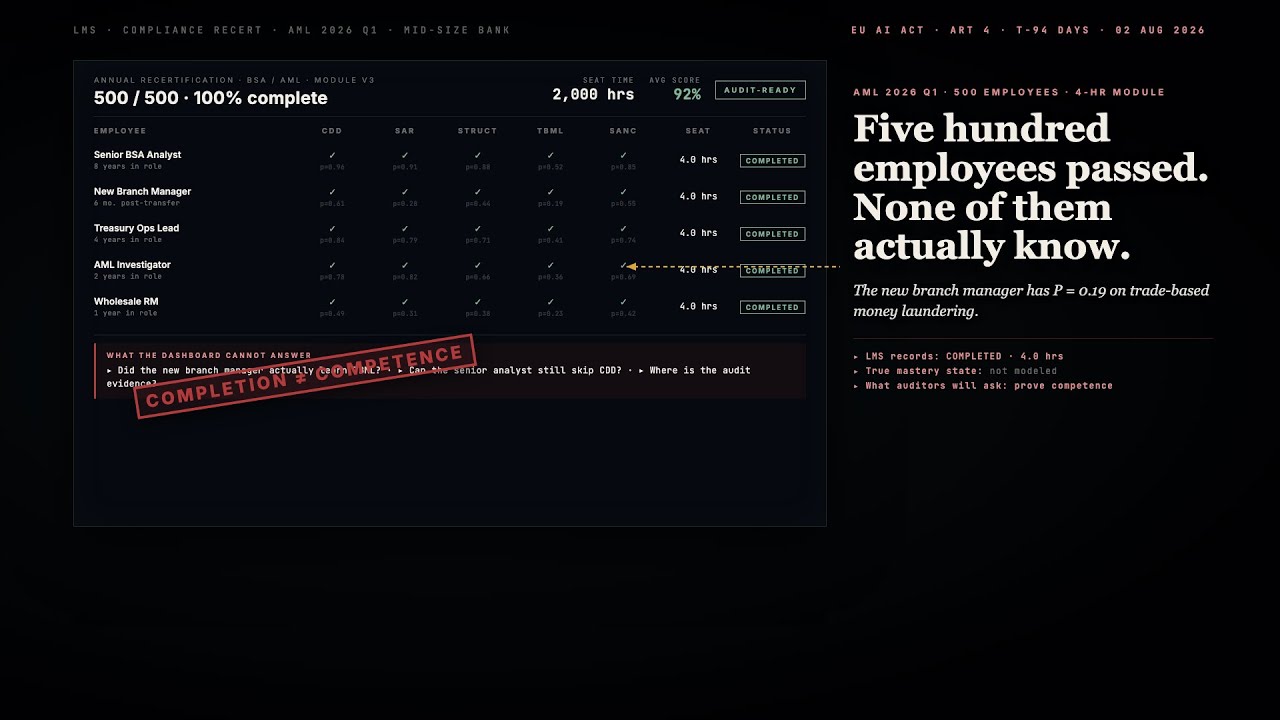
Every regulated enterprise runs annual compliance recertification. The typical approach: assign the same 4-hour AML module to all 500 employees in the compliance function. Here is what actually happens.
Consider a mid-size bank's annual AML training. The compliance team assigns a 4-hour module covering customer due diligence (CDD), suspicious activity reporting (SAR), structured transaction detection, trade-based money laundering (TBML), and sanctions screening.
| Employee Profile | CDD P(correct) |
SAR Filing P(correct) |
Structured Txn P(correct) |
TBML P(correct) |
Sanctions P(correct) |
Adaptive Time |
|---|---|---|---|---|---|---|
| Senior BSA Analyst 8 years in role |
0.96 | 0.91 | 0.88 | 0.52 | 0.85 | ~55 min |
| New Branch Manager 6 months post-transfer |
0.61 | 0.28 | 0.44 | 0.19 | 0.55 | ~3.5 hrs |
At $874 average training cost per learner (Training Magazine, 2025), that seat-time reduction across 500 employees represents $200K-$250K in recovered productivity annually. For organizations with 5,000+ compliance-trained staff, the numbers scale proportionally.
Every LMS vendor now claims "AI-powered adaptive learning." Here is what that means in practice, what it does not cover, and where you may need custom work.
| Approach | What It Does | Adaptive Method | Gaps |
|---|---|---|---|
| Cornerstone Galaxy AI | AI-driven content recommendations, quizzes, role-play scenarios. SkillsDNA framework. Adaptive Learning Agent (March 2026). | Collaborative filtering. Recommends based on peer completion patterns. | No concept-level knowledge tracing. Recommends "what to learn next," not "what you don't know." Learner experience historically criticized. Integration with non-Cornerstone content limited. |
| Docebo + 365 Talents | AI-enabled LMS+LXP. Skills assessment via 365 Talents acquisition. Content development, coaching, simulations. | Skills inference from job titles, self-assessments, content completion. AI admin automation. | Skills tracking is declaration-based (employee says they know X) or completion-based (employee finished course Y), not mastery-measured. No interaction-level tracking. |
| SAP SuccessFactors | Deep HR integration. Compliance controls and global regulatory support. AI-powered talent intelligence hub. | AI learning path recommendations. Skill-gap analysis through Talent Intelligence Hub. | Learning module is an "add-on" to HCM. Functional for compliance tracking but not built for adaptive delivery. Limited content engagement analytics. |
| Fulcrum Labs | Dedicated adaptive learning platform. Proprietary BKM (Behavior & Knowledge Mapping) algorithm. Proven compliance results. | Proprietary adaptive engine. Mastery-based progression. Real-time content adjustment. | Requires content migration to their platform. Not an overlay on existing LMS. Works best with Fulcrum-formatted content. Smaller enterprise footprint than Cornerstone/SAP. |
| Riiid / EdTech Platforms | AI-driven test prep and adaptive learning. DKT implementations for academic settings. $256M funding. | Knowledge tracing models (closest to true KT). | Built for academic assessment (standardized tests, K-12). Not designed for corporate compliance workflows, LMS integration, or regulatory audit evidence. |
| Big 4 / Large SIs | Workforce transformation consulting. LMS implementation, change management, organizational design. PwC/Deloitte agentic workforce research. | None. They implement and configure vendor platforms. | They install Cornerstone or SAP, not build adaptive intelligence. Engagements run $500K-$5M+. You get a configured LMS, not a knowledge tracing engine. The adaptive logic belongs to the vendor, not you. |
| Custom Build (Veriprajna) |
Knowledge tracing engine (SAKT/AKT) as an intelligence layer on your existing LMS. xAPI/LTI integration. Domain-specific model tuning. | Concept-level knowledge tracing. Models mastery probability per skill per employee. Updates with every interaction. | Requires xAPI-capable infrastructure (we help build this). Higher initial technical investment than buying a platform. Not a full LMS replacement. Depends on content quality and concept tagging. |
An honest note on the "custom build" column: the biggest risk in any adaptive learning project is not the model. It is content tagging. If your compliance modules are tagged at the course level ("AML Training") rather than the concept level ("structured transaction detection under $10K"), the knowledge tracing model has nothing granular to track. We address this in Phase 1 of every engagement.
Each capability is a standalone engagement or part of a broader adaptive learning program. We work with your existing LMS, your existing content, and your existing compliance workflows.
We build SAKT-based knowledge tracing models that plug into your LMS via xAPI. We reach for SAKT when your content has clear skill tags, which most compliance content does: each regulation maps to specific concepts. For longer learning sequences or blended programs where context matters across sessions, AKT's context-aware attention handles the complexity better.
The model assigns a mastery probability to every concept for every employee and updates it with each interaction. Not "Employee X completed AML Training." Instead: "Employee X has P=0.91 on CDD, P=0.52 on TBML, P=0.33 on sanctions evasion techniques."
Technical note: SAKT runs at ~0.7M parameters with AUC ~0.80 on standard benchmarks. Lightweight enough for real-time inference without dedicated GPU infrastructure for most enterprise deployments.
Takes your existing compliance content and wraps it with an adaptive intelligence layer. Employees who demonstrate mastery in the first few interactions skip ahead. Those with gaps get targeted remediation at the right difficulty level.
The system operates in the "Flow Zone," where the challenge matches the learner's current ability (P=0.40-0.70). Content that is too easy (P>0.75) gets skipped. Content that is too hard (P<0.35) gets scaffolded with prerequisite review first. This is Vygotsky's Zone of Proximal Development, operationalized with probability vectors.
Output: mastery certificates with concept-level evidence. Your compliance audit shows which specific AML concepts each employee has demonstrated proficiency in, not just that they clicked through 4 hours of slides.
Article 4 requires role-based AI literacy. The EU AI Office has explicitly stated there is no one-size-fits-all approach. A data engineer deploying models needs different literacy than a procurement officer evaluating AI vendor contracts.
We build adaptive AI literacy training where the knowledge tracing model maps each employee's understanding across role-specific AI concepts: data provenance, model limitations, bias detection, human oversight obligations, and the specific AI systems they interact with daily.
With national market surveillance enforcement beginning August 2, 2026, this is not a nice-to-have. Organizations need audit-ready evidence of role-appropriate AI literacy across their workforce.
Employees are increasingly using ChatGPT and other AI tools to breeze through compliance modules. The response patterns are detectable: consistent high accuracy with unnaturally fast response times across unrelated topics. The knowledge tracing model flags these anomalies because genuine mastery produces specific patterns that AI-assisted gaming does not.
We build scenario-based assessment layers where the KT model generates verification challenges calibrated to the employee's demonstrated mastery state. If someone claims P=0.95 on sanctions screening but their response-time distribution looks inconsistent with genuine recall, the system surfaces targeted verification questions.
Gartner predicts 50% of organizations will require "AI-free" skill assessments through 2026 due to critical thinking atrophy from GenAI. This is that assessment system.
The buyer-facing product. Your L&D team and compliance officers see team mastery heatmaps across every compliance domain, certification readiness predictions ("85% probability Employee X passes the AML recertification"), ROI analytics (hours saved, cost per competency point gained), and compliance audit exports with timestamped mastery evidence.
This is what turns the knowledge tracing engine from a technical capability into something your CLO can present to the board. 26% of leaders report difficulty measuring training ROI. This dashboard answers their question with specific numbers, not completion percentages.
Three phases. The first phase is the most important and the one most teams skip.
We audit your training content library and build a concept taxonomy. This is where most adaptive learning projects succeed or fail. If your AML module is tagged as one course ("AML Training"), the KT model has nothing granular to trace. We decompose it into 15-40 discrete concepts: CDD procedures, enhanced due diligence triggers, SAR narrative requirements, BSA/AML risk factors, OFAC screening procedures.
We also audit your data infrastructure. Can your LMS emit xAPI statements? If you are on SCORM 1.2, we scope the wrapper needed to extract interaction-level data. We map your existing completion data to identify which courses have enough interaction history for initial model training.
Deliverable: Concept taxonomy, data readiness report, integration architecture, and a realistic assessment of expected seat-time reduction based on your content structure and employee population.
We train the knowledge tracing model on your historical interaction data. If you have limited history (common for new compliance programs), we use transfer learning from anonymized cross-client datasets and run a diagnostic assessment period to bootstrap the model.
Integration happens in parallel. We deploy the LRS, connect xAPI pipelines, build the LTI bridge to your LMS, and configure the adaptive recommendation API. For Cornerstone, this means the Edge Marketplace and REST API. For SAP SuccessFactors, SAP BTP and the standard learning APIs.
Deliverable: Working KT model with validated AUC on your data, LMS integration in staging, and the L&D dashboard connected to live data streams.
We run the adaptive system alongside your existing training for a controlled group (typically 100-500 employees in one compliance domain). We measure seat-time reduction, assessment pass rates, and knowledge retention at 30/60/90 days against a control group following the standard curriculum.
During the pilot, we tune Flow Zone thresholds for your population. The default range (P=0.40-0.70) works well for most compliance content, but some domains need calibration. Safety-critical content (clinical protocols, hazardous materials handling) often benefits from tighter thresholds that keep learners in the mastery zone longer.
Deliverable: Pilot results with measured seat-time reduction, pass-rate data, retention comparison, and a rollout plan for your full employee population.
A realistic caveat on timelines:
These phases assume your IT team can provide LMS API access and your content team can participate in concept mapping. In practice, LMS API access is the most common bottleneck. If your Cornerstone instance requires a 6-week IT security review for API integration, that shifts Phase 2 accordingly. We scope this in Phase 1 so there are no surprises.
Input your numbers to see how much seat time adaptive learning could recover. This calculator uses conservative estimates based on published case studies. Your actual results depend on content structure, concept tagging quality, and employee population characteristics.
Include all mandatory compliance modules (AML, privacy, safety, ethics, etc.)
Salary + benefits + overhead. U.S. average for knowledge workers: $60-$90/hr
How much content do your employees already know before starting? Higher overlap = more time saved.
Current annual training hours
10,000 hrs
Projected hours with adaptive learning
5,500 hrs
Annual seat-time savings
4,500 hrs
Recovered productivity value
$337,500
Seat-time reduction
45%
Based on conservative adaptive learning efficiency: mastery overlap (45%) produces proportional time savings. Allegiant Airlines achieved 55% with Fulcrum Labs. Published case studies range from 22% (healthcare onboarding) to 55% (compliance recertification).
For your CFO
Frame recovered productivity as "hours returned to revenue-generating work." If 500 employees each save 9 hours, that is 4,500 hours. At your blended rate, quantify what that time is worth in terms of billable work, customer interactions, or operational capacity.
For your compliance officer
Emphasize mastery evidence over completion records. The average non-compliance incident costs $9.4M, which is 3x the cost of the compliance program itself (Secureframe, 2026). Concept-level mastery tracking turns training from a checkbox into a risk management tool.
For your CHRO
Position this as employee experience. "Lack of time" has been the #1 employee obstacle to training for three consecutive years. Eliminating redundant content is not just efficient, it signals respect for your employees' time and expertise.
We build an intelligence layer that sits alongside your LMS, not a replacement. The integration works through xAPI (Experience API) and LTI (Learning Tools Interoperability). Your existing SCORM content stays where it is. We deploy a Learning Record Store that captures granular interaction data from your modules, including every response, every hint request, every time-on-task metric. The knowledge tracing model processes these signals and feeds adaptive recommendations back into your LMS through LTI.
For Cornerstone specifically, we use the Edge Marketplace for distribution and the REST API for learner data sync. For SAP SuccessFactors, we connect through SAP BTP (Business Technology Platform) and the standard learning APIs. The biggest technical hurdle is usually SCORM content that only reports pass/fail. We build a lightweight xAPI wrapper that extracts the interaction-level data needed for knowledge tracing without rebuilding your content library. Most integrations reach production in 6-8 weeks.
Most LMS AI features, including Cornerstone's Adaptive Learning Agent launched in March 2026, use collaborative filtering. That means they recommend content based on what similar employees completed. It is Netflix for training: people like you watched Course X next.
Knowledge tracing is fundamentally different. It builds a mathematical model of what each employee actually knows at the concept level. Instead of tracking that someone completed an AML module, knowledge tracing tracks whether they understand structured transaction detection, know CTR filing thresholds, and can identify layering schemes. The model assigns mastery probabilities to each concept and updates them with every interaction. When we say an employee has a 0.62 probability of correctly identifying a placement scenario, that is a specific, testable prediction.
The practical difference: collaborative filtering sends everyone through roughly the same content in roughly the same order. Knowledge tracing identifies that Employee A already understands customer due diligence (P=0.94) but struggles with trade-based money laundering (P=0.31), and adapts the learning path accordingly. One approach tracks completion patterns. The other tracks competence.
The strongest published evidence comes from Fulcrum Labs, whose adaptive platform reduced Allegiant Airlines station training from 51 days to 23 days, a 55% reduction. That same deployment cut accidents and equipment damage by 60%, proving the time savings did not come at the expense of competence. A global med-tech company using adaptive compliance training saved 16,000+ hours of seat time across 113,000 learners, translating to over $500,000 in recovered productivity. A global retailer achieved 600% ROI from a single adaptive initiative covering 3,000 employees.
The mechanism is straightforward: in a typical 30-minute compliance module, employees who already understand 60-70% of the material still sit through all of it. Knowledge tracing identifies mastered concepts within the first few interactions and skips them. An employee who demonstrates proficiency in anti-bribery basics moves directly to advanced scenarios they have not mastered. In our implementations, we target 30-50% seat-time reduction as the baseline. The actual number depends on how much content overlap exists across your employee population and how well the existing content maps to discrete skill concepts.
Article 4 of the EU AI Act requires providers and deployers of AI systems to ensure sufficient AI literacy among staff, taking into account their technical knowledge, experience, and the context in which AI systems are used. The obligation has been in effect since February 2, 2025. National market surveillance authorities begin enforcement from August 2, 2026, with penalties up to EUR 35 million or 7% of global revenue.
The core challenge is that Article 4 explicitly requires role-based training. A data engineer deploying AI models needs different literacy than a marketing manager using AI-generated content or a compliance officer reviewing AI-assisted decisions. Generic AI awareness workshops do not satisfy this requirement.
We build adaptive AI literacy training programs where the knowledge tracing model maps each employee's understanding across AI concepts specific to their role. The system tracks comprehension of topics like data provenance, model limitations, bias detection, and human oversight obligations. Because the model captures actual understanding rather than just completion, you can generate audit evidence that demonstrates role-appropriate AI literacy to regulators. This is the difference between telling a regulator your employees watched a video about AI and showing concept-level mastery data across your workforce.
For the initial assessment, we need your content catalog (what modules exist, what topics they cover, how they are tagged) and anonymized completion data (who completed what, when, and any available assessment scores). We do not need PII for the assessment phase.
For knowledge tracing deployment, the model processes interaction-level data: response correctness, response time, hint usage, and concept tags. User identifiers are hashed at the integration boundary. The model operates on anonymized sequences. We support single-tenant deployment for regulated industries where data cannot leave your infrastructure. The LRS (Learning Record Store) can run in your private cloud or on-premises.
For organizations subject to GDPR, we build data retention policies into the architecture: automatic deletion schedules, right-to-erasure workflows, and data processing agreements that specify exactly which interaction signals are captured and how long they persist. For HIPAA-regulated environments in healthcare, we deploy within your existing compliant infrastructure and sign BAAs. We have built adaptive systems in both configurations.
Platforms like Docebo and Fulcrum Labs are strong products for specific use cases. Docebo excels at AI-powered content management and social learning. Fulcrum Labs has proven adaptive compliance results with a proprietary BKM algorithm. If your needs fit squarely within what their platforms offer out of the box, use them.
Where a custom build makes sense: (1) You have a complex existing LMS ecosystem you cannot replace. Most enterprises run Cornerstone or SAP SuccessFactors with years of content, integrations, and workflows. A platform swap is a multi-year, multi-million dollar project. We build the adaptive layer that plugs into what you have. (2) You need domain-specific knowledge tracing models. Off-the-shelf platforms use general-purpose algorithms. If your compliance training covers anti-money laundering, clinical protocols, or safety procedures with specific regulatory requirements, a model tuned to your content taxonomy outperforms a generic one. (3) You want to own the intelligence. Platform subscriptions mean the adaptive logic belongs to the vendor. If you are building training as a competitive advantage, particularly in highly regulated industries where mastery verification has legal weight, owning the model and the data pipeline matters.
We also work alongside platforms. A common engagement: keep Docebo or Cornerstone for content management and use Veriprajna's knowledge tracing engine as the adaptive intelligence layer connected via xAPI.
The technical foundations behind our adaptive learning approach, explored in depth.
True Educational Intelligence: Deep Knowledge TracingHow Deep Knowledge Tracing models student cognition over time, the mathematics of the Flow Zone, and the neuro-symbolic architecture that bridges adaptive engines with conversational AI.
Average U.S. training spend: $874 per learner per year. Non-compliance incidents average $9.4M each.
The gap between "completed training" and "actually competent" is where regulatory risk lives. We build the systems that close it.