Enterprise Deepfake Defense
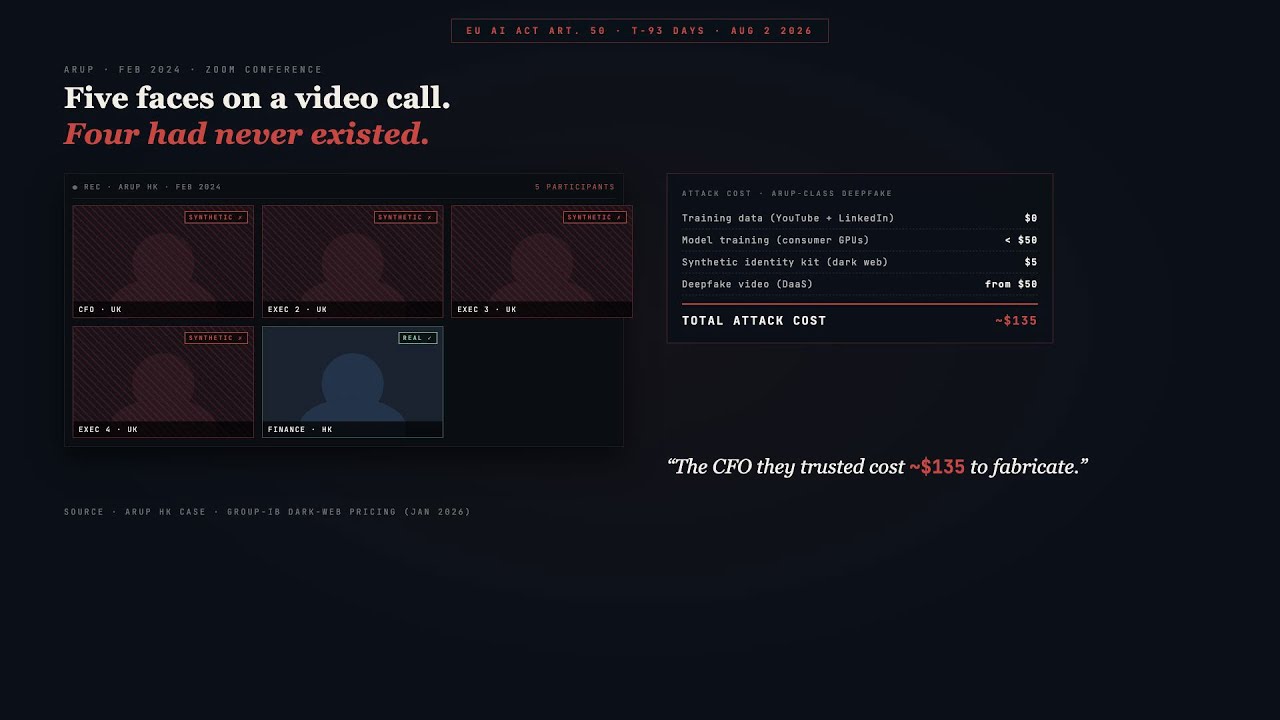
In February 2024, attackers used AI-generated deepfakes of an entire executive team to steal $25.6 million from Arup in a single video call. Since January 2026, standard cyber insurance policies explicitly exclude deepfake fraud. If it happens to you, the loss is uninsured. We build the layered defense that stops it.
$680K
Average enterprise deepfake incident loss
2024 enterprise data
1,300%
Deepfake fraud surge, 2025 YoY
Pindrop Voice Intelligence Report
50-65%
Real-world detection tool accuracy
Purdue University benchmark, 2025
Understanding the mechanics matters because it reveals which controls fail and which survive. The Arup breach was not a technology failure. It was a process failure exploited by convincing technology.
Attackers harvested publicly available video and audio of Arup executives from YouTube, conference presentations, and LinkedIn. This material trained Generative Adversarial Networks (GANs) and neural voice synthesis models to replicate not just the appearance of the CFO, but speech patterns, intonation, and micro-expressions. Total cost for training data collection: zero. Total cost for model training on consumer GPUs: under $50.
A spear-phishing email from the "CFO" requested help with a confidential transaction. When the Hong Kong finance employee expressed skepticism, the attackers escalated to a video call. The employee joined a conference with familiar faces, familiar voices, and a familiar discussion format. Every person on that call except the victim was synthetic.
The attackers used virtual camera software (tools like OBS VirtualCam or the open-source Deepfake Offensive Toolkit) to feed synthetic video frames directly into the Zoom data stream. This is a video injection attack, not a presentation attack. The distinction matters: a presentation attack holds a screen in front of a camera and can be caught by liveness checks. An injection attack bypasses the camera entirely. The conferencing application treats the synthetic feed as legitimate hardware input. Most "deepfake detection" tools are designed for presentation attacks. Injection attacks bypass them.
The deepfaked CFO instructed 15 wire transfers totaling $25.6 million across five Hong Kong bank accounts. The employee complied. The fraud was discovered only when the employee later contacted the real CFO's office in the UK. No malware was deployed. No credentials were stolen. No network was breached. The only thing that was compromised was trust in what the employee saw and heard.
Not detection technology alone. Detection tools might have flagged anomalies, but with real-world accuracy at 50-65%, you cannot stake $25.6 million on a probabilistic alert. What would have stopped it: a mandatory out-of-band verification policy requiring any financial instruction above a defined threshold to be confirmed through a pre-registered callback number or encrypted channel before execution. This process control costs nothing to implement and is effective against every variant of synthetic media fraud. Detection layers add confidence. Process controls add certainty.
This table is a reference for CISOs evaluating options. No single vendor covers all attack vectors. The right answer is almost always a combination, and the process layer matters more than any individual tool.
| Vendor | Primary Modality | Platform Integration | Best For | Gap |
|---|---|---|---|---|
| Reality Defender | Video + audio + image | Zoom Marketplace, API | Real-time meeting monitoring, content verification | Server-side analysis adds latency; limited injection attack coverage |
| Pindrop | Voice / audio | Zoom Contact Center (March 2026) | Call centers, telephony-heavy environments | Audio-only; does not analyze video stream |
| iProov | Biometric liveness (Flashmark) | SDK, API | Identity onboarding, login verification | Designed for onboarding, not continuous meeting authentication |
| GetReal Security | Biometric + behavioral + context | API, enterprise integration | Continuous identity authentication during calls | Newer entrant ($17.5M Series A); limited track record at scale |
| Beyond Identity (RealityCheck) | Device attestation | Zoom plugin | Verifying webcam feed comes from physical hardware | Device-level only; does not analyze content of the video stream |
| Adaptive Security | Deepfake simulation training | Standalone platform | Employee awareness, simulated attack exercises | Training platform, not a detection tool; does not block attacks |
| Resemble AI (Detect 2B) | Audio + video | Zoom, Teams, Meet, Webex | Multi-platform meeting detection | Accuracy data limited; emerging product |
| Big 4 / Large SIs | Advisory / policy | N/A | Governance frameworks, board-level reporting | No detection tooling. Engagements run $500K-$5M+ for policy documents. Recommend vendors, rarely build or integrate. |
| DIY / In-house | Custom | Whatever you build | Organizations with large ML teams and specific accuracy requirements | Requires continuous adversarial retraining. Detection models degrade within weeks as generation techniques evolve. |
Vendor data current as of April 2026. Veriprajna is vendor-neutral and does not resell any of these products. We evaluate, integrate, and build what your environment needs.
Five capabilities, each addressing a specific gap that no single vendor fills. Every engagement is scoped to your environment, your conferencing stack, and your regulatory obligations.
We design and integrate a multi-vendor detection stack tuned to your conferencing environment. For a Zoom-heavy organization, that might mean Reality Defender for video analysis, Pindrop for voice authentication on the telephony side, and Beyond Identity's RealityCheck for device attestation to catch injection attacks. For Teams-first environments, we reach for Resemble's Detect 2B or Truly, which support the Teams SDK directly.
The integration layer is the part no vendor provides: correlation logic that connects weak signals across modalities. A slightly anomalous audio spectrogram alone might not trigger an alert. Combined with an unattested device and a transaction request above your threshold, it escalates to the SOC before the wire instruction reaches treasury.
The highest-ROI intervention in deepfake defense costs nothing in software licenses. We design mandatory secondary verification channels for high-value transactions: callback to a pre-registered mobile number via encrypted channel (Signal, not SMS), hardware token confirmation for transfers above your defined threshold, and dual authorization from a second approver who was not on the original video call.
We embed these workflows into your existing treasury management and ERP systems so they are enforced automatically, not dependent on an employee remembering to follow procedure under pressure. SWIFT's Customer Security Programme already mandates out-of-band verification for interbank transfers. We bring the same discipline to intra-corporate authorization.
We simulate the attacks that matter against your controls before criminals do. That means generating deepfake video of consenting executives using the same publicly available training data an attacker would harvest, injecting it into your Zoom/Teams environment via virtual camera software, and testing whether your detection stack, your process controls, and your employees catch it.
The output is not a 200-page report. It is a gap map: which attack vectors your controls stop, which they miss, and the specific configuration changes or process additions that close each gap. We also test your SOC's incident response. When a deepfake alert fires, does the analyst know what to do? If the runbook does not exist, we write it.
EU AI Act Article 50 takes effect August 2, 2026. SEC Form 8-K cybersecurity disclosure applies to any material incident. Illinois BIPA creates class-action exposure if you deploy behavioral biometrics without proper consent. ISO/IEC 30107-3 is the benchmark for presentation attack detection. CEN/TS 18099 covers injection attacks.
We map each regulation to specific technical controls in your defense architecture and identify where requirements conflict. Behavioral biometrics (keystroke dynamics, mouse tracking) are effective for continuous authentication but create BIPA and GDPR Article 9 exposure. We design the consent framework and data minimization architecture that makes deployment defensible, not just functional.
For organizations where off-the-shelf detection accuracy is not acceptable, particularly financial institutions processing high-value wire transfers or defense contractors on classified calls, we build custom detection pipelines. This involves ensemble models that combine multiple detection approaches (frame-level visual analysis, audio spectrogram comparison, temporal consistency checks, physiological signal verification), domain-specific fine-tuning on your organization's actual communication patterns, and adversarial hardening against the latest generation techniques.
We also build the retraining infrastructure. Detection models degrade within weeks as generation techniques evolve. A custom pipeline without automated adversarial retraining is a depreciating asset. We design the feedback loop that keeps detection current: new attack samples from red-team exercises and threat intelligence feeds are continuously incorporated into the training pipeline.
Every engagement starts with understanding your specific risk profile. A private equity firm with $500M in monthly wire transfers has different needs than a technology company concerned about executive impersonation in investor calls.
Map your communication workflows, wire transfer authorization paths, and conferencing stack. Identify which executives are most targetable based on publicly available training data. Score current controls against the injection attack, presentation attack, and social engineering vectors. Weeks 1-3
Select and integrate detection tools based on your platform, accuracy requirements, and regulatory constraints. Build OOB verification workflows into treasury and ERP systems. Design correlation logic across detection layers. Weeks 4-8
Run simulated deepfake attacks against your deployed controls. Test SOC response procedures. Tune detection thresholds based on your false-positive tolerance. Close identified gaps with configuration changes or additional controls. Weeks 9-12
Simulation-based employee training using deepfake replicas of your own executives (with consent). SOC runbook creation. Incident response playbook. Quarterly red-team schedule to maintain readiness as attack techniques evolve. Weeks 12-14
A Deloitte or EY engagement in this space produces a governance framework and vendor shortlist. Typical cost: $500K-$2M+. Timeline: 4-6 months. Deliverable: a PDF. They do not build the integration layer, write the correlation logic, run the red-team exercises, or tune the detection thresholds. They recommend vendors, then a different team (often a different firm) does the implementation. We do the assessment, integration, red-teaming, and training as a single engagement because the team that understands your threat model should be the team that builds and tests the defenses.
Score your organization across the five control layers that matter. This is not a sales funnel. Low scores point to specific controls you can implement independently.
When someone requests a wire transfer or sensitive action during a video call, what happens?
Do you have any deepfake detection tools deployed on your conferencing platforms?
Have your employees experienced simulated deepfake attacks?
Does your incident response plan specifically address synthetic media attacks?
Have you reviewed your cyber insurance policy for AI/deepfake exclusions and mapped compliance obligations?
No single tool covers all attack vectors. Video-level detection (Reality Defender, GetReal Security) catches face-swap artifacts and physiological signal absence. Audio-level detection (Pindrop, OmniSpeech) catches voice cloning through spectrogram analysis. But the most dangerous attacks use video injection, where synthetic frames are fed directly into the conferencing data stream via virtual camera software like OBS, bypassing client-side liveness checks entirely.
Effective defense requires layering: a detection plugin for the conferencing platform, device attestation to verify the webcam feed comes from physical hardware (Beyond Identity's RealityCheck does this for Zoom), and mandatory out-of-band verification for any financial instruction received during a call. We design the integration architecture that connects these layers and build the correlation logic so a weak signal from one layer (slightly anomalous audio) combined with another (unverified device) triggers escalation before a transfer is authorized.
Enterprise detection solutions range from $10,000 to $250,000+ per year depending on volume and integration depth. But framing deepfake defense as a line-item cost misses the picture. Since January 2026, standard cyber insurance policies explicitly exclude AI-generated intermediaries from social engineering coverage. That means a deepfake-driven wire transfer loss comes directly off your balance sheet, with no policy backstop.
For context, the average enterprise deepfake incident costs $500,000-$680,000 (2024 data), and the Arup breach hit $25.6 million. The business case is straightforward: compare the annual cost of a phased detection deployment ($50K-$150K for most mid-to-large enterprises) against uninsured loss exposure. We help CISOs build this case with specifics: mapping your wire transfer volume, identifying high-risk authorization workflows, and calculating exposure based on your transaction profile.
Be skeptical. Lab benchmarks and real-world performance diverge dramatically. Purdue University's 2025 benchmark found that commercial detection tools claiming 96%+ accuracy in controlled settings dropped to 50-65% against deepfakes circulating in the wild. The gap exists because lab datasets use known generation methods, while real attacks use the latest models, compression artifacts from conferencing codecs, and adversarial techniques specifically designed to evade detection.
When evaluating vendors, ask three questions: What dataset was the benchmark run against, and when was it last updated? What is the false-acceptance rate (FAR), meaning how often does a deepfake get through as real? And does the system detect injection attacks (virtual camera feeds), or only presentation attacks (someone holding a screen in front of a webcam)? CEN/TS 18099 is the emerging standard for injection attack detection testing. If a vendor cannot cite their performance against this standard, their coverage has a critical blind spot.
Three regulatory forces are converging. First, EU AI Act Article 50 transparency obligations take effect August 2, 2026, requiring deployers of AI systems that generate deepfakes to disclose that content is artificially generated. Penalties reach EUR 35 million or 7% of global turnover. The Code of Practice is expected finalized by May-June 2026.
Second, the SEC cybersecurity incident disclosure rule (effective since December 2023) requires public companies to report material cybersecurity incidents on Form 8-K within four business days. A $500K+ deepfake fraud likely qualifies as material for most mid-cap firms.
Third, if you deploy behavioral biometrics (keystroke dynamics, mouse tracking) for continuous authentication, Illinois BIPA and GDPR Article 9 create litigation exposure. BIPA settlements in 2025 included Clearview AI at $51.75 million and Speedway at $12.1 million for employee biometric collection without consent. We map each of these requirements to specific technical controls so your defense architecture is compliant from day one, not retrofitted after a legal review.
Training alone is not sufficient, but it is still necessary. Meta-analysis of 56 studies on human deepfake detection shows average accuracy around 50%, which is statistically equivalent to guessing. Current generation deepfakes, especially with diffusion-model temporal consistency, produce video that trained security professionals cannot reliably distinguish from reality.
That said, training changes behavior in ways that technology cannot. An employee who has experienced a simulated deepfake attack (Adaptive Security, which raised $146.5 million and serves 500+ enterprises, offers exactly this) is far more likely to follow out-of-band verification procedures instead of trusting the video call at face value. The right approach pairs simulation-based training with mandatory process controls. Specifically: any financial instruction above your threshold received during a video call must be confirmed through a pre-registered callback number or encrypted channel before execution. This process layer, not detection technology, is what would have stopped the Arup breach.
A phased deployment typically runs 8-14 weeks for a mid-to-large enterprise. Phase 1 (weeks 1-3) covers threat assessment and architecture design: we map your communication workflows, identify high-risk authorization paths, evaluate your current controls, and design the layered defense. Phase 2 (weeks 4-8) handles tool selection and integration: vendor evaluation based on your specific environment (Zoom vs. Teams vs. both, cloud vs. on-premise requirements, BIPA/GDPR constraints on biometrics), deployment of detection plugins, and implementation of out-of-band verification workflows in your treasury and finance operations.
Phase 3 (weeks 9-12) is red-teaming and hardening: we run simulated deepfake attacks against the deployed controls, identify gaps, and tune detection thresholds. Phase 4 (weeks 12-14) covers training and go-live: simulation-based employee training, runbook creation for the SOC, and incident response playbook development. The timeline compresses if you have a single conferencing platform and a well-defined authorization workflow. It extends if you operate across multiple platforms, jurisdictions with different biometric privacy laws, or have complex multi-party authorization chains.
Our in-depth analysis behind this solution page:
Forensic analysis of the Arup $25.6M deepfake breach, real-time generative fraud techniques, and the architectural case for multi-layered enterprise defense.
Deloitte projects AI-facilitated fraud losses will reach $40 billion by 2027. Since January 2026, standard cyber policies exclude deepfake fraud from social engineering coverage.
We start with a threat assessment that maps your specific exposure: which executives are most targetable, which authorization workflows are vulnerable, and which controls close the gaps fastest.