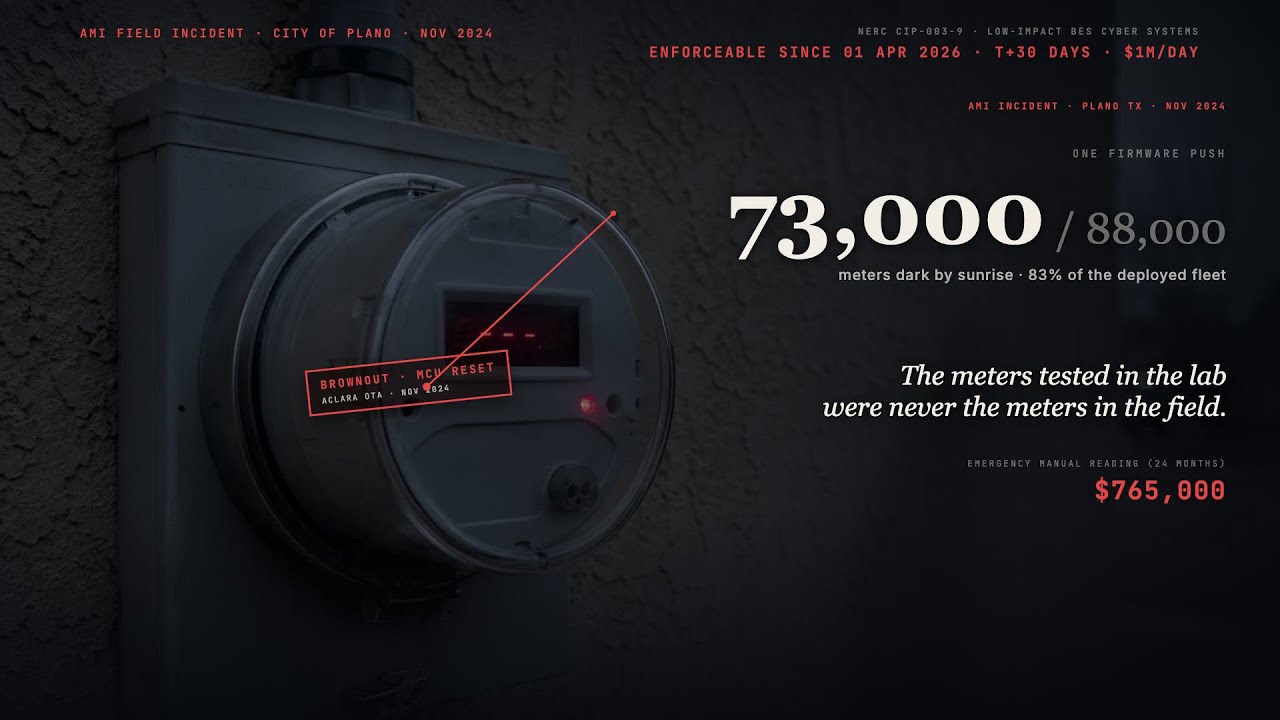
One bad firmware push cost Plano, TX $765,000 and knocked 73,000 meters offline. Memphis is spending $9M on repairs. Your AMI head-end tracks which meters stopped talking. We build the system that tells you which ones will stop next.
73,000
Meters bricked by one firmware push
Plano, TX (Nov 2024)
29%
Endpoints failing silently without alerts
Electric Energy Online
$15.4M+
Combined remediation costs (3 incidents)
Plano + Toronto + Memphis
Smart meter failures follow predictable patterns that current monitoring tools miss entirely.
Here is exactly what happened in Plano. Aclara pushed a firmware update to 88,000 water meters in November 2024. The update was supposed to optimize power consumption and fix bugs related to premature battery drain reported since 2023. In the lab, the firmware worked. In the field, 73,000 meters went dark.
The root cause: the firmware was tested against meters with new batteries and strong RF signal. But 83% of the deployed fleet had batteries at 60-75% capacity after 4-5 years of operation. The updated power management routines drew slightly more current during the initial flash write, enough to trigger brownout protection on degraded batteries. The transmission modules reset, lost their network registration, and never recovered.
The city hired 20 temporary meter readers at $765,000 over two years. Similar Aclara failures have been documented in Minneapolis, Toronto, and New York City.
Smart meters use NAND flash memory for firmware storage and data logging. Every write operation generates obsolete data cleared through garbage collection, which physically wears the memory cells. Manufacturers spec 20-year lifespans, but high-frequency data logging (15-minute intervals for demand response, event logs for outage detection) burns through write cycles faster than the original projections assumed.
The failure is insidious. The meter keeps operating, but stored data corrupts. Consumption readings drift by 2-8%, causing billing disputes that erode public trust. Toronto Hydro discovered 470,000 transmitters failing this way, costing $5.6M in initial remediation alone.
Your MDMS sees the meter reporting. It does not see that the underlying data is increasingly unreliable. By the time the meter stops communicating entirely, the flash memory is too degraded to accept a firmware fix, and the unit needs physical replacement at $650-$1,400 per endpoint.
| Location | Scale | Root Cause | Cost |
|---|---|---|---|
| Plano, TX | 73,000 of 88,000 meters | Aclara firmware update on degraded batteries | $765,000 |
| Toronto, ON | 470,000 transmitters | NAND flash wear / transmitter degradation | $5.6M |
| Memphis, TN | 8% systemic failure rate | Hardware/software malfunction | $9M |
| United Kingdom | 900,000 meters repaired | Installation/operational faults (20% failure rate) | £40/customer |
Pull this table up the next time someone proposes a meter analytics vendor. Every option has trade-offs.
| Option | What You Get | What's Missing | Typical Cost |
|---|---|---|---|
| Itron Distributed Intelligence | 16M+ DI-enabled meters, NVIDIA edge AI partnership (March 2026), real-time waveform analysis, automatic firmware rollback | Only works with Itron Gen5 endpoints. No cross-vendor analytics. No pre-deployment firmware simulation. Proprietary lock-in. | Bundled with meter procurement |
| Landis+Gyr Gridstream + Revelo | 1MHz load disaggregation (Sense partnership), grid sensor capabilities, remote firmware upgrades without service interruption | Only sees Landis+Gyr meters. App-based firmware model is newer and less field-proven. No predictive endpoint health scoring. | Bundled with meter procurement |
| Sensus/Xylem Evolve + FlexNet | New grid sensor platform (DTECH 2026), software-based meter design, 90% reduction in field investigations | Evolve is brand new (launched Feb 2026). Limited production deployments. Only works with Sensus endpoints. | Bundled with meter procurement |
| Oracle / SAP MDMS | Oracle: AI anomaly detection (June 2025). SAP: IDC MarketScape Leader. Multi-vendor meter data ingestion. | Detects consumption anomalies, not endpoint hardware degradation. Does not predict meter failures. Does not validate firmware. | $500K-$2M+ license + implementation |
| OT Security (Claroty, Nozomi, Armis) | Asset discovery down to firmware version, OT protocol understanding (Modbus, DNP3), industrial threat detection | Security-focused, not maintenance-focused. Will tell you a meter is running vulnerable firmware. Will not tell you the meter is 3 months from hardware failure. | $200K-$1M+ annual |
| Big 4 / Large SIs | IT/OT convergence strategy, vendor evaluation, governance frameworks, regulatory compliance programs | They write frameworks, not firmware test harnesses. A Big 4 team will produce a 200-page AMI strategy document. They will not build a QEMU emulation environment for your Aclara STAR meters. | $500K-$5M+ per engagement |
| Internal Build | Full control, no vendor dependency, builds institutional knowledge | Requires embedded systems expertise, ML engineering, and AMI protocol knowledge that most utility IT teams lack. Hiring timeline: 6-12 months for the right team. Realistic ramp to production: 18-24 months. | $1.5M-$3M+ first year (team + infrastructure) |
None of these options address the specific gap that caused Plano, Memphis, and Toronto: predicting which endpoints will fail and validating firmware before it reaches your fleet. That is where custom AI consulting fits.
Four capabilities, each addressing a specific gap that platform vendors do not cover.
We build QEMU-based emulation environments that replicate your specific meter hardware: Itron Gen5, Landis+Gyr Revelo, Aclara STAR, or Sensus FlexNet. Before a firmware image goes to 100,000 endpoints, it runs through 200-400 edge case combinations including degraded batteries, worn flash memory, and weak RF signal conditions.
We pull degradation parameters from your actual AMI head-end telemetry, so the test environment reflects your real fleet, not lab conditions. The Plano incident would have been caught in the first test cycle.
Your AMI head-end tells you which meters stopped communicating. We build the system that tells you which ones will stop in 3-6 months. Five primary signals: RSSI trend over 90-day windows, packet loss rate changes, missed scheduled reads, battery voltage slope, and firmware response latency.
Each endpoint gets a 0-100 health score updated daily, with estimated time-to-failure. We train on your historical failure data. Most utilities with 100,000+ endpoints have enough labeled failures (2-8% annual rate) to build a meaningful model within 60 days.
Most utilities with a decade of procurement history run meters from 2-4 manufacturers. Itron's analytics only see Itron endpoints. We build a unified analytics layer between your AMI head-ends and MDMS that normalizes data across vendors into a single fleet health dashboard.
The normalization handles vendor-specific quirks: Itron Gen5 reports battery voltage in 10mV increments, Aclara STAR uses a 4-level status code, Sensus FlexNet uses percentage remaining. We map all of these to standardized depletion curves. Integration takes 3-4 weeks per AMI head-end.
NERC CIP-003-9, effective April 1, 2026, requires security controls for vendor remote access to low-impact BES Cyber Systems. Your meter firmware OTA pipeline now falls under these requirements. We audit your firmware supply chain against IEC 62443 at the component level, not just the system level where most vendors certify.
Binary analysis of firmware images, third-party library vulnerability identification, and chain-of-custody documentation from vendor build environment to deployed endpoint. Non-compliance penalties: up to $1M per day per violation.
A typical engagement runs 12-16 weeks from discovery to production deployment. The most common delay is data access approvals between AMI and MDMS teams.
Weeks 1-2
Map your AMI architecture: head-end systems, meter vendors and models, MDMS platform, communication protocols (RF mesh, cellular, power line), and current monitoring capabilities. Inventory your fleet by manufacturer, firmware version, installation date, and known failure history. Identify data access paths and begin integration planning.
Weeks 3-10
Construct the analytics pipeline: telemetry normalization across vendors, health scoring models trained on your failure data, and firmware validation infrastructure if scoped. Typical infrastructure requirements: 4-8 vCPUs, 32GB RAM, 500GB storage. Deploy on your infrastructure (on-premise VMs or cloud VPC). No data leaves your environment.
Weeks 11-12
Run the system against live fleet telemetry and compare predictions against known outcomes. Health scores are validated against meters that have already failed in your fleet (backtesting). Firmware validation is tested against previously deployed updates with known outcomes. Calibrate scoring thresholds for your operational workflow.
Ongoing
Production deployment with model performance monitoring. Models retrain monthly as new failure data accumulates. Alert thresholds adjust based on seasonal patterns (extreme temperatures affect battery performance). Quarterly review of prediction accuracy with your operations team. Knowledge transfer to your internal team for long-term ownership.
Caveat: Timelines assume your AMI head-end has an accessible API or data export capability. Older head-end systems (pre-2018 installations) may require custom data extraction connectors, which adds 2-4 weeks. We assess this in the first week of discovery.
Answer 8 questions about your meter fleet. Get a scored readiness report with specific next steps, whether or not you work with us.
We build a virtualized test harness using QEMU that emulates your specific meter hardware, including the processor architecture, memory layout, and RF communication stack. The key difference from vendor QA is that we test against degraded conditions: batteries at 60-70% capacity, NAND flash with 40-60% of write cycles consumed, and RF signal strengths at the bottom 10th percentile of your actual fleet distribution.
We pull these degradation parameters from your AMI head-end telemetry data, so the test environment reflects your real-world fleet, not lab conditions. A typical validation run covers 200-400 edge case combinations per firmware image, takes 48-72 hours, and produces a go/no-go report with specific failure scenarios documented.
For context, the Plano, TX incident happened because firmware was tested against new-condition meters in a lab, not against the 73,000 endpoints in the field that had 4-year-old batteries and varying signal conditions. Our harness would have caught that interaction in the first test cycle.
Yes, and this is the core reason utilities bring us in. Itron's Distributed Intelligence platform only analyzes Itron endpoints. Landis+Gyr's Gridstream MDM only sees Landis+Gyr meters. If you run a mixed fleet, which most utilities with more than 200,000 endpoints do after a decade of procurement cycles, you have no single view of fleet health.
We normalize telemetry at the protocol layer. DLMS/COSEM meters, DNP3 devices, RF mesh endpoints, and cellular (LTE Cat-M1/NB-IoT) meters all get mapped to a common health data model. The normalization handles vendor-specific quirks: Itron Gen5 reports battery voltage in 10mV increments, Aclara STAR reports it as a 4-level status code, and Sensus FlexNet uses percentage remaining. We convert all of these to a standardized depletion curve so your operations team sees one consistent fleet view regardless of manufacturer.
Integration typically takes 3-4 weeks per AMI head-end, with Itron OpenWay Riva being fastest (well-documented REST API) and Aclara STAR taking longest (proprietary protocol, limited documentation).
CIP-003-9 became effective April 1, 2026. The critical change is Requirement R1, Part 1.2.6, which mandates security controls for vendor electronic remote access to low-impact BES Cyber Systems. Smart meters are generally classified as low-impact BES Cyber Systems, which means your firmware OTA update pipeline now falls under these controls.
Specifically, you need to document and enforce controls on how your meter vendor (Itron, Landis+Gyr, Aclara) accesses your AMI head-end to push firmware updates. If Aclara's engineering team can remotely push firmware to your 80,000 endpoints, as they did in Plano, that remote access session must now comply with CIP-003-9 security controls. Non-compliance penalties run up to $1 million per day per violation.
Many utilities are discovering they have no documented controls for this access path because meter firmware updates were previously treated as routine maintenance, not as a cybersecurity-relevant event. We audit your current firmware supply chain, document the access paths, implement monitoring controls, and build the compliance documentation NERC auditors expect to see.
Smart meters do not have vibration sensors or temperature probes like industrial equipment. The predictive signals are all in the communication telemetry your AMI head-end already collects but likely does not analyze for degradation trends. We build per-endpoint models using five primary signals: RSSI (received signal strength) trend over 90-day windows, packet loss rate changes, missed scheduled read intervals, battery voltage slope (not absolute level, but the rate of decline), and firmware response latency.
A healthy meter shows stable patterns across all five. A meter heading toward failure typically shows RSSI degradation 3-6 months before communication loss, followed by increasing packet loss, then missed reads. Battery voltage slope steepens 2-4 months before complete depletion.
The model outputs a 0-100 health score per endpoint, updated daily, with an estimated time-to-failure window. We train the initial model on your historical failure data: meters that have already died provide the labeled training set. Most utilities with more than 100,000 endpoints have enough historical failures (typically 2-8% annual failure rate) to build a statistically meaningful model within the first 60 days.
The Guaranteed Standards of Performance became effective February 23, 2026, and create a direct financial liability for every meter fault your operations team cannot resolve quickly. GSOP Standard 2 requires a written fault investigation and resolution plan within 5 working days of a customer reporting a meter problem. If you miss that window, the automatic compensation is 40 GBP per instance, payable within 10 working days.
For a supplier managing 500,000 smart meters with a 5% fault rate, that is 25,000 potential compensation events per year, or up to 1 million GBP in annual liability if resolution timelines slip. Our predictive health scoring directly reduces this exposure by identifying meters likely to fault before the customer reports the problem.
If your operations team can proactively schedule a site visit for a meter showing health score degradation, the customer never reports a fault, and the GSOP clock never starts. We also build automated GSOP tracking dashboards that monitor the 5-working-day clock for every open fault, flag approaching deadlines, and generate the written resolution plans that satisfy the regulatory requirement.
A full engagement from discovery to production deployment runs 12-16 weeks. Discovery (weeks 1-2) requires access to your AMI head-end system, MDMS, and a sample of historical meter failure records. We need read-only API access, not administrative credentials. We also need your meter fleet inventory showing manufacturer, model, firmware version, and installation date per endpoint.
Build phase (weeks 3-10) is where we construct the analytics pipeline and any firmware validation infrastructure. Your IT team needs to provide a deployment environment, either on-premise VMs or a VPC in your cloud provider. We typically need 4-8 vCPUs, 32GB RAM, and 500GB storage for the analytics layer.
Validation (weeks 11-12) runs the system against live fleet data and compares predictions against known outcomes. Deploy and monitor is ongoing. The most common blocker is data access: many utilities have AMI head-end and MDMS systems managed by different teams with separate approval processes. Starting those access requests during the contracting phase, before discovery begins, can save 2-4 weeks.
The research behind this solution page, available as an interactive whitepaper.
The Silent Crisis of Advanced Metering Infrastructure: Architecting Resilience through Deep AI and Sovereign IntelligenceCovers real-world AMI failure incidents (Plano, Toronto, Memphis), firmware verification pipelines, anomaly detection architectures, and the economic case for predictive maintenance in utility infrastructure.
29% of endpoints can fail silently. Your head-end will not warn you until the billing cycle catches up.
Start with a 2-week discovery engagement to map your AMI architecture, assess your firmware OTA pipeline against current NERC CIP requirements, and identify the endpoints most likely to fail in the next 6 months.