GPS-DENIED DRONE AUTONOMY
Russian R-330Zh jammers create multi-kilometer GPS blackout zones across Ukrainian front lines. The FCC blocked new authorizations for every foreign-made drone in December 2025. The Army just bought 2,500 Skydio X10D units in 72 hours because nothing else in the cleared inventory could handle a contested electromagnetic environment. We build the Visual Inertial Odometry, semantic SLAM, and edge AI navigation stacks that let your existing airframes operate when satellites and radio links fail.
50%+
Ukrainian FPV drones downed by EW jamming
IEEE Spectrum, 2025
$1B/day
US economic loss from a GPS service outage
RTI International for NIST, 2019
Dec 2025
FCC added all foreign-made UAS to Covered List
FCC DA 25-1086
Whether you are a defense prime evaluating Blue UAS autonomy payloads for the first time, an OEM whose mining customers keep losing drones in tunnels, or a program manager who watched the December FCC action delete half your procurement options overnight, this page covers what GPS-denied autonomy actually requires, who builds what today, and where a focused engineering engagement fills the gap.
Three forces converged in 2024 and 2025 that turned GPS dependency from an inconvenience into a procurement and operational dead end. None of them are going to reverse.
A GPS satellite orbits 20,200 kilometers above the Earth. By the time its L1 signal reaches a drone receiver, it carries roughly the same power as a 25-watt light bulb seen from 10,000 miles away. A ground-based jammer sitting a few kilometers from your airframe is, in path-loss terms, a million times closer. A 10-watt jammer has trivially more signal-to-noise ratio at the receiver than the satellite constellation, and the receiver locks onto the strongest signal in band. This is not a defect of any specific GPS chip. It is the inverse-square law applied to a constellation that was never designed for a contested electromagnetic environment.
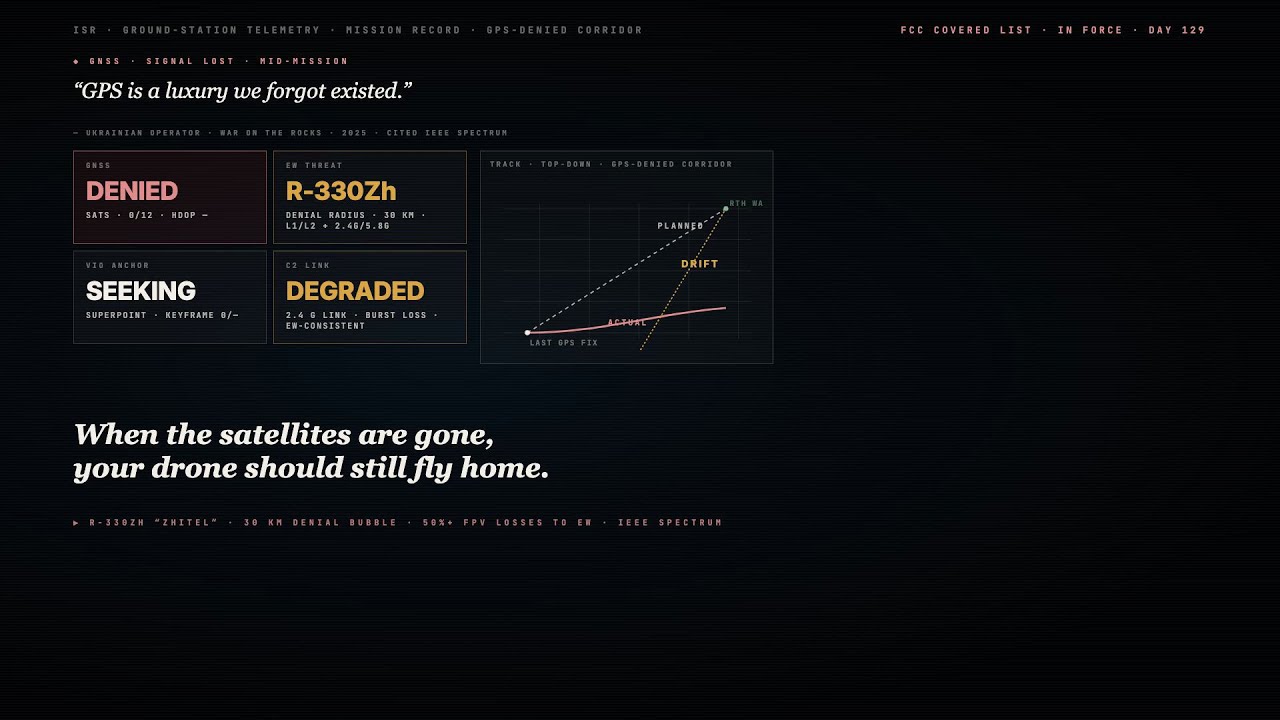
Russian R-330Zh "Zhitel" systems extend this physics across 30+ kilometer denial bubbles along the Ukrainian front. Inside those bubbles, FPV drones report 50% or higher loss rates to electronic warfare. A 2025 War on the Rocks dispatch from a Ukrainian operator described GPS as "a luxury we forgot existed." The IEEE Spectrum reporting on autonomous drone warfare has documented the specific shift: front-line FPV operators now build airframes that ship without GPS receivers at all, because GPS is no longer assumed to be present.
The civilian version of this problem is geometry, not warfare. An IMU is a fast sensor (1000 Hz typical) but a noisy one, and you compute position by double-integrating acceleration. Any error in the accelerometer reading accumulates as t squared. A consumer-grade MEMS IMU left to run open-loop in an underground mine drifts meters within seconds. Without an external position reference, the drone has no way to detect the drift, and the operator finds out when the airframe puts itself into a wall.
On December 22, 2025, the FCC added all foreign-produced unmanned aircraft systems and UAS critical components to its Covered List in a single sweeping public notice. This went substantially beyond what the FY2025 NDAA had directed; Congress had told the FCC to act on DJI and Autel specifically, and the FCC chose to act on every foreign manufacturer at once. Equipment on the Covered List cannot receive new FCC equipment authorizations. Existing certified models can still be sold and used, but the procurement runway for any program that depends on the foreign UAS supply chain is now finite.
For any federal customer, defense prime, or grant-funded municipal program, the practical effect is that DJI Matrice 30T and Autel Evo II Pro variants are off the table for new procurement plans. The Army's March 22, 2026 award of $52 million for 2,500 Skydio X10D drones, the largest single-vendor sUAS contract in Army history, closed bid-to-award in under 72 hours specifically because there was nowhere else to send the procurement. That speed is a signal: the cleared inventory of GPS-denied capable platforms is small, the demand is enormous, and the gap is currently being filled by whichever US/allied OEMs can ship a calibrated VIO stack on a Blue UAS frame today.
In underground mining, the LKAB Kiruna iron ore operation in Sweden replaced an 8-hour manual stope inspection with a 20-minute Flyability Elios 3 flight, and that ratio holds across most underground use cases. A manual survey crew costs thousands of dollars per day; a single drone mission collects more accurate point-cloud data in 30 minutes. The catch is that a non-autonomous drone in a confined mine shaft is likely to crash on its first ten flights, and industrial drone platforms cost $10,000 to $50,000 each. Without VIO, the math does not close.
The pipeline inspection version of the math is starker. A single oil and gas pipeline failure runs $8.5 million in cleanup, regulatory penalties, and remediation, against a $75,000 routine drone inspection that would have caught the corrosion. The ROI of drone inspection depends on the drone reaching the inspection location; if the camera bay sits in a GPS shadow under a steel bridge or alongside a tank farm, multipath effects drift position by several meters and the drone cannot hold the station-keeping required for high-resolution photogrammetry. Either you fly the inspection without VIO and accept the photogrammetry quality loss, or you fly it with VIO and your inspection program actually delivers the savings the business case promised.
A reference for evaluating the field. Each of these is the right answer for some buyer, some mission, and some procurement vehicle. Veriprajna fits one specific gap.
| Category | Key Players | What They Actually Deliver | Gap |
|---|---|---|---|
| End-to-end Tactical sUAS | Skydio (X10D), Anduril (Bolt-M, Ghost-X), AeroVironment (Puma VNS) | Complete drones with proprietary integrated VIO. Skydio holds the SRR Program of Record (2022, 2025). $52M Army X10D award March 2026. Anduril $23.9M USMC Bolt-M deliveries Feb 2026 to Apr 2027. | Fixed product envelopes. You buy their airframe, their sensor suite, and their mission profile. No path to add custom payloads or run their autonomy on a different chassis. |
| Defense Autonomy Stacks | Shield AI (Hivemind, V-BAT), Auterion (Skynode S) | Software-defined autonomy that other drone OEMs license. Auterion's $50M Pentagon contract for 33,000 Skynode kits to Ukraine, plus the Airlogix joint venture for 50,000 more units. First US kinetic swarm strike Jan 19, 2026. | Optimized for specific mission classes (loitering munitions, ISR swarms). Less suited for industrial, mining, or sub-prime SBIR work. Engagement model assumes you are a defense prime with Skynode-class budgets. |
| Edge Compute + Reference Drones | ModalAI (VOXL 2, Starling 2 / 2 Max), NVIDIA (Jetson Orin, Isaac ROS Visual SLAM) | Blue UAS Framework hardware (Qualcomm QRB5165, 15+ TOPS) and free GPU-accelerated VIO libraries (cuVSLAM). NVIDIA Isaac ROS commoditizes the baseline VIO algorithm. | You still need to integrate, calibrate, optimize, and field-test. Reference drones are development platforms, not deployable products. Isaac ROS is a starting point, not an autonomy product. |
| Industrial Inspection Specialists | Emesent (Hovermap ST-X, GX1), Flyability (Elios 3), Exyn Technologies | LiDAR SLAM-based autonomous platforms purpose-built for mines, tunnels, and confined spaces. Hovermap pioneered autonomous underground stope mapping. ATEX-certified Elios 3 variants for explosive atmospheres. | Fixed hardware, premium pricing ($150K to $200K+ for ATEX-certified units). No path to deploy their autonomy on a customer's existing drone fleet. You replace your fleet, you do not retrofit it. |
| Big SIs / Federal Primes | Booz Allen, Leidos, SAIC, Accenture Federal | Program management, ATO documentation, security clearances, government MSA relationships. Bid Replicator and AFWERX programs at scale. Subcontract specialty engineering. | They do not keep deep ORB-SLAM3 / SuperPoint / TensorRT engineers on permanent staff. The autonomy line items get subcontracted to smaller teams. Engagements run multi-million with significant overhead loaded onto the customer rate. |
| Open-Source Foundations | ORB-SLAM3 (GPLv3), VINS-Fusion, PX4 / ArduPilot, Isaac ROS Visual SLAM | Free, well-documented, peer-reviewed VIO and SLAM implementations. Native MAVLink integration paths. | A working open-source VIO is 10% of the engineering. The other 90% is calibration, robustness, edge optimization, sensor fusion, and qualification. ORB-SLAM3's GPLv3 license is also a problem for closed-source defense deliverables. |
| Veriprajna | Custom integration partner | VIO + Semantic SLAM autonomy payloads delivered onto the customer's chosen Blue UAS or industrial frame. Hardware-time-synchronized stereo + IMU calibration. SuperPoint front-end with TensorRT INT8, ORB-SLAM3 backend, VPI offload. PX4 or ArduPilot integration via MAVLink. Sub-prime engagement model on SBIR / AFWERX / Replicator 2. | Smaller firm. We do not manufacture airframes, hold ITAR registration on your behalf, or run your test range. We are a focused engineering team, not a turn-key SI. |
Honest gaps: ATEX/IECEx certification for explosive atmospheres adds 6 to 12 months and ~$100K of process work that no vendor on this list, including us, can shortcut. Hardware-time synchronization between IMU and image sensors is a physical-layer problem; if your existing fleet uses USB cameras with software timestamps, no autonomy stack will fully fix the drift.
Four capabilities, each addressing a specific failure mode in current GPS-denied deployments. We do not sell a product. We deliver a calibrated, flight-tested autonomy payload onto your airframe under your procurement vehicle.
An ORB-SLAM3 backend with a SuperPoint+SuperGlue learned front-end, compiled through TensorRT INT8 and running on Jetson Orin NX 16GB. Pose estimates publish over MAVLink VISION_POSITION_ESTIMATE at 50 Hz into your existing PX4 EKF2 or ArduPilot EKF3 estimator. The stack is country-of-origin neutral software that inherits the NDAA compliance posture of the underlying Blue UAS hardware.
We reach for ORB-SLAM3 over Isaac ROS cuVSLAM when the customer needs multi-map merging (Atlas system) for kidnap-robot recovery in long missions, and we move to learned features when the environment defeats classical ORB descriptors. For closed-source defense deliverables we replace the ORB-SLAM3 backend with a clean-room equivalent to avoid the GPLv3 license entanglement.
VIO accuracy lives or dies on the IMU-camera extrinsic calibration. We build a calibration jig specific to your airframe variant, solve the camera-IMU transform with sub-millimeter and sub-degree accuracy using the Kalibr or Allan Variance toolchains, and hand the procedure to your test pilots so you can recalibrate after a hard landing without flying us back out.
Where the environment defeats vision (total darkness, dense fog, fresh snow), we tightly couple a solid-state LiDAR (Livox Mid-360 or Unitree L1) into the optimization back-end so geometric constraints anchor the visual solution. We call out the SWaP-C cost honestly: 250 to 400 grams added payload, 8 to 12 watts of power draw. If your airframe cannot carry it, we say so before the engagement starts.
A control loop running at 20 Hz is the difference between a stable hover and an oscillation that crashes the airframe. We compile every neural network in the perception pipeline through TensorRT with INT8 quantization calibrated against representative footage from your target environment, not generic ImageNet calibration which will degrade accuracy in mines and tunnels.
Feature tracking and optical flow offload to NVIDIA VPI on the dedicated Programmable Vision Accelerator cores, freeing the GPU for semantic segmentation. ORB-SLAM3 bundle adjustment runs in CUDA kernels so map updates do not stall the tracking thread. The result is 30 to 45 FPS sustained on Orin NX 16GB with thermal headroom for sealed enclosures, against the 14 FPS that stock SuperPoint inference produces on the same hardware.
Customers in defense and mining demand demonstrated capability. We run benchmark missions in representative environments (warehouse, parking garage, abandoned mine, tank farm) with ground-truth pose tracking and publish the results as part of the deliverable. Side-by-side comparisons against stock ORB-SLAM3 and Isaac ROS cuVSLAM are part of every engagement so the customer can defend the architecture choice in a technical review.
For SBIR / AFWERX / Replicator 2 work we deliver as a sub-prime under your SI's Statement of Work, including the technical narrative for the Phase II proposal and the demonstration video that procurement officers actually watch. For commercial mining and inspection deployments we hand off the calibrated airframe along with operator training and the diagnostic dashboard for in-flight retrieval-confidence monitoring.
A defense ISR drone flies over a friendly forward operating base (GPS available) into a contested area where Russian R-330Zh systems have created an EW bubble. The transition is invisible to the operator. Here is what the autonomy stack actually does, frame by frame, from the moment GPS quality drops.
The PX4 EKF2 estimator continuously fuses GPS, IMU, and our VIO pose source. When GPS reported accuracy crosses a configured threshold (typically the satellite count drops below 6 or HDOP exceeds 2.5), the filter automatically reweights toward the VIO source. There is no mode change visible to the operator. The drone keeps flying its current mission. The transition takes a few hundred milliseconds and the position estimate stays continuous because the VIO source has been publishing pose estimates the whole time, not just starting cold when GPS failed.
The Pixhawk 6X IMU samples accelerometer and gyroscope at 1000 Hz over a hardware-synchronized timing line. Between camera frames (which arrive at 30 to 60 Hz), we pre-integrate IMU readings into a delta-pose factor. This is the fast prediction step: the drone's state estimate updates every millisecond from the IMU alone, while the camera contributes the slower correction step. The pre-integration uses the manifold formulation from Forster et al. 2017 so we can re-linearize without re-integrating the IMU measurements every time the optimizer touches the state.
A SuperPoint network running through TensorRT INT8 extracts up to 1000 keypoints per stereo frame, with 256-dimensional descriptors. SuperPoint runs on the GPU. Stock ORB descriptors fail in low-contrast environments (dust, smoke, low light) because they encode local intensity gradients that vanish when contrast is poor. SuperPoint encodes higher-level structural patterns and survives those conditions. The trade-off is a 6 to 9 watt GPU budget that we account for explicitly when sizing the edge compute.
In parallel, a YOLOv8-segmentation model identifies pixel masks for moving classes (vehicles, humans, animals, foliage in wind). Features that fall on those masks are excluded from the VIO factor graph because tracking them would inject ego-motion error from objects that are not actually static landmarks. This is the failure mode that broke standard ORB-SLAM3 in the original Ukrainian battlefield deployments: the algorithm would lock onto a moving truck and infer that the drone was stationary while the truck moved. The semantic mask prevents that class of failure.
The remaining static features feed into a sliding-window factor graph (the ORB-SLAM3 local mapping thread, parallelized in CUDA). The optimizer minimizes reprojection error across the last 10 to 15 keyframes plus IMU pre-integration constraints, producing a re-linearized trajectory estimate at 30 Hz. Marginalized states feed the global map as anchored constraints. This is where the 1 to 2 percent drift rate of well-tuned VIO comes from: even without loop closure, optimization-based VIO outperforms filter-based MSCKF approaches by an order of magnitude on EuRoC and KITTI benchmarks.
When the drone returns toward a previously mapped area, a place-recognition module (NetVLAD descriptors over the keyframe database, not the original DBoW3 bag-of-words which fails in repetitive environments like tunnels and pipelines) detects the revisit and triggers pose-graph optimization in g2o. The accumulated drift collapses into the loop, and the drone's "home" position snaps back into alignment with where it actually is. This is what makes the system suitable for long missions like perimeter patrol and pipeline inspection: the trajectory remains consistent over hours of flight without an external position reference.
Four phases. Each has a defined deliverable and a benchmark gate. We do not move forward until the previous phase clears.
We characterize your specific airframe and target environments before writing software. Mechanical layout for sensor mounting, power budget, thermal envelope, IMU/clock distribution, autopilot version, and existing flight test infrastructure. Then we fly representative footage in the actual environments you need to operate in: your mine, your bridge, your test range. Generic VIO benchmarks on EuRoC do not predict performance in real dust, real lighting, or real vibration.
Timeline: 3 to 4 weeks.
Caveat: If the survey reveals that the existing camera mount has IMU-image timing drift, or that the airframe vibration profile saturates the IMU, we issue a hardware change order before writing autonomy code. Building VIO on a bad mechanical foundation is throwing money at the wrong problem.
Output: Environment characterization report, baseline performance numbers from off-the-shelf cuVSLAM and ORB-SLAM3 against your footage, and a hardware bill of materials for the integrated payload.
We build the calibration jig, solve the IMU-camera extrinsic transform, profile the IMU bias instability, and tune the EKF noise parameters for your specific sensor stack. The autonomy stack is brought up on the bench against pre-recorded footage so the software is validated against ground-truth before any drone leaves the ground.
Timeline: 4 to 6 weeks.
Benchmark: Less than 1 percent drift over a 100-meter recorded trajectory in your representative environment, validated against motion-capture or RTK GPS ground truth. If we cannot hit this on the bench, we do not move to flight test.
Output: Calibrated payload, calibration procedure handed off to your team, EKF parameter file for your autopilot.
We deploy to your test range with your pilots flying. The autonomy stack runs in passive mode first (publishing pose to the autopilot but not commanding flight), and we tune the EKF source weights and the VIO front-end against real flight dynamics. Then we hand control to the autonomy stack progressively: hover, waypoint navigation, GPS-denied corridor flight, return-to-home from a kidnapped state. Every test produces a flight log we analyze post-flight.
Timeline: 4 to 8 weeks depending on weather and range availability.
Output: Demonstration video, flight log archive, benchmark report comparing against stock cuVSLAM and ORB-SLAM3, and a closeout document suitable for inclusion in an SBIR Phase II technical narrative or a customer technical review.
We train your engineering team on the calibration procedure, the diagnostic dashboard, and the EKF tuning workflow so you can iterate without us. For multi-airframe fleets, we hand off the per-frame calibration playbook so your team can extend the autonomy stack to new variants. Sustainment is on a retainer basis: we are on call for environment-driven re-tuning, new sensor integrations, and field issues that need a deep look at the flight logs.
Ongoing cost: Retainer typically $4,000 to $10,000 per month depending on fleet size and operational tempo.
Expansion: Adding a new airframe variant typically takes 4 to 6 weeks, mostly mechanical re-calibration. New environment classes (e.g., adding underwater dock inspection to a mining-trained system) require Phase 1 to be re-run for that class.
Tell us about your environment, payload, and mission profile. This tool estimates whether VIO alone is sufficient, whether you need LiDAR fusion, and where the engineering risk lives. The output is a specific recommendation you can take to your own engineering team. There is no contact form attached.
Where will the drone primarily fly?
How far from the takeoff point and how long?
What can the airframe carry and power?
How tight does the position estimate need to be?
Who is the customer for the deployed system?
If your airframe runs PX4 or ArduPilot, retrofitting VIO is a payload integration project, not an airframe replacement. We bolt on a Jetson Orin NX 16GB compute module, a calibrated stereo camera (Intel RealSense D455 or a custom global-shutter pair for harsher environments), and tap into the existing Pixhawk IMU over UART for hardware-time-synchronized inertial samples. The VIO stack publishes pose estimates over MAVLink VISION_POSITION_ESTIMATE at 50 Hz, which the autopilot fuses into its EKF2 estimator alongside the existing GPS source. When GPS quality drops below threshold, the EKF automatically reweights toward the VIO source, so the operator never sees a mode change. The hard part is not the software install, it is calibration. The IMU-camera extrinsic transform must be solved with sub-millimeter accuracy or the filter diverges in seconds. We build a calibration jig for your specific airframe and hand it to your test pilots. Total integration timeline for a single airframe variant is 8 to 12 weeks; multi-variant fleets take longer because each frame needs its own calibration profile.
Buy Skydio if your mission fits the X10D envelope: short-range tactical reconnaissance, sub-300m altitude VIO, the specific payload bays Skydio offers, and a procurement path that can clear the SRR Program of Record price point. The Army's $52M, 2,500-unit award in March 2026 closed bid-to-award in under 72 hours, which tells you Skydio has the easy buy locked. We are not going to win against that. You need a custom build when one of three things is true. First, your airframe is bigger or smaller than what Skydio sells, which is most industrial inspection, mining, agricultural and heavy-lift cargo missions. Second, you are an OEM building your own platform on a Blue UAS frame and you need an autonomy module to differentiate, not a competitor's complete drone. Third, your sensor stack includes payloads that Skydio does not integrate, such as multispectral imaging, methane sniffers, ground-penetrating radar, or radiation detectors, and you need the autonomy stack to drive flight patterns conditioned on those readings. Anduril Bolt-M is a loitering munition with a fixed mission profile, not a navigation library you can license. If you fall outside those products, custom is the only path.
A prototype that flies a single airframe through a representative GPS-denied environment with calibrated VIO, basic obstacle avoidance, and waypoint navigation under PX4 typically takes 4 to 6 months and costs $250,000 to $600,000 depending on sensor selection and how much hardware change is required. That gets you a working system you can demo to a customer or use as the foundation for an SBIR Phase II proposal. A production-ready stack with semantic masking, learned loop closure, multi-environment robustness, and full PX4 EKF integration is a 9 to 18 month engagement in the $700,000 to $1.5M range. Compare that to two reference points. Skydio's eight years of internal VIO development represents hundreds of millions in cumulative R&D. Building a Replicator 2 prototype the Pentagon will actually field requires demonstrated capability, not architecture diagrams; the September 2025 DefenseScoop reporting on Replicator delays explicitly cited the gap in software able to command large heterogeneous swarms as the primary blocker. A focused custom build is the fastest credible path from zero to that demo. The cost is a fraction of a single Phase II AFWERX award, which typically runs $750K to $1.25M.
Yes, but only with aggressive optimization, and with honest trade-offs. Stock SuperPoint inference on Orin Nano max tops out around 14 FPS, which is below the 30 FPS minimum for stable VIO control loops. To hit real-time on Orin NX 16GB, we run SuperPoint through TensorRT with INT8 quantization (calibrated against your environment, not generic ImageNet), offload feature tracking to NVIDIA VPI on the Programmable Vision Accelerator cores, and run ORB-SLAM3's bundle adjustment in CUDA kernels on the GPU. With this pipeline, we hit 30 to 45 FPS for the VIO front-end alone. The trade-off is that running semantic segmentation simultaneously, for dynamic object masking, eats another 8 to 12 watts of GPU budget and forces you to accept either a lower seg model resolution or a 20 Hz semantic update rate while the VIO front-end stays at 30 Hz. The SuperPoint-SLAM3 work published in arXiv 2506.13089 shows the accuracy payoff is real: KITTI translational error drops from 4.15% to 0.34%, a 12x improvement over stock ORB features. For long-trajectory missions like pipeline inspection or perimeter patrol, that difference is the gap between centimeter-level final position and several meters of drift.
The autonomy software is country-of-origin neutral. Section 848 of the FY2020 NDAA restricts hardware components manufactured in covered foreign countries (primarily China) from DoD procurement. Software written by a US-allied team running on NDAA-compliant hardware inherits the underlying compliance posture. Our standard reference build pairs the autonomy stack with NVIDIA Jetson Orin (designed in the US, manufactured in compliant facilities), Intel RealSense or Lucid Vision Labs cameras, and a Pixhawk 6X flight controller. The whole bill of materials is Blue UAS Framework compatible by component. The autonomy stack itself is platform-neutral and targets Blue UAS frames including Freefly Astro, ModalAI Starling 2 Max, and Inspired Flight IF800; the integration work for any specific airframe is the airframe-specific calibration and the MAVLink configuration. The December 22, 2025 FCC action that added all foreign-produced UAS and critical components to the Covered List makes this question urgent for any defense or federal customer: previously authorized DJI and Autel models can still be flown, but new authorizations are blocked, and most federal program managers will not approve a procurement plan that depends on those vendors. If you are migrating off DJI Matrice or Autel Evo II, the autonomy stack ports across to a Blue UAS frame; what changes is the airframe-specific calibration and the MAVLink integration, which we redo for the new platform.
VIO breaks in feature-poor scenes because the front-end has nothing to track. There are three honest answers, and we deploy them in combination depending on your environment. First, learned features (SuperPoint, DISK, ALIKED) extract trackable points from textures that classical ORB or FAST detectors miss, including dust-coated rock walls, faded paint, and low-contrast surfaces in tunnel lighting. This gets you maybe 20 to 30 percent more usable environment than stock ORB-SLAM3. Second, when the camera truly has nothing to work with (total darkness, dense fog, fresh snow on featureless ground), the only honest answer is sensor fusion with active ranging. We integrate a lightweight solid-state LiDAR like the Livox Mid-360 or Unitree L1, and the LiDAR point cloud anchors the VIO solution through tight coupling in the optimization back-end. This adds 250 to 400 grams to your payload and 8 to 12 watts of power draw, which has to fit your SWaP-C budget. Third, for environments that really cannot be navigated optically or with LiDAR (smoke-filled rooms, deep coal mines with no line-of-sight features), we recommend you do not fly there at all and route around. Honest engineering means saying no to the missions VIO genuinely cannot serve, not selling you a system that will crash an expensive drone.
Systems integrators like Booz Allen, Leidos, SAIC and Accenture Federal have the program management, ATO documentation, security clearances, and government MSA relationships that take years to build. We do not. What we have is the embedded computer vision and SLAM engineering depth they typically subcontract out anyway. On a Replicator 2 or AFWERX-funded program, a typical structure has the prime SI handle the Statement of Work, the security artifacts, the test range coordination, and the customer-facing program reviews; we sit underneath as a sub-prime delivering the autonomy payload. This lets you bid the program with credible technical depth on the autonomy line item without staffing a permanent computer-vision team. The structure works at SBIR Phase II scope and above; below that, the proposal overhead does not pay for itself. For direct-to-customer work with mining or infrastructure operators, no SI is required and we work with the operator's drone team directly. The right structure depends on your procurement vehicle, not on a fixed delivery model.
The detailed technical architecture and engineering rationale behind this solution page.
The Autonomy Paradox: Engineering Resilient Navigation in GNSS-Denied and Contested EnvironmentsFull technical analysis of GNSS denial physics, Visual Inertial Odometry mathematics, ORB-SLAM3 versus VINS-Fusion architecture choice, semantic SLAM for dynamic environments, NVIDIA Jetson Orin edge compute optimization, and operational deployment for defense, mining, and infrastructure customers.
A single oil and gas pipeline failure runs $8.5M against a $75K inspection. An industrial drone is a $10K to $50K asset that crashes the first time the IMU drifts unchecked. The autonomy gap between GPS-dependent and GPS-denied is the difference between an inspection program that delivers and one that does not.
Whether you need a feasibility study before scoping an SBIR Phase II proposal, a VIO retrofit for an existing fleet, or a sub-prime engineering partner for a Replicator 2 bid, we can scope the engagement in a single conversation.