Autonomous Lab Design + AI Integration
The gap between what high-throughput screening covers and what the chemical space contains is not incremental. It is astronomical. Self-driving labs close that gap by replacing random search with strategic, AI-directed experimentation. We build the optimization engines, instrument integrations, and closed-loop architectures that turn your existing lab into an autonomous discovery system.
10-50x
Fewer experiments to reach target
Bayesian Optimization vs. random screening
Up to 90%
Reagent cost reduction with CIBO
Cost-Informed BO, ChemRxiv 2024
24/7
Equipment utilization vs. 30-40% human-staffed
Autonomous operation benchmark
The methodology Thomas Edison used to test thousands of carbon filaments was a product of an era where theory lagged behind experiment. In 2026, R&D labs are still running variations of it, and the economics have gotten worse, not better.
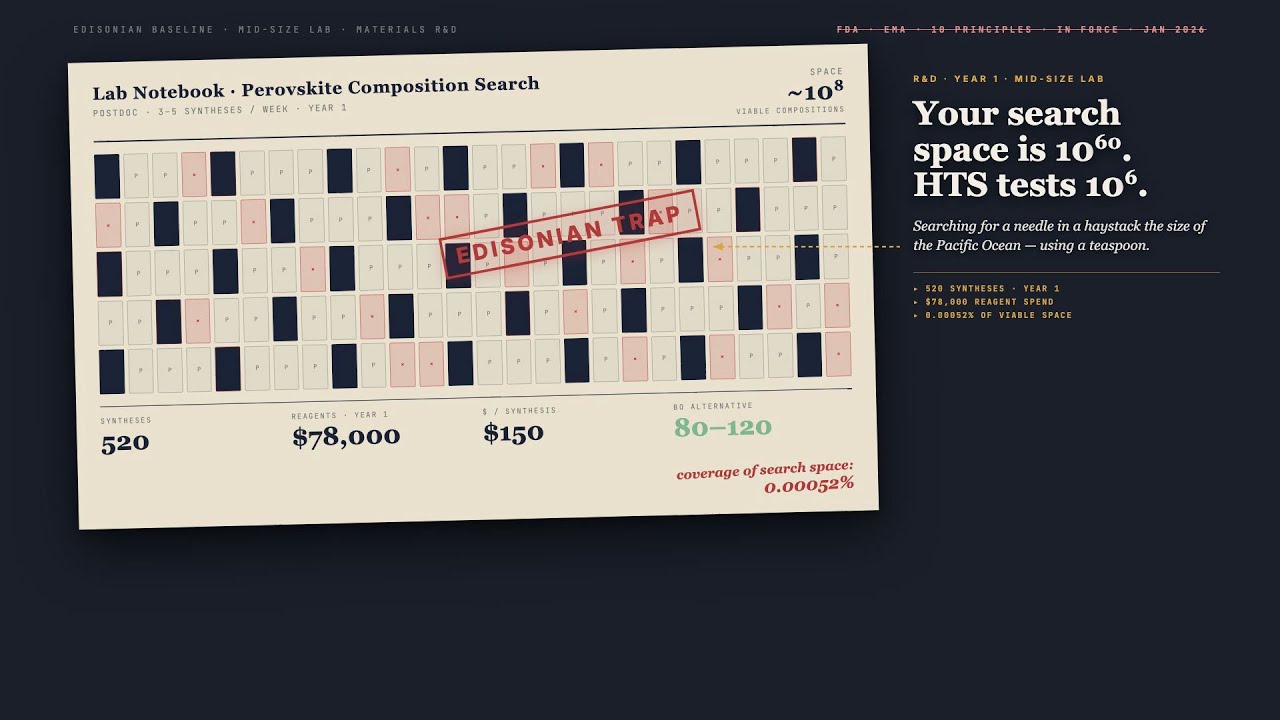
The number of pharmacologically active small molecules adhering to Lipinski's rules is estimated at 1060. A large HTS campaign tests 106 compounds. That covers 0.000000000000000000000000000000000000000000000000000001% of the space. Extending to complex biologics and multi-element alloys, the space approaches 10100, which exceeds the number of atoms in the observable universe (1080).
HTS assumes the answer exists in a pre-synthesized library. For novel material classes, the optimal composition almost certainly does not exist in any library on Earth. You are searching for a needle in a haystack the size of the Pacific Ocean using a teaspoon.
Drug development cost per asset has reached $2B+ (Deloitte, 2024). The pharmaceutical R&D failure rate hovers at 90% in clinical trials. Pharma IRR hit a 12-year low of 1.2% in 2022 before recovering to 5.9% in 2024, largely on the back of GLP-1 outliers. This is Eroom's Law: R&D productivity declining despite rising spend.
In materials science, the cost is measured differently but the pattern is the same. Battery researchers pursue materials that theoretically offer high energy density but violate thermodynamic stability constraints. Without simulation-before-synthesis, these dead ends are discovered only after months of lab time and hundreds of thousands in reagent costs.
A mid-size materials lab is searching for a lead-free halide perovskite with specific bandgap and stability properties for next-generation solar cells. The composition space includes 5 cation options, 8 anion combinations, and continuous stoichiometry ratios, yielding roughly 108 viable compositions.
Traditional approach: a postdoc synthesizes 3-5 compositions per week based on literature intuition and adviser suggestions. At $150 per synthesis (precursors, substrate preparation, characterization), they spend $78,000 over a year testing 520 compositions. That's 0.00052% of the space. The best candidate found may be nowhere near the global optimum.
With Bayesian optimization using a GNN surrogate model pre-trained on 50,000 DFT-calculated perovskite structures from the Materials Project, the system identifies the top 0.1% of the composition space in 80-120 targeted experiments. Total reagent cost: $12,000-$18,000. The surrogate model predicts bandgap and formation energy in milliseconds. The acquisition function (Expected Improvement) selects only the compositions where either the predicted performance is high or the model uncertainty is large enough to warrant investigation. The remaining 400+ experiments that would have yielded incremental or useless data are never run.
The self-driving lab space has consolidated rapidly since 2024. Before choosing a path, you should understand what each option actually provides and where it falls short.
| Option | What You Get | Typical Cost | Honest Gap |
|---|---|---|---|
| Radical AI | Full autonomous lab. 25+ alloys/day. Billions of compositions screened. Brooklyn Navy Yard facility (Jan 2026). $55M Seed+, $60M Series A. | Partnership/contract | Alloy-focused. Your data lives on their stack. Optimization logic is their black box, not yours to modify. Works for metallurgy, less so for pharma or MOFs. |
| Emerald Cloud Lab | 200+ automated instruments at CMU. Ship samples, get results. GxP enterprise tier available. | Subscription ($50K-$500K+/yr) | Remote-only. You don't touch the instruments. Limited to their supported assay catalog. Proprietary chemical data leaves your premises. |
| Atinary | SDL software platform with ML optimizers. DMTAL cycles. Launched Boston "Scientific Discovery Factory" (2025). | SaaS + integration | Supports certain instrument types. Customizing optimization logic beyond their UI requires their engineering. Growing but not yet battle-tested at enterprise scale. |
| Kebotix | Enterprise AI for materials discovery. Cloud + ML + physical modeling + automation. | Enterprise contract | Cambridge-based, founded 2017. Less public validation than newer entrants. Platform approach means your workflow adapts to them, not the reverse. |
| Big 4 / Large SIs | Digital transformation consulting. Lab strategy, vendor selection, change management. Large teams, recognizable names. | $500K-$5M+ engagement | They implement platforms, not build optimization engines. No in-house BO/GNN expertise. Deliverable is a strategy deck and vendor integration, not a working closed loop. Engagements run 6-18 months for what should take 3-4 months. |
| In-House Team | Full control. Build your own BO engine, write your own SiLA 2 drivers, train your own GNNs. | 2-3 ML engineers + 1-2 automation engineers ($800K-$1.5M/yr) | Hiring ML engineers who also understand Gaussian Processes, chemical space, and SiLA 2 is extremely difficult. 6-12 month ramp time before any experimental value. High attrition in tight labor market. |
| Veriprajna | Custom-built BO engines, GNN surrogates, SiLA 2 instrument drivers, GxP compliance layers. You own all code and models. Integrates with your existing hardware. | $150K-$600K project | No hosted lab facility. No pre-built instrument library. Every integration is custom engineering. Slower for standardized assays where a platform would suffice. |
The right choice depends on your instrument mix, data sensitivity, and regulatory requirements. For standardized assays on common instruments with no IP sensitivity, a platform can work. For labs with legacy equipment, proprietary data, GxP constraints, or non-standard optimization problems, custom integration is the only path.
Six capabilities that transform an existing lab into an autonomous discovery system. Each is a standalone engagement or part of a full closed-loop build.
We configure the surrogate model, acquisition function, and fidelity levels for your specific materials domain. We reach for Sparse Variational GP (SVGP) when your composition space exceeds 50 dimensions because standard Gaussian Processes with O(n3) complexity will not converge. For reaction optimization with 10-15 parameters and expensive reagents, we deploy Cost-Informed BO to minimize cost per unit of information.
The acquisition function matters more than most labs realize. Expected Improvement is conservative, good for exploiting known promising regions. Thompson Sampling promotes batch diversity, better when running multiple parallel syntheses. We select based on your experimental setup, not a default.
Each instrument in your lab speaks a different language. Hamilton STAR uses VENUS scripting. Tecan EVO uses FluentControl API. Agilent instruments expose FAST API or legacy serial protocols. We build SiLA 2 microservice drivers for each, so your AI optimization layer sends one consistent command format regardless of the instrument underneath.
Legacy instruments (10-20 years old) that lack modern APIs get wrapped with adapter hardware (Raspberry Pi or embedded controller) running a Python SiLA 2 server. Each driver integration runs 2-4 weeks depending on the vendor's API documentation quality. A typical mid-size lab needs 6-12 drivers for a functional closed loop.
Graph Neural Networks outperform LLMs for molecular property prediction because molecules are 3D graphs, not text strings. We build GNN surrogates (CGCNN for crystal structures, SchNet or DimeNet for molecular geometries) that predict target properties in milliseconds instead of the hours DFT calculations require.
For well-studied material families, we bootstrap from Materials Project (154,000+ structures) or AFLOW. For novel classes, we use transfer learning from a related family and active learning to fill gaps with targeted DFT calculations. The Matbench Discovery benchmark (2026) shows the best models achieve a 6.1x discovery acceleration factor. We target that range for your domain.
For pharma labs, FDA's ALCOA+ framework requires every automated step to be attributable, legible, contemporaneous, original, and accurate. Most SDL software treats compliance as an afterthought. We build the audit trail layer as a dedicated service: it intercepts every data event from the BO engine, every robotic action, and every characterization result, timestamps it, and stores it in an append-only log.
CDER warning letters jumped 50% in FY2025, with data integrity as a major citation category. The Jan 2026 FDA/EMA joint guidance on AI in drug development sets explicit expectations for data governance and human oversight. We architect compliance from the start, not bolt it on after an audit finding.
The full Design-Make-Test-Analyze (DMTA) cycle as a production system. The BO engine generates a candidate. The robotic platform receives synthesis instructions via SiLA 2. Characterization instruments (XRD, spectroscopy, microscopy) measure results. The feedback updates the surrogate model. The cycle repeats without human intervention.
We include a digital twin layer that simulates each experiment before physical execution: validates the protocol timing, checks for collision paths in robotic arms, flags reagent compatibility issues, and detects anomalies by comparing real-time sensor data against predicted behavior. This prevents the 29% synthesis failure rate that Berkeley's A-Lab encountered and keeps your 24/7 operation running without overnight surprises.
Your 20-year-old HPLC wrapped in a SiLA 2 microservice driver. Your Excel experiment tracking replaced with a structured data pipeline that feeds directly into the optimization loop. Your disconnected LIMS, ELN, and instrument outputs unified into a single data lake where every experiment, including failures, becomes training data for the surrogate model.
No rip-and-replace. We add an intelligence layer on top of equipment that still works. The typical modernization path: instrument drivers first (weeks 1-8), data pipeline second (weeks 4-12, overlapping), BO engine third (weeks 8-16), closed-loop integration last (weeks 12-20). Scientists continue running their current workflows throughout.
This is a representative workflow for a materials lab optimizing lead-free halide perovskite compositions for specific bandgap and thermal stability targets.
We pull 50,000 DFT-calculated halide perovskite structures from the Materials Project. A CGCNN (Crystal Graph Convolutional Neural Network) is pre-trained on this data to predict formation energy and bandgap from crystal structure. Training takes 4-8 hours on a single GPU. The model achieves MAE of ~0.05 eV on formation energy for known perovskites, which is accurate enough to rank candidates but not accurate enough to replace experimental validation. That's the point: the surrogate is a filter, not an oracle.
The composition space is defined: Cs/MA/FA cation ratios, Sn/Ge/Bi substitution levels, I/Br/Cl halide ratios. This creates a ~30-dimensional continuous space. Multi-objective: maximize bandgap stability (target 1.2-1.5 eV for tandem solar cell application), minimize formation energy (thermodynamic stability), and maximize thermal decomposition temperature (operational durability). The BO engine uses a multi-objective acquisition function (Expected Hypervolume Improvement) to explore the Pareto front.
The BO engine first queries the CGCNN surrogate (milliseconds per prediction, near-zero cost). It generates 10,000 candidate compositions and ranks them by predicted Pareto optimality. The top 200 are passed to a quick DFT relaxation (minutes per calculation, ~$0.50 compute cost each). The MF-BO framework learns the correlation between the GNN prediction and the DFT result. Where correlation is strong, the GNN prediction is trusted. Where correlation is weak (typically at the edges of the training distribution), more DFT calculations are triggered. This stage eliminates ~99% of candidates without any physical synthesis.
The top 20 DFT-validated candidates are sent to the robotic platform as synthesis instructions. A liquid handler (controlled via SiLA 2) dispenses precursor solutions. A hotplate/tube furnace runs the annealing protocol. An XRD instrument (SiLA 2-connected) confirms crystal phase. A UV-Vis spectrometer measures bandgap. A TGA instrument measures thermal decomposition. All results are timestamped, linked to the original BO recommendation, and stored in the structured data pipeline.
Every experimental result, including failures, feeds back into the surrogate model. A composition that decomposed at 150C instead of the predicted 300C is valuable: it tells the model where its prediction was wrong and sharpens the decision boundary. The BO engine updates its posterior, recalculates the acquisition function, and selects the next batch. After 4-6 cycles (80-120 total experiments over 2-3 weeks), the system has mapped the viable Pareto front. The lab now has 5-10 compositions that meet all three objectives, confirmed by physical measurement, with a complete uncertainty characterization for each.
A typical closed-loop lab build runs 16-24 weeks from kickoff to autonomous operation. Each phase has a clear deliverable and a go/no-go gate.
We inventory every instrument, its API capabilities, current data flows, and integration complexity. We map the optimization problem: what are you searching for, in how many dimensions, with what constraints. We assess the existing data (LIMS exports, ELN records, prior experiment results) for surrogate model bootstrapping potential.
Deliverable: Technical architecture document specifying BO engine configuration, instrument integration plan with per-instrument timelines, surrogate model strategy, and data pipeline design. This document is detailed enough that your internal team could execute it independently if you chose not to proceed with us.
SiLA 2 driver development for each instrument in parallel. Data pipeline construction: raw instrument output to structured format to model-ready features. Legacy system adapters where needed. Each driver is tested individually and then in orchestrated sequences.
Deliverable: Working SiLA 2 drivers for all instruments. Unified data pipeline with structured experiment logging. Your lab continues running existing workflows during this phase.
Surrogate model training (or transfer learning + fine-tuning for novel material classes). BO engine configuration with selected acquisition function and fidelity hierarchy. Digital twin layer for protocol simulation. Integration testing with the instrument layer: full DMTA cycle on a known material to validate the loop before deploying on your actual search problem.
Deliverable: Working BO engine producing experiment recommendations. Validated surrogate model with quantified prediction accuracy on your material family. Digital twin catching protocol errors before physical execution.
Full autonomous operation on a pilot search problem. The system runs 24/7 with human oversight gradually reducing from active monitoring to exception-based alerts. Performance metrics tracked: experiments per day, hit rate vs. baseline, cost per experiment, model prediction accuracy over iterations.
Deliverable: Autonomous lab running your actual optimization problem. Complete handoff documentation. Your team trained on the system. All code, models, and configurations transferred to you. We are no longer required for operation.
Answer 8 questions about your current lab setup. The assessment identifies your strongest and weakest areas for autonomous lab deployment and provides specific next steps for each category, whether or not you work with us.
You don't need to replace anything. The critical layer is middleware, not hardware. We wrap each existing instrument in a SiLA 2 microservice driver that translates high-level commands (dispense 5ml, heat to 200C, run XRD scan) into the vendor-specific protocol your instrument speaks. A Hamilton STAR needs VENUS scripting commands. A Tecan EVO needs FluentControl API calls. An older Agilent HPLC might need serial port communication wrapped in a Python adapter running on a Raspberry Pi.
Each driver takes 2-4 weeks to build depending on the instrument's API documentation quality. Once wrapped, every instrument looks the same to the AI optimization layer: a SiLA 2 microservice with defined capabilities. We've found that labs typically need 6-12 instrument drivers for a functional closed loop. The total integration timeline is 8-16 weeks for a mid-size lab, and your instruments keep running their existing workflows during the build.
The only hardware addition is usually a small orchestration server (on-premises or cloud-connected) that runs the BO engine and coordinates instrument commands.
The honest answer depends on three variables: your current experiment throughput, the dimensionality of your search space, and your reagent costs. A materials science lab running 20 manual experiments per week on a 30-dimension composition space with $200 average reagent cost per experiment will see the math work differently than a pharma lab running 500 HTS plates per week.
For the materials science case, deploying Cost-Informed Bayesian Optimization (CIBO) typically reduces the number of experiments needed to find a viable candidate by 10-50x. If you were running 1,000 experiments to cover a composition space and CIBO gets you to the same result in 50-100 experiments, your reagent savings alone are $180K-$190K. Add the labor reallocation (scientists designing experiments instead of pipetting) and the 24/7 utilization of robotic equipment (vs. 30-40% utilization in human-staffed labs), and most mid-size labs see payback in 12-18 months on the integration investment.
The caveat: these numbers assume your data infrastructure is clean enough to feed the optimization loop. If your first 3 months are spent normalizing data from Excel spreadsheets and disconnected LIMS, the ROI timeline shifts right. McKinsey estimates comprehensive automation and AI integration cuts overall pharma R&D costs by approximately 25% and can reduce cycle times by over 500 days.
HTS is brute force: synthesize and test as many candidates as physically possible, hoping the answer is in your library. Bayesian optimization is strategic search: use a probabilistic surrogate model to predict where the best candidates are, test only those, update the model, and repeat.
The numbers make the case. A standard HTS campaign tests roughly 106 compounds. The pharmacologically active small-molecule space is estimated at 1060. HTS works when the answer is likely in a pre-existing library and you can afford the infrastructure. It fails when you're exploring novel material classes where the optimal composition probably doesn't exist in any library.
BO with Gaussian Process surrogates excels in exactly this regime: small initial data, expensive experiments, large search spaces. The acquisition function mathematically balances exploring unknown regions against exploiting known promising areas. Cost-Informed BO adds a cost dimension: if two experiments offer similar information gain but one costs $5,000 in reagents and the other $50, CIBO picks the cheaper path. Studies show CIBO reduces optimization costs by up to 90% while reaching the same target.
The limitation: standard BO with Gaussian Processes scales as O(n3) in observations and struggles above 50 dimensions. For high-dimensional composition spaces, we use sparse GP approximations (SVGP) or deep kernel learning, which require more upfront engineering but handle hundreds of dimensions.
Yes, but only with deliberate compliance architecture. Most SDL platforms were designed for academic research, not regulated environments. The FDA's ALCOA+ framework requires every data point to be Attributable (who generated it, including which algorithm selected the experiment), Legible, Contemporaneous (timestamped at creation, not batch-logged later), Original, and Accurate.
For an autonomous lab, this means the BO engine's experiment selection must be logged with full decision context: which acquisition function, what the surrogate model predicted, why this experiment was chosen over alternatives. Every robotic action must generate an immutable audit trail. Failed experiments must be captured with failure mode analysis, not silently discarded.
CDER warning letters jumped 50% in fiscal year 2025, with data integrity a major citation category. In January 2026, the FDA and EMA jointly published 10 Guiding Principles for Good AI Practice in Drug Development, covering data governance, documentation, lifecycle management, and human oversight.
We build the compliance layer as a separate service that wraps around your SDL workflow: it intercepts every data event, timestamps it, links it to the originating process, and stores it in an append-only audit log. This layer adds approximately 3-4 weeks to the integration timeline and requires coordination with your quality team to validate against your specific SOPs.
This is the cold-start problem, and it's the most common technical challenge in autonomous materials discovery. If you're working on a well-studied material family (perovskites, metal-organic frameworks, common small molecules), large DFT-calculated datasets in the Materials Project (154,000+ structures), AFLOW, or the Open Quantum Materials Database can bootstrap your surrogate model.
For novel material classes, the path is three-phase. Phase 1: Transfer learning. Pre-train a GNN on a related material family where data is abundant (say, binary oxides) and fine-tune on your target class with whatever data you have, even 50-100 structures. ACS Central Science published work showing transfer learning can achieve useful prediction accuracy with orders of magnitude less target-domain data.
Phase 2: Active learning with multi-fidelity BO. Use cheap DFT calculations (minutes each) to rapidly expand the surrogate model's knowledge of your space, then selectively validate the most uncertain predictions with expensive high-fidelity calculations or actual synthesis. The MF-BO framework learns the correlation between simulation and experiment so it knows when to trust the cheap calculation.
Phase 3: Negative data capture. Every failed experiment gets structured logging: what was attempted, what went wrong, measured properties. This sharpens decision boundaries and prevents the system from repeatedly exploring dead ends. Most labs throw this data away. We treat it as permanent IP. Timeline to useful surrogate model: 2-4 weeks for well-studied families with transfer learning, 3-6 months for truly novel classes requiring DFT bootstrapping.
It depends on three factors: how unique your instruments are, how sensitive your data is, and how much control you need over the optimization logic.
Platforms like Emerald Cloud Lab offer turnkey access to 200+ automated instruments. You ship samples, they run experiments, you get data back. This works for standardized assays where you don't need workflow customization and you're comfortable with proprietary data living on someone else's infrastructure. Radical AI builds full autonomous labs that screen billions of compositions per day. If your problem aligns with their alloy focus, their throughput is hard to match. But you're running on their stack, their algorithms, their data pipeline.
Custom build makes sense when: (1) your instrument mix includes legacy or specialized equipment no platform supports, (2) your data sovereignty requirements prohibit sending proprietary chemical data off-premises, (3) your optimization problem requires non-standard approaches (multi-fidelity BO with custom fidelity sources, physics-informed surrogates, domain-specific acquisition functions), or (4) you need GxP compliance layers that platforms don't offer.
The typical mid-size materials lab has 3-5 instruments no platform supports out of the box, at least one regulatory constraint, and an optimization problem that doesn't fit a generic UI. Custom integration built on open standards (SiLA 2, open-source BO libraries like BoTorch) gives you autonomous capability without lock-in.
The methodology and technical architecture behind this solution page are detailed in our interactive whitepaper.
Covers Bayesian optimization mathematics, PIML vs. black-box AI, GNN architectures for molecular property prediction, SiLA 2 middleware design, and the economic case for simulation-before-synthesis.
McKinsey estimates AI and automation integration cuts pharma R&D costs by 25% and reduces cycle times by 500+ days.
Whether you need a lab architecture assessment, a BO engine for an existing automation setup, or a full closed-loop build from instrument integration to autonomous operation, we scope the engagement to match your current state and goals.