Sovereign AI Infrastructure
One in five organizations has already suffered a breach from unsanctioned AI tool usage. Banning AI does not work. Building secure, sovereign alternatives does. We deploy private LLMs inside your VPC with document-level permissions, runtime guardrails, and the compliance documentation that regulators demand.
For CISOs, CTOs, and infrastructure leaders at regulated enterprises evaluating private AI deployment, building sovereign AI architecture, or containing Shadow AI risk.
$670K
Additional cost of Shadow AI breaches vs. traditional incidents
IBM Cost of a Data Breach, 2025
EUR 55M
Combined GDPR + AI Act maximum penalty ceiling
EU AI Act + GDPR combined provisions
247 Days
Average time to detect a Shadow AI breach
IBM Cost of a Data Breach, 2025
The enterprise AI security challenge has three layers, and most organizations are stuck addressing only the first.
Samsung's semiconductor code leak in 2023 was the warning shot. Three years later, the problem has scaled exponentially. IBM's 2025 data shows 43% of employees share sensitive work information with AI tools without employer knowledge. Netskope tracks over 317 distinct GenAI applications in enterprise environments. Your firewall blocks ChatGPT and Claude. Your employees use any of the other 315 tools, or simply switch to their phone's 5G connection.
The psychology is straightforward: when AI tools deliver a 3-5x productivity gain and the official policy says "don't use them," the policy loses. Forty-six percent of employees explicitly state they will continue using AI tools regardless of a ban. These are not rogue actors. They are your highest performers trying to do their jobs. The breach vector is not malice but desperation for efficiency that the enterprise has failed to satisfy.
Azure OpenAI and AWS Bedrock solve the "data stays in your tenant" problem effectively. Network isolation, VPC endpoints, SOC 2 compliance. For many organizations, this is sufficient. But "managed private" does not equal "sovereign."
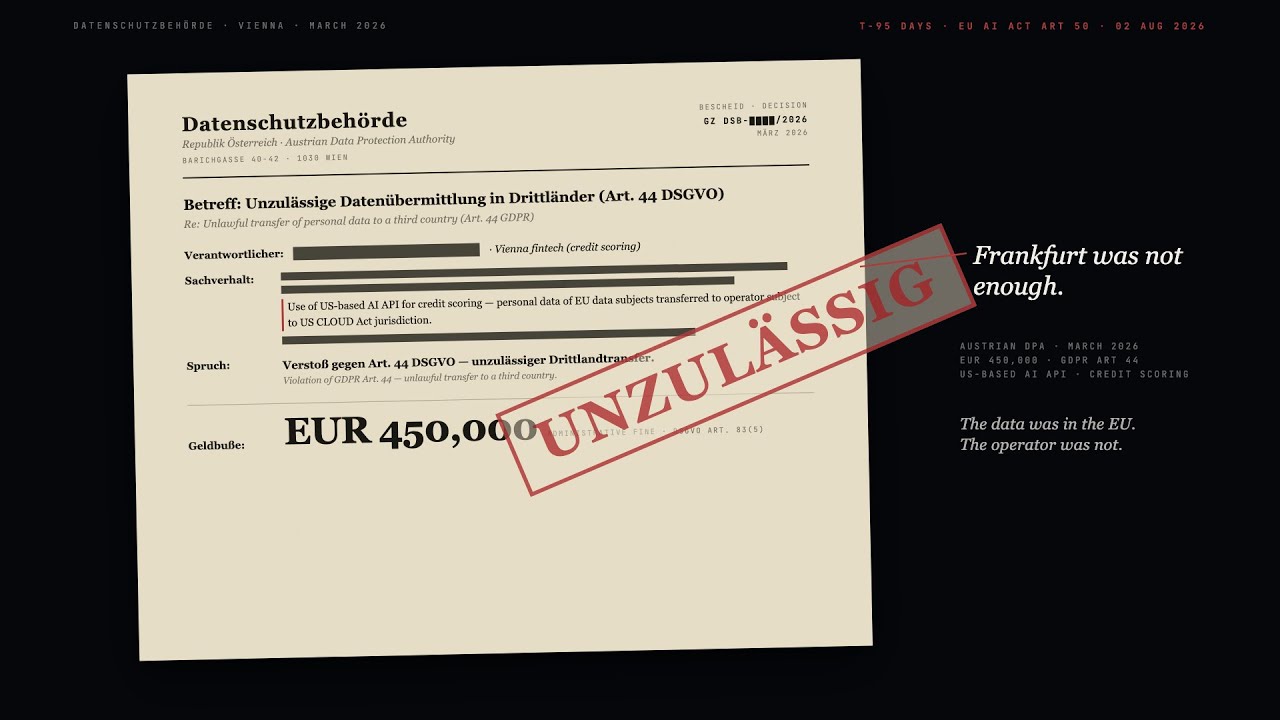
Both Microsoft and Amazon are US-headquartered, subject to the US CLOUD Act. This allows US law enforcement to compel data access even when servers sit in Frankfurt or Dublin. In March 2026, Austria's Data Protection Authority fined a Vienna fintech EUR 450,000 for using a US-based AI API for credit scoring, calling it an unlawful transfer under GDPR. The ruling confirms what privacy lawyers have warned for years: hosting in an EU region of a US hyperscaler does not eliminate jurisdictional exposure.
Here is where most sovereign AI projects actually stall. You deploy Llama on a GPU cluster in your VPC. You connect it to a vector database. You index your SharePoint document library. And then you discover that your Active Directory has 15 years of permission inheritance debt.
Nested security groups, orphaned distribution lists, cross-OU inheritance chains, and dynamic group membership rules that nobody fully understands. When a junior analyst asks the AI about quarterly projections, the retrieval system pulls board-level financial documents because the permission mapping was not correctly inherited through three layers of group nesting. This is not a theoretical risk. It is the reason most enterprise RAG pilots fail their security review. The naive approach (tag each document chunk with a flat ACL) collapses under the complexity of real enterprise identity systems.
Reference table for evaluating sovereign AI deployment approaches. Bring this to your next architecture review.
| Approach | Examples | Data Residency | CLOUD Act Exposure | Honest Gaps |
|---|---|---|---|---|
| US Hyperscaler Managed Private | Azure OpenAI, AWS Bedrock, Google Vertex AI | Regional (data in your tenant, your chosen region) | Yes (US-headquartered parent) | Best compliance certifications. Easiest path. But legal jurisdiction remains US, regardless of server location. Frontier model access is a genuine advantage. |
| European Sovereign Cloud | OVHcloud, Scaleway, Hetzner + open-weight models | Full EU (EU-headquartered operator) | None | True jurisdiction isolation. But smaller GPU fleets, fewer managed AI services, and you own the full MLOps stack. Scaleway now offers Blackwell B300 GPUs. |
| Sovereign AI Platforms | Cohere Model Vault, Mistral Compute, TrueFoundry | VPC / On-prem | Varies (Cohere is Canadian; Mistral is French; TrueFoundry is US-based) | Purpose-built for private deployment. Cohere ($240M ARR) and Mistral ($830M raised) are well-funded. But you are locked into their model ecosystem and pricing. |
| Open-Source DIY | Llama 4 + vLLM + Qdrant on your infra | Full control | None (if EU-based infra) | Maximum flexibility and lowest inference cost at scale. But requires 2-3 dedicated MLOps engineers ($400K-$1M/year loaded), and you own every outage, model update, and security patch. |
| Big 4 / Large SIs | Accenture, Deloitte, IBM Consulting, Wipro | Depends on implementation | Depends on infra choice | Deep enterprise relationships and change management expertise. But engagements run $500K-$5M+, timelines stretch to 12-18 months, and they typically implement vendor platforms rather than build custom sovereign infrastructure. Accenture's new Cyber.AI partnership with Anthropic locks you into one model provider. |
| Veriprajna | Vendor-neutral architecture + custom build | Your choice (we design for your risk profile) | Your choice | Smaller team than Big 4 (depth over breadth). No proprietary platform to sell, which means no vendor lock-in but also no turnkey product. Every engagement is custom, which takes longer than deploying a managed platform but fits the actual requirement. |
Six capabilities organized around the problems that bring CISOs and CTOs to sovereign AI in the first place.
We map your data classification, regulatory obligations (EU AI Act, GDPR, HIPAA, SOX), and risk tolerance to determine the right deployment topology. Not always full self-hosted. A US financial services firm with no EU data subjects may find Azure OpenAI in a dedicated tenant sufficient. A European bank processing customer PII under GDPR needs open-weight models on EU sovereign infrastructure. We design for the actual risk profile, provide the regulatory justification documentation, and build the architecture decision record your compliance team needs.
We deploy open-weight models (Llama 4, Mistral Large, DeepSeek) on your VPC or on-prem GPU cluster. We reach for vLLM with speculative decoding when throughput matters (batch document processing, high-concurrency chat) and TensorRT-LLM when latency is critical (customer-facing applications under 500ms SLA). Current H100 pricing runs $2.50-$3.50/hour on neo-cloud providers, with inference costs at roughly $0.013 per 1,000 tokens for a 70B model. We benchmark against your actual workload, not synthetic benchmarks, and provide a TCO model that includes MLOps staffing costs.
We build the permission layer that most enterprise RAG deployments lack. Our synchronization engine sits between your identity provider (Active Directory, Okta, Azure AD) and the vector database (Qdrant, Milvus, Weaviate), resolving nested group membership, flattening inheritance chains, and syncing permissions on a 60-90 second cadence. Critical revocations (terminations, role changes) trigger immediate webhook-driven updates. We handle the edge cases that break naive implementations: attribute-based access control, time-limited document access, conditional policies, and classification-level inheritance across organizational units.
Off-the-shelf guardrail tools (NVIDIA NeMo, Lakera/Check Point, Protect AI's LLM Guard) provide a foundation. They do not handle industry-specific compliance patterns out of the box. We build custom guardrail configurations: PII/PHI redaction tuned to your data taxonomy for healthcare, topic adherence policies aligned with your compliance matrix for financial services, and prompt injection defense hardened against your specific attack surface. NeMo adds 50-150ms latency on optimized infrastructure. For latency-critical paths, we build lighter custom classifiers that run alongside the inference engine.
Blocking ChatGPT does not contain Shadow AI. There are 317+ GenAI applications in enterprise environments, and employees switch to personal devices when corporate tools are restricted. We build the sanctioned alternative that is genuinely better than the shadow tools: internal AI platform with SSO integration, usage analytics, guardrail enforcement, and audit trails. The platform connects to your internal knowledge base through the RBAC-aware RAG pipeline, giving employees answers that public tools cannot provide because they lack your proprietary context. When the secure option is the most useful option, shadow usage drops without enforcement.
Gartner projects 40% of enterprise applications will embed AI agents by end of 2026. When those agents auto-execute actions on sensitive systems (triggering transactions, modifying records, querying databases), data sovereignty becomes even more critical. Ninety-two percent of security leaders currently lack full visibility into their AI identities. We build identity governance for AI agents on private infrastructure: zero-trust access controls, audit trails for autonomous actions, and guardrails that constrain what an agent can do based on the sensitivity of the data and systems it touches. The sovereign infrastructure ensures that agent telemetry, decision logs, and the data agents process never leave your environment.
A concrete walkthrough of what we build, using a European bank as the reference scenario.
We build a bidirectional connector to Azure AD (or Okta). The connector resolves the bank's security group hierarchy: the "EMEA Credit Risk" group contains nested groups for each country office, each country group inherits from regional policy groups, and individual users carry additional attribute-based claims (clearance level, department, temporary project assignments). The connector flattens this into a permission matrix updated every 60 seconds. When HR processes a termination in Workday, the Azure AD webhook fires within 30 seconds, and our connector revokes all vector database access tokens for that user before the IT department has even started their offboarding checklist.
SharePoint documents are chunked, embedded, and stored in Qdrant with permission metadata attached to each vector. But we do not store a flat ACL. We store a reference to the permission policy, which the retrieval engine evaluates at query time against the current state of the identity provider. This means a document shared with "EMEA Credit Risk Managers" does not need to be re-indexed when a new manager joins the group. The permission evaluation happens at retrieval time, not ingestion time. For the bank's 2.3 million internal documents, this approach reduces re-indexing overhead by roughly 85% compared to flat ACL tagging.
When a relationship manager queries the system about a client's credit exposure, the retrieval pipeline first resolves their current permissions (group memberships, attribute claims, time-based access windows), then filters vector search results against those permissions before anything reaches the LLM context window. The model never sees documents the user cannot access. The latency overhead is 40-80ms per query, depending on the complexity of the permission evaluation. For the bank's compliance team, we add a secondary audit log that records which documents were retrieved, which were filtered out (and why), and the full prompt-response pair for regulatory review.
The bank's compliance requirements demand PII redaction in model outputs (client names, account numbers), topic adherence (the AI must not provide investment advice without appropriate disclaimers), and data classification enforcement (the AI must flag when its response draws from documents classified as "Internal Only" if the output channel is external-facing). We configure NeMo Guardrails with custom Colang policies for these rules and add an output classifier trained on the bank's specific compliance taxonomy. Total inference pipeline latency: model generation (800-1200ms for Llama 3.3 70B on 2x H100) + permission evaluation (60ms) + guardrail processing (120ms) = roughly 1-1.4 seconds end-to-end.
Four phases from assessment to hardened production. Timelines are honest ranges, not marketing numbers.
We audit your current AI usage (sanctioned and shadow), map data classification across business units, identify regulatory exposure (EU AI Act, GDPR, HIPAA, SOX, sector-specific mandates), and evaluate your existing infrastructure and team capabilities.
Deliverable: Architecture decision record with recommended deployment topology, honest TCO comparison across approaches, and a gap analysis against your compliance requirements. This document is yours regardless of whether you engage us for implementation.
We select the right model for your use case through empirical benchmarking against your actual data (not MMLU scores). We design the infrastructure topology, configure the identity provider integration, and build the permission synchronization layer. Model choice is opinionated: we reach for Llama 4 Maverick for complex reasoning tasks and Llama 3.3 70B for cost-sensitive high-throughput workloads where it matches GPT-4o quality at a fraction of the cost.
Caveat: If your existing cloud infrastructure requires significant changes (no Kubernetes, no GPU-capable instances), add 2-3 weeks for infrastructure provisioning.
We deploy the model serving infrastructure, connect the RAG pipeline to your document repositories (SharePoint, Confluence, Google Drive, Jira), configure the guardrail layer, integrate SSO, and build the internal chat UI. The range is wide because document ingestion time depends on corpus size. A 500K document SharePoint takes 2-3 weeks to index. A 5 million document corpus takes 6-8 weeks with quality checks.
Milestone: Pilot deployment with 50-100 users from a single business unit. We measure latency, retrieval accuracy, permission enforcement correctness, and user satisfaction before expanding.
Red-team the deployed system for prompt injection, permission bypass, and data exfiltration. Build monitoring dashboards (hallucination rate, semantic drift, guardrail trigger frequency, shadow AI detection). Prepare EU AI Act compliance documentation (transparency records, training data provenance, risk assessment). Train your internal team to operate the system independently.
Honest caveat: Model updates (Meta releases Llama 5, Mistral ships a new version) require re-evaluation, re-benchmarking, and re-deployment. We can handle this as ongoing retainer work, but your internal team should be able to manage day-to-day operations without us. Dependency on a consultancy for routine maintenance is a design failure.
Answer six questions to understand where you stand. The results give you specific next steps, whether or not you work with us.
1. Where does your most sensitive data currently flow through AI systems?
2. What is your regulatory exposure?
3. Do you have GPU infrastructure or Kubernetes expertise in-house?
4. How large is the document corpus your AI needs to access?
5. What is your estimated daily AI token volume across the organization?
6. Do you have visibility into current Shadow AI usage in your organization?
Azure OpenAI and AWS Bedrock offer strong network isolation and compliance certifications. Data stays within your cloud tenant, and both support VPC endpoints and private networking. For many enterprises, this is sufficient. The critical distinction is legal jurisdiction. Both Microsoft and Amazon are US-headquartered companies subject to the US CLOUD Act, which allows US law enforcement to compel access to data stored abroad.
In March 2026, Austria's Data Protection Authority fined a Vienna fintech EUR 450,000 for using a US-based AI API for credit scoring, ruling it an unlawful data transfer under GDPR. Hosting in a Frankfurt region does not change the legal exposure.
A fully self-hosted deployment using open-weight models on European sovereign cloud providers (OVHcloud, Scaleway, Hetzner) eliminates CLOUD Act exposure entirely because the infrastructure operator is not subject to US jurisdiction.
We help enterprises evaluate this spectrum honestly. For a US-based financial services firm with no EU data subjects, Azure OpenAI is often the right answer. For a European bank processing customer data, the calculus is different. The architecture should follow the risk profile, not a vendor preference.
The honest answer depends on three variables: daily token volume, team maturity, and compliance requirements. At current prices (April 2026), H100 GPU rental runs $2.50-$3.50/hour on neo-cloud providers like Lambda Labs or CoreWeave. A single H100 running Llama 3.3 70B with vLLM serves roughly 30-50 concurrent users with sub-2-second latency.
For a self-hosted 70B model, inference costs roughly $0.013 per 1,000 tokens versus $0.15-$0.60 for GPT-4o mini through APIs. The break-even point for most enterprises sits around 2 million tokens per day. Below that threshold, APIs are cheaper because you are not paying for idle GPU time. Above it, self-hosting saves 60-85% on inference costs alone.
But inference is not the full picture. You need MLOps engineers ($200K-$350K each, minimum two for production reliability), monitoring infrastructure, model evaluation pipelines, and a rollback strategy for fine-tuned models. For teams new to LLM operations, total cost of ownership runs roughly 3.2x the raw API cost. For mature teams with existing tooling, the multiplier drops to about 1.8x.
One fintech client cut monthly AI spend from $47,000 to $8,000 by moving to hybrid self-hosting, but they had an existing Kubernetes team and 18 months of MLOps experience.
This is the hardest unsolved problem in enterprise RAG. The concept is straightforward: if a user cannot access a document in SharePoint, the AI should not be able to retrieve that document as context for their query. The implementation is where things break.
Most enterprises have 15+ years of Active Directory permission inheritance built up across organizational units, security groups, nested groups, and distribution lists. When you map this to vector database access controls, the naive approach (tag each document chunk with a flat permission list) collapses under the weight of group nesting and dynamic membership.
We build a synchronization layer that sits between your identity provider (Active Directory, Okta, Azure AD) and the vector database (Qdrant, Milvus, or Weaviate). The layer resolves group membership recursively, flattens inheritance chains, and updates vector metadata on a configurable cadence. For most deployments, we sync every 60-90 seconds as a balance between freshness and API load on the identity provider. Critical permission revocations (employee termination, role changes) trigger immediate sync via webhook from Okta or Azure AD.
The deeper challenge is attribute-based access control. Time-limited document access, conditional policies (access only from managed devices), and classification-level inheritance require custom logic that no off-the-shelf RAG platform handles. We build this as a policy engine that intercepts every retrieval call, evaluates the requesting user's current attributes against the document's access policy, and filters results before they reach the LLM context window.
Article 50 introduces transparency obligations that affect any enterprise deploying AI in the EU market, regardless of where the company is headquartered. The requirements include clearly informing users when they interact with an AI system, labeling AI-generated content (text, audio, images, video) with machine-readable markers, and identifying deepfakes and synthetic media.
Penalties reach EUR 15 million or 3% of global annual turnover for transparency violations specifically. When combined with other AI Act provisions and GDPR, the combined maximum penalty exposure reaches EUR 55 million or 11% of global annual turnover.
The practical impact for sovereign AI deployments is significant. Article 50 requires demonstrating the provenance of model training data. With closed-source API providers (OpenAI, Anthropic, Google), you cannot independently verify what data trained the model, what biases exist in the training set, or whether the training data included copyrighted European content. Self-hosted open-weight models give you full visibility into training data composition, enabling the transparency documentation Article 50 demands.
The European Commission published its first draft Code of Practice on AI content marking in December 2025, with the final version expected by May-June 2026. Enterprises should be preparing compliance documentation now rather than waiting for final guidance.
Prompt injection is the SQL injection of the LLM era. An attacker embeds instructions in user input or retrieved documents that override the model's system prompt. In enterprise RAG systems, the risk compounds because injected instructions can arrive through documents the model retrieves, not just through direct user input.
We build defense in depth across four layers. First, input sanitization: preprocessing all user inputs through a classifier that detects instruction patterns, invisible Unicode characters, and encoding tricks before they reach the model. Second, system prompt hardening: structuring the system prompt with clear delimiters and instruction hierarchies that make override attempts less effective. Third, output filtering: scanning model responses for data exfiltration patterns, PII leakage, and off-topic content before returning to the user. Fourth, runtime monitoring: logging all prompt-response pairs and running anomaly detection to catch novel attack patterns.
We typically deploy NVIDIA NeMo Guardrails for the orchestration layer, with custom Colang policies tailored to the client's compliance requirements. For customer-facing deployments, we add Lakera (now part of Check Point) for real-time threat detection. NeMo adds 50-150ms latency on optimized NVIDIA infrastructure, which is acceptable for most enterprise use cases. For latency-critical applications, we build lighter custom classifiers that run alongside the inference engine.
Yes, and for most enterprises, hybrid is the right answer. Full sovereignty (everything on private infrastructure) makes sense for defense contractors, intelligence agencies, and organizations processing classified data. For everyone else, the pragmatic approach is routing workloads based on sensitivity.
We design tiered architectures where sensitive workloads (customer data processing, financial analysis, HR documents, legal review) run on private LLM infrastructure within your VPC, while general-purpose tasks (email drafting, meeting summaries, code completion for non-proprietary code) route through managed services like Azure OpenAI or AWS Bedrock.
The routing layer classifies each request based on the data it contains and the user's role. A compliance officer querying internal audit documents hits the private Llama deployment with RBAC-enforced retrieval. A marketing coordinator drafting a blog post routes to Azure OpenAI because the data sensitivity is low and the frontier model quality is worth the trade-off.
This hybrid approach typically reduces infrastructure costs by 40-60% compared to full self-hosting while maintaining sovereignty for the workloads that actually need it. The routing intelligence itself runs on private infrastructure so that the classification of what is sensitive never leaves your environment.
The interactive whitepapers behind this solution page. For the buyer who wants to verify the depth.
Deep analysis of the Shadow AI crisis, why enterprise bans fail, and the technical architecture of private LLM deployment including VPC containerization, open-weight model selection, and RBAC-aware retrieval.
Quantitative analysis of AI-generated threats (phishing, deepfakes, BEC), the four-layer sovereign AI stack, adversarial ML defense, EU AI Act and NIST AI RMF compliance, and C2PA cryptographic provenance for multimedia authenticity.
IBM's 2025 data is clear: the longer you operate without a sanctioned AI alternative, the higher the exposure.
Start with a sovereignty assessment. We map your current AI usage, regulatory exposure, and infrastructure readiness, then deliver an architecture decision record with honest cost comparisons. The assessment is yours to keep regardless of next steps.