QSR Voice AI Engineering
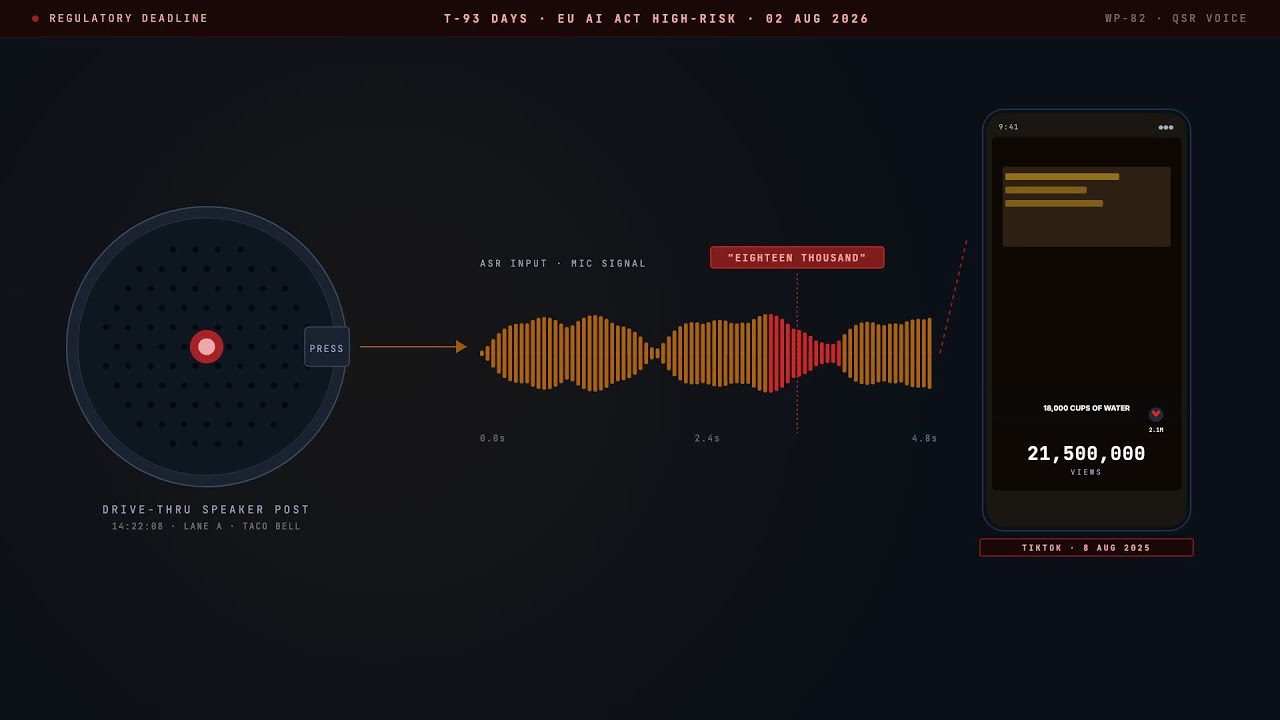
McDonald's lost three years and killed its IBM partnership at 80% accuracy. Taco Bell's AI processed 18,000 water cups because nobody built a quantity check. Wendy's FreshAI cuts off customers who stutter. The technology works. The architecture around it does not. We build the missing layers.
93-96%
Autonomous accuracy at scale
Hi Auto / Bojangles, 500 locations, 2026
$58K
Annual savings per location
SoundHound / White Castle, 2026
22 sec
Faster per order vs. human baseline
2025 Intouch Insight Drive-Thru Study
These numbers come from chains that got the architecture right. The gap between 80% accuracy (McDonald's-IBM) and 96% (Hi Auto-Bojangles) is not a better model. It is better signal processing, deterministic validation, and POS integration engineering.
Every high-profile drive-thru AI failure traces back to one of these. The AI model itself is rarely the problem.
A drive-thru speaker post is one of the most acoustically hostile environments for machine hearing. Engine rumble sits at 200-400Hz, directly overlapping with male voice fundamentals. Wind creates non-stationary pressure waves against the microphone. Rain adds broadband noise across the entire speech frequency range. A car radio in the background introduces competing speech that standard voice activity detection cannot separate from the customer's order.
The McDonald's-IBM system handled this by sending raw, unfiltered audio to Watson NLP. The result: the system "overheard" orders from adjacent lanes (the "9 sweet teas" incident), misinterpreted engine transients as speech onset, and hallucinated menu items from phonetic fragments. When a customer said "water and vanilla ice cream," the system matched degraded audio to high-probability tokens and produced "caramel sundae with butter and ketchup."
The fix is not a better language model. It is a multi-stage audio pipeline: neural VAD (Silero-class) with 400ms continuous probability thresholds instead of energy-based spike detection, spectral gating that removes 75% of background noise before ASR receives the signal, and beamforming via microphone arrays (Andrea DA-252 or Veovox AudioBox) that spatially isolate the driver's voice from all other sound sources. This layer must be engineered per speaker post model and per acoustic environment. Off-the-shelf noise cancellation trained on office audio fails here.
Taco Bell's AI correctly understood "18,000 cups of water." That was not a speech recognition failure. The system had no quantity validation layer, no anomaly detection, and no rate limit per session. The voice AI's output flowed directly to the POS because nobody built the middleware to check whether an order is physically plausible before it hits the kitchen display.
The same architectural gap caused McDonald's AI to add 260 Chicken McNuggets to a single car's tab and garnish vanilla ice cream with bacon. In each case, the AI's language understanding was correct. The business logic was absent.
A deterministic validation engine takes 2-3 weeks to build per chain. It enforces quantity caps derived from actual order distributions (the 99.9th percentile for water at any QSR location is likely 8 cups), item combination logic (the historical probability of "ice cream + bacon" in McDonald's order data is effectively zero), price thresholds per transaction, and mandatory human escalation for orders that exceed configurable anomaly bounds. This is rule-based middleware, not AI. It is the cheapest and fastest fix available, and it prevents the category of failure that generates 21.5 million social media views.
Wendy's FreshAI is described as "unusable" by customers who stutter. When a person who stutters says "b-b-b-baconator," the ASR produces duplicate tokens that break NLU logic. When they experience a block (a silent pause mid-word), the VAD interprets it as end-of-turn and cuts them off. When they prolong a sound ("Mmmmilk"), the phoneme distortion causes misrecognition ("Silk"). The system was trained on fluent, standard American English. It fails on the 80 million people worldwide who stutter, plus millions more with accents, elderly speech patterns, or non-native pronunciation.
The legal exposure is real and growing. Food and beverage is the second-most-targeted industry for ADA digital accessibility lawsuits, with filings up 40% in 2025 over 2024. Canada published CAN-ASC-6.2:2025, the world's first national standard for accessible AI, requiring equitable performance across disability status. The EU AI Act transparency obligations take effect August 2026. No voice AI accessibility lawsuit has landed yet, but the McDonald's BIPA voiceprint case showed that drive-thru AI is in the litigation crosshairs. Retrofitting accessibility into a deployed system costs approximately 5x what building it in from the start would have.
A reference for vendor evaluation meetings. Honest gaps included. Pull this up when your team is comparing options.
| Vendor / Approach | What They Do Well | Deployment Scale | Honest Gaps |
|---|---|---|---|
| SoundHound (Julia) | Voice-native platform, 90%+ order completion, omnichannel (drive-thru + phone), $58K/yr savings per location | 100+ White Castle locations, Red Lobster (~500 for phone) | General-purpose voice engine, not QSR-specific NLU. Limited modifier depth for complex menus. No published disfluency support. |
| Hi Auto | 93% completion, 96% accuracy at scale. Car image integration for order matching. 100M+ orders/year. | ~500 Bojangles, ~1,000 total stores | Less focus on accessibility/disfluency. Noise cancellation is proprietary but undocumented. Limited multi-language support. |
| Presto (+ Presto IQ) | FreshAI founder Michael Chorey as President. QSR-native. $10M raised Jan 2026. Building AI-native data analytics. | Del Taco, Checkers, Carl's Jr. | May inherit FreshAI's architectural assumptions. Presto IQ (analytics) is new and unproven. Small team relative to market ambition. |
| Vox AI | 90+ languages/dialects. $8.7M seed funding (Aug 2025). Claims 17x ROI. | Early deployments with undisclosed major chains | Pre-scale. Limited public deployment data. ROI claims unverified by third parties. |
| ConverseNow | 2M+ conversations/month. 25% same-store sales increase. Olo POS integration. | Pizza chains, phone ordering focus | Strongest on phone ordering, less proven in outdoor drive-thru acoustics. Pizza-menu depth may not transfer to broader QSR. |
| Google Cloud (Vertex AI) | Powers Wendy's FreshAI and McDonald's next-gen. Massive R&D. Distributed Cloud edge appliances. | Wendy's (500-600), McDonald's (43,000 planned) | Platform dependency. Cloud latency adds 100-500ms. General-purpose models require extensive QSR tuning. FreshAI's 86% autonomous accuracy shows the gap. |
| NVIDIA (Orin / Yum!) | Edge GPU hardware. Powers Taco Bell's Byte by Yum! platform. | 500+ Taco Bell locations (paused) | Hardware infrastructure, not a voice AI solution. The 18,000 waters incident happened on their hardware. Missing validation layer was the gap. |
| Big 4 / Large SIs | Enterprise relationships, project management at scale, vendor selection advisory. | Advisory, not product deployments | They recommend SoundHound or Hi Auto, they don't build custom VAD pipelines or acoustic engineering. Engagements run $500K-$5M+ over 6-18 months. |
| Veriprajna | Vendor-neutral architecture. Custom acoustic pipelines, deterministic validation, accessibility engineering, POS middleware. | Consulting engagements | Not a voice AI platform. We don't replace SoundHound or Hi Auto. If you need a turnkey ordering system, start with them. We fix what breaks after deployment. |
Gaps that nobody solves well yet: multi-speaker diarization in noisy outdoor environments, real-time Spanish-English code-switching, and consistent accuracy across all US regional accents. These are unsolved research problems, not vendor shortcomings.
We work alongside your voice AI vendor, not instead of them. These are the layers between the vendor's platform and production reliability.
Before you choose a vendor or troubleshoot a failing deployment, we map the entire signal flow: microphone hardware, speaker post acoustics, network path, ASR engine, NLU layer, POS integration, kitchen display routing, and human escalation logic. The output is a signal-flow diagram with measured SNR at each stage and specific technical recommendations.
Typical engagement: 3-4 weeks, includes on-site acoustic measurement at 3-5 representative locations.
The Taco Bell layer. Rule-based middleware between your voice AI's output and POS submission. Enforces quantity caps from your actual order distributions, item combination logic from historical pairing data, price thresholds, daypart rules, and session rate limits. We derive every rule from your order data, not assumptions. When an order exceeds bounds, the system routes to human confirmation with full conversational context.
Build time: 2-3 weeks per chain. Runs as a stateless microservice. Sub-5ms added latency.
We tune the audio path for your specific hardware and environment. This means configuring neural VAD with 400ms continuous probability thresholds (not energy-spike detection), implementing spectral gating calibrated to your locations' noise profiles, and setting up beamforming on array microphones (Andrea DA-252 or Veovox AudioBox) to spatially isolate the driver from engine, wind, and adjacent-lane audio. We don't build a new ASR. We make the audio your vendor receives 30-40% cleaner.
Requires on-site acoustic profiling. Deployed as an edge-native DSP service on existing hardware or recommended upgrades.
Disfluency-tolerant preprocessing that sits upstream of any ASR engine. Dynamic pause tolerance (600-1000ms, context-aware), repetition normalization that maps "b-b-b-baconator" to "baconator" before the ASR sees it, block detection that distinguishes a speech block from end-of-turn, and prolongation handling. We also extend the pipeline for accent diversity, elderly speech patterns, and non-native speakers. This is how you build ADA compliance and CAN-ASC-6.2 readiness into an existing deployment.
Includes a Voice Inclusion Audit: we test your system across 8 demographic dimensions and produce a compliance-ready report.
Custom connectors for the POS systems that run QSR: NCR Aloha (rate-limited API, requires modifier batching and sequence management), Toast (needs multi-lane session isolation for dual drive-thru), and Oracle Simphony (requires a protocol adapter for voice AI JSON output). Beyond the API connection, we handle daypart enforcement in real-time, LTO injection within hours of launch (not after a model retrain), kitchen display routing by item category, and multi-lane session management that prevents order contamination.
Typical integration: 4-8 weeks depending on POS platform and modifier complexity.
Multi-agent orchestration for the full drive-thru workflow. A demand forecasting agent predicts order volume by 15-minute window and triggers prep alerts. A lane assignment agent routes cars to the optimal lane based on order complexity and current kitchen capacity. An escalation routing agent monitors confidence scores across all active sessions and pulls a human operator into the conversation before the customer notices a problem. This is the 2026 shift from "AI takes orders" to "AI runs the drive-thru operation."
Built on deterministic workflow orchestration with LLM reasoning at the edge. Phased rollout recommended.
Four phases. The first two can run in parallel with your vendor selection process. We do not require you to pause operations.
On-site measurement at 3-5 representative locations. We record audio at the speaker post under varied conditions (peak, rain, wind, dual-lane), measure SNR at each stage of the current pipeline, map POS integration points, and document the full order-to-kitchen signal flow. If you have an existing voice AI deployment, we benchmark its accuracy by demographic segment.
Timeline: 2-3 weeks. Deliverable: Signal-flow diagram, SNR measurements, gap analysis with prioritized recommendations.
Based on the audit, we design the target architecture: which layers run on edge hardware, which route to cloud, where the validation engine sits, how human escalation triggers, and how the POS integration handles your specific menu complexity. We specify hardware upgrades if the current speaker post microphones are inadequate. For new deployments, we design the architecture before you select a voice AI vendor so the vendor's platform plugs into a system that already handles the hard parts.
Timeline: 2-3 weeks. Deliverable: Architecture specification, hardware BOM (if needed), integration plan, compliance requirements matrix.
We build the validation engine, acoustic pipeline, POS middleware, and inclusive voice layer. Deployment starts at 3-5 pilot locations running in shadow mode (AI runs alongside human operators, outputs compared but not live). Shadow mode typically runs 2-4 weeks to calibrate validation thresholds and tune acoustic parameters to real-world performance before going live.
Timeline: 6-10 weeks. Deliverable: Deployed microservices, pilot performance data, go/no-go recommendation for rollout.
Phased rollout from pilot to fleet. Real-time dashboards track accuracy, escalation rates, throughput (CPHPL), and demographic performance. Automated drift detection flags when accuracy degrades by location, time of day, or speaker profile. Menu change automation ensures LTOs are live in the NLU within hours of corporate's menu update, not after a model retrain cycle.
Timeline: Ongoing. Deliverable: Monitoring dashboard, monthly performance reviews, automated retraining triggers.
Realistic caveat: Total timeline from audit to fleet-wide deployment is 4-9 months depending on location count, POS complexity, and whether you're building new or fixing existing. This is faster than the McDonald's-IBM timeline (3 years to plateau at 80%) but slower than a vendor sales pitch. The engineering takes the time it takes.
Answer six questions about your current setup. The assessment produces specific recommendations, not a generic readiness score.
SaaS voice AI platforms charge $200-$500 per location per month for the software license. But total cost of ownership runs higher: $400-$980/month when you add edge hardware amortization, POS integration maintenance, and menu configuration labor.
Edge computing hardware (NVIDIA Orin modules or equivalent) adds $500-$1,500 per location as a one-time capital expense with a 3-5 year refresh cycle. POS integration is the hidden cost most vendors underquote. Connecting to NCR Aloha requires middleware development that can take 8-12 weeks and $50K-$150K depending on your modifier complexity and multi-lane requirements. Toast integration is faster (4-6 weeks) but still requires custom work for real-time order streaming.
The ROI math typically works at scale: restaurants report $3,000-$18,000 in additional monthly revenue per location from throughput gains and consistent upselling, plus $900-$1,200 in monthly labor savings. SoundHound claims $58,000 in annual savings per White Castle location. The break-even point for most 100+ location chains is 4-8 months after deployment completes.
Most accuracy problems originate in two places that have nothing to do with your vendor's AI model. First, the acoustic signal. Standard drive-thru speaker posts create resonance in the 200-400Hz range that overlaps with male voice fundamentals. If your vendor is receiving degraded audio, no amount of NLU sophistication will fix it. An acoustic audit measures the actual signal-to-noise ratio at your speaker posts across conditions (rain, wind, peak traffic) and identifies whether spectral gating, beamforming reconfiguration, or hardware upgrades will have the highest impact.
Second, the endpointing logic. Most drive-thru AI uses a static 500ms pause threshold to decide when a customer has finished speaking. In practice, customers pause for 1-2 seconds to read the menu board, and the system cuts them off mid-order. Switching to dynamic endpointing with context-aware turn-taking (recognizing that "and..." means the turn is not complete) typically reduces repeat-order rates by 15-25%.
Neither fix requires replacing your voice AI vendor. They sit upstream (acoustic pipeline) and downstream (validation layer) of whatever platform you run.
Probably not, and the regulatory trajectory is accelerating. Stuttering affects over 80 million people globally, and standard ASR models are trained almost exclusively on fluent speech. When a person who stutters interacts with drive-thru AI, sound repetitions trigger token duplication errors, blocks (silent pauses mid-word) are misinterpreted as end-of-turn, and prolongations cause phoneme distortion. The result: the system either cuts them off repeatedly or produces nonsensical transcriptions.
No major QSR voice AI vendor currently ships disfluency-tolerant ASR as a standard feature. Canada published CAN-ASC-6.2:2025 in December 2025, the world's first national standard for accessible AI systems. It mandates equitable performance across disability status and meaningful choice to decline AI for a human operator. The EU AI Act transparency obligations take effect August 2026. In the US, food and beverage companies are the second-most-targeted industry for ADA digital accessibility lawsuits, with filings up 40% in 2025.
No voice AI accessibility lawsuit has been filed yet, but the McDonald's BIPA voiceprint case (Carpenter v. McDonald's) demonstrated that drive-thru AI is squarely in the litigation crosshairs. The cost of retrofitting accessibility into an existing deployment runs approximately 5x the cost of building it in from the start.
The answer depends on your tolerance for latency, your data privacy requirements, and your location count. Cloud-based voice AI (the approach Wendy's FreshAI uses with Google Cloud) adds 100-500ms of network round-trip latency before the model starts processing. For casual conversation that is manageable. For drive-thru ordering where the gold standard is sub-300ms total response time, it creates the "sluggish" feeling customers complain about.
Edge AI processes audio locally on hardware at the restaurant, reducing inference latency to 5-10ms. The trade-off is capital cost ($500-$1,500 per location for NVIDIA Orin or equivalent) and a hardware refresh cycle every 3-5 years. For chains with 200+ locations, that is $100K-$300K in upfront hardware alone.
The practical answer for most chains in 2026 is hybrid: run the VAD, noise cancellation, and initial ASR on edge hardware for speed, then route to cloud-based NLU and business logic for the heavy reasoning. This gives you sub-100ms audio processing with the full reasoning power of larger models for complex orders.
Data sovereignty is the other consideration. If you operate in Illinois (BIPA), Canada (PIPEDA), or serve EU customers (GDPR), processing voice data through third-party cloud creates regulatory exposure. Edge processing keeps audio data on premises.
The Taco Bell 18,000 water cups incident was not an AI failure. It was a missing validation layer. The voice AI correctly understood the order. The problem was that nothing between the AI and the POS checked whether 18,000 units of anything is physically plausible.
A deterministic validation engine sits between your voice AI output and POS submission. It enforces: quantity caps based on historical order distributions (99.9th percentile for water at Taco Bell is probably 8 cups), item combination logic (bacon plus ice cream is a 0% pairing in McDonald's order history), price thresholds per transaction, and rate limits per session. This is not complex AI. It is rule-based middleware that takes 2-3 weeks to build and configure per chain. The rules are derived from your actual order data, not guesswork.
Beyond quantity validation, adversarial resilience includes confidence-based human escalation (if the model's confidence drops below 0.85, route to a human operator with full context), session anomaly detection (unusual ordering patterns trigger a manager alert), and input sanitization (filtering prompt injection attempts in voice-to-text output). The key principle: the AI handles language understanding, deterministic code handles business logic. Never let a probabilistic model make a deterministic business decision.
POS integration is where most drive-thru AI deployments stall. Each POS platform has specific limitations that voice AI vendors often discover mid-deployment. NCR Aloha's API is rate-limited and does not support real-time modifier streaming natively. If a customer says "no pickles, extra cheese, light lettuce" in rapid succession, the modifiers need to be batched and sent in the correct sequence. Custom middleware handles the translation between the voice AI's modifier output and Aloha's expected input format.
Toast's API is more modern but lacks multi-lane session isolation out of the box. If your restaurant has dual drive-thru lanes, you need session management that prevents Lane A's order from contaminating Lane B's ticket. Oracle Simphony requires a middleware adapter for any voice integration, adding a translation layer between the voice AI's JSON output and Simphony's proprietary protocols.
Beyond the API connection, the integration must handle: daypart enforcement (breakfast menu items cannot be ordered after 10:30 AM, and the AI must know this in real-time), LTO injection (when a new limited-time offer launches, the NLU must recognize it within hours, not after a model retrain), and kitchen display routing (the order must appear on the correct make station's screen based on item category). We build POS-specific middleware that handles these requirements as a persistent service layer, so your voice AI vendor can focus on language understanding while the integration handles business logic.
The whitepapers behind this solution page. Each explores a specific dimension of QSR voice AI architecture in depth.
Uses the McDonald's-IBM drive-thru failure as a case study for deterministic core architecture, sovereign deployment, and the 4-Pillar consulting methodology for QSR voice AI.
Deep technical analysis of Wendy's FreshAI failures: VAD bottlenecks, disfluency-aware ASR, edge vs. cloud architecture, and the ADA/EAA regulatory horizon for accessible voice AI.
Deconstructs the Taco Bell adversarial ordering incident. Covers multi-agent orchestration, deterministic state machines, semantic validation layers, and voice-native guardrails for production AI.
At $400-$980/month per location in total cost of ownership, voice AI is a significant fleet-wide investment. Architecture failures waste that spend and create brand liability.
We start with an acoustic and architecture audit at 3-5 locations. You get a signal-flow diagram, measured gap analysis, and specific recommendations before committing to a build engagement.