Insurance Claims AI
Auto insurers are caught between two AI-driven threats: fraudsters generating synthetic damage photos that pass existing checks, and "enhancement" tools that alter evidence before adjusters see it. Veriprajna builds forensic computer vision that authenticates, measures, and preserves every pixel of claims evidence.
36%
of consumers would alter a claim image
Verisk, March 2026
Only 32%
of insurers confident detecting deepfakes
Verisk, March 2026
24 States
adopted NAIC AI Model Bulletin
NAIC, late 2025
Whether you're evaluating AI claims tools for the first time, replacing a vendor that can't explain its decisions, or scaling a pilot to production across multiple states, this page covers what your claims AI stack actually needs to handle in 2026.
Most claims AI was designed in an era when the biggest risk was inaccurate damage estimates. The threat model has changed.
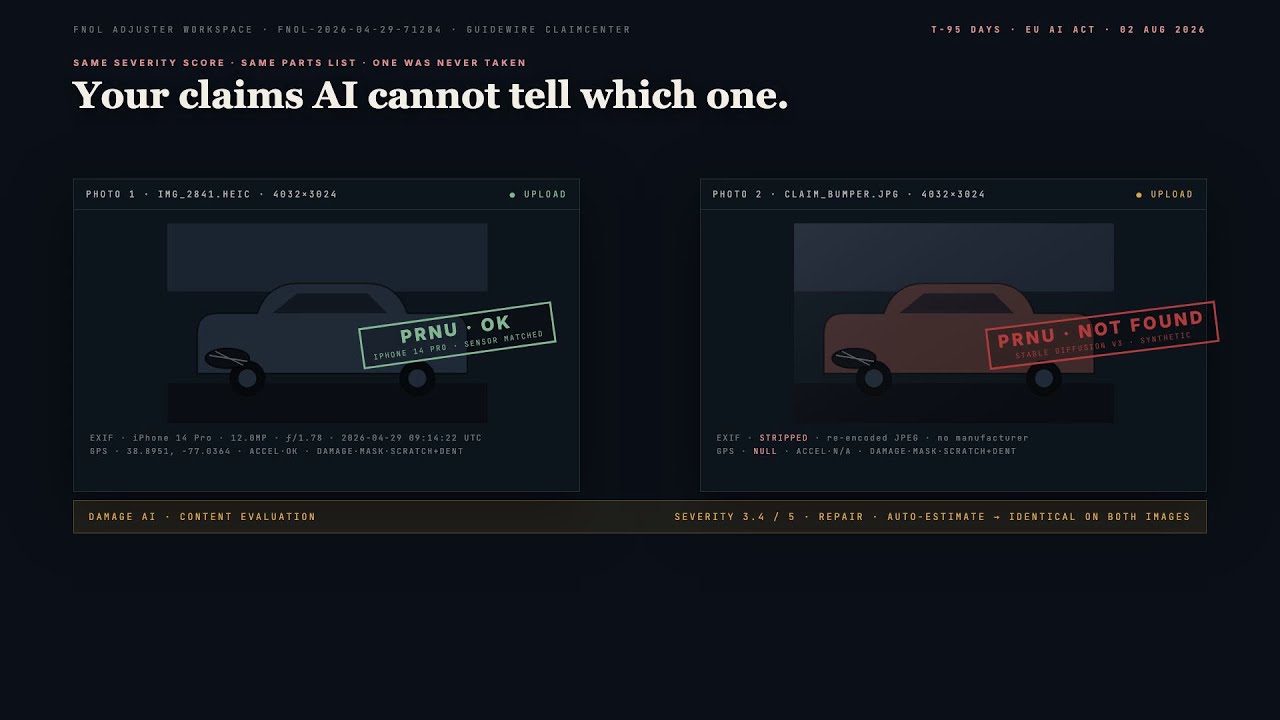
A fraudster takes a photo of an undamaged vehicle and uses a diffusion model to add a convincing smashed bumper. The generated image includes proper lighting, shadows, and surface reflections. Your AI damage assessment tool evaluates the image and confirms: yes, this is a damaged car. It generates a severity score and a repair estimate. The claim pays out.
This is not hypothetical. In April 2025, UK motor carriers disclosed that fraudsters had used diffusion models to inject scratches and cracks into benign photos, inflating average payouts by roughly GBP 13,000 per incident. Verisk's March 2026 study found that 55% of Gen Z consumers would consider digitally altering a claim image. Among those who have tried, 44% described their results as "very realistic."
Your damage assessment AI fails here because it evaluates content (what does the damage look like?) rather than authenticity (was this damage physically present when the photo was taken?).
A policyholder uploads a photo of a dented rear quarter panel through your mobile app. Your image processing pipeline "enhances" the photo for clarity using a GenAI upscaler. The model, trained to maximize image quality, interprets the dent as visual noise and smooths it. The adjuster sees a cleaner image with reduced damage visibility.
Under US law, alteration of evidence relevant to a legal proceeding constitutes spoliation. If a denied claim goes to litigation and your workflow overwrote the original with an AI-modified version, you face adverse inference instructions, sanctions, or summary judgment. The intention to "improve" the image is irrelevant. The introduction of synthetic pixels (pixels not captured by the camera sensor) is the legal test.
This risk exists in any pipeline where GenAI touches claims images before assessment. If your photo processing includes upscaling, denoising, or "enhancement," you have a spoliation exposure you may not have audited.
These threats collide with a tightening regulatory environment. The NAIC Model Bulletin, now adopted by 24 states, requires documented AI governance programs, explainable claim decisions, and ongoing model monitoring. The EU AI Act classifies insurance AI as high-risk with an August 2026 enforcement deadline and penalties up to EUR 35 million or 7% of global turnover. A carrier using a black-box AI score to deny a claim cannot produce the explanation regulators require. A carrier whose pipeline altered evidence cannot produce the original image a court demands.
The claims AI landscape has strong players. Understanding what each does well, and where each falls short, is the first step toward a system that actually covers your exposure.
| Vendor | What They Do Well | Gaps | Deployment |
|---|---|---|---|
| Tractable | Market-leading damage assessment. 80+ panels/parts. 95% accuracy claimed. STP integration with Mitchell. Partners with major carriers (Tokio Marine, Hartford, GEICO). | No segmentation mask exposed to adjusters (explainability gap). No evidence chain-of-custody. No deepfake detection. SaaS-only, no on-prem option. You don't own the model. | SaaS |
| CCC Intelligent Solutions | End-to-end claims platform. $100M AI revenue. Estimate-STP in seconds. 125+ insurer customers. Deep Guidewire integration. OEC RepairLogic integration (2026). | Shared model trained on aggregated data. No carrier-specific fine-tuning. No forensic evidence handling. Limited on-prem. No deepfake detection. | SaaS |
| Mitchell/Enlyte | Cloud-native Guidewire integration. Comprehensive repair data. Tractable partnership for AI assessment. | AI capability comes from Tractable partnership, not proprietary. Same Tractable gaps apply to the AI layer. | SaaS/Cloud |
| Verisk (Digital Media Forensics) | Strong fraud detection and analytics. Published authoritative research (2026 State of Fraud study). Broad insurer adoption for SIU workflows. | Detection is post-hoc (after claim submission), not integrated into the assessment pipeline. Separate product from damage assessment. Not a CV damage tool. | SaaS |
| VAARHAFT | Purpose-built insurance image fraud detection. Synthetic probability scoring, metadata analysis, heat-map overlay for adjusters. Secure recapture feature. | Fraud detection only. No damage assessment capability. Requires separate vendor for the actual CV analysis. | API/SaaS |
| Big 4 / Large SIs | Proven integration capability with Guidewire and Duck Creek. Risk assessment frameworks. Regulatory consulting. | They recommend and integrate platform vendors, not build custom CV models. Engagements run $500K-$5M+ with 6-18 month timelines before production AI touches a claim. Heavy on governance docs, light on actual model development. | Consulting |
The structural gap: no single vendor combines damage assessment, deepfake detection, evidence integrity, and model ownership. Carriers cobble together Tractable + Verisk + a GRC tool and still can't produce an explainable, forensically defensible claim record from a single pipeline.
Four capabilities that work as a single pipeline. Each addresses a gap that existing platforms leave open.
Runs before damage assessment, not after. Multi-layer authentication: PRNU sensor noise analysis (checks the image was captured by a physical camera, not generated), metadata consistency verification, diffusion-model artifact detection in frequency domain, and perceptual hash comparison against historical claims.
We train detection models on insurance-relevant image types (vehicle damage, property, medical documents) rather than using general-purpose deepfake detectors built for face-swap videos. Detection completes in under 3 seconds per image. Flagged images generate a forensic report with probability scores and highlighted anomaly regions for SIU referral.
Custom semantic segmentation models trained on your claims data. Pixel-level damage masks: scratch (yellow), dent (red), crack (blue), deformation (orange). Surface area calculation calibrated to OEM part dimensions. We reach for Mask R-CNN when your damage types are well-defined and the priority is mask precision. For carriers with diverse damage patterns and limited labeled data, we use a U-Net encoder-decoder architecture that generalizes better from smaller training sets.
Monocular depth estimation provides severity scoring. On flat panels, depth maps reliably distinguish PDR-repairable dents (shallow gradient, typically under 8mm depth) from replacement-severity creases. On complex curved surfaces like wheel arches, we flag for adjuster review rather than generating an unreliable automated recommendation. Honest boundaries matter more than inflated accuracy claims.
Every image is SHA-256 hashed at ingestion. Our analysis pipeline reads the image buffer but never writes to it. Segmentation masks, depth maps, and structured reports are saved as sidecar files linked to the original hash. Every access and processing step is logged with timestamps and model version identifiers.
This architecture means the original evidence is always available, unaltered, with a complete audit trail. If a claim goes to litigation, you can produce the original image, the analysis overlay, and a log showing exactly what processing occurred and when. This is not just good practice; it is a defense against spoliation claims that could otherwise result in adverse inference instructions or sanctions.
Structured JSON output compatible with Guidewire ClaimCenter Cloud API and Duck Creek Claims. The payload maps to ClaimCenter's exposure and activity models: damage inventory (parts identified, damage type per part), severity scores, repair/replace recommendations, and links to sidecar files. Adjusters see the analysis inside their existing workflow, not in a separate tool.
The adjuster dashboard adds a mask toggle overlay (turn segmentation on/off over the original image), a depth heatmap for severity visualization, and an audit trail showing every step of the AI's reasoning. For low-severity, high-confidence claims that match your configured business rules, the system supports straight-through processing with full documentation.
A step-by-step walkthrough of how we process a single claim image, from the moment the policyholder takes a photo to the moment the adjuster sees the analysis.
The policyholder opens the mobile SDK. The camera view detects the vehicle in frame and guides a 4-angle walk-around (front, rear, left, right). Each capture is checked in real-time for blur, glare, distance, and angle. If a photo is unusable, the SDK coaches the user ("Move closer to the damage," "Step to the right to reduce glare") before accepting. This reduces unusable submissions from the industry average of 30-40% to under 10%. At capture, GNSS coordinates and accelerometer data are locked to the image file. The accelerometer data confirms the phone was moving naturally in 3D space, preventing "photo of a screen" attacks.
Before damage assessment begins, the image passes through the authentication pipeline. PRNU analysis checks for a physical sensor fingerprint. Metadata is validated against the claim record (location, timestamp, device). The frequency domain is analyzed for GAN/diffusion artifacts. Perceptual hashes are compared against the carrier's historical claim database. If the image passes, it moves to assessment. If flagged, a forensic report is generated and the claim is routed to SIU with highlighted anomaly regions. Processing time: under 3 seconds.
Three models run in parallel on the authenticated image. The segmentation engine identifies damage boundaries at the pixel level and classifies each damaged area by type. The depth engine generates a depth map and calculates dent volume by integrating depth values over the segmented area. The severity scoring engine combines surface area, depth, and damage type to produce a repair/replace recommendation based on the carrier's configured thresholds and OEM-specific repair procedures (for example, Tesla's aluminum panel replacement requirements differ from steel-body manufacturers that allow PDR). All analysis is saved as sidecar files linked to the original image hash.
The structured analysis payload lands in the adjuster's ClaimCenter or Duck Creek queue. They see the original photo with a togglable damage mask overlay. The depth heatmap shows severity distribution across the damaged area. The structured report lists each damaged part, the measured surface area in square centimeters, the depth classification, and the AI's recommendation. For straightforward exterior damage matching carrier-defined STP rules, the system can process payment automatically with a full audit trail documenting exactly why. Complex or edge-case claims route to a senior adjuster with the AI analysis as a starting point, not a final decision.
Three phases. Five to eight months from kickoff to live claims processing. No phase is skippable.
Phase 1: 4-6 weeks
Phase 2: 3-4 months
Phase 3: 4-8 weeks
After cutover, we monitor model performance continuously: accuracy drift, bias in outcomes across vehicle types and claim demographics, and detection rate against emerging fraud techniques. We retrain models quarterly or when performance metrics cross predefined thresholds. Monthly compliance reports map directly to NAIC AIS Program documentation requirements. This runs $8,000-$15,000/month depending on claim volume and deployment complexity.
Answer six questions about your current claims AI stack. The assessment evaluates your readiness across four dimensions: evidence integrity, fraud detection, explainability, and vendor dependency. Results include specific next steps you can take regardless of whether you work with us.
1. Does your current claims AI pipeline alter, enhance, or upscale submitted images before assessment?
2. Can your system detect AI-generated or manipulated claim photos?
3. When your AI adjusts or denies a claim, can you explain exactly why to a regulator?
4. Do you have a documented AIS Program that covers your claims AI, as required by the NAIC Model Bulletin?
5. What is your claims AI deployment model?
6. How many states do you write auto insurance in?
We run a multi-layer authentication pipeline before any damage assessment begins. The first layer is PRNU (Photo Response Non-Uniformity) analysis, which checks whether the sensor noise pattern in the submitted image matches the device it claims to come from. Every camera sensor has a unique noise fingerprint, similar to a ballistic signature on a bullet. GAN-generated and diffusion-model images lack this fingerprint entirely because they were never captured by a physical sensor.
The second layer is metadata consistency checking. We verify EXIF data, GPS coordinates, and timestamps against the claim record. AI-generated images often have scrubbed or internally contradictory metadata. The third layer is structural artifact detection. Current diffusion models leave subtle signatures: frequency-domain anomalies, inconsistent noise distributions across color channels, and geometric inconsistencies in reflections. We train detection models specifically on insurance-relevant image types (vehicle damage, property damage, medical documents) rather than using general-purpose deepfake detectors built for face-swap videos.
The fourth layer is perceptual hash comparison against the carrier's historical claim database, catching recycled or near-duplicate images from prior claims. When our pipeline flags an image, it generates a forensic report with probability scores, highlighted anomaly regions, and a human-readable explanation suitable for SIU referral. The detection runs in under 3 seconds per image and integrates directly into the FNOL workflow so suspicious claims are flagged before they enter the assessment pipeline.
Tractable and CCC are strong platforms, and many carriers should use them. The question is whether a platform fits your specific situation. Tractable returns a severity score (1-5) and repair/replace recommendation, but does not expose the underlying segmentation mask to your adjusters. When a claimant disputes the AI's assessment, your adjuster cannot show them exactly which pixels the model identified as damage, which creates an explainability gap that matters under NAIC requirements. CCC's Estimate-STP generates full repair estimates in seconds using their proprietary parts and labor database, which is genuinely impressive for straightforward exterior damage. But CCC's AI runs on their shared infrastructure, trained on their aggregated dataset. You do not own the model weights, cannot deploy on-premise, and cannot fine-tune for your specific fleet mix or claims patterns.
We build something different: custom segmentation models trained on your claims data that you own. The output is a pixel-level damage mask your adjusters can toggle on and off, with surface area calculations calibrated to OEM part dimensions and depth estimation for severity scoring. We also wrap every analysis in a forensic evidence chain (SHA-256 hash, sidecar metadata, audit trail) that Tractable and CCC do not provide because their focus is processing speed, not litigation defensibility. For carriers processing 50,000+ auto claims annually with regulatory exposure across multiple states, the ownership and explainability advantages matter. For a smaller carrier wanting fast time-to-value, Tractable or CCC is probably the right choice.
The NAIC Model Bulletin on the Use of AI by Insurers, adopted in December 2023 and now implemented by 24 states, requires three things that directly affect claims AI. First, a documented AIS Program: a written governance framework covering development, deployment, and monitoring of every AI system used in claims decisions. This includes third-party vendor tools. If you use Tractable or CCC, you need documented due diligence on their data lineage, model architecture, and validation testing. The bulletin explicitly states that outsourcing AI does not outsource liability.
Second, explainability: if a claim is denied or adjusted based on AI analysis, you must be able to explain the decision in terms a policyholder and a regulator can understand. A severity score of 3 out of 5 is not an explanation. A segmentation mask showing exactly which areas the model identified as damaged, with measured surface area and depth, is.
Third, ongoing monitoring: you must track model performance over time, including accuracy degradation, bias in outcomes across demographic groups, and drift in the types of claims being processed. We build compliance into the system architecture rather than bolting it on afterward. Every analysis generates a structured audit record that maps directly to NAIC documentation requirements. The system logs model version, input image hash, processing steps, confidence scores, and the adjuster's final decision, creating a complete chain from photo submission to claim resolution.
Yes, and integration architecture is where most claims AI projects either succeed or stall. We have built integrations with both Guidewire ClaimCenter and Duck Creek Claims. For Guidewire, we use the Cloud API (REST) to push structured analysis results directly into the claim file. The output is a JSON payload containing the damage inventory (parts identified, damage type per part), severity scores, repair/replace recommendations, and links to the sidecar files (segmentation masks, depth maps, forensic reports). This payload maps to ClaimCenter's exposure and activity models so adjusters see our analysis alongside their existing workflow. For Duck Creek, we integrate through their API gateway with similar structured output.
The integration typically takes 4 to 6 weeks for a standard ClaimCenter cloud deployment. On-premise Guidewire installations take longer, usually 8 to 10 weeks, because of environment-specific configuration and security review. The critical design decision is where the AI runs relative to your claims platform. We support three deployment models: our managed cloud (fastest to deploy, data leaves your perimeter), your VPC (you control the infrastructure, we manage the models), or fully on-premise (you control everything, longest deployment timeline). Most carriers with regulatory sensitivity choose the VPC model because it balances security with operational simplicity.
Photo quality is the single biggest variable in AI damage assessment accuracy, and most vendors understate this problem. In controlled conditions with good lighting and proper angles, semantic segmentation models achieve 90%+ accuracy on surface-level damage identification (scratches, dents, cracks). In real-world conditions with customer-submitted phone photos, 30 to 40 percent of first submissions are unusable: wrong angle, too far away, heavy glare, fingers over the lens, or taken at night with flash creating specular highlights that mask damage.
This is why we invest heavily in the guided capture experience. Our mobile SDK coaches the policyholder in real-time: it detects the vehicle in frame, guides them through a 4-angle walk-around, checks for blur and glare before accepting each photo, and rejects images that will produce unreliable analysis. This reduces the unusable submission rate from 30-40% to under 10%.
For the images that pass quality checks, our segmentation models produce pixel-level damage masks. We calibrate surface area calculations against known OEM part dimensions (a 2024 Toyota Camry rear bumper cover is 1,820mm wide, which gives us a pixel-to-millimeter ratio). Depth estimation from monocular images has inherent limitations. We are honest about this: for flat panels, our depth estimates are reliable enough to distinguish PDR-repairable dents (shallow gradient) from replacement-severity damage (sharp crease). For complex curved surfaces like wheel arches, depth accuracy drops and we flag these for adjuster review rather than generating a misleading automated recommendation.
A typical engagement runs in three phases over 5 to 8 months. Phase 1 is a 4 to 6 week assessment where we audit your current claims AI stack, map your integration architecture (Guidewire, Duck Creek, or proprietary), analyze a sample of 5,000 historical claim photos to establish baseline quality and damage distribution, and identify your highest-value automation target. This phase costs between $60,000 and $90,000 depending on complexity.
Phase 2 is the build, typically 3 to 4 months. We train custom segmentation models on your labeled claims data (we handle the labeling pipeline using a combination of our annotation tools and your adjusters' domain knowledge). We build the integration layer, deploy the deepfake detection pipeline, and set up the adjuster dashboard. This phase runs $250,000 to $400,000 depending on deployment model (cloud vs. VPC vs. on-premise) and the number of damage types in scope. Phase 3 is a supervised pilot on live claims, usually 4 to 8 weeks. We run the AI alongside your existing process, compare outputs, measure accuracy against adjuster decisions, and tune the models before full production cutover. Pilot cost is included in Phase 2.
Ongoing model maintenance and monitoring runs $8,000 to $15,000 per month. For context, a single disputed claim that reaches litigation costs a carrier $30,000 to $75,000 in legal and settlement expenses. A carrier processing 50,000 auto claims annually with even a 2% dispute rate where better evidence could have prevented escalation is looking at $300,000 to $750,000 in avoidable costs per year.
The technical foundations behind this solution page, published as an interactive whitepaper.
The Forensic Imperative: Deterministic Computer Vision in Insurance Claims AutomationCovers semantic segmentation architectures, monocular depth estimation for severity scoring, specular reflection analysis, and the legal framework for digital evidence in insurance.
Better evidence prevents disputes before they start.
For a carrier processing 50,000+ auto claims annually, a 2% reduction in dispute escalation from improved evidence quality saves $300,000-$750,000 per year. That is before accounting for fraud losses from undetected synthetic claims, which the Verisk 2026 study suggests are growing rapidly.