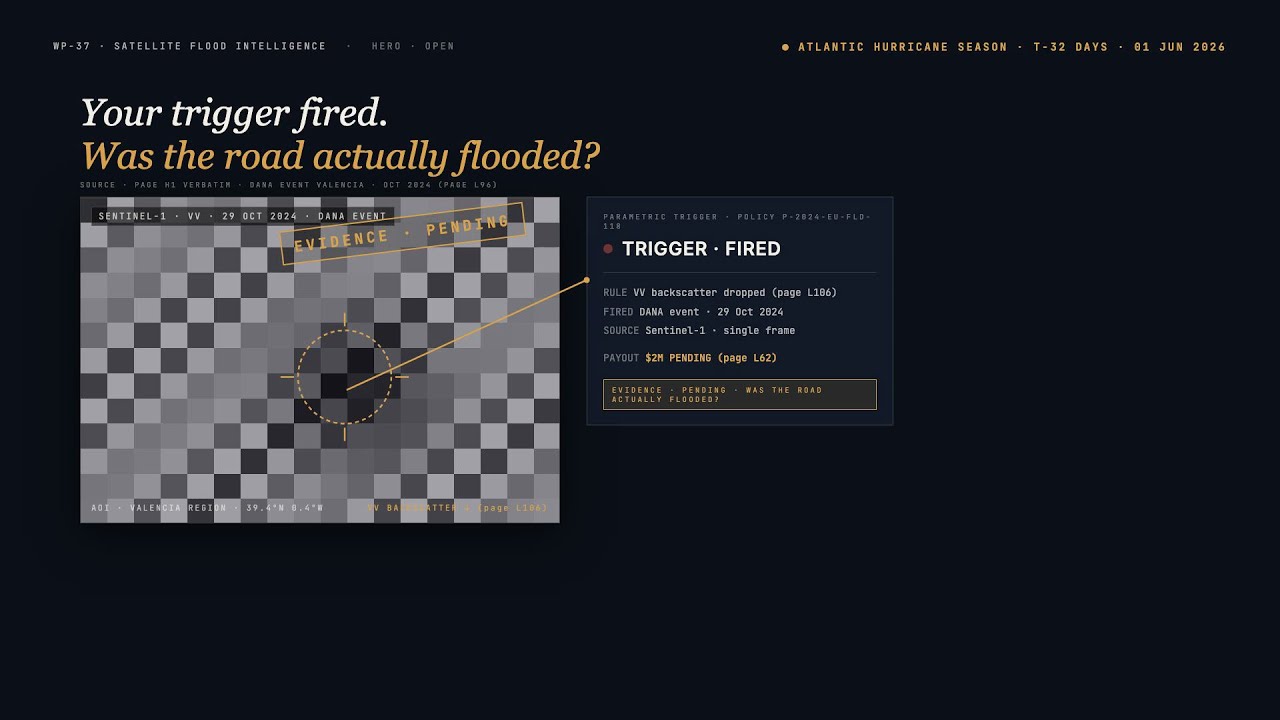
Single-frame satellite detection confuses cloud shadows with floodwater. When a $2M parametric payout depends on that classification, "probably flooded" is not good enough. We build flood verification systems that separate shadows from water using temporal SAR-optical fusion, producing forensic-grade evidence trails for every trigger event.
$129B
Global insured nat-cat losses, 2025
Gallagher Re, Jan 2026
52-56%
Of catastrophe losses uninsured globally
Munich Re, 2025
70%
Of supply chain disruptions are flood-related
DOXA, 2024
Cloud shadows and floodwater look nearly identical in optical satellite imagery. Both absorb near-infrared and shortwave infrared radiation. Both have amorphous, irregular boundaries. Both suppress ground texture in the pixel. A single Sentinel-2 frame captured during a flood event cannot reliably distinguish one from the other using spectral indices alone. NDWI and MNDWI, the standard water detection indices, flag both as "water-like" because the underlying physics is the same: reduced reflectance across NIR/SWIR bands. Models trained on disaster datasets compound this problem. Training sets are weighted to penalize missed floods more heavily than false alarms, because the humanitarian cost of missing a real flood outweighs the cost of a false detection. The result is classifiers that are systematically trigger-happy, flagging marginal cases as flood when the signal is ambiguous.
Valencia, Spain, October 2024. A year's worth of rain fell in 8 hours. 227+ people died. The Copernicus Emergency Management Service, the system Europe depends on for satellite-based disaster response, took 3-4 days to publish flood extent analysis. When the results came, they confirmed 15,633 hectares affected and approximately 190,000 people impacted. The delay was structural, not accidental. Copernicus EMS Service Level 2 operates 08:00-20:00 Brussels time on working days only. Valencia's critical first 24 hours overlapped with evening hours and overnight. The system that a continent relies on for flood intelligence was effectively closed during the window when information was most needed.
Nagaland, India. A parametric flood insurance scheme failed to trigger despite heavy rainfall and confirmed on-the-ground flooding. The satellite-derived threshold was set too high relative to ground reality. This is the opposite failure mode: false negatives from trigger miscalibration. Parametric insurance faces both directions of failure simultaneously. False positives (cloud shadow triggers payout for a non-flood event) drain reserves and invite fraud. False negatives (real flood fails to trigger the policy) destroy policyholder trust and generate litigation. Both failure modes undermine the credibility of the parametric model itself, making it harder for insurers to sell and harder for regulators to approve.
Synthetic aperture radar (SAR) is often presented as the solution because it penetrates clouds. Sentinel-1's VV polarization backscatter drops when radar hits smooth water surfaces due to specular reflection. But backscatter also drops over terrain shadows in mountainous areas because of radar layover and foreshortening. SAR is not a silver bullet. NASA's LANCE near-real-time flood product, derived from MODIS and VIIRS, demonstrates the problem at global scale. The 1-day composite has so many false positives that NASA does not even release it in the Worldview visualization tool. Only the 2-day and 3-day composites, which use temporal persistence to filter noise, are published for operational use. New reservoirs are misclassified as floods for up to 3 years until the permanent water mask updates. The false positive problem exists across every sensor modality.
A direct comparison of the major providers, products, and approaches in satellite flood detection and analytics.
| Provider | What They Do | Strengths | Gaps |
|---|---|---|---|
| ICEYE | SAR constellation + Flood Rapid Impact product (ML-powered, 6-12hr delivery) | Vertically integrated: owns 60+ satellites AND analytics. Hurricane Helene: 150+ images through storm clouds, 80,000+ buildings mapped in Florida. | Pricing makes per-event forensic verification prohibitive at portfolio scale. You're buying their product, not building your own intelligence capability. No optical fusion. |
| Floodbase (ex-Cloud to Street) | Multi-sensor parametric flood triggers with Capella SAR partnership | End-to-end parametric solution: pricing, trigger design, payout certification. Munich Re-backed Colombia program. | Trigger certification, not forensic verification. Limited to their sensor partnerships. You get their methodology, not a system tuned to your specific portfolio. |
| Copernicus EMS | Government rapid mapping using Sentinel data | Free. Gold standard for European disaster response. Backed by ESA. | Activation-only (not continuous monitoring). SL2 operates 08:00-20:00 Brussels working days only. 3-4 day turnaround (Valencia). Only authorized users can request activations. |
| Planet Labs | 200+ optical satellites, daily global imaging | Massive revisit rate. Good baseline monitoring. | Optical only. Useless during active storms when cloud cover is 100%. Cannot verify flood beneath clouds. |
| Maxar | Very high-res optical, Open Data Program for disasters | Best optical resolution. Government trust (FEMA, NGA). | Event-driven, not continuous. Optical limitations same as Planet. Activation delays. |
| H2O.ai / NVIDIA | Multi-agent flood intelligence blueprint | Predictive AI from USGS/NOAA/weather data. NVIDIA-accelerated. | Software framework, not a satellite data pipeline. Forecasting, not verification. You still need the observation layer. |
| Big 4 / Large SIs | Climate risk consulting, ESG reporting | Brand credibility. Existing enterprise relationships. | They don't build satellite analytics pipelines. Engagements run $500K-$5M+ with long timelines. They'll recommend ICEYE, not build you a custom verification system. |
| NASA LANCE | Free near-real-time flood products (MODIS/VIIRS) | Free, global, operational. | 1-day product too noisy for release (false positive rate). New reservoirs misclassified as floods for up to 3 years. Not insurance-grade. |
Each system is purpose-built for your risk geography, trigger parameters, and operational requirements.
For parametric trigger verification
We assemble temporal SAR-optical stacks from Sentinel-1/2 archives for your specific area of interest and event window. The pipeline runs shadow discrimination classifiers on the temporal signature of each pixel: shadows move at cloud speed (50+ km/h) and vanish within minutes. Floodwater persists for hours to days and flows downhill. The output is a forensic report with pixel-level evidence, flood extent polygons, duration estimates, and confidence scores. Designed for parametric payout decisions where the evidence must withstand auditor scrutiny.
Cross-referencing satellite detections against independent data
We build validation layers that cross-reference satellite detections against multiple independent data sources: DEM slope constraints (water doesn't pool on 30-degree slopes), river gauge telemetry, weather radar precipitation, and historical permanent water masks. When Sentinel-1 shows low backscatter on steep terrain, the system flags radar shadow, not flood. When Sentinel-2 shows darkness but Sentinel-1 shows high backscatter (rough dry surface), it's cloud shadow. Every suppressed false positive includes an explanation chain showing which data source contradicted the flood classification and why.
Tracking the gap between triggers and reality
The gap between what a parametric trigger measures and what actually happens on the ground is the single biggest obstacle to parametric insurance adoption. We build dashboards that continuously track this gap. For each event, the system compares trigger measurements against ground-truth proxies (gauge data, claims reports, aerial surveys). Over time, this produces the data underwriters need to refine trigger parameters and the audit trail that IAIS/FSI guidance now expects for parametric products.
Sub-hour analysis during active events
For clients who need sub-hour analysis during active events. We build pipelines that process incoming SAR acquisitions within minutes of downlink, overlay critical infrastructure layers (hospitals, evacuation routes, power substations), and push impact estimates to emergency management dashboards. The architecture uses pre-trained classifiers on Sentinel-1 GFM data as the baseline, supplemented with commercial SAR tasking from Capella or Umbra when higher resolution or faster revisit is needed.
Continuous watch over critical logistics nodes
We build watch systems over your critical supply chain nodes: factories, warehouses, ports, transport corridors. Using a combination of Sentinel-1 continuous monitoring and commercial SAR tasking during weather events, the system generates alerts with estimated disruption timelines based on flood trajectory modeling. For the 70% of weather-related supply chain disruptions caused by flooding, this converts "we found out when the shipment didn't arrive" into "we rerouted 48 hours before the flood reached the facility."
Four phases from audit to continuous refinement. Each phase produces a concrete deliverable you can evaluate before proceeding.
Map your current satellite data sources, trigger parameters (for insurance) or monitoring coverage (for supply chain). Identify false positive exposure by running your existing triggers against historical events where ground truth is available. Quantify basis risk or detection gaps with specific metrics.
Deliverable: Audit report with quantified gap analysis and recommended architecture.
Design the data ingestion, fusion, and classification pipeline. Select sensor sources based on your geography and revisit requirements (Sentinel-1/2 for baseline, commercial SAR for surge capacity). Build and validate shadow discrimination models on 3-5 historical flood events in your areas of interest.
Deliverable: Working prototype processing real satellite data over your AOIs.
Harden the pipeline for production: automated data ingestion, quality checks, alert routing, report generation. Integrate with your existing systems (claims platforms, GIS, emergency management dashboards). Calibrate classification thresholds against your risk tolerance.
Deliverable: Production system with monitoring, alerting, and performance baselines.
Every flood event is a learning opportunity. Post-event analysis compares system predictions against ground truth to update models and trigger parameters. Quarterly basis risk reviews for parametric programs. Annual architecture review as new satellites launch and sensor capabilities evolve. Sentinel-1C (December 2024) restored 6-day SAR revisit. SMAGNet (March 2026) introduced open-source multimodal fusion. The field moves fast.
Evaluate your organization's satellite flood detection capabilities across four dimensions. Results include specific recommendations you can act on regardless of vendor choice.
Research benchmarks put SAR-only flood detection at 94-95% F1-score and optical-only around 90-93% in clear conditions. SAR-optical fusion pushes to 96-97%, with the biggest gains in two scenarios: vegetated floodplains where canopy obscures water from optical sensors but SAR L-band penetrates, and urban areas where SAR suffers from double-bounce building reflections but optical resolves street-level detail. The accuracy gain from fusion sounds incremental (2-3 percentage points), but in parametric insurance terms those percentage points represent the difference between triggering and not triggering. At portfolio scale with hundreds of monitored assets, a 3% accuracy improvement translates directly to fewer disputed payouts and lower basis risk reserves. The critical variable is temporal depth. Single-frame fusion (one SAR + one optical image from roughly the same period) captures about 60% of the accuracy gain. Adding temporal stacks (3-5 frames spanning the event) captures the rest, because temporal persistence is the strongest signal distinguishing flood from shadow. Sentinel-1C's December 2024 launch restored the twin-satellite constellation with 6-day SAR revisit, which means post-event temporal stacks are now feasible from free data for events lasting 48+ hours.
A forensic report for a parametric trigger event contains four layers of evidence. First, the temporal SAR stack showing backscatter change across the event window, with each acquisition timestamped and geolocated to the trigger's area of interest. Second, the optical confirmation layer where cloud-free frames are available, showing spectral indices (NDWI, MNDWI) with the specific reflectance values that distinguish water from shadow. Third, the false positive elimination log documenting every pixel initially classified as flood that was reclassified after cross-referencing against DEM slope data, permanent water masks, or radar shadow geometry. Fourth, a confidence map assigning each pixel a probability score based on multi-source agreement. For trigger disputes, the critical element is the provenance chain: which satellite, which orbit, what processing was applied, and how the classification threshold was set. The IAIS/FSI guidance on parametric insurance specifically calls for "verifiable triggers" and "standardised basis risk disclosures." Our reports are designed to meet that standard. They document not just the conclusion (flooded/not flooded) but the full evidence path from raw data to classification decision.
ICEYE's Flood Rapid Impact is the best commercial product in the market for SAR-based flood extent. If you need a standard flood map delivered in 6-12 hours, ICEYE is the right choice. The question is whether a standard product covers your specific requirements. Three scenarios where custom systems add value: First, trigger verification at portfolio scale. ICEYE pricing is per-event and per-AOI. If you're running a parametric book with 200+ insured locations and need forensic verification for every trigger event, the per-event cost model becomes prohibitive. A custom pipeline using Sentinel-1/2 (free) as baseline with ICEYE tasking only for high-value events cuts data costs by 60-80%. Second, multi-source fusion. ICEYE is SAR-only. For trigger disputes where the claimant argues "your SAR showed water but our on-ground survey showed dry," having optical confirmation and gauge cross-reference strengthens your position. Third, audit trail ownership. With a product, ICEYE owns the methodology and you receive a report. With a custom system, you own the pipeline, the models, and the complete audit trail. For regulated insurers under Solvency II, owning your analytical methodology rather than depending on a vendor's black box is increasingly a governance requirement.
Sentinel-1A+1C now provides 6-day SAR revisit over most land areas. For post-event forensic analysis (parametric trigger verification, claims investigation), this is sufficient because events typically last 48+ hours and temporal stacks can be assembled retrospectively from the archive. For real-time monitoring during active events, 6 days is obviously too slow. We address this through a tiered architecture. The continuous baseline uses Sentinel-1 GFM (Copernicus Global Flood Monitoring) which processes every SAR acquisition automatically within 8 hours. When a weather event triggers the monitoring threshold (heavy rainfall forecast, upstream gauge spike), the system escalates to commercial SAR tasking through Capella Space or Umbra APIs. Commercial constellation tasking provides sub-24-hour revisit with sub-meter resolution, but at a cost of $3,000-$15,000 per acquisition depending on resolution and urgency. The economics work when you're monitoring a defined set of high-value assets and only escalating to commercial data when probability exceeds a threshold. For most parametric programs, 80% of trigger events can be verified with free Sentinel data. The 20% that need commercial data are the contested cases where the investment in higher resolution directly reduces dispute costs.
Urban flooding is the hardest problem in satellite flood intelligence. SAR signals bounce off building walls and return to the sensor (double-bounce), producing high backscatter that masks the low-backscatter water signal on streets between buildings. Standard SAR flood algorithms trained on rural floodplains systematically underestimate urban inundation. We address this with three approaches. First, polarimetric decomposition. If the SAR data includes dual-pol (VV+VH), the ratio of co-pol to cross-pol backscatter shifts when the ground surface beneath the double-bounce changes from dry to wet. This signal is subtle but detectable with models specifically trained on urban training data (UrbanSARFloods dataset: 8,879 chips across 20 land cover classes). Second, optical confirmation during cloud gaps. Even in storm events, cloud cover is rarely 100% continuous. We archive every optical acquisition during the event window and use even partially clear frames to confirm street-level inundation. Third, proxy signals. Traffic speed data (from aggregators like TomTom or HERE) drops to zero on flooded streets. Power outage data confirms inundation in areas where substation flooding causes cascading failures. These non-satellite signals don't replace SAR, but they confirm or deny SAR classifications in the urban areas where SAR alone is least reliable.
The EU AI Act (Regulation 2024/1689) does not explicitly regulate earth observation or satellite surveillance systems. There is a regulatory gap: the Act covers high-risk AI systems in domains like healthcare, employment, and law enforcement, but satellite-based environmental monitoring falls outside the enumerated high-risk categories. However, if your flood detection system triggers automated parametric payouts (insurance) or automated emergency responses (evacuation orders, infrastructure shutdowns), the downstream decision it informs may fall under high-risk classification. The Act requires that training data be "relevant, sufficiently representative, free of errors, and complete." For flood models trained on Sen1Floods11 (11 events, mostly rural), this representativeness requirement is a problem. Urban floods, pluvial events, and tropical cyclone-driven surges are underrepresented. An auditor could argue the model wasn't trained on data representative of the events it's classifying. We build systems with full data lineage: which training datasets, what geographic distribution, what event types, and where known gaps exist. The bias audit documentation we produce covers geographic representation (are tropical flood morphologies covered?), temporal representation (does the training set include both slow-onset riverine and rapid-onset flash events?), and sensor representation (does the model degrade when switching between Sentinel-1 and commercial SAR?). This documentation positions your system favorably if the Act's scope extends to EO applications in future revisions.
The research behind this solution page explores the physics of spectral deception in satellite imagery, the mathematics of spatio-temporal fusion architectures, and the engineering of production-grade flood intelligence pipelines.
Technical analysis of why single-frame satellite classification fails for flood verification and how temporal SAR-optical fusion resolves the ambiguity.
Parametric trigger disputes average $200K-$2M in legal and remediation costs.
Whether you're verifying parametric triggers across a reinsurance portfolio, building rapid flood intelligence for emergency response, or monitoring supply chain nodes against flood exposure, we build the satellite analytics pipeline specific to your risk geography and trigger parameters.