ALGORITHMIC TRADING COMPLIANCE
Regulators are done accepting order logs as audit evidence. After the August 2024 flash crash wiped $1 trillion in value and Citigroup paid $92 million in fines for a single algorithmic failure, the question has shifted from "do you have controls?" to "can you reconstruct every decision your algorithm made?" We build the compliance intelligence layer that answers that question across SEC, MiFID II, EU AI Act, and DORA, for firms that need enterprise-grade capability without enterprise-grade vendor lock-in.
$92M
Citigroup fined across 3 jurisdictions for one algo control failure
BaFin + UK regulators, 2024
70%
of banks report false positive rates above 25% in trade surveillance
Eventus / Datos Insights Survey
Aug 2, 2026
EU AI Act high-risk financial AI compliance deadline
EU AI Act, Article 6
A FINRA examiner arrives for your Rule 15c3-5 market access review. An FCA supervisor requests your RTS 6 self-assessment. Here is the sequence that exposes most firms.
The FCA's August 2025 multi-firm review of 10 principal trading firms found that most had incomplete or out-of-date documentation, with no clear inventory of who owns each algorithm, which markets it trades, and what risk parameters govern it. Some firms omitted entire RTS 6 elements from their self-assessments. If you cannot produce a current, complete inventory of every algorithm in production, including its approved markets, position limits, and the registered person responsible for its development (per FINRA Rule 16-21), the examination stops here.
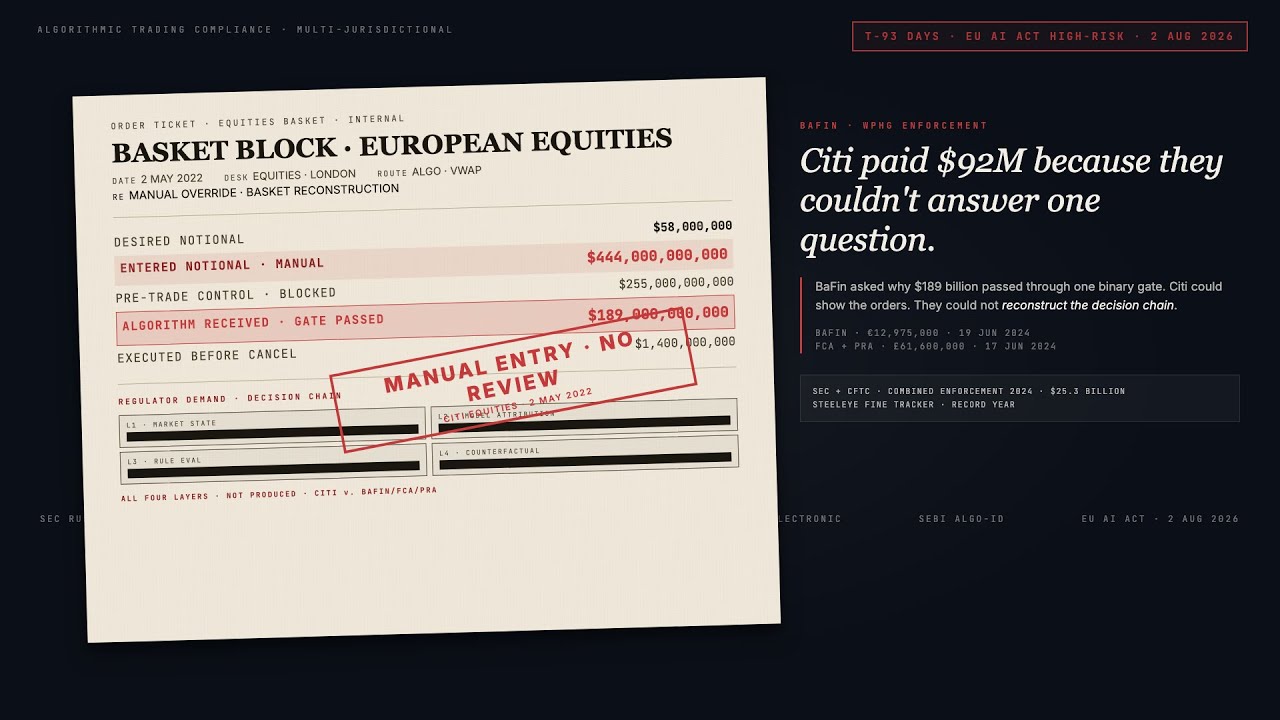
This is where the Citigroup failure becomes instructive. In May 2022, a trader meant to sell $58 million in equities but created a $444 billion basket. Citi's pre-trade controls caught $255 billion, but $189 billion reached the trading algorithm, which broke it into sell orders and pushed $1.4 billion into European markets before cancellation. When BaFin and UK regulators investigated, the question was not just "what happened" but "why did your controls let $189 billion through?" Citi could show the orders. They could not adequately reconstruct the decision chain of the algorithm that executed them, or explain why their risk thresholds were set where they were. That gap cost $92 million across three jurisdictions.
The FCA explicitly flagged "variable technical knowledge in compliance" as a systemic weakness. Compliance teams at most firms can read alert reports but cannot interrogate the algorithm's logic, challenge its risk parameters, or verify that a code change did not introduce new regulatory exposure. The industry solution has been to hire more quant-literate compliance staff, but talent in this intersection (people who understand both CFTC market access rules and GNN model architectures) is scarce. The alternative: build systems that translate algorithmic decisions into audit-ready explanations that compliance staff can review, challenge, and present to examiners without needing to read the source code.
SEC and CFTC combined for a record $25.3 billion in enforcement actions in 2024. FINRA's 2026 oversight priorities explicitly include algorithmic trading and AI. The EU AI Act requires high-risk financial AI systems to have technical documentation, risk management systems, and human oversight capability by August 2026. DORA mandates ICT resilience testing and incident reporting for all EU financial entities since January 2025. SEBI now requires unique Algo-IDs and exchange approval for every strategy before live deployment. The question is not whether your algorithms will be examined. It is whether they can survive the examination.
The trade surveillance market is projected to reach $4.2 to $9.3 billion by 2033. The top five vendors hold 55-59% market share. Here is what they cover and where the gaps remain.
| Approach | What It Covers | Where It Stops | Typical Cost |
|---|---|---|---|
| NICE Actimize (X-Sight) | Cross-asset surveillance, ML-based pattern detection (spoofing, layering, wash trading), pre- and post-trade monitoring | Enterprise-scale pricing and implementation complexity. Configuration rigidity limits customization. No algo decision explainability or multi-regulatory compliance mapping. | $1-5M+/year |
| Nasdaq Surveillance AI | Gen-AI powered behavioral analytics, cross-venue manipulation detection, exchange-grade throughput | Exchange-centric design. Strong for sell-side but may not fit buy-side compliance workflows. Detection-focused, not compliance-workflow-focused. | $1-3M+/year |
| Eventus (Validus) | Statistical behavior profiling, configurable detection rules, strong for HFT firms | Focused on detection rather than holistic compliance workflow. Limited custom model integration. Smaller ecosystem than Tier 1 vendors. | $500K-2M/year |
| In-House Build | Full control over logic, deep integration with proprietary systems, no vendor lock-in | Requires quant engineering talent that competes with hedge fund compensation. Ongoing maintenance burden. Regulatory documentation often treated as afterthought. | $2-10M build + $1M+/year |
| Big 4 / Large SIs | Regulatory advisory, gap assessments, program design, vendor selection support | They advise on what to build but rarely build it. Engagements produce PowerPoint decks and framework documents, not working systems. When they do build, they reach for the same Tier 1 vendor platforms. $500K-$5M+ engagements. | $500K-5M+ |
| Veriprajna | Custom compliance intelligence: explainable algo audits, multi-jurisdictional mapping, intelligent circuit breakers, GNN-based contagion detection, alert triage | Not a surveillance platform. Does not replace your existing detection vendor. Does not provide market data feeds. Requires your firm to have basic order management and execution data accessible via API. | $300K-1.2M build |
Pricing is estimated based on publicly available information and market research. Actual costs vary by firm size, scope, and vendor negotiation.
Six capabilities that fill the gaps between your surveillance vendor and what regulators actually ask for. Each addresses a specific failure mode that current tools leave open.
When a regulator points to a specific trade and asks "why," most firms show order logs. We build systems that reconstruct the full decision chain: market state at the timestamp, model feature attribution (SHAP values showing which signals drove the decision and by how much), deterministic rule evaluation (which thresholds were checked), and counterfactual analysis (what would have happened under different conditions).
We reach for SHAP over LIME for feature attribution because SHAP provides theoretically grounded, consistent attributions that hold up under regulatory scrutiny. LIME's local approximations can produce unstable explanations when market conditions shift between the trade and the audit.
Current kill switches are binary: on or off. Citigroup's controls blocked $255 billion but let $189 billion through because the threshold was a single gate, not a graduated system. We build multi-tier circuit breakers with four response levels: throttle (reduce order rate), restrict (limit to specific instruments or venues), gate (require human approval per order), and halt (full stop).
Each tier triggers based on behavioral anomaly scoring, not just size thresholds. A sudden shift in cancellation rate combined with cross-asset correlation changes might trigger a gate, while a single large order within normal parameters passes through.
The August 2024 flash crash showed how a Bank of Japan rate hike propagated through the yen carry trade into U.S. tech equities via margin calls. Traditional surveillance sees each market in isolation. We build graph-based systems using GNN architectures that model cross-asset dependency networks and detect cascading stress signals before they become systemic.
Research shows GNN-LSTM hybrid architectures achieve AUC-ROC of 0.891 for interbank risk contagion detection versus 0.734 for conventional approaches, with early warning lead times extended by 11.5 days (Springer Nature, 2025). We adapt these architectures for multi-asset trading environments.
A single algorithmic trading control must satisfy SEC Rule 15c3-5, MiFID II RTS 6, EU AI Act documentation requirements, DORA resilience standards, and potentially SEBI's Algo-ID framework. Most firms maintain separate compliance processes per jurisdiction. We build a unified control layer where each risk parameter maps to every applicable regulation simultaneously.
When you modify a pre-trade capital threshold, the system shows the compliance impact across all jurisdictions before the change takes effect. Dual-format audit trails generate output for both FINRA examination and FCA/NCA review from the same underlying data.
70% of banks report false positive rates above 25%. The problem is structural: surveillance systems apply static thresholds without context. A market maker's routine order-and-cancel pattern triggers the same spoofing alert as actual layering. We build context-aware scoring across three dimensions: trader behavioral baselines, market regime adjustment, and cross-reference pattern analysis.
During the August 2024 flash crash, firms running static thresholds generated hundreds of false spoofing alerts as normal algorithmic behavior looked abnormal under extreme volatility. Regime-aware thresholds prevent this alert flood while maintaining sensitivity to genuine manipulation hiding behind market noise.
SEBI now requires unique Algo-IDs and exchange approval before live deployment. FINRA requires registration of persons who develop algo strategies. The FCA demands complete RTS 6 self-assessments. We build end-to-end lifecycle management: from algorithm development and testing through regulatory approval, deployment, monitoring, modification tracking, and retirement.
Every code change is versioned against its compliance impact. A modification to a trading strategy's momentum signal triggers an automatic reassessment of which regulatory approvals need updating, which risk parameters changed, and whether the modification requires re-registration under FINRA or a new Algo-ID under SEBI.
Walk through what happens when a compliance intelligence system detects a pre-market VIX anomaly similar to what occurred on August 5, 2024.
The GNN-based cross-asset monitor detects that VIX mid-quote prices are rising 180% pre-market, but realized volatility (actual S&P 500 price movement) is rising only 12%. On August 5, 2024, this divergence was caused by market makers widening bid-ask spreads on S&P 500 options, mechanically inflating the quote-based VIX calculation. The system flags this as a SPREAD-DRIVEN VIX ANOMALY, not a genuine volatility spike.
Your volatility-targeting algorithms are programmed to reduce equity exposure as implied volatility rises. Under normal conditions, a 180% VIX spike would trigger massive sell orders. The circuit breaker checks: Is this VIX reading driven by realized volatility or spread mechanics? The spread-driven flag triggers a THROTTLE response. Algorithms can continue trading but at 25% of normal order rate, buying time for the signal to resolve.
The contagion graph traces the anomaly's propagation path. Is USD/JPY moving? (Yes, yen strengthening 2.1%.) Are Nikkei futures dropping? (Yes, down 6%.) Is the correlation between yen strength and tech equity sell-offs exceeding the 95th percentile of the historical distribution? (Yes.) The system upgrades the alert to CARRY TRADE UNWIND DETECTED and adds the propagation chain: BOJ rate signal, yen appreciation, margin call pressure on leveraged positions, correlated selling across asset classes.
With the carry trade unwind confirmed, the circuit breaker escalates from THROTTLE to GATE: all sell orders in correlated instruments (tech equities, EM positions, anything funded by yen borrowing) require manual approval. Buy orders and orders in uncorrelated instruments continue at normal rate. The risk desk receives a structured alert with the full propagation chain, SHAP attributions for each signal component, and estimated portfolio impact under three scenarios.
Every decision in this sequence is logged with timestamp, market state snapshot, model inputs, rule evaluations, and response actions. When the examiner arrives six months later, the system produces a structured report showing: what was detected, why the VIX reading was classified as spread-driven, why the response escalated from THROTTLE to GATE, and what the algorithms would have done without intervention (counterfactual). This is the audit trail that the Citigroup investigation lacked.
A typical engagement runs 4 to 8 months from kickoff to production. Three phases, each with defined deliverables.
4-6 weeks
Deliverable: Regulatory gap analysis + build roadmap
8-16 weeks
Deliverable: Working system in staging environment
4-6 weeks
Deliverable: Production-ready system + regulatory documentation
Answer eight questions about your current algorithmic trading compliance posture. The assessment identifies your gaps against SEC, MiFID II, EU AI Act, and DORA requirements and produces actionable next steps you can take with or without Veriprajna.
The core challenge is that SEC Rule 15c3-5 and MiFID II RTS 6 overlap in intent but diverge in specifics. Rule 15c3-5 requires pre-trade risk controls (capital thresholds, credit limits, erroneous order filters) with annual CEO certification. RTS 6 requires algorithmic trading firms to maintain records of algo decisions for five years, submit strategy descriptions to competent authorities, and demonstrate that compliance staff can technically review algo processes.
We build a unified control layer where each risk control maps to both frameworks simultaneously. A single pre-trade capital threshold check, for example, satisfies Rule 15c3-5's market access requirement and RTS 6's risk control documentation requirement. The system maintains dual audit trails: one formatted for FINRA examination and one for FCA/national competent authority review. When you modify a control parameter, the system shows the compliance impact across both jurisdictions before the change takes effect.
For firms also operating under DORA, we add a third mapping layer covering ICT risk management and incident reporting obligations. The alternative, maintaining separate compliance processes per jurisdiction, is how most firms operate today. It works until a cross-border incident hits and three regulators ask different questions about the same event.
When a regulator asks why your algorithm sold 200,000 shares of a particular stock at 9:47 AM during a volatility spike, they need more than order logs showing the trade happened. They need the decision chain.
Our audit system reconstructs four layers for any flagged trade. First, the market state snapshot: what data the algorithm received at that timestamp, including order book depth, spread width, volatility readings, and cross-asset signals. Second, the model attribution: which features drove the decision and by how much, using SHAP values that show, for example, that 43% of the sell signal came from a VIX spike, 31% from order book imbalance, and 26% from a cross-asset correlation shift. Third, the rule evaluation log: which deterministic constraints were checked (position limits, capital thresholds, instrument restrictions) and whether any triggered. Fourth, the counterfactual: what the algorithm would have done under different conditions, such as if the VIX reading had been 10% lower or if the cross-asset signal had been absent.
This produces a structured report that a compliance officer can hand to an examiner. The reconstruction runs on historical data, so you can audit trades from weeks or months ago, not just real-time events.
The 25%+ false positive rate that 70% of banks report comes from a fundamental design problem: most surveillance systems apply static thresholds to individual trades or patterns without considering context. A large block trade looks identical to layering if you only examine order size and cancellation rate.
We build context-aware alert scoring across three dimensions. First, trader behavioral baselines: the system learns each trader's normal patterns (instruments, timing, size distribution, cancellation rates) and flags deviations from their own baseline, not a generic threshold. A market maker who routinely places and cancels large orders generates different alerts than a portfolio manager who does the same thing. Second, market regime adjustment: during high-volatility periods like the August 2024 flash crash, normal algorithmic behavior looks abnormal by static standards. The system adjusts thresholds based on current regime (bull, bear, crisis, low-liquidity) so a volatility-driven sell-off doesn't generate hundreds of false spoofing alerts. Third, cross-reference scoring: before escalating an alert, the system checks whether the pattern appears across multiple venues, whether the trader has counterparty relationships that explain the activity, and whether similar patterns are occurring market-wide (suggesting regime-driven behavior rather than manipulation).
Each alert gets a composite confidence score. Compliance teams review high-confidence alerts first, and the system continuously refines scoring based on which alerts lead to genuine investigations versus dismissals.
The EU AI Act classifies certain AI applications as high-risk, requiring conformity assessments, technical documentation, CE marking, and registration in the EU database. Financial credit scoring is explicitly listed as high-risk. Whether algorithmic trading AI qualifies was expected to be clarified in the European Commission's February 2026 guidelines on high-risk classification.
Regardless of the final classification, firms using AI in trading face three practical requirements by August 2, 2026. First, documentation: you need technical documentation describing your AI system's purpose, architecture, training data, performance metrics, and known limitations. Most algo trading firms have code repositories but not the structured documentation the Act requires. Second, risk management: you need a documented risk management system that identifies and mitigates risks throughout the AI lifecycle, including testing under conditions that differ from training data, which matters enormously for trading algorithms that may have been developed during low-volatility periods. Third, human oversight: the system must allow human intervention, including the ability to override or stop the AI system. For trading, this means documented kill switch procedures, escalation paths, and evidence that human operators can actually interpret what the system is doing.
The EBA published a report in November 2025 on AI Act implications for banking, which we use as the baseline for gap assessments. The Act has global reach: if your AI system interacts with EU-based users or markets, you are in scope regardless of where your firm is incorporated.
A typical engagement runs 4 to 8 months from kickoff to production, depending on scope and the state of your existing infrastructure. The first phase (4 to 6 weeks) is a compliance architecture assessment. We audit your current algorithmic trading controls against every jurisdiction you operate in, map your existing surveillance tools and their gaps, review your algo inventory and documentation state, and identify which regulatory deadlines are most pressing. This phase produces a gap report and a prioritized build plan.
The second phase (8 to 16 weeks) is system build. We work within your existing infrastructure, not replacing your OMS or surveillance vendor, but building the compliance intelligence layer that sits between them. This includes the explainability pipeline (decision chain reconstruction, SHAP attribution), the multi-jurisdictional control mapping, and the alert triage system. Integration with existing data feeds (order management, market data, execution records) is typically the longest single task.
The third phase (4 to 6 weeks) is validation and regulatory alignment. We run the system against historical data, validate audit outputs against actual regulatory examination formats, tune alert thresholds against your false positive baseline, and document everything to EU AI Act and RTS 6 standards.
One caveat: if your algo inventory is poorly documented (the FCA found this at most firms they reviewed), add 3 to 4 weeks for the discovery and cataloging work that must happen before any compliance system can be built on top of it.
It works alongside your existing vendor. Replacing an enterprise surveillance platform is a multi-year, multi-million dollar project that most firms should not undertake unless the platform is fundamentally broken.
What we build fills the gaps your current vendor does not cover. NICE Actimize, Eventus, and Nasdaq Surveillance are strong at pattern-based detection: spoofing, layering, wash trading, front-running. They scan order flow for known manipulation signatures and generate alerts. What they typically lack is three things. First, algo decision explainability: when a regulator asks why your algorithm did something, your surveillance vendor can show that the trade happened and whether it matched a manipulation pattern, but not why the algorithm made that decision. The explainability layer we build reconstructs the decision chain from your algorithm's own logic, model features, and market state. Second, cross-regulatory compliance mapping: your surveillance vendor detects market abuse, but it does not map your algorithmic trading controls to SEC Rule 15c3-5 requirements, MiFID II RTS 6 self-assessment criteria, EU AI Act documentation obligations, and DORA resilience standards simultaneously. That mapping is what we build. Third, intelligent circuit breakers: your vendor generates alerts after trades execute. The circuit breaker system we build intervenes before or during execution with graduated responses based on the severity and pattern of deviation.
The integration is typically through your vendor's API or alert feed. We consume their alerts as one input into the broader compliance picture, adding context, cross-referencing, and explainability on top of what they already detect.
The technical foundation behind this solution page.
Analysis of the August 2024 flash crash mechanics, GNN-based market topology modeling, and neuro-symbolic architectures for deterministic control in algorithmic trading environments.
Citigroup paid $92 million for one algorithmic control failure. Two Sigma paid $90 million for inadequate model governance.
Your algorithms are running. Your regulators are watching. The question is whether you can explain every decision your systems make, across every jurisdiction you operate in, before the examiner asks.