Software Update Deployment Integrity
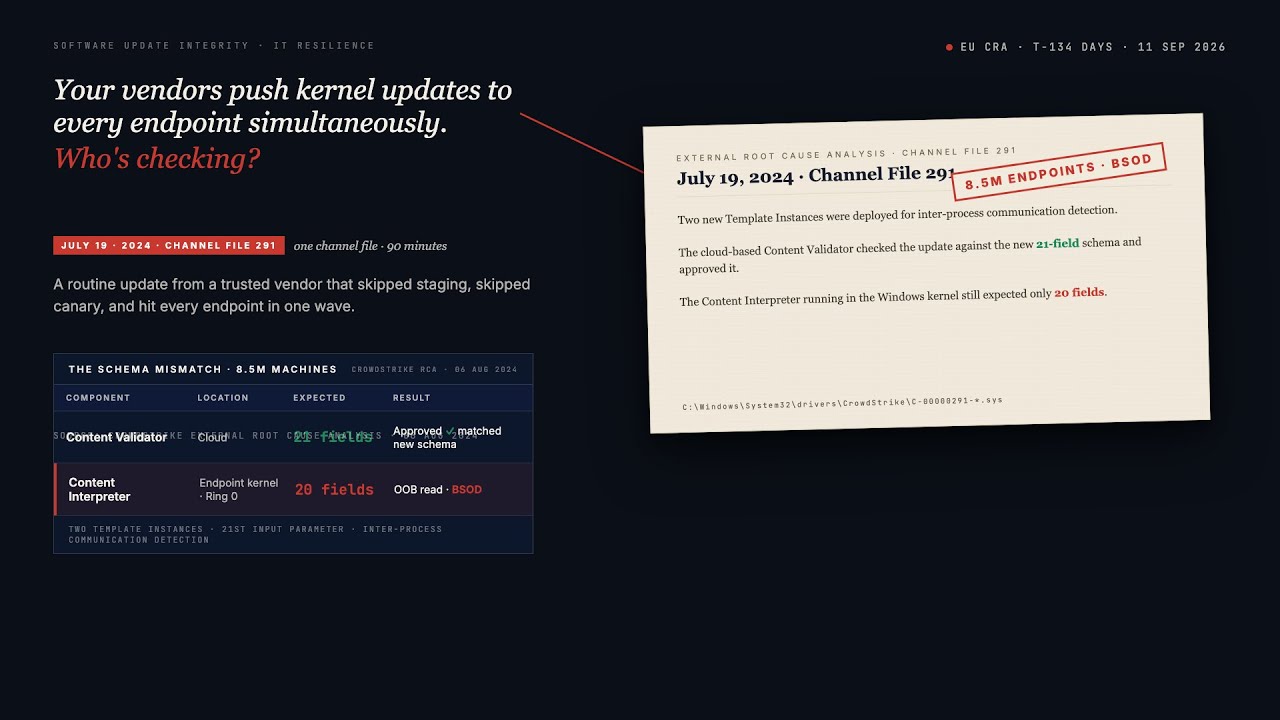
On July 19, 2024, a single configuration file crashed 8.5 million Windows machines in under 90 minutes. Not malware. Not a zero-day. A routine update from a trusted vendor that skipped staging, skipped canary, and hit every endpoint in one wave.
If you've already reviewed your update risk post-CrowdStrike, the question is whether that review was a one-time exercise or a permanent capability. If you haven't, the legal and regulatory landscape has shifted under you since July 2024. Either way, the gap is the same: no independent layer sits between your vendors' update pipelines and your production endpoints.
$10B+
Global damages from CrowdStrike outage
Fortune/Parametrix, 2024
$2M/hr
Median cost of significant IT downtime
New Relic, Sept 2025
8-12
Kernel-level agents on a typical enterprise endpoint
Industry survey data
CrowdStrike's Falcon sensor uses a "Rapid Response Content" mechanism to push detection logic updates without requiring a full binary update. On July 19, two new Template Instances were deployed for inter-process communication detection. These instances referenced a 21st input parameter. The cloud-based Content Validator checked the update against the new 21-field schema and approved it. But the Content Interpreter running in the Windows kernel still expected only 20 fields.
| Component | Location | Expected Fields | What Happened |
|---|---|---|---|
| Content Validator | Cloud | 21 fields | Approved the update (matched new schema) |
| Content Interpreter | Endpoint kernel (Ring 0) | 20 fields | Out-of-bounds memory read, immediate BSOD |
Source: CrowdStrike External Root Cause Analysis, August 6, 2024
The crash happened so early in the boot sequence that the Falcon management agent never initialized. This created a "dead agent" loop: the endpoints couldn't receive a rollback command from CrowdStrike because the software meant to receive that command was the cause of the crash. IT teams had to boot each machine into Safe Mode, navigate to C:\Windows\System32\drivers\CrowdStrike\, and manually delete the faulty C-00000291-*.sys file. Delta Air Lines did this across 40,000 servers. Recovery took five days.
CrowdStrike is the case study, but the pattern applies to every vendor that pushes privileged updates. Your fleet runs an EDR agent, a DLP agent, an encryption agent, a patching agent, a VPN client, and a device management agent. Each operates at kernel level or with elevated system privileges. Each has its own update channel. Each pushes updates on its own schedule. Your change advisory board reviews internal deployments but waves through vendor updates because "we trust the vendor."
The second failure mode nobody discusses: agent conflict cascades. When two vendors update kernel interfaces on the same day, driver compatibility issues can produce the same blue-screen outcome as a single vendor failure. But the root cause analysis takes weeks instead of hours because you're triangulating across two vendor support teams who each blame the other's update.
The cost of "we trust the vendor"
41% of mid-to-large enterprises estimate their downtime cost at $1M-$5M per hour. Finance and healthcare organizations report $5M+ per hour. A 4-hour outage from a vendor update your CAB never reviewed costs more than your entire annual security tool spend. (ITIC / New Relic, 2025)
The CrowdStrike outage produced more than technical remediation. It changed the legal framework around software vendor liability. Three developments matter for your next vendor contract renewal.
May 2025 | Fulton County Superior Court
Judge Ellerbe allowed claims for gross negligence, computer trespass, and fraud by omission to proceed despite CrowdStrike's contractual liability cap. Delta had opted out of auto-updates, but the channel file bypassed that preference at the kernel level.
Your exposure: If your vendor can push Ring 0 content through a channel your settings don't control, your contract's update preferences may be unenforceable. Review whether your agreement distinguishes between full sensor updates and rapid response content.
Reporting starts September 11, 2026
Mandatory 24-hour vulnerability reporting to ENISA. Software suppliers must demonstrate security-by-design in their update processes, including documented validation and rollback capability.
Your exposure: If a vendor update causes an outage in your EU operations, you may have reporting obligations within 24 hours, separate from the vendor's. The clock starts when you become aware, not when the vendor notifies you.
Revised 2024, effective 2026
Software is now explicitly classified as a "product" under strict liability. Companies cannot contractually exclude liability for software and cybersecurity defects. This applies to standalone software and software embedded in products.
Your exposure: Vendor liability caps in your subscription agreements may not hold in EU jurisdictions. If you operate in EU markets, your contracts need to reflect this shift.
SEC disclosure requirement
Public companies must now disclose material cybersecurity incidents within 4 business days and describe software supply chain risk exposure in 10-K risk factor filings. A vendor-caused outage that costs $2M/hour for 4+ hours likely crosses the materiality threshold. Your IR team needs a vendor-outage playbook, not just a breach playbook. (SEC Final Rule, effective 2024)
Every player in this space solves a piece of the problem. None solves the whole thing. The gap is between what vendors do to their own update processes and what you can independently verify.
| Player | What They Offer | The Gap |
|---|---|---|
| CrowdStrike (post-incident) | Self-recovery mode, content pinning, customer deployment controls, Digital Operations Center. Q3 2025 retention: 97%+ | Vendor self-policing. Their validation improvements are meaningful, but you're trusting the same organization to validate its own updates. No independent verification layer. |
| Microsoft (Windows Resiliency Initiative) | Quick Machine Recovery (GA in Win 11 24H2). Endpoint Security Platform moving security products from kernel to user mode. 2026-2027 migration timeline. | Platform-level, not audit-level. Addresses boot recovery and reduces kernel surface area, but doesn't validate how other vendors deploy updates to your fleet. |
| SentinelOne / Palo Alto (Cortex XDR) | Autonomous endpoint protection with their own update pipelines. Competitive alternatives to CrowdStrike. | Same structural risk. They push kernel-level updates through their own channels. Different vendor, same "who watches the watchers?" problem. |
| Datadog / Dynatrace / Splunk | AI-powered observability, anomaly detection, real-time alerting. Mature data ingestion at enterprise scale. | Reactive, not preventive. They detect anomalies after the update reaches production. By the time Datadog alerts, the BSoD has already cascaded. |
| SBOM / SCA Tools (Snyk, Sonatype) | Open-source dependency scanning, software composition analysis, vulnerability tracking. | Wrong layer entirely. They audit open-source libraries in your code. CrowdStrike's channel file was proprietary vendor config, not an open-source dependency. These tools never see it. |
| ITSM Platforms (ServiceNow, Jira) | Change management workflows, CAB review, audit trails for internal deployments. | Vendor updates bypass CAB. Your ITSM tracks changes your team makes. Vendor-pushed updates to kernel agents bypass the workflow entirely. No ticket, no review, no audit trail. |
| Big 4 / Large SIs | IT risk assessments, compliance audits, governance framework design. Deloitte, Accenture, KPMG all have cybersecurity practices. | Framework-heavy, not technical. They deliver governance maturity models, not pre-deployment sandboxes. A 6-month assessment produces a report. You need an automated system that intercepts updates in real time. Also: $500K+ engagement minimums for enterprise-wide assessments. |
Honest caveat: Some gaps on this list aren't solvable by any external consultancy. Organizational change management (getting your CAB to actually review vendor updates), vendor relationship politics (telling CrowdStrike you don't trust their update process), and legacy endpoint diversity (machines running Windows Server 2012 that can't be virtualized in a sandbox) require internal ownership. We build the technical infrastructure. Your team has to use it.
Five capabilities, each addressing a specific gap in the landscape above. Every engagement is custom, but the architecture follows patterns we've designed for environments with 5,000+ endpoints and 6+ kernel-level agents.
We map every kernel-level and privileged agent running on your fleet. For each agent, we document the update channel mechanics, rollback capability, staging controls (or lack thereof), and what happens when the agent itself is the crash source.
Output: a risk-ranked agent inventory showing which vendors can push updates to Ring 0 without CAB review, which agents create dead-agent loops if they crash the boot sequence, and which vendor contracts lack staged rollout guarantees. Most enterprises discover agents they didn't know were running at kernel level.
We build a virtual environment that mirrors your actual endpoint diversity: OS versions, patch levels, hardware profiles, and the full agent stack you run in production. CrowdStrike's crash only manifested with certain Windows builds and driver configurations. A single clean VM would have missed it.
When a critical vendor pushes an update, the sandbox receives it first, runs it through 5 reboot cycles across representative configurations, and validates schema compatibility. We model your specific agent stack combinations because conflicts between agents (e.g., EDR and encryption updating the same kernel callback table on the same day) are the failure mode nobody tests for.
Post-Delta v. CrowdStrike, every vendor subscription agreement needs review. We analyze your contracts for liability caps, forced-update clauses, "computer trespass" exposure, notification obligations, and SLA gaps. We cross-reference against EU CRA, Product Liability Directive, and SEC disclosure requirements so the amendments hold across jurisdictions.
Output: specific contract amendment language your legal team can use in the next renewal. We flag which vendors distinguish between full binary updates and rapid response content in their agreements, which contracts have carve-outs for kernel-level access, and which liability caps are at risk under the Delta precedent.
We build automated workflows that intercept vendor updates before they reach production endpoints. The system integrates with your ITSM (ServiceNow, Jira Service Management), creates audit trails the CAB currently lacks for vendor-pushed updates, and enforces staged rollout policies the vendor may not support natively.
The system watches for schema changes in config-level updates, binary diff anomalies that indicate a larger change than the vendor documented, and deployment velocity spikes (all endpoints in one wave, matching the CrowdStrike failure pattern). Alerts route to your security operations team with enough context to make a hold/proceed decision in minutes.
Only 29% of board directors find CISO cybersecurity reports "very effective" (IANS Research, 2026). We build a reporting framework that quantifies your software update deployment risk in terms the board understands: financial exposure per hour of downtime based on your actual business operations, regulatory liability mapped to specific statutes (EU CRA, SEC disclosure timelines), and vendor concentration risk showing which single-vendor failure would cause the widest outage.
This is a quarterly deliverable, not a dashboard. Each report includes updated risk scores, changes since the last quarter (new vendor updates, contract renewals, regulatory developments), and specific recommendations ranked by cost-to-fix vs. exposure-reduced. Your CISO walks into the audit committee with numbers, not narrative.
Four phases. The first two run in parallel and typically complete in 4-6 weeks. Implementation takes 6-10 weeks depending on endpoint fleet size and vendor count. Ongoing support is quarterly.
Weeks 1-3
Weeks 2-5 (parallel with Phase 1)
Weeks 6-14
Quarterly
Caveat: Ongoing support is optional. The system we build in Phase 3 is designed to run with your internal team. We stay involved when you want vendor-neutral expertise at the table during renewals or regulatory changes.
Ten questions about your current update governance. The results give you a prioritized action list you can execute regardless of whether you work with us. Takes about 3 minutes.
Start by mapping every kernel-level and privileged agent running on your fleet. Most enterprises discover they run 8-12 agents (EDR, DLP, encryption, VPN, MDM, patching) and have no centralized record of which vendor can push updates to Ring 0 without passing through change advisory board review.
For each agent, document three things: the update channel mechanics (does it push rapid response content like CrowdStrike's channel files, or only full sensor builds?), the rollback capability (can the agent recover itself if it crashes the boot sequence, or does it create a dead-agent loop like CrowdStrike's Falcon did?), and the staging controls your contract actually grants you (not what the vendor's marketing says, but what the subscription agreement allows you to delay or defer).
Then establish a pre-deployment sandbox that mirrors your real endpoint diversity. CrowdStrike's July 19 update crashed specific Windows builds with specific driver configurations. A sandbox running a single clean VM would have missed it. You need representative hardware profiles, OS patch levels, and agent combinations. Run every critical vendor update through 5 reboot cycles across these configurations before it reaches production.
Finally, review your vendor contracts. Post-Delta v. CrowdStrike, forced-update clauses and liability caps are litigation targets. If your agreement still has a single-digit-million liability cap and no staged rollout guarantee, you have a contractual gap that matches the technical one.
Vendor update auditing requires visibility into three layers that most enterprises lack. Layer 1: the update channel architecture. Request technical documentation from each vendor on how their updates traverse from development to your endpoints. Specifically, ask whether config-level updates (like CrowdStrike's channel files) follow the same validation pipeline as full binary updates, or whether they take a shortcut. CrowdStrike's Content Validator and Content Interpreter had different schema expectations. That mismatch was the root cause.
Layer 2: deployment velocity and blast radius controls. Ask each vendor to document their staged rollout cadence. How many internal rings do they use? What percentage of external customers receive the update in the first wave? CrowdStrike pushed to all 8.5 million endpoints in one wave. Your contract should specify maximum blast radius per deployment stage.
Layer 3: rollback and recovery capability. For each vendor, test what happens when their agent causes a boot failure. Can the agent's management process receive a rollback command if the agent itself is the crash source? CrowdStrike's management agent never initialized because the crash occurred too early in boot sequence, creating orphaned endpoints that required manual Safe Mode intervention on each machine.
We build automated audit frameworks that continuously validate these three layers, flag deviations from documented practices, and generate vendor scorecards your security team can review quarterly.
Canary deployment for endpoint security is operationally different from canary deployment for web services. You cannot route 1% of traffic to a new version. You need hardware diversity rings that match your actual fleet composition.
Ring 0 is your pre-deployment sandbox: virtualized environments covering your OS matrix (Windows Server 2019, 2022, Windows 10 22H2, 11 23H2, etc.), patch levels, and the full agent stack you run in production. This ring catches schema mismatches and driver conflicts before any real endpoint is exposed. Ring 1 is your IT department's own machines, typically 50-200 endpoints. These are staffed by people who can report anomalies in detail and tolerate a rebuild if something fails.
Ring 2 is a representative sample of production endpoints, selected for hardware diversity, not convenience. If your fleet includes thin clients, kiosk machines, and domain controllers, Ring 2 must include all three. Don't just pick 500 standard desktops. Ring 3 is a broader wave, typically 10-20% of production, with 24-hour watch windows between stages. Ring 4 is the remainder.
Each ring needs a defined watch window (minimum 4 hours for Ring 1, 24 hours for Ring 2+), automated health checks (boot success, agent heartbeat, kernel crash reports), and a rollback trigger that halts the deployment if failure rate exceeds a threshold you set, not the vendor. The key is that your rings must be enforced on your side, not delegated to the vendor's deployment controls. We build the ring infrastructure, automated health monitoring, and rollback triggers as a system that sits between your fleet and every vendor's update channel.
The May 2025 ruling in Fulton County Superior Court changed the risk calculus for every enterprise running third-party security software. Judge Kelly Lee Ellerbe allowed Delta's claims for gross negligence, computer trespass, and fraud by omission to proceed despite CrowdStrike's argument that the Subscription Services Agreement capped liability to the contract value.
Three implications matter for your vendor contracts. First, forced-update clauses are now litigation targets. Delta had opted out of automatic updates in its settings, but CrowdStrike's kernel-level channel file mechanism bypassed that preference. If your vendor can push Ring 0 content through a channel your settings don't control, your contract's update preferences may be unenforceable. Review whether your agreement distinguishes between full sensor updates and rapid response content.
Second, liability caps may not hold under tort claims. The court ruled that statutory duties regarding computer trespass exist independently of the subscription agreement. If a vendor's update constitutes unauthorized access to your systems, the contractual cap is irrelevant. Your legal team should negotiate explicit carve-outs for kernel-level access and mandatory staged rollout obligations.
Third, the EU Product Liability Directive now classifies software as a product under strict liability. Companies cannot contractually exclude liability for software defects starting in 2026. If you operate in EU jurisdictions, your vendor agreements need to reflect this. We audit vendor contracts against these three dimensions and draft specific amendment language for your next renewal cycle.
The EU Cyber Resilience Act's vulnerability reporting obligations start September 11, 2026. If you manufacture, distribute, or import software with digital elements into the EU market, you must report actively exploited vulnerabilities within 24 hours to ENISA, provide a detailed notification within 72 hours, and issue a final report within 14 days.
For enterprises consuming third-party software (including endpoint security agents), the CRA creates three compliance obligations. First, due diligence on vendors. You must verify that your software suppliers meet CRA requirements, including security-by-design in their update processes, documented vulnerability handling, and update integrity guarantees. If your vendor pushed the CrowdStrike-style update without staged rollout, that may not meet the CRA's security-by-design standard.
Second, your own update processes. If you build or integrate software deployed in EU markets, your CI/CD pipelines must demonstrate security validation, update integrity verification, and documented rollback capability.
Third, incident reporting chain. If a vendor update causes an outage in your EU operations, you may have reporting obligations to ENISA within 24 hours, separate from the vendor's own obligations. The reporting clock starts when you become aware, not when the vendor notifies you. Beyond the CRA, the revised EU Product Liability Directive classifies software as a product under strict liability, and manufacturers cannot contractually exclude liability for security defects. We build CRA-ready update governance frameworks: vendor assessment questionnaires aligned to CRA requirements, internal pipeline validation tooling, and incident reporting workflows that meet the 24/72-hour timelines.
Microsoft's Windows Resiliency Initiative, announced after the CrowdStrike outage, includes a fundamental shift: moving third-party endpoint security products from kernel mode (Ring 0) to user mode. The Quick Machine Recovery feature is already GA in Windows 11 24H2, enabling remote remediation even when machines cannot boot normally. The larger change, the Windows Endpoint Security Platform, is a structured migration path for security vendors to operate outside the kernel while maintaining detection capability.
This migration will unfold through 2026-2027 and creates three practical challenges for enterprises. First, your security vendors will ship architectural updates that are more significant than any channel file. The transition from kernel-mode to user-mode is a fundamental rewrite of how the agent intercepts system calls, monitors file operations, and inspects network traffic. Test these transitions aggressively. The architectural change itself carries the same blast-radius risk as the CrowdStrike incident.
Second, during the transition period, you will run a mixed fleet: some endpoints on kernel-mode agents, some on user-mode agents, some on versions that straddle both. Your security policy enforcement, detection rules, and incident response playbooks need to account for this inconsistency.
Third, not all vendors will migrate at the same pace. CrowdStrike, SentinelOne, and Palo Alto each have different timelines. If you run multiple security agents, their migration schedules will overlap differently, creating new compatibility risks. We map your current agent architecture, build a phased migration plan that sequences vendor transitions to minimize overlap risk, and establish validation gates for each stage of the kernel-to-user-mode migration.
The research behind this solution page, including the full CrowdStrike technical analysis and resilient systems architecture.
Technical post-mortem of the CrowdStrike outage, legal analysis of the Delta v. CrowdStrike litigation, and architectural framework for AI-driven update validation and self-healing systems.
The assessment that prevents it costs less than one hour of downtime.
We build independent update governance systems that sit between your vendors and your production endpoints. No platform bias. No vendor partnerships that conflict with honest assessment.