AgeTech · Ambient Monitoring · Fall Prevention
Passive, privacy-preserving fall detection and ambient monitoring for assisted living and skilled nursing facilities. mmWave radar for high-risk rooms. Wi-Fi sensing for whole-building coverage. Integrated with your nurse call system. No wearables. No cameras. No blind spots.
$30,000
Average cost per fall with injury
CDC / PMC, inpatient data
63%
of facilities short-staffed
Senior Housing News, 2025
50%
mortality within 6 months if on floor >1 hour
BMC Geriatrics / Physiopedia
Fall detection in senior care has three options. All three fail at the moment they matter most.
The PERS model assumes your 85-year-old resident with MCI will remember to wear, charge, and press a button during a crisis. The data says otherwise.
The device is removed for bathing, sleeping, and charging. The bathroom is the highest-risk room. The pendant is on the vanity.
AI-powered cameras like SafelyYou deliver strong clinical results: 40% fewer falls, 80% fewer ER visits. But cameras cannot go where falls are most dangerous.
A camera system that covers bedrooms but not bathrooms covers the second-most-dangerous room while ignoring the first.
Pressure mats and bed alarms detect bed exit, not falls. They tell you the resident left the bed. They do not tell you the resident fell walking to the bathroom 30 seconds later.
When every alarm sounds the same, none of them mean anything. Alarm fatigue is the #1 reason facilities abandon fall detection technology.
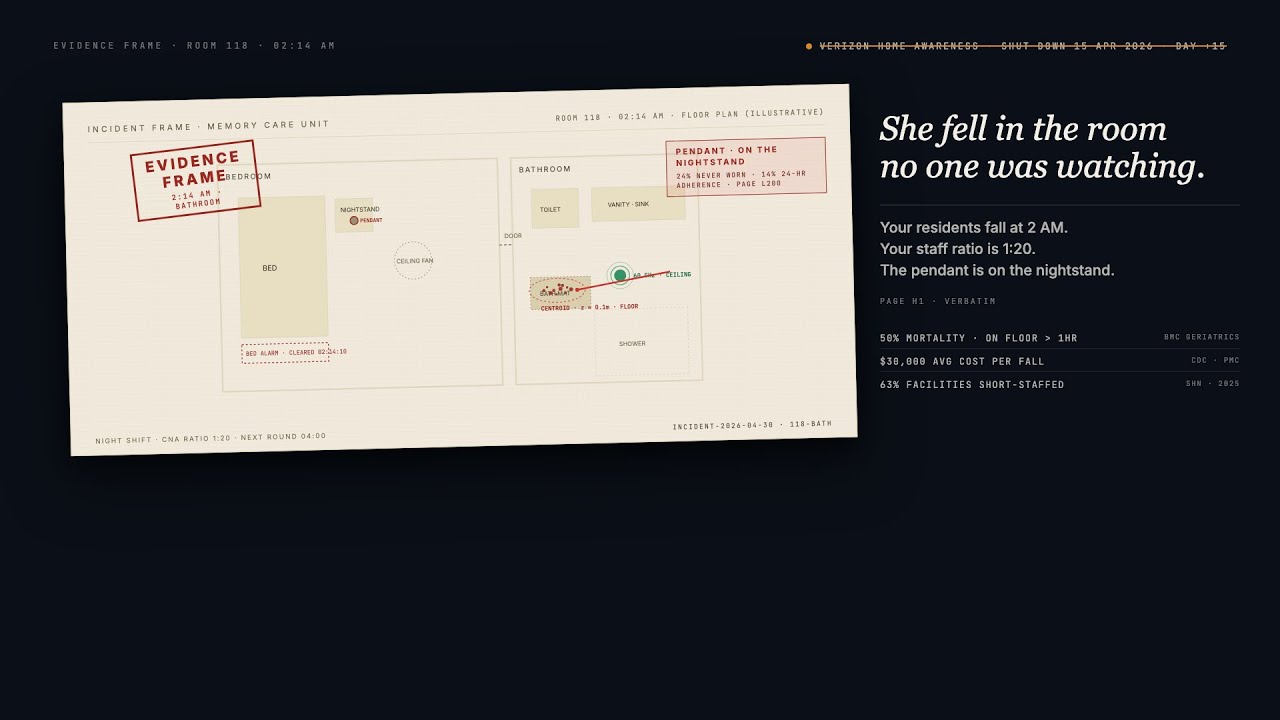
Mrs. Hernandez, 84, memory care, gets out of bed at 2:14 AM. Her pendant is on the nightstand. The bed alarm fires. The CNA, midway through a med pass on the opposite wing, acknowledges the alert. Mrs. Hernandez walks to the bathroom. Thirteen seconds later, she catches her foot on the bath mat and falls, striking her hip on the tile floor. She cannot reach the pull cord. She cannot get up. The radar sensor mounted on the bathroom ceiling detects the fall signature: sudden acceleration (Doppler burst), impact, then a point cloud at floor level with micro-Doppler breathing but no gross motor recovery. At 2:14:23, the nurse call station shows "Room 118 Bathroom: Fall Detected, High Confidence, Resident on Floor." The CNA reaches her in under 4 minutes. Without the sensor, Mrs. Hernandez would have been discovered during the next round at 4:00 AM. That 106-minute long lie carries a 50% six-month mortality risk. The radar changes the outcome because it requires nothing from the resident and covers the room no camera can enter.
A reference for evaluating vendors and approaches. Pull this up when your administrator asks "what are our options?"
| Approach | Representative Vendors | Accuracy | Per-Room Cost | Strengths | Honest Gaps |
|---|---|---|---|---|---|
| mmWave Radar (60 GHz) | Vayyar Care, Milesight VS373, AKM AK5816 | 95-99% | $150-400 hardware + install | 4D data (range, velocity, angles). Works through shower curtains. Bathroom-safe. Detects breathing. Mature commercially. | Dedicated sensor per room. Cannot cover hallways efficiently. Single-occupancy detection only (multi-person is emerging). Environment-specific calibration needed. |
| Wi-Fi CSI Sensing | Origin Wireless, Cognitive Systems, ESP32 (open-source) | 85-92% | $0-60 if APs are compatible | Uses existing Wi-Fi infrastructure. Whole-building coverage. 802.11bf ratified Sept 2025. Through-wall sensing. | Lower accuracy than radar. Sensitive to RF interference. Most existing SNF APs lack CSI support. Verizon killed Home Awareness (4/15/2026). Environment adaptation (DANN) unproven at scale. |
| AI Camera (Event-Based) | SafelyYou, KamiCare | 94-97% | $100-300 + monthly SaaS | Proven results: 40% fewer falls, 80% fewer ER visits (SafelyYou). Video review for root cause analysis. Strong clinical evidence. | Cannot monitor bathrooms. 19 states regulate cameras. Privacy concerns block adoption in many facilities. Requires adequate lighting. |
| Infrared / LiDAR | VirtuSense VSTAlert | ~95% | Custom pricing | Predicts bed exit 30-65 seconds before it happens. 85% fall reduction claimed. 100,000+ falls prevented across hundreds of facilities. | Requires line of sight. Primarily bed/chair exit prediction, not general fall detection. Does not cover bathrooms or common areas. |
| Predictive AI (Radio Wave) | Helpany "Paul" | N/A (preventive) | Not disclosed | 66% average fall reduction across 14 Arizona communities. Predicts risk 3 weeks ahead via gait and sleep analysis. | Limited geographic deployment (Arizona only). Predictive focus may miss acute events. Limited integration documentation. |
| Wearable PERS | Medical Guardian, Philips Lifeline, Bay Alarm | Varies | $20-50/month | Low cost. Established workflows. Familiar to staff and families. | 24% never worn. 14% 24-hour adherence. Removed for bathing. Charging fatigue. Stigma of frailty drives rejection. |
| Big 4 / Large SIs | Deloitte, Accenture, vendor professional services | N/A | $500K-5M+ engagements | Enterprise credentials. Broad healthcare consulting experience. Can mobilize large teams. | They deploy platforms, not build sensor AI. Engagements are scoped for health systems, not 100-bed ALFs. Minimum project sizes exclude most assisted living operators. They will recommend a vendor, not build custom integration. |
Accuracy figures from vendor claims and published research. Real-world performance varies by environment, installation quality, and calibration. We validate claims during pilot deployments.
We do not sell sensors. We build the intelligence layer that makes sensors useful and integrate them into your care workflow.
We assess your facility room by room. Bathrooms and memory care rooms get mmWave radar (TI IWR6843 or Infineon BGT60TR13C modules, depending on your form factor requirements). Common areas and hallways get Wi-Fi CSI sensing if your APs support it, or ESP32 mesh nodes ($5-10/unit) if they don't. Bed exit prediction gets infrared overlay where clinically indicated.
The output is a sensor map with specific hardware specs, mounting positions, and coverage zones. Not a generic recommendation to "deploy sensors."
Off-the-shelf sensors ship with generic models. Your facility has ceiling fans in every room, a therapy dog on the memory care wing, and curtains near the AC vent in Room 214. We build environment-specific clutter maps: the fan at ceiling coordinate (x,y,z) gets fixed-location Doppler masking. The 40-lb Labrador gets filtered through radar cross-section thresholds and horizontal bounding-box geometry. Window zones get confidence-threshold adjustments via Extended Kalman Filtering.
We then layer a hierarchical classification cascade: lightweight presence detection runs continuously, the full dual-stream model (CNN on micro-Doppler spectrograms + PointNet on 3D point clouds, fused via attention layer) activates only on motion triggers, and temporal consistency checks (LSTM sequence memory) require the full acceleration-impact-immobility narrative before generating an alert.
This is the part that determines whether the system actually gets used. We connect sensor output to your specific NCS: Rauland Responder (dry-contact relay to auxiliary input), Ascom Telligence (REST API to Unite platform), Austco Tacera (MQTT with structured JSON payloads), Hill-Rom Connexall (HL7 or API bridge). Legacy systems get opto-isolated solid-state relays. Modern platforms get contextual alerts.
We also configure escalation logic: unacknowledged fall alert escalates from CNA to charge nurse at 90 seconds, to DON at 3 minutes. UL 1069/UL 2560 compliance is maintained throughout, including the electrical isolation documentation your state surveyor will ask about.
Detection is reactive. Prevention is the goal. We build longitudinal analytics from the same sensor infrastructure: gait velocity trending (a 20% decline over 2-3 weeks is the strongest predictor of an impending fall), sleep quality scoring (bed restlessness, bathroom visit frequency and duration), and daily activity level indexing.
The analytics feed into your EHR and MDS documentation. When Mrs. Hernandez's gait velocity drops 18% over 10 days, the system flags her for a physical therapy consult, not after she falls. This directly supports CMS F689 compliance and strengthens your QAPI fall prevention program.
IEEE 802.11bf was ratified in September 2025. Future Wi-Fi access points will natively support motion sensing. If your facility is upgrading its wireless infrastructure in the next 12-18 months, we help you select sensing-capable APs (Qualcomm Networking Pro with Hexagon NPU, or Broadcom BroadStream chipsets) and architect the edge computing layer so your Wi-Fi network doubles as a sensing fabric.
For facilities that cannot wait for AP upgrades, we deploy ESP32-based sensing meshes ($5-10 per node) as an interim solution. The open-source ESP-CSI toolkit provides CSI extraction today, and our DANN-based environment adaptation models handle the room-to-room calibration challenge.
A step-by-step view of the detection pipeline, from radar chirp to nurse notification.
The 60 GHz FMCW radar on the bathroom ceiling transmits frequency-swept chirps at 20 frames per second. Each chirp reflects off surfaces in the room. The beat frequency encodes the distance to each reflector. A sequence of Range FFT, Doppler FFT, and Angle FFT transforms produce a 4D data cube: range, velocity, azimuth, and elevation for every voxel in the room. This runs continuously at under 500mW.
Static objects (walls, toilet, grab bars) are removed via adaptive filtering that preserves "living static" targets. The system uses phase stability to distinguish an unconscious human (chest wall micro-Doppler at 0.3-0.5 Hz) from a towel rack (zero phase modulation). OS-CFAR detection dynamically adjusts the noise threshold so a metal grab bar doesn't mask the weaker human reflection beside it.
Stream A processes the micro-Doppler spectrogram through a lightweight CNN. A fall produces a broadband velocity burst (torso flash at low frequencies, limb flashes at high frequencies) followed by zero velocity. Stream B processes the 3D point cloud through a PointNet variant, tracking the vertical centroid. The centroid dropping from standing height (~1.5m) to floor level (~0.1m) confirms spatial descent. An attention-based fusion layer combines both streams. The critical differentiator: a hard sit onto the toilet shows the velocity spike but the centroid settles at 0.45m (seat height), not floor level. The system suppresses the alarm.
The LSTM sequence model requires the full narrative: standing (normal gait pattern), instability (irregular micro-Doppler), acceleration (gravity-driven descent), impact (broadband energy cessation), and post-impact immobility with confirmed breathing. A 3-5 second hold timer ensures the classification is stable before alerting. This prevents false triggers from a resident bending down to pick up a dropped towel.
All inference runs on the sensor's edge processor (TI AM62A with DNN accelerator or equivalent). No raw radar data leaves the room. The sensor pushes a structured payload to the nurse call system: {"event": "FALL", "room": "118B", "location": "bathroom", "confidence": 0.96, "floor_time_sec": 8, "breathing": true}. On the nurse's Vocera badge: "Room 118 Bathroom: Fall Detected. Resident on floor. Breathing confirmed." Total latency from impact to alert: 6-10 seconds.
Four phases. Each has a deliverable your administrator can review before proceeding.
2-3 weeks. We walk your facility with your maintenance director. Room-by-room risk scoring: bathroom layout, room dimensions, furniture density, ceiling height (affects radar field of view). IT infrastructure audit: AP inventory (brand, model, firmware, CSI capability), network topology, VLAN segmentation, nurse call system model and software version.
Deliverable: Sensor architecture document with specific hardware recommendations, mounting positions, network requirements, and nurse call integration approach. Cost estimate for pilot and full deployment.
8-10 weeks, 10-15 rooms. Install sensors in representative rooms. Run 4 weeks in shadow mode (alerts logged but not routed to staff). Compare detections against your incident reports. Calibrate clutter maps and false alarm thresholds per room. Transition to live mode for final 4 weeks with staff receiving alerts.
Deliverable: Pilot results report with hard data: detection rate, false alarm rate per room per day, staff response time delta, comparison against your previous 6 months of fall incident data. ROI projection for full deployment.
6-10 weeks for 100 rooms. Roll out to remaining rooms in waves (20-25 rooms per wave). Each wave includes room-specific calibration, nurse call integration testing, and staff training. Predictive analytics dashboard goes live after sufficient baseline data (typically 30 days of continuous monitoring).
Deliverable: Fully operational system with unified dashboard, NCS integration, escalation protocols configured, staff trained, and 30-day baseline for predictive analytics.
Ongoing. Monthly model updates based on your facility's data. False alarm patterns that emerge seasonally (windows open in summer, heaters cycling in winter) get addressed through clutter map updates. Predictive risk thresholds refined as the system accumulates longitudinal gait and activity data.
Deliverable: Quarterly analytics reports for your QAPI committee and CMS survey preparation. Fall rate trend data, predictive intervention success rates, and system uptime metrics.
Answer six questions about your facility. Get a readiness score with specific next steps you can act on today.
False alarm reduction requires a layered approach that most off-the-shelf sensors cannot provide out of the box. We build environment-specific clutter maps during installation: ceiling fans get fixed-coordinate masking because their high Doppler signature at a known (x,y,z) position is predictable. Pets get filtered through radar cross-section thresholds and bounding-box aspect ratios, since a dog occupies a horizontal volume (aspect ratio greater than 1) while a human occupies a vertical column. Curtains near windows get zone-based confidence thresholds via Extended Kalman Filtering.
Beyond spatial filtering, we implement hierarchical classification cascades. The system runs a lightweight presence detector continuously, then activates the full dual-stream CNN+LSTM model only when coarse motion triggers it. The deep model requires temporal consistency: a fall signature must show the acceleration phase, impact, and post-impact immobility in sequence before generating an alert. A hard sit onto a sofa triggers the velocity spike but the centroid height stabilizes at 0.5m, not floor level, so the system correctly suppresses it.
The target is fewer than 2 false alarms per room per day, compared to the 5-15 that drive alarm fatigue in most deployments. We validate this during the pilot phase by running the system in shadow mode alongside your existing monitoring for 30 days, comparing alert accuracy before going live.
Yes, and this integration is often the hardest part of any fall detection deployment. The approach depends on your nurse call platform. For legacy systems like older Rauland Responder installations, we use dry-contact solid-state relays. The sensor's relay closes when a fall is confirmed, connecting to the auxiliary input on the room's nurse call station. This triggers the standard call light and pager workflow with no software changes to the NCS. It works with roughly 90% of installed nurse call infrastructure.
For modern IP-based platforms like Ascom Telligence, Austco Tacera, or Hill-Rom Connexall, we push structured JSON payloads via MQTT or REST API. Instead of a generic alarm, the nurse sees "Room 302: Fall Detected, High Confidence, Resident on floor 45 seconds" on their Vocera badge or smartphone. This contextual information changes response behavior because staff trust the alert.
We also integrate with the NCS's escalation logic: if no response within 90 seconds, the alert escalates from the assigned CNA to the charge nurse, then to the DON. One technical detail that trips up most integrations is UL compliance. If your facility's NCS is certified to UL 1069 or the newer UL 2560, adding an auxiliary input device must not break the certification. We handle the electrical isolation (opto-coupled relays) and documentation required for the facility to maintain compliance during state surveys.
These are complementary technologies, not competitors, and the right choice depends on the room and use case. mmWave radar (60 GHz FMCW) is a dedicated sensor that generates 4D data: range, velocity, azimuth, and elevation for every detected point. It sees through shower curtains, works in complete darkness, and distinguishes a breathing human from a static chair through micro-Doppler signatures. Accuracy for fall detection is consistently above 95% in controlled studies and real-world deployments like Vayyar Care in the UK have cut hospital admissions.
Wi-Fi sensing uses Channel State Information (CSI) from existing Wi-Fi signals to detect motion and presence. With IEEE 802.11bf ratified in September 2025, future access points will natively support sensing. The advantage is infrastructure reuse: if your facility already has compatible APs (Qualcomm or Broadcom chipsets), you add sensing through a software update. Coverage is broader since signals penetrate walls. The trade-off is lower accuracy (85-90% for fall detection versus 95%+ for radar) and sensitivity to RF interference from microwaves, Bluetooth devices, and neighboring networks.
We typically recommend radar for high-risk rooms (bathrooms, bedrooms, memory care) where accuracy is critical, and Wi-Fi sensing for common areas, hallways, and whole-building presence monitoring where coverage matters more than precision. The systems share a common analytics dashboard so your staff sees one unified view.
mmWave radar is architecturally more privacy-friendly than any camera-based alternative. The sensor emits 60 GHz radio waves and processes the reflections as point clouds and Doppler signatures. It physically cannot produce an image of a person's face or body. Even if someone intercepted the raw data stream, they would see coordinate tuples and velocity values, not visual information.
Under HIPAA, the behavioral patterns derived from radar (bathroom frequency, sleep quality, gait velocity) do qualify as Protected Health Information because they describe an individual's health status. We handle this through edge processing: raw radar data is processed on the sensor's embedded processor and never leaves the device. Only abstracted events ("Fall Detected, Room 302, Confidence 0.98") transmit to your network, encrypted with TLS 1.2+ in transit and AES-256 at rest.
Wi-Fi CSI data has a slightly more complex regulatory profile. Under GDPR Article 9, gait patterns extracted from CSI can theoretically identify individuals, which classifies the raw data as biometric. Our architecture addresses this through the same edge-processing strategy: CSI is analyzed locally, discarded immediately after inference, and only event-level data is transmitted.
For state privacy laws, 19 states now explicitly allow cameras in nursing home rooms with consent. Radar and Wi-Fi sensing sidestep this debate entirely because they are not surveillance devices. No state currently regulates non-visual RF sensing. That said, we still recommend documenting the monitoring in your resident admission agreement because transparency builds trust with families.
The long lie is where the real danger lives. Half of elderly individuals who remain on the floor for more than one hour die within six months, even without a direct injury from the fall itself. Complications include rhabdomyolysis from sustained muscle compression, hypothermia from cold floors, dehydration, and acute renal failure.
Standard accelerometer-based wearables cannot reliably detect long lies because the device may have been removed, or the initial fall event may not have triggered the threshold. mmWave radar handles long lie detection through a specific capability that simpler sensors lack: micro-Doppler breathing detection. Even when a person is completely motionless on the floor, their chest wall displaces 4-12mm during respiration. At 60 GHz, this displacement represents a significant fraction of the 5mm wavelength, creating a detectable phase modulation in the reflected signal.
The system confirms: the person's point cloud centroid is at floor level (z approximately 0m), gross motor movement has ceased, but micro-Doppler confirms breathing. This state triggers a "fall with inability to recover" alert. We configure escalation timers based on your clinical protocols. Typically, if gross movement does not resume within 3 minutes post-fall, the system alerts the assigned CNA. If no staff acknowledgment within 90 seconds, it escalates. If the breathing signature also degrades or stops, the system triggers an emergency response.
The temporal modeling (LSTM networks maintaining sequence memory) is what separates this from simple motion detectors. The system understands the narrative: standing, then acceleration, then impact, then stillness with breathing. That sequence is unambiguous.
We start with 10-15 rooms, selected to represent your facility's range of challenges: a few standard private rooms, at least 2 bathrooms (the highest-risk space), a memory care room if applicable, and one common area. The pilot runs for 60 days and has three phases.
Phase 1 (Weeks 1-2) is site assessment and installation. We audit your IT infrastructure: what access points are installed, what nurse call system you run, whether your network supports VLAN segmentation for IoT traffic. Many facilities run on 10-year-old Ruckus or Aruba APs that cannot handle additional sensor traffic without degrading call-light system performance. We install radar sensors in high-risk rooms and configure Wi-Fi sensing in common areas if your APs support CSI extraction.
Phase 2 (Weeks 3-6) is shadow mode. The system runs alongside your existing monitoring. Every alert is logged but not routed to staff. We compare our detections against your incident reports, calibrate false alarm thresholds per room (the room with the ceiling fan needs different parameters than the room without), and tune the clutter maps.
Phase 3 (Weeks 7-8) is live mode with measurement. Staff receives alerts. We track response time improvement, false alarm rate per room per day, and any falls the system catches that your previous approach missed.
The pilot costs $15,000-25,000 for a 100-bed facility (10-15 rooms instrumented). At the end, you have hard data: how many falls the system detected, how many false alarms per day, staff response time delta, and a clear ROI projection for full deployment. Full deployment for 100 rooms typically runs $150,000-250,000 including hardware, integration, and the first year of analytics, which works out to $125-210 per room per month. Given that a single fall with injury costs $30,000 on average, the system pays for itself if it prevents 5-8 injurious falls per year.
The interactive whitepapers behind this solution page. These go deeper into the signal processing, neural network architectures, and sensor physics.
60 GHz FMCW radar physics, dual-stream AI architectures (CNN + PointNet + LSTM), edge inference on Cortex-M/A processors, CFAR detection, and UL 1069 nurse call integration.
Channel State Information (CSI) analysis, Fresnel zone micro-motion detection, domain adversarial neural networks (DANN) for environment adaptation, and IEEE 802.11bf implementation architecture.
A 100-bed facility averaging 40 falls per year is absorbing $120K-240K in direct costs before legal exposure.
Start with a facility assessment. We audit your rooms, infrastructure, and nurse call system, then deliver a sensor architecture document with specific recommendations and cost projections. No commitment beyond the assessment.