Brand Content + AI Governance
The other half doesn't care, as long as they can't tell. We build hybrid AI production pipelines, brand fidelity scoring systems, and governance frameworks that let you use AI aggressively in the process while keeping it invisible in the output.
For CMOs and creative leaders at premium brands navigating the gap between AI efficiency and consumer trust.
50%
of consumers prefer brands avoiding GenAI content
Gartner, March 2026
37-point gap
between exec optimism and consumer reality on AI ads
IAB, 2026
EUR 15M
maximum fine per violation under EU AI Act transparency rules
EU AI Act Article 50, Aug 2026
Your marketing leadership probably believes consumers are warming to AI content. The data says otherwise, and the distance between perception and reality is where brand equity goes to die.
82% of ad executives think Gen Z and millennial consumers feel positive about AI in advertising (IAB, 2026). Marketing teams are building entire content strategies around this assumption.
The internal pitch deck says AI content is "the future consumers want." The agency is billing for AI-augmented production. The savings projections look excellent.
Only 45% of those consumers feel positive. Consumer preference for AI content has dropped from 60% in 2023 to 26% in 2026. One-third stop interacting with a brand entirely when they discover content is AI-generated (Adobe 2026 Digital Trends).
NielsenIQ's neuroscience research found that even polished AI ads trigger weaker memory activation in the brain. Consumers rated AI-generated ads significantly more annoying, boring, and confusing than traditional ads.
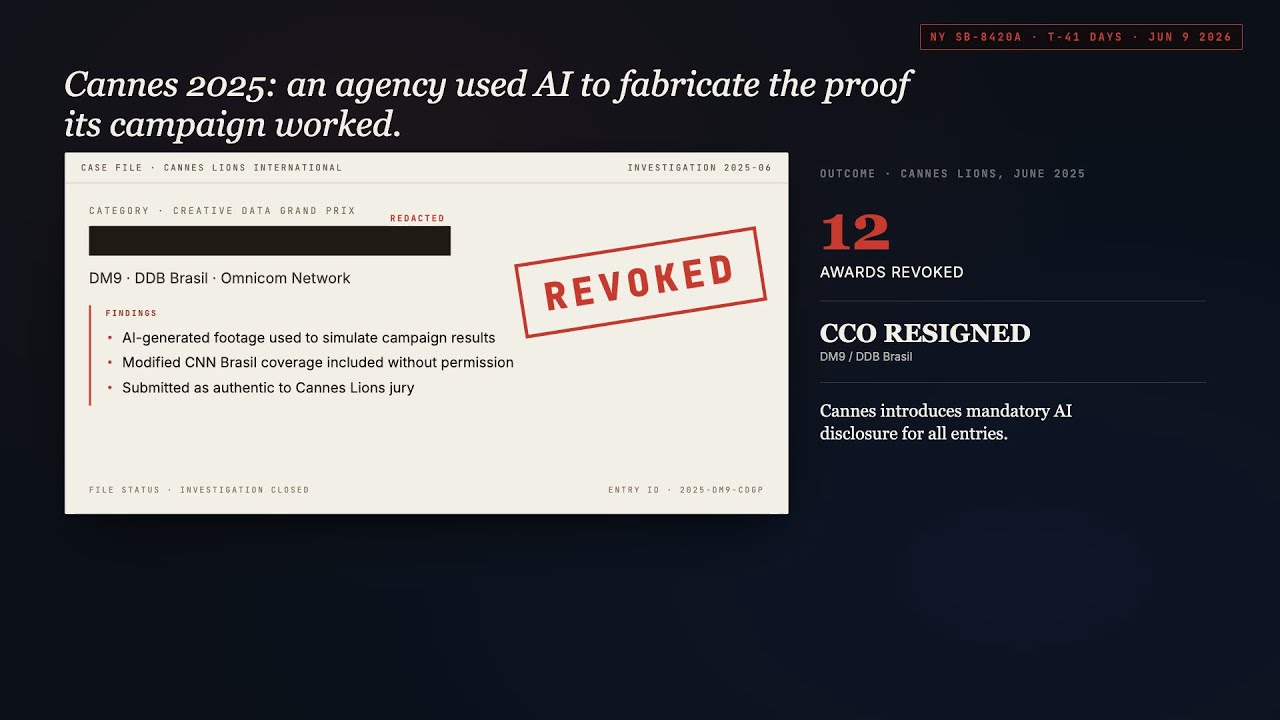
In June 2025, Brazilian agency DM9, part of the Omnicom/DDB network, won the Creative Data Grand Prix at Cannes Lions. Investigators later found the case film used AI-generated footage to simulate campaign results, including modified CNN Brasil coverage created without permission. The CCO resigned. Twelve awards were revoked. Cannes introduced mandatory AI disclosure and detection tools for all future entries.
This was not a rogue freelancer. It was a major network agency submitting fabricated results for the industry's highest honor. The incident exposed a systemic problem: when agencies face pressure to demonstrate AI-driven results, the temptation to let AI fabricate the evidence is real.
For the brands those agencies serve, the question is straightforward. If your agency is using AI in ways you haven't approved, who owns the reputational risk when it surfaces? You do.
Trust drops from 48% to 13% when ads are created entirely by AI versus co-created with humans (Smartly.io, 2025). That is a 73% trust reduction from a single production decision. No amount of production cost savings offsets a 73% drop in consumer trust. The math does not work unless the AI is invisible.
Pull this table up in your next vendor evaluation. Every platform below solves a real problem. None solves the whole problem. The gap column is where most brand content initiatives stall.
| Platform | Best For | Brand Governance | Where It Stops |
|---|---|---|---|
| Adobe GenStudio | Full content supply chain for Creative Cloud teams. StyleIDs encode brand rules into Firefly generation. | Strong within Adobe ecosystem | Locked to Firefly for generation. Video capabilities trail Runway and Kling by 12-18 months. No cross-platform governance. |
| Typeface | Brand intelligence and auto-validation. Arc Graph maps brand rules dynamically. Used by PepsiCo, Disney, Estee Lauder. | Strong governance layer | Not a generation engine for video or complex visuals. Governance only covers content produced through Typeface itself. |
| Bria.ai | Custom LoRA model training. Up to 5,000 brand images for fine-tuning. Won 2026 HPA awards. | Moderate | Primarily image generation. No video. Enterprise governance is basic compared to Typeface. Custom models need retraining when base models update. |
| Runway Gen-4.5 | Professional-grade AI video with physics simulation. Best temporal consistency available. | Minimal | Generation engine only. No brand governance, no compliance tracking, no approval workflows. You get raw video output. |
| Superside | AI-enhanced creative services with human-in-the-loop. Managed creative team at scale. | Moderate (service-based) | People-dependent scaling. You are buying labor augmented by AI, not a system you own. No transferable IP or pipeline you retain. |
| Big 4 / Large SIs | Enterprise transformation. Can mobilize 50-person teams for org-wide content strategy. | Framework-level | They architect strategies, not production pipelines. Engagements run $500K-$5M+ and deliver slide decks, not working systems. Subcontract the actual build to firms like us. |
| In-House Teams | Full control. Direct access to brand knowledge. No vendor dependency. | Custom (if built) | Talent acquisition for AI-native creative producers is extremely competitive. Building governance from scratch takes 6-12 months. Most teams lack ML engineering for custom brand models. |
Honest gap: no external party, including Veriprajna, can solve the organizational buy-in problem. If your creative director fundamentally opposes AI in the workflow, the best technology sits unused. Human change management is yours to own.
Six capabilities, each addressing a specific gap in the current market. We are vendor-neutral. We work with your existing platforms and agencies, not against them.
Cross-jurisdictional compliance framework covering FTC endorsement rules, New York's SB-8420A (June 2026), California's CAITA (August 2026), and EU AI Act Article 50 (August 2026). Not a legal memo. A working system.
We map every content touchpoint in your production workflow, tag where AI enters the pipeline, and build automated disclosure triggers per jurisdiction. Your legal team gets a compliance dashboard, not a quarterly audit to dread.
VLM-based automated auditing that evaluates every AI-generated asset against your actual brand guidelines document. Not generic CLIP similarity scores, which cannot distinguish your specific Pantone red from a competitor's.
Checks color accuracy within Delta-E tolerances, logo clear-space compliance, typography consistency, tonal scoring against your reference images, and the uncanny markers (over-smoothed skin, glossy AI sheen) that NielsenIQ found trigger the negative halo effect. Assets below threshold get flagged with specific failure reasons before a human reviews them.
Vendor-neutral architecture that determines where human craft is essential and where AI accelerates. This is not a theoretical framework. It is a working pipeline with routing rules, quality gates, and fallback paths.
We reach for human talent when content involves faces conveying genuine emotion, product hero shots where packaging texture matters, and cultural moments requiring local authenticity. AI handles backgrounds, environment generation, format adaptation (9:16 to 16:9), storyboard variations, and high-volume social derivatives. The boundary is specific to your brand's risk tolerance and content mix.
Systematic verification of what AI tools your agencies are actually using, how they are using them, and whether the output meets your disclosure obligations. After the DM9 scandal, this is no longer optional.
We examine delivered assets for generation artifacts, review metadata and EXIF data for tool signatures, and benchmark production timelines against industry norms. We also draft contract language: AI usage disclosure requirements, training data restrictions to prevent your brand assets from training public models, and clear ownership terms for custom models.
Architecture for routing different content types to the right generation tools without locking into any single vendor. With Sora shut down in March 2026, multi-model strategy is no longer a luxury.
We build routing logic: Runway Gen-4.5 for hero video where physics accuracy matters, Kling 3.0 for high-volume social video at 40% of Runway's cost, Firefly for static variants needing Creative Cloud integration, custom LoRA models through Bria for brand-specific style consistency. Each route includes quality gates and brand fidelity checks before assets enter your DAM.
Automated content adaptation across markets with embedded cultural review gates. AI handles the volume. Human reviewers handle the nuance that prevents PR disasters no AI model can anticipate.
Poor localization costs 20% of potential revenue annually. The global video localization market reached $4.02B in 2026 as brands enter 1.5 new markets on average (36% increase over 2025). AI cuts localization costs roughly in half, but only when paired with cultural reviewers who catch inappropriate imagery, tonal mismatches, and references that do not translate.
A CPG brand launches a holiday campaign across 12 markets. Here is what the hybrid production pipeline looks like from brief to delivery, with specific tools and timing at each stage.
Audit the DAM for LoRA training readiness. Most brand libraries have 2,000+ images but only 300-500 meet the diversity and quality bar for fine-tuning. Tag, curate, and begin custom LoRA training through Bria (auto mode: 200 images for a baseline model in 48 hours). Simultaneously, map all content touchpoints where AI will and will not be used, establishing the human/AI boundary for this specific campaign.
Creative director provides the campaign brief. AI generates 40-60 storyboard variations in the brand's trained style within hours, replacing two weeks of traditional storyboarding at 60-80% cost reduction. The director selects and refines. Human talent is cast for hero shots. Sets are planned for the product interactions, human faces, and emotional moments that stay in the human-craft zone.
Human talent filmed on LED volume or green screen for hero elements: the smile, the product pour, the family moment. AI generates backgrounds, environment extensions, and atmospheric elements using Runway Gen-4.5 for physics-accurate lighting interaction. The human footage is real. The world around it is generated. Viewers feel the warmth of a real person in a setting that would have cost $200K to build physically.
AI handles format adaptation: the hero 16:9 TV spot becomes a 9:16 social cut, a 1:1 Instagram post, a 6-second bumper. Each format is scored by the brand fidelity system against guidelines. Assets below threshold are flagged and re-generated. Human editors do the final pass on the hero cut and top social variants. The remaining 20+ format variations ship through the automated pipeline with brand scoring as the quality gate.
The hero campaign adapts across 12 markets. AI dubbing handles voice-over localization. Visual elements adapt for cultural context: different family compositions, food items, holiday traditions. Each market version passes through a cultural review gate staffed by regional reviewers who verify the AI's adaptation choices are culturally appropriate. Total localization cost: roughly $15K-30K per market versus $50K-100K traditional.
Every asset is tagged with its provenance: which elements are human-produced, which are AI-generated, what tools were used. Disclosure rules applied per jurisdiction. New York market assets get synthetic performer disclosures where required. EU market assets get machine-readable AI content labels per Article 50. The compliance dashboard shows green across all 12 markets before any asset goes live.
The bottom line: A 12-market holiday campaign that would traditionally take 14-16 weeks and $1.2-2M in production, delivered in 6 weeks at roughly $400K-600K. The savings come from pre-production (AI storyboarding), post-production (automated format adaptation), and localization (AI dubbing + cultural QA). The human craft budget stays intact for the moments that matter.
Three major jurisdictions introduce AI content disclosure requirements within weeks of each other. If your brand advertises in New York, California, or the EU, this is your implementation timeline.
| Date | Regulation | What It Requires | Penalty |
|---|---|---|---|
| June 9, 2026 | New York SB-8420A | "Conspicuous" disclosure of AI-generated synthetic performers in commerce advertisements distributed in New York. | Civil enforcement by NY AG |
| Aug 2, 2026 | EU AI Act Article 50 | AI-generated content marked in machine-readable format. Deployers must disclose AI manipulation of text published for public interest. | Up to EUR 15M or 3% global turnover |
| Aug 2026 | California CAITA (AB 853) | Phased AI disclosure requirements for advertising. Specifics still being finalized. | Civil penalties (TBD) |
| Ongoing | FTC Section 5 | AI-generated content falls under existing deceptive practices rules. "Clear and conspicuous" disclosure standard for synthetic testimonials. | Consent orders, civil penalties |
The operational challenge is that each jurisdiction has different thresholds. A background generated by Firefly in an otherwise human-shot ad may not trigger New York's synthetic performer rule (which targets digitally created persons) but could trigger the EU's broader content marking requirement. Your content pipeline needs asset-level provenance tracking so legal can apply the right rules per market.
Answer these six questions to gauge where your organization stands on AI content governance, production capability, and regulatory preparedness. The result gives you a specific action plan based on your current state.
The backlash pattern is predictable: it happens when AI replaces the emotional core of the content. Coca-Cola used AI to generate the entire holiday ad, including human faces and crowd reactions. Consumers rejected it as soulless. Nike used AI to analyze 23 years of Serena Williams' gameplay data and simulate a match between her 1999 and 2017 selves. It won a Cannes Grand Prix.
The difference is not the amount of AI used. It is where the AI sits in the workflow. We design hybrid production pipelines where AI handles the high-volume, low-emotion work: storyboarding, background generation, format adaptation across platforms, localization. Human talent stays on camera for faces, product hero shots, and anything requiring emotional resonance.
The NielsenIQ research confirms this approach: the only AI ad consumers could not spontaneously identify as synthetic was one where a professional heavily directed and edited the AI output. The key is making AI invisible in the output while using it aggressively in the process. Your audience should never think about whether AI was involved. They should just feel that the content works.
Three major disclosure regimes hit within months of each other. New York SB-8420A takes effect June 9, 2026, requiring conspicuous disclosure of AI-generated synthetic performers in commerce advertisements. Any ad distributed in New York featuring a digitally created person who appears genuine but is not identifiable as a real individual must carry a visible disclosure. California's CAITA begins phasing in August 2026 with similar requirements. The EU AI Act Article 50 becomes enforceable August 2, 2026, requiring AI-generated content to be marked in a machine-readable format and detectable as artificially generated. Penalties reach EUR 15 million or 3% of global turnover for transparency violations.
The compliance challenge is not just legal review. It is operational. Your content pipeline needs to track which assets contain AI-generated elements, what type of AI was used, and whether any synthetic performers are present. Each jurisdiction has different thresholds for what triggers disclosure. A background generated by Firefly in an otherwise human-shot ad may not trigger New York's synthetic performer rule but could trigger the EU's broader content marking requirement.
We build content provenance systems that tag every asset with its generation method at the point of creation, so your legal team can apply the right disclosure rules per market without reviewing every piece manually.
Each platform solves a different problem, and choosing one as your foundation creates specific lock-in risks. Adobe GenStudio is strongest when your team already lives in Creative Cloud and you need tight integration with Experience Manager for content distribution. Its Content Production Agent can auto-generate campaign assets from briefs, and StyleIDs encode your brand guidelines into the generative system. The limitation is that you are locked into Firefly as your generation engine. For video, Firefly still trails Runway and Kling significantly.
Typeface, founded by Adobe's former CTO, has the most sophisticated brand governance with its Arc Graph dynamic brand intelligence and Brand Agent auto-validation. Major brands including PepsiCo, Disney, and Estee Lauder use it. But its governance is only as good as the content it governs, and it is not a generation platform for video.
Bria excels at custom model training. Its LoRA fine-tuning supports up to 5,000 images in expert mode, and its Fast LoRA technology produces usable brand models quickly. It won 2026 HPA awards for Transformative Impact. But it is primarily an image generation platform.
The honest answer: most enterprise brands need more than one platform. The question is how they connect. We architect multi-platform pipelines where each tool handles what it does best, with a unified governance and brand-checking layer that works across all of them. That governance layer is the piece no single vendor provides, because it needs to sit above their platforms, not inside them.
This is a real and growing problem. The DM9 scandal at Cannes Lions 2025 showed the extreme end: an agency used AI-generated footage to fabricate campaign results, winning a Grand Prix before investigators found modified CNN Brasil footage in their case film. The CCO resigned. Twelve awards were revoked.
Most agency AI usage is not fraudulent, but it is often undisclosed. The economics are obvious: an agency that uses Midjourney to generate 20 concept variations in an hour instead of briefing three designers for two days can keep the same billing rate with dramatically lower costs.
The practical indicators include an unusual increase in concept volume during the ideation phase, stylistic inconsistencies between mockups and final photography, and metadata in delivered files that shows generation tool signatures.
We run agency AI audits that examine delivered assets for generation artifacts, review metadata and EXIF data, and benchmark production timelines against industry norms for the scope of work. The goal is not to ban agency AI use. It is to ensure transparency so you can make informed decisions about where AI is appropriate in your brand's content and ensure compliance with the disclosure regulations taking effect in 2026. Contract language should specify AI usage disclosure requirements, training data restrictions for brand assets, and clear ownership terms for any custom models trained on your brand materials.
The cost depends on what you are automating and what you are protecting. A basic setup covering static content generation with brand governance typically runs $150K-$300K for the initial build, including platform licensing, brand model training, governance workflow design, and integration with your DAM. That covers the technology layer. The governance architecture, compliance framework, and team training add another $100K-$200K depending on how many jurisdictions you operate in and how many agencies you work with.
Enterprise content spending averages $167.7 million per year and is climbing toward $184 million (IBM, 2026). Against that baseline, the ROI numbers are clear: AI-augmented production delivers content at roughly $100 per asset compared to $500-$2,000 per asset through traditional agency work. That is a 75-80% reduction in per-asset cost. Content teams report 3.2x ROI in year one with payback under four months.
But the savings only materialize if governance is in place from day one. Without brand fidelity scoring and compliance workflows, you trade production budgets for reputation costs. Coca-Cola's fully-AI holiday ad was cheaper to produce than a traditional shoot, but the reputational damage and earned media backlash dwarfed any production savings. The correct framing for your CFO: this is not a production cost reduction initiative. It is a production capacity investment with built-in brand protection. You produce more content at lower per-unit cost while maintaining the quality controls that protect the brand equity your company has spent decades building.
Most teams rely on manual creative review, which does not scale. Others fall back on generic metrics like CLIP similarity scores, which measure whether an image is semantically close to a text description. Neither approach works for brand fidelity at volume.
CLIP can tell you that an image contains a red truck in a snowy setting. It cannot tell you whether the Pantone red matches your brand's PMS 484, whether the logo has sufficient clear space per your guidelines, or whether the overall tone feels premium versus discount.
We build VLM-based brand auditing systems. These use vision-language models trained on your specific brand guidelines document to evaluate every generated asset before it enters the review queue. The system checks color accuracy within Delta-E tolerances against your Pantone specifications, logo placement and clear-space compliance, typography consistency with your brand fonts, tonal scoring against reference images you define as on-brand, and the uncanny markers that trigger consumer rejection: over-smoothed skin textures, unnaturally symmetrical compositions, the glossy AI sheen that NielsenIQ found triggers the negative halo effect.
Each asset gets a brand fidelity score before a human ever sees it. Assets below threshold are automatically flagged with specific failure reasons. This means your creative directors spend their time on subjective judgment calls about emotional resonance and storytelling, not catching whether an AI hallucinated an extra finger on a hand holding your product.
The research behind this solution page, with detailed technical analysis of hybrid AI architectures for brand content production.
Technical analysis of why fully AI-generated brand content fails and how hybrid workflows with ControlNet, custom LoRA training, and human-in-the-loop architecture preserve brand equity while accelerating production.
A single AI content incident can cost more than the production savings of an entire year.
We help premium brands use AI aggressively in the production process while keeping it invisible in the output. Start with an assessment of where your organization stands today.