Precision Agriculture
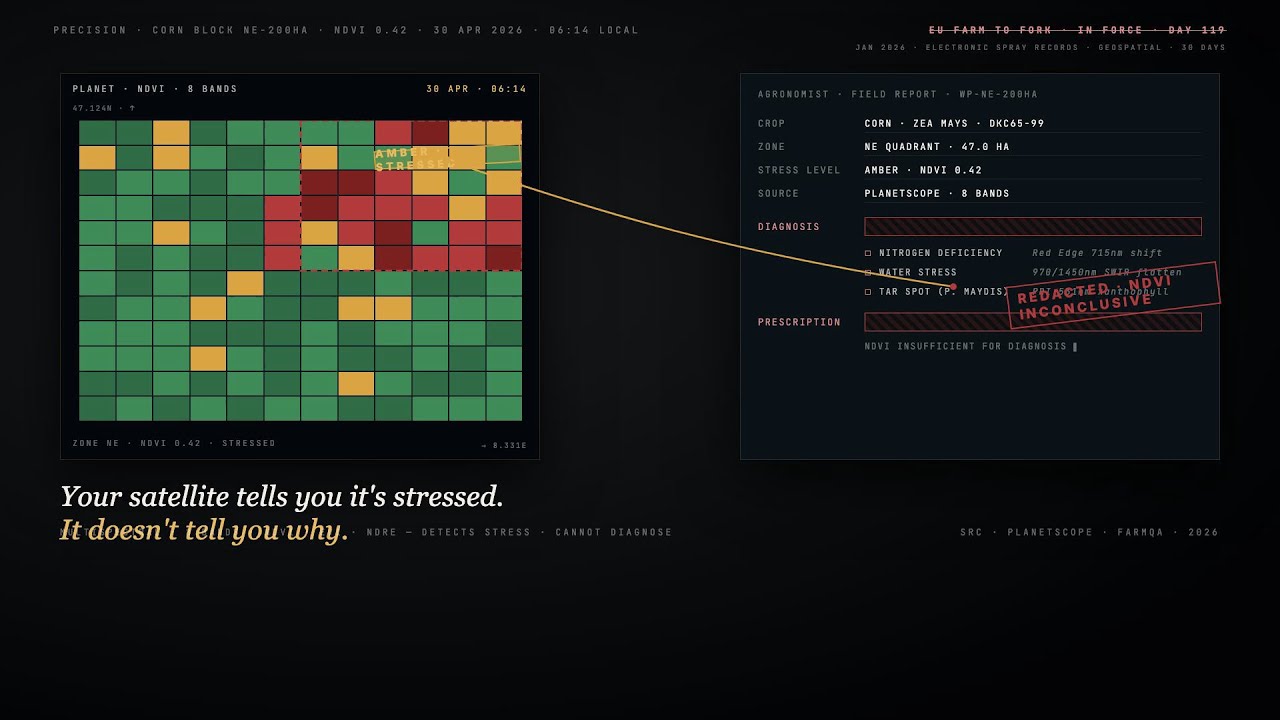
Multispectral monitoring (Planet, Sentinel-2, NDVI) detects that something is wrong. Hyperspectral deep learning diagnoses what is wrong, why, and what to do about it. We build the custom spectral analytics that close the gap between detection and prescription for large-scale farming operations and specialty growers.
7-14 Days
Pre-symptomatic detection advantage
Hyperspectral vs. RGB/NDVI latency gap
963M bu.
US corn yield lost to disease in 2024
Crop Protection Network, 2024
$0.85/ac
Planet multispectral monitoring cost
FarmQA/Planet, 2026 pricing
Planet PlanetScope gives you 8 bands. Sentinel-2 gives you 13. Both compute NDVI, EVI, and NDRE to track general canopy health. This works for broad-scale monitoring: identifying which fields need attention and tracking seasonal biomass trends. It breaks down when you need a diagnosis.
Your agronomist is looking at a 200-hectare corn block. NDVI shows a depression in the northeast quarter. The multispectral stress map lights up amber. Three possible causes:
NDVI flags all three as "stress." It cannot distinguish between them because it compresses the entire red and NIR spectrum into two broadband values. Applying nitrogen to a water-stressed field wastes $15-25/acre in fertilizer. Missing a fungicide window on tar spot costs up to $29.75/acre (Illinois, 2024). The wrong response to an ambiguous alert is often worse than no response at all.
Hyperspectral sensors resolve 135-270+ narrow spectral bands. A 3D-CNN trained on your crop's spectral signatures reads the full reflectance curve at each pixel, extracting the diagnostic features that broadband indices average away. The detection window shifts from post-symptomatic (NDVI catches damage after it is visible) to pre-symptomatic (spectral models catch biochemical changes weeks before the human eye or camera can see them).
Pull this up in your next vendor evaluation meeting. The question isn't whether to use spectral data. It's who builds the analytics layer between raw spectral data and an actionable prescription.
| Provider | What They Deliver | Spectral Depth | Where It Stops |
|---|---|---|---|
| Planet (PlanetScope) | Daily global multispectral imagery, 3m resolution. NDVI/EVI analytics. $0.85/ac/yr via FarmQA. | 8 bands | Detects stress, cannot diagnose cause. No prescription pipeline. No VRT integration. |
| Planet (Tanager-1) | Hyperspectral 400-2500nm. GA since Sep 2025. Methane Quicklook product. Tasking credits model. | Full VNIR+SWIR | Designed for methane/carbon monitoring, not crop diagnostics. No agronomic models included. Single satellite limits revisit cadence. |
| Pixxel (Firefly) | 6 operational HSI satellites, 5.4m GSD, 135 bands (470-900nm). Via UP42/SkyFi. Honeybee Zero (SWIR) planned 2026. | 135 bands | Sells data, not analytics. No crop-specific models. Current constellation lacks SWIR (no water stress detection until Honeybee Zero). 14-day minimum tasking window may miss fast-moving disease events. |
| Bayer Climate FieldView | Farm management platform. 150M+ acres subscribed. 60+ integrations. Prescription map execution. | None (consumer) | Ingests third-party imagery but performs no spectral analysis. Locked to Bayer's agronomic recommendations for seed/chemical customers. |
| Gamaya | Drone-based HSI. Sugarcane expertise (Brazil). Google Cloud partnership for processing. | Hyperspectral | Narrow crop focus (sugarcane). Limited geographic availability. Not a platform you can build on for other crops. |
| Headwall / Specim / Resonon | Drone-mounted HSI sensors. 270+ bands (Headwall Nano-Hyperspec). Specim AFX series with GPS/IMU. | Full spectrum | Hardware vendors. No analytics, no models, no agronomic interpretation. Sensor costs $50K-$150K before any software development. |
| Accenture / Deloitte | Strategic advisory. Accenture acquired EU precision ag analytics firm (Feb 2025). Deloitte focuses on ESG/sustainability. | None (advisory) | Implement platforms, not spectral pipelines. Will recommend FieldView or a SaaS solution. Cannot build a 3D-CNN or collect ground truth samples. Engagement costs $500K-$5M+ for strategic advisory that still requires a technical builder. |
| Veriprajna | Custom spectral analytics: 3D-CNN/transformer models, spectral disease libraries, HSI-to-VRT prescription pipelines. | Sensor-agnostic | Does not own satellites or manufacture sensors. Requires a data source (Pixxel, Planet, drone HSI) and client agronomic domain knowledge for ground truth collection. |
Every engagement starts from the buyer's operation, not from a product catalog. These are the capabilities we reach for most often in agricultural spectral analytics.
Custom 3D-CNN and spectral-spatial transformer models that go beyond "stressed/not stressed." We train on your crop's hyperspectral signatures to differentiate nitrogen deficiency, water stress, and specific pathogens by reading the full reflectance curve at each pixel.
We reach for 3D convolutions when the diagnostic signal is in local band correlations (Red Edge shape, specific absorption pits). We add transformer attention layers when the signal involves long-range spectral dependencies (connecting visible chlorophyll patterns to SWIR water features hundreds of bands apart). The architecture follows from the physics, not the other way around.
The most valuable asset in spectral agriculture is a field-validated library of spectral signatures for your crop's specific stress types. We coordinate ground truth collection (tissue sampling, lab analysis, spectral correlation) across two growing seasons to build a library that hits 92%+ classification accuracy for your three to four highest-impact stress vectors.
This is not transfer learning from public benchmarks. Indian Pines and Pavia University datasets are land cover classification tasks, not agricultural stress diagnostics. Spectral signatures vary by cultivar, soil composition, and regional climate. A wheat nitrogen-deficiency signature in Iowa does not transfer to Punjab without retraining.
End-to-end system from raw spectral cube to VRT prescription map. Includes atmospheric correction (MODTRAN/6S parameterized per scene), radiometric calibration against ground reference panels, geometric correction with sub-pixel co-registration for temporal analysis, and model inference.
The output is not a heatmap. It is an ISO-XML or shapefile prescription that exports to John Deere Operations Center (via Precision Tech API) or Climate FieldView, respecting your actual equipment geometry: boom width, nozzle spacing, minimum application rates, and turn compensation zones.
From January 2026, EU farms must maintain electronic spray records with geospatial coordinates, updated within 30 days. Integrated Pest Management requires certified agronomist approval for chemical applications.
We connect spectral diagnostics to compliance workflows: the same model that identifies a fungal signature in Zone B generates the IPM justification record (alternative methods evaluated, spectral evidence of pathogen presence, recommended application with geospatial coordinates) that satisfies the regulatory chain. Your spray records become a direct output of your monitoring system, not a separate paperwork exercise.
From raw photons to prescription map. This is the sequence your agronomist sees, and the processing that happens behind each step.
Satellite (Pixxel Firefly at 5.4m GSD for broad coverage, or Planet Tanager-1 for SWIR-inclusive analysis) or drone (Headwall Nano-Hyperspec for sub-meter resolution on high-value blocks). Acquisition frequency matched to crop growth rate: 5-7 day revisit during critical growth stages (corn V6-R3, grape veraison-harvest), 14-21 days during dormancy.
This step consumes roughly 40% of pipeline development effort and is where most off-the-shelf solutions fail. We convert Top-of-Atmosphere (TOA) radiance to Bottom-of-Atmosphere (BOA) surface reflectance using physics-based radiative transfer models (MODTRAN or 6S), parameterized per scene for water vapor, aerosol optical depth, and solar geometry. For drone data, we calibrate against in-field reference panels (Spectralon or calibrated gray targets) placed before each flight. Without this correction, a model learns atmospheric conditions, not crop chemistry.
The calibrated hyperspectral cube feeds into the crop-specific 3D-CNN/transformer model. The 3D convolutional front-end extracts local spectral-spatial features (Red Edge slope, absorption pit depths). The transformer back-end models long-range spectral dependencies (connecting visible pigment patterns to SWIR water absorption). Output: per-pixel classification (healthy, nitrogen-deficient, water-stressed, pathogen X, pathogen Y) with confidence scores and severity estimates.
Model output converts to VRT prescription maps at your equipment's operational resolution. A 27-meter boom does not benefit from 1-meter diagnostic resolution. We aggregate zones to match your machinery, calculate application rates based on severity estimates and agronomic lookup tables (calibrated during library development), and export as ISO-XML or shapefile to John Deere Operations Center or Climate FieldView.
Post-application spectral monitoring validates whether the prescription worked. If Zone B was diagnosed as nitrogen-deficient and received 15 kg/ha urea, the next imaging pass should show Red Edge recovery within 10-14 days. This closed-loop data feeds back into the model, improving accuracy over successive growing seasons. The spectral disease library is a living asset that gets more valuable with each season of validated data.
We do not sell a SaaS subscription. We build a system your team operates. Here is what the engagement timeline looks like.
| Phase | Duration | What Happens | Deliverable |
|---|---|---|---|
| Discovery | 2-4 weeks | Audit current monitoring stack. Identify highest-value diagnostic gaps. Select data source (satellite vs. drone vs. hybrid). Define target stress types and ground truth collection protocol. | Technical brief: recommended architecture, data source, integration points, cost model. |
| Season 1: Library Build | 1 growing season | Deploy sensors. Coordinate ground truth collection (80-150 points per flight, tissue sampling, lab analysis). Build atmospheric correction pipeline. Train initial 3D-CNN models. Deliver draft spectral disease library at 85-90% accuracy. | Working diagnostic model. Draft spectral library. Preprocessing pipeline running on your cloud. |
| Season 2: Validation | 1 growing season | Real-time model testing against new field conditions. Edge case capture (mixed stress, soil variation, weather anomalies). VRT prescription integration and equipment calibration. Push accuracy above 92%. | Production-grade spectral library. Integrated prescription pipeline. Trained operations team. |
| Handoff + Expansion | Ongoing (optional) | Your team operates the system independently. Optional: expand to additional crops, geographies, or migrate from drone to satellite scale as Pixxel Honeybee Zero (SWIR, 2026) comes online. | All models, libraries, and pipelines are your proprietary assets. |
Caveats: Timelines assume access to fields during growing season and cooperation from your agronomic team for ground truth collection. Ground truth sampling costs ($50-200 per point) are borne by the client or included in the engagement scope. Satellite data licensing costs (Pixxel, Planet) are separate.
Answer six questions about your operation. The assessment identifies where hyperspectral monitoring adds value over your current setup and what prerequisites you need before investing.
The short answer: multispectral tells you something is wrong; hyperspectral tells you what is wrong and what to do about it.
The longer answer involves how NDVI compresses the entire red and NIR spectrum into a single ratio. That ratio correlates with canopy greenness, but it saturates in dense canopies (above LAI 3-4, NDVI flattens and stops distinguishing between "healthy" and "very healthy") and it cannot differentiate stress types because nitrogen deficiency, water stress, and early fungal infection all reduce NDVI.
The diagnostic information lives in narrow spectral features that broadband indices average away: the exact position of the Red Edge Inflection Point (which shifts 3-5nm blueward under nitrogen stress), the depth of water absorption features at 970nm and 1450nm (which flatten under drought), and the Photochemical Reflectance Index at 531nm (which responds to xanthophyll cycle changes during early pathogen colonization). A hyperspectral sensor resolves these features. A multispectral sensor physically cannot, regardless of how sophisticated the analytics layer is.
The practical implication: your existing monitoring stays. It handles the broad-scale "where to look" question well. Hyperspectral adds the "what is it and what do I do" layer on the fields where misdiagnosis costs you the most.
You do not need your own satellite access. We are sensor-agnostic and build on whichever data source matches your operation's economics and revisit requirements.
The decision tree is straightforward. Satellite HSI (Pixxel Firefly via UP42/SkyFi, or Planet Tanager-1) makes sense for portfolios above 10,000 hectares where per-hectare data cost needs to be low and you can tolerate a 7-14 day revisit cadence. The current limitation: Pixxel Firefly covers VNIR only (470-900nm), so water stress detection via SWIR bands requires their upcoming Honeybee Zero constellation (expected 2026). Tanager-1 covers full VNIR+SWIR but was designed primarily for methane and carbon monitoring, not crop diagnostics.
Drone-based HSI (Headwall Nano-Hyperspec, Specim AFX) makes sense for high-value crops under 5,000 acres where you need sub-meter spatial resolution and on-demand flight timing aligned to growth stages. Sensor costs run $50K-$150K, but for vineyards producing $10,000+/acre the per-flight analytics cost ($15-50/acre) is trivially justified.
Hybrid approaches work well: drone HSI on your highest-value blocks for model training and validation, satellite HSI across the broader portfolio for operational monitoring once the models are proven. We handle the full preprocessing stack regardless of sensor choice, including the atmospheric correction parameterization that consumes roughly 40% of pipeline development effort.
A field-validated spectral disease library for a single crop in a single geography typically requires two growing seasons.
The first season is collection: we deploy hyperspectral sensors across your fields at 7-10 day intervals, coordinate with your agronomists to collect tissue samples at each imaging pass (typically 80-150 ground truth points per flight), and run laboratory analysis to correlate spectral signatures with actual nitrogen content, chlorophyll concentration, pathogen presence, and water potential measurements. Ground truth sampling costs $50-200 per point depending on the analysis required.
By end of season one, we have a draft spectral library with initial classification models running at 85-90% accuracy for the three to four most common stress types in your crop. Season two is validation and refinement. We test the models in real-time against new field conditions, add edge cases (mixed stress, different soil types, weather-related spectral variation), and push accuracy above 92% for production deployment. The library becomes your proprietary asset.
We have seen that rushing this process, trying to skip season-two validation or using transfer learning from public hyperspectral datasets like Indian Pines, produces models that work on benchmarks but fail in your actual fields because spectral signatures vary significantly by cultivar, soil composition, and regional climate patterns.
Yes, and this integration is where the practical value of hyperspectral monitoring actually materializes. We build VRT prescription maps that export as shapefiles or ISO-XML format compatible with John Deere Operations Center (via the Precision Tech API, which requires partner certification) and Climate FieldView (via their 60+ partner connectivity framework).
The prescription maps account for your actual equipment constraints: boom width, nozzle spacing, minimum application rates, and turn compensation zones. A common failure in precision agriculture is generating a beautiful 1-meter resolution stress map that then gets applied through a 27-meter spray boom, averaging out all the precision. We design prescriptions at your equipment's operational resolution from the start.
For EU operations subject to Farm to Fork requirements starting January 2026, we also connect spectral-based application recommendations to automated electronic spray record generation with the required geospatial coordinates, giving your IPM documentation a direct link from spectral diagnosis to application decision to compliance record.
The cost structure has three layers. First, data acquisition: satellite HSI runs on per-square-kilometer tasking credits (Pixxel, Planet) while drone HSI runs $15-50 per acre per flight with 6-10 flights per season. Second, the spectral disease library development, which is the foundational two-season investment. Third, ongoing pipeline operation (cloud compute, model inference), which your team runs after handoff.
ROI math differs sharply by crop economics. For commodity operations, the calculus is volume-based: preventing even 3% of the disease losses described in the problem section above translates to meaningful per-acre savings, but the monitoring cost per acre must stay below $5-8 to pencil out. Satellite-based HSI at scale hits this number. For specialty crops (vineyards, citrus, avocados), the calculus inverts: monitoring costs are a rounding error against crop value, and the ROI driver is quality preservation rather than yield volume. A California vineyard pilot showed 22% reduction in fungicide use while maintaining quality scores (2025), which matters because fungicide residue affects both wine quality ratings and organic certification eligibility.
The variable most buyers underestimate is the value of specificity in VRT prescriptions. Moving from soil-zone-based uniform application to spectrally-informed variable rate nitrogen improved gains 7.2% in a 2025 wheat study (164 EUR/ha). That gain compounds across every application cycle for the life of the system.
Fair concern. At least 28 AgTech companies ceased operations in 2024-2025, and VC investment in the sector dropped 25.6% in 2024 alone (Agriculture Dive). The pattern is consistent: venture-funded startups build proprietary platforms, burn through capital acquiring customers below cost, and fold when funding dries up. You lose access to your data, your models, and your investment in integration.
A consultancy engagement is structurally different in three ways. First, we build on infrastructure you control. Your models run on your cloud environment, your data stays in your systems, and the spectral disease library we develop is your proprietary asset. If Veriprajna disappeared tomorrow, you retain everything. Second, we are data-source agnostic. We build on Pixxel, Planet, Headwall, Specim, or whatever sensor fits your economics. If Pixxel changes pricing or Planet discontinues a product, we migrate your pipeline to the alternative. A platform startup married to one data source cannot do this. Third, the engagement has a defined scope and end state. We deliver a working pipeline, train your team to operate it, and move on. You are not dependent on our continued existence for the system to function.
The consulting model costs more upfront than a SaaS subscription, but it eliminates the platform dependency risk that has burned AgTech buyers repeatedly.
The spectral analytics methodology behind this solution page is detailed in our interactive whitepaper.
3D-CNN and spectral-spatial transformer architectures for agricultural hyperspectral image classification, Red Edge analysis, and self-supervised learning for label-scarce agronomic datasets.
Corn disease alone cost US growers 963 million bushels in 2024. Early, specific diagnosis changes the economics of every treatment decision.
Whether you are evaluating hyperspectral for the first time or scaling an existing pilot to satellite coverage, we build the spectral analytics pipeline that connects sensor data to prescription maps your equipment can execute.