Edge AI for Manufacturing
Whether you are evaluating AI-based inspection for the first time, recovering from a cloud pilot that could not meet cycle time, or scaling a working prototype to 15 plants, the problem is the same: getting edge AI into production is an integration and operations challenge, not a hardware purchase.
We build custom edge vision and acoustic AI systems that integrate with your existing PLCs, MES, and quality workflows. Vendor-neutral architecture. Real OT/IT convergence. Fleet operations that scale.
84%
of integration projects fail or partially fail
HiveMQ / Industry data, 2025
5-15%
false reject rate from out-of-box AOI
Edge AI Vision Alliance, 2026
$22K/min
average cost of unplanned downtime (automotive)
Siemens True Cost of Downtime, 2024
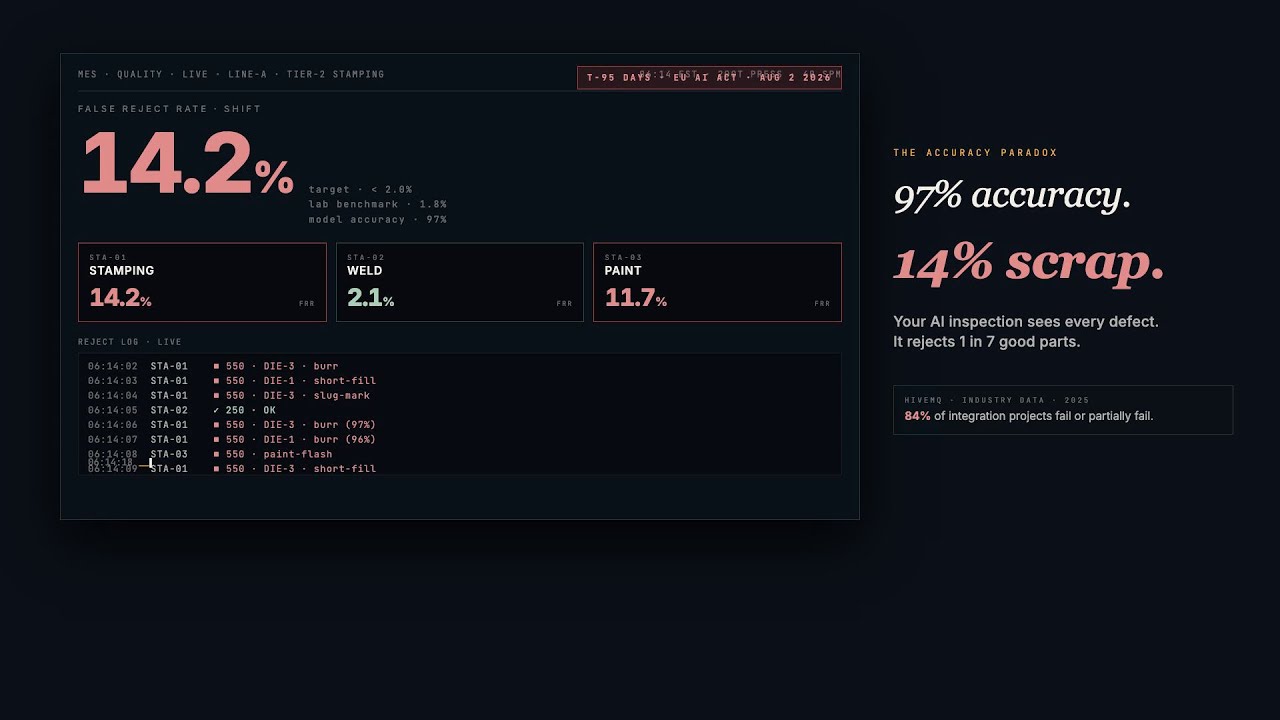
The edge AI pitch is compelling: put a Jetson on the conveyor, run inference in 12ms, catch defects in real time. NVIDIA will sell you the hardware. Landing AI will sell you the model. But 84% of system integration projects fail or partially fail, and the reason is never the inference speed.
A Tier 2 automotive stamping shop installs two GigE cameras on a 200-ton progressive die press running at 40 strokes per minute. The vision model catches burrs, short fills, and slug marks at 97% accuracy in the lab. In production, the false reject rate hits 14%.
Why? The lab images were taken under controlled LED ring lighting. On the press, the sheet metal surface reflects the overhead bay lights differently at each stroke angle. Stamping lubricant pools differently on warm versus cold dies. The first 50 parts of a shift look different from parts at thermal equilibrium.
The fix is not a better model. It is structured lighting with polarized backlights to eliminate specular reflection, a thermal camera to correlate surface appearance with die temperature, and a training pipeline that includes images from cold-start, mid-run, and end-of-run conditions. Then the integration work begins: mapping the inspection result to the Allen-Bradley ControlLogix via EtherNet/IP so the reject actuator fires within the 750ms stroke window, tagging each part with its inspection result in the MES for traceability, and routing defect images to the quality engineer's dashboard filtered by defect class and die station.
That integration work is 60% of the project timeline. The model training is 15%. The hardware is a purchase order.
Only 34% of manufacturers have production systems with real-time data streaming. The remaining 66% are still in pilot or research phases. Without plant-level real-time data infrastructure, edge AI cannot function at scale. If your historian collects data every 5 seconds but your inspection decisions need to happen in 50ms, there is an architectural mismatch that no amount of edge compute will solve.
A 2025 logistics edge deployment collapsed six months after launch. 30% of 500 edge devices went offline due to power issues, and IT needed 48 hours to resolve each one because they had no established process for field troubleshooting. Edge AI at scale needs operational frameworks: OTA model updates with rollback, device health monitoring, and maintenance procedures that OT teams can execute without the vendor on speed dial.
The landscape includes platform vendors, pure-play AI startups, industrial automation incumbents, and large system integrators. Each solves part of the problem. None solves the full integration-to-operations pipeline for a mid-size manufacturer who runs Siemens and Allen-Bradley side by side.
| Vendor | What They Sell | Strength | Gap |
|---|---|---|---|
| Siemens Industrial Edge | Platform for edge apps within the Siemens OT ecosystem. IEC 62443-4-2 compliant fleet management. | Deep PLC integration (S7-1500), Xcelerator marketplace, security certifications. | Siemens-centric. If you run Allen-Bradley on half your lines, Industrial Edge does not bridge that gap. January 2026 CISA security advisory required patching. |
| NVIDIA Metropolis | Developer tools and workflows for vision AI. 50+ factory customers including Foxconn and Wistron. | 99.8% AOI accuracy benchmarks. GPU ecosystem, TensorRT optimization, DeepStream pipelines. | Sells hardware and SDKs, not deployed solutions. You still need integration, OT connectivity, and operational frameworks. Full NVIDIA lock-in. |
| Rockwell FactoryTalk VisionAI | No-code AI inspection with closed-loop integration to Rockwell PLCs. | Plant operators train models without ML expertise. Tight ControlLogix integration. | Rockwell ecosystem only. Cannot integrate with Siemens, Mitsubishi, or mixed-vendor plants. Limited model sophistication compared to custom architectures. |
| Landing AI (LandingLens) | Data-centric visual inspection platform. Up to 60% cost reduction in AI development. | Strong data labeling workflow. Andrew Ng's team understands the training data bottleneck. | Platform, not integration. Does not handle OPC-UA connectivity, PLC programming, or fleet operations in your specific OT environment. |
| Cognex (In-Sight + Edge Learning) | FPGA-based edge learning (5-10 training images) plus deep learning for complex defects. | Industry-standard machine vision. Fast setup for simple pass/fail checks. Hardened for factory environments. | Rule-based heritage limits flexibility. Complex multi-class defect detection or custom segmentation logic requires moving beyond the Cognex ecosystem. |
| Augury | Acoustic and vibration AI for machine health. $1B+ valuation, customers include PepsiCo and Nestle. | Proven predictive maintenance with Fortune 500 deployments. Strong sensor-to-insight pipeline. | SaaS model, not edge-first. Focused on continuous process industries, not discrete manufacturing inspection. No visual inspection capability. |
| On-premise IPC + GPU | Ruggedized x86 industrial PC with NVIDIA RTX A2000/A4000 or Intel Arc. | Familiar to OT teams. Standard PCIe expansion. Easier maintenance, swap a GPU card like any other component. | Higher power draw (70W+ vs 25W). Larger form factor requires cabinet space. Higher unit cost at scale ($3-5K vs $500-900 per Jetson module). Not practical for high-density deployments. |
| Big 4 / Large SIs | Accenture, Deloitte, and the large industrial SIs offer "smart factory" transformation programs. | Enterprise credibility. Large teams that can staff multi-year programs. Existing relationships with your C-suite. | They implement platforms, not build custom inference pipelines. Engagements start at $500K-$2M+ and move at enterprise speed. A 6-month discovery phase to decide which platform to buy is not the same as getting a working inspection station on Line 3. |
Gaps that no vendor solves well: organizational change management for AI adoption, training data curation when only 5% of manufacturers keep comprehensive equipment failure records, and cross-vendor OT integration where a single plant runs three generations of PLCs from two manufacturers.
Every engagement is custom. These are the capabilities we bring to the factory floor.
We design the full inspection pipeline: camera selection (global shutter GigE Vision for moving conveyors, area scan with structured lighting for static stations), model architecture (YOLOv8 variants for real-time multi-class detection, U-Net segmentation for dimensional tolerance and surface grading), and quantization strategy.
We reach for INT8 quantization with QAT (quantization-aware training) when defect classes include subtle features like hairline cracks or discoloration. Post-training quantization works for high-contrast defects like missing components or gross deformation. The choice depends on your specific defect taxonomy, and we validate accuracy per defect class, not just aggregate metrics.
Ultrasonic MEMS microphone arrays (96-192 kHz sampling) paired with lightweight 1D-CNN classifiers running on ARM Cortex-M7 microcontrollers. Models under 200KB, inference under 1ms. We use 4-8 element arrays for spatial filtering, which provides sufficient directivity to isolate bearing housing emissions in 85-100 dB factory environments without the $10,000-50,000 cost of 64-element research arrays.
The real work is building the spectral library. Each bearing type, each machine, each operating condition has a different baseline acoustic signature. We establish baselines over 2-4 weeks of monitored operation, then train fault classifiers on the specific frequency bands (typically 25-50 kHz) where lubrication loss and early spalling manifest for your equipment.
Integration is the leading cause of project failure (see the stat above). We bridge the protocols: Modbus TCP for legacy equipment, EtherNet/IP for Allen-Bradley ControlLogix, Profinet for Siemens S7-1500, and OPC-UA as the unifying layer. We handle tag mapping, data type conversion, and the timing constraints that determine whether your rejection actuator fires within the stroke window.
Integration extends beyond the PLC. Inspection results feed your MES for part-level traceability, your ERP for scrap accounting, and your quality dashboard for real-time SPC charts. We build these data pipelines using lightweight MQTT brokers at the edge, not by routing everything through the cloud.
Managing 50-500 edge devices across multiple plants is an operational discipline, not a software feature. We build the fleet management layer: containerized model deployment via K3s (lightweight Kubernetes), OTA update pipelines with staged rollout and automatic rollback, device health monitoring with alerting, and model versioning with audit trails for regulatory traceability.
Each device stores its current model and two previous versions. If a new model increases the false reject rate beyond a configurable threshold during its first production shift, the device rolls back automatically. This means a bad retraining cycle costs one shift of elevated false rejects, not a production crisis.
EU AI Act obligations become fully applicable August 2, 2026. Manufacturing AI used for safety-critical quality decisions requires conformity assessment, data lineage tracking, human-in-the-loop checkpoints, and risk classification tags on every deployed model. We build this traceability into the deployment pipeline from day one: every model artifact carries metadata linking it to its training run, dataset hash, validation metrics, and approval record. On the security side, we design edge device network segmentation following IEC 62443 zone and conduit models, hardening the attack surface that distributed edge devices introduce to your OT network.
Four phases. Realistic timelines. The caveats you need to plan around.
We map your current inspection process, OT network topology, PLC platforms, MES integration points, and data infrastructure. We measure your actual cycle times and latency budgets. We inventory existing defect data, if any exists.
Caveat: If your plant has no labeled defect images and no systematic defect categorization, the data collection phase (Phase 2) will take 3-5 weeks longer than if you have historical data. We are honest about this upfront because it is the single biggest variable in the timeline.
Hardware procurement and installation. Training data collection if needed: we deploy cameras in capture mode alongside your existing inspection for 1-3 weeks, with operators labeling defects via a touchscreen interface. Model training, quantization, and validation against your specific defect taxonomy. PLC integration development: tag mapping, communication testing, rejection logic programming.
Caveat: Model accuracy on your production line will not match lab benchmarks. Real-world conditions like lighting variation, material supplier changes, and thermal effects require iterative tuning. We budget 2-3 training iterations into this phase.
The AI system runs alongside your existing inspection without actuating the reject mechanism. Every decision is logged: would-have-rejected, would-have-passed. We compare against the existing process to validate detection rates, false reject rates, and cycle time compliance. Operators build confidence with the system before cutover.
Caveat: Shadow mode will reveal defect classes the training data missed. This is expected, not a failure. We use shadow mode findings to retrain before cutover. Rushing past shadow mode to hit a go-live date is the single most common cause of post-deployment problems.
Cutover to live reject actuation. Operational handoff to your team: monitoring dashboards, retraining procedures, escalation paths. For multi-line rollouts, each subsequent line takes 3-5 weeks using established model and integration patterns. Multi-plant rollouts add 2-3 weeks per plant for network provisioning and site calibration.
Caveat: The first line is the most expensive and slowest. Lines 2-5 are significantly faster. But every plant has site-specific variables (lighting, vibration, network topology) that require local calibration. Do not assume Plant B is a copy-paste of Plant A.
Total timeline for a single-line deployment: 8-14 weeks from kickoff to production validation. The biggest variable is training data availability, not hardware procurement. Budget 2-4 hours/week of quality engineer time for ongoing label review and model performance monitoring after go-live.
Answer six questions about your current state. The assessment identifies which deployment phase applies to your plant and what foundational work is needed before edge AI can deliver results.
1. What is your current inspection method?
2. Do you have labeled defect image data from your production lines?
3. What PLC/automation platforms are on your factory floor?
4. What is your target deployment scale?
5. Does your plant have real-time data streaming from production equipment?
6. Do you have EU AI Act compliance requirements for your production AI?
Traditional automated optical inspection systems produce 5-15% false reject rates out of the box. Well-tuned AI vision systems bring that under 2% while maintaining 99%+ true defect detection. The path from 15% to under 2% is a calibration and data problem, not a model architecture problem.
First, train on acceptable product variation, not just defect libraries. A cosmetic scratch on a non-sealing surface is not the same defect as a scratch on a mating face, and pixel-level segmentation lets you encode that distinction: "reject if scratch length exceeds 2mm within 5mm of the sealing surface."
Second, hardware maintenance causes more false reject drift than model degradation. Lighting intensity drops, camera optics collect residue, mounting vibration shifts alignment. We build scheduled hardware validation into every deployment: spectral output checks on lighting, MTF measurement on optics, positional drift monitoring on mounts.
Third, retrain continuously with recent false reject samples. The model that shipped six months ago has never seen the new supplier's slightly different surface finish. We set up feedback loops where operators flag false rejects on a touchscreen, and those images feed the next retraining cycle automatically.
The threshold tuning itself is defect-class specific: critical structural defects get aggressive sensitivity (accept more false positives), cosmetic defects get relaxed thresholds (minimize false rejects). This is not a single confidence slider. It is a per-class decision matrix built around your quality spec.
This is the most common technical question we hear, and the honest answer is: it depends on your operational maturity and scale.
Jetson Orin NX delivers 100 TOPS in a 15W-25W envelope. An industrial PC with an NVIDIA RTX A2000 delivers similar inference throughput at 70W but gives you a familiar x86 environment, standard PCIe expansion, and maintenance procedures your OT team already knows.
For single-station deployments or plants with strong IT support, the IPC route is often faster to production. Your maintenance team can swap a GPU card without learning embedded Linux. For high-density deployments (10+ inspection stations per line, multiple lines), Jetson's power efficiency and form factor win. Mounting a fanless 100x87mm module directly on the conveyor frame eliminates the need for a separate cabinet.
For multi-plant rollouts where you need 50-200+ devices, Jetson's lower unit cost ($500-900 for the module vs. $3,000-5,000 for a ruggedized IPC) changes the total cost of ownership significantly.
We design for hardware flexibility. Models export to ONNX format, which compiles to TensorRT on Jetson or runs via ONNX Runtime on Intel/AMD IPCs. The application container is the same either way. This means you can start with IPCs in your pilot plant and migrate to Jetson for the scaled rollout without rebuilding the software stack.
A single-line deployment with one inspection station typically takes 8-14 weeks from kickoff to production validation. The timeline breaks down unevenly, and the split surprises most teams.
Hardware selection, procurement, and mounting takes 2-3 weeks. Model development, if you have labeled training data, takes 2-3 weeks. If you do not have labeled data, add 3-5 weeks for data collection and annotation.
OT integration, meaning getting the inspection result from the edge device into the PLC rejection logic via OPC-UA or Modbus TCP, takes 2-4 weeks. This is where we see the most schedule slippage. Tag mapping between the AI output and the PLC program requires coordination between the AI team and the controls engineer.
Production validation, running the system in shadow mode alongside existing inspection for 1-2 weeks, then cutover with parallel verification for another week.
Multi-line rollouts after the first line are faster: 3-5 weeks per line because the model, integration pattern, and operational procedures are established. Multi-plant rollouts add 2-3 weeks per plant for network provisioning, OT team training, and site-specific calibration. The biggest variable is data. If your current process generates labeled defect images, we can train on day one. If operators currently scrap parts without photographing the defect, the data collection phase dominates the timeline.
This is the question most edge AI vendors avoid, and it is the one that determines whether your investment compounds or depreciates. Every product changeover, new supplier material, or tooling adjustment can shift what "normal" looks like to the vision system. A new anodizing supplier produces a slightly different surface texture. A retooled die creates a different parting line profile. The model trained on old production starts flagging good parts.
We build the retraining pipeline as a core deliverable, not an afterthought. Edge devices continuously capture and pre-label images during production. Operators confirm or correct labels on a local touchscreen interface. Labeled images sync to an on-premise training server during shift changes, not in real-time, so production bandwidth is unaffected. Retraining runs automatically when the dataset exceeds a threshold, typically weekly. New model candidates are validated against a held-out test set before deployment.
The key architectural choice is versioned model deployment with instant rollback. Each edge device stores the current model and the previous two versions. If a new model increases the false reject rate beyond a configurable threshold during its first production shift, the device automatically rolls back and flags the operations team. This means a bad retraining cycle costs you one shift of elevated false rejects, not a production crisis.
For major product changes, like an entirely new part geometry, we run a focused data collection sprint: 3-5 days of production with enhanced capture, manual annotation by quality engineers, and a dedicated training cycle. This is the maintenance cost of AI inspection. Budget 2-4 hours per week of quality engineer time for label review, plus compute cost for weekly retraining on the on-premise GPU server.
Most EU AI Act obligations become fully applicable August 2, 2026. Manufacturing AI systems used for safety-critical decisions, quality-gating that affects product safety, or worker monitoring fall under high-risk classification and require conformity assessment before deployment.
The practical requirements that affect your edge AI architecture: full data lineage tracking from training data through model versions to production decisions. Every inspection decision needs a traceable path back to the model version, training dataset, and calibration state that produced it. Human-in-the-loop checkpoints for workflows that impact safety. If your AI system decides whether a brake component passes inspection, a qualified human must be able to review and override. Risk classification tags on each deployed model specifying risk level, usage context, and compliance status.
For edge deployments, this means your fleet management system must track which model version runs on which device, when it was last updated, and what training data it was built from. We build this traceability into the deployment pipeline: every model artifact carries metadata linking it to its training run, dataset hash, validation metrics, and approval record.
The penalties are significant: up to EUR 35 million or 7% of global annual turnover for prohibited AI violations. Even for non-prohibited but non-compliant high-risk systems, fines reach EUR 15 million or 3% of turnover. Starting compliance assessment now is not optional if you plan to have AI in production by August.
Yes, and the physics explains why. Vibration is a lagging indicator. A bearing only vibrates abnormally after physical damage has occurred: spalling on the inner race, pitting on the rolling elements. By the time an accelerometer picks up elevated amplitude at the ball pass frequency, the damage is structural.
Ultrasonic acoustic emission is a leading indicator. When a bearing loses lubrication or develops a microscopic crack, the increased metal-on-metal friction generates high-frequency stress waves in the 20-100 kHz range. These ultrasonic emissions appear weeks before low-frequency vibration signatures or audible noise. The detection window between ultrasonic anomaly and vibration alarm is typically 4-8 weeks for slow-speed bearings (under 1,000 RPM) and days to weeks for high-speed spindles.
Deployment uses MEMS microphone arrays sampling at 96 kHz or 192 kHz, paired with lightweight 1D-CNN classifiers running on microcontrollers like the ARM Cortex-M7. The models are small, typically under 200KB, and inference takes under 1ms. Total system cost per monitoring point is $500-2,000 depending on the sensor configuration and mounting requirements.
The practical challenge is environmental noise. A factory floor at 85-100 dB contains forklifts, pneumatic tools, adjacent machinery. We use spatial filtering through small microphone arrays (4-8 elements, not the 64-element arrays that some papers propose) to focus on the bearing housing and reject ambient noise from other directions. Four elements provide sufficient directivity for most mounting geometries at a fraction of the cost of large arrays.
For critical spindles running above 10,000 RPM where a dry-running event can weld bearings in seconds, we wire the classifier output directly to the machine emergency stop circuit via a safety-rated relay. Latency from detection to actuation is under 5ms. The cost difference between a $500 bearing replacement caught by acoustic detection and a $45,000 spindle replacement caught by vibration monitoring makes the ROI case straightforward.
The technical foundations behind this solution page, available as an interactive whitepaper.
The Latency Kill-Switch: Engineering the Post-Cloud Industrial ArchitectureDeep technical analysis of edge inference latency, INT8 quantization benchmarks, acoustic TinyML architectures, and the economic case for moving AI from cloud to factory floor.
Knauf Insulation achieved 511% ROI in year one with edge-vision AI for scrap reduction.
Whether you need a single-line pilot to prove the business case or a fleet architecture to scale across plants, we start with a latency and integration audit of your current production lines.